Sets (BITSAT Level)
Cheatsheet Content
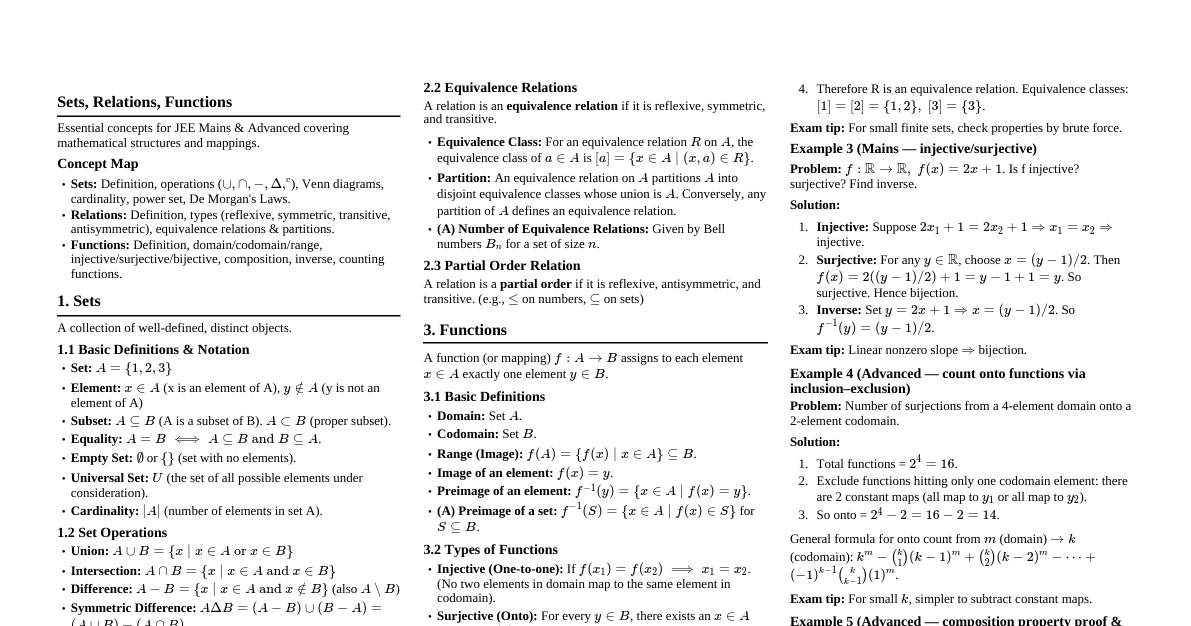
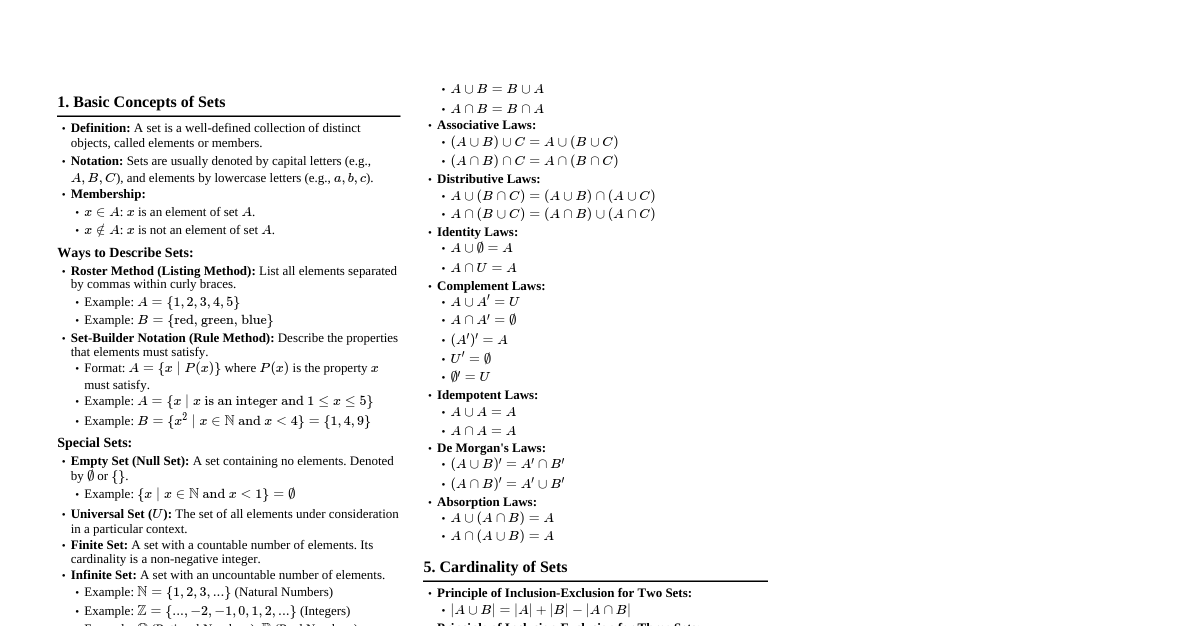
### Introduction to Sets - **Definition:** A well-defined collection of distinct objects. Objects are called elements or members. - **Representation:** - **Roster/Tabular Form:** Elements listed within curly braces, separated by commas. *Example:* $A = \{1, 2, 3, 4\}$ - **Set-builder Form:** Describing elements by a common property. *Example:* $B = \{x : x \text{ is an even natural number}\}$ ### Types of Sets - **Empty Set (Null Set):** A set containing no elements. Denoted by $\emptyset$ or $\{\}$. *Example:* $A = \{x : x \in \mathbb{N}, 1 ### Subsets and Supersets - **Subset:** $A$ is a subset of $B$ ($A \subseteq B$) if every element of $A$ is also an element of $B$. - Every set is a subset of itself ($A \subseteq A$). - The empty set is a subset of every set ($\emptyset \subseteq A$). - **Proper Subset:** $A$ is a proper subset of $B$ ($A \subset B$) if $A \subseteq B$ and $A \neq B$. - **Superset:** If $A \subseteq B$, then $B$ is a superset of $A$ ($B \supseteq A$). - **Power Set:** The collection of all possible subsets of a set $A$, denoted by $P(A)$. - If $n(A) = m$, then $n(P(A)) = 2^m$. *Example:* If $A = \{1, 2\}$, $P(A) = \{\emptyset, \{1\}, \{2\}, \{1, 2\}\}$. ### Operations on Sets - **Union ($\cup$):** $A \cup B = \{x : x \in A \text{ or } x \in B\}$. - $n(A \cup B) = n(A) + n(B) - n(A \cap B)$. - For three sets: $n(A \cup B \cup C) = n(A) + n(B) + n(C) - n(A \cap B) - n(B \cap C) - n(C \cap A) + n(A \cap B \cap C)$. - **Intersection ($\cap$):** $A \cap B = \{x : x \in A \text{ and } x \in B\}$. - **Disjoint Sets:** If $A \cap B = \emptyset$. - **Difference ($-$):** $A - B = \{x : x \in A \text{ and } x \notin B\}$. Also written as $A \setminus B$. - $A - B = A - (A \cap B)$. - $B - A = B - (A \cap B)$. - **Symmetric Difference ($\Delta$):** $A \Delta B = (A - B) \cup (B - A)$. - $A \Delta B = (A \cup B) - (A \cap B)$. - **Complement ($'$ or $^c$):** $A' = U - A = \{x : x \in U \text{ and } x \notin A\}$. - $(A')' = A$. - $\emptyset' = U$, $U' = \emptyset$. ### Laws of Set Algebra - **Idempotent Laws:** $A \cup A = A$, $A \cap A = A$. - **Identity Laws:** $A \cup \emptyset = A$, $A \cap U = A$, $A \cup U = U$, $A \cap \emptyset = \emptyset$. - **Commutative Laws:** $A \cup B = B \cup A$, $A \cap B = B \cap A$. - **Associative Laws:** $(A \cup B) \cup C = A \cup (B \cup C)$, $(A \cap B) \cap C = A \cap (B \cap C)$. - **Distributive Laws:** - $A \cup (B \cap C) = (A \cup B) \cap (A \cup C)$. - $A \cap (B \cup C) = (A \cap B) \cup (A \cap C)$. - **De Morgan's Laws:** - $(A \cup B)' = A' \cap B'$. - $(A \cap B)' = A' \cup B'$. - **Complement Laws:** $A \cup A' = U$, $A \cap A' = \emptyset$. ### Venn Diagrams - Visual representation of sets and their relationships using circles within a rectangle (Universal Set). - **Shaded regions represent:** - $A \cup B$: Union of A and B - $A \cap B$: Intersection of A and B - $A - B$: Elements in A but not in B - $A'$: Complement of A ### Important Results - $A \subseteq B \iff A \cap B = A \iff A \cup B = B$. - $n(A \text{ only}) = n(A) - n(A \cap B)$. - $n(B \text{ only}) = n(B) - n(A \cap B)$. - $n(\text{exactly one of A or B}) = n(A \Delta B) = n(A) + n(B) - 2n(A \cap B)$. - $n(A' \cap B') = n((A \cup B)') = n(U) - n(A \cup B)$. (Neither A nor B) - $n(A' \cup B') = n((A \cap B)') = n(U) - n(A \cap B)$.