Zoology Cheatsheet (BSc Level)
Cheatsheet Content
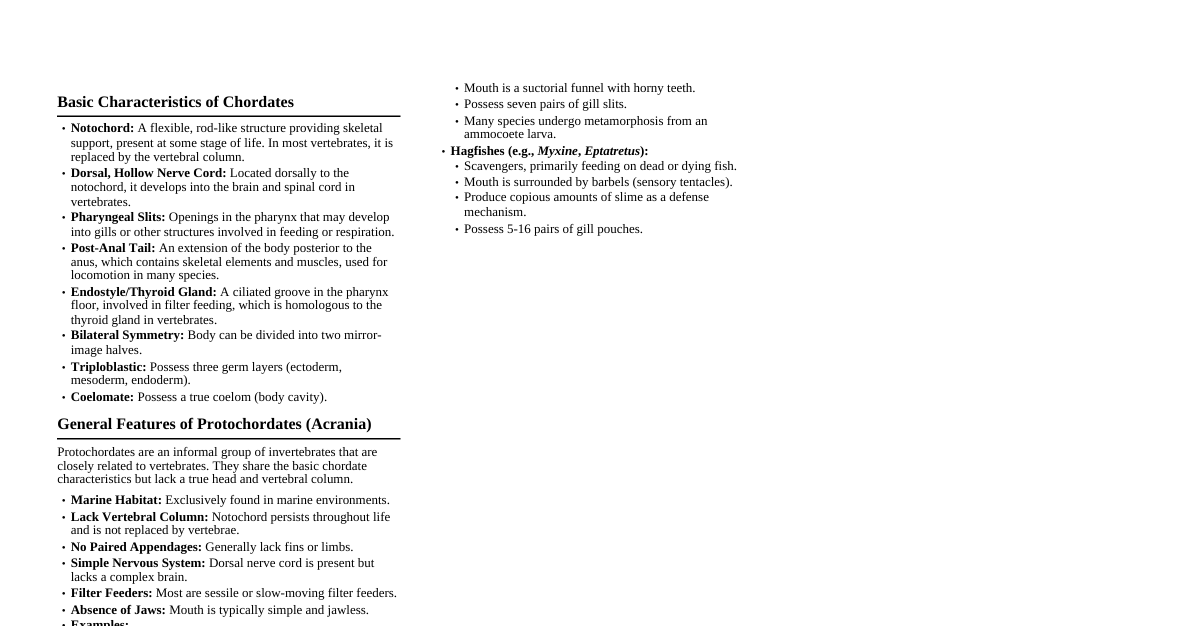
### Subphylum Urochordata - **Characteristic Features:** - Marine, sessile or free-swimming. - Body covered by a tunic (test) made of tunicate. - Larva (tadpole larva) is free-swimming, possessing notochord, dorsal hollow nerve cord, and post-anal tail, showing chordate characteristics. - Adults are highly degenerate; notochord, nerve cord, and tail are lost. - Presence of pharyngeal gill slits (stigmata) for filter feeding. - Open circulatory system. - Hermaphroditic. - **Classification:** - Class Ascidiacea (e.g., *Herdmania*, sea squirts) - sessile adults, prominent tunic. - Class Thaliacea (e.g., *Salpa*, doliolids) - free-swimming pelagic, barrel-shaped. - Class Larvacea (e.g., *Oikopleura*) - retains larval features (neoteny), builds a mucous house. - **Examples:** *Herdmania*, *Salpa*, *Oikopleura*. ### Subphylum Vertebrata - **General Characters:** - Possess a notochord during embryonic stage, later replaced by a vertebral column (backbone). - Dorsal hollow nerve cord, anteriorly enlarged into a brain protected by a cranium. - Paired appendages (fins or limbs). - Closed circulatory system with a ventral heart. - Presence of pharyngeal gill slits at some stage of life. - Specialized excretory organs (kidneys). - Complex sensory organs. - **Classification (Major Classes):** - **Agnatha (Jawless Fish):** Lack jaws, paired fins. E.g., Cyclostomata (lampreys, hagfishes). - **Gnathostomata (Jawed Vertebrates):** Possess jaws and paired appendages. - **Chondrichthyes (Cartilaginous Fish):** Cartilaginous skeleton, placoid scales. E.g., sharks, rays. - **Osteichthyes (Bony Fish):** Bony skeleton, cycloid/ctenoid/ganoid scales. E.g., most fish. - **Amphibia:** Dual life (water/land), moist skin, metamorphosis. E.g., frogs, salamanders. - **Reptilia:** Dry, scaly skin, amniotic egg, cold-blooded. E.g., snakes, lizards, crocodiles. - **Aves:** Feathers, wings, beaks, warm-blooded, hollow bones. E.g., birds. - **Mammalia:** Hair/fur, mammary glands, warm-blooded, viviparous. E.g., humans, cats. - **Examples:** Fish, amphibians, reptiles, birds, mammals. ### Cephalaspis - **Classification:** - Phylum: Chordata - Subphylum: Vertebrata - Class: Agnatha - Subclass: Osteostraci (extinct) - **Characteristics:** - An extinct jawless fish from the Silurian and Devonian periods. - Head covered by a large, bony, shield-like carapace (hence "head shield"). - Body was covered by small scales. - Dorsal and anal fins present, but paired fins were absent (pectoral fins were flap-like extensions of the head shield). - Terminal mouth, indicating bottom-feeding habits. - Dorsal eyes and a single median pineal opening. - Possessed a sensory field on the dorsal surface of the head shield, possibly electroreceptive. - Internal skeleton was cartilaginous. - **Diagram (Conceptual):** *(Note: A neat labelled diagram would typically show the head shield, eyes, mouth, gill openings, trunk, dorsal fin, and caudal fin.)* ### Superclass Pisces - **General Characters:** - Aquatic vertebrates, typically streamlined body. - Paired fins (pectoral and pelvic) and unpaired fins (dorsal, anal, caudal). - Respiration by gills, covered by an operculum (in bony fish) or exposed gill slits (in cartilaginous fish). - Skin covered by scales (placoid, cycloid, ctenoid, ganoid) or naked. - Two-chambered heart (one atrium, one ventricle). - Poikilothermic (cold-blooded). - Lateral line system for sensing vibrations and pressure changes in water. - Mostly oviparous, some ovoviviparous or viviparous. - **Classification (Major Classes):** - **Chondrichthyes (Cartilaginous Fish):** - Cartilaginous endoskeleton. - Placoid scales. - 5-7 pairs of gill slits, uncovered. - Heterocercal caudal fin. - No swim bladder. - Internal fertilization. - E.g., Sharks (*Scoliodon*), Rays, Skates. - **Osteichthyes (Bony Fish):** - Bony endoskeleton. - Cycloid, ctenoid, or ganoid scales. - Gills covered by an operculum. - Homocercal caudal fin (mostly). - Swim bladder usually present. - External fertilization (mostly). - E.g., Rohu, Catla, Tuna, Eel. - **Examples:** Sharks, rays, salmon, tuna, seahorses. ### Affinities of Dipnoi (Lungfishes) - **Affinities with Superclass Pisces:** - **Fish-like Characters:** - Streamlined body with median and paired fins. - Presence of scales (cosmoid scales). - Gills for aquatic respiration. - Lateral line system well-developed. - Presence of a conus arteriosus in the heart. - Mostly aquatic habitat. - Presence of a notochord. - **Affinities and Differences of Dipnoi with Class Amphibia:** - **Amphibian-like Affinities:** - **Lungs:** Possess functional lungs (modified swim bladder) for aerial respiration, especially during aestivation. This is a key adaptation for terrestrial life. - **Internal Nostrils (Choanae):** Presence of internal nostrils connecting the nasal cavity to the mouth, allowing breathing with the mouth closed, similar to tetrapods. - **Paired Appendages:** Their paired fins are lobed and fleshy, with a central skeletal element, showing a resemblance to the pentadactyl limb precursors. - **Circulatory System:** Partial division of atrium and ventricle, and separate pulmonary circulation, indicating a transition towards a three-chambered heart. - **Excretory System:** Development of a pronephric kidney in larvae and opisthonephric in adults, similar to amphibians. - **Brain Structure:** Similarities in brain morphology, particularly the cerebrum. - **Differences from Amphibia:** - **Scales:** Dipnoi retain fish-like scales, absent in most amphibians. - **Fins vs. Limbs:** Possess fins, not true pentadactyl limbs. - **Gills:** Retain gills for primary aquatic respiration throughout life (though reduced in adults). Amphibians lose most larval gills. - **Reproduction:** External fertilization and aquatic eggs, unlike many amphibians with internal fertilization or terrestrial eggs. - **Lateral Line System:** Fully functional lateral line system, which is lost in most adult amphibians. - **Vertebral Column:** Notochord is prominent and vertebral centra are poorly developed, unlike the fully developed vertebral column in amphibians. ### Amphiuma - **Classification:** - Phylum: Chordata - Subphylum: Vertebrata - Class: Amphibia - Order: Urodela (Caudata) - Family: Amphiumidae - **Characteristics:** - Commonly known as "Congo Eel" or "Ditch Eel." - Elongated, eel-like body, reaching up to 1 meter in length. - Possess four tiny, greatly reduced limbs, which are almost vestigial. - Dwell in muddy freshwater habitats, often burrowing in soft mud. - Retain one pair of gill slits and rudimentary internal gills throughout life, indicating neoteny (retention of larval features in adult). - Possess functional lungs for aerial respiration, essential when water oxygen levels are low or during drought. - Skin is smooth and moist, but lacks external gills. - Carnivorous, feeding on small fish, crustaceans, and insects. - Internal fertilization, laying eggs in terrestrial burrows near water. - Have a strong bite and can be aggressive if provoked. - **Diagram (Conceptual):** *(Note: A neat labelled diagram would show the elongated body, small limbs, head, and single gill slit.)* ### Class Aves (Birds) - **General Characters:** - **Feathers:** Unique epidermal covering for insulation, flight, and display. - **Wings:** Forelimbs modified into wings for flight (though some are flightless). - **Beak:** Jaws modified into a horny beak, lacking teeth. - **Skeletal Adaptations:** Lightweight, strong skeleton; hollow bones (pneumatic bones), fused vertebrae, keeled sternum for flight muscle attachment. - **Warm-blooded (Homoiothermic):** Maintain a constant body temperature. - **Four-chambered Heart:** Complete separation of oxygenated and deoxygenated blood. - **Efficient Respiratory System:** Lungs connected to air sacs, allowing unidirectional airflow and highly efficient gas exchange. - **Excretion:** Kidneys produce semi-solid uric acid, conserving water. - **Reproduction:** Oviparous, laying hard-shelled amniotic eggs; parental care is common. - **Absence of Urinary Bladder:** Further adaptation for weight reduction. - **Example: Pigeon (*Columba livia*)** - **Habitat:** Cosmopolitan, found in urban areas, agricultural lands, cliffs. - **Feeding:** Granivorous (seed-eater), but opportunistic. - **Flight:** Powerful fliers with strong pectoral muscles. - **Reproduction:** Monogamous, build simple nests, lay 1-2 eggs per clutch. Both parents incubate and feed squabs with "crop milk." - **Adaptations:** Excellent vision, strong homing instinct, highly adapted for aerial life. ### Class Reptilia with *Chelonia* (Turtles/Tortoises) - **Characteristic Features of Class Reptilia:** - **Dry, Scaly Skin:** Epidermal scales or scutes, preventing water loss; lack glands. - **Amniotic Egg:** Lay cleidoic (shelled) eggs, enabling reproduction away from water. - **Cold-blooded (Poikilothermic):** Body temperature regulated externally (basking). - **Three-chambered Heart (mostly):** Incomplete ventricular septum (except crocodiles with four chambers). - **Respiration:** Pulmonary respiration (lungs) throughout life. - **Internal Fertilization:** Essential for amniotic egg development. - **Paired Limbs:** Typically pentadactyl, adapted for various locomotion; some snakes are limbless. - **Excretion:** Metanephric kidneys, typically produce uric acid. - **Example: *Chelonia* (Green Sea Turtle)** - **Order:** Testudines (Chelonia) - **Habitat:** Marine, tropical and subtropical oceans. - **Body:** Streamlined carapace (shell) for aquatic life, flattened forelimbs modified into flippers. - **Feeding:** Herbivorous as adults, feeding on seagrass and algae; omnivorous as juveniles. - **Respiration:** Lungs, can hold breath for extended periods underwater. - **Reproduction:** Migrates long distances to nesting beaches; females lay clutches of eggs in sandy nests; external fertilization is not present, rather internal fertilization followed by egg-laying. - **Protection:** Carapace provides protection from predators. ### Insect-eating Mammals (Insectivora) - **Characteristics:** - **Diet:** Primarily feed on insects, worms, and other invertebrates. - **Dentition:** Sharp, pointed teeth (cusps) adapted for crushing insect exoskeletons. - **Size:** Generally small in size, often with long, pointed snouts. - **Sensory Organs:** Well-developed sense of smell and touch, often using vibrissae (whiskers). Poor eyesight in many species. - **Locomotion:** Plantigrade locomotion (walk on soles of feet). - **Metabolism:** High metabolic rate due to small size and active lifestyle. - **Examples:** Shrews, moles, hedgehogs. - **Shrews (*Sorex*):** Smallest mammals, extremely high metabolism, continuous foraging. - **Moles (*Talpa*):** Fossorial (burrowing) adaptations, powerful forelimbs, tiny eyes, velvety fur. ### Gnawing Mammals (Rodentia) - **Characteristics:** - **Dentition:** Characterized by a single pair of continuously growing, chisel-like incisors in both upper and lower jaws. These incisors lack enamel on the posterior surface, leading to a self-sharpening edge. - **Diet:** Herbivorous or omnivorous, using incisors for gnawing wood, nuts, and seeds. - **Size:** Highly diverse in size, from small mice to large capybaras. - **Reproduction:** High reproductive rate, often producing multiple litters per year. - **Examples:** Rats, mice, squirrels, beavers, hamsters, guinea pigs. - **Squirrels (*Sciurus*):** Arboreal, bushy tails, excellent climbers, store food. - **Rats (*Rattus*):** Highly adaptable, commensal with humans, omnivorous. ### *Scoliodon* (Dogfish Shark): Habit, Habitat, Distribution, and Classification - **Classification:** - Phylum: Chordata - Subphylum: Vertebrata - Class: Chondrichthyes - Order: Carcharhiniformes - Family: Carcharhinidae - Genus: *Scoliodon* (e.g., *S. laticaudus* - the common Indian Dogfish) - **Habit:** - **Predatory:** Active predator, uses its keen sense of smell and lateral line system to detect prey. - **Carnivorous:** Feeds on small fish, crustaceans, and other invertebrates. - **Gregarious:** Often found in schools. - **Nocturnal/Crepuscular:** More active during twilight and night. - **Habitat:** - Marine, typically found in coastal waters, estuaries, and shallow seas. - Demersal, meaning it lives near the bottom. - **Distribution:** - Indo-Pacific region, especially common in tropical and subtropical waters. - Found along the coasts of India, Southeast Asia, and Australia. ### Nervous System of *Scoliodon* - **Central Nervous System (CNS):** - **Brain:** Well-developed, consisting of: - **Forebrain:** Olfactory lobes (very large, reflecting keen sense of smell), cerebrum (small). - **Midbrain:** Optic lobes (well-developed, for vision). - **Hindbrain:** Cerebellum (large and convoluted, for coordination and balance), medulla oblongata (connects to spinal cord). - **Spinal Cord:** Extends from the medulla oblongata posteriorly through the vertebral column. - **Peripheral Nervous System (PNS):** - **Cranial Nerves:** 10 pairs of cranial nerves, originating from the brain, serving sensory and motor functions for the head and anterior body (e.g., olfactory, optic, trigeminal, vagus). - **Spinal Nerves:** Arise from the spinal cord, innervating the trunk and tail. - **Autonomic Nervous System (ANS):** - Controls involuntary functions, including sympathetic and parasympathetic divisions. - **Sensory Organs:** - **Olfactory Sacs:** Highly sensitive to chemicals in water. - **Eyes:** Well-developed, adapted for vision in water. - **Internal Ears:** For balance and hearing. - **Lateral Line System:** Mechanoreceptors detecting water movements and vibrations. - **Ampullae of Lorenzini:** Electroreceptors, detecting weak electrical fields generated by prey. ### Copulation, Fertilization, and Development in *Scoliodon* - **Copulation:** - Internal fertilization, a characteristic feature of Chondrichthyes. - Male *Scoliodon* possesses paired copulatory organs called **claspers**, which are modifications of the pelvic fins. - During copulation, one clasper is inserted into the female's cloaca to transfer sperm. - **Fertilization:** - Sperm travel up the female reproductive tract to fertilize the eggs (ova) in the oviduct. - **Development:** - **Ovoviviparous:** *Scoliodon* exhibits ovoviviparity. The fertilized eggs are retained within the female's oviduct, where they develop. - The embryos are enclosed in thin, membranous egg cases, but there is no direct placental connection with the mother. - Embryos derive nourishment primarily from the yolk sac. - Gaseous exchange and waste removal occur through the maternal blood supply via the oviductal wall. - Development is direct, without a larval stage. - After a gestation period, fully formed, miniature sharks (pups) are born alive. - The number of pups per litter varies but can be substantial. ### *Rhinobatus* (Guitarfish) - **Description:** - A genus of cartilaginous fish belonging to the family Rhinobatidae. - Commonly known as guitarfish due to their flattened, guitar-shaped body, intermediate between sharks and rays. - Possess a flattened head and trunk, with a distinct, elongated tail that resembles a shark's. - Dorsal fins are located on the tail, and the caudal fin is well-developed. - Skin is covered with small dermal denticles (placoid scales). - Mouth is ventral, adapted for bottom feeding. - Respiration via five pairs of ventral gill slits. - Habitat: Coastal tropical and subtropical waters, often found on sandy or muddy bottoms. - Diet: Primarily feeds on small invertebrates and benthic fish. - Reproduction: Ovoviviparous, giving birth to live young. - **Diagram (Conceptual):** *(Note: A neat labelled diagram would show the head, eyes, spiracles, mouth, gill slits, pectoral fins, dorsal fins, and caudal fin.)* ### *Salpa* - **Description:** - A genus of free-swimming tunicates (Phylum Chordata, Subphylum Urochordata, Class Thaliacea). - Pelagic, cylindrical or barrel-shaped body, often transparent. - Possess prominent incurrent and excurrent siphons at opposite ends of the body. - Unique life cycle involving alternation of generations: - **Solitary form (Oozoid):** Asexual, produces a chain of aggregate forms by budding. - **Aggregate form (Blastozooid):** Sexual, forms long chains, each individual (zooid) is hermaphroditic and produces eggs and sperm. Fertilized eggs develop into oozoids. - Filter feeders, pumping water through their bodies to capture phytoplankton. - Important component of marine planktonic food webs and carbon cycling. - Can form massive blooms, impacting ocean ecosystems. - **Diagram (Conceptual):** *(Note: A neat labelled diagram would show the incurrent siphon, excurrent siphon, gill slits (stigmata), digestive tract, and stolon with developing zooids in the oozoid form, or the individual zooids in the aggregate chain.)* ### Differences between Agnatha and Gnathostomata | Feature | Agnatha (Jawless Vertebrates) | Gnathostomata (Jawed Vertebrates) | | :------------------ | :-------------------------------------------------------- | :-------------------------------------------------------- | | **Jaws** | Absent | Present | | **Paired Appendages** | Absent (no pectoral or pelvic fins) | Present (paired fins or limbs) | | **Notochord** | Persistent throughout life | Replaced by vertebral column in adults (mostly) | | **Scales** | Absent or dermal denticles (e.g., in lampreys) | Present (placoid, cycloid, ctenoid, ganoid) or absent | | **Gill Slits** | 6-15 pairs, typically pouch-like | 5-7 pairs, typically slit-like | | **Mouth** | Circular, suctorial | Terminal or subterminal, with jaws | | **Heart** | 2-chambered | 2, 3, or 4-chambered | | **Examples** | Lampreys, Hagfishes (extinct: Ostracoderms like *Cephalaspis*) | Fish, Amphibians, Reptiles, Birds, Mammals | ### *Chamaeleo* (Chameleon) - **Description:** - A genus of Old World lizards, highly specialized reptiles (Class Reptilia, Order Squamata, Family Chamaeleonidae). - **Prehensile Tail:** Used for grasping branches, providing stability. - **Zygodactylous Feet:** Toes fused into two opposing groups (2+3), providing a strong grip on branches. - **Independently Moving Eyes:** Each eye can move and focus independently, providing a 360-degree field of vision without moving the head. - **Projectile Tongue:** Extremely long, sticky tongue can be rapidly extended to catch prey (insects). - **Color Change:** Possess chromatophores allowing rapid and dramatic color changes for camouflage, communication, and thermoregulation. - **Body Shape:** Often laterally compressed, with crests or horns on the head in many species. - **Habitat:** Arboreal (tree-dwelling), found in forests and shrublands of Africa, Madagascar, and parts of Europe/Asia. - **Diet:** Insectivorous. - **Reproduction:** Mostly oviparous, laying eggs in burrows. ### *Funambulus* (Indian Palm Squirrel) - **Description:** - A genus of rodents (Class Mammalia, Order Rodentia, Family Sciuridae). - Commonly known as the Indian Palm Squirrel or Three-striped Palm Squirrel. - **Distinctive Stripes:** Characterized by three prominent white or cream-colored dorsal stripes running along its back. - **Arboreal:** Primarily tree-dwelling, but also spends time on the ground. - **Diet:** Omnivorous, feeding on nuts, seeds, fruits, insects, and bird eggs. - **Body:** Small to medium-sized, with a bushy tail. - **Habitat:** Widely distributed in South Asia, common in urban gardens, parks, and agricultural areas. - **Behavior:** Diurnal and highly active. Known for its chattering calls. - **Reproduction:** Breed year-round, producing multiple litters of 2-5 young. - **Ecological Role:** Important in seed dispersal. ### Placoid Scale of *Scoliodon* - **Description:** - Placoid scales are characteristic of cartilaginous fish (Chondrichthyes), giving their skin a rough, sandpaper-like texture (dermal denticles). - Each placoid scale consists of a **basal plate** embedded in the dermis and a **spine** (or cusp) projecting posteriorly through the epidermis. - The spine is covered by **enamel** (vitrodentine), and its core is made of **dentine**, similar to a tooth. - Inside the dentine is a **pulp cavity**, containing blood vessels and nerves. - **Origin:** Develops from the dermis, similar to teeth, and is homologous to vertebrate teeth. - **Function:** - **Protection:** Provides a protective covering against abrasion and predators. - **Hydrodynamics:** Reduces drag and turbulence during swimming, improving efficiency. - **Sensory:** Some theories suggest they might play a role in sensory perception. - **Replacement:** Scales are not shed but are continuously replaced throughout the shark's life. - **Diagram (Conceptual):** *(Note: A neat labelled diagram would show the basal plate, spine, enamel, dentine, and pulp cavity, highlighting its tooth-like structure.)*