Physics Class 12 Definitions
Cheatsheet Content
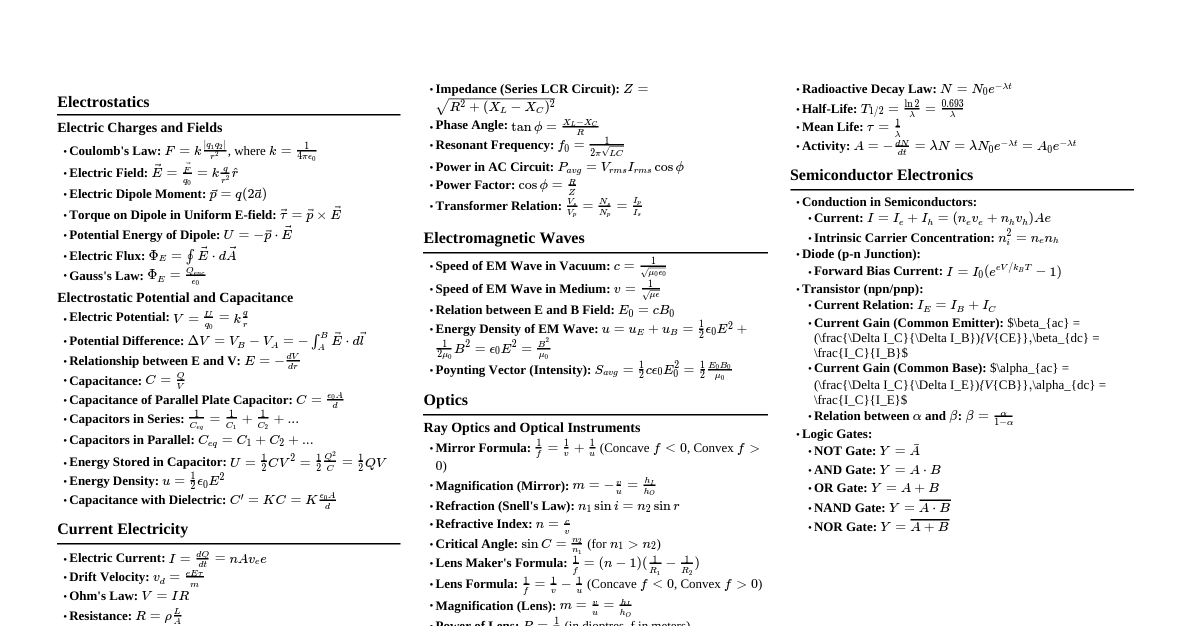
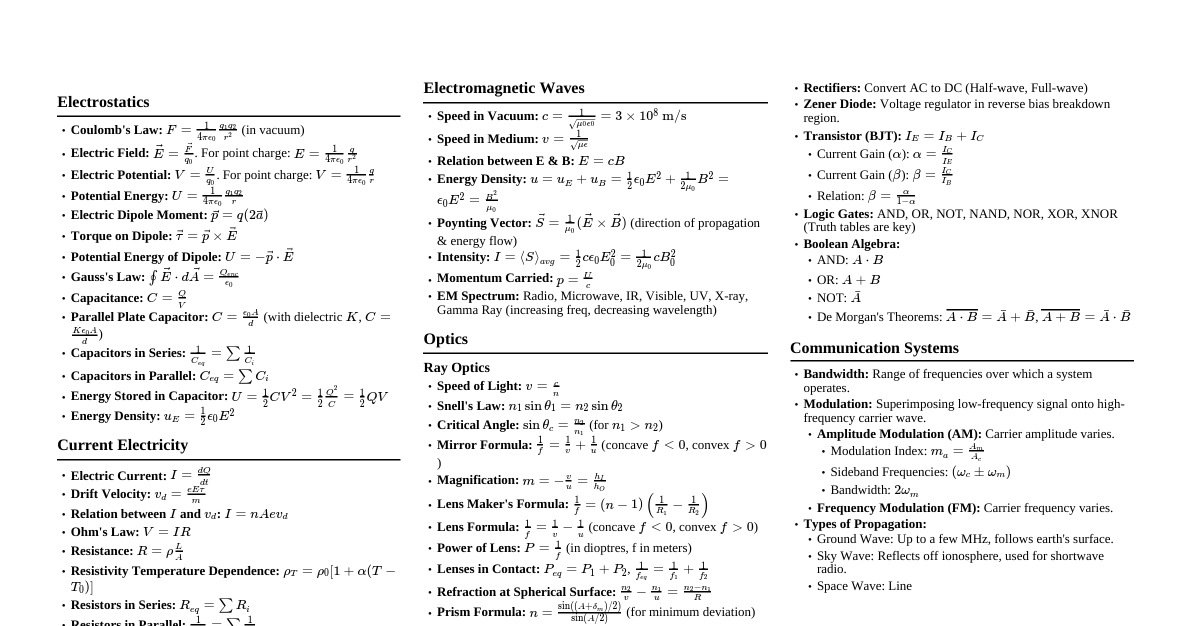
### Electric Charge - **Definition:** Intrinsic property of fundamental particles that gives rise to electric force between them. - **Quantization of Charge:** Electric charge is always an integral multiple of the basic elementary charge ($e = 1.6 \times 10^{-19}$ C). $Q = \pm ne$. - **Conservation of Charge:** Total electric charge of an isolated system remains constant. ### Coulomb's Law - **Definition:** States that the force between two point charges is directly proportional to the product of the magnitudes of the charges and inversely proportional to the square of the distance between them. - **Formula:** $F = k \frac{|q_1 q_2|}{r^2}$, where $k = \frac{1}{4\pi\epsilon_0} = 9 \times 10^9 \text{ N m}^2/\text{C}^2$. ### Electric Field - **Definition:** The space surrounding an electric charge or a system of charges within which other charged particles experience an electrostatic force. - **Formula:** $\vec{E} = \frac{\vec{F}}{q_0}$ (force per unit positive test charge). - **Due to a point charge:** $E = \frac{1}{4\pi\epsilon_0} \frac{q}{r^2}$. ### Electric Field Lines - **Definition:** Imaginary lines or curves drawn in such a way that the tangent to any point on the curve gives the direction of the electric field at that point. - **Properties:** - Originate from positive charges and terminate on negative charges. - Never intersect each other. - Closer lines indicate stronger fields. ### Electric Flux - **Definition:** A measure of the number of electric field lines passing through a given surface. - **Formula:** $\Phi_E = \int \vec{E} \cdot d\vec{A}$. For a uniform field and flat surface, $\Phi_E = E A \cos\theta$. ### Gauss's Law - **Definition:** States that the total electric flux through any closed surface is equal to $\frac{1}{\epsilon_0}$ times the net charge enclosed by the surface. - **Formula:** $\Phi_E = \oint \vec{E} \cdot d\vec{A} = \frac{Q_{enclosed}}{\epsilon_0}$. ### Electric Potential - **Definition:** The amount of work done per unit positive test charge in bringing it from infinity to that point in an electric field without acceleration. - **Formula:** $V = \frac{W}{q_0}$. - **Due to a point charge:** $V = \frac{1}{4\pi\epsilon_0} \frac{q}{r}$. ### Potential Difference - **Definition:** The work done per unit positive test charge in moving it from one point to another in an electric field. - **Formula:** $\Delta V = V_B - V_A = \frac{W_{AB}}{q_0}$. ### Equipotential Surface - **Definition:** A surface over which the electric potential is constant at all points. - **Properties:** - No work is done in moving a charge on an equipotential surface. - Electric field lines are always perpendicular to equipotential surfaces. ### Capacitor - **Definition:** A device used to store electric charge and electrical energy. It typically consists of two conductors separated by a dielectric medium. - **Capacitance:** The ability of a capacitor to store charge. $C = \frac{Q}{V}$. - **Unit:** Farad (F). ### Dielectric Constant - **Definition:** The ratio of the capacitance of a capacitor with a dielectric medium between its plates to its capacitance with vacuum or air as the medium. - **Formula:** $K = \frac{C_{medium}}{C_{vacuum}} = \frac{\epsilon}{\epsilon_0}$. Also known as relative permittivity ($\epsilon_r$). ### Electric Current - **Definition:** The rate of flow of electric charge through a conductor. - **Formula:** $I = \frac{dQ}{dt}$. - **Unit:** Ampere (A). ### Current Density - **Definition:** The current flowing per unit cross-sectional area of a conductor, perpendicular to the direction of current flow. - **Formula:** $\vec{J} = \frac{I}{A} \hat{n}$. - **Relation with drift velocity:** $\vec{J} = n e \vec{v}_d$. ### Drift Velocity - **Definition:** The average velocity attained by charged particles (electrons) in a material due to an electric field. - **Formula:** $\vec{v}_d = -\frac{e\vec{E}}{m}\tau$, where $\tau$ is relaxation time. ### Ohm's Law - **Definition:** States that the current flowing through a conductor between two points is directly proportional to the voltage across the two points, provided the temperature and other physical conditions remain constant. - **Formula:** $V = IR$. ### Resistance - **Definition:** The opposition offered by a conductor to the flow of electric current. - **Formula:** $R = \rho \frac{L}{A}$. - **Unit:** Ohm ($\Omega$). ### Resistivity - **Definition:** The intrinsic property of a material that quantifies how strongly it resists electric current. It is the resistance of a conductor of unit length and unit cross-sectional area. - **Formula:** $\rho = \frac{RA}{L}$. - **Unit:** Ohm-meter ($\Omega$ m). ### Conductivity - **Definition:** The reciprocal of resistivity, indicating how easily a material conducts electric current. - **Formula:** $\sigma = \frac{1}{\rho}$. - **Unit:** Siemens per meter (S/m) or $\Omega^{-1} m^{-1}$. ### Kirchhoff's Laws - **Junction Rule (KCL):** The algebraic sum of currents entering any junction (node) in an electrical circuit is equal to the sum of currents leaving the junction. (Based on conservation of charge). - **Loop Rule (KVL):** The algebraic sum of changes in potential around any closed loop in an electrical circuit is zero. (Based on conservation of energy). ### Wheatstone Bridge - **Definition:** An electrical circuit used to measure an unknown electrical resistance by balancing two legs of a bridge circuit, one leg of which includes the unknown component. - **Balanced Condition:** $\frac{P}{Q} = \frac{R}{S}$. ### Electromotive Force (EMF) - **Definition:** The potential difference developed across the terminals of a cell or battery when no current is drawn from it. It is the energy provided by the source per unit charge. - **Unit:** Volt (V). ### Magnetic Field - **Definition:** The region around a magnet or a current-carrying conductor where magnetic forces can be detected. - **Unit:** Tesla (T) or Gauss (G). ($1 \text{ T} = 10^4 \text{ G}$). ### Lorentz Force - **Definition:** The total force experienced by a charged particle moving in a region where both electric and magnetic fields are present. - **Formula:** $\vec{F} = q(\vec{E} + \vec{v} \times \vec{B})$. ### Biot-Savart Law - **Definition:** A fundamental law in electromagnetism that describes the magnetic field generated by a steady electric current. - **Formula (for a current element):** $d\vec{B} = \frac{\mu_0}{4\pi} \frac{I d\vec{l} \times \vec{r}}{r^3}$. ### Ampere's Circuital Law - **Definition:** States that the line integral of the magnetic field $\vec{B}$ around any closed loop is equal to $\mu_0$ times the total current $I_{enclosed}$ passing through the loop. - **Formula:** $\oint \vec{B} \cdot d\vec{l} = \mu_0 I_{enclosed}$. ### Magnetic Flux - **Definition:** A measure of the total number of magnetic field lines passing through a given area. - **Formula:** $\Phi_B = \int \vec{B} \cdot d\vec{A}$. For a uniform field and flat surface, $\Phi_B = B A \cos\theta$. - **Unit:** Weber (Wb). ### Faraday's Law of Electromagnetic Induction - **Definition:** States that the magnitude of the induced electromotive force (EMF) in a circuit is directly proportional to the rate of change of magnetic flux through the circuit. - **Formula:** $\mathcal{E} = -N \frac{d\Phi_B}{dt}$. ### Lenz's Law - **Definition:** States that the direction of the induced current or EMF is always such that it opposes the cause that produced it (i.e., the change in magnetic flux). It is a consequence of the conservation of energy. ### Self-Induction - **Definition:** The phenomenon where a change in current in a coil induces an EMF in the same coil. - **Self-Inductance (L):** The property of a coil that opposes the change in current flowing through it. $\mathcal{E} = -L \frac{dI}{dt}$. - **Unit:** Henry (H). ### Mutual Induction - **Definition:** The phenomenon where a change in current in one coil induces an EMF in a neighboring coil. - **Mutual Inductance (M):** The property that quantifies this effect. $\mathcal{E}_2 = -M \frac{dI_1}{dt}$. ### Alternating Current (AC) - **Definition:** Electric current whose magnitude and direction vary periodically with time, typically sinusoidally. - **Peak Current:** $I_0$. **RMS Current:** $I_{rms} = \frac{I_0}{\sqrt{2}}$. ### Reactance - **Definition:** The opposition offered to the flow of alternating current by inductors or capacitors due to their inductance or capacitance, respectively. - **Inductive Reactance:** $X_L = \omega L = 2\pi f L$. - **Capacitive Reactance:** $X_C = \frac{1}{\omega C} = \frac{1}{2\pi f C}$. - **Unit:** Ohm ($\Omega$). ### Impedance - **Definition:** The total effective opposition to the flow of alternating current in a circuit containing resistance, inductance, and capacitance. It is the complex generalization of resistance. - **Formula (RLC series circuit):** $Z = \sqrt{R^2 + (X_L - X_C)^2}$. - **Unit:** Ohm ($\Omega$). ### Resonance (AC Circuits) - **Definition:** The condition in an RLC series circuit where the inductive reactance equals the capacitive reactance ($X_L = X_C$), leading to minimum impedance and maximum current. - **Resonant Frequency:** $f_r = \frac{1}{2\pi\sqrt{LC}}$. ### Power Factor - **Definition:** The cosine of the phase angle ($\phi$) between the voltage and current in an AC circuit. It represents the ratio of true power (active power) to apparent power. - **Formula:** $\cos\phi = \frac{R}{Z}$. ### Displacement Current - **Definition:** A term added by Maxwell to Ampere's circuital law to account for the changing electric field, particularly in the space between the plates of a charging capacitor. It produces a magnetic field just like a conduction current. - **Formula:** $I_d = \epsilon_0 \frac{d\Phi_E}{dt}$. ### Electromagnetic Waves - **Definition:** Waves that are created as a result of vibrations between an electric field and a magnetic field. They are transverse in nature and do not require a medium for propagation. - **Properties:** - Travel at the speed of light in vacuum ($c = \frac{1}{\sqrt{\mu_0\epsilon_0}}$). - Electric and magnetic fields are perpendicular to each other and to the direction of propagation. ### Reflection of Light - **Definition:** The phenomenon of bouncing back of light when it strikes a surface. - **Laws of Reflection:** - The angle of incidence equals the angle of reflection ($\angle i = \angle r$). - The incident ray, the reflected ray, and the normal to the surface all lie in the same plane. ### Refraction of Light - **Definition:** The bending of light as it passes from one transparent medium to another due to a change in its speed. - **Snell's Law:** $\frac{\sin i}{\sin r} = \frac{n_2}{n_1} = \frac{v_1}{v_2}$. ### Refractive Index - **Definition:** A measure of how much the speed of light is reduced when passing through a medium. - **Absolute Refractive Index:** $n = \frac{c}{v}$. - **Relative Refractive Index:** $n_{21} = \frac{n_2}{n_1}$. ### Total Internal Reflection (TIR) - **Definition:** The phenomenon where a ray of light travelling from a denser optical medium to a rarer optical medium, at an angle of incidence greater than the critical angle, is reflected back into the denser medium. - **Conditions:** - Light must travel from denser to rarer medium. - Angle of incidence must be greater than the critical angle ($i > i_c$). ### Dispersion of Light - **Definition:** The phenomenon of splitting of white light into its constituent colours when it passes through a transparent medium (like a prism) due to the variation of refractive index with wavelength. ### Interference of Light - **Definition:** The phenomenon of redistribution of light energy resulting from the superposition of two or more coherent light waves. - **Constructive Interference:** Maxima, phase difference $2n\pi$, path difference $n\lambda$. - **Destructive Interference:** Minima, phase difference $(2n+1)\pi$, path difference $(n+1/2)\lambda$. ### Diffraction of Light - **Definition:** The phenomenon of bending of light waves around corners or obstacles and spreading into the region of geometrical shadow. ### Polarization of Light - **Definition:** The phenomenon of restricting the vibrations of light waves to a single plane. Unpolarized light vibrates in all possible planes perpendicular to the direction of propagation. - **Plane-polarized light:** Light with vibrations confined to a single plane. ### Brewster's Law - **Definition:** States that when unpolarized light is incident on a transparent medium at the Brewster angle ($i_p$), the reflected light is completely plane-polarized perpendicular to the plane of incidence, and the reflected and refracted rays are perpendicular to each other. - **Formula:** $\tan i_p = n$. ### Photoelectric Effect - **Definition:** The phenomenon of emission of electrons from a metal surface when light of suitable frequency (above a threshold frequency) falls on it. - **Einstein's Photoelectric Equation:** $h\nu = \phi_0 + K_{max}$, where $\phi_0$ is work function and $K_{max}$ is maximum kinetic energy of emitted electrons. ### Work Function ($\phi_0$) - **Definition:** The minimum amount of energy required to remove an electron from the surface of a metal. - **Formula:** $\phi_0 = h\nu_0$, where $\nu_0$ is the threshold frequency. ### Threshold Frequency ($\nu_0$) - **Definition:** The minimum frequency of incident light below which no photoelectric emission occurs, no matter how intense the light is. ### de Broglie Wavelength - **Definition:** The wavelength associated with a moving particle, exhibiting wave-particle duality. - **Formula:** $\lambda = \frac{h}{p} = \frac{h}{mv}$. ### Atomic Spectra - **Definition:** The characteristic pattern of electromagnetic radiation emitted or absorbed by an atom when its electrons undergo transitions between different energy levels. - **Emission spectra:** Discrete bright lines against a dark background. - **Absorption spectra:** Discrete dark lines against a continuous spectrum. ### Bohr's Model of Hydrogen Atom - **Postulates:** 1. Electrons revolve in specific stable orbits without radiating energy. 2. Electrons can only revolve in orbits for which the angular momentum is an integral multiple of $\frac{h}{2\pi}$ ($mvr = n\frac{h}{2\pi}$). 3. Energy is radiated or absorbed only when an electron jumps from one stationary orbit to another. ### Mass Defect - **Definition:** The difference between the sum of the masses of the individual nucleons (protons and neutrons) in a nucleus and the actual mass of the nucleus. - **Formula:** $\Delta m = (Z m_p + N m_n) - M_{nucleus}$. ### Binding Energy - **Definition:** The energy required to separate all the nucleons (protons and neutrons) in a nucleus to an infinite distance. It is equivalent to the mass defect according to Einstein's mass-energy equivalence. - **Formula:** $E_b = \Delta m c^2$. ### Nuclear Fission - **Definition:** The process in which a heavy atomic nucleus splits into two or more smaller nuclei, along with the release of a large amount of energy, typically by bombardment with neutrons. ### Nuclear Fusion - **Definition:** The process in which two or more light atomic nuclei combine to form a heavier nucleus, with a concomitant release of a very large amount of energy. This process powers the sun and stars. ### Half-Life ($T_{1/2}$) - **Definition:** The time required for half of the radioactive nuclei in a sample to decay. - **Formula:** $T_{1/2} = \frac{0.693}{\lambda}$, where $\lambda$ is the decay constant. ### Radioactivity - **Definition:** The spontaneous emission of radiation (alpha, beta, gamma rays) by unstable atomic nuclei to achieve a more stable configuration. ### N-type Semiconductor - **Definition:** An extrinsic semiconductor formed by doping a pure semiconductor (like Silicon or Germanium) with pentavalent impurities (e.g., Phosphorus, Arsenic). It has excess free electrons as majority charge carriers. ### P-type Semiconductor - **Definition:** An extrinsic semiconductor formed by doping a pure semiconductor with trivalent impurities (e.g., Boron, Aluminium). It has an excess of holes as majority charge carriers. ### P-N Junction - **Definition:** A boundary or interface between two types of semiconductor materials, p-type and n-type, inside a single crystal of semiconductor. It forms the basic building block of most semiconductor devices. ### Depletion Region - **Definition:** A region near the p-n junction that is depleted of free charge carriers (electrons and holes) due to the diffusion of carriers across the junction, leaving behind immobile donor and acceptor ions. ### Rectifier - **Definition:** An electronic device that converts alternating current (AC) into direct current (DC) by allowing current to flow in only one direction. - **Half-wave rectifier:** Uses one diode, rectifies only half of the AC cycle. - **Full-wave rectifier:** Uses two or four diodes, rectifies both halves of the AC cycle. ### Zener Diode - **Definition:** A special type of p-n junction diode designed to operate in the reverse breakdown region without being destroyed, primarily used as a voltage regulator. ### Transistor - **Definition:** A semiconductor device used to amplify or switch electronic signals and electrical power. It consists of three terminals: emitter, base, and collector. (e.g., Bipolar Junction Transistor - BJT). ### Logic Gates - **Definition:** Elementary building blocks of digital circuits that implement basic logical functions (AND, OR, NOT, NAND, NOR, XOR, XNOR). They take one or more binary inputs and produce a single binary output.