Health Education Outcomes
Cheatsheet Content
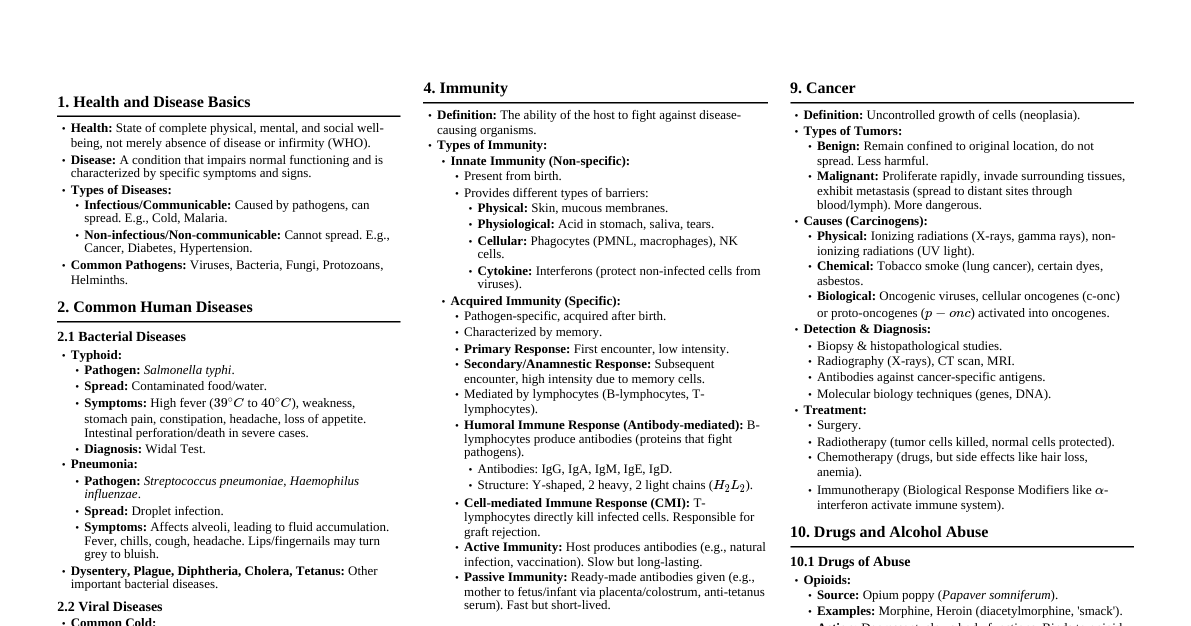
### Fundamental Definitions #### A. Definition of Health (WHO) Health is a state of complete **physical, mental, and social well-being**, and not merely the absence of disease or infirmity. - **Physical Well-being:** The functional integrity of the body and its systems. - **Mental Well-being:** The ability to handle stress, anxiety, and cope with life challenges. - **Social Well-being:** Healthy interaction with others and avoidance of total isolation. #### B. Definition of Education A complex and planned series of learning experiences designed to bring about changes in: - **Cognitive Domain:** Acquisition of knowledge and information. - **Affective Domain:** Changes in attitudes, beliefs, and values. - **Psychomotor Domain:** Development of physical skills and movement. #### C. Health Education A specialized teaching process aimed at changing health-related **knowledge, attitudes, and practices** to improve overall health outcomes. ### Importance of Health Education - **Health Promotion:** Elevates the health status of individuals, families, and communities. - **Quality of Life:** Enhances the standard of living and subjective well-being. - **Longevity:** Decreases rates of premature and sudden deaths. - **Economic Efficiency:** - Reductions in the health budget by lowering hospital admissions and drug consumption. - Optimization of human resources by reducing the burden on medical staff through prevention. ### The Health Educator Profile #### A. Key Characteristics - **Time Management:** Ability to control session duration and prioritize core information. - **Cultural Competence:** Awareness of society's traditions and specific problems. - **Professional Appearance:** Acting as a role model (e.g., an educator must not exhibit unhealthy habits like smoking). - **Observation Skills:** Monitoring facial expressions to ensure audience comprehension. - **Leadership:** Controlling the educational setting and maintaining audience focus. #### B. Strategic Roles - **Active Listening:** Understanding the audience's specific problems before delivering solutions. - **Behavioral Analysis:** Identifying actions that lead to health issues. - **Causality Explanation:** Helping people understand the "Reason" behind diseases to foster prevention. ### Core Principles - **Interest:** The topic must align with the audience's needs. - **Participation:** Encouraging active engagement rather than passive listening. - **Motivation:** Providing incentives to encourage a change toward better health. - **Simple to Complex:** Starting with simple concepts before moving to complicated medical details. - **Reinforcement:** Summarizing main points at the end of the session to solidify knowledge. ### Channels of Delivery - **Electronic:** TV, Radio, Internet. - **Print:** Newspapers, Magazines, Information booklets. - **Visual:** Posters, Banners, Documentary films. ### Barriers to Effective Health Education #### A. Educator-Related Barriers - Lack of motivation to teach or lack of scientific proficiency. - Poor teaching skills or choosing an inappropriate time. #### B. Recipient-Related Barriers - Lack of interest or motivation to learn. - **Denial:** Refusal to admit the existence of health problems or the need for learning. #### C. Environmental Barriers - Poor ventilation, noise, distractions, or extreme temperatures. - Lack of privacy during the educational session.