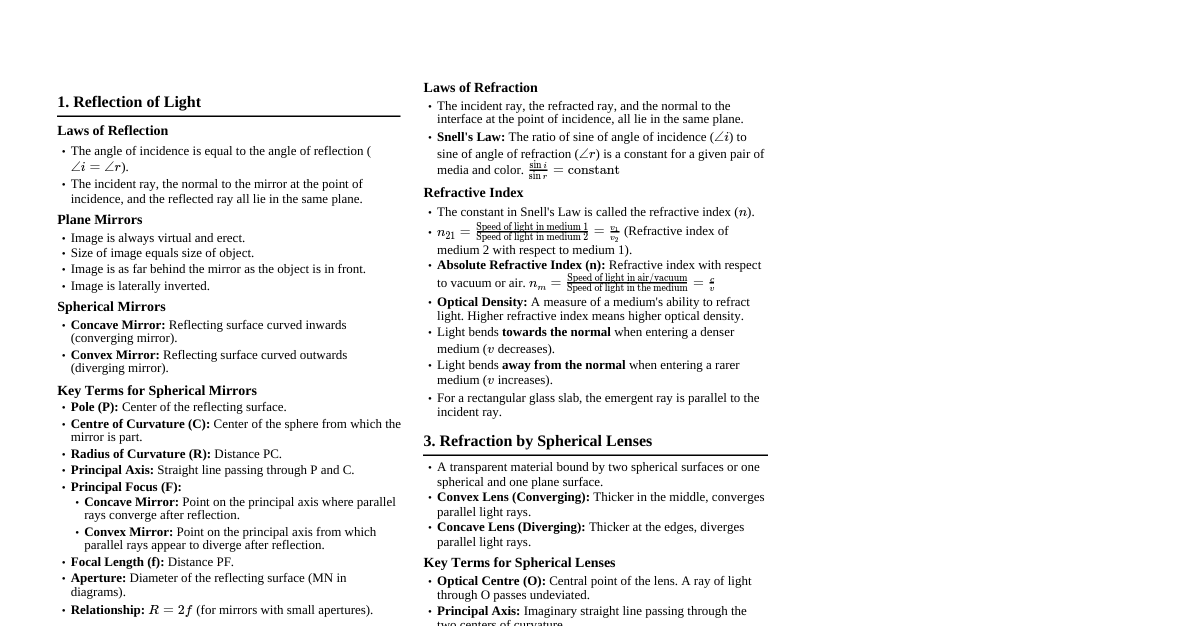
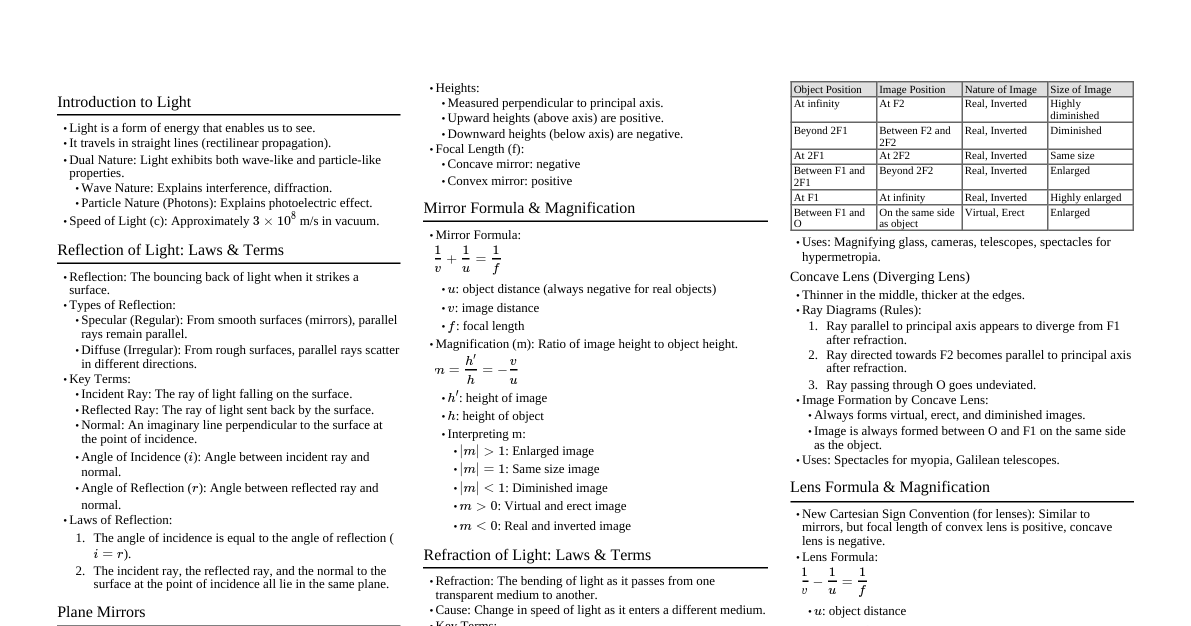
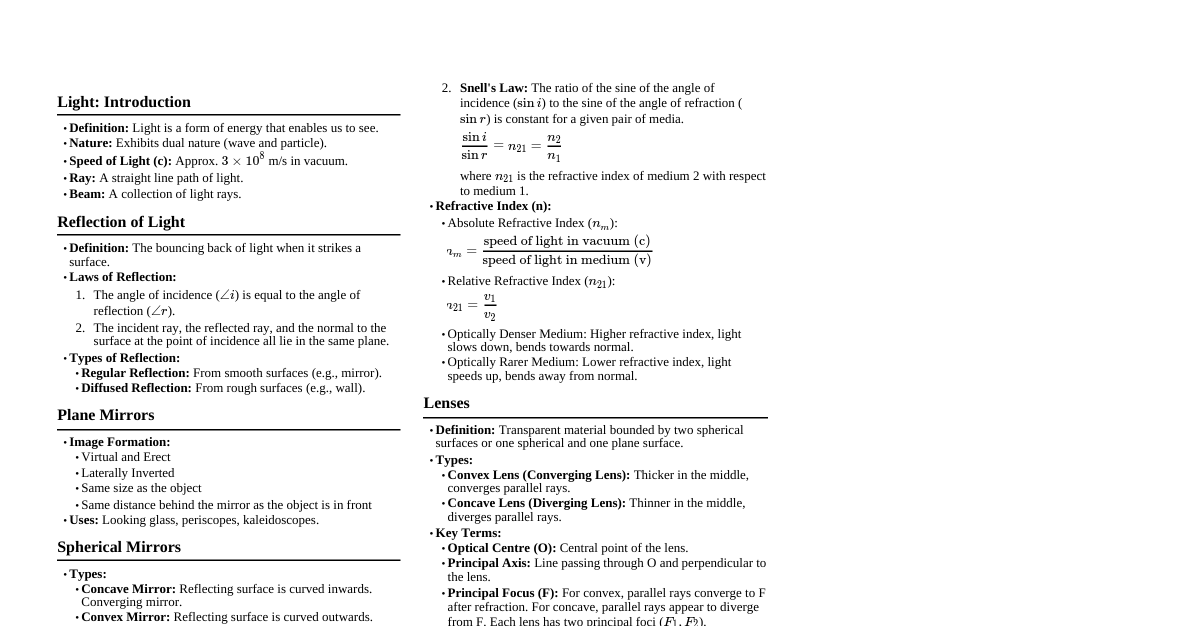
Reflection of Light
Cheatsheet Content
### Objectives: Reflection of Light This lesson aims to achieve the following learning outcomes: - **Cognitive (Knowledge):** Students will be able to state the Law of Reflection ($\theta_i = \theta_r$) and differentiate between specular and diffuse reflection. - **Psychomotor (Skills):** Students will construct accurate ray diagrams using a protractor to show light hitting and reflecting off a plane mirror. - **Affective (Attitude):** Students will identify and value the importance of reflective surfaces in daily safety tools like vehicle mirrors and road signs. ### Experiment: The Mirror Target Challenge **Materials:** Small mirror, flashlight (or laser pointer), protractor, white paper. #### Step 1: Prove the Law (Cognitive) 1. Place the mirror upright on paper and draw its edge. 2. Shine light at an angle towards the mirror, marking incoming and outgoing paths. 3. **The Test:** Draw a "Normal" line ($90^\circ$ to the mirror). Measure both angles with a protractor ($\theta_i$ and $\theta_r$). They should be identical. #### Step 2: Map the Path (Psychomotor) 1. On a new paper, draw a "Target X" 10 inches from the mirror. 2. **The Test:** Without moving the mirror, calculate the exact angle needed to hold the flashlight so the reflected beam hits "X." This tests manipulation of light paths. #### Step 3: Observe the Texture (Affective) 1. Replace the mirror with crumpled aluminum foil or plain white paper. Shine light at the same angle. 2. **The Test:** Observe why you can't "aim" the light at the target. This demonstrates diffuse reflection and its importance for smooth surfaces in safety and vision. ### Why Reflection of Light Works Well for a Demo Reflection of Light is an excellent topic for a teaching demonstration due to its visual nature and hands-on potential. 1. **High "Action" Potential:** Dimming lights and using laser pointers instantly captures attention. 2. **Clear Success Criteria:** The Law of Reflection ($\theta_i = \theta_r$) is a simple, concrete concept, allowing quick progression from theory to experiment. 3. **Integrated Learning (3 Domains):** - **Cognitive:** Use whiteboards for ray diagrams. - **Psychomotor:** Students can hit a target with a mirror. - **Affective:** Real-world applications like periscopes or ambulance mirrors provide a strong hook. ### Tips for a "Winning" Demonstration - **The "Hook":** Start with a relatable question, e.g., "Why can we see our face in a phone screen when it's off, but not a piece of wood?" - **Visual Aids:** Use a large protractor for visibility. Chalk dust or fog can make laser beams visible. - **Check for Understanding:** Employ a "Predict-Observe-Explain" (POE) strategy. Ask, "If I move the light to 20°, where will the reflection go?" and let students vote. ### Demonstration Outline: The Law of Reflection **Time:** 20 Minutes | **Topic:** Reflection of Light | **Target:** Grade 7-10 Science #### 1. Introduction & Hook (3 Minutes) - **Action:** Hold up a mirror; ask: "Why do I need two mirrors to see the back of my head?" - **Concept:** Explain we see objects due to reflected light. - **Objective:** Students will predict where light bounces. #### 2. Direct Instruction & Modeling (5 Minutes) - **Action:** Draw a horizontal line (mirror) and a vertical dashed line ($90^\circ$) (The Normal) on the board. - **Key Vocabulary:** - **Incident Ray:** Incoming light. - **Reflected Ray:** Bouncing light. - **Angle of Incidence ($\theta_i$):** Measured from the Normal. - **State the Law:** $\theta_i = \theta_r$ (Angle of Incidence = Angle of Reflection). #### 3. Guided Exploration: "The Laser Challenge" (8 Minutes) - **Setup:** Dim lights. Place a plane mirror on a table with a printed protractor. - **Activity:** Use a laser pointer to hit the mirror at $30^\circ$. Ask a student to predict where light exits and place a "target." - **Observation:** Turn on the laser, showing the beam hitting the target. - **Check for Understanding:** Ask: "If I move the laser to $60^\circ$, should I move the target closer to the Normal or further away?" #### 4. Application & Real-World Hook (2 Minutes) - **Visual Aid:** Show an ambulance picture. Ask why "AMBULANCE" is written backward on the front. - **Explanation:** This is **lateral inversion**, ensuring drivers see it correctly in rearview mirrors. #### 5. Closure & Assessment (2 Minutes) - **Quick Quiz:** Present a diagram with an incident ray at $45^\circ$; ask students to draw the reflected ray. - **Wrap-up:** Summarize: light is predictable, measurable, and essential for vision. ### Recommended Materials for Demo - **Laser Pointer:** High visibility (green best). - **Fog or Chalk Dust:** To make the laser beam visible. - **Flat Mirror:** Secured with modeling clay. - **Large Protractor:** For class visibility. ### Final Demo Checklist: Reflection of Light #### 1. Pre-Demo Setup (Technical) - **Visibility Check:** Can students see the mirror and laser beam (use chalk dust/humidifier)? - **Room Lighting:** Do you know where switches are for dimming lights? - **Stability:** Is the mirror secured from tipping? - **Safety:** Have you reminded students not to shine lasers into eyes? #### 2. Activity & Analysis (The "Engagement" Check) - **Clear Instructions:** Did you give instructions *before* handing out lasers? - **The "Aha!" Moment:** Did you let students discover "the angles are the same" rather than telling them? - **Comparison:** Was crumpled foil ready to show diffuse vs. specular reflection? #### 3. Abstraction (The "Board Work" Check) - **The Normal:** Did you emphasize that the Normal is a $90^\circ$ line (not mirror surface)? - **Mathematical Notation:** Is the formula $\theta_i = \theta_r$ clearly written and boxed? - **Vocabulary Labels:** Are Incident, Reflected, and Normal clearly labeled on your diagram? #### 4. Application & Affective (The "Connection" Check) - **The "So What?":** Did you link to real-life safety (ambulance text, road reflectors)? - **Student Value:** Did you ask a question making them appreciate reflection, e.g., "How would our world look if light didn't reflect off objects?" #### 5. Final Impression (The "Pro" Check) - **Time Management:** Are you on track to finish "Application" by 15-minute mark? - **Materials Management:** Do you have a plan to quickly collect lasers/mirrors? ### Teacher's "Secret Sauce" Tip If measurements aren't perfectly equal (e.g., $30^\circ$ and $32^\circ$), use it as a teaching moment! Explain that "Experimental Error" happens in science due to factors like mirror glass thickness or laser beam width. This shows you are an honest and observant scientist. ### Scoring High on Your COT (Classroom Observation Tool) This section shows how to hit key PPST Indicators within your 4A's Lesson Plan. #### I. Objectives & Preparation - **Indicator 1 (Content Knowledge):** Integrated into Objectives, linking physics of light to Geometry. - **Indicator 10 (Diversity of Learners):** Objectives target Cognitive, Psychomotor, Affective domains. - **Indicator 14 (Curriculum Alignment):** Objectives are based on DepEd K-12 Melcs. #### II. Activity (The "Heart" of Student Engagement) - **Indicator 4 (Communication):** Explain "Laser Target Challenge" instructions clearly. - **Indicator 7 (Safety and Security):** Give explicit safety warning: "Class, never point the laser at anyone's eyes." - **Indicator 8 (Fair Learning Environment):** Assign roles (Timer, Scorer, Laser Operator) to ensure participation. - **Indicator 11 (Learner Backgrounds):** Use Localized Materials like a used CD or common mirrors. - **Indicator 13 (Differentiated Teaching):** Hands-on activity targets Kinesthetic Learners. #### III. Analysis (The "Thinking" Phase) - **Indicator 3 (Critical Thinking/HOTS):** Ask "What if" questions: "What if the mirror was curved?" or "Why can't we see our reflection on a wall?" - **Indicator 18 (Feedback):** Provide Immediate Feedback for student answers: "Correct! And why do you think that happened?" #### IV. Abstraction (The "Mastery" Phase) - **Indicator 20 (Monitoring Progress):** Walk around, checking Data Tables for struggling students. - **Indicator 5 (ICT Integration):** Use PowerPoint or Phet Interactive Simulation to show rays. - **Indicator 6 (Language/Mother Tongue):** Use simple analogies or translate complex terms into local dialect if needed. - **Indicator 19 (Professional Development):** Demonstrate Mastery of Subject Matter (no errors in ray diagrams). - **Indicator 9 (Management of Behavior):** Use "Positive Discipline" techniques to regain attention after activities. #### V. Application (The "Connection" Phase) - **Indicator 12 (Community Linkages):** Link to local road safety (blind spot mirrors). - **Indicator 15 (Contextualization):** Discuss why "AMBULANCE" is written in reverse for real-world service connection. - **Indicator 17 (Planning and Management):** Mention how this lesson leads to tomorrow's lesson on Refraction. #### VI. Evaluation & Assignment - **Indicator 16 (Assessment Strategies):** Use a 5-item quiz or "Exit Ticket." - **Indicator 8 (Numeracy):** Include a Math problem in the quiz, e.g., "If angle $i$ is $35^\circ$, find angle $r$." - **Indicator 9 (Literacy):** Assignment requires short explanation, building scientific writing skills. - **Indicator 21 (Reporting Progress):** Conclude by saying: "Most of you mastered the angles today, tomorrow we will apply this to curved mirrors!" ### Pro-Tip for your Demo Keep a "Teacher's Reflection Log" (Indicator 2) on your desk. This shows you are a research-based, reflective practitioner, even if the observer doesn't ask for it. ### Critical Indicators Script for COT To land a perfect score on your Classroom Observation Tool (COT), here's the exact script for two critical indicators: #### 1. Indicator 7: Safety and Security *Target this immediately before the Activity phase.* **Teacher Script:** "Before we begin our 'Target Challenge,' let's establish our Safety Protocols. Remember, we are using laser pointers. **Rule #1:** Never point the laser at your classmates' eyes, as it can cause permanent damage. **Rule #2:** Keep the laser beam low and focused on the paper. I will be monitoring each group; if I see unsafe behavior, your group will shift to using a standard flashlight instead. Safety first so we can enjoy the science!" #### 2. Indicator 3: Critical Thinking (HOTS) *Target this during the Analysis and Abstraction phases to move students beyond simple recall.* **Ask these 3 "Level-Up" Questions:** 1. **The "What If" (Analysis):** "Look at your data. If I were to tilt the mirror just 5 degrees to the left, what would happen to our reflected beam? Don't move it yet—**predict** the path first based on our law." 2. **The "Comparison" (Abstraction):** "We saw that the mirror gives a perfect reflection, but the crumpled foil scatters the light. Does the **Law of Reflection** still work on the tiny, microscopic bumps of the foil, or does the law only exist for smooth surfaces?" (Lead them to realize the law works everywhere, but the surface geometry changes the outcome). 3. **The "Evaluation" (Application):** "If you were designing a 'Stealth' airplane that needs to be invisible to radar (which uses radio waves that reflect like light), would you make the surface of the plane **curved and smooth** or **flat and angled**? Why?" #### Summary Checklist for the Observer | Indicator | Location in 4A's | Action to Perform | | :-------------------- | :--------------- | :----------------------------------------------------------------------------- | | Indicator 4 (Comm) | Activity | Use clear hand signals to show the "V" shape of reflection. | | Indicator 8 (Numeracy)| Analysis | Walk around and check if students aligned the $0^\circ$ mark of the protractor with the **Normal line**. | | Indicator 5 (ICT) | Abstraction | Use the PhET Bending Light Simulation to show the rays. | | Indicator 15 (Context)| Application | Explain the "Ambulance" mirror writing using the Official LTO Road Safety Guidelines. | ### Essential Instructional Materials (IMs) To secure a high rating, present a well-organized set of Instructional Materials (IMs), which serve as physical evidence of your preparation across the 21 PPST indicators. - **Manipulative Kit (Group Set):** - **Plane Mirror:** A 4"x4" square mirror with taped edges. - **Light Source:** Laser pointer (for sharp rays) or high-intensity narrow-beam flashlight. - **Protractor:** Large printed or plastic protractor for measuring angles $\theta_i$ and $\theta_r$. - **Target Cards:** Small cards with a "Target X" for light redirection practice. - **Visual Aids:** - **Large Ray Diagram Poster:** Pre-drawn diagram showing the **Normal line**, **Incident ray**, and **Reflected ray** for the Abstraction phase. - **Contextual Images:** Photos of an **Ambulance** (lateral inversion) and **Road Safety** mirrors (blind curves). - **ICT Integration:** - **PhET Bending Light Simulation:** Demonstrates that the reflected angle matches the incident angle. - **Assessment Tools:** - **Activity Log/Data Table:** Printed sheet for recording measured angles. - **Exit Ticket/Quiz:** Short 5-item evaluation on the Law of Reflection. #### Indicator Mastery Guide for IMs | Indicator | IM Linkage & Action | | :-------------------- | :------------------------------------------------------------------------------- | | Indicator 5 (ICT) | Use the PhET Simulation to show the path of light in "wave" vs. "ray" mode. | | Indicator 8 (Numeracy)| Have students use the **Protractor** to verify that $\theta_i = \theta_r$ to the nearest degree. | | Indicator 9 (Literacy)| Use the **Activity Log** for students to write their findings in complete sentences. | ### Detailed Lesson Flow This detailed lesson flow is designed to satisfy the 21 PPST Indicators using the 4A's model. #### I. Pre-Lesson (The Foundation) - **Teacher Action:** Greet class, check attendance, state three learning objectives. - **Student Response:** Students respond and focus on goals. - **PPST Hits:** Indicator 10 (Purposive learning), Indicator 14 (Curriculum alignment). #### II. Activity: "The Laser Target Challenge" - **Teacher Action:** Divide class into groups, distribute kits (mirrors, lasers, protractors). - **Script:** "Before we start, remember our safety rule: Never point lasers at anyone's eyes. It's strictly for the paper target!" - **Student Activity:** Students place a mirror on a protractor, shine laser at $30^\circ, 45^\circ, 60^\circ$, and mark exit points in their Activity Log. - **PPST Hits:** Indicator 7 (Safety), Indicator 8 (Fairness/Group management), Indicator 13 (Differentiated kinesthetic learning). #### III. Analysis: "Patterns in the Paths" - **Teacher Action:** Facilitate discussion based on data logs. - **Script:** "Look at your logs for $30^\circ$. What was the exit angle? What happened when you used the crumpled foil instead of the mirror?" - **Student Response:** Students analyze recorded angles, reporting that "for every angle we put in, the same angle came out!" and that foil scattered light. - **PPST Hits:** Indicator 3 (Higher-Order Thinking Skills/HOTS), Indicator 4 (Communication), Indicator 8 (Numeracy skills). #### IV. Abstraction: "Mastering the Law" - **Teacher Action:** Formalize concept using a Ray Diagram on board and an ICT Simulation. - **Script:** "This is the Law of Reflection. $\theta_i = \theta_r$. Let's test this in our digital simulation." - **Student Activity:** Students draw ray diagram in notebooks, labeling **Normal Line**, **Incident Ray**, **Reflected Ray**. - **PPST Hits:** Indicator 1 (Mastery of content), Indicator 5 (ICT integration), Indicator 6 (Verbal/Non-verbal strategies). #### V. Application: "Science in the Streets" - **Teacher Action:** Link lesson to daily life. - **Script:** "Think about ambulances. Why is 'AMBULANCE' written backward? How do mirrors help drivers see around blind curves?" - **Student Response:** Students relate light's "bouncing" behavior to road safety and visibility. - **PPST Hits:** Indicator 11 (Learner backgrounds), Indicator 12 (Community linkage), Indicator 15 (Contextualization). #### VI. Evaluation & Closure - **Teacher Action:** Conduct a 5-item formative quiz, provide immediate verbal feedback. - **Script:** "Most of you correctly calculated the reflection for a $40^\circ$ hit. Great job, Group 2!" - **Student Response:** Students complete quiz and summarize learning. - **PPST Hits:** Indicator 16 (Assessment strategies), Indicator 18 (Immediate feedback), Indicator 20 (Monitoring progress). #### Observer's Quick-Reference Table | 4A's Phase | Primary Student Activity | Top PPST Indicators to Observe | | :---------- | :------------------------------- | :----------------------------- | | Activity | Manipulating lasers and protractors. | 7, 8, 13, 18 | | Analysis | Comparing entry and exit angles. | 3, 4, 8, 9 | | Abstraction | Sketching and labeling ray diagrams. | 1, 2, 5, 6 | | Application | Discussing ambulance and road mirrors. | 11, 12, 15 | ### Procedures: Detailed Directions Here are the detailed directions and instructions for the teacher to lead each part of the lesson plan, including anticipated student responses. #### Preliminaries - **Teacher's Activity:** "Good morning, class! Let's begin with a prayer and a quick attendance check. Before we start our activity, please remember our classroom rule for today: Safety first with our equipment. No lasers pointed at anyone's eyes." - **Student's Expected Response/Activity:** Students participate in preliminaries and acknowledge safety rules by nodding or verbally confirming. #### A. Review - **Teacher's Activity:** "Yesterday, we identified sources of light. Who can name some of those sources?" - **Student's Expected Response/Activity:** Students volunteer answers: "The sun, fire, lamps, flashlights." #### B. Establishing Purpose - **Teacher's Activity:** "Our goal today is to master reflection. By the end of this class, you will be able to state the Law of Reflection ($\theta_i = \theta_r$). Look at this mirror. Why can we see our face in a smooth mirror, but not on the wooden wall?" - **Student's Expected Response/Activity:** Students listen to objectives and offer initial theories about smoothness of the surface. #### C. Presentation: ACTIVITY - **Teacher's Activity:** "You have your mirrors, lasers, protractors, and Activity Logs. Position the mirror on the paper. Shine the light at 3 different angles ($30^\circ, 45^\circ, 60^\circ$). Mark the path of the incoming and outgoing light. Record your angles in the log." - **Student's Expected Response/Activity:** Students work in groups, setting up equipment, marking light paths with pencils, and recording angle measurements in their data logs. #### D. Developing Mastery: ANALYSIS - **Teacher's Activity:** "Let's review your data. What do you notice about the angle you put in versus the angle that came out? What happened when you used the rough aluminum foil instead of the smooth mirror?" - **Student's Expected Response/Activity:** Students compare results: "The angles were the same!" and "The foil scattered the light, it didn't bounce back the same way." #### E. Generalization: ABSTRACTION - **Teacher's Activity:** "You just discovered the Law of Reflection: The angle of incidence ($\theta_i$) is always equal to the angle of reflection ($\theta_r$). Draw this ray diagram in your notebooks, labeling the Normal line, Incident, and Reflected rays." - **Student's Expected Response/Activity:** Students draw the diagram in their notebooks, actively labeling parts based on teacher's board work. #### F. Practical Application: APPLICATION - **Teacher's Activity:** "How does this law help drivers? Look at this picture of a rearview mirror or the word 'AMBULANCE' written backward on an ambulance. Why does that work?" - **Student's Expected Response/Activity:** Students discuss practical application of light reflection in ensuring road safety and visibility. #### G. EVALUATION - **Teacher's Activity:** "Time for a quick quiz. Answer these 5 items on a clean sheet of paper. We will check this quickly before we dismiss." - **Student's Expected Response/Activity:** Students complete the quiz individually. #### V. ASSIGNMENT / AGREEMENT - **Teacher's Activity:** "For homework, observe your bathroom mirror. Why is it that when you lift your right hand, the person in the mirror lifts their left? Write 3 sentences explaining the science of this 'lateral inversion'." - **Student's Expected Response/Activity:** Students will complete the homework task. #### Lesson Plan Activity Names Here are catchy, relevant names for each part of your 4A's Lesson Plan on the reflection of light. | Phase in Lesson Plan | Activity Name | Focus | | :------------------- | :------------------------ | :------------------------------------------------------------------ | | A. Activity | The Laser Target Challenge| Hands-on manipulation and data gathering using lasers, mirrors, and targets. | | D. Analysis | Patterns in the Paths | Guided questioning and critical thinking about the collected angle measurements. | | E. Abstraction | Mastering the Law & Ray Diagram | Formal lecture where the $\theta_i = \theta_r$ principle and scientific terms are introduced. | | --SSF. Application | Science in the Streets | Connecting the lesson to real-world objects like ambulance writing and road safety mirrors. | | G. Evaluation | The Reflection Quick-Check| A short 5-item quiz to test immediate understanding and mastery of the concept. | | V. Assignment | The Mirror Writing Challenge | Homework task where students apply the concept of lateral inversion at home. |