Comprehensive Calculus
Cheatsheet Content
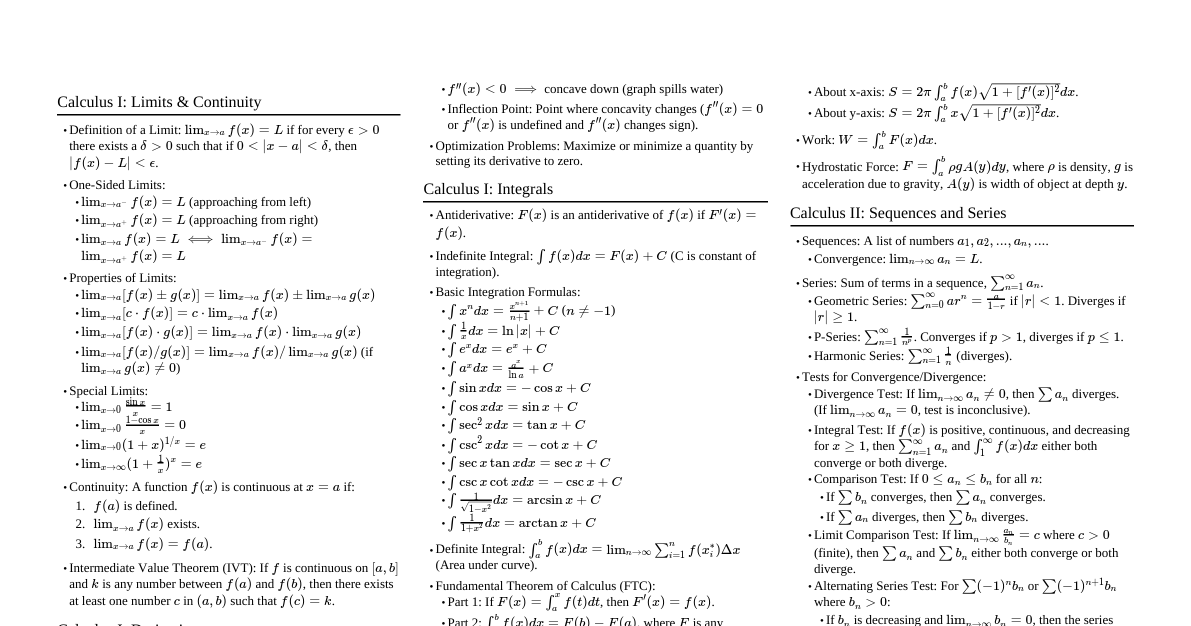
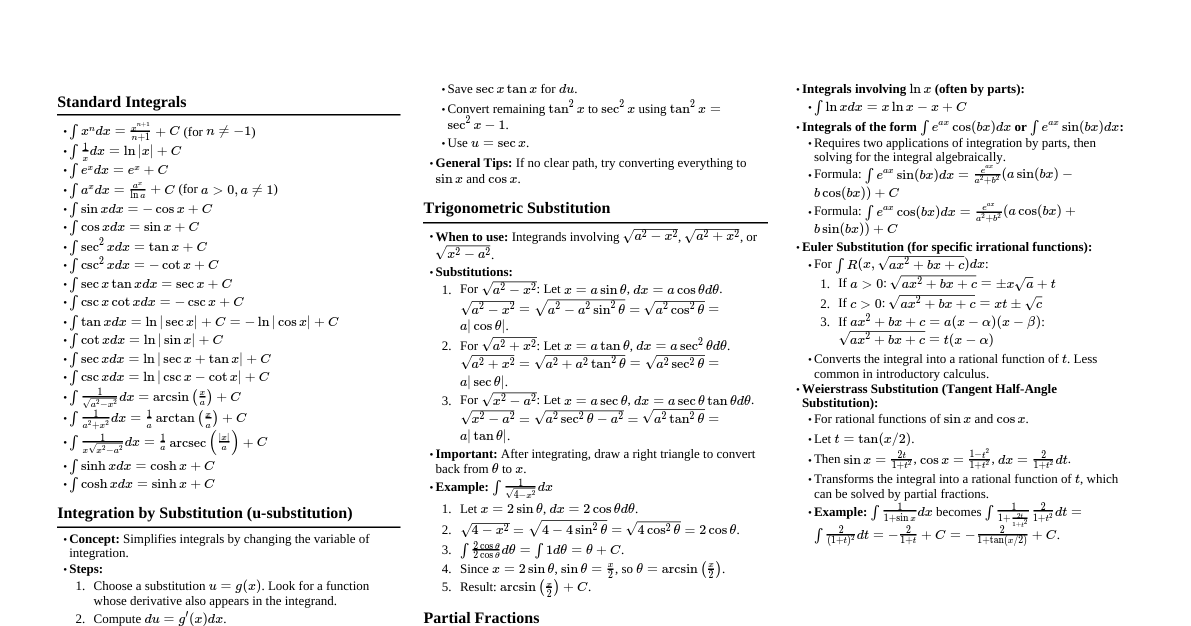
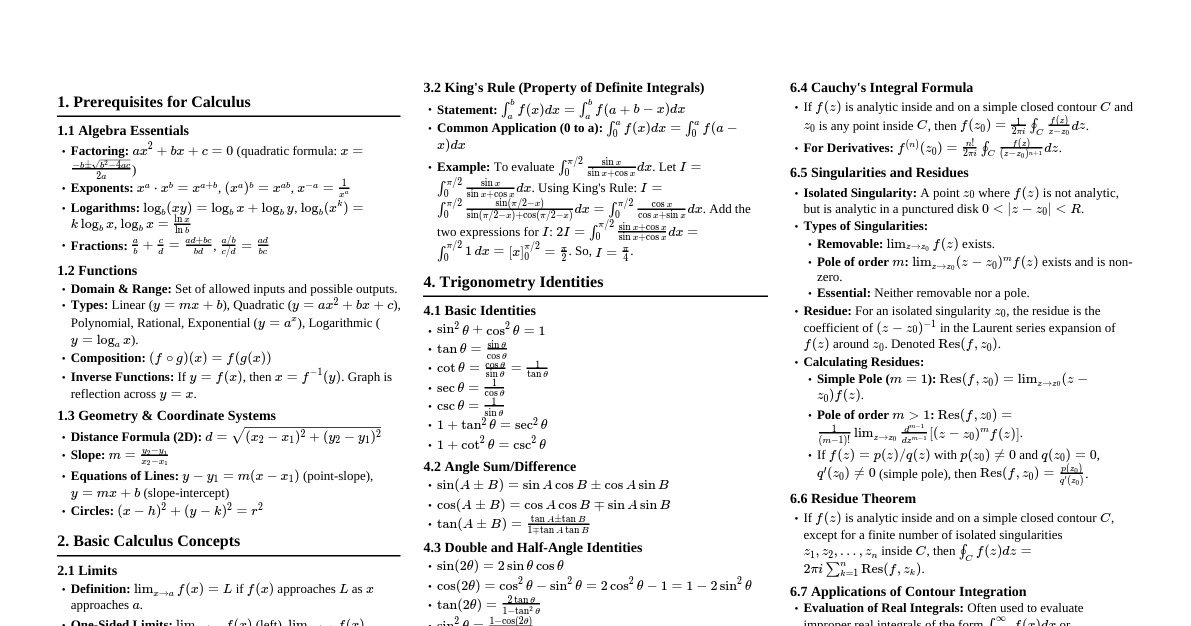
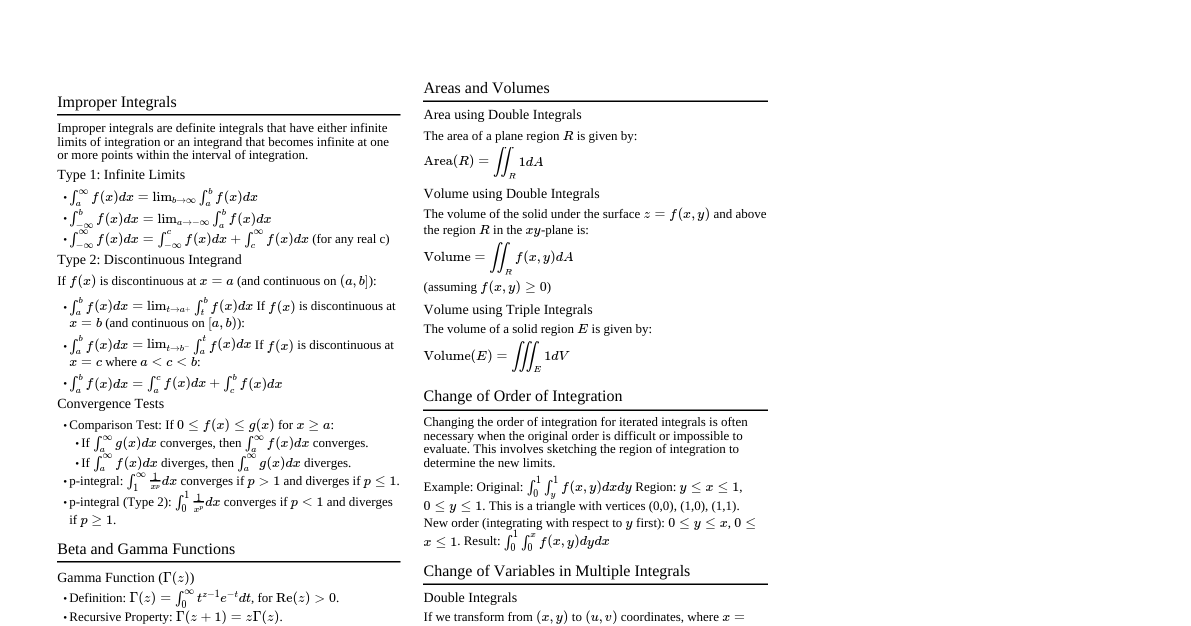
### Foundations & Pre-Calculus - #### Sets & Notation - **Set:** A well-defined collection of distinct objects. - **Intervals:** Open $(a,b)$, Closed $[a,b]$, Half-open $[a,b)$, $(a,b]$. Infinite $(-\infty, a]$, $(a, \infty)$. - **Union ($A \cup B$):** Elements in A OR B (or both). - **Intersection ($A \cap B$):** Elements in A AND B. - **Element of ($\in$):** $x \in A$. - **Subset ($\subseteq$):** $A \subseteq B$. - #### Functions - **Definition:** A rule $f: X \to Y$ that assigns to each element $x$ in set $X$ (domain) exactly one element $y$ in set $Y$ (codomain). The set of all actual output values is the **range**. - **Notation:** $y = f(x)$. - **Types of Functions:** - **Linear:** $f(x) = mx+b$. - **Polynomial:** $f(x) = a_n x^n + \dots + a_1 x + a_0$. Degree $n$. - **Rational:** $f(x) = P(x)/Q(x)$ where $P, Q$ are polynomials. - **Exponential:** $f(x) = a^x$ where $a > 0, a \ne 1$. - **Logarithmic:** $f(x) = \log_a x$ (inverse of $a^x$). $\ln x = \log_e x$. - **Trigonometric:** $\sin x, \cos x, \tan x, \csc x, \sec x, \cot x$. - **Piecewise:** Defined by different formulas on different parts of its domain. - **Function Properties:** - **Even:** $f(-x) = f(x)$ (symmetric about y-axis). - **Odd:** $f(-x) = -f(x)$ (symmetric about origin). - **One-to-one:** Each $y$ corresponds to exactly one $x$ (passes horizontal line test). Has an inverse. - **Composition of Functions:** $(f \circ g)(x) = f(g(x))$. - **Inverse Functions:** If $f$ is one-to-one, its inverse $f^{-1}$ exists. $f(f^{-1}(x)) = x$ and $f^{-1}(f(x)) = x$. Graph of $f^{-1}$ is reflection of $f$ across $y=x$. - #### Common Mathematical Identities & Formulas - **Algebraic:** - $(a+b)^2 = a^2+2ab+b^2$ - $(a-b)^2 = a^2-2ab+b^2$ - $a^2-b^2 = (a-b)(a+b)$ - $a^3 \pm b^3 = (a \pm b)(a^2 \mp ab + b^2)$ - Quadratic Formula: For $ax^2+bx+c=0$, $x = \frac{-b \pm \sqrt{b^2-4ac}}{2a}$. - **Exponents & Logarithms:** - $a^x \cdot a^y = a^{x+y}$ - $(a^x)^y = a^{xy}$ - $a^0 = 1$ - $a^{-x} = 1/a^x$ - $\log_b x = y \iff b^y = x$ - $\log_b (xy) = \log_b x + \log_b y$ - $\log_b (x/y) = \log_b x - \log_b y$ - $\log_b (x^p) = p \log_b x$ - $\log_b b = 1$, $\log_b 1 = 0$ - Change of Base: $\log_b x = \frac{\ln x}{\ln b} = \frac{\log_a x}{\log_a b}$ - **Trigonometric Identities:** - **Pythagorean:** $\sin^2\theta + \cos^2\theta = 1$, $\tan^2\theta + 1 = \sec^2\theta$, $1 + \cot^2\theta = \csc^2\theta$. - **Double Angle:** - $\sin(2\theta) = 2\sin\theta\cos\theta$ - $\cos(2\theta) = \cos^2\theta - \sin^2\theta = 2\cos^2\theta - 1 = 1 - 2\sin^2\theta$ - **Half Angle (Power-Reducing):** - $\sin^2\theta = \frac{1-\cos(2\theta)}{2}$ - $\cos^2\theta = \frac{1+\cos(2\theta)}{2}$ - **Sum/Difference:** - $\sin(A \pm B) = \sin A \cos B \pm \cos A \sin B$ - $\cos(A \pm B) = \cos A \cos B \mp \sin A \sin B$ ### Limits & Continuity - #### Limits - **Intuitive Definition:** The limit $\lim_{x \to a} f(x) = L$ means that as $x$ gets arbitrarily close to $a$ (from either side, but not equal to $a$), $f(x)$ gets arbitrarily close to $L$. - **Formal ($\epsilon-\delta$) Definition:** For every $\epsilon > 0$, there exists a $\delta > 0$ such that if $0 ### Differential Calculus - #### Derivatives - **Definition:** The derivative of a function $f(x)$ with respect to $x$ is: $$f'(x) = \lim_{h \to 0} \frac{f(x+h) - f(x)}{h}$$ This represents the **instantaneous rate of change** of $f(x)$ and the **slope of the tangent line** to the curve $y=f(x)$ at $x$. - **Alternative Form:** $f'(a) = \lim_{x \to a} \frac{f(x) - f(a)}{x - a}$. - **Notation:** $f'(x)$, $\frac{dy}{dx}$, $\frac{d}{dx}[f(x)]$, $D_x y$. - **Differentiability and Continuity:** If $f(x)$ is differentiable at $a$, then $f(x)$ is continuous at $a$. The converse is not true (e.g., $f(x) = |x|$ is continuous at $x=0$, but not differentiable there). - **Conditions for Non-Differentiability:** - Discontinuity. - Sharp corner (e.g., $|x|$). - Vertical tangent line (e.g., $x^{1/3}$ at $x=0$). - #### Differentiation Rules - **Constant Rule:** $\frac{d}{dx}(c) = 0$. - **Power Rule:** $\frac{d}{dx}(x^n) = nx^{n-1}$ for any real number $n$. - **Constant Multiple Rule:** $\frac{d}{dx}(c \cdot f(x)) = c \cdot f'(x)$. - **Sum/Difference Rule:** $\frac{d}{dx}(f(x) \pm g(x)) = f'(x) \pm g'(x)$. - **Product Rule:** $\frac{d}{dx}(f(x)g(x)) = f'(x)g(x) + f(x)g'(x)$. - **Quotient Rule:** $\frac{d}{dx}\left(\frac{f(x)}{g(x)}\right) = \frac{f'(x)g(x) - f(x)g'(x)}{(g(x))^2}$. - **Chain Rule:** $\frac{d}{dx}(f(g(x))) = f'(g(x))g'(x)$. (In Leibniz notation: $\frac{dy}{dx} = \frac{dy}{du} \frac{du}{dx}$). - #### Derivatives of Common Functions - **Exponential:** - $\frac{d}{dx}(e^x) = e^x$ - $\frac{d}{dx}(a^x) = a^x \ln a$ - **Logarithmic:** - $\frac{d}{dx}(\ln x) = \frac{1}{x}$, for $x > 0$. - $\frac{d}{dx}(\ln|x|) = \frac{1}{x}$, for $x \ne 0$. - $\frac{d}{dx}(\log_b x) = \frac{1}{x \ln b}$. - **Trigonometric:** - $\frac{d}{dx}(\sin x) = \cos x$ - $\frac{d}{dx}(\cos x) = -\sin x$ - $\frac{d}{dx}(\tan x) = \sec^2 x$ - $\frac{d}{dx}(\cot x) = -\csc^2 x$ - $\frac{d}{dx}(\sec x) = \sec x \tan x$ - $\frac{d}{dx}(\csc x) = -\csc x \cot x$ - **Inverse Trigonometric:** - $\frac{d}{dx}(\arcsin x) = \frac{1}{\sqrt{1-x^2}}$ - $\frac{d}{dx}(\arccos x) = -\frac{1}{\sqrt{1-x^2}}$ - $\frac{d}{dx}(\arctan x) = \frac{1}{1+x^2}$ - $\frac{d}{dx}(\operatorname{arccot} x) = -\frac{1}{1+x^2}$ - $\frac{d}{dx}(\operatorname{arcsec} x) = \frac{1}{|x|\sqrt{x^2-1}}$ - $\frac{d}{dx}(\operatorname{arccsc} x) = -\frac{1}{|x|\sqrt{x^2-1}}$ - **Hyperbolic Functions (Optional but common):** - $\frac{d}{dx}(\sinh x) = \cosh x$ - $\frac{d}{dx}(\cosh x) = \sinh x$ - $\frac{d}{dx}(\tanh x) = \operatorname{sech}^2 x$ - #### Advanced Differentiation Techniques - **Implicit Differentiation:** Used to find $\frac{dy}{dx}$ when $y$ is not explicitly defined as a function of $x$. Differentiate both sides of the equation with respect to $x$, treating $y$ as a function of $x$ and applying the Chain Rule for terms involving $y$. - **Logarithmic Differentiation:** Use for functions with variables in the exponent ($y = f(x)^{g(x)}$) or complicated products/quotients. 1. Take $\ln$ of both sides: $\ln y = \ln(f(x)^{g(x)}) = g(x) \ln f(x)$. 2. Differentiate implicitly: $\frac{1}{y}\frac{dy}{dx} = g'(x)\ln f(x) + g(x)\frac{f'(x)}{f(x)}$. 3. Solve for $\frac{dy}{dx}$: $\frac{dy}{dx} = y \left( g'(x)\ln f(x) + g(x)\frac{f'(x)}{f(x)} \right)$. - **Higher-Order Derivatives:** Derivatives of derivatives ($f''(x), f'''(x), f^{(n)}(x)$). - #### Applications of Derivatives - **Tangent Lines & Normal Lines:** - Equation of tangent line to $y=f(x)$ at $(x_0, y_0)$: $y - y_0 = f'(x_0)(x - x_0)$. - Equation of normal line at $(x_0, y_0)$: $y - y_0 = -\frac{1}{f'(x_0)}(x - x_0)$, assuming $f'(x_0) \ne 0$. - **Rates of Change:** - Average rate of change: $\frac{f(b)-f(a)}{b-a}$. - Instantaneous rate of change: $f'(x)$. - Applied to physics: velocity $v(t) = s'(t)$, acceleration $a(t) = v'(t) = s''(t)$. - **Related Rates:** Problems where rates of change of two or more related quantities are given, and an unknown rate is sought. 1. Identify knowns and unknowns. 2. Find an equation relating the quantities. 3. Differentiate implicitly with respect to time ($t$). 4. Substitute known values and solve. - **Linear Approximation (Linearization):** $L(x) = f(a) + f'(a)(x-a)$. Approximates $f(x)$ for $x$ values near $a$. - **Differentials:** $dy = f'(x) dx$. Used to estimate the change in $y$ ($\Delta y \approx dy$) for a small change in $x$ ($\Delta x = dx$). - **Optimization:** Finding absolute maximum and minimum values of a function. - **Critical Numbers/Points:** Values of $x$ where $f'(x)=0$ or $f'(x)$ is undefined. - **First Derivative Test:** Determines intervals of increase ($f'(x)>0$) and decrease ($f'(x) 0$, local minimum at $c$. - If $f''(c) 0$). - **Concave Down:** Graph of $f$ lies below its tangent lines ($f''(x) ### Integral Calculus - #### Antiderivatives & Indefinite Integrals - **Definition:** A function $F(x)$ is an **antiderivative** of $f(x)$ if $F'(x) = f(x)$. - **Indefinite Integral:** The collection of all antiderivatives of $f(x)$ is the indefinite integral, denoted $\int f(x) dx = F(x) + C$, where $C$ is the **constant of integration**. - **Properties:** - $\int (f(x) \pm g(x)) dx = \int f(x) dx \pm \int g(x) dx$ - $\int c \cdot f(x) dx = c \cdot \int f(x) dx$ - **Table of Common Antiderivatives (Integrals):** - $\int k dx = kx + C$ - $\int x^n dx = \frac{x^{n+1}}{n+1} + C$, for $n \ne -1$ - $\int \frac{1}{x} dx = \ln|x| + C$ - $\int e^x dx = e^x + C$ - $\int a^x dx = \frac{a^x}{\ln a} + C$ - $\int \sin x dx = -\cos x + C$ - $\int \cos x dx = \sin x + C$ - $\int \sec^2 x dx = \tan x + C$ - $\int \csc^2 x dx = -\cot x + C$ - $\int \sec x \tan x dx = \sec x + C$ - $\int \csc x \cot x dx = -\csc x + C$ - $\int \frac{1}{\sqrt{a^2-x^2}} dx = \arcsin(\frac{x}{a}) + C$ - $\int \frac{1}{a^2+x^2} dx = \frac{1}{a} \arctan(\frac{x}{a}) + C$ - $\int \frac{1}{x\sqrt{x^2-a^2}} dx = \frac{1}{a} \operatorname{arcsec}(\frac{|x|}{a}) + C$ - $\int \tan x dx = \ln|\sec x| + C = -\ln|\cos x| + C$ - $\int \cot x dx = \ln|\sin x| + C$ - $\int \sec x dx = \ln|\sec x + \tan x| + C$ - $\int \csc x dx = \ln|\csc x - \cot x| + C$ - #### Definite Integrals - **Riemann Sums:** A definite integral can be approximated by sums of areas of rectangles (left, right, midpoint, trapezoidal). - The definite integral is the limit of these sums: $\int_a^b f(x) dx = \lim_{n \to \infty} \sum_{i=1}^n f(x_i^*)\Delta x$. - **Interpretation:** - If $f(x) \ge 0$, $\int_a^b f(x) dx$ represents the area under the curve from $x=a$ to $x=b$. - More generally, it represents the net signed area. - **Fundamental Theorem of Calculus (FTC):** - **Part 1:** If $F(x) = \int_a^x f(t) dt$, then $F'(x) = f(x)$. If the limits of integration are functions of $x$: $\frac{d}{dx} \int_{g(x)}^{h(x)} f(t) dt = f(h(x))h'(x) - f(g(x))g'(x)$. - **Part 2:** If $f$ is continuous on $[a, b]$ and $F$ is any antiderivative of $f$, then $\int_a^b f(x) dx = F(b) - F(a)$. - **Properties of Definite Integrals:** - $\int_a^b f(x) dx = -\int_b^a f(x) dx$ - $\int_a^a f(x) dx = 0$ - $\int_a^b c f(x) dx = c \int_a^b f(x) dx$ - $\int_a^b (f(x) \pm g(x)) dx = \int_a^b f(x) dx \pm \int_a^b g(x) dx$ - $\int_a^c f(x) dx = \int_a^b f(x) dx + \int_b^c f(x) dx$ - Comparison Properties: If $f(x) \ge 0$ on $[a,b]$, then $\int_a^b f(x) dx \ge 0$. If $f(x) \ge g(x)$, then $\int_a^b f(x) dx \ge \int_a^b g(x) dx$. - #### Integration Techniques - **Substitution (u-Substitution):** The reverse of the Chain Rule. Use for integrals of the form $\int f(g(x))g'(x) dx$. 1. Let $u = g(x)$. 2. Compute $du = g'(x) dx$. 3. Rewrite the integral in terms of $u$ and $du$. 4. Integrate with respect to $u$. 5. Substitute back $u = g(x)$. - **Integration by Parts (IBP):** The reverse of the Product Rule. $\int u dv = uv - \int v du$. - **LIATE Rule** for choosing $u$: Logarithmic, Inverse trig, Algebraic, Trigonometric, Exponential. Choose $u$ first in this list, $dv$ for the rest. - **Trigonometric Integrals:** - Integrals involving powers of $\sin x$ and $\cos x$: Use identities like $\sin^2 x + \cos^2 x = 1$, power-reducing formulas. - Integrals involving powers of $\tan x$ and $\sec x$: Use identities like $\tan^2 x + 1 = \sec^2 x$. - **Trigonometric Substitution:** Used for integrals containing radical expressions: - $\sqrt{a^2-x^2}$: Let $x = a\sin\theta$, $dx = a\cos\theta d\theta$. $\sqrt{a^2-x^2} = a\cos\theta$. - $\sqrt{a^2+x^2}$: Let $x = a\tan\theta$, $dx = a\sec^2\theta d\theta$. $\sqrt{a^2+x^2} = a\sec\theta$. - $\sqrt{x^2-a^2}$: Let $x = a\sec\theta$, $dx = a\sec\theta\tan\theta d\theta$. $\sqrt{x^2-a^2} = a\tan\theta$. - **Partial Fraction Decomposition:** Used for integrating rational functions $\frac{P(x)}{Q(x)}$ where degree($P$) ### Sequences & Series - #### Sequences - **Definition:** An infinite sequence is an ordered list of numbers $\{a_n\}_{n=1}^\infty = a_1, a_2, a_3, \dots$. - **Convergence:** A sequence $\{a_n\}$ converges to a limit $L$ if $\lim_{n \to \infty} a_n = L$. If the limit does not exist or is infinite, the sequence diverges. - **Properties of Limits of Sequences:** Similar to limit laws for functions. - **Monotonic Sequence Theorem:** If a sequence is both bounded (bounded above and below) and monotonic (either non-decreasing or non-increasing), then it converges. - #### Series - **Definition:** An infinite series is the sum of the terms of a sequence: $\sum_{n=1}^\infty a_n = a_1 + a_2 + a_3 + \dots$. - **Partial Sums:** The $N$-th partial sum is $S_N = \sum_{n=1}^N a_n$. - **Convergence of a Series:** A series $\sum a_n$ **converges** to $S$ if its sequence of partial sums $\{S_N\}$ converges to $S$. Otherwise, the series **diverges**. - **Divergence Test (n-th Term Test):** If $\lim_{n \to \infty} a_n \ne 0$, then the series $\sum a_n$ diverges. (If $\lim_{n \to \infty} a_n = 0$, the test is inconclusive). - **Geometric Series:** $\sum_{n=0}^\infty ar^n = a + ar + ar^2 + \dots$. - Converges to $\frac{a}{1-r}$ if $|r| 1$. - Diverges if $0 0$): - If $b_n$ is decreasing ($b_{n+1} \le b_n$). - AND $\lim_{n \to \infty} b_n = 0$. - Then the series converges. - **Ratio Test:** Let $L = \lim_{n \to \infty} \left|\frac{a_{n+1}}{a_n}\right|$. - If $L 1$ or $L = \infty$, the series diverges. - If $L = 1$, the test is inconclusive. - **Root Test:** Let $L = \lim_{n \to \infty} \sqrt[n]{|a_n|}$. - If $L 1$ or $L = \infty$, the series diverges. - If $L = 1$, the test is inconclusive. - **Absolute vs. Conditional Convergence:** - A series $\sum a_n$ is **absolutely convergent** if $\sum |a_n|$ converges. - If a series is absolutely convergent, then it is convergent. - A series is **conditionally convergent** if $\sum a_n$ converges but $\sum |a_n|$ diverges. - #### Power Series - **Definition:** A series of the form $\sum_{n=0}^\infty c_n (x-a)^n = c_0 + c_1(x-a) + c_2(x-a)^2 + \dots$. - **Radius of Convergence (R):** For a given power series, there is a nonnegative number $R$ (could be $0, \infty$) such that the series converges if $|x-a| R$. Apply Ratio Test to find $R$. - **Interval of Convergence:** The set of all $x$ for which the power series converges. This includes checking the endpoints ($x = a+R$ and $x = a-R$) separately, as the series might converge conditionally or diverge there. - **Differentiation and Integration of Power Series:** A power series can be differentiated or integrated term by term within its interval of convergence (the radius of convergence remains the same, but endpoints may change). - #### Taylor and Maclaurin Series - **Taylor Series (centered at $a$):** A representation of a function $f(x)$ as an infinite sum of terms calculated from the values of the function's derivatives at $a$. $$f(x) = \sum_{n=0}^\infty \frac{f^{(n)}(a)}{n!}(x-a)^n = f(a) + f'(a)(x-a) + \frac{f''(a)}{2!}(x-a)^2 + \frac{f'''(a)}{3!}(x-a)^3 + \dots$$ - **Maclaurin Series:** A special case of the Taylor series where $a = 0$. $$f(x) = \sum_{n=0}^\infty \frac{f^{(n)}(0)}{n!}x^n = f(0) + f'(0)x + \frac{f''(0)}{2!}x^2 + \frac{f'''(0)}{3!}x^3 + \dots$$ - **Taylor Polynomial ($T_N(x)$):** The $N$-th degree Taylor polynomial is the sum of the first $N+1$ terms of the Taylor series. Used for approximation. - **Taylor's Inequality (Remainder Estimation):** If $|f^{(N+1)}(x)| \le M$ for $|x-a| \le d$, then the remainder $R_N(x) = f(x) - T_N(x)$ satisfies: $$|R_N(x)| \le \frac{M}{(N+1)!}|x-a|^{N+1}$$ - **Common Maclaurin Series (and their radius of convergence):** - $e^x = \sum_{n=0}^\infty \frac{x^n}{n!} = 1 + x + \frac{x^2}{2!} + \frac{x^3}{3!} + \dots \quad (R=\infty)$ - $\sin x = \sum_{n=0}^\infty \frac{(-1)^n x^{2n+1}}{(2n+1)!} = x - \frac{x^3}{3!} + \frac{x^5}{5!} - \dots \quad (R=\infty)$ - $\cos x = \sum_{n=0}^\infty \frac{(-1)^n x^{2n}}{(2n)!} = 1 - \frac{x^2}{2!} + \frac{x^4}{4!} - \dots \quad (R=\infty)$ - $\frac{1}{1-x} = \sum_{n=0}^\infty x^n = 1 + x + x^2 + x^3 + \dots \quad (R=1)$ - $\ln(1+x) = \sum_{n=1}^\infty \frac{(-1)^{n-1} x^n}{n} = x - \frac{x^2}{2} + \frac{x^3}{3} - \dots \quad (R=1)$ - $\arctan x = \sum_{n=0}^\infty \frac{(-1)^n x^{2n+1}}{2n+1} = x - \frac{x^3}{3} + \frac{x^5}{5} - \dots \quad (R=1)$ - Binomial Series: $(1+x)^k = \sum_{n=0}^\infty \binom{k}{n} x^n = 1 + kx + \frac{k(k-1)}{2!}x^2 + \dots \quad (R=1)$ ### Parametric & Polar Coordinates - #### Parametric Equations - **Definition:** A curve defined by equations $x = f(t)$ and $y = g(t)$, where $t$ is a parameter. - **Derivative ($dy/dx$):** $\frac{dy}{dx} = \frac{dy/dt}{dx/dt}$, provided $\frac{dx}{dt} \ne 0$. - **Second Derivative ($d^2y/dx^2$):** $\frac{d^2y}{dx^2} = \frac{\frac{d}{dt}(\frac{dy}{dx})}{\frac{dx}{dt}}$. - **Arc Length:** For $t$ from $t_1$ to $t_2$: $L = \int_{t_1}^{t_2} \sqrt{(\frac{dx}{dt})^2 + (\frac{dy}{dt})^2} dt$. - **Surface Area of Revolution:** - About x-axis: $S_x = \int_{t_1}^{t_2} 2\pi y \sqrt{(\frac{dx}{dt})^2 + (\frac{dy}{dt})^2} dt$. - About y-axis: $S_y = \int_{t_1}^{t_2} 2\pi x \sqrt{(\frac{dx}{dt})^2 + (\frac{dy}{dt})^2} dt$. - #### Polar Coordinates - **Definition:** A point is represented by $(r, \theta)$, where $r$ is the distance from the origin (pole) and $\theta$ is the angle from the positive x-axis. - **Conversion Formulas:** - $x = r \cos \theta$ - $y = r \sin \theta$ - $r^2 = x^2 + y^2$ - $\tan \theta = y/x$ - **Area in Polar Coordinates:** Area of the region bounded by $r=f(\theta)$ from $\theta=\alpha$ to $\theta=\beta$: $$A = \int_{\alpha}^{\beta} \frac{1}{2}r^2 d\theta$$ - **Arc Length in Polar Coordinates:** For $r=f(\theta)$ from $\theta=\alpha$ to $\theta=\beta$: $$L = \int_{\alpha}^{\beta} \sqrt{r^2 + (\frac{dr}{d\theta})^2} d\theta$$ - **Slope of Tangent Line ($dy/dx$):** Convert to parametric form $x = r(\theta) \cos \theta$, $y = r(\theta) \sin \theta$. $$\frac{dy}{dx} = \frac{dy/d\theta}{dx/d\theta} = \frac{r' \sin \theta + r \cos \theta}{r' \cos \theta - r \sin \theta}$$ where $r' = dr/d\theta$. ### Multivariable Calculus - #### Vectors & Geometry of Space - **Vectors in $\mathbb{R}^2$ and $\mathbb{R}^3$:** Representation $\langle a_1, a_2 \rangle$ or $\langle a_1, a_2, a_3 \rangle$. Position vector, Component form. - **Magnitude (Length):** $|\vec{v}| = \sqrt{v_1^2 + v_2^2}$ or $\sqrt{v_1^2 + v_2^2 + v_3^2}$. - **Unit Vector:** $\hat{u} = \vec{v}/|\vec{v}|$. - **Vector Operations:** - **Addition:** $\vec{a} + \vec{b} = \langle a_1+b_1, a_2+b_2, a_3+b_3 \rangle$. - **Scalar Multiplication:** $c\vec{a} = \langle ca_1, ca_2, ca_3 \rangle$. - **Dot Product (Scalar Product):** $\vec{a} \cdot \vec{b} = a_1b_1 + a_2b_2 + a_3b_3 = |\vec{a}||\vec{b}|\cos\theta$. - $\vec{a} \cdot \vec{b} = 0 \iff \vec{a} \perp \vec{b}$ (orthogonal). - Projection of $\vec{b}$ onto $\vec{a}$: $\operatorname{proj}_{\vec{a}}\vec{b} = \frac{\vec{a} \cdot \vec{b}}{|\vec{a}|^2}\vec{a}$. - **Cross Product (Vector Product, only in $\mathbb{R}^3$):** $\vec{a} \times \vec{b}$. Result is a vector orthogonal to both $\vec{a}$ and $\vec{b}$. - Magnitude: $|\vec{a} \times \vec{b}| = |\vec{a}||\vec{b}|\sin\theta$ (Area of parallelogram formed by $\vec{a}$, $\vec{b}$). - $\vec{a} \times \vec{b} = \begin{vmatrix} \mathbf{i} & \mathbf{j} & \mathbf{k} \\ a_1 & a_2 & a_3 \\ b_1 & b_2 & b_3 \end{vmatrix}$. - $\vec{a} \times \vec{b} = \vec{0} \iff \vec{a} || \vec{b}$ (parallel). - **Scalar Triple Product:** $\vec{a} \cdot (\vec{b} \times \vec{c})$ (Volume of parallelepiped formed by the three vectors). - **Lines in Space:** - **Vector Equation:** $\vec{r}(t) = \vec{r}_0 + t\vec{v}$ (where $\vec{r}_0$ is position vector of a point on the line, $\vec{v}$ is direction vector). - **Parametric Equations:** $x = x_0 + at, y = y_0 + bt, z = z_0 + ct$. - **Symmetric Equations:** $\frac{x-x_0}{a} = \frac{y-y_0}{b} = \frac{z-z_0}{c}$. - **Planes in Space:** - **Vector Equation:** $\vec{n} \cdot (\vec{r} - \vec{r}_0) = 0$ (where $\vec{n}$ is normal vector, $\vec{r}_0$ is position vector of a point on the plane). - **Scalar Equation:** $a(x-x_0) + b(y-y_0) + c(z-z_0) = 0$. - **General Equation:** $ax+by+cz=d$. - **Distances:** - Point to Plane: $D = \frac{|ax_0+by_0+cz_0+d|}{\sqrt{a^2+b^2+c^2}}$. - #### Vector Functions & Motion in Space - **Vector-Valued Functions:** $\vec{r}(t) = \langle f(t), g(t), h(t) \rangle = f(t)\mathbf{i} + g(t)\mathbf{j} + h(t)\mathbf{k}$. - **Limits, Continuity, Derivatives, Integrals:** Applied component-wise. - **Derivative of $\vec{r}(t)$:** $\vec{r}'(t) = \langle f'(t), g'(t), h'(t) \rangle$. This is the **tangent vector**. - **Velocity:** $\vec{v}(t) = \vec{r}'(t)$. - **Speed:** $|\vec{v}(t)| = |\vec{r}'(t)| = \sqrt{(f'(t))^2 + (g'(t))^2 + (h'(t))^2}$. - **Acceleration:** $\vec{a}(t) = \vec{r}''(t)$. - **Arc Length of a Space Curve:** $L = \int_a^b |\vec{r}'(t)| dt$. - **Curvature ($\kappa$):** Measures how sharply a curve bends. - $\kappa = \frac{|\vec{T}'(t)|}{|\vec{r}'(t)|}$, where $\vec{T}(t) = \frac{\vec{r}'(t)}{|\vec{r}'(t)|}$ is the unit tangent vector. - Also $\kappa = \frac{|\vec{r}'(t) \times \vec{r}''(t)|}{|\vec{r}'(t)|^3}$. - For $y=f(x)$, $\kappa(x) = \frac{|f''(x)|}{(1 + [f'(x)]^2)^{3/2}}$. - #### Partial Derivatives - **Functions of Several Variables:** $z = f(x,y)$, $w = F(x,y,z)$. - **Partial Derivative Definition:** - $\frac{\partial f}{\partial x} = f_x = \lim_{h \to 0} \frac{f(x+h, y) - f(x, y)}{h}$ (treat $y$ as a constant). - $\frac{\partial f}{\partial y} = f_y = \lim_{h \to 0} \frac{f(x, y+h) - f(x, y)}{h}$ (treat $x$ as a constant). - **Higher-Order Partial Derivatives:** $f_{xx}, f_{yy}, f_{xy}, f_{yx}$. - **Clairaut's Theorem (Equality of Mixed Partials):** If $f_{xy}$ and $f_{yx}$ are continuous, then $f_{xy} = f_{yx}$. - **Chain Rule for Multivariable Functions:** - If $z=f(x,y)$ and $x=g(t), y=h(t)$: $\frac{dz}{dt} = \frac{\partial z}{\partial x}\frac{dx}{dt} + \frac{\partial z}{\partial y}\frac{dy}{dt}$. - If $z=f(x,y)$ and $x=g(s,t), y=h(s,t)$: $\frac{\partial z}{\partial s} = \frac{\partial z}{\partial x}\frac{\partial x}{\partial s} + \frac{\partial z}{\partial y}\frac{\partial y}{\partial s}$ and $\frac{\partial z}{\partial t} = \frac{\partial z}{\partial x}\frac{\partial x}{\partial t} + \frac{\partial z}{\partial y}\frac{\partial y}{\partial t}$. - **Implicit Differentiation (Multivariable):** If $F(x,y,z)=0$, then $\frac{\partial z}{\partial x} = -\frac{F_x}{F_z}$ and $\frac{\partial z}{\partial y} = -\frac{F_y}{F_z}$. - #### Gradient, Directional Derivatives & Tangent Planes - **Gradient Vector:** For $f(x,y,z)$, $\nabla f(x,y,z) = \langle \frac{\partial f}{\partial x}, \frac{\partial f}{\partial y}, \frac{\partial f}{\partial z} \rangle$. - Direction of steepest ascent: $\nabla f$ points in the direction in which $f$ increases most rapidly. - Maximum rate of increase: $|\nabla f|$. - Orthogonality: $\nabla f$ is orthogonal to the level curves/surfaces of $f$. - **Directional Derivative:** The rate of change of $f$ in the direction of a unit vector $\vec{u}$: $$D_{\vec{u}} f(x,y,z) = \nabla f(x,y,z) \cdot \vec{u}$$ - **Tangent Planes to Surfaces:** - For a surface $z = f(x,y)$ at $(x_0, y_0, z_0)$: $z - z_0 = f_x(x_0, y_0)(x - x_0) + f_y(x_0, y_0)(y - y_0)$. - For a level surface $F(x,y,z) = k$ at $(x_0, y_0, z_0)$: The normal vector is $\vec{n} = \nabla F(x_0, y_0, z_0)$. - Tangent Plane: $F_x(x_0, \dots)(x - x_0) + F_y(x_0, \dots)(y - y_0) + F_z(x_0, \dots)(z - z_0) = 0$. - Normal Line: Passes through $(x_0, y_0, z_0)$ and has direction vector $\nabla F(x_0, y_0, z_0)$. - **Linear Approximation for $f(x,y)$:** For $(x,y)$ near $(a,b)$: $$L(x,y) = f(a,b) + f_x(a,b)(x-a) + f_y(a,b)(y-b)$$ - #### Extrema of Multivariable Functions - **Critical Points:** A point $(a,b)$ is a critical point if $f_x(a,b)=0$ and $f_y(a,b)=0$, or if one of the partial derivatives does not exist. - **Second Derivative Test (D-Test):** For a critical point $(a,b)$ where $f_x=f_y=0$: - Compute the discriminant $D(a,b) = f_{xx}(a,b)f_{yy}(a,b) - [f_{xy}(a,b)]^2$. - If $D > 0$ and $f_{xx}(a,b) > 0$, then $f$ has a **local minimum** at $(a,b)$. - If $D > 0$ and $f_{xx}(a,b) ### Differential Equations - #### Basic Concepts & Classification - **Differential Equation (DE):** An equation that relates a function with its derivatives. - **Ordinary Differential Equation (ODE):** Involves functions of a single independent variable and its ordinary derivatives. - **Partial Differential Equation (PDE):** Involves functions of multiple independent variables and their partial derivatives. - **Order:** The order of the highest derivative in the equation. - **Degree:** The power of the highest order derivative (after algebraic simplification). - **Linear ODE:** Can be written in the form $a_n(x)y^{(n)} + a_{n-1}(x)y^{(n-1)} + \dots + a_1(x)y' + a_0(x)y = f(x)$. (No products of $y$ or its derivatives, no nonlinear functions of $y$). - **Nonlinear ODE:** Any ODE that is not linear. - **Homogeneous Linear ODE:** $f(x)=0$. - **Nonhomogeneous Linear ODE:** $f(x) \ne 0$. - **Solution:** A function that satisfies the DE. - **General Solution:** A solution containing arbitrary constants (e.g., $C_1, C_2$ for a 2nd order DE). It represents a family of solutions. - **Particular Solution:** A solution obtained from the general solution by applying specific initial or boundary conditions. - **Initial Value Problem (IVP):** An ODE along with sufficient initial conditions (e.g., $y(x_0)=y_0, y'(x_0)=y'_0, \dots$). - #### First-Order ODEs - **Separable Equations:** Can be written in the form $\frac{dy}{dx} = g(x)h(y)$. - Solve by separating variables and integrating: $\int \frac{dy}{h(y)} = \int g(x) dx$. - **First-Order Linear Equations:** Form $\frac{dy}{dx} + P(x)y = Q(x)$. - **Integrating Factor:** $I(x) = e^{\int P(x) dx}$. - Multiply the entire ODE by $I(x)$. The left side becomes $\frac{d}{dx}[I(x)y]$. - Integrate both sides: $I(x)y = \int I(x)Q(x) dx + C$. - **Exact Equations:** Form $M(x,y) dx + N(x,y) dy = 0$. - **Test for Exactness:** $\frac{\partial M}{\partial y} = \frac{\partial N}{\partial x}$. - If exact, there exists a potential function $f(x,y)$ such that $f_x = M$ and $f_y = N$. The solution is implicitly $f(x,y) = C$. - **Homogeneous Equations (of degree $n$):** $\frac{dy}{dx} = F(y/x)$. - Substitution: Let $v = y/x$, so $y = vx$ and $\frac{dy}{dx} = v + x\frac{dv}{dx}$. This transforms it into a separable equation in $v$ and $x$. - **Bernoulli Equations:** Form $\frac{dy}{dx} + P(x)y = Q(x)y^n$. - Substitution: Let $u = y^{1-n}$. This transforms it into a first-order linear ODE in $u$. - #### Second-Order Linear Homogeneous ODEs (Constant Coefficients) - General form: $ay'' + by' + cy = 0$ (where $a, b, c$ are constants). - **Characteristic Equation:** $ar^2 + br + c = 0$. - **Roots of the Characteristic Equation determine the form of the general solution $y_c$:** - **Case 1: Two Distinct Real Roots ($r_1 \ne r_2$):** $y_c = c_1 e^{r_1 x} + c_2 e^{r_2 x}$. - **Case 2: One Repeated Real Root ($r_1 = r_2 = r$):** $y_c = c_1 e^{rx} + c_2 x e^{rx}$. - **Case 3: Complex Conjugate Roots ($r = \alpha \pm i\beta$):** $y_c = e^{\alpha x}(c_1 \cos(\beta x) + c_2 \sin(\beta x))$. - #### Second-Order Linear Nonhomogeneous ODEs (Constant Coefficients) - General form: $ay'' + by' + cy = f(x)$. - **General Solution:** $y = y_c + y_p$, where $y_c$ is the general solution to the associated homogeneous equation, and $y_p$ is any particular solution to the nonhomogeneous equation. - **Method of Undetermined Coefficients:** Used to find $y_p$ when $f(x)$ is a polynomial, exponential, sine/cosine, or a sum/product of these basic types. - **Strategy:** Guess the form of $y_p$ based on $f(x)$, with undetermined coefficients. If any part of the guess for $y_p$ is already in $y_c$, multiply that part by $x$ (or $x^2$ if there is a double root) until no term in $y_p$ is a solution to the homogeneous equation. - **Variation of Parameters:** A more general method to find $y_p$ when $f(x)$ is not of the "special" form, or for non-constant coefficient ODEs. - If $y_c = c_1 y_1(x) + c_2 y_2(x)$, then $y_p = u_1(x) y_1(x) + u_2(x) y_2(x)$. - $u_1'(x) = -\frac{y_2(x) f(x)}{W(y_1,y_2)(x)}$, $u_2'(x) = \frac{y_1(x) f(x)}{W(y_1,y_2)(x)}$. - Wronskian $W(y_1,y_2)(x) = y_1 y_2' - y_2 y_1'$. Integrate $u_1'$ and $u_2'$ to find $u_1$ and $u_2$. - #### Series Solutions of ODEs - For ODEs with non-constant coefficients or those that cannot be solved by elementary methods, solutions can often be found in the form of power series. - Assume a solution $y = \sum_{n=0}^\infty c_n x^n$. - Differentiate term-by-term and substitute into the DE. - Equate coefficients of powers of $x$ to zero to find a recurrence relation for $c_n$. - #### Laplace Transforms - **Definition:** The Laplace transform of a function $f(t)$ for $t \ge 0$ is given by: $$\mathcal{L}\{f(t)\} = F(s) = \int_0^\infty e^{-st} f(t) dt$$ - **Properties & Important Transforms:** - **Linearity:** $\mathcal{L}\{af(t) + bg(t)\} = aF(s) + bG(s)$. - $\mathcal{L}\{1\} = 1/s$ - $\mathcal{L}\{t^n\} = n!/s^{n+1}$ - $\mathcal{L}\{e^{at}\} = 1/(s-a)$ - $\mathcal{L}\{\sin(kt)\} = k/(s^2+k^2)$ - $\mathcal{L}\{\cos(kt)\} = s/(s^2+k^2)$ - **Transform of Derivatives:** - $\mathcal{L}\{f'(t)\} = sF(s) - f(0)$ - $\mathcal{L}\{f''(t)\} = s^2F(s) - sf(0) - f'(0)$ - **First Shifting Theorem:** $\mathcal{L}\{e^{at}f(t)\} = F(s-a)$. - **Heaviside Step Function (Unit Step Function):** $u_c(t) = \begin{cases} 0 & t ### Fourier Series & Integrals - #### Fourier Series (for Periodic Functions) - **Definition:** For a function $f(x)$ with period $2L$ (i.e., $f(x+2L)=f(x)$) that satisfies Dirichlet's conditions, its Fourier series is: $$f(x) = a_0 + \sum_{n=1}^\infty \left[a_n \cos\left(\frac{n\pi x}{L}\right) + b_n \sin\left(\frac{n\pi x}{L}\right)\right]$$ - **Fourier Coefficients:** - $a_0 = \frac{1}{2L} \int_{-L}^L f(x) dx$ - $a_n = \frac{1}{L} \int_{-L}^L f(x) \cos\left(\frac{n\pi x}{L}\right) dx$ - $b_n = \frac{1}{L} \int_{-L}^L f(x) \sin\left(\frac{n\pi x}{L}\right) dx$ - **Convergence of Fourier Series (Dirichlet's Theorem):** If $f$ is periodic, piecewise continuous, and has a finite number of maxima/minima in one period, then the series converges to: - $f(x)$ where $f$ is continuous. - $\frac{1}{2}[f(x^+) + f(x^-)]$ at a point of discontinuity $x$. - **Even and Odd Functions ($2L$ period):** - If $f(x)$ is **even** ($f(-x)=f(x)$): $b_n = 0$. (Fourier Cosine Series). - $a_0 = \frac{1}{L} \int_0^L f(x) dx$ - $a_n = \frac{2}{L} \int_0^L f(x) \cos\left(\frac{n\pi x}{L}\right) dx$ - If $f(x)$ is **odd** ($f(-x)=-f(x)$): $a_n = 0$ (including $a_0=0$). (Fourier Sine Series). - $b_n = \frac{2}{L} \int_0^L f(x) \sin\left(\frac{n\pi x}{L}\right) dx$ - **Half-Range Expansions:** For a function defined only on $[0, L]$, it can be extended as an even or odd function to $[-L, L]$ to obtain a cosine or sine series, respectively, over that interval. - #### Fourier Integrals (for Non-Periodic Functions) - **Definition:** For a non-periodic function $f(x)$ defined on $(-\infty, \infty)$ such that $\int_{-\infty}^\infty |f(x)| dx$ converges, its Fourier Integral representation is: $$f(x) = \frac{1}{\pi} \int_0^\infty [A(\omega)\cos(\omega x) + B(\omega)\sin(\omega x)] d\omega$$ - **Fourier Integral Coefficients (Spectra):** - $A(\omega) = \int_{-\infty}^\infty f(x)\cos(\omega x) dx$ - $B(\omega) = \int_{-\infty}^\infty f(x)\sin(\omega x) dx$ - **Complex Fourier Integral:** $f(x) = \frac{1}{2\pi} \int_{-\infty}^\infty F(\omega) e^{i\omega x} d\omega$, where $F(\omega) = \int_{-\infty}^\infty f(x)e^{-i\omega x} dx$ is the **Fourier Transform**.