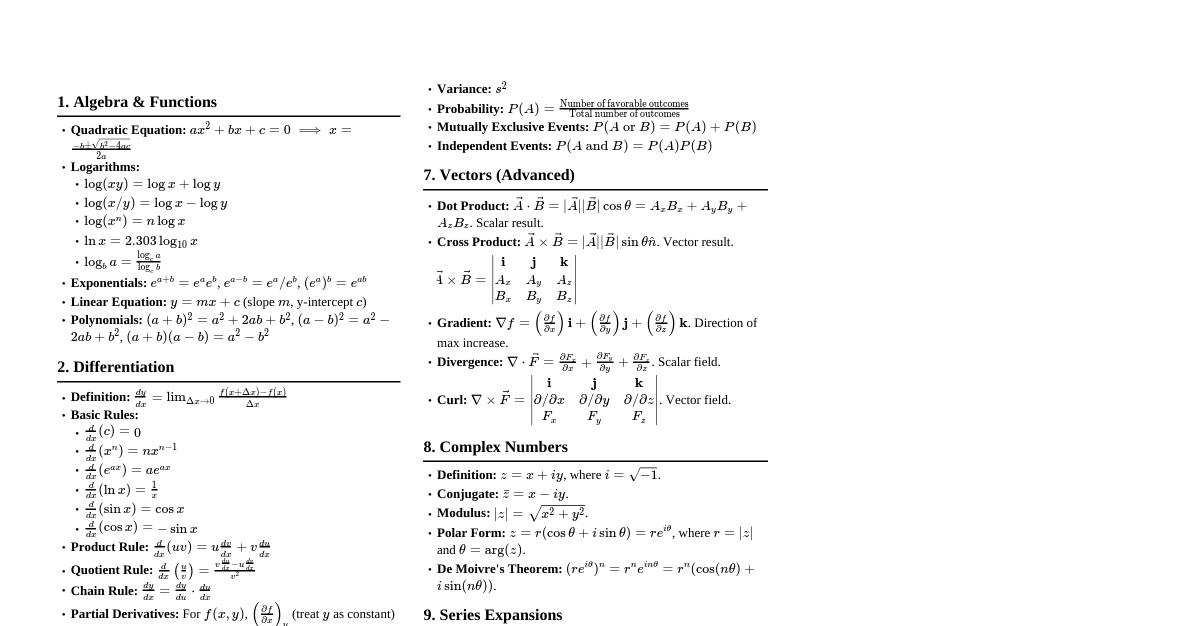
Math Overview
Shared 5/18/2026•11 views
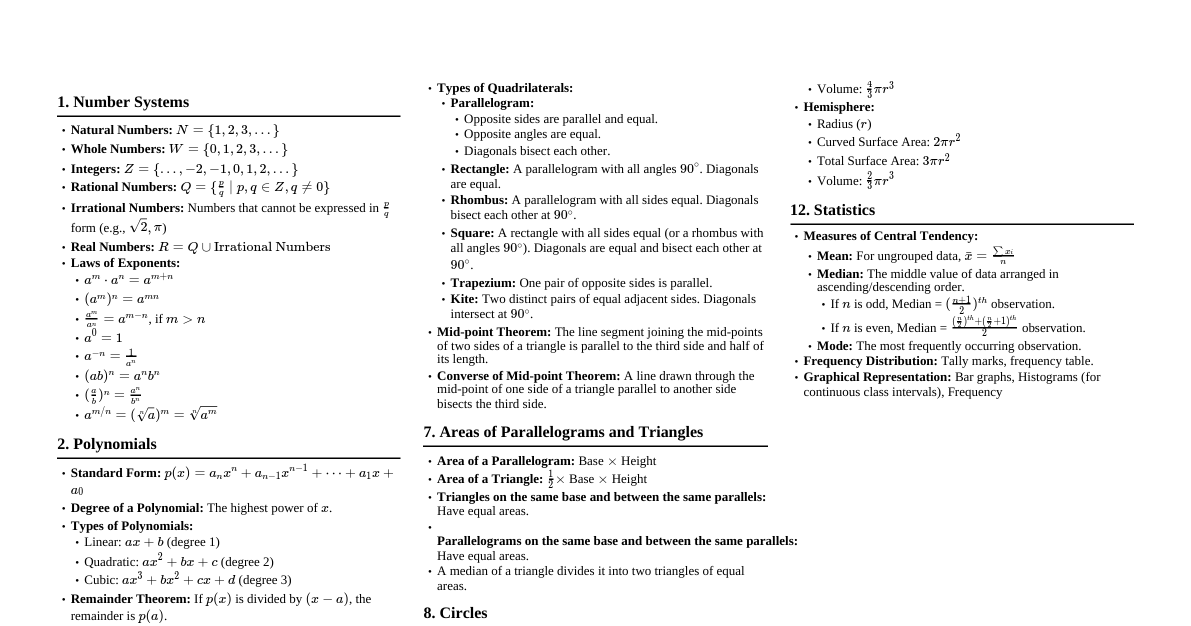
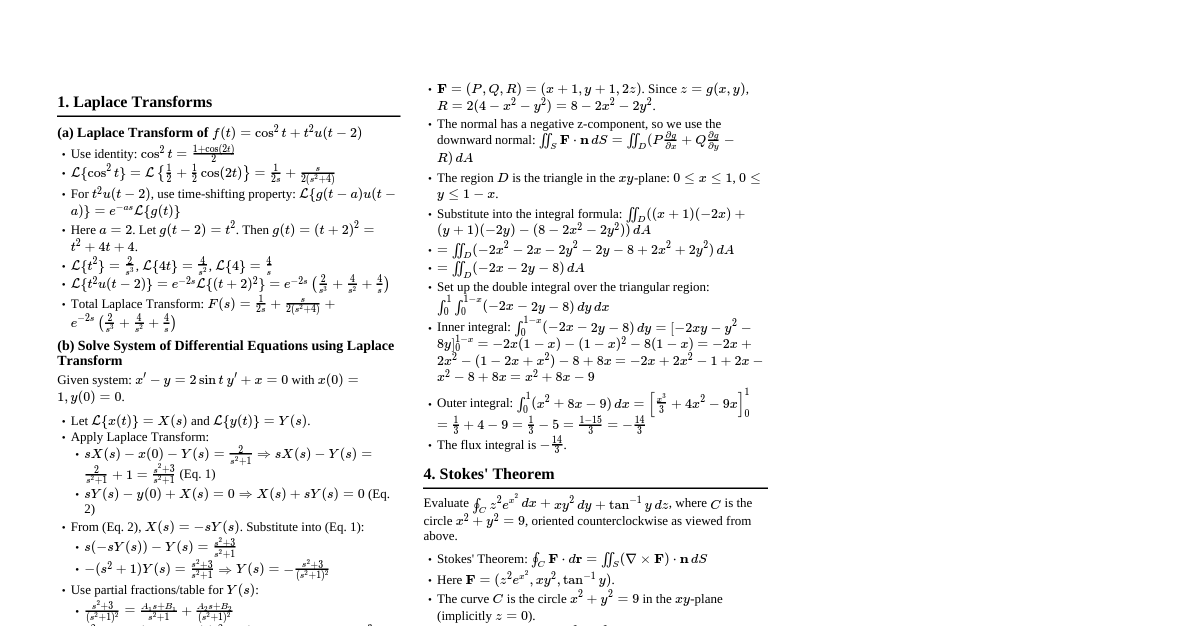
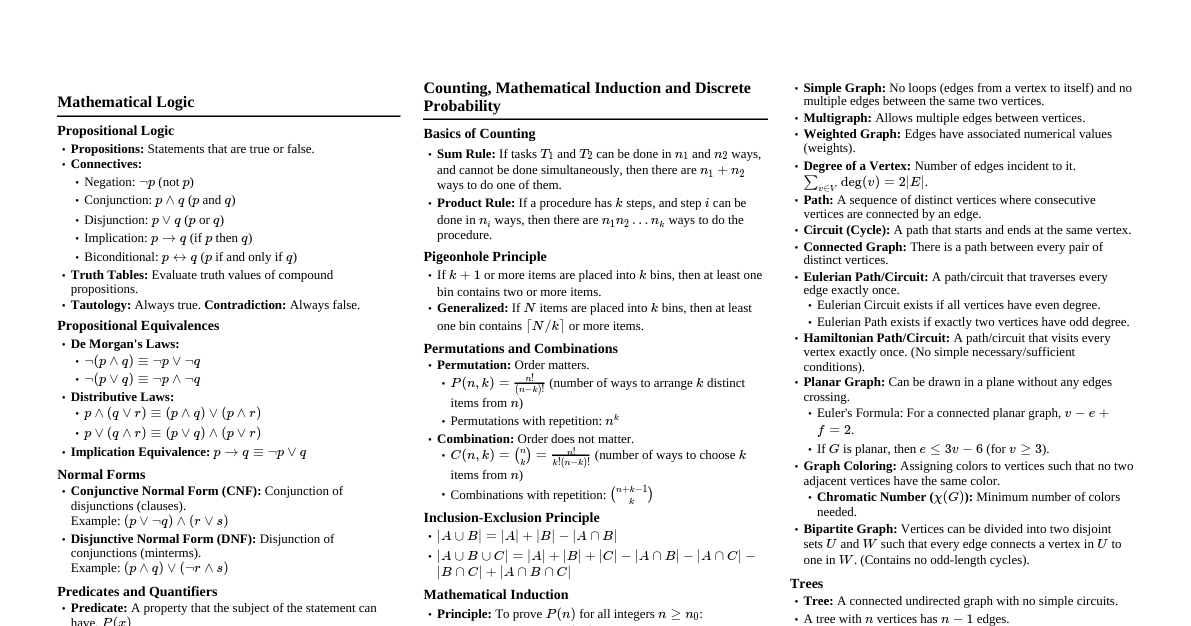
### How to Use This Reference System This system is organized into Tiers, then Topics, and finally into three essential sheets for each topic: - **Concept Sheet:** Definitions, intuition, relationships, theoretical understanding, vocabulary. - **Formula Sheet:** Equations, identities, theorems, transform rules, standard forms. - **Problem-Solving Sheet:** Techniques, recognition patterns, problem workflows, common traps, strategy. --- ### TIER 1 — FOUNDATIONAL MATHEMATICS *The core engine of everything else.* #### 1. Precalculus Foundations - Concept Sheet - **Real number system:** Natural, integers, rational, irrational, real numbers. - **Function behavior:** Domain, range, injectivity, surjectivity, bijectivity, inverse functions. - **Coordinate systems:** Cartesian (2D, 3D), polar, spherical, cylindrical. - **Geometric interpretation:** Shapes, angles, distances, transformations. - **Trigonometric relationships:** Angles, sides of triangles, unit circle, periodic nature. #### 1. Precalculus Foundations - Formula Sheet - **Distance Formula (2D):** $D = \sqrt{(x_2-x_1)^2 + (y_2-y_1)^2}$. - **Midpoint Formula (2D):** $M = \left(\frac{x_1+x_2}{2}, \frac{y_1+y_2}{2}\right)$. - **Function Transformations:** - Vertical shift: $f(x) + c$. - Horizontal shift: $f(x-c)$. - Vertical stretch/compress: $cf(x)$. - Horizontal stretch/compress: $f(cx)$. - Reflection: $-f(x)$ (over x-axis), $f(-x)$ (over y-axis). - **Trig Identities:** - Pythagorean: $\sin^2\theta + \cos^2\theta = 1$, $\tan^2\theta + 1 = \sec^2\theta$, $1 + \cot^2\theta = \csc^2\theta$. - Double Angle: $\sin(2\theta) = 2\sin\theta\cos\theta$, $\cos(2\theta) = \cos^2\theta - \sin^2\theta = 2\cos^2\theta - 1 = 1 - 2\sin^2\theta$. - Sum/Difference: $\sin(A \pm B) = \sin A \cos B \pm \cos A \sin B$, $\cos(A \pm B) = \cos A \cos B \mp \sin A \sin B$. - **Quadratic Formula:** For $ax^2+bx+c=0$, $x = \frac{-b \pm \sqrt{b^2-4ac}}{2a}$. - **Logarithm Properties:** $\log_b(xy) = \log_b x + \log_b y$, $\log_b(x/y) = \log_b x - \log_b y$, $\log_b(x^p) = p \log_b x$. #### 1. Precalculus Foundations - Problem-Solving Sheet - **Factoring strategies:** Common factor, grouping, difference of squares, sum/difference of cubes, quadratic trinomials. - **Graph recognition:** Identifying parent functions (linear, quadratic, exponential, log, trig) and transformations. - **Solving trig equations:** Using identities, unit circle, inverse trig functions, general solutions. - **Conic classification:** Identifying parabola, ellipse, hyperbola, circle from general equation $Ax^2+Bxy+Cy^2+Dx+Ey+F=0$. - **Function transformations:** Systematically applying shifts, stretches, reflections to sketch graphs. #### 2. Vectors - Concept Sheet - **Magnitude:** The length of a vector. - **Direction:** The orientation of a vector in space. - **Vector spaces:** Collections of vectors that can be added and scaled, satisfying certain axioms. - **Linear combination:** Expressing a vector as a sum of scaled vectors. - **Span:** The set of all linear combinations of a set of vectors. #### 2. Vectors - Formula Sheet - **Vector components:** $\vec{v} = \langle v_x, v_y, v_z \rangle = v_x\mathbf{i} + v_y\mathbf{j} + v_z\mathbf{k}$. - **Magnitude:** $|\vec{v}| = \sqrt{v_x^2 + v_y^2 + v_z^2}$. - **Unit Vector:** $\hat{u} = \frac{\vec{v}}{|\vec{v}|}$. - **Dot Product:** $\vec{a} \cdot \vec{b} = a_x b_x + a_y b_y + a_z b_z = |\vec{a}||\vec{b}|\cos\theta$. - **Cross Product (3D):** $\vec{a} \times \vec{b} = \begin{vmatrix} \mathbf{i} & \mathbf{j} & \mathbf{k} \\ a_x & a_y & a_z \\ b_x & b_y & b_z \end{vmatrix}$. - **Vector Projection:** $\text{proj}_{\vec{b}} \vec{a} = \frac{\vec{a} \cdot \vec{b}}{|\vec{b}|^2} \vec{b}$. - **Angle between vectors:** $\cos\theta = \frac{\vec{a} \cdot \vec{b}}{|\vec{a}||\vec{b}|}$. #### 2. Vectors - Problem-Solving Sheet - **Angle finding:** Using the dot product formula to find the angle between two vectors. - **Orthogonality tests:** Checking if $\vec{a} \cdot \vec{b} = 0$. - **Geometric applications:** Calculating areas of parallelograms (using cross product magnitude), volumes of parallelepipeds (using scalar triple product), finding equations of lines and planes. - **Determining parallelism:** Checking if $\vec{a} = c\vec{b}$ for some scalar $c$. #### 3. Matrices & Linear Algebra - Concept Sheet - **Linear transformations:** Functions that preserve vector addition and scalar multiplication. Represented by matrices. - **Span:** The set of all possible linear combinations of a set of vectors. - **Basis:** A linearly independent set of vectors that spans a vector space. - **Dimension:** The number of vectors in a basis for a vector space. - **Eigenvalues/Eigenvectors:** Special vectors that are only scaled by a linear transformation. #### 3. Matrices & Linear Algebra - Formula Sheet - **Matrix multiplication:** $(AB)_{ij} = \sum_k A_{ik}B_{kj}$. - **Determinant ($2 \times 2$):** $\det \begin{pmatrix} a & b \\ c & d \end{pmatrix} = ad - bc$. - **Matrix Inverse ($2 \times 2$):** $A^{-1} = \frac{1}{\det(A)} \begin{pmatrix} d & -b \\ -c & a \end{pmatrix}$. - **Eigenvalue equation:** $A\vec{v} = \lambda\vec{v}$. - **Characteristic equation:** $\det(A - \lambda I) = 0$. - **Rank-Nullity Theorem:** $\text{rank}(A) + \text{nullity}(A) = \text{number of columns}$. #### 3. Matrices & Linear Algebra - Problem-Solving Sheet - **Row reduction (Gaussian/Gauss-Jordan elimination):** Solving systems of linear equations, finding matrix inverses, determining rank. - **Diagonalization:** Finding $P$ and $D$ such that $A = PDP^{-1}$ where $D$ is a diagonal matrix of eigenvalues. - **Solving systems of linear equations:** Using matrix inverse, Cramer's rule, augmented matrices. - **Finding basis for null space and column space:** From row echelon form. #### 4. Combinatorics - Concept Sheet - **Counting principles:** Fundamental principle of counting (multiplication rule). - **Arrangements:** Order matters (permutations). - **Selection logic:** Order does not matter (combinations). - **Inclusion-Exclusion Principle:** For counting elements in the union of sets. #### 4. Combinatorics - Formula Sheet - **Factorials:** $n! = n \times (n-1) \times \dots \times 1$. $0! = 1$. - **Permutations (of $k$ items from $n$):** $P(n,k) = \frac{n!}{(n-k)!}$. - **Combinations (of $k$ items from $n$):** $C(n,k) = \binom{n}{k} = \frac{n!}{k!(n-k)!}$. - **Binomial Theorem:** $(x+y)^n = \sum_{k=0}^n \binom{n}{k} x^{n-k} y^k$. - **Inclusion-Exclusion (for 2 sets):** $|A \cup B| = |A| + |B| - |A \cap B|$. #### 4. Combinatorics - Problem-Solving Sheet - **Overcounting:** Identifying and correcting for situations where arrangements are counted multiple times. - **Cases:** Breaking down a complex counting problem into simpler, disjoint cases. - **Inclusion-Exclusion:** Applying the principle to count elements satisfying at least one of several properties. - **Decision trees:** Visualizing sequences of choices. #### 5. Probability & Statistics - Concept Sheet - **Randomness:** Unpredictable outcomes of an event. - **Distributions:** How probabilities are spread over possible outcomes (e.g., discrete, continuous). - **Statistical inference:** Drawing conclusions about a population from a sample. - **Events:** Subsets of a sample space. - **Independence:** The outcome of one event does not affect the outcome of another. #### 5. Probability & Statistics - Formula Sheet - **Basic Probability:** $P(E) = \frac{\text{Number of favorable outcomes}}{\text{Total number of possible outcomes}}$. - **Conditional Probability:** $P(A|B) = \frac{P(A \cap B)}{P(B)}$. - **Bayes' Theorem:** $P(A|B) = \frac{P(B|A)P(A)}{P(B)}$. - **Expected Value (Discrete):** $E[X] = \sum x_i P(X=x_i)$. - **Variance (Discrete):** $\text{Var}(X) = E[X^2] - (E[X])^2$. - **Standard Deviation:** $\sigma = \sqrt{\text{Var}(X)}$. - **Binomial Probability:** $P(X=k) = \binom{n}{k} p^k (1-p)^{n-k}$. #### 5. Probability & Statistics - Problem-Solving Sheet - **Distribution selection:** Choosing appropriate probability distributions (e.g., binomial, Poisson, normal) for a given problem. - **Counting-probability connection:** Using combinatorics to determine favorable and total outcomes for probability calculations. - **Hypothesis interpretation:** Understanding null and alternative hypotheses, p-values, and confidence intervals. - **Tree diagrams:** Visualizing sequential events and their probabilities. --- ### TIER 2 — CORE CALCULUS #### 6. Calculus I — Limits & Derivatives - Concept Sheet - **Instantaneous change:** The rate of change at a single point, as opposed to average rate over an interval. - **Continuity:** A function is continuous if its graph can be drawn without lifting the pen. Formal definition: $\lim_{x \to c} f(x) = f(c)$. - **Differentiability:** A function is differentiable at a point if it has a well-defined tangent line at that point (implies continuity, but not vice versa). - **Limit:** The value a function approaches as the input approaches some value. #### 6. Calculus I — Limits & Derivatives - Formula Sheet - **Definition of Derivative:** $f'(x) = \lim_{h \to 0} \frac{f(x+h) - f(x)}{h}$. - **Limit Laws:** Sum, difference, product, quotient, constant multiple, power laws. - **Derivative Rules:** - **Power Rule:** $\frac{d}{dx}[x^n] = nx^{n-1}$. - **Product Rule:** $\frac{d}{dx}[f(x)g(x)] = f'(x)g(x) + f(x)g'(x)$. - **Quotient Rule:** $\frac{d}{dx}\left[\frac{f(x)}{g(x)}\right] = \frac{f'(x)g(x) - f(x)g'(x)}{[g(x)]^2}$. - **Chain Rule:** $\frac{d}{dx}[f(g(x))] = f'(g(x))g'(x)$. - **Derivatives of Trig Functions:** $\frac{d}{dx}[\sin x] = \cos x$, $\frac{d}{dx}[\cos x] = -\sin x$, $\frac{d}{dx}[\tan x] = \sec^2 x$. - **Derivatives of Exponential/Logarithmic Functions:** $\frac{d}{dx}[e^x] = e^x$, $\frac{d}{dx}[\ln x] = \frac{1}{x}$. #### 6. Calculus I — Limits & Derivatives - Problem-Solving Sheet - **Optimization workflow:** 1. Identify quantity to optimize. 2. Write formula for quantity. 3. Express in terms of single variable (using constraints). 4. Find critical points ($f'(x)=0$ or undefined). 5. Use First/Second Derivative Test to classify (max/min). 6. Check endpoints if on a closed interval. - **Related rates setup:** 1. Draw diagram and assign variables. 2. Write equation relating variables. 3. Differentiate implicitly with respect to time ($t$). 4. Substitute known values and solve for unknown rate. - **Curve sketching:** 1. Find intercepts. 2. Find asymptotes (vertical, horizontal, slant). 3. Find $f'(x)$ for increasing/decreasing intervals and local extrema. 4. Find $f''(x)$ for concavity and inflection points. 5. Plot points and sketch. #### 7. Applications of Derivatives - Concept Sheet - **Physical interpretation:** Derivatives represent rates of change in physical systems (e.g., velocity, acceleration). - **Motion:** Describing position, velocity, and acceleration of objects. - **Approximation:** Using derivatives to estimate function values (linearization). - **Extrema:** Local and global maximum/minimum values of a function. #### 7. Applications of Derivatives - Formula Sheet - **Velocity from position:** $v(t) = s'(t) = \frac{ds}{dt}$. - **Acceleration from velocity:** $a(t) = v'(t) = s''(t) = \frac{dv}{dt}$. - **Linearization (Tangent Line Approximation):** $L(x) = f(a) + f'(a)(x-a)$. - **Mean Value Theorem:** If $f$ is continuous on $[a,b]$ and differentiable on $(a,b)$, then there exists a $c$ in $(a,b)$ such that $f'(c) = \frac{f(b) - f(a)}{b-a}$. #### 7. Applications of Derivatives - Problem-Solving Sheet - **Max/min problems:** Setting derivative to zero, using First/Second Derivative Tests. - **Motion analysis:** Interpreting signs of velocity and acceleration, finding displacement and total distance. - **Tangent line construction:** Finding $f'(a)$ and using point-slope form. - **L'Hôpital's Rule:** For indeterminate forms $\frac{0}{0}$ or $\frac{\infty}{\infty}$, $\lim_{x \to c} \frac{f(x)}{g(x)} = \lim_{x \to c} \frac{f'(x)}{g'(x)}$. #### 8. Calculus II — Integrals - Concept Sheet - **Accumulation:** Integrals represent the total change or accumulation of a quantity. - **Area:** The definite integral can represent the area under a curve. - **Antiderivatives:** The reverse process of differentiation. - **Riemann Sums:** Approximating area under a curve using rectangles. #### 8. Calculus II — Integrals - Formula Sheet - **Indefinite Integral:** $\int f(x) dx = F(x) + C$ where $F'(x) = f(x)$. - **Power Rule for Integrals:** $\int x^n dx = \frac{x^{n+1}}{n+1} + C$ for $n \ne -1$. - **Integral of $\frac{1}{x}$:** $\int \frac{1}{x} dx = \ln|x| + C$. - **Fundamental Theorem of Calculus (FTC) Part 1:** $\frac{d}{dx} \int_a^x f(t) dt = f(x)$. - **Fundamental Theorem of Calculus (FTC) Part 2:** $\int_a^b f(x) dx = F(b) - F(a)$. - **Integration by Parts:** $\int u dv = uv - \int v du$. #### 8. Calculus II — Integrals - Problem-Solving Sheet - **U-substitution recognition:** Identifying appropriate $u$ and $du$ for composite functions. - **Integration by Parts selection (LIATE/ILATE):** - **L**ogarithmic - **I**nverse Trig - **A**lgebraic - **T**rigonometric - **E**xponential - Choose $u$ higher on the list. - **Partial fraction decomposition:** For rational functions, breaking into simpler fractions for integration. - **Trig Substitution:** Choosing $x = a\sin\theta$, $x = a\tan\theta$, or $x = a\sec\theta$ based on integrand form ($\sqrt{a^2-x^2}$, $\sqrt{a^2+x^2}$, $\sqrt{x^2-a^2}$). #### 9. Applications of Integrals - Concept Sheet - **Continuous accumulation:** Summing infinitesimal parts over a continuous range. - **Geometric measurement:** Calculating areas, volumes, arc lengths, surface areas of revolution. - **Average value:** The mean height of a function over an interval. #### 9. Applications of Integrals - Formula Sheet - **Area between curves:** $\int_a^b [f(x) - g(x)] dx$ (if $f(x) \ge g(x)$). - **Volume by Disk Method:** $V = \pi \int_a^b [R(x)]^2 dx$. - **Volume by Washer Method:** $V = \pi \int_a^b ([R(x)]^2 - [r(x)]^2) dx$. - **Volume by Shell Method:** $V = 2\pi \int_a^b (\text{radius})(\text{height}) dx$. - **Arc Length:** $L = \int_a^b \sqrt{1 + [f'(x)]^2} dx$ or $L = \int_c^d \sqrt{1 + [g'(y)]^2} dy$. - **Average Value of a Function:** $f_{avg} = \frac{1}{b-a} \int_a^b f(x) dx$. #### 9. Applications of Integrals - Problem-Solving Sheet - **Choosing disk/shell methods:** - **Disk/Washer:** When revolving around an axis parallel to the integration variable (e.g., $dx$ and revolving around x-axis). - **Shell:** When revolving around an axis perpendicular to the integration variable (e.g., $dx$ and revolving around y-axis). - **Region setup:** Carefully drawing the region, identifying upper/lower or right/left bounds, and intersection points. - **Bounds interpretation:** Correctly setting the limits of integration based on the problem's context. - **Setting up improper integrals:** Recognizing infinite limits or discontinuities and using limits for evaluation. #### 10. Series & Sequences - Concept Sheet - **Convergence:** A sequence or series approaches a finite value. - **Divergence:** A sequence or series does not approach a finite value. - **Infinite approximation:** Using infinite series to represent and approximate functions. - **Radius of Convergence:** The range of $x$ values for which a power series converges. #### 10. Series & Sequences - Formula Sheet - **Geometric Series:** $\sum_{n=0}^\infty ar^n = \frac{a}{1-r}$ for $|r| 1$, diverges if $p \le 1$. - **Ratio Test:** $\lim_{n \to \infty} \left|\frac{a_{n+1}}{a_n}\right| = L$. Converges if $L 1$, inconclusive if $L = 1$. - **Root Test:** $\lim_{n \to \infty} \sqrt[n]{|a_n|} = L$. Same conclusions as Ratio Test. - **Taylor Series (centered at $a$):** $f(x) = \sum_{n=0}^\infty \frac{f^{(n)}(a)}{n!}(x-a)^n$. - **Maclaurin Series (Taylor series at $a=0$):** $f(x) = \sum_{n=0}^\infty \frac{f^{(n)}(0)}{n!}x^n$. - **Common Maclaurin Series:** - $e^x = \sum_{n=0}^\infty \frac{x^n}{n!}$ - $\sin x = \sum_{n=0}^\infty (-1)^n \frac{x^{2n+1}}{(2n+1)!}$ - $\cos x = \sum_{n=0}^\infty (-1)^n \frac{x^{2n}}{(2n)!}$ - $\frac{1}{1-x} = \sum_{n=0}^\infty x^n$ for $|x| #### 10. Series & Sequences - Problem-Solving Sheet - **Test selection:** Choosing the appropriate convergence test (Divergence, Integral, Comparison, Limit Comparison, Alternating Series, Ratio, Root) based on the series structure. - **Radius of convergence:** Using the Ratio Test or Root Test to find $R$ and the interval of convergence. - **Approximation strategy:** Using Taylor polynomials to approximate function values or definite integrals. - **Manipulating series:** Differentiating, integrating, or substituting into known power series to find new series representations. --- ### TIER 3 — ADVANCED CALCULUS & ANALYSIS #### 11. Multivariable Calculus - Concept Sheet - **Functions of many variables:** Functions where the input is a vector (e.g., $f(x,y)$, $f(x,y,z)$). - **Partial derivatives:** Rate of change with respect to one variable, holding others constant. - **Vector fields:** Assigning a vector to each point in space. - **Level curves/surfaces:** Sets of points where a multivariable function has a constant value. #### 11. Multivariable Calculus - Formula Sheet - **Partial Derivatives:** $\frac{\partial f}{\partial x}$, $\frac{\partial f}{\partial y}$. - **Gradient:** $\nabla f = \langle \frac{\partial f}{\partial x}, \frac{\partial f}{\partial y}, \frac{\partial f}{\partial z} \rangle$. Points in direction of steepest ascent. - **Directional Derivative:** $D_{\mathbf{u}}f = \nabla f \cdot \mathbf{u}$. - **Jacobian Matrix:** For $\mathbf{f}(\mathbf{x}) = \langle f_1(\mathbf{x}), \dots, f_m(\mathbf{x}) \rangle$, $J_{ij} = \frac{\partial f_i}{\partial x_j}$. - **Double Integral (Cartesian):** $\iint_R f(x,y) dA$. - **Double Integral (Polar):** $\iint_R f(r\cos\theta, r\sin\theta) r dr d\theta$. - **Triple Integral (Cartesian):** $\iiint_D f(x,y,z) dV$. - **Triple Integral (Cylindrical):** $\iiint_D f(r\cos\theta, r\sin\theta, z) r dz dr d\theta$. - **Triple Integral (Spherical):** $\iiint_D f(\rho\sin\phi\cos\theta, \rho\sin\phi\sin\theta, \rho\cos\phi) \rho^2\sin\phi d\rho d\phi d\theta$. #### 11. Multivariable Calculus - Problem-Solving Sheet - **Coordinate changes:** Transforming integrals and derivatives between Cartesian, polar, cylindrical, and spherical coordinates. - **Gradient interpretation:** Finding directions of maximum increase/decrease, normal vectors to level surfaces. - **Optimization constraints (Lagrange Multipliers):** Finding extrema of $f(x,y,z)$ subject to $g(x,y,z)=c$. Solve $\nabla f = \lambda \nabla g$. - **Finding critical points:** Setting partial derivatives to zero for multivariable optimization. #### 12. Vector Calculus - Concept Sheet - **Flux:** The flow of a vector field through a surface. - **Circulation:** The tendency of a vector field to rotate around a curve. - **Conservative fields:** Vector fields that are gradients of scalar functions (path independent). - **Divergence:** Measures the outward flux per unit volume. - **Curl:** Measures the rotation or circulation per unit area. #### 12. Vector Calculus - Formula Sheet - **Gradient:** $\nabla f = \langle \frac{\partial f}{\partial x}, \frac{\partial f}{\partial y}, \frac{\partial f}{\partial z} \rangle$. - **Divergence:** $\nabla \cdot \mathbf{F} = \frac{\partial F_1}{\partial x} + \frac{\partial F_2}{\partial y} + \frac{\partial F_3}{\partial z}$. - **Curl:** $\nabla \times \mathbf{F} = \begin{vmatrix} \mathbf{i} & \mathbf{j} & \mathbf{k} \\ \partial/\partial x & \partial/\partial y & \partial/\partial z \\ F_1 & F_2 & F_3 \end{vmatrix}$. - **Line Integral (scalar field):** $\int_C f(x,y,z) ds$. - **Line Integral (vector field):** $\int_C \mathbf{F} \cdot d\mathbf{r} = \int_C (F_1 dx + F_2 dy + F_3 dz)$. - **Green's Theorem:** $\oint_C (P dx + Q dy) = \iint_R \left(\frac{\partial Q}{\partial x} - \frac{\partial P}{\partial y}\right) dA$. - **Stokes' Theorem:** $\oint_C \mathbf{F} \cdot d\mathbf{r} = \iint_S (\nabla \times \mathbf{F}) \cdot d\mathbf{S}$. - **Divergence Theorem (Gauss's Theorem):** $\iint_S \mathbf{F} \cdot d\mathbf{S} = \iiint_E (\nabla \cdot \mathbf{F}) dV$. #### 12. Vector Calculus - Problem-Solving Sheet - **Line integrals:** Parameterizing curves, evaluating work done by force fields. - **Surface integrals:** Parameterizing surfaces, calculating flux through surfaces. - **Green/Stokes/Gauss usage:** Choosing the appropriate theorem to simplify calculations of line/surface integrals by converting them to double/triple integrals, or vice versa. - **Testing for conservative fields:** Checking if $\nabla \times \mathbf{F} = \mathbf{0}$ (in 3D simply connected domains) or $\frac{\partial P}{\partial y} = \frac{\partial Q}{\partial x}$ (in 2D). #### 13. Differential Equations - Concept Sheet - **Dynamic systems:** Mathematical models describing how quantities change over time. - **Continuous modeling:** Using differential equations to represent continuous processes. - **Order:** The highest derivative present in the equation. - **Linearity:** An equation is linear if the dependent variable and its derivatives appear only to the first power and are not multiplied together. #### 13. Differential Equations - Formula Sheet - **Separable Equations:** $\frac{dy}{dx} = g(x)h(y) \implies \int \frac{1}{h(y)} dy = \int g(x) dx$. - **First-Order Linear DE:** $\frac{dy}{dx} + P(x)y = Q(x)$. Integrating factor $e^{\int P(x) dx}$. - **Homogeneous Second-Order Linear DE with Constant Coefficients:** $ay'' + by' + cy = 0$. Characteristic equation $ar^2+br+c=0$. - Real distinct roots: $y = C_1e^{r_1 x} + C_2e^{r_2 x}$. - Real repeated roots: $y = C_1e^{rx} + C_2xe^{rx}$. - Complex conjugate roots: $y = e^{\alpha x}(C_1\cos(\beta x) + C_2\sin(\beta x))$. - **Undetermined Coefficients:** Method for non-homogeneous linear DEs ($ay'' + by' + cy = G(x)$). #### 13. Differential Equations - Problem-Solving Sheet - **ODE classification:** Identifying order, linearity, homogeneity to choose appropriate solution method. - **Integrating factors:** Applying the method for first-order linear equations. - **Initial value problems (IVPs):** Using initial conditions to find specific solutions (values of constants). - **Solving exact equations:** Checking if $\frac{\partial M}{\partial y} = \frac{\partial N}{\partial x}$ for $M(x,y)dx + N(x,y)dy = 0$. - **Variation of Parameters:** Method for non-homogeneous linear DEs when undetermined coefficients is not applicable. #### 14. PDEs - Concept Sheet - **Multi-variable change systems:** Describing phenomena that vary with multiple independent variables (e.g., space and time). - **Boundary conditions:** Conditions specified at the boundaries of a spatial domain. - **Initial conditions:** Conditions specified at the initial time. #### 14. PDEs - Formula Sheet - **Heat Equation (1D):** $\frac{\partial u}{\partial t} = k \frac{\partial^2 u}{\partial x^2}$. - **Wave Equation (1D):** $\frac{\partial^2 u}{\partial t^2} = c^2 \frac{\partial^2 u}{\partial x^2}$. - **Laplace's Equation (2D):** $\frac{\partial^2 u}{\partial x^2} + \frac{\partial^2 u}{\partial y^2} = 0$. (Also $\nabla^2 u = 0$). #### 14. PDEs - Problem-Solving Sheet - **Boundary conditions:** Applying Dirichlet (fixed value), Neumann (fixed derivative/flux), or Robin conditions. - **Separation of variables:** Assuming a solution of the form $u(x,t) = X(x)T(t)$ to convert a PDE into a system of ODEs. - **Fourier series/transforms:** Using these to represent initial conditions and solve PDEs. #### 15. Real Analysis - Concept Sheet - **Rigorous foundations of calculus:** Formal definitions and proofs for concepts like limits, continuity, derivatives, integrals. - **Sequences and series:** Deep dive into convergence, uniform convergence. - **Topology of real numbers:** Open sets, closed sets, compact sets, connectedness. - **Measure theory:** Generalization of length, area, volume. #### 15. Real Analysis - Formula Sheet - **Epsilon-Delta Definition of Limit:** $\lim_{x \to c} f(x) = L$ if for every $\epsilon > 0$, there exists a $\delta > 0$ such that if $0 0$, there exists an integer $N$ such that if $n > N$, then $|a_n - L| #### 15. Real Analysis - Problem-Solving Sheet - **Proof construction:** Developing rigorous mathematical proofs for theorems related to limits, continuity, differentiation, and integration. - **Limit rigor:** Applying $\epsilon-\delta$ and $\epsilon-N$ definitions to prove limits. - **Sequence arguments:** Proving convergence or divergence of sequences using formal definitions and theorems. - **Testing for uniform continuity/convergence:** Applying specific criteria to determine uniform properties. #### 16. Complex Analysis - Concept Sheet - **Analytic functions:** Functions that are complex differentiable in an open set. - **Complex integration:** Integration along paths in the complex plane. - **Residues:** Coefficients in Laurent series expansions, crucial for complex integration. - **Conformal mappings:** Transformations that preserve angles. #### 16. Complex Analysis - Formula Sheet - **Complex Number:** $z = x + iy = re^{i\theta}$. - **Cauchy-Riemann Equations:** For $f(z) = u(x,y) + iv(x,y)$ to be analytic, $\frac{\partial u}{\partial x} = \frac{\partial v}{\partial y}$ and $\frac{\partial u}{\partial y} = -\frac{\partial v}{\partial x}$. - **Cauchy's Integral Theorem:** If $f(z)$ is analytic inside and on a simple closed contour $C$, then $\oint_C f(z) dz = 0$. - **Cauchy's Integral Formula:** If $f(z)$ is analytic inside and on $C$, then $f(z_0) = \frac{1}{2\pi i} \oint_C \frac{f(z)}{z-z_0} dz$. - **Residue Theorem:** $\oint_C f(z) dz = 2\pi i \sum (\text{residues of } f(z) \text{ inside } C)$. - **Laurent Series (for $0 #### 16. Complex Analysis - Problem-Solving Sheet - **Contour integration:** Choosing appropriate contours (e.g., semicircular, rectangular) to evaluate real integrals using complex methods. - **Pole classification:** Identifying simple poles, poles of order $m$, essential singularities. - **Finding residues:** Using formulas for simple poles, or Laurent series expansion. - **Applying Cauchy-Riemann equations:** Testing for analyticity. --- ### TIER 4 — PURE MATHEMATICS #### 17. Number Theory - Concept Sheet - **Divisibility:** Properties of integers related to division. - **Modular systems:** Arithmetic with remainders. - **Prime numbers:** Integers greater than 1 with only two divisors: 1 and itself. - **Congruence:** $a \equiv b \pmod n$ means $n$ divides $a-b$. #### 17. Number Theory - Formula Sheet - **Euclidean Algorithm:** For finding greatest common divisor (GCD). - **Bezout's Identity:** If $d = \text{gcd}(a,b)$, then there exist integers $x,y$ such that $ax+by=d$. - **Euler's Totient Function:** $\phi(n)$ counts positive integers up to $n$ that are relatively prime to $n$. - **Euler's Theorem:** If $\text{gcd}(a,n)=1$, then $a^{\phi(n)} \equiv 1 \pmod n$. - **Fermat's Little Theorem:** If $p$ is a prime, then $a^p \equiv a \pmod p$. If $p \nmid a$, then $a^{p-1} \equiv 1 \pmod p$. - **Chinese Remainder Theorem (CRT):** Solving systems of congruences. #### 17. Number Theory - Problem-Solving Sheet - **Modular inverses:** Finding $x$ such that $ax \equiv 1 \pmod n$. - **Congruence solving:** Using properties of modular arithmetic to solve linear congruences. - **Prime factorization:** Decomposing integers into their prime components. - **Applying Euclidean Algorithm:** Finding GCD and expressing it as a linear combination. #### 18. Discrete Mathematics - Concept Sheet - **Logic systems:** Propositional and predicate logic, truth values, logical equivalences. - **Graph structures:** Vertices and edges, representing relationships. - **Set theory:** Operations on sets (union, intersection, complement). - **Proof techniques:** Induction, contradiction, direct proof. #### 18. Discrete Mathematics - Formula Sheet - **Combinatorics formulas:** Factorials, permutations, combinations (as in Tier 1). - **Recurrence Relations:** E.g., Fibonacci sequence $F_n = F_{n-1} + F_{n-2}$. - **Pigeonhole Principle:** If $n$ items are put into $m$ containers, with $n > m$, then at least one container must contain more than one item. - **Graph Theory (Eulerian Path/Circuit):** - Eulerian circuit exists if all vertices have even degree. - Eulerian path exists if exactly two vertices have odd degree. #### 18. Discrete Mathematics - Problem-Solving Sheet - **Proof by induction:** Proving statements for all natural numbers. - **Truth-table analysis:** Evaluating logical expressions and determining validity of arguments. - **Graph traversal algorithms:** Depth-First Search (DFS), Breadth-First Search (BFS). - **Solving recurrence relations:** Iteration, characteristic equation method. #### 19. Abstract Algebra - Concept Sheet - **Groups:** Sets with a binary operation satisfying closure, associativity, identity, and inverses. - **Rings:** Sets with two binary operations (usually called addition and multiplication) satisfying certain axioms. - **Fields:** Rings where non-zero elements have multiplicative inverses. - **Homomorphisms/Isomorphisms:** Structure-preserving maps between algebraic structures. #### 19. Abstract Algebra - Formula Sheet - **Group Axioms:** 1. Closure: $a \cdot b \in G$. 2. Associativity: $(a \cdot b) \cdot c = a \cdot (b \cdot c)$. 3. Identity: $e \cdot a = a \cdot e = a$. 4. Inverse: $a \cdot a^{-1} = a^{-1} \cdot a = e$. - **Lagrange's Theorem:** If $H$ is a subgroup of a finite group $G$, then $|H|$ divides $|G|$. - **Cayley's Theorem:** Every group is isomorphic to a subgroup of a permutation group. - **First Isomorphism Theorem:** If $\phi: G \to H$ is a group homomorphism, then $G/\text{ker}(\phi) \cong \text{Im}(\phi)$. #### 19. Abstract Algebra - Problem-Solving Sheet - **Subgroup tests:** Checking if a subset forms a subgroup. - **Isomorphism reasoning:** Establishing bijections and checking if they preserve operations. - **Identifying group properties:** Commutativity, cyclic nature, order of elements. - **Quotient groups:** Constructing and understanding factor groups. #### 20. Topology - Concept Sheet - **Continuity of spaces:** Generalizing the concept of continuity from real analysis to topological spaces. - **Connectedness:** A space cannot be divided into two disjoint non-empty open sets. - **Compactness:** Every open cover has a finite subcover. - **Homeomorphism:** A continuous bijection with a continuous inverse (topological equivalence). #### 20. Topology - Formula Sheet - **Open Set Definition:** A set $U$ is open if for every point $x \in U$, there exists an open ball (or basis element) containing $x$ and contained in $U$. - **Continuity (Topological):** A function $f: X \to Y$ is continuous if for every open set $V \subseteq Y$, $f^{-1}(V)$ is open in $X$. - **Product Topology:** Definition of open sets in a product space. #### 20. Topology - Problem-Solving Sheet - **Open/closed set analysis:** Determining if sets are open, closed, neither, or both in a given topology. - **Constructing continuous functions:** Verifying the topological definition of continuity. - **Proving connectedness/compactness:** Using definitions and theorems (e.g., for compactness, showing existence of finite subcovers). - **Identifying homeomorphisms:** Demonstrating that two spaces are topologically equivalent. --- ### TIER 5 — GEOMETRY & PHYSICS MATHEMATICS #### 21. Tensor Calculus & Differential Geometry - Concept Sheet - **Curvature:** A measure of how much a geometric object deviates from being flat. - **Manifolds:** Spaces that locally resemble Euclidean space. - **Tensors:** Objects that transform in a specific way under coordinate transformations. - **Geodesics:** The "straightest possible paths" in a curved space. #### 21. Tensor Calculus & Differential Geometry - Formula Sheet - **Metric Tensor:** $g_{ij}$ defines distances and angles in a curved space. - **Christoffel Symbols:** $\Gamma^k_{ij} = \frac{1}{2}g^{kl} \left( \frac{\partial g_{il}}{\partial x^j} + \frac{\partial g_{jl}}{\partial x^i} - \frac{\partial g_{ij}}{\partial x^l} \right)$. Used in covariant derivatives. - **Covariant Derivative:** $\nabla_j V^i = \frac{\partial V^i}{\partial x^j} + \Gamma^i_{jk} V^k$. - **Riemann Curvature Tensor:** $R^i_{jkl} = \frac{\partial \Gamma^i_{jl}}{\partial x^k} - \frac{\partial \Gamma^i_{jk}}{\partial x^l} + \Gamma^i_{km}\Gamma^m_{jl} - \Gamma^i_{lm}\Gamma^m_{jk}$. #### 21. Tensor Calculus & Differential Geometry - Problem-Solving Sheet - **Coordinate transformations:** Transforming tensor components between different coordinate systems. - **Calculating Christoffel symbols:** From a given metric tensor. - **Geodesic equations:** Solving differential equations to find geodesics. - **Interpreting curvature:** Relating curvature tensors to the geometry of space (e.g., Einstein's field equations in General Relativity). #### 22. Fractals & Chaos Theory - Concept Sheet - **Self-similarity:** Objects that appear similar at various scales. - **Dynamical instability:** Small changes in initial conditions lead to large differences in outcomes (butterfly effect). - **Attractors:** States towards which a dynamical system evolves over time. - **Fractal dimension:** A non-integer dimension that describes the complexity of a fractal. #### 22. Fractals & Chaos Theory - Formula Sheet - **Hausdorff Dimension:** A formal definition of fractal dimension. - **Box-Counting Dimension:** $D_B = \lim_{\epsilon \to 0} \frac{\log N(\epsilon)}{\log(1/\epsilon)}$, where $N(\epsilon)$ is the number of boxes of side length $\epsilon$ needed to cover the set. - **Logistic Map:** $x_{n+1} = r x_n (1 - x_n)$, a simple model exhibiting chaotic behavior. #### 22. Fractals & Chaos Theory - Problem-Solving Sheet - **Iterative behavior analysis:** Analyzing the long-term behavior of iterated functions (e.g., logistic map, Mandelbrot set). - **Calculating fractal dimensions:** Applying box-counting or other methods to simple fractals. - **Identifying self-similarity:** Recognizing patterns that repeat at different scales. - **Phase space diagrams:** Visualizing the evolution of dynamical systems. --- ### TIER 6 — COMPUTATIONAL & APPLIED MATHEMATICS #### 23. Numerical Methods - Concept Sheet - **Approximation methods:** Using iterative or discrete steps to find approximate solutions to problems that are difficult to solve analytically. - **Error analysis:** Understanding sources of error (round-off, truncation) and how they propagate. - **Convergence:** How quickly and reliably a numerical method approaches the true solution. #### 23. Numerical Methods - Formula Sheet - **Newton's Method (Root Finding):** $x_{n+1} = x_n - \frac{f(x_n)}{f'(x_n)}$. - **Euler's Method (ODE Solving):** $y_{n+1} = y_n + h f(x_n, y_n)$. - **Trapezoidal Rule (Numerical Integration):** $\int_a^b f(x) dx \approx \frac{h}{2} [f(x_0) + 2f(x_1) + \dots + 2f(x_{n-1}) + f(x_n)]$. - **Simpson's Rule (Numerical Integration):** $\int_a^b f(x) dx \approx \frac{h}{3} [f(x_0) + 4f(x_1) + 2f(x_2) + \dots + 4f(x_{n-1}) + f(x_n)]$ (for even $n$). #### 23. Numerical Methods - Problem-Solving Sheet - **Stability analysis:** Determining if a numerical method produces bounded errors or if errors grow uncontrollably. - **Numerical convergence:** Assessing how close the numerical solution is to the true solution as step size decreases or iterations increase. - **Choosing appropriate method:** Selecting the best numerical method for a given problem based on accuracy, stability, and computational cost. - **Implementing algorithms:** Translating numerical methods into code. #### 24. Optimization Theory - Concept Sheet - **Objective functions:** The function to be maximized or minimized. - **Constraints:** Conditions that limit the possible values of the variables. - **Convexity:** Properties of functions and sets that simplify optimization problems. - **Feasible region:** The set of all points that satisfy the constraints. #### 24. Optimization Theory - Formula Sheet - **Lagrange Multipliers:** For optimizing $f(\mathbf{x})$ subject to $g(\mathbf{x})=c$, solve $\nabla f(\mathbf{x}) = \lambda \nabla g(\mathbf{x})$ and $g(\mathbf{x})=c$. - **Gradient Descent (for minimization):** $\mathbf{x}_{k+1} = \mathbf{x}_k - \alpha \nabla f(\mathbf{x}_k)$. - **Karush-Kuhn-Tucker (KKT) Conditions:** Generalization of Lagrange multipliers for inequality constraints. #### 24. Optimization Theory - Problem-Solving Sheet - **Constraint setup:** Formulating real-world problems into mathematical objective functions and constraints. - **Convexity analysis:** Determining if an optimization problem is convex to guarantee global optimality. - **Applying Lagrange multipliers:** Solving constrained optimization problems. - **Interpreting dual variables:** Understanding the sensitivity of the optimal solution to changes in constraints. #### 25. Information Theory - Concept Sheet - **Entropy:** A measure of uncertainty or randomness in a system. - **Information content:** The amount of surprise associated with an event. - **Channel capacity:** The maximum rate at which information can be transmitted reliably over a communication channel. - **Data compression:** Reducing the amount of data needed to represent information. #### 25. Information Theory - Formula Sheet - **Shannon Entropy (for discrete random variable $X$):** $H(X) = -\sum_{i=1}^n P(x_i) \log_b P(x_i)$. - **Joint Entropy:** $H(X,Y)$. - **Conditional Entropy:** $H(X|Y)$. - **Mutual Information:** $I(X;Y) = H(X) - H(X|Y)$. - **Kullback-Leibler (KL) Divergence:** $D_{KL}(P||Q) = \sum P(i) \log \frac{P(i)}{Q(i)}$. #### 25. Information Theory - Problem-Solving Sheet - **Compression reasoning:** Understanding how entropy relates to the theoretical limits of data compression. - **Calculating entropy:** For given probability distributions. - **Channel coding:** Designing codes to transmit information reliably over noisy channels. - **Source coding:** Designing codes to compress data efficiently. #### 26. Fourier & Transform Methods - Concept Sheet - **Frequency decomposition:** Representing complex signals as a sum of simpler sinusoidal components. - **Time domain vs. Frequency domain:** Analyzing signals in terms of time or frequency. - **Transform pairs:** Functions and their corresponding transforms. #### 26. Fourier & Transform Methods - Formula Sheet - **Fourier Series (for periodic $f(x)$ on $[-L,L]$):** $f(x) = a_0 + \sum_{n=1}^\infty (a_n \cos(\frac{n\pi x}{L}) + b_n \sin(\frac{n\pi x}{L}))$. - $a_0 = \frac{1}{2L}\int_{-L}^L f(x) dx$. - $a_n = \frac{1}{L}\int_{-L}^L f(x) \cos(\frac{n\pi x}{L}) dx$. - $b_n = \frac{1}{L}\int_{-L}^L f(x) \sin(\frac{n\pi x}{L}) dx$. - **Fourier Transform:** $\mathcal{F}\{f(t)\} = F(\omega) = \int_{-\infty}^\infty f(t) e^{-i\omega t} dt$. - **Inverse Fourier Transform:** $f(t) = \frac{1}{2\pi} \int_{-\infty}^\infty F(\omega) e^{i\omega t} d\omega$. - **Laplace Transform:** $\mathcal{L}\{f(t)\} = F(s) = \int_0^\infty e^{-st} f(t) dt$. - **Inverse Laplace Transform:** $\mathcal{L}^{-1}\{F(s)\} = f(t)$. #### 26. Fourier & Transform Methods - Problem-Solving Sheet - **Signal decomposition:** Breaking down complex signals into their sinusoidal components using Fourier analysis. - **PDE solving:** Using Laplace or Fourier transforms to convert PDEs into algebraic equations, solve them, and then inverse transform. - **Filtering:** Designing filters in the frequency domain to remove unwanted signal components. - **Convolution Theorem:** Using transforms to simplify convolution operations. #### 27. Advanced Probability Theory - Concept Sheet - **Random processes:** Sequences of random variables indexed by time or space. - **Stochastic systems:** Systems whose future state is not perfectly predictable. - **Martingales:** Stochastic processes where the conditional expectation of the next value, given all past values, is equal to the current value. - **Measure theory basis:** Formal foundation for probability using measure theory. #### 27. Advanced Probability Theory - Formula Sheet - **Markov Chains (Transition Matrix):** $P_{ij} = P(X_{n+1}=j | X_n=i)$. - **Chapman-Kolmogorov Equation:** $P_{ij}^{(n+m)} = \sum_k P_{ik}^{(n)} P_{kj}^{(m)}$. - **Expectation Operator (General):** $E[X] = \int_{-\infty}^\infty x f(x) dx$ (continuous). - **Conditional Expectation:** $E[X|Y]$. - **Law of Total Probability:** $P(A) = \sum_n P(A|B_n)P(B_n)$. #### 27. Advanced Probability Theory - Problem-Solving Sheet - **Process modeling:** Developing stochastic models for real-world phenomena (e.g., stock prices, queuing systems). - **Analyzing Markov chain behavior:** Finding stationary distributions, hitting times. - **Proving convergence of random variables:** Using modes of convergence (e.g., in probability, almost surely, in mean). - **Applying expectation operators:** Calculating expected values for complex random variables. #### 28. Machine Learning Mathematics - Concept Sheet - **Optimization-based learning:** Training models by minimizing a loss function. - **Statistical inference:** Using data to make predictions or decisions. - **Bias-variance trade-off:** Balancing underfitting (high bias) and overfitting (high variance). - **Feature engineering:** Transforming raw data into features suitable for machine learning algorithms. #### 28. Machine Learning Mathematics - Formula Sheet - **Linear Regression (Cost Function):** $J(\theta) = \frac{1}{2m} \sum_{i=1}^m (h_\theta(x^{(i)}) - y^{(i)})^2$. - **Gradient Descent Update Rule:** $\theta_j := \theta_j - \alpha \frac{\partial}{\partial \theta_j} J(\theta)$. - **Sigmoid Function (Logistic Regression):** $\sigma(z) = \frac{1}{1 + e^{-z}}$. - **Cross-Entropy Loss (for binary classification):** $L = -[y \log(\hat{y}) + (1-y) \log(1-\hat{y})]$. - **Backpropagation (Chain Rule for Neural Networks):** $\delta_j^{(l)} = ((W^{(l)})^T \delta^{(l+1)}) \odot \sigma'(z^{(l)})$. - **Softmax Function:** $P(y=k|\mathbf{x}) = \frac{e^{\mathbf{w}_k^T \mathbf{x}}}{\sum_{j=1}^K e^{\mathbf{w}_j^T \mathbf{x}}}$. #### 28. Machine Learning Mathematics - Problem-Solving Sheet - **Model fitting:** Adjusting model parameters to best fit the training data. - **Bias-variance reasoning:** Diagnosing underfitting/overfitting and applying techniques like regularization, more data, or different model complexity. - **Gradient descent:** Implementing and tuning learning rates for optimization algorithms. - **Backpropagation:** Understanding and deriving the gradients for neural network training. - **Evaluating model performance:** Using metrics like accuracy, precision, recall, F1-score, ROC curves.