Basic Chemistry Concepts (NCERT)
Cheatsheet Content
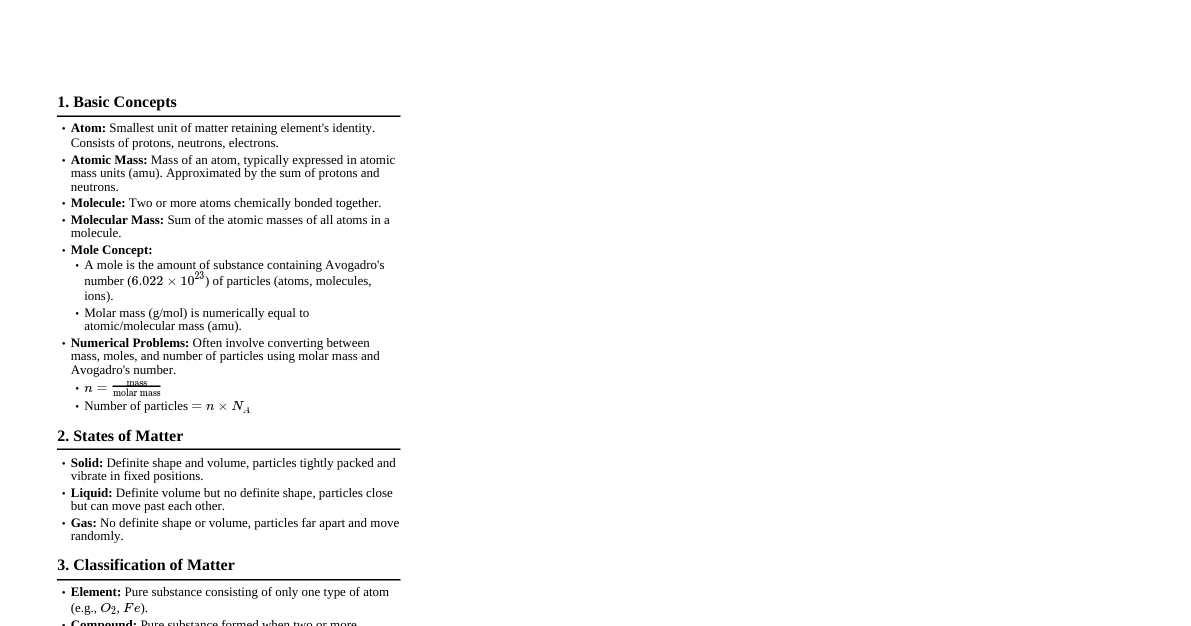
1. Matter and its Classification Matter: Anything that has mass and occupies space. Physical Classification: Solid: Definite volume & shape. Particles closely packed. Liquid: Definite volume, indefinite shape. Particles close but can move. Gas: Indefinite volume & shape. Particles far apart, random motion. Chemical Classification: Pure Substances: Elements: Cannot be broken down further by chemical means (e.g., H, O, Na). Compounds: Formed from two or more elements in a fixed ratio (e.g., $H_2O$, $CO_2$). Properties differ from constituent elements. Mixtures: Two or more substances mixed in any ratio. Homogeneous: Uniform composition throughout (e.g., sugar solution, air). Heterogeneous: Non-uniform composition (e.g., sand & salt, oil & water). 2. Properties of Matter and their Measurement Physical Properties: Can be measured or observed without changing identity (e.g., color, odor, melting point, density). Chemical Properties: Observed during a chemical reaction, leading to change in identity (e.g., acidity, basicity, flammability). SI Units (International System of Units): Base Quantity SI Unit Symbol Length metre m Mass kilogram kg Time second s Electric Current ampere A Temperature kelvin K Amount of Substance mole mol Luminous Intensity candela cd Prefixes used in SI System: Prefix Symbol Multiple giga G $10^9$ mega M $10^6$ kilo k $10^3$ deci d $10^{-1}$ centi c $10^{-2}$ milli m $10^{-3}$ micro $\mu$ $10^{-6}$ nano n $10^{-9}$ pico p $10^{-12}$ Mass vs. Weight: Mass: Amount of matter present in a substance (constant). Weight: Force exerted by gravity on an object (varies). Volume: Space occupied by matter. SI unit $m^3$. Common units: $L$ (liter), $cm^3$, $dm^3$. ($1 L = 1 dm^3 = 1000 cm^3$). Density: Mass per unit volume. $D = \frac{M}{V}$. SI unit $kg \ m^{-3}$. Temperature: Degree of hotness or coldness. Units: Celsius ($^\circ C$), Fahrenheit ($^\circ F$), Kelvin (K). Conversions: $^\circ F = \frac{9}{5}(^\circ C) + 32$; $K = ^\circ C + 273.15$. Significant Figures: Meaningful digits in a measured or calculated quantity. Non-zero digits are significant. Zeros between non-zero digits are significant. Zeros to the left of the first non-zero digit are not significant. Zeros at the end or right of a number are significant if they are on the right side of the decimal point. Exact numbers (e.g., counting objects) have infinite significant figures. Scientific Notation: $N \times 10^n$, where $N$ is a number between 1 and 10. 3. Laws of Chemical Combination Law of Conservation of Mass (Lavoisier): Mass can neither be created nor destroyed in a chemical reaction. Total mass of reactants = Total mass of products. Law of Definite Proportions (Proust): A given chemical compound always contains the same elements in the same proportion by mass, regardless of source. (e.g., $H_2O$ always has H:O ratio of 1:8 by mass). Law of Multiple Proportions (Dalton): If two elements can combine to form more than one compound, the masses of one element that combine with a fixed mass of the other element are in a ratio of small whole numbers. (e.g., $CO$ and $CO_2$). Gay Lussac's Law of Gaseous Volumes: When gases combine or are produced in a chemical reaction, they do so in a simple ratio by volume, provided all gases are at the same temperature and pressure. Avogadro's Law: Equal volumes of all gases at the same temperature and pressure contain equal number of molecules. 4. Dalton's Atomic Theory (1808) Matter consists of indivisible atoms. All atoms of a given element have identical properties, including identical mass. Atoms of different elements differ in mass. Compounds are formed when atoms of different elements combine in a fixed ratio. Chemical reactions involve reorganization of atoms. Atoms are neither created nor destroyed. Limitations: Failed to explain subatomic particles, isotopes, isobars. 5. Atomic and Molecular Masses Atomic Mass Unit (amu or u): Defined as exactly one-twelfth the mass of one atom of carbon-12. $1 \ amu = 1.66056 \times 10^{-24} \ g$. Average Atomic Mass: Weighted average of isotopic masses based on their natural abundance. Average atomic mass $= \sum (\text{fractional abundance of isotope} \times \text{isotopic mass})$ Molecular Mass: Sum of the atomic masses of all atoms in a molecule. Formula Mass: Sum of atomic masses of all ions in a formula unit of an ionic compound. (Used for ionic compounds instead of molecular mass). 6. Mole Concept and Molar Mass Mole: The amount of substance that contains as many elementary entities (atoms, molecules, ions, particles) as there are atoms in exactly 12 g of the carbon-12 isotope. Avogadro's Number ($N_A$): $6.022 \times 10^{23}$ entities per mole. Molar Mass: The mass of one mole of a substance in grams. Numerically equal to atomic/molecular/formula mass in amu. Molar mass of $H_2O = 18.02 \ g/mol$. Calculations: Number of moles ($n$) $= \frac{\text{Mass of substance (g)}}{\text{Molar mass (g/mol)}}$ Number of moles ($n$) $= \frac{\text{Number of particles}}{N_A}$ For gases at STP (Standard Temperature & Pressure: $0^\circ C$ or 273.15 K, 1 atm): $n = \frac{\text{Volume of gas (L)}}{22.4 \ L/mol}$ 7. Stoichiometry and Stoichiometric Calculations Stoichiometry: Deals with the quantitative relationships between reactants and products in chemical reactions. Balanced Chemical Equation: Represents a chemical reaction, showing the relative number of moles/molecules of reactants and products. Obeys Law of Conservation of Mass. Limiting Reagent: The reactant that is completely consumed in a chemical reaction, thereby limiting the amount of product formed. Excess Reagent: The reactant present in a greater amount than required to react with the limiting reagent. Yield: Theoretical Yield: Maximum amount of product that can be formed from given amounts of reactants. Actual Yield: Amount of product actually obtained from a reaction. Percent Yield: $\frac{\text{Actual Yield}}{\text{Theoretical Yield}} \times 100\%$ 8. Solutions Solution: Homogeneous mixture of two or more components. Solute: Component present in smaller amount. Solvent: Component present in larger amount, determines physical state. Concentration Terms: Mass Percent: $\frac{\text{Mass of solute}}{\text{Mass of solution}} \times 100\%$ Mole Fraction ($x$): $\frac{\text{Moles of component}}{\text{Total moles of all components}}$. Sum of mole fractions is 1. Molarity (M): Moles of solute per liter of solution. $M = \frac{\text{Moles of solute}}{\text{Volume of solution (L)}}$. (Temperature dependent). Molality (m): Moles of solute per kilogram of solvent. $m = \frac{\text{Moles of solute}}{\text{Mass of solvent (kg)}}$. (Temperature independent).