12th Physics Ch 1-3
Cheatsheet Content
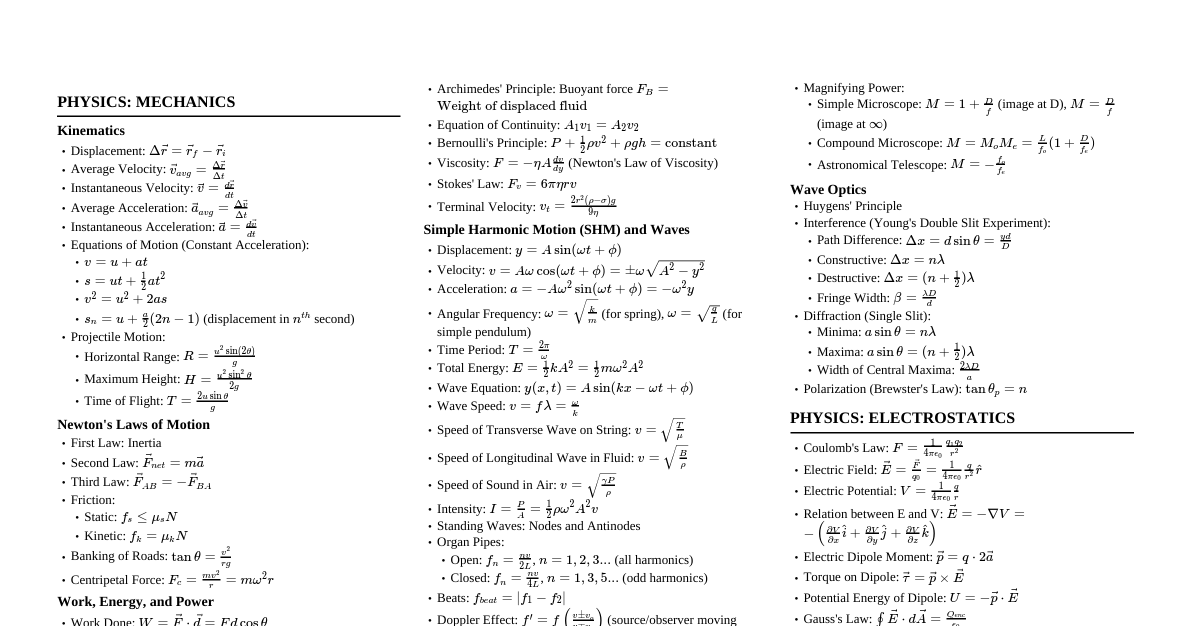
### Chapter 1: Electric Charges and Fields #### 1.1 Electric Charge - **Definition:** Intrinsic property of matter causing it to experience force in electromagnetic field. - **Types:** Positive (+) and Negative (-). - **Quantization:** $q = \pm ne$, where $n$ is an integer and $e = 1.6 \times 10^{-19}$ C (elementary charge). - **Conservation:** Total charge in an isolated system remains constant. #### 1.2 Coulomb's Law - **Statement:** Force between two point charges is directly proportional to product of charges and inversely proportional to square of distance between them. - **Formula:** $F = k \frac{|q_1 q_2|}{r^2}$ - $k = \frac{1}{4\pi\epsilon_0} = 9 \times 10^9 \text{ N m}^2/\text{C}^2$ (in vacuum) - $\epsilon_0 = 8.854 \times 10^{-12} \text{ C}^2/\text{N m}^2$ (permittivity of free space) - **Vector Form:** $\vec{F}_{12} = \frac{1}{4\pi\epsilon_0} \frac{q_1 q_2}{r_{21}^2} \hat{r}_{21}$ #### 1.3 Electric Field - **Definition:** Region around a charge where its influence can be experienced. - **Electric Field Intensity (E):** Force per unit positive test charge. - **Formula:** $\vec{E} = \frac{\vec{F}}{q_0}$ - **Due to a point charge Q:** $E = \frac{1}{4\pi\epsilon_0} \frac{Q}{r^2}$ - **Electric Field Lines:** - Originate from positive charges, terminate on negative charges. - Never intersect. - Tangent gives direction of E-field. - Density of lines proportional to field strength. #### 1.4 Electric Dipole - **Definition:** Pair of equal and opposite charges ($+q$ and $-q$) separated by a small distance $2a$. - **Electric Dipole Moment (p):** $\vec{p} = q(2\vec{a})$ (direction from $-q$ to $+q$) - **E-field on Axial Line:** $E_{axial} = \frac{1}{4\pi\epsilon_0} \frac{2pr}{(r^2 - a^2)^2} \approx \frac{1}{4\pi\epsilon_0} \frac{2p}{r^3}$ (for $r \gg a$) - **E-field on Equatorial Line:** $E_{equatorial} = \frac{1}{4\pi\epsilon_0} \frac{p}{(r^2 + a^2)^{3/2}} \approx \frac{1}{4\pi\epsilon_0} \frac{p}{r^3}$ (for $r \gg a$) - **Torque on Dipole in Uniform E-field:** $\vec{\tau} = \vec{p} \times \vec{E} = pE \sin\theta$ - **Potential Energy of Dipole:** $U = -\vec{p} \cdot \vec{E} = -pE \cos\theta$ #### 1.5 Gauss's Law - **Statement:** Total electric flux through any closed surface is $1/\epsilon_0$ times the total charge enclosed by the surface. - **Formula:** $\Phi_E = \oint \vec{E} \cdot d\vec{A} = \frac{Q_{enclosed}}{\epsilon_0}$ - **Applications:** - **Infinite Long Straight Wire:** $E = \frac{\lambda}{2\pi\epsilon_0 r}$ - **Uniformly Charged Infinite Plane Sheet:** $E = \frac{\sigma}{2\epsilon_0}$ - **Uniformly Charged Thin Spherical Shell:** - Outside: $E = \frac{1}{4\pi\epsilon_0} \frac{Q}{r^2}$ - On surface: $E = \frac{1}{4\pi\epsilon_0} \frac{Q}{R^2}$ - Inside: $E = 0$ - **Uniformly Charged Non-conducting Solid Sphere:** - Outside: $E = \frac{1}{4\pi\epsilon_0} \frac{Q}{r^2}$ - On surface: $E = \frac{1}{4\pi\epsilon_0} \frac{Q}{R^2}$ - Inside: $E = \frac{1}{4\pi\epsilon_0} \frac{Qr}{R^3}$ ### Chapter 2: Electrostatic Potential and Capacitance #### 2.1 Electric Potential - **Definition:** Work done per unit positive test charge in bringing it from infinity to a point in the electric field. - **Formula:** $V = \frac{W}{q_0}$ (Scalar quantity) - **Due to a point charge Q:** $V = \frac{1}{4\pi\epsilon_0} \frac{Q}{r}$ - **Due to an Electric Dipole:** - On Axial Line: $V = \frac{1}{4\pi\epsilon_0} \frac{p \cos\theta}{r^2}$ (for $r \gg a$) - On Equatorial Line: $V = 0$ - **Relation between E and V:** $\vec{E} = -\nabla V$ or $E = -\frac{dV}{dr}$ #### 2.2 Equipotential Surfaces - **Definition:** Surface over which electric potential is constant. - **Properties:** - No work is done in moving a charge on an equipotential surface. - Electric field lines are always perpendicular to equipotential surfaces. - Two equipotential surfaces never intersect. #### 2.3 Potential Energy of a System of Charges - **Two point charges:** $U = \frac{1}{4\pi\epsilon_0} \frac{q_1 q_2}{r_{12}}$ - **External Field:** $U = qV(\vec{r})$ - **Dipole in External Field:** $U = -\vec{p} \cdot \vec{E}$ #### 2.4 Conductors in Electrostatic Field - Inside a conductor, $\vec{E} = 0$. - Net charge resides on the surface of the conductor. - Electric potential is constant throughout the volume of the conductor and equal to its surface potential. - Electric field at the surface of a charged conductor is normal to the surface: $E = \frac{\sigma}{\epsilon_0}$. #### 2.5 Capacitance - **Definition:** Ability of a conductor to store electric charge. - **Formula:** $C = \frac{Q}{V}$ (Unit: Farad, F) - **Parallel Plate Capacitor:** $C = \frac{\epsilon_0 A}{d}$ - **Spherical Capacitor:** $C = 4\pi\epsilon_0 \frac{R_1 R_2}{R_2 - R_1}$ - **Isolated Spherical Conductor:** $C = 4\pi\epsilon_0 R$ #### 2.6 Combination of Capacitors - **Series:** $\frac{1}{C_{eq}} = \frac{1}{C_1} + \frac{1}{C_2} + \frac{1}{C_3} + ...$ (Charge same, Voltage divides) - **Parallel:** $C_{eq} = C_1 + C_2 + C_3 + ...$ (Voltage same, Charge divides) #### 2.7 Energy Stored in a Capacitor - **Formula:** $U = \frac{1}{2}CV^2 = \frac{1}{2}\frac{Q^2}{C} = \frac{1}{2}QV$ - **Energy Density:** $u = \frac{1}{2}\epsilon_0 E^2$ #### 2.8 Dielectrics and Polarization - **Dielectric:** Insulating material that can be polarized by an electric field. - **Dielectric Constant (K):** $K = \frac{C_{dielectric}}{C_{air}} = \frac{E_0}{E}$ ($K \ge 1$) - **Polarization (P):** Dipole moment per unit volume. $\vec{P} = \chi_e \epsilon_0 \vec{E}$ - **Effect of Dielectric:** Reduces E-field and increases capacitance ($C' = KC$). ### Chapter 3: Current Electricity #### 3.1 Electric Current - **Definition:** Rate of flow of electric charge. - **Formula:** $I = \frac{dQ}{dt}$ (Unit: Ampere, A) - **Direction:** Conventionally, direction of flow of positive charge. - **Drift Velocity ($\vec{v}_d$):** Average velocity of free electrons in a conductor under an electric field. - **Relation between I and $\vec{v}_d$:** $I = nAe v_d$ - $n$: number density of free electrons - $A$: cross-sectional area - $e$: elementary charge #### 3.2 Ohm's Law - **Statement:** At constant temperature, current flowing through a conductor is directly proportional to potential difference across its ends. - **Formula:** $V = IR$ - $R$: Resistance (Unit: Ohm, $\Omega$) - **Resistance:** $R = \rho \frac{L}{A}$ - $\rho$: Resistivity (Unit: Ohm-meter, $\Omega \cdot m$) - $L$: Length, $A$: Area - **Conductance (G):** $G = \frac{1}{R}$ (Unit: Siemens, S) - **Conductivity ($\sigma$):** $\sigma = \frac{1}{\rho}$ (Unit: S/m) - **Temperature Dependence of Resistance:** $R_T = R_0[1 + \alpha(T - T_0)]$ - $\alpha$: Temperature coefficient of resistance #### 3.3 Electrical Energy and Power - **Electrical Energy (W):** $W = VIt = I^2Rt = \frac{V^2}{R}t$ (Unit: Joule, J) - **Electrical Power (P):** $P = VI = I^2R = \frac{V^2}{R}$ (Unit: Watt, W) #### 3.4 Combination of Resistors - **Series:** $R_{eq} = R_1 + R_2 + R_3 + ...$ (Current same, Voltage divides) - **Parallel:** $\frac{1}{R_{eq}} = \frac{1}{R_1} + \frac{1}{R_2} + \frac{1}{R_3} + ...$ (Voltage same, Current divides) #### 3.5 Cells, EMF, and Internal Resistance - **Electromotive Force (EMF, $\mathcal{E}$):** Work done by the cell in moving a unit positive charge once around the whole circuit (including inside the cell). - **Terminal Potential Difference (V):** Potential difference across the terminals of the cell when current is drawn. - **Internal Resistance (r):** Resistance offered by the electrolyte of the cell. - **Relation:** $V = \mathcal{E} - Ir$ (when discharging) - $V = \mathcal{E} + Ir$ (when charging) - $I = \frac{\mathcal{E}}{R+r}$ #### 3.6 Combination of Cells - **Series:** - If cells aid each other: $\mathcal{E}_{eq} = \mathcal{E}_1 + \mathcal{E}_2 + ...$, $r_{eq} = r_1 + r_2 + ...$ - If cells oppose: $\mathcal{E}_{eq} = |\mathcal{E}_1 - \mathcal{E}_2|$, $r_{eq} = r_1 + r_2$ - **Parallel (Identical cells):** $\mathcal{E}_{eq} = \mathcal{E}$, $r_{eq} = r/n$ - For $n$ identical cells, $I = \frac{n\mathcal{E}}{R+nr}$ #### 3.7 Kirchhoff's Laws - **1. Kirchhoff's Current Law (KCL) / Junction Rule:** - Sum of currents entering a junction equals sum of currents leaving the junction. - $\sum I_{in} = \sum I_{out}$ (Conservation of Charge) - **2. Kirchhoff's Voltage Law (KVL) / Loop Rule:** - Algebraic sum of changes in potential around any closed loop in a circuit is zero. - $\sum \Delta V = 0$ (Conservation of Energy) #### 3.8 Wheatstone Bridge - **Principle:** Used to measure unknown resistance. - **Balanced Condition:** $\frac{P}{Q} = \frac{R}{S}$ (No current flows through galvanometer) #### 3.9 Meter Bridge - **Application:** Practical application of Wheatstone bridge. - **Formula:** $\frac{R}{S} = \frac{l}{(100-l)}$ #### 3.10 Potentiometer - **Principle:** Used to measure EMF of a cell, compare EMFs, and measure internal resistance. - **Principle:** Potential drop across any length of the wire is directly proportional to its length ($V \propto l$). - **Comparison of EMFs:** $\frac{\mathcal{E}_1}{\mathcal{E}_2} = \frac{l_1}{l_2}$ - **Internal Resistance:** $r = R \left(\frac{l_1}{l_2} - 1\right)$