Physics Problems & Solutions
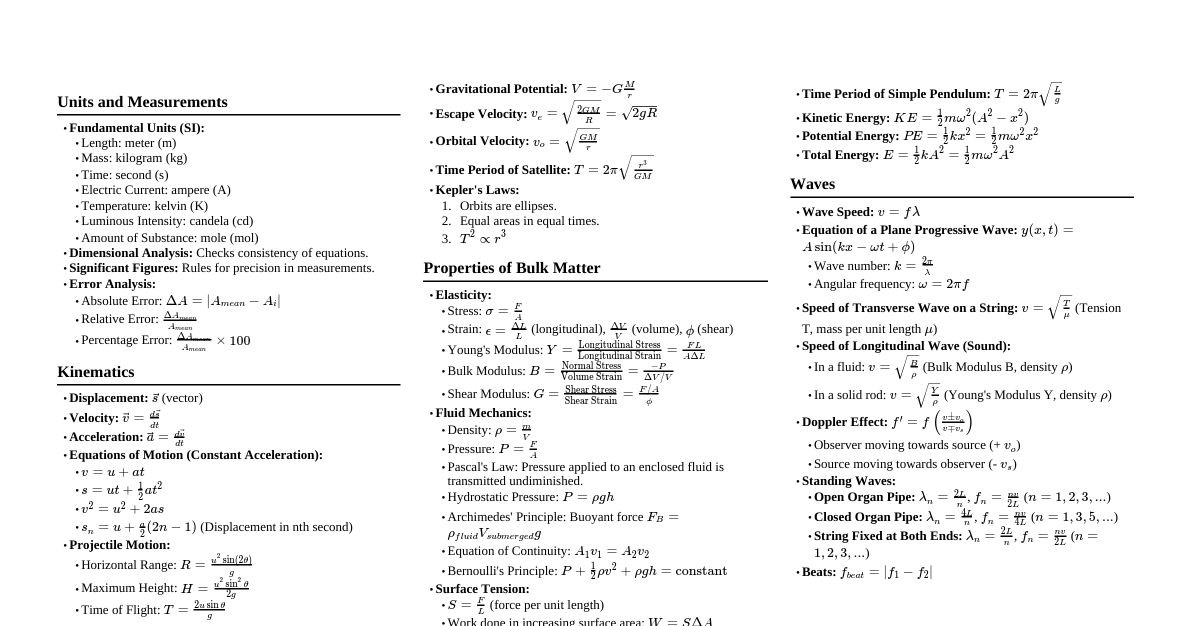
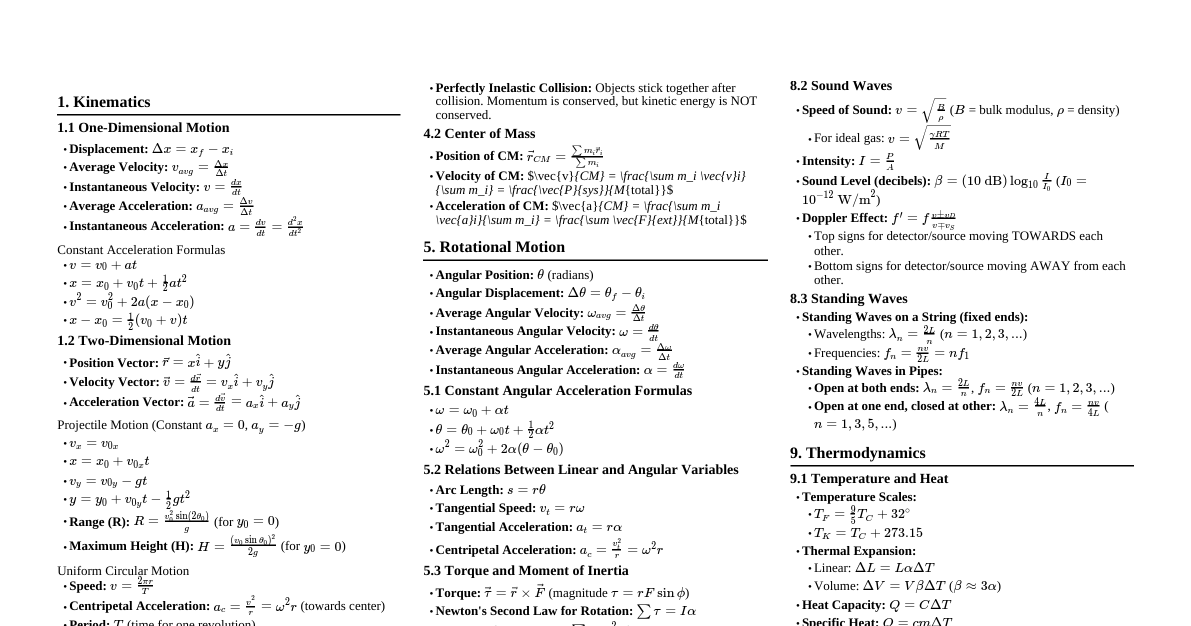
Cheatsheet Content
### Kinematics in 1D #### Problem 3.5 A jet airplane travelling at the speed of 500 km h-1 ejects its products of combustion at the speed of 1500 km h-1 relative to the jet plane. What is the speed of the latter with respect to an observer on the ground? **Solution:** Given: Speed of jet airplane ($v_j$) = 500 km/h Speed of combustion products relative to jet ($v_{pj}$) = 1500 km/h The speed of the combustion products with respect to the ground ($v_p$) is: $v_p = v_j - v_{pj}$ (since products are ejected backward) $v_p = 500 \text{ km/h} - 1500 \text{ km/h} = -1000 \text{ km/h}$ The speed of the combustion products with respect to an observer on the ground is 1000 km/h in the direction opposite to the jet's motion. #### Problem 3.6 A car moving along a straight highway with speed of 126 km h-1 is brought to a stop within a distance of 200 m. What is the retardation of the car (assumed uniform), and how long does it take for the car to stop? **Solution:** Given: Initial speed ($u$) = 126 km/h = $126 \times \frac{5}{18}$ m/s = 35 m/s Final speed ($v$) = 0 m/s Distance ($s$) = 200 m Using the kinematic equation $v^2 = u^2 + 2as$: $0^2 = (35)^2 + 2a(200)$ $0 = 1225 + 400a$ $400a = -1225$ $a = -\frac{1225}{400} = -3.0625 \text{ m/s}^2$ The retardation is $3.0625 \text{ m/s}^2$. Using the kinematic equation $v = u + at$: $0 = 35 + (-3.0625)t$ $3.0625t = 35$ $t = \frac{35}{3.0625} = 11.43 \text{ s}$ It takes approximately 11.43 seconds for the car to stop. #### Problem 3.7 Two trains A and B of length 400 m each are moving on two parallel tracks with a uniform speed of 72 km h-1 in the same direction, with A ahead of B. The driver of B decides to overtake A and accelerates by 1 m s-2. If after 50 s, the guard of B just brushes past the driver of A, what was the original distance between them? **Solution:** Given: Length of each train ($L_A = L_B$) = 400 m Initial speed of both trains ($u_A = u_B$) = 72 km/h = $72 \times \frac{5}{18}$ m/s = 20 m/s Acceleration of train B ($a_B$) = 1 m/s$^2$ Time ($t$) = 50 s Let the original distance between the driver of A and the guard of B be $d$. Distance covered by train A in 50 s ($S_A$): $S_A = u_A t = 20 \times 50 = 1000 \text{ m}$ Distance covered by train B in 50 s ($S_B$): $S_B = u_B t + \frac{1}{2} a_B t^2 = (20 \times 50) + \frac{1}{2} (1) (50)^2$ $S_B = 1000 + \frac{1}{2} (2500) = 1000 + 1250 = 2250 \text{ m}$ When the guard of B just brushes past the driver of A, the total distance covered by B relative to A is the initial distance $d$ plus the length of train A. Considering the front of train B (driver) and the rear of train A (guard), the relative distance covered for overtaking is $d$. However, the problem states "guard of B just brushes past the driver of A". This means train B has covered its own length and the initial gap, and part of train A's length. Let's consider the reference point of the driver of A. The position of the driver of A at time $t$ is $x_A(t) = x_{A0} + u_A t$. The position of the guard of B at time $t$ is $x_B(t) = x_{B0} + u_B t + \frac{1}{2} a_B t^2$. Let the driver of A be at $x=0$ initially. So, $x_{A0} = 0$. The guard of B is at $x_{B0} = -(d + L_A)$. (Assuming B is behind A, and A is ahead of B). No, let's simplify. Let the initial position of the driver of A be $x_A = 0$. The initial position of the driver of B is $x_B = -(d + L_B)$. The initial position of the guard of B is $x_G = -(d + L_B + L_B)$. No, this is confusing. Let's consider the relative displacement. Relative acceleration $a_{rel} = a_B - a_A = 1 - 0 = 1 \text{ m/s}^2$. Relative initial velocity $u_{rel} = u_B - u_A = 20 - 20 = 0 \text{ m/s}$. The total relative distance B needs to cover to overtake A such that the guard of B ($L_B$ behind its driver) passes the driver of A ($L_A$ in front of its guard) is $d + L_A$ (if $d$ is distance between A's rear and B's front). However, "guard of B just brushes past the driver of A" means B has moved forward by an amount equal to the initial separation *plus* the length of A *plus* the length of B. No, it means the front of B has traveled $d$ + the length of A and B's front has travelled $d$. Let $d_{AB}$ be the initial distance between the driver of A and the guard of B. The displacement of B relative to A needed for the guard of B to pass the driver of A is $d_{AB}$. Relative displacement $\Delta S_{rel} = S_B - S_A = \frac{1}{2} a_{rel} t^2$ $\Delta S_{rel} = \frac{1}{2} (1) (50)^2 = \frac{1}{2} (2500) = 1250 \text{ m}$. The relative distance covered is $1250 \text{ m}$. This relative distance is the sum of the initial separation between the driver of A and the driver of B, plus the length of train A (because B's guard passed A's driver). Let $x$ be the initial distance between the front of A and the front of B. When the guard of B ($L_B$ behind its driver) passes the driver of A (front of A). The total distance B's front has moved relative to A's front is $x + L_A$. So, $x + L_A = 1250 \text{ m}$. $x + 400 = 1250$ $x = 850 \text{ m}$. The original distance between the driver of A and the driver of B was 850 m. #### Problem 3.8 On a two-lane road, car A is travelling with a speed of 36 km h-1. Two cars B and C approach car A in opposite directions with a speed of 54 km h-1 each. At a certain instant, when the distance AB is equal to AC, both being 1 km. B decides to overtake A before C does. What minimum acceleration of car B is required to avoid an accident? **Solution:** Given: Speed of car A ($v_A$) = 36 km/h = $36 \times \frac{5}{18}$ m/s = 10 m/s Speed of car B ($v_B$) = 54 km/h = $54 \times \frac{5}{18}$ m/s = 15 m/s Speed of car C ($v_C$) = 54 km/h = $54 \times \frac{5}{18}$ m/s = 15 m/s Initial distance AB = AC = 1 km = 1000 m. All speeds are with respect to the ground. Car B is behind A, moving in the same direction. Car C is in front of A, moving in the opposite direction. Time for C to reach A ($t_C$): Relative speed of C with respect to A = $v_C + v_A = 15 + 10 = 25 \text{ m/s}$. Distance = 1000 m. $t_C = \frac{1000}{25} = 40 \text{ s}$. Car B must overtake A within 40 seconds. For B to overtake A: Relative initial speed of B with respect to A ($u_{BA}$) = $v_B - v_A = 15 - 10 = 5 \text{ m/s}$. Relative distance B needs to cover = 1000 m. Let $a_B$ be the acceleration of car B. Using $S = ut + \frac{1}{2}at^2$ for relative motion: $1000 = (5)(40) + \frac{1}{2} a_B (40)^2$ $1000 = 200 + \frac{1}{2} a_B (1600)$ $1000 = 200 + 800 a_B$ $800 a_B = 800$ $a_B = 1 \text{ m/s}^2$. The minimum acceleration of car B required is $1 \text{ m/s}^2$. #### Problem 3.9 Two towns A and B are connected by a regular bus service with a bus leaving in either direction every T minutes. A man cycling with a speed of 20 km h-1 in the direction A to B notices that a bus goes past him every 18 min in the direction of his motion, and every 6 min in the opposite direction. What is the period T of the bus service and with what speed (assumed constant) do the buses ply on the road? **Solution:** Let $v_b$ be the speed of the bus and $v_m$ be the speed of the man. $v_m = 20 \text{ km/h}$. Let $T$ be the time interval between buses in minutes. Let $D$ be the distance covered by a bus in time $T$. So $D = v_b T$. **Case 1: Bus in the direction of man's motion (A to B)** Relative speed of bus with respect to man = $v_b - v_m$. A bus passes the man every 18 minutes ($t_1 = 18 \text{ min}$). In time $t_1$, the bus must cover the distance between two consecutive buses, which is $v_b T$. So, $(v_b - v_m) t_1 = v_b T$. $(v_b - 20) \times \frac{18}{60} = v_b \times \frac{T}{60}$ $18(v_b - 20) = v_b T$ (Equation 1) **Case 2: Bus in the opposite direction to man's motion (B to A)** Relative speed of bus with respect to man = $v_b + v_m$. A bus passes the man every 6 minutes ($t_2 = 6 \text{ min}$). In time $t_2$, the bus must cover the distance between two consecutive buses, which is $v_b T$. So, $(v_b + v_m) t_2 = v_b T$. $(v_b + 20) \times \frac{6}{60} = v_b \times \frac{T}{60}$ $6(v_b + 20) = v_b T$ (Equation 2) Equating (1) and (2): $18(v_b - 20) = 6(v_b + 20)$ $3(v_b - 20) = v_b + 20$ $3v_b - 60 = v_b + 20$ $2v_b = 80$ $v_b = 40 \text{ km/h}$. Now substitute $v_b = 40$ into Equation 2 to find $T$: $6(40 + 20) = 40 T$ $6(60) = 40 T$ $360 = 40 T$ $T = \frac{360}{40} = 9 \text{ minutes}$. The period of the bus service is 9 minutes and the speed of the buses is 40 km/h. #### Problem 3.12 A ball is dropped from a height of 90 m on a floor. At each collision with the floor, the ball loses one tenth of its speed. Plot the speed-time graph of its motion between t = 0 to 12 s. **Solution:** Given: Initial height ($H$) = 90 m Loss of speed on collision = 1/10 of current speed. So, new speed is $0.9 \times$ previous speed. Take $g = 9.8 \text{ m/s}^2$. **First fall:** Initial velocity ($u_0$) = 0 m/s. Time to reach the floor ($t_1$): $H = \frac{1}{2}gt_1^2 \Rightarrow 90 = \frac{1}{2}(9.8)t_1^2 \Rightarrow t_1 = \sqrt{\frac{180}{9.8}} \approx 4.29 \text{ s}$. Speed just before first impact ($v_1 = gt_1$): $v_1 = 9.8 \times 4.29 \approx 42.04 \text{ m/s}$. **First rebound:** Speed just after first impact ($u_1 = 0.9 v_1$): $u_1 = 0.9 \times 42.04 \approx 37.84 \text{ m/s}$. Time to reach max height ($t_{up1}$): $0 = u_1 - gt_{up1} \Rightarrow t_{up1} = \frac{u_1}{g} = \frac{37.84}{9.8} \approx 3.86 \text{ s}$. Total time for first bounce cycle (up and down) = $2 \times t_{up1} = 2 \times 3.86 = 7.72 \text{ s}$. Time of second impact = $t_1 + 7.72 = 4.29 + 7.72 = 12.01 \text{ s}$. Since we need to plot up to 12 s, the ball will just complete its first rebound cycle. **Speed-time graph points:** 1. **0 to 4.29 s (falling):** Speed increases linearly from 0 to 42.04 m/s. $v = gt$. - At $t=0$, $v=0$. - At $t=4.29$, $v=42.04$. 2. **At 4.29 s (impact):** Speed instantly changes from -42.04 m/s (downwards) to +37.84 m/s (upwards). The graph will show a discontinuous jump. 3. **4.29 s to (4.29 + 3.86) = 8.15 s (moving upwards):** Speed decreases linearly from 37.84 m/s to 0 m/s. $v = u_1 - g(t - 4.29)$. - At $t=4.29$, $v=37.84$. - At $t=8.15$, $v=0$. 4. **8.15 s to (8.15 + 3.86) = 12.01 s (falling again):** Speed increases linearly from 0 m/s to 37.84 m/s. $v = g(t - 8.15)$. - At $t=8.15$, $v=0$. - At $t=12.01$, $v=37.84$. **Summary of points for plotting (absolute speed):** - (0, 0) - (4.29, 42.04) - (4.29, 37.84) (after impact) - (8.15, 0) - (12.01, 37.84) The graph will consist of straight line segments. The first segment goes from (0,0) to (4.29, 42.04). Then a vertical drop to (4.29, 37.84). Then a segment from (4.29, 37.84) to (8.15, 0). Then a segment from (8.15, 0) to (12.01, 37.84). *(Due to text-based output, I cannot plot the graph. The description above details how the graph would look.)* #### Problem 3.23 A three-wheeler starts from rest, accelerates uniformly with 1 m s-2 on a straight road for 10 s, and then moves with uniform velocity. Plot the distance covered by the vehicle during the nth second (n = 1,2,3 .... ) versus n. What do you expect this plot to be during accelerated motion: a straight line or a parabola? **Solution:** Given: Initial velocity ($u$) = 0 m/s Acceleration ($a$) = 1 m/s$^2$ for 10 s. Distance covered in the $n^{th}$ second ($S_n$) is given by: $S_n = u + a(n - \frac{1}{2})$ For $u=0$ and $a=1 \text{ m/s}^2$: $S_n = (0) + (1)(n - \frac{1}{2}) = n - \frac{1}{2}$ Let's calculate $S_n$ for $n = 1, 2, ..., 10$: - For $n=1$: $S_1 = 1 - 0.5 = 0.5 \text{ m}$ - For $n=2$: $S_2 = 2 - 0.5 = 1.5 \text{ m}$ - For $n=3$: $S_3 = 3 - 0.5 = 2.5 \text{ m}$ - ... - For $n=10$: $S_{10} = 10 - 0.5 = 9.5 \text{ m}$ After 10 seconds, the vehicle moves with uniform velocity. Velocity at $t=10$ s ($v_{10}$) = $u + at = 0 + 1 \times 10 = 10 \text{ m/s}$. For $n > 10$, the distance covered in the $n^{th}$ second will be constant and equal to $v_{10}$. - For $n=11$: $S_{11} = 10 \text{ m}$ - For $n=12$: $S_{12} = 10 \text{ m}$ - ... **Plot of $S_n$ versus $n$:** - For $n=1$ to $n=10$: The points will be (1, 0.5), (2, 1.5), (3, 2.5), ..., (10, 9.5). These points lie on a straight line with a positive slope. - For $n > 10$: The points will be (11, 10), (12, 10), etc., forming a horizontal line. **Expectation for accelerated motion:** During accelerated motion (for $n=1$ to $n=10$), the plot of distance covered in the $n^{th}$ second ($S_n = n - \frac{1}{2}$) versus $n$ is a **straight line**. This is because $S_n$ is a linear function of $n$. The total distance covered ($S = ut + \frac{1}{2}at^2$) is a parabola with respect to time $t$, but distance in the $n^{th}$ second is linear with $n$. #### Problem 3.24 A boy standing on a stationary lift (open from above) throws a ball upwards with the maximum initial speed he can, equal to 49 m s-1. How much time does the ball take to return to his hands? If the lift starts moving up with a uniform speed of 5 m s-1 and the boy again throws the ball up with the maximum speed he can, how long does the ball take to return to his hands? **Solution:** Given: Initial speed of ball relative to boy ($u_{rel}$) = 49 m/s Speed of lift ($v_L$) = 5 m/s (upwards) Take $g = 9.8 \text{ m/s}^2$. **Case 1: Stationary lift** The motion of the ball is observed from the ground frame. Initial speed of ball ($u$) = 49 m/s (upwards). When the ball returns to the boy's hands, its net displacement is zero. Using $S = ut + \frac{1}{2}gt^2$: $0 = 49t + \frac{1}{2}(-9.8)t^2$ $0 = 49t - 4.9t^2$ $4.9t^2 = 49t$ Since $t \neq 0$, we can divide by $t$: $4.9t = 49 \Rightarrow t = 10 \text{ s}$. The ball takes 10 s to return to his hands. **Case 2: Lift moving upwards with uniform speed** The lift moves with a uniform speed of $v_L = 5 \text{ m/s}$. The boy throws the ball upwards with a speed of $u_{rel} = 49 \text{ m/s}$ relative to himself. From the ground frame: Initial speed of ball ($u_{ball}$) = $u_{rel} + v_L = 49 + 5 = 54 \text{ m/s}$ (upwards). Initial speed of boy ($u_{boy}$) = $v_L = 5 \text{ m/s}$ (upwards). When the ball returns to the boy's hands, their positions must be the same. Position of ball: $y_{ball}(t) = u_{ball}t + \frac{1}{2}gt^2 = 54t - 4.9t^2$. Position of boy: $y_{boy}(t) = u_{boy}t = 5t$. (Assuming initial position is $y=0$) Set $y_{ball}(t) = y_{boy}(t)$: $54t - 4.9t^2 = 5t$ $49t - 4.9t^2 = 0$ $4.9t(10 - t) = 0$ So, $t=0$ or $t=10 \text{ s}$. The ball takes 10 s to return to his hands. **Conclusion:** The time taken for the ball to return to the boy's hands is independent of the uniform velocity of the lift. This is because the relative velocity of the ball with respect to the boy remains the same, and the acceleration due to gravity is also the same for both. #### Problem 3.26 Two stones are thrown up simultaneously from the edge of a cliff 200 m high with initial speeds of 15 m s-1 and 30 m s-1. Verify that the graph shown in Fig. 3.27 correctly represents the time variation of the relative position of the second stone with respect to the first. Neglect air resistance and assume that the stones do not rebound after hitting the ground. Take g = 10 m s-2. Give the equations for the linear and curved parts of the plot. **Solution:** Given: Height of cliff ($H$) = 200 m Initial speed of first stone ($u_1$) = 15 m/s (upwards) Initial speed of second stone ($u_2$) = 30 m/s (upwards) $g = 10 \text{ m/s}^2$. Let's define upwards as positive. Position of first stone: $y_1(t) = u_1 t - \frac{1}{2}gt^2 = 15t - 5t^2$. Position of second stone: $y_2(t) = u_2 t - \frac{1}{2}gt^2 = 30t - 5t^2$. Relative position of second stone with respect to first ($y_{21}$): $y_{21}(t) = y_2(t) - y_1(t)$ $y_{21}(t) = (30t - 5t^2) - (15t - 5t^2)$ $y_{21}(t) = 15t$. This equation $y_{21}(t) = 15t$ describes a **linear** relationship. This is valid as long as both stones are in the air. **Time for each stone to hit the ground:** For stone 1: $y_1(t) = -200$ (displacement from cliff top to ground) $-200 = 15t - 5t^2$ $5t^2 - 15t - 200 = 0$ $t^2 - 3t - 40 = 0$ $(t-8)(t+5) = 0$ Since $t>0$, $t_1 = 8 \text{ s}$. For stone 2: $y_2(t) = -200$ $-200 = 30t - 5t^2$ $5t^2 - 30t - 200 = 0$ $t^2 - 6t - 40 = 0$ Using quadratic formula $t = \frac{-b \pm \sqrt{b^2 - 4ac}}{2a}$: $t = \frac{6 \pm \sqrt{(-6)^2 - 4(1)(-40)}}{2(1)}$ $t = \frac{6 \pm \sqrt{36 + 160}}{2} = \frac{6 \pm \sqrt{196}}{2} = \frac{6 \pm 14}{2}$ Since $t>0$, $t_2 = \frac{6+14}{2} = \frac{20}{2} = 10 \text{ s}$. **Analysis of the graph:** - **From $t=0$ to $t=8 \text{ s}$ (when stone 1 hits the ground):** Both stones are in the air. The relative position is given by $y_{21}(t) = 15t$. This is a linear part of the graph, increasing from $y_{21}(0)=0$ to $y_{21}(8)=15 \times 8 = 120 \text{ m}$. Equation for linear part: $y_{21}(t) = 15t$. - **From $t=8 \text{ s}$ to $t=10 \text{ s}$ (when stone 2 hits the ground):** Stone 1 has hit the ground and stopped. Stone 2 is still in the air. The relative position is no longer simply $y_2(t) - y_1(t)$ because $y_1(t)$ is fixed at -200 m (or effectively, the first stone is no longer part of the "flying" system). The graph shows the relative position of the second stone with respect to the *initial position* of the first stone (or where the first stone would have been if it kept going down, but it stopped at the ground). More accurately, the problem states "relative position of the second stone with respect to the first". Once the first stone hits the ground, its position is fixed at the ground. So, for $t > 8 \text{ s}$: $y_{21}(t) = y_2(t) - (-200 \text{ m})$ (position relative to the ground where stone 1 is). $y_{21}(t) = (30t - 5t^2) - (-200)$ $y_{21}(t) = 30t - 5t^2 + 200$. This is a **curved** (parabolic) part of the graph. Let's check values: At $t=8 \text{ s}$: $y_{21}(8) = 30(8) - 5(8)^2 + 200 = 240 - 5(64) + 200 = 240 - 320 + 200 = 120 \text{ m}$. (Matches the end of the linear part). At $t=10 \text{ s}$: $y_{21}(10) = 30(10) - 5(10)^2 + 200 = 300 - 500 + 200 = 0 \text{ m}$. (This means stone 2 is at the ground level where stone 1 also is). The graph is indeed linear from $t=0$ to $t=8$ s, then curved from $t=8$ s to $t=10$ s, ending at 0. Equations: - Linear part (for $0 \le t \le 8 \text{ s}$): $y_{21}(t) = 15t$ - Curved part (for $8 \text{ s} ### Kinematics in 2D #### Problem 4.12 Rain is falling vertically with a speed of 30 m s-1. A woman rides a bicycle with a speed of 10 m s-1 in the north to south direction. What is the direction in which she should hold her umbrella? **Solution:** Given: Velocity of rain ($v_r$) = 30 m/s (vertically downwards) Velocity of woman ($v_w$) = 10 m/s (north to south) We need to find the velocity of rain relative to the woman ($v_{rw}$). $v_{rw} = v_r - v_w$. Let's set up a coordinate system: - Vertical: positive upwards, negative downwards. - Horizontal: North is positive Y, South is negative Y. So, $v_r = -30 \hat{k}$ (if vertical is z-axis) or just consider magnitudes and directions. Let downward be positive for rain, and south be positive for woman. No, let's use vectors. $\vec{v}_r = -30 \hat{j}$ (assuming $\hat{j}$ is vertically up) $\vec{v}_w = -10 \hat{i}$ (assuming $\hat{i}$ is towards south) $\vec{v}_{rw} = \vec{v}_r - \vec{v}_w = -30 \hat{j} - (-10 \hat{i}) = 10 \hat{i} - 30 \hat{j}$. The magnitude of $v_{rw} = \sqrt{(10)^2 + (-30)^2} = \sqrt{100 + 900} = \sqrt{1000} \approx 31.62 \text{ m/s}$. The direction can be found using trigonometry. Let $\theta$ be the angle with the vertical. $\tan \theta = \frac{\text{horizontal component}}{\text{vertical component}} = \frac{10}{30} = \frac{1}{3}$. $\theta = \arctan(\frac{1}{3}) \approx 18.43^\circ$. The horizontal component is towards the south (positive $\hat{i}$). The vertical component is downwards (negative $\hat{j}$). So, she should hold her umbrella at an angle of $18.43^\circ$ with the vertical, tilted towards the south. #### Problem 4.13 A man can swim with a speed of 4.0 km/h in still water. How long does he take to cross a river 1.0 km wide if the river flows steadily at 3.0 km/h and he makes his strokes normal to the river current? How far down the river does he go when he reaches the other bank? **Solution:** Given: Speed of man in still water ($v_m$) = 4.0 km/h Width of river ($d$) = 1.0 km Speed of river flow ($v_r$) = 3.0 km/h Man makes strokes normal to the river current. **Time to cross the river:** The component of man's velocity perpendicular to the current is $v_m$. Time ($t$) = $\frac{\text{width of river}}{\text{speed of man perpendicular to current}} = \frac{d}{v_m}$ $t = \frac{1.0 \text{ km}}{4.0 \text{ km/h}} = 0.25 \text{ h}$. $0.25 \text{ h} = 0.25 \times 60 = 15 \text{ minutes}$. **Distance drifted down the river:** While the man crosses the river, the river current carries him downstream. Distance drifted ($x$) = (speed of river) $\times$ (time to cross) $x = v_r \times t = 3.0 \text{ km/h} \times 0.25 \text{ h} = 0.75 \text{ km}$. He takes 15 minutes to cross the river and drifts 0.75 km downstream. #### Problem 4.14 In a harbour, wind is blowing at the speed of 72 km/h and the flag on the mast of a boat anchored in the harbour flutters along the N-E direction. If the boat starts moving at a speed of 51 km/h to the north, what is the direction of the flag on the mast of the boat? **Solution:** Given: Speed of wind ($v_w$) = 72 km/h Direction of wind (relative to ground) = N-E (45° from North towards East). Speed of boat ($v_b$) = 51 km/h (North). When the boat is anchored, the flag shows the direction of the wind relative to the ground. So, $\vec{v}_w$ has components: $v_{wx} = v_w \cos(45^\circ) = 72 \times \frac{1}{\sqrt{2}} = 36\sqrt{2} \text{ km/h}$ (East component) $v_{wy} = v_w \sin(45^\circ) = 72 \times \frac{1}{\sqrt{2}} = 36\sqrt{2} \text{ km/h}$ (North component) (Let East be x-axis, North be y-axis). $\vec{v}_w = (36\sqrt{2} \hat{i} + 36\sqrt{2} \hat{j}) \text{ km/h}$. When the boat starts moving North: $\vec{v}_b = 51 \hat{j} \text{ km/h}$. The flag on the mast shows the direction of the wind relative to the boat ($v_{wb}$). $\vec{v}_{wb} = \vec{v}_w - \vec{v}_b$ $\vec{v}_{wb} = (36\sqrt{2} \hat{i} + 36\sqrt{2} \hat{j}) - (51 \hat{j})$ $\vec{v}_{wb} = 36\sqrt{2} \hat{i} + (36\sqrt{2} - 51) \hat{j}$. $36\sqrt{2} \approx 36 \times 1.414 = 50.904$. So, the y-component is $50.904 - 51 = -0.096 \text{ km/h}$. $\vec{v}_{wb} \approx 50.904 \hat{i} - 0.096 \hat{j}$. The x-component is positive (East). The y-component is negative (South). This means the relative wind is blowing predominantly from East-South direction. The flag will flutter along the direction of $\vec{v}_{wb}$. Let $\phi$ be the angle with the East direction (x-axis). $\tan \phi = \frac{\text{y-component}}{\text{x-component}} = \frac{-0.096}{50.904} \approx -0.00188$. $\phi \approx \arctan(-0.00188) \approx -0.108^\circ$. The angle is very small and negative, meaning it's slightly south of East. So, the flag will flutter almost along the East direction, slightly tilted towards the South. #### Problem 4.15 The ceiling of a long hall is 25 m high. What is the maximum horizontal distance that a ball thrown with a speed of 40 m s-1 can go without hitting the ceiling of the hall? **Solution:** Given: Maximum height ($H_{max}$) = 25 m Initial speed ($u$) = 40 m/s Take $g = 9.8 \text{ m/s}^2$. For projectile motion, the maximum height reached is $H = \frac{u^2 \sin^2 \theta}{2g}$. We are given $H_{max} = 25 \text{ m}$ as the constraint. $25 = \frac{(40)^2 \sin^2 \theta}{2 \times 9.8}$ $25 = \frac{1600 \sin^2 \theta}{19.6}$ $\sin^2 \theta = \frac{25 \times 19.6}{1600} = \frac{490}{1600} = \frac{49}{160}$. $\sin \theta = \sqrt{\frac{49}{160}} = \frac{7}{\sqrt{160}} = \frac{7}{4\sqrt{10}} \approx \frac{7}{4 \times 3.162} \approx \frac{7}{12.648} \approx 0.5534$. $\theta = \arcsin(0.5534) \approx 33.6^\circ$. Now, we need to find the horizontal range ($R$) for this angle $\theta$. $R = \frac{u^2 \sin(2\theta)}{g} = \frac{u^2 (2 \sin \theta \cos \theta)}{g}$. We have $\sin \theta = 0.5534$. $\cos \theta = \sqrt{1 - \sin^2 \theta} = \sqrt{1 - \frac{49}{160}} = \sqrt{\frac{111}{160}} \approx \sqrt{0.69375} \approx 0.8329$. $R = \frac{(40)^2 \times 2 \times 0.5534 \times 0.8329}{9.8}$ $R = \frac{1600 \times 0.9221}{9.8} \approx \frac{1475.36}{9.8} \approx 150.55 \text{ m}$. The maximum horizontal distance is approximately 150.55 m. #### Problem 4.16 A cricketer can throw a ball to a maximum horizontal distance of 100 m. How much high above the ground can the cricketer throw the same ball? **Solution:** Given: Maximum horizontal range ($R_{max}$) = 100 m. We know that maximum range occurs at $\theta = 45^\circ$. $R_{max} = \frac{u^2}{g}$. So, $\frac{u^2}{g} = 100$. Now, we need to find the maximum height the cricketer can throw the same ball. This occurs when the ball is thrown vertically upwards ($\theta = 90^\circ$). Maximum height ($H_{max}$) = $\frac{u^2 \sin^2(90^\circ)}{2g} = \frac{u^2 (1)^2}{2g} = \frac{u^2}{2g}$. Substitute $\frac{u^2}{g} = 100$: $H_{max} = \frac{1}{2} \left(\frac{u^2}{g}\right) = \frac{1}{2} \times 100 = 50 \text{ m}$. The cricketer can throw the ball 50 m high. #### Problem 4.26 A vector has magnitude and direction. Does it have a location in space? Can it vary with time? Will two equal vectors a and b at different locations in space necessarily have identical physical effects? Give examples in support of your answer. **Solution:** 1. **Does it have a location in space?** In general, a vector (like displacement, velocity, acceleration, force) does not have a fixed location in space. It can be translated anywhere without changing its identity, as long as its magnitude and direction remain the same. These are called **free vectors**. However, some vectors, like **position vectors**, are defined with respect to an origin and thus have a specific starting point. Also, a **bound vector** or **localized vector** (like a force acting on a rigid body) has a specific point of application. The physical effect of such a vector depends on its point of application. 2. **Can it vary with time?** Yes, a vector can vary with time. For example: - **Position vector:** The position vector of a moving particle changes with time. - **Velocity vector:** The velocity vector of an accelerating object changes with time (in magnitude and/or direction). - **Acceleration vector:** The acceleration vector can also change with time, e.g., in simple harmonic motion. 3. **Will two equal vectors a and b at different locations in space necessarily have identical physical effects?** No, not necessarily. This depends on the nature of the physical quantity represented by the vector. - **Identical effects (Free vectors):** For quantities like **displacement** or **velocity**, two equal vectors at different locations will have the same physical effect. If you displace an object by 5 meters East, it doesn't matter where you started, the final displacement is the same. - **Different effects (Localized/Bound vectors):** For quantities like **force** or **torque**, two equal vectors at different locations can have different physical effects. * **Example for Force:** Pushing a door near the hinges with a certain force will have a different effect (less rotation) than pushing it far from the hinges with the same force. The force vector itself has the same magnitude and direction, but its point of application changes the outcome (torque). * **Example for Torque:** A force applied at point A on a lever will produce a different torque about a pivot than the same force applied at point B, even if the force vectors are identical. #### Problem 4.27 A vector has both magnitude and direction. Does it mean that anything that has magnitude and direction is necessarily a vector? The rotation of a body can be specified by the direction of the axis of rotation, and the angle of rotation about the axis. Does that make any rotation a vector? **Solution:** 1. **Does anything with magnitude and direction necessarily a vector?** No. For a quantity to be a true vector, it must satisfy two additional conditions besides having magnitude and direction: - **Vector Addition (Triangle Law/Parallelogram Law):** It must obey the rules of vector addition. If you combine two such quantities, their resultant must be found using the triangle or parallelogram law of vector addition. - **Commutativity of Addition:** Vector addition must be commutative (i.e., $\vec{A} + \vec{B} = \vec{B} + \vec{A}$). 2. **Does rotation make any rotation a vector?** Small rotations can be treated as vectors because they are approximately commutative. For infinitesimally small rotations, the order of rotation does not matter, and they add vectorially. However, **finite rotations are NOT vectors**. They have magnitude (the angle of rotation) and direction (the axis of rotation), but they do not obey the commutative law of vector addition. **Example:** Consider a book on a table. - Rotate it $90^\circ$ about the x-axis (around its length) then $90^\circ$ about the y-axis (around its width). - Now, return it to its original position and rotate it $90^\circ$ about the y-axis first, then $90^\circ$ about the x-axis. The final orientations of the book will be different. Since the order of addition matters ($\vec{A} + \vec{B} \neq \vec{B} + \vec{A}$), finite rotations are not vectors. Finite rotations are better described by **rotational operators** or **tensors**. #### Problem 4.28 Can you associate vectors with (a) the length of a wire bent into a loop, (b) a plane area, (c) a sphere? Explain. **Solution:** 1. **(a) The length of a wire bent into a loop:** No, length is a scalar quantity. Even if the wire is bent into a loop, its total length is just a numerical value with a unit. There is no associated direction in a vector sense. 2. **(b) A plane area:** Yes, a plane area can be associated with a vector, called an **area vector**. - **Magnitude:** The magnitude of the area vector is the numerical value of the area. - **Direction:** The direction of the area vector is perpendicular to the plane of the area. For a closed surface, the convention is that the direction points outwards (normal to the surface). For an open surface, the direction is chosen based on the orientation of the boundary (e.g., using the right-hand rule for the circulation around the boundary). This vector nature is crucial in physics, especially in fluid dynamics (flux) and electromagnetism (electric and magnetic flux). For example, in calculating electric flux $\Phi_E = \vec{E} \cdot \vec{A}$, where $\vec{A}$ is the area vector. 3. **(c) A sphere:** No, a sphere (or its volume) is a scalar quantity. Volume has magnitude but no inherent direction. While you can define an area vector for an infinitesimal patch on the surface of a sphere, you cannot associate a single vector with the entire sphere itself in the same way you can for a plane area. The overall "shape" or "volume" of a sphere is purely scalar. #### Problem 4.29 A bullet fired at an angle of 30° with the horizontal hits the ground 3.0 km away. By adjusting its angle of projection, can one hope to hit a target 5.0 km away? Assume the muzzle speed to the fixed, and neglect air resistance. **Solution:** Given: Initial angle ($\theta_1$) = 30° Range ($R_1$) = 3.0 km = 3000 m. We know the range formula for projectile motion is $R = \frac{u^2 \sin(2\theta)}{g}$. From the first shot: $3000 = \frac{u^2 \sin(2 \times 30^\circ)}{g}$ $3000 = \frac{u^2 \sin(60^\circ)}{g}$ $3000 = \frac{u^2 (\sqrt{3}/2)}{g}$ So, $\frac{u^2}{g} = \frac{3000 \times 2}{\sqrt{3}} = \frac{6000}{\sqrt{3}} \approx 3464.1 \text{ m}$. The maximum possible range ($R_{max}$) for a given muzzle speed occurs at an angle of $45^\circ$. $R_{max} = \frac{u^2 \sin(2 \times 45^\circ)}{g} = \frac{u^2 \sin(90^\circ)}{g} = \frac{u^2}{g}$. Therefore, $R_{max} = \frac{u^2}{g} = 3464.1 \text{ m} \approx 3.46 \text{ km}$. The target is 5.0 km away. Since the maximum possible range (3.46 km) is less than 5.0 km, one **cannot** hope to hit a target 5.0 km away by just adjusting the angle of projection with the same muzzle speed. #### Problem 4.30 A fighter plane flying horizontally at an altitude of 1.5 km with speed 720 km/h passes directly overhead an anti-aircraft gun. At what angle from the vertical should the gun be fired for the shell with muzzle speed 600 m s-1 to hit the plane? At what minimum altitude should the pilot fly the plane to avoid being hit? (Take g = 10 m s-2). **Solution:** Given: Altitude of plane ($H$) = 1.5 km = 1500 m. Speed of plane ($v_p$) = 720 km/h = $720 \times \frac{5}{18}$ m/s = 200 m/s. Muzzle speed of shell ($u_s$) = 600 m/s. $g = 10 \text{ m/s}^2$. **Part 1: Angle from the vertical to hit the plane** Let the gun be fired at an angle $\theta$ from the horizontal. The angle from the vertical would be $90^\circ - \theta$. Let $t$ be the time taken for the shell to hit the plane. In time $t$, the horizontal distance covered by the shell must be equal to the horizontal distance covered by the plane. Horizontal distance by shell: $x = (u_s \cos \theta) t$. Horizontal distance by plane: $x = v_p t$. So, $(u_s \cos \theta) t = v_p t$. $u_s \cos \theta = v_p$ (Assuming $t \ne 0$) $600 \cos \theta = 200$ $\cos \theta = \frac{200}{600} = \frac{1}{3}$. $\theta = \arccos(\frac{1}{3}) \approx 70.53^\circ$. This is the angle from the horizontal. The angle from the vertical ($\alpha$) = $90^\circ - \theta = 90^\circ - 70.53^\circ = 19.47^\circ$. Now, we must also ensure that the shell reaches the plane's altitude at this time $t$. Vertical position of shell: $y = (u_s \sin \theta) t - \frac{1}{2}gt^2$. We need $y = H = 1500 \text{ m}$. First, find $\sin \theta$: $\sin \theta = \sqrt{1 - \cos^2 \theta} = \sqrt{1 - (\frac{1}{3})^2} = \sqrt{1 - \frac{1}{9}} = \sqrt{\frac{8}{9}} = \frac{2\sqrt{2}}{3}$. Now, find $t$ using the vertical motion: $1500 = \left(600 \times \frac{2\sqrt{2}}{3}\right) t - \frac{1}{2}(10)t^2$ $1500 = (400\sqrt{2})t - 5t^2$ $5t^2 - 400\sqrt{2}t + 1500 = 0$ $t^2 - 80\sqrt{2}t + 300 = 0$. Using quadratic formula, $t = \frac{-b \pm \sqrt{b^2 - 4ac}}{2a}$: $t = \frac{80\sqrt{2} \pm \sqrt{(-80\sqrt{2})^2 - 4(1)(300)}}{2(1)}$ $t = \frac{80\sqrt{2} \pm \sqrt{(6400 \times 2) - 1200}}{2}$ $t = \frac{80\sqrt{2} \pm \sqrt{12800 - 1200}}{2}$ $t = \frac{80\sqrt{2} \pm \sqrt{11600}}{2} = \frac{80\sqrt{2} \pm 10\sqrt{116}}{2} = 40\sqrt{2} \pm 5\sqrt{116}$. $t = 40(1.414) \pm 5(10.77) = 56.56 \pm 53.85$. Two possible times: $t_1 = 56.56 - 53.85 = 2.71 \text{ s}$ and $t_2 = 56.56 + 53.85 = 110.41 \text{ s}$. The smaller time $t_1 = 2.71 \text{ s}$ corresponds to the shell hitting the plane on its way up. The larger time $t_2$ corresponds to hitting it on the way down. Both are valid in principle. The problem usually implies the first encounter. So, the gun should be fired at an angle of $19.47^\circ$ from the vertical. **Part 2: Minimum altitude to avoid being hit** To avoid being hit, the plane needs to fly at an altitude higher than the maximum height the shell can reach horizontally. The shell is fired at $\theta = \arccos(1/3) \approx 70.53^\circ$. Maximum height reached by the shell for this angle: $H_{shell} = \frac{u_s^2 \sin^2 \theta}{2g} = \frac{(600)^2 (\frac{2\sqrt{2}}{3})^2}{2 \times 10}$ $H_{shell} = \frac{360000 \times \frac{8}{9}}{20} = \frac{320000}{20} = 16000 \text{ m} = 16 \text{ km}$. If the plane flies at an altitude of 1.5 km, it will be hit. The pilot must fly at an altitude greater than $16 \text{ km}$ to avoid being hit, assuming the gun is always aimed this way. However, "minimum altitude" implies the pilot should fly above the *maximum possible height* the shell can reach, regardless of the plane's speed. The maximum height a projectile can reach is when it is fired vertically ($\theta = 90^\circ$). $H_{max,shell} = \frac{u_s^2 \sin^2(90^\circ)}{2g} = \frac{(600)^2}{2 \times 10} = \frac{360000}{20} = 18000 \text{ m} = 18 \text{ km}$. So, to *always* avoid being hit, regardless of the plane's speed or the gun's aiming, the pilot must fly above 18 km. However, the question implies for the specific scenario where the plane is flying at 200 m/s and the gun is aimed to hit it. In this context, the plane needs to fly higher than $H_{shell} = 16 \text{ km}$ to avoid being hit. Let's re-read: "At what minimum altitude should the pilot fly the plane to avoid being hit?". This means, if the plane is still flying at 200 m/s, what is the minimum altitude $H'_{min}$ such that the shell cannot reach it (given the optimal firing angle for the gun to hit a plane at that altitude). The condition for hitting is $H \le \frac{u_s^2 \sin^2 \theta}{2g}$ and $v_p = u_s \cos \theta$. So, $\sin^2 \theta = 1 - \cos^2 \theta = 1 - (\frac{v_p}{u_s})^2$. $H_{hit} = \frac{u_s^2 (1 - (v_p/u_s)^2)}{2g} = \frac{u_s^2 - v_p^2}{2g}$. This is the maximum altitude a shell can hit, given the plane's speed. $H_{hit} = \frac{(600)^2 - (200)^2}{2 \times 10} = \frac{360000 - 40000}{20} = \frac{320000}{20} = 16000 \text{ m} = 16 \text{ km}$. So, the minimum altitude the pilot should fly to avoid being hit *by a shell from this gun aimed specifically at the plane moving at 200 m/s* is just above 16 km. #### Problem 4.31 A cyclist is riding with a speed of 27 km/h. As he approaches a circular turn on the road of radius 80 m, he applies brakes and reduces his speed at the constant rate of 0.50 m/s every second. What is the magnitude and direction of the net acceleration of the cyclist on the circular turn? **Solution:** Given: Initial speed ($v$) = 27 km/h = $27 \times \frac{5}{18}$ m/s = 7.5 m/s. Radius of circular turn ($R$) = 80 m. Rate of reduction of speed ($a_t$) = 0.50 m/s$^2$. This is the tangential acceleration, and it's negative (retardation). So, $a_t = -0.50 \text{ m/s}^2$. The cyclist is on a circular turn, so there are two components of acceleration: 1. **Tangential acceleration ($a_t$):** This is due to the change in the magnitude of velocity. $a_t = -0.50 \text{ m/s}^2$. The direction is opposite to the direction of motion (decelerating). 2. **Centripetal (radial) acceleration ($a_c$):** This is due to the change in the direction of velocity. $a_c = \frac{v^2}{R}$. At the moment he approaches the turn, his speed is 7.5 m/s. $a_c = \frac{(7.5)^2}{80} = \frac{56.25}{80} = 0.703125 \text{ m/s}^2$. The direction is towards the center of the circular turn. **Net acceleration ($a_{net}$):** The tangential and centripetal accelerations are perpendicular to each other. $a_{net} = \sqrt{a_t^2 + a_c^2}$. $a_{net} = \sqrt{(-0.50)^2 + (0.703125)^2}$ $a_{net} = \sqrt{0.25 + 0.4944} = \sqrt{0.7444} \approx 0.8628 \text{ m/s}^2$. **Direction of net acceleration:** Let $\phi$ be the angle the net acceleration makes with the tangential direction (opposite to motion). $\tan \phi = \frac{a_c}{|a_t|} = \frac{0.703125}{0.50} = 1.40625$. $\phi = \arctan(1.40625) \approx 54.59^\circ$. The net acceleration has a magnitude of approximately $0.863 \text{ m/s}^2$. Its direction is $54.59^\circ$ with respect to the tangential direction, pointing inwards towards the center of the turn and backwards against the direction of motion. ### Newton's Laws of Motion #### Problem 5.20 A batsman deflects a ball by an angle of 45° without changing its initial speed which is equal to 54 km/h. What is the impulse imparted to the ball? (Mass of the ball is 0.15 kg.) **Solution:** Given: Mass of ball ($m$) = 0.15 kg. Initial speed ($v_i$) = Final speed ($v_f$) = 54 km/h = $54 \times \frac{5}{18}$ m/s = 15 m/s. Deflection angle = 45°. This means the angle between the initial and final velocity vectors is 45°. Impulse ($\vec{J}$) = Change in momentum ($\Delta \vec{p}$) = $\vec{p}_f - \vec{p}_i = m(\vec{v}_f - \vec{v}_i)$. Let the initial velocity be along the x-axis. $\vec{v}_i = v_i \hat{i} = 15 \hat{i} \text{ m/s}$. The ball is deflected by 45°. This means the final velocity vector is at an angle of 45° to the initial velocity vector. Assuming deflection is upwards or downwards, let's take it as $45^\circ$ from the initial direction. $\vec{v}_f = v_f \cos(45^\circ) \hat{i} + v_f \sin(45^\circ) \hat{j}$ $\vec{v}_f = 15 \cos(45^\circ) \hat{i} + 15 \sin(45^\circ) \hat{j}$ $\vec{v}_f = 15 \frac{1}{\sqrt{2}} \hat{i} + 15 \frac{1}{\sqrt{2}} \hat{j} = \frac{15}{\sqrt{2}} (\hat{i} + \hat{j}) \text{ m/s}$. Change in velocity: $\Delta \vec{v} = \vec{v}_f - \vec{v}_i = \left(\frac{15}{\sqrt{2}} - 15\right) \hat{i} + \frac{15}{\sqrt{2}} \hat{j}$ $\Delta \vec{v} = 15 \left(\frac{1}{\sqrt{2}} - 1\right) \hat{i} + \frac{15}{\sqrt{2}} \hat{j}$ $\Delta \vec{v} = 15 (0.707 - 1) \hat{i} + 15 (0.707) \hat{j}$ $\Delta \vec{v} = 15 (-0.293) \hat{i} + 10.605 \hat{j}$ $\Delta \vec{v} = -4.395 \hat{i} + 10.605 \hat{j} \text{ m/s}$. Magnitude of impulse: $|\vec{J}| = m |\Delta \vec{v}| = 0.15 \times \sqrt{(-4.395)^2 + (10.605)^2}$ $|\vec{J}| = 0.15 \times \sqrt{19.316 + 112.466} = 0.15 \times \sqrt{131.782}$ $|\vec{J}| = 0.15 \times 11.48 \approx 1.722 \text{ N s}$. Alternatively, using a geometric approach for magnitude: $|\Delta \vec{v}|^2 = v_i^2 + v_f^2 - 2v_i v_f \cos(45^\circ)$ Since $v_i = v_f = v = 15 \text{ m/s}$: $|\Delta \vec{v}|^2 = v^2 + v^2 - 2v^2 \cos(45^\circ) = 2v^2 (1 - \cos(45^\circ))$ $|\Delta \vec{v}| = v \sqrt{2(1 - \frac{1}{\sqrt{2}})} = v \sqrt{2 - \sqrt{2}}$ $|\Delta \vec{v}| = 15 \sqrt{2 - 1.414} = 15 \sqrt{0.586} = 15 \times 0.7655 \approx 11.48 \text{ m/s}$. $|\vec{J}| = m |\Delta \vec{v}| = 0.15 \times 11.48 = 1.722 \text{ N s}$. The direction of the impulse is the direction of $\Delta \vec{v}$. $\tan \alpha = \frac{10.605}{-4.395} \approx -2.413$. The angle is in the second quadrant, approximately $180^\circ - 67.4^\circ = 112.6^\circ$ with respect to the initial direction of motion. The impulse imparted to the ball is approximately $1.72 \text{ N s}$. #### Problem 5.25 Figure 5.18 shows a man standing stationary with respect to a horizontal conveyor belt that is accelerating with 1 m s-2. What is the net force on the man? If the coefficient of static friction between the man's shoes and the belt is 0.2, up to what acceleration of the belt can the man continue to be stationary relative to the belt? (Mass of the man = 65 kg.) **Solution:** Given: Acceleration of belt ($a_b$) = 1 m/s$^2$. Mass of man ($m$) = 65 kg. Coefficient of static friction ($\mu_s$) = 0.2. Take $g = 9.8 \text{ m/s}^2$. **Part 1: Net force on the man when $a_b = 1 \text{ m/s}^2$** Since the man is stationary with respect to the belt, he is also accelerating with the same acceleration as the belt ($a_m = a_b = 1 \text{ m/s}^2$). According to Newton's Second Law, the net force on the man is $F_{net} = m a_m$. $F_{net} = 65 \text{ kg} \times 1 \text{ m/s}^2 = 65 \text{ N}$. The direction of the net force is in the direction of the belt's acceleration. This force is provided by the static friction between the man's shoes and the belt. **Part 2: Maximum acceleration of the belt for the man to remain stationary** For the man to remain stationary relative to the belt, the static friction force must provide the necessary acceleration. The maximum static friction force ($f_{s,max}$) is given by $f_{s,max} = \mu_s N$, where $N$ is the normal force. On a horizontal surface, $N = mg$. $f_{s,max} = \mu_s mg = 0.2 \times 65 \text{ kg} \times 9.8 \text{ m/s}^2 = 0.2 \times 637 = 127.4 \text{ N}$. If the man is to accelerate with the belt, the required force is $F_{required} = m a_{max}$, where $a_{max}$ is the maximum acceleration the belt can have. For the man to remain stationary, $F_{required} \le f_{s,max}$. $m a_{max} = f_{s,max}$ $65 \text{ kg} \times a_{max} = 127.4 \text{ N}$ $a_{max} = \frac{127.4}{65} \approx 1.96 \text{ m/s}^2$. The man can continue to be stationary relative to the belt up to an acceleration of approximately $1.96 \text{ m/s}^2$. #### Problem 5.27 A helicopter of mass 1000 kg rises with a vertical acceleration of 15 m s-2. The crew and the passengers weigh 300 kg. Give the magnitude and direction of the (a) force on the floor by the crew and passengers, (b) action of the rotor of the helicopter on the surrounding air, (c) force on the helicopter due to the surrounding air. **Solution:** Given: Mass of helicopter ($M_h$) = 1000 kg. Mass of crew and passengers ($M_p$) = 300 kg. Total mass ($M_{total} = M_h + M_p$) = 1300 kg. Vertical acceleration ($a$) = 15 m/s$^2$ (upwards). Take $g = 9.8 \text{ m/s}^2$. **(a) Force on the floor by the crew and passengers:** Consider the crew and passengers as a system. They are accelerating upwards with $a = 15 \text{ m/s}^2$. Forces acting on the crew and passengers: 1. Weight ($M_p g$) acting downwards. 2. Normal force from the floor ($N$) acting upwards. Applying Newton's Second Law: $N - M_p g = M_p a$. $N = M_p (g + a) = 300 \text{ kg} (9.8 \text{ m/s}^2 + 15 \text{ m/s}^2)$ $N = 300 \times 24.8 = 7440 \text{ N}$. By Newton's Third Law, the force on the floor by the crew and passengers is equal in magnitude and opposite in direction to the normal force from the floor on them. So, the force on the floor is $7440 \text{ N}$ acting downwards. **(b) Action of the rotor of the helicopter on the surrounding air:** Consider the entire helicopter system (helicopter + crew + passengers). Total weight ($M_{total} g$) = $1300 \times 9.8 = 12740 \text{ N}$ (downwards). The rotor exerts a downward force on the air (action). By Newton's Third Law, the air exerts an upward force (lift, $F_L$) on the rotor. Applying Newton's Second Law to the helicopter system: $F_L - M_{total} g = M_{total} a$. $F_L = M_{total} (g + a) = 1300 \text{ kg} (9.8 \text{ m/s}^2 + 15 \text{ m/s}^2)$ $F_L = 1300 \times 24.8 = 32240 \text{ N}$. This is the force exerted by the air on the rotor (lift). The action of the rotor on the surrounding air is equal in magnitude and opposite in direction to this lift force. So, the action of the rotor on the surrounding air is $32240 \text{ N}$ acting downwards. **(c) Force on the helicopter due to the surrounding air:** This is the lift force ($F_L$) calculated in part (b). The force on the helicopter due to the surrounding air is $32240 \text{ N}$ acting upwards. #### Problem 5.28 A stream of water flowing horizontally with a speed of 15 m s-1 gushes out of a tube of cross-sectional area 10-2 m2, and hits a vertical wall nearby. What is the force exerted on the wall by the impact of water, assuming it does not rebound? **Solution:** Given: Speed of water ($v$) = 15 m/s. Cross-sectional area of tube ($A$) = 10$^{-2}$ m$^2$. Density of water ($\rho$) = 1000 kg/m$^3$. Assume water does not rebound (final horizontal velocity = 0). The force exerted on the wall is due to the change in momentum of the water per unit time. Force ($F$) = $\frac{\Delta p}{\Delta t} = \frac{m \Delta v}{\Delta t}$. Here, $\frac{m}{\Delta t}$ is the mass of water hitting the wall per second. Mass flow rate ($\frac{dm}{dt}$) = density $\times$ volume flow rate = $\rho \times (A \times v)$. $\frac{dm}{dt} = 1000 \text{ kg/m}^3 \times 10^{-2} \text{ m}^2 \times 15 \text{ m/s} = 150 \text{ kg/s}$. The change in velocity for the water is $\Delta v = v_f - v_i$. Since the water hits horizontally and does not rebound, its final horizontal velocity is $v_f = 0$. Its initial horizontal velocity is $v_i = 15 \text{ m/s}$. $\Delta v = 0 - 15 = -15 \text{ m/s}$. Force exerted *on the water* by the wall: $F_{on\_water} = \frac{dm}{dt} \Delta v = 150 \text{ kg/s} \times (-15 \text{ m/s}) = -2250 \text{ N}$. The negative sign indicates the force is opposite to the initial direction of water flow. By Newton's Third Law, the force exerted *on the wall by the water* ($F_{on\_wall}$) is equal in magnitude and opposite in direction. $F_{on\_wall} = 2250 \text{ N}$. The direction of the force on the wall is in the direction of initial water flow. #### Problem 5.33 A monkey of mass 40 kg climbs on a rope (Fig. 5.20) which can stand a maximum tension of 600 N. In which of the following cases will the rope break: the monkey (a) climbs up with an acceleration of 6 m s-2 (b) climbs down with an acceleration of 4 m s-2 (c) climbs up with a uniform speed of 5 m s-1 (d) falls down the rope nearly freely under gravity? (Ignore the mass of the rope). **Solution:** Given: Mass of monkey ($m$) = 40 kg. Maximum tension rope can withstand ($T_{max}$) = 600 N. Take $g = 9.8 \text{ m/s}^2$. Forces on the monkey: 1. Tension ($T$) upwards. 2. Weight ($mg$) downwards. Applying Newton's Second Law: $T - mg = ma$ (taking upwards as positive). So, $T = mg + ma = m(g+a)$. Let's check each case: **(a) Climbs up with an acceleration of 6 m s-2 ($a = +6 \text{ m/s}^2$):** $T = 40 \text{ kg} (9.8 \text{ m/s}^2 + 6 \text{ m/s}^2)$ $T = 40 \times 15.8 = 632 \text{ N}$. Since $T = 632 \text{ N} > T_{max} = 600 \text{ N}$, the rope will **break**. **(b) Climbs down with an acceleration of 4 m s-2 ($a = -4 \text{ m/s}^2$):** (Here, $a$ is downwards, so if we take upwards as positive, $a$ is negative. Or, we can use $mg - T = ma$). Using $T = m(g+a)$: $T = 40 \text{ kg} (9.8 \text{ m/s}^2 - 4 \text{ m/s}^2)$ $T = 40 \times 5.8 = 232 \text{ N}$. Since $T = 232 \text{ N} **Solution:** Given: Mass of A ($m_A$) = 5 kg. Mass of B ($m_B$) = 10 kg. Coefficient of friction ($\mu = \mu_s = \mu_k$) = 0.15. Applied force ($F$) = 200 N (on A, horizontally). Take $g = 9.8 \text{ m/s}^2$. **Initial situation: Bodies rest against a rigid wall.** The system (A and B) is at rest. The acceleration $a=0$. **(a) Reaction of the partition (wall):** Consider the system A + B. Forces acting horizontally: - Applied force $F = 200 \text{ N}$ (to the right, on A). - Friction force $f$ (to the left, on A and B from the table). $f = f_A + f_B = \mu m_A g + \mu m_B g = \mu (m_A + m_B) g$. $f = 0.15 \times (5 + 10) \times 9.8 = 0.15 \times 15 \times 9.8 = 22.05 \text{ N}$. - Reaction force from the wall ($R_w$) (to the left, on B). Since the system is at rest: $F - f - R_w = 0$. $200 - 22.05 - R_w = 0$. $R_w = 200 - 22.05 = 177.95 \text{ N}$. The reaction of the partition is $177.95 \text{ N}$ to the left. **(b) Action-reaction forces between A and B:** Consider block B. Forces on B: - Force from A on B ($F_{AB}$) (to the right). - Friction on B ($f_B = \mu m_B g$) (to the left). $f_B = 0.15 \times 10 \times 9.8 = 14.7 \text{ N}$. - Reaction force from wall ($R_w$) (to the left). Since B is at rest: $F_{AB} - f_B - R_w = 0$. $F_{AB} - 14.7 - 177.95 = 0$. $F_{AB} = 14.7 + 177.95 = 192.65 \text{ N}$. The action force of A on B is $192.65 \text{ N}$ to the right. The reaction force of B on A is $192.65 \text{ N}$ to the left. **What happens when the wall is removed?** Now, the system A + B is free to move. Total mass ($M_{total}$) = 15 kg. Applied force ($F$) = 200 N. Total friction force ($f$) = $\mu M_{total} g = 22.05 \text{ N}$. Net force on the system: $F_{net} = F - f = 200 - 22.05 = 177.95 \text{ N}$. Acceleration of the system ($a$) = $\frac{F_{net}}{M_{total}} = \frac{177.95}{15} \approx 11.86 \text{ m/s}^2$. The bodies will accelerate to the right with $11.86 \text{ m/s}^2$. **Does the answer to (b) change, when the bodies are in motion?** Yes, the action-reaction forces between A and B will change. Let $F'_{AB}$ be the force of A on B when in motion. Consider block B again. Forces on B: - $F'_{AB}$ (to the right). - Friction on B ($f_B = \mu m_B g = 14.7 \text{ N}$) (to the left). - There is no wall, so no $R_w$. Applying Newton's Second Law for B: $F'_{AB} - f_B = m_B a$. $F'_{AB} - 14.7 = 10 \times 11.86$. $F'_{AB} - 14.7 = 118.6$. $F'_{AB} = 118.6 + 14.7 = 133.3 \text{ N}$. Alternatively, consider block A. Forces on A: - Applied force $F = 200 \text{ N}$ (to the right). - Friction on A ($f_A = \mu m_A g$) (to the left). $f_A = 0.15 \times 5 \times 9.8 = 7.35 \text{ N}$. - Reaction force from B on A ($F'_{BA}$) (to the left). Applying Newton's Second Law for A: $F - f_A - F'_{BA} = m_A a$. $200 - 7.35 - F'_{BA} = 5 \times 11.86$. $192.65 - F'_{BA} = 59.3$. $F'_{BA} = 192.65 - 59.3 = 133.35 \text{ N}$. The results match ($F'_{AB} = F'_{BA}$). So yes, the action-reaction force between A and B changes from $192.65 \text{ N}$ (when at rest) to $133.3 \text{ N}$ (when in motion and accelerating). #### Problem 5.35 A block of mass 15 kg is placed on a long trolley. The coefficient of static friction between the block and the trolley is 0.18. The trolley accelerates from rest with 0.5 m s-2 for 20 s and then moves with uniform velocity. Discuss the motion of the block as viewed by (a) a stationary observer on the ground, (b) an observer moving with the trolley. **Solution:** Given: Mass of block ($m$) = 15 kg. Coefficient of static friction ($\mu_s$) = 0.18. Acceleration of trolley ($a_t$) = 0.5 m/s$^2$ for 20 s. Take $g = 9.8 \text{ m/s}^2$. Maximum static friction force ($f_{s,max}$) between block and trolley: $f_{s,max} = \mu_s N = \mu_s mg = 0.18 \times 15 \text{ kg} \times 9.8 \text{ m/s}^2 = 0.18 \times 147 = 26.46 \text{ N}$. The force required to accelerate the block with the trolley's acceleration ($a_t = 0.5 \text{ m/s}^2$) is: $F_{required} = m a_t = 15 \text{ kg} \times 0.5 \text{ m/s}^2 = 7.5 \text{ N}$. Since $F_{required} = 7.5 \text{ N} 20 \text{ s}$:** The trolley moves with uniform velocity. Since the block does not slip, the block also moves with the same uniform velocity of $10 \text{ m/s}$. - The block continues to move in the same direction with constant velocity. **(b) Motion as viewed by an observer moving with the trolley:** This is a non-inertial frame of reference (when the trolley is accelerating). - **For $t \le 20 \text{ s}$:** The trolley is accelerating. In this frame, a pseudo force acts on the block in the direction opposite to the trolley's acceleration. - Pseudo force ($F_p$) = $m a_t = 15 \times 0.5 = 7.5 \text{ N}$. This force acts backward. - Static friction force ($f_s$) = $7.5 \text{ N}$ acts forward to prevent slipping. - Since these forces balance, the net force on the block in the trolley's frame is zero. - Therefore, the observer on the trolley sees the block **at rest** relative to the trolley. - **For $t > 20 \text{ s}$:** The trolley moves with uniform velocity, so it is an inertial frame of reference. - Since the block is at rest relative to the trolley during the acceleration phase and the trolley now moves at a constant velocity, the block will continue to be **at rest** relative to the trolley. - No pseudo force acts, and no friction force is needed to keep it stationary. In summary, the observer on the ground sees the block accelerate then move at constant velocity, while the observer on the trolley sees the block always at rest relative to the trolley. #### Problem 5.39 A 70 kg man stands in contact against the inner wall of a hollow cylindrical drum of radius 3 m rotating about its vertical axis with 200 rev/min. The coefficient of friction between the wall and his clothing is 0.15. What is the minimum rotational speed of the cylinder to enable the man to remain stuck to the wall (without falling) when the floor is suddenly removed? **Solution:** Given: Mass of man ($m$) = 70 kg. Radius of drum ($R$) = 3 m. Coefficient of static friction ($\mu_s$) = 0.15. Take $g = 9.8 \text{ m/s}^2$. When the man is stuck to the wall, the forces acting on him in the vertical direction are: 1. Weight ($mg$) acting downwards. 2. Static friction force ($f_s$) acting upwards, provided by the wall. In the horizontal direction (towards the center of the cylinder), the normal force ($N$) from the wall provides the necessary centripetal force. $N = \frac{mv^2}{R}$, where $v$ is the tangential speed of the man. Also, $v = R\omega$, where $\omega$ is the angular speed. So, $N = m R \omega^2$. For the man to remain stuck without falling, the upward static friction force must be at least equal to his weight: $f_s \ge mg$. We know that $f_s \le \mu_s N$. So, $\mu_s N \ge mg$. Substitute $N = m R \omega^2$: $\mu_s (m R \omega^2) \ge mg$. $\mu_s R \omega^2 \ge g$. We need the minimum rotational speed, so we use the equality: $\mu_s R \omega_{min}^2 = g$. $\omega_{min}^2 = \frac{g}{\mu_s R}$. $\omega_{min} = \sqrt{\frac{g}{\mu_s R}}$. $\omega_{min} = \sqrt{\frac{9.8 \text{ m/s}^2}{0.15 \times 3 \text{ m}}} = \sqrt{\frac{9.8}{0.45}} = \sqrt{21.777...} \approx 4.667 \text{ rad/s}$. The question gives the initial speed as 200 rev/min. Let's convert this to rad/s to compare. $200 \text{ rev/min} = 200 \times \frac{2\pi \text{ rad}}{60 \text{ s}} = \frac{400\pi}{60} = \frac{20\pi}{3} \approx 20.94 \text{ rad/s}$. The initial speed (20.94 rad/s) is much greater than the minimum required speed (4.67 rad/s), so the man will certainly remain stuck. The minimum rotational speed required is approximately $4.67 \text{ rad/s}$. ### Work, Energy & Power #### Problem 6.9 A body is initially at rest. It undergoes one-dimensional motion with constant acceleration. The power delivered to it at time t is proportional to (i) t^1/2 (ii) t (iii) t3/2 (iv) t^2 **Solution:** Given: Initial velocity ($u$) = 0. Constant acceleration ($a$). Velocity at time $t$: $v = u + at = 0 + at = at$. Force on the body ($F$) = $ma$. (Since acceleration is constant, force is constant). Power delivered ($P$) = $F \cdot v$. Since motion is one-dimensional and force is in the direction of motion: $P = Fv = (ma)(at) = ma^2 t$. Since $m$ and $a$ are constants, $P \propto t$. The correct option is **(ii) t**. #### Problem 6.10 A body is moving unidirectionally under the influence of a source of constant power. Its displacement in time t is proportional to (i) t^1/2 (ii) t (iii) t3/2 (iv) t^2 **Solution:** Given: Constant power ($P$). Unidirectional motion. Power ($P$) = $\frac{dW}{dt} = Fv = \left(m \frac{dv}{dt}\right) v$. $P = mv \frac{dv}{dt}$. Integrate to find velocity: $P dt = mv dv$ $\int P dt = \int mv dv$ $Pt = \frac{1}{2}mv^2 + C$. Assuming the body starts from rest ($v=0$ at $t=0$), $C=0$. $Pt = \frac{1}{2}mv^2$. $v^2 = \frac{2P}{m}t$. $v = \sqrt{\frac{2P}{m}} t^{1/2}$. Now, find displacement $x$: $v = \frac{dx}{dt}$. $dx = v dt = \sqrt{\frac{2P}{m}} t^{1/2} dt$. $\int dx = \int \sqrt{\frac{2P}{m}} t^{1/2} dt$. $x = \sqrt{\frac{2P}{m}} \frac{t^{3/2}}{3/2} + C'$. Assuming $x=0$ at $t=0$, $C'=0$. $x = \frac{2}{3} \sqrt{\frac{2P}{m}} t^{3/2}$. Since $P$ and $m$ are constants, $x \propto t^{3/2}$. The correct option is **(iii) t3/2**. #### Problem 6.13 A rain drop of radius 2 mm falls from a height of 500 m above the ground. It falls with decreasing acceleration (due to viscous resistance of the air) until at half its original height, it attains its maximum (terminal) speed, and moves with uniform speed thereafter. What is the work done by the gravitational force on the drop in the first and second half of its journey? What is the work done by the resistive force in the entire journey if its speed on reaching the ground is 10 m s-1? **Solution:** Given: Radius of rain drop ($r$) = 2 mm = $2 \times 10^{-3}$ m. Initial height ($H$) = 500 m. Terminal speed reached at $H/2 = 250$ m. Speed on reaching the ground ($v_f$) = 10 m/s. Density of water ($\rho$) = 1000 kg/m$^3$. Take $g = 9.8 \text{ m/s}^2$. Mass of rain drop ($m$) = volume $\times$ density = $\frac{4}{3}\pi r^3 \rho$. $m = \frac{4}{3} \times \pi \times (2 \times 10^{-3})^3 \times 1000$ $m = \frac{4}{3} \times \pi \times 8 \times 10^{-9} \times 1000 = \frac{32\pi}{3} \times 10^{-6} \text{ kg} \approx 3.35 \times 10^{-5} \text{ kg}$. **Work done by gravitational force:** Work done by gravity ($W_g$) = $mgh$. 1. **First half of journey (from 500 m to 250 m):** Height fallen ($h_1$) = 250 m. $W_{g1} = mgh_1 = (3.35 \times 10^{-5} \text{ kg}) \times (9.8 \text{ m/s}^2) \times (250 \text{ m})$ $W_{g1} = 8.2075 \times 10^{-2} \text{ J}$. 2. **Second half of journey (from 250 m to 0 m):** Height fallen ($h_2$) = 250 m. $W_{g2} = mgh_2 = (3.35 \times 10^{-5} \text{ kg}) \times (9.8 \text{ m/s}^2) \times (250 \text{ m})$ $W_{g2} = 8.2075 \times 10^{-2} \text{ J}$. **Work done by resistive force in the entire journey:** Total height fallen ($H_{total}$) = 500 m. Initial speed ($u$) = 0 (dropped). Final speed ($v_f$) = 10 m/s (on reaching ground). According to the Work-Energy Theorem: Total Work Done = Change in Kinetic Energy. $W_{total} = W_g + W_r = \frac{1}{2}mv_f^2 - \frac{1}{2}mu^2$. $W_g$ (total) = $mgH_{total} = (3.35 \times 10^{-5}) \times 9.8 \times 500 = 1.6415 \times 10^{-1} \text{ J}$. $\frac{1}{2}mv_f^2 = \frac{1}{2} \times (3.35 \times 10^{-5}) \times (10)^2 = \frac{1}{2} \times 3.35 \times 10^{-5} \times 100 = 1.675 \times 10^{-3} \text{ J}$. So, $W_g + W_r = \frac{1}{2}mv_f^2$. $1.6415 \times 10^{-1} + W_r = 1.675 \times 10^{-3}$. $W_r = 1.675 \times 10^{-3} - 1.6415 \times 10^{-1}$ $W_r = 0.001675 - 0.16415 = -0.162475 \text{ J}$. The work done by the resistive force is approximately $-0.162 \text{ J}$. The negative sign indicates that the resistive force does negative work (it opposes the motion). #### Problem 6.15 A pump on the ground floor of a building can pump up water to fill a tank of volume 30 m^3 in 15 min. If the tank is 40 m above the ground, and the efficiency of the pump is 30%, how much electric power is consumed by the pump? **Solution:** Given: Volume of water ($V$) = 30 m$^3$. Time ($t$) = 15 min = $15 \times 60 = 900 \text{ s}$. Height ($h$) = 40 m. Efficiency ($\eta$) = 30% = 0.30. Density of water ($\rho$) = 1000 kg/m$^3$. Take $g = 9.8 \text{ m/s}^2$. First, calculate the mass of water pumped: Mass ($m$) = $V \times \rho = 30 \text{ m}^3 \times 1000 \text{ kg/m}^3 = 30000 \text{ kg}$. Now, calculate the useful power output of the pump (power required to lift the water): Useful Work Done ($W_{out}$) = $mgh = 30000 \text{ kg} \times 9.8 \text{ m/s}^2 \times 40 \text{ m} = 11760000 \text{ J}$. Useful Power Output ($P_{out}$) = $\frac{W_{out}}{t} = \frac{11760000 \text{ J}}{900 \text{ s}} \approx 13066.67 \text{ W}$. Efficiency is defined as $\eta = \frac{P_{out}}{P_{in}}$, where $P_{in}$ is the electric power consumed. $P_{in} = \frac{P_{out}}{\eta}$. $P_{in} = \frac{13066.67 \text{ W}}{0.30} \approx 43555.56 \text{ W}$. The electric power consumed by the pump is approximately $43.56 \text{ kW}$. #### Problem 6.20 A body of mass 0.5 kg travels in a straight line with velocity $v = a x^{3/2}$ where $a = 5 \text{ m}^{-1/2} \text{ s}^{-1}$. What is the work done by the net force during its displacement from $x = 0$ to $x = 2 \text{ m}$? **Solution:** Given: Mass ($m$) = 0.5 kg. Velocity ($v$) = $a x^{3/2}$. Constant ($a$) = 5 m$^{-1/2}$ s$^{-1}$. Displacement from $x_1 = 0$ to $x_2 = 2 \text{ m}$. According to the Work-Energy Theorem, the work done by the net force is equal to the change in kinetic energy. $W_{net} = \Delta KE = KE_f - KE_i$. Initial kinetic energy ($KE_i$): At $x_1 = 0$, $v_1 = a (0)^{3/2} = 0$. So, $KE_i = \frac{1}{2}m v_1^2 = 0$. Final kinetic energy ($KE_f$): At $x_2 = 2 \text{ m}$, $v_2 = a (2)^{3/2} = 5 \times (2\sqrt{2}) = 10\sqrt{2} \text{ m/s}$. $KE_f = \frac{1}{2}m v_2^2 = \frac{1}{2} \times 0.5 \text{ kg} \times (10\sqrt{2} \text{ m/s})^2$ $KE_f = \frac{1}{2} \times 0.5 \times (100 \times 2) = \frac{1}{2} \times 0.5 \times 200 = 0.5 \times 100 = 50 \text{ J}$. $W_{net} = KE_f - KE_i = 50 \text{ J} - 0 \text{ J} = 50 \text{ J}$. The work done by the net force is 50 J. #### Problem 6.21 The blades of a windmill sweep out a circle of area A. (a) If the wind flows at a velocity v perpendicular to the circle, what is the mass of the air passing through it in time t? (b) What is the kinetic energy of the air? (c) Assume that the windmill converts 25% of the wind's energy into electrical energy, and that A = 30 m², v = 36 km/h and the density of air is 1.2 kg m-³. What is the electrical power produced? **Solution:** Given: Area of circle swept by blades = $A$. Velocity of wind = $v$ (perpendicular to A). Time = $t$. Conversion efficiency = 25% = 0.25. $A = 30 \text{ m}^2$. $v = 36 \text{ km/h} = 36 \times \frac{5}{18} = 10 \text{ m/s}$. Density of air ($\rho$) = 1.2 kg/m$^3$. **(a) Mass of air passing through in time t:** Volume of air passing through in time $t$ = Area $\times$ distance = $A \times (v \times t)$. Mass of air ($m$) = Density $\times$ Volume = $\rho A v t$. **(b) Kinetic energy of the air:** $KE = \frac{1}{2}mv^2$. Substitute $m = \rho A v t$: $KE = \frac{1}{2}(\rho A v t) v^2 = \frac{1}{2} \rho A v^3 t$. **(c) Electrical power produced:** Power in the wind ($P_{wind}$) = Rate of kinetic energy passing through. $P_{wind} = \frac{KE}{t} = \frac{1}{2} \rho A v^3$. Electrical power produced ($P_{elec}$) = Efficiency $\times P_{wind}$. $P_{elec} = 0.25 \times \frac{1}{2} \rho A v^3 = \frac{1}{8} \rho A v^3$. Now substitute the given values: $P_{elec} = \frac{1}{8} \times (1.2 \text{ kg/m}^3) \times (30 \text{ m}^2) \times (10 \text{ m/s})^3$. $P_{elec} = \frac{1}{8} \times 1.2 \times 30 \times 1000$. $P_{elec} = 0.15 \times 30 \times 1000 = 4500 \text{ W}$. The electrical power produced is 4500 W or 4.5 kW. #### Problem 6.24 A bullet of mass 0.012 kg and horizontal speed 70 m s-1 strikes a block of wood of mass 0.4 kg and instantly comes to rest with respect to the block. The block is suspended from the ceiling by means of thin wires. Calculate the height to which the block rises. Also, estimate the amount of heat produced in the block. **Solution:** Given: Mass of bullet ($m_b$) = 0.012 kg. Initial speed of bullet ($v_b$) = 70 m/s. Mass of block ($m_w$) = 0.4 kg. The bullet comes to rest *with respect to the block* (perfectly inelastic collision). Take $g = 9.8 \text{ m/s}^2$. **Part 1: Height to which the block rises** This is a two-part problem: 1. **Inelastic collision:** Conservation of momentum. 2. **Swing of the combined mass:** Conservation of mechanical energy. **1. Collision:** Let $V$ be the speed of the combined bullet+block system immediately after the collision. Initial momentum = $m_b v_b$. Final momentum = $(m_b + m_w) V$. By conservation of momentum: $m_b v_b = (m_b + m_w) V$. $0.012 \text{ kg} \times 70 \text{ m/s} = (0.012 + 0.4) \text{ kg} \times V$. $0.84 = 0.412 V$. $V = \frac{0.84}{0.412} \approx 2.0388 \text{ m/s}$. **2. Swing:** The combined mass $(m_b + m_w)$ rises to a height $h$. Initial kinetic energy (after collision) = $\frac{1}{2}(m_b + m_w)V^2$. Final potential energy (at max height) = $(m_b + m_w)gh$. By conservation of mechanical energy: $\frac{1}{2}(m_b + m_w)V^2 = (m_b + m_w)gh$. $\frac{1}{2}V^2 = gh$. $h = \frac{V^2}{2g} = \frac{(2.0388)^2}{2 \times 9.8} = \frac{4.1565}{19.6} \approx 0.212 \text{ m}$. The block rises to a height of approximately 0.212 m. **Part 2: Amount of heat produced in the block** Heat produced ($Q$) in an inelastic collision is the loss in kinetic energy during the collision. Initial kinetic energy ($KE_i$) = $\frac{1}{2}m_b v_b^2 = \frac{1}{2} \times 0.012 \text{ kg} \times (70 \text{ m/s})^2$. $KE_i = 0.006 \times 4900 = 29.4 \text{ J}$. Final kinetic energy (immediately after collision) ($KE_f$) = $\frac{1}{2}(m_b + m_w)V^2$. $KE_f = \frac{1}{2} \times 0.412 \text{ kg} \times (2.0388 \text{ m/s})^2$. $KE_f = \frac{1}{2} \times 0.412 \times 4.1565 \approx 0.856 \text{ J}$. Heat produced ($Q$) = $KE_i - KE_f = 29.4 \text{ J} - 0.856 \text{ J} = 28.544 \text{ J}$. The amount of heat produced in the block is approximately 28.54 J. #### Problem 6.26 A 1 kg block situated on a rough incline is connected to a spring of spring constant 100 Nm-1 as shown in Fig. 6.17. The block is released from rest with the spring in the unstretched position. The block moves 10 cm down the incline before coming to rest. Find the coefficient of friction between the block and the incline. Assume that the spring has a negligible mass and the pulley is frictionless. **Solution:** Given: Mass of block ($m$) = 1 kg. Spring constant ($k$) = 100 N/m. Distance moved down the incline ($x$) = 10 cm = 0.1 m. Angle of incline ($\theta$) = 37° (from figure). Initial state: rest, spring unstretched. Final state: rest, spring stretched by $x$. Take $g = 9.8 \text{ m/s}^2$. We can use the Work-Energy Theorem, considering all forces. The change in kinetic energy is zero since the block starts and ends at rest. $\Delta KE = 0$. So, $W_{gravity} + W_{spring} + W_{friction} = 0$. 1. **Work done by gravity ($W_g$):** The block moves down the incline by $x = 0.1 \text{ m}$. The vertical height descended is $h = x \sin \theta = 0.1 \sin(37^\circ)$. $\sin(37^\circ) \approx 0.6018$. $h = 0.1 \times 0.6018 = 0.06018 \text{ m}$. $W_g = mgh = 1 \text{ kg} \times 9.8 \text{ m/s}^2 \times 0.06018 \text{ m} = 0.589764 \text{ J}$. 2. **Work done by the spring ($W_s$):** The spring is stretched by $x = 0.1 \text{ m}$. The spring force acts up the incline, opposing the motion. $W_s = -\frac{1}{2}kx^2 = -\frac{1}{2} \times 100 \text{ N/m} \times (0.1 \text{ m})^2$. $W_s = -50 \times 0.01 = -0.5 \text{ J}$. 3. **Work done by friction ($W_f$):** The normal force ($N$) on the incline is $mg \cos \theta$. $\cos(37^\circ) \approx 0.7986$. $N = 1 \text{ kg} \times 9.8 \text{ m/s}^2 \times 0.7986 = 7.82628 \text{ N}$. Friction force ($f_k$) = $\mu_k N = \mu_k (7.82628)$. The friction force opposes the motion (acts up the incline). $W_f = -f_k x = -\mu_k (7.82628) \times 0.1 = -0.782628 \mu_k \text{ J}$. Now, apply the Work-Energy Theorem: $W_g + W_s + W_f = 0$ $0.589764 - 0.5 - 0.782628 \mu_k = 0$ $0.089764 = 0.782628 \mu_k$ $\mu_k = \frac{0.089764}{0.782628} \approx 0.1147$. The coefficient of friction between the block and the incline is approximately 0.115. #### Problem 6.27 A bolt of mass 0.3 kg falls from the ceiling of an elevator moving down with an uniform speed of 7 m s-1. It hits the floor of the elevator (length of the elevator = 3 m) and does not rebound. What is the heat produced by the impact? Would your answer be different if the elevator were stationary? **Solution:** Given: Mass of bolt ($m$) = 0.3 kg. Speed of elevator ($v_e$) = 7 m/s (downwards, uniform). Length of elevator ($L$) = 3 m. The bolt falls from the ceiling and hits the floor (displacement = $L$). The bolt does not rebound (perfectly inelastic collision). Take $g = 9.8 \text{ m/s}^2$. **Part 1: Heat produced by the impact** Heat produced is the loss in kinetic energy during the collision. This loss depends on the relative speed of the bolt with respect to the floor *just before impact*. Since the elevator is moving at a uniform speed, it is an inertial frame of reference. We can analyze the motion of the bolt from the elevator's frame. From the elevator's frame: The bolt falls from rest (relative to the ceiling). The distance it falls is $L = 3 \text{ m}$. The speed of the bolt just before hitting the floor ($v_{rel}$) can be found using $v^2 = u^2 + 2gL$. $v_{rel}^2 = 0^2 + 2 \times 9.8 \times 3 = 58.8$. $v_{rel} = \sqrt{58.8} \approx 7.668 \text{ m/s}$. When the bolt hits the floor and does not rebound, its speed relative to the floor becomes zero. The kinetic energy lost (and converted to heat) is the kinetic energy associated with this relative speed. Heat produced ($Q$) = $\frac{1}{2}m v_{rel}^2$. $Q = \frac{1}{2} \times 0.3 \text{ kg} \times 58.8 \text{ (m/s)}^2 = 0.15 \times 58.8 = 8.82 \text{ J}$. The heat produced by the impact is 8.82 J. **Part 2: Would the answer be different if the elevator were stationary?** If the elevator were stationary, the scenario would be identical. The bolt would fall from the ceiling a distance of 3 m. Its speed just before impact would still be $\sqrt{2gL} = 7.668 \text{ m/s}$ (relative to the floor, which is stationary). The kinetic energy lost would be the same. So, the heat produced would be $8.82 \text{ J}$. **Conclusion:** The heat produced by the impact would **not be different** if the elevator were stationary. This is because the heat produced in a collision depends on the relative velocity of the colliding objects, which is the same whether the elevator is stationary or moving at a constant velocity (since both are inertial frames). The uniform motion of the elevator does not affect the relative speed of the bolt with respect to the floor. ### Rotational Motion #### Problem 7.9 A car weighs 1800 kg. The distance between its front and back axles is 1.8 m. Its centre of gravity is 1.05 m behind the front axle. Determine the force exerted by the level ground on each front wheel and each back wheel. **Solution:** Given: Mass of car ($M$) = 1800 kg. Distance between axles ($L$) = 1.8 m. Distance of center of gravity (CG) from front axle ($x_{CG,F}$) = 1.05 m. Take $g = 9.8 \text{ m/s}^2$. Let $R_F$ be the total normal force on the front wheels and $R_B$ be the total normal force on the back wheels. The car is on a level ground and is in equilibrium, so net force and net torque are zero. **Vertical forces (Translational Equilibrium):** Sum of upward forces = Sum of downward forces. $R_F + R_B = Mg$. $R_F + R_B = 1800 \text{ kg} \times 9.8 \text{ m/s}^2 = 17640 \text{ N}$. (Equation 1) **Torque equilibrium:** Take torques about the front axle. (This eliminates $R_F$ from the torque equation). Distance of CG from front axle = $x_{CG,F} = 1.05 \text{ m}$. Distance of back axle from front axle = $L = 1.8 \text{ m}$. Torque due to weight ($Mg$) = $Mg \times x_{CG,F}$ (clockwise). Torque due to normal force on back wheels ($R_B$) = $R_B \times L$ (counter-clockwise). For equilibrium: $R_B \times L = Mg \times x_{CG,F}$. $R_B \times 1.8 = 17640 \text{ N} \times 1.05 \text{ m}$. $R_B = \frac{17640 \times 1.05}{1.8} = \frac{18522}{1.8} = 10290 \text{ N}$. Now, substitute $R_B$ into Equation 1 to find $R_F$: $R_F + 10290 = 17640$. $R_F = 17640 - 10290 = 7350 \text{ N}$. These are the total forces on the front and back axles. **Force on each front wheel:** $\frac{R_F}{2} = \frac{7350}{2} = 3675 \text{ N}$. **Force on each back wheel:** $\frac{R_B}{2} = \frac{10290}{2} = 5145 \text{ N}$. #### Problem 7.14 A rope of negligible mass is wound round a hollow cylinder of mass 3 kg and radius 40 cm. What is the angular acceleration of the cylinder if the rope is pulled with a force of 30 N? What is the linear acceleration of the rope? Assume that there is no slipping. **Solution:** Given: Mass of hollow cylinder ($M$) = 3 kg. Radius of hollow cylinder ($R$) = 40 cm = 0.4 m. Force applied to rope ($F$) = 30 N. **1. Angular acceleration of the cylinder ($\alpha$):** The moment of inertia of a hollow cylinder about its central axis is $I = MR^2$. $I = 3 \text{ kg} \times (0.4 \text{ m})^2 = 3 \times 0.16 = 0.48 \text{ kg m}^2$. The torque ($\tau$) applied to the cylinder by the rope is $\tau = F R$. $\tau = 30 \text{ N} \times 0.4 \text{ m} = 12 \text{ N m}$. Using Newton's Second Law for rotation: $\tau = I \alpha$. $12 \text{ N m} = 0.48 \text{ kg m}^2 \times \alpha$. $\alpha = \frac{12}{0.48} = 25 \text{ rad/s}^2$. The angular acceleration of the cylinder is $25 \text{ rad/s}^2$. **2. Linear acceleration of the rope ($a$):** Assuming no slipping, the linear acceleration of the rope is related to the angular acceleration of the cylinder by $a = R \alpha$. $a = 0.4 \text{ m} \times 25 \text{ rad/s}^2 = 10 \text{ m/s}^2$. The linear acceleration of the rope is $10 \text{ m/s}^2$. #### Problem 7.15 To maintain a rotor at a uniform angular speed or 200 rad s-1, an engine needs to transmit a torque of 180 Nm. What is the power required by the engine? (Note: uniform angular velocity in the absence of friction implies zero torque. In practice, applied torque is needed to counter frictional torque). Assume that the engine is 100% efficient. **Solution:** Given: Uniform angular speed ($\omega$) = 200 rad/s. Torque transmitted ($\tau$) = 180 N m. Efficiency = 100%. The power required by the engine to maintain a uniform angular speed against a resisting torque is given by: Power ($P$) = $\tau \omega$. $P = 180 \text{ N m} \times 200 \text{ rad/s} = 36000 \text{ W}$. The power required by the engine is 36000 W or 36 kW. #### Problem 7.16 From a uniform disk of radius R, a circular hole of radius R/2 is cut out. The centre of the hole is at R/2 from the centre of the original disc. Locate the centre of gravity of the resulting flat body. **Solution:** Given: Original disk: Radius $R$. Let its mass be $M$. Hole: Radius $r = R/2$. Center of original disk: Let this be the origin (0,0). Center of the hole: $(R/2, 0)$. We can use the concept of negative mass for the hole. Area of original disk ($A_D$) = $\pi R^2$. Area of hole ($A_H$) = $\pi r^2 = \pi (R/2)^2 = \frac{\pi R^2}{4}$. Since the disk is uniform, mass is proportional to area. Mass of original disk ($M_D$) = $M$. Mass of the cut-out portion (hole equivalent) ($M_H$) = $\frac{A_H}{A_D} M = \frac{\pi R^2/4}{\pi R^2} M = \frac{M}{4}$. The remaining body is the original disk minus the hole. Let $M_{rem}$ be the mass of the remaining body. $M_{rem} = M_D - M_H = M - \frac{M}{4} = \frac{3M}{4}$. Let the center of mass of the original disk be $x_D = 0$. Let the center of mass of the hole be $x_H = R/2$. The x-coordinate of the center of mass of the remaining body ($X_{CM}$) is given by: $X_{CM} = \frac{M_D x_D - M_H x_H}{M_D - M_H}$ $X_{CM} = \frac{M(0) - (M/4)(R/2)}{M - M/4}$ $X_{CM} = \frac{-MR/8}{3M/4} = -\frac{MR}{8} \times \frac{4}{3M} = -\frac{R}{6}$. Since the center of the original disk is at $(0,0)$, and the hole is cut along the x-axis, the y-coordinate of the center of mass will be 0. So, the center of gravity of the resulting flat body is at $(-R/6, 0)$. This means it is at a distance of $R/6$ from the center of the original disk, on the side opposite to the hole. #### Problem 7.24 A bullet of mass 10 g and speed 500 m/s is fired into a door and gets embedded exactly at the centre of the door. The door is 1.0 m wide and weighs 12 kg. It is hinged at one end and rotates about a vertical axis practically without friction. Find the angular speed of the door just after the bullet embeds into it. (Hint: The moment of inertia of the door about the vertical axis at one end is ML2/3.) **Solution:** Given: Mass of bullet ($m_b$) = 10 g = 0.010 kg. Speed of bullet ($v_b$) = 500 m/s. Mass of door ($M_d$) = 12 kg. Width of door ($L$) = 1.0 m. Bullet embeds at the center of the door. So, distance from hinges to impact point ($r$) = $L/2 = 0.5 \text{ m}$. Door is hinged at one end. Moment of inertia of door about hinge ($I_d$) = $\frac{1}{3}M_d L^2$. $I_d = \frac{1}{3} \times 12 \text{ kg} \times (1.0 \text{ m})^2 = 4 \text{ kg m}^2$. This is a problem involving conservation of angular momentum. The angular momentum of the bullet-door system is conserved about the hinge just before and just after the collision. **Initial angular momentum (just before collision):** The bullet has linear momentum $p_b = m_b v_b$. Angular momentum of bullet ($L_b$) = $p_b \times r_{\perp}$, where $r_{\perp}$ is the perpendicular distance from the hinge to the line of motion of the bullet. Since the bullet hits at the center, $r_{\perp} = L/2 = 0.5 \text{ m}$. $L_b = m_b v_b (L/2) = 0.010 \text{ kg} \times 500 \text{ m/s} \times 0.5 \text{ m}$. $L_b = 2.5 \text{ kg m}^2/\text{s}$. The door is initially at rest, so its initial angular momentum is 0. Total initial angular momentum ($L_i$) = $2.5 \text{ kg m}^2/\text{s}$. **Final angular momentum (just after collision):** After the bullet embeds, the bullet and door rotate together as a single system. The moment of inertia of the combined system ($I_{sys}$) = $I_d + I_b$. The bullet is now part of the door, at a distance $L/2$ from the hinge. Moment of inertia of bullet about hinge ($I_b$) = $m_b (L/2)^2$. $I_b = 0.010 \text{ kg} \times (0.5 \text{ m})^2 = 0.010 \times 0.25 = 0.0025 \text{ kg m}^2$. $I_{sys} = 4 \text{ kg m}^2 + 0.0025 \text{ kg m}^2 = 4.0025 \text{ kg m}^2$. Let $\omega_f$ be the final angular speed of the door. Final angular momentum ($L_f$) = $I_{sys} \omega_f$. **Conservation of angular momentum:** $L_i = L_f$. $2.5 \text{ kg m}^2/\text{s} = 4.0025 \text{ kg m}^2 \times \omega_f$. $\omega_f = \frac{2.5}{4.0025} \approx 0.6246 \text{ rad/s}$. The angular speed of the door just after the bullet embeds into it is approximately $0.625 \text{ rad/s}$. #### Problem 7.30 A solid disc and a ring, both of radius 10 cm are placed on a horizontal table simultaneously, with initial angular speed equal to 10 pi rad s-1. Which of the two will start to roll earlier? The co-efficient of kinetic friction is uk = 0.2. **Solution:** Given: Radius of disc and ring ($R$) = 10 cm = 0.1 m. Initial angular speed ($\omega_0$) = $10\pi$ rad/s. Coefficient of kinetic friction ($\mu_k$) = 0.2. Take $g = 9.8 \text{ m/s}^2$. When placed on the table, both the disc and ring initially have pure rotation (no translational velocity, $v_0 = 0$). Friction will act to give them translational motion and reduce their angular speed until pure rolling is achieved. For pure rolling, $v = R\omega$. Let's analyze the motion until pure rolling starts. Forces: - Friction force ($f_k$) acts at the point of contact, opposing the slipping. $f_k = \mu_k N = \mu_k mg$. - This friction force provides a torque about the center of mass, causing angular deceleration. $\tau = f_k R = I \alpha$. - This friction force also provides a linear acceleration. $f_k = ma$. From linear motion: $a = \frac{f_k}{m} = \frac{\mu_k mg}{m} = \mu_k g$. The linear velocity at time $t$ is $v(t) = v_0 + at = 0 + (\mu_k g) t = \mu_k g t$. From rotational motion: $\alpha = \frac{\tau}{I} = \frac{f_k R}{I} = \frac{\mu_k mgR}{I}$. The angular velocity at time $t$ is $\omega(t) = \omega_0 - \alpha t = \omega_0 - \frac{\mu_k mgR}{I} t$. Pure rolling condition: $v(t) = R\omega(t)$. $\mu_k g t = R \left(\omega_0 - \frac{\mu_k mgR}{I} t\right)$. $\mu_k g t = R\omega_0 - \frac{\mu_k mgR^2}{I} t$. $t \left(\mu_k g + \frac{\mu_k mgR^2}{I}\right) = R\omega_0$. $t = \frac{R\omega_0}{\mu_k g (1 + \frac{mR^2}{I})}$. Let's calculate $I$ for the solid disc and the ring. **For a solid disc:** $I_{disc} = \frac{1}{2}mR^2$. $t_{disc} = \frac{R\omega_0}{\mu_k g (1 + \frac{mR^2}{ \frac{1}{2}mR^2})} = \frac{R\omega_0}{\mu_k g (1 + 2)} = \frac{R\omega_0}{3\mu_k g}$. **For a ring:** $I_{ring} = mR^2$. $t_{ring} = \frac{R\omega_0}{\mu_k g (1 + \frac{mR^2}{mR^2})} = \frac{R\omega_0}{\mu_k g (1 + 1)} = \frac{R\omega_0}{2\mu_k g}$. Comparing $t_{disc}$ and $t_{ring}$: Since $\frac{1}{3} ### Gravitation #### Problem 8.17 A rocket is fired vertically with a speed of 5 km s-1 from the earth's surface. How far from the earth does the rocket go before returning to the earth? Mass of the earth = 6.0 x 1024 kg; mean radius of the earth = 6.4 x 10⁶ m; G = 6.67 x 10⁻¹¹ N m2kg-2. **Solution:** Given: Initial speed of rocket ($v$) = 5 km/s = $5 \times 10^3$ m/s. Mass of Earth ($M_E$) = $6.0 \times 10^{24}$ kg. Radius of Earth ($R_E$) = $6.4 \times 10^6$ m. Gravitational constant ($G$) = $6.67 \times 10^{-11}$ N m$^2$/kg$^2$. We can use the conservation of mechanical energy. Let $h$ be the maximum height reached above the Earth's surface. The distance from the center of the Earth will be $r = R_E + h$. Initial energy (on Earth's surface): $KE_i = \frac{1}{2}mv^2$. $PE_i = -\frac{GM_E m}{R_E}$. $E_i = \frac{1}{2}mv^2 - \frac{GM_E m}{R_E}$. Final energy (at maximum height, $v_f = 0$): $KE_f = 0$. $PE_f = -\frac{GM_E m}{r}$. $E_f = -\frac{GM_E m}{r}$. By conservation of energy: $E_i = E_f$. $\frac{1}{2}mv^2 - \frac{GM_E m}{R_E} = -\frac{GM_E m}{r}$. Divide by $m$: $\frac{1}{2}v^2 - \frac{GM_E}{R_E} = -\frac{GM_E}{r}$. $\frac{1}{r} = \frac{1}{R_E} - \frac{v^2}{2GM_E}$. $\frac{1}{r} = \frac{2GM_E - v^2 R_E}{2GM_E R_E}$. $r = \frac{2GM_E R_E}{2GM_E - v^2 R_E}$. Let's calculate $GM_E$: $GM_E = 6.67 \times 10^{-11} \times 6.0 \times 10^{24} = 4.002 \times 10^{14} \text{ N m}^2/\text{kg}$. Now substitute values into the equation for $r$: $r = \frac{2 \times (4.002 \times 10^{14}) \times (6.4 \times 10^6)}{2 \times (4.002 \times 10^{14}) - (5 \times 10^3)^2 \times (6.4 \times 10^6)}$. Numerator: $2 \times 4.002 \times 6.4 \times 10^{14+6} = 51.2256 \times 10^{20} = 5.12256 \times 10^{21}$. Denominator: $8.004 \times 10^{14} - (25 \times 10^6) \times (6.4 \times 10^6)$ $= 8.004 \times 10^{14} - (25 \times 6.4 \times 10^{12})$ $= 8.004 \times 10^{14} - (160 \times 10^{12})$ $= 8.004 \times 10^{14} - 1.6 \times 10^{14}$ $= (8.004 - 1.6) \times 10^{14} = 6.404 \times 10^{14}$. $r = \frac{5.12256 \times 10^{21}}{6.404 \times 10^{14}} \approx 0.7999 \times 10^7 \text{ m} \approx 8.0 \times 10^6 \text{ m}$. This is the distance from the center of the Earth. The height above the Earth's surface ($h$) = $r - R_E$. $h = 8.0 \times 10^6 \text{ m} - 6.4 \times 10^6 \text{ m} = 1.6 \times 10^6 \text{ m} = 1600 \text{ km}$. The rocket goes approximately 1600 km above the Earth's surface before returning. #### Problem 8.18 The escape speed of a projectile on the earth's surface is 11.2 km s-1. A body is projected out with thrice this speed. What is the speed of the body far away from the earth? Ignore the presence of the sun and other planets. **Solution:** Given: Escape speed ($v_e$) = 11.2 km/s. Initial projection speed ($v_i$) = $3 v_e = 3 \times 11.2 = 33.6 \text{ km/s}$. We use the conservation of mechanical energy. Let $M_E$ and $R_E$ be the mass and radius of Earth. Escape speed $v_e = \sqrt{\frac{2GM_E}{R_E}}$. So, $\frac{2GM_E}{R_E} = v_e^2$. Initial energy (on Earth's surface): $E_i = \frac{1}{2}mv_i^2 - \frac{GM_E m}{R_E} = \frac{1}{2}mv_i^2 - \frac{1}{2}m v_e^2$. Final energy (far away from Earth, $r \to \infty$, so $PE_f = 0$): Let $v_f$ be the speed of the body far away from Earth. $E_f = \frac{1}{2}mv_f^2$. By conservation of energy: $E_i = E_f$. $\frac{1}{2}mv_i^2 - \frac{1}{2}m v_e^2 = \frac{1}{2}mv_f^2$. Divide by $\frac{1}{2}m$: $v_i^2 - v_e^2 = v_f^2$. $v_f = \sqrt{v_i^2 - v_e^2}$. Substitute $v_i = 3v_e$: $v_f = \sqrt{(3v_e)^2 - v_e^2} = \sqrt{9v_e^2 - v_e^2} = \sqrt{8v_e^2} = \sqrt{8} v_e = 2\sqrt{2} v_e$. Now substitute the value of $v_e$: $v_f = 2\sqrt{2} \times 11.2 \text{ km/s} = 2 \times 1.414 \times 11.2 \text{ km/s}$. $v_f \approx 2.828 \times 11.2 \text{ km/s} \approx 31.68 \text{ km/s}$. The speed of the body far away from the Earth is approximately 31.7 km/s. #### Problem 8.22 As you have learnt in the text, a geostationary satellite orbits the earth at a height of nearly 36,000 km from the surface of the earth. What is the potential due to earth's gravity at the site of this satellite? (Take the potential energy at infinity to be zero). Mass of the earth = 6.0x 1024 kg, radius = 6400 km. **Solution:** Given: Height of geostationary satellite ($h$) = 36,000 km = $36 \times 10^6$ m. Mass of Earth ($M_E$) = $6.0 \times 10^{24}$ kg. Radius of Earth ($R_E$) = 6400 km = $6.4 \times 10^6$ m. Gravitational constant ($G$) = $6.67 \times 10^{-11}$ N m$^2$/kg$^2$. The distance of the satellite from the center of the Earth ($r$) is: $r = R_E + h = 6.4 \times 10^6 \text{ m} + 36 \times 10^6 \text{ m} = 42.4 \times 10^6 \text{ m}$. Gravitational potential ($V$) at a distance $r$ from the center of a mass $M_E$ is given by: $V = -\frac{GM_E}{r}$. (Potential energy at infinity is zero). $V = -\frac{(6.67 \times 10^{-11} \text{ N m}^2/\text{kg}^2) \times (6.0 \times 10^{24} \text{ kg})}{42.4 \times 10^6 \text{ m}}$. $V = -\frac{40.02 \times 10^{13}}{42.4 \times 10^6} = -\frac{4.002 \times 10^{14}}{4.24 \times 10^7}$. $V \approx -0.9438 \times 10^7 \text{ J/kg}$. $V \approx -9.44 \times 10^6 \text{ J/kg}$. The potential due to Earth's gravity at the site of the satellite is approximately $-9.44 \times 10^6 \text{ J/kg}$. #### Problem 8.23 A star 2.5 times the mass of the sun and collapsed to a size of 12 km rotates with a speed of 1.2 rev. per second. (Extremely compact stars of this kind are known as neutron stars. Certain stellar objects called pulsars belong to this category). Will an object placed on its equator remain stuck to its surface due to gravity? (mass of the sun = 2x 1030 kg). **Solution:** Given: Mass of the star ($M_s$) = 2.5 $\times$ Mass of Sun. Mass of Sun ($M_{sun}$) = $2 \times 10^{30}$ kg. So, $M_s = 2.5 \times 2 \times 10^{30} = 5 \times 10^{30}$ kg. Radius of the star ($R_s$) = 12 km = $12 \times 10^3$ m. Rotational speed ($\nu$) = 1.2 rev/s. Gravitational constant ($G$) = $6.67 \times 10^{-11}$ N m$^2$/kg$^2$. For an object to remain stuck on the equator, the gravitational force must be greater than or equal to the required centripetal force. Gravitational force ($F_g$) = $\frac{GM_s m}{R_s^2}$, where $m$ is the mass of the object. Centripetal force ($F_c$) = $\frac{mv^2}{R_s}$, where $v$ is the tangential speed at the equator. Tangential speed ($v$) = $R_s \omega$. $\omega = 2\pi \nu = 2\pi \times 1.2 \text{ rad/s} = 2.4\pi \text{ rad/s}$. $v = (12 \times 10^3 \text{ m}) \times (2.4\pi \text{ rad/s}) \approx 90477.8 \text{ m/s}$. Now, let's compare $F_g$ and $F_c$. The condition for remaining stuck is $F_g \ge F_c$. $\frac{GM_s m}{R_s^2} \ge \frac{mv^2}{R_s}$. Divide by $m/R_s$: $\frac{GM_s}{R_s} \ge v^2$. Let's calculate $\frac{GM_s}{R_s}$: $\frac{GM_s}{R_s} = \frac{(6.67 \times 10^{-11} \text{ N m}^2/\text{kg}^2) \times (5 \times 10^{30} \text{ kg})}{12 \times 10^3 \text{ m}}$ $= \frac{33.35 \times 10^{19}}{12 \times 10^3} = \frac{33.35}{12} \times 10^{16} \approx 2.779 \times 10^{16} \text{ m}^2/\text{s}^2$. Now calculate $v^2$: $v^2 \approx (90477.8 \text{ m/s})^2 \approx 8.186 \times 10^9 \text{ m}^2/\text{s}^2$. Comparing the values: $2.779 \times 10^{16} \text{ m}^2/\text{s}^2 \ge 8.186 \times 10^9 \text{ m}^2/\text{s}^2$. This inequality is clearly true ($10^{16}$ is much larger than $10^9$). Yes, an object placed on its equator will remain stuck to its surface due to gravity. The gravitational force is immensely stronger than the centripetal force required by the rotation. #### Problem 8.24 A spaceship is stationed on Mars. How much energy must be expended on the spaceship to launch it out of the solar system? Mass of the space ship = 1000 kg; mass of the sun = 2x 1030 kg; mass of mars = 6.4x 10²³ kg; radius of mars = 3395 km; radius of the orbit of mars = 2.28 x 10⁸ km; G = 6.67x10⁻¹¹ N m2kg-2. **Solution:** Given: Mass of spaceship ($m$) = 1000 kg. Mass of Sun ($M_S$) = $2 \times 10^{30}$ kg. Mass of Mars ($M_M$) = $6.4 \times 10^{23}$ kg. Radius of Mars ($R_M$) = 3395 km = $3.395 \times 10^6$ m. Radius of Mars' orbit around Sun ($R_{orbit}$) = $2.28 \times 10^8$ km = $2.28 \times 10^{11}$ m. Gravitational constant ($G$) = $6.67 \times 10^{-11}$ N m$^2$/kg$^2$. To launch the spaceship out of the solar system from Mars, we need to provide enough energy for it to escape both the gravitational pull of Mars and the Sun. The initial position of the spaceship is on the surface of Mars. Initial potential energy ($PE_i$) of the spaceship on the surface of Mars due to both Mars and the Sun: $PE_i = -\frac{GM_M m}{R_M} - \frac{GM_S m}{R_{orbit}}$. To escape the solar system, the spaceship must reach infinity with zero kinetic energy. Final potential energy ($PE_f$) = 0 (at infinity from both Mars and Sun). Final kinetic energy ($KE_f$) = 0. So, final total energy ($E_f$) = 0. Initial kinetic energy ($KE_i$): The spaceship is "stationed" on Mars. This implies it is initially at rest relative to Mars. However, Mars itself is orbiting the Sun. To escape the solar system, the spaceship needs to overcome the gravitational pull of the Sun while it's in orbit. So, it has an initial kinetic energy due to Mars' orbital motion around the Sun. The orbital speed of Mars ($v_{orbit}$) can be approximated by assuming a circular orbit: $\frac{M_S m v_{orbit}^2}{R_{orbit}} = \frac{GM_S m}{R_{orbit}^2}$. $v_{orbit}^2 = \frac{GM_S}{R_{orbit}}$. So, $KE_i = \frac{1}{2}m v_{orbit}^2 = \frac{1}{2}m \frac{GM_S}{R_{orbit}}$. Total initial energy ($E_i$) = $KE_i + PE_i = \frac{1}{2}m \frac{GM_S}{R_{orbit}} - \frac{GM_M m}{R_M} - \frac{GM_S m}{R_{orbit}}$. $E_i = -\frac{GM_M m}{R_M} - \frac{1}{2}\frac{GM_S m}{R_{orbit}}$. The energy to be expended ($E_{expended}$) is the difference between the final energy (0) and the initial energy: $E_{expended} = E_f - E_i = 0 - \left(-\frac{GM_M m}{R_M} - \frac{1}{2}\frac{GM_S m}{R_{orbit}}\right)$ $E_{expended} = \frac{GM_M m}{R_M} + \frac{1}{2}\frac{GM_S m}{R_{orbit}}$. Let's calculate each term: **Term 1 (Mars escape):** $\frac{GM_M m}{R_M}$ $= \frac{(6.67 \times 10^{-11}) \times (6.4 \times 10^{23}) \times 1000}{3.395 \times 10^6}$ $= \frac{42.688 \times 10^{15}}{3.395 \times 10^6} \approx 12.574 \times 10^9 \text{ J}$. **Term 2 (Sun escape from Mars orbit):** $\frac{1}{2}\frac{GM_S m}{R_{orbit}}$ $= \frac{1}{2} \frac{(6.67 \times 10^{-11}) \times (2 \times 10^{30}) \times 1000}{2.28 \times 10^{11}}$ $= \frac{1}{2} \frac{13.34 \times 10^{22}}{2.28 \times 10^{11}} = \frac{6.67 \times 10^{22}}{2.28 \times 10^{11}} \approx 2.925 \times 10^{11} \text{ J}$. Total energy expended: $E_{expended} = (12.574 \times 10^9) + (2.925 \times 10^{11})$ $E_{expended} = (0.12574 \times 10^{11}) + (2.925 \times 10^{11})$ $E_{expended} = 3.05074 \times 10^{11} \text{ J}$. The energy that must be expended on the spaceship is approximately $3.05 \times 10^{11} \text{ J}$. #### Problem 8.25 A rocket is fired 'vertically' from the surface of mars with a speed of 2 km s-1. If 20% of its initial energy is lost due to martian atmospheric resistance, how far will the rocket go from the surface of mars before returning to it? Mass of mars = 6.4x10²³ kg; radius of mars = 3395 km; G = 6.67x10⁻¹¹ N m2kg-2. **Solution:** Given: Initial speed of rocket ($v_i$) = 2 km/s = $2 \times 10^3$ m/s. Energy loss = 20% of initial energy. Mass of Mars ($M_M$) = $6.4 \times 10^{23}$ kg. Radius of Mars ($R_M$) = 3395 km = $3.395 \times 10^6$ m. Gravitational constant ($G$) = $6.67 \times 10^{-11}$ N m$^2$/kg$^2$. Let $m$ be the mass of the rocket. Initial mechanical energy ($E_i$) on the surface of Mars: $E_i = KE_i + PE_i = \frac{1}{2}mv_i^2 - \frac{GM_M m}{R_M}$. Energy lost due to resistance = $0.20 \times E_i$. The remaining energy ($E_{rem}$) = $E_i - 0.20 E_i = 0.80 E_i$. This remaining energy determines the maximum height reached. At maximum height ($h$) above Mars' surface, the speed is zero. The distance from the center of Mars is $r = R_M + h$. Final energy ($E_f$) = $KE_f + PE_f = 0 - \frac{GM_M m}{r}$. So, $E_{rem} = E_f$. $0.80 \left(\frac{1}{2}mv_i^2 - \frac{GM_M m}{R_M}\right) = -\frac{GM_M m}{r}$. Divide by $m$: $0.80 \left(\frac{1}{2}v_i^2 - \frac{GM_M}{R_M}\right) = -\frac{GM_M}{r}$. Let's calculate $GM_M$: $GM_M = (6.67 \times 10^{-11}) \times (6.4 \times 10^{23}) = 42.688 \times 10^{12} \text{ N m}^2/\text{kg}$. Now plug in values: $0.80 \left(\frac{1}{2}(2 \times 10^3)^2 - \frac{42.688 \times 10^{12}}{3.395 \times 10^6}\right) = -\frac{42.688 \times 10^{12}}{r}$. $0.80 \left(\frac{1}{2}(4 \times 10^6) - (12.574 \times 10^6)\right) = -\frac{42.688 \times 10^{12}}{r}$. $0.80 \left(2 \times 10^6 - 12.574 \times 10^6\right) = -\frac{42.688 \times 10^{12}}{r}$. $0.80 \left(-10.574 \times 10^6\right) = -\frac{42.688 \times 10^{12}}{r}$. $-8.4592 \times 10^6 = -\frac{42.688 \times 10^{12}}{r}$. $r = \frac{42.688 \times 10^{12}}{8.4592 \times 10^6} \approx 5.046 \times 10^6 \text{ m}$. This is the distance from the center of Mars. Height above the surface ($h$) = $r - R_M$. $h = 5.046 \times 10^6 \text{ m} - 3.395 \times 10^6 \text{ m} = 1.651 \times 10^6 \text{ m} = 1651 \text{ km}$. The rocket will go approximately 1651 km from the surface of Mars.