Heredity and Variation
Cheatsheet Content
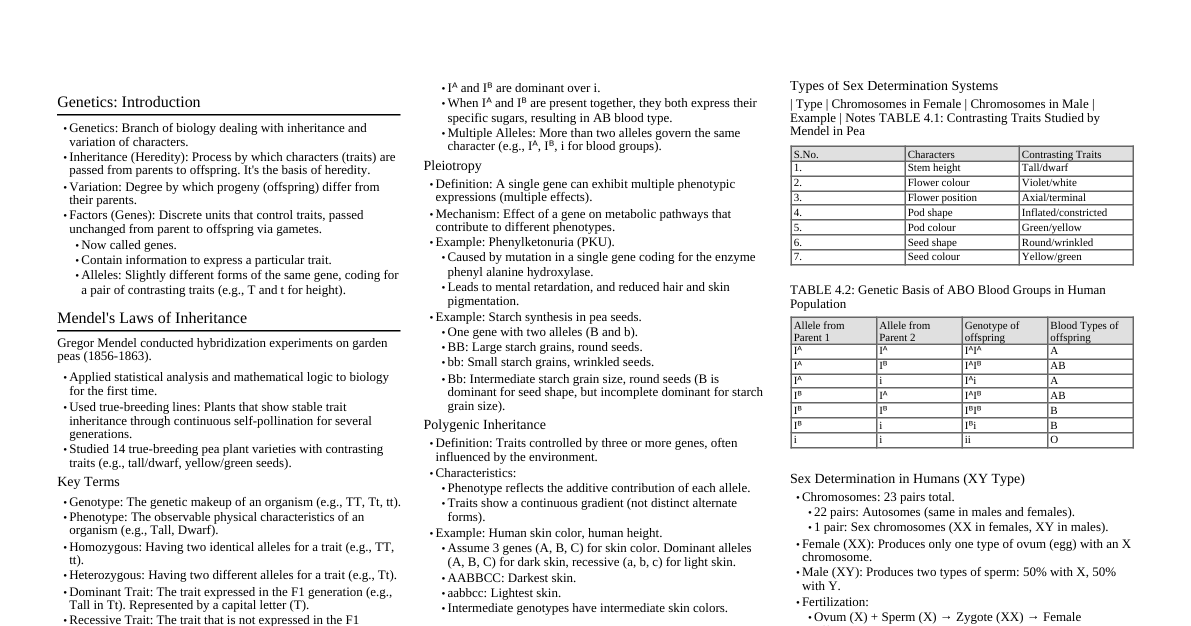
1. Introduction to Heredity Heredity: The passing of traits from parents to offspring. Genetics: The scientific study of heredity and variation. Trait: A specific characteristic of an organism (e.g., eye color, height). Gene: A segment of DNA that codes for a specific trait. Allele: Different forms of a gene (e.g., blue vs. brown eyes). 2. Mendelian Genetics 2.1. Gregor Mendel's Contributions "Father of Genetics" - studied pea plants. Identified basic principles of heredity. 2.2. Key Principles Principle of Segregation: During gamete formation, the two alleles for a heritable character segregate (separate) from each other so that each gamete receives only one allele. Principle of Independent Assortment: Alleles for different genes assort independently of each other during gamete formation, if they are on different chromosomes. 2.3. Terminology Dominant Allele: An allele that is fully expressed in the phenotype when present (represented by a capital letter, e.g., $A$). Recessive Allele: An allele whose phenotypic effect is not observed in a heterozygote (represented by a lowercase letter, e.g., $a$). Homozygous: Having two identical alleles for a given gene (e.g., $AA$ or $aa$). Heterozygous: Having two different alleles for a given gene (e.g., $Aa$). Genotype: The genetic makeup of an organism (e.g., $AA$, $Aa$, $aa$). Phenotype: The observable physical and physiological traits of an organism (e.g., purple flowers, white flowers). 2.4. Punnett Squares A diagram used to predict the genotypes and phenotypes of offspring from a genetic cross. Monohybrid Cross: Cross involving one trait. Example: Aa x Aa | A | a --|---|--- A | AA| Aa --|---|--- a | Aa| aa Genotypic Ratio: 1 AA : 2 Aa : 1 aa Phenotypic Ratio: 3 Dominant : 1 Recessive Dihybrid Cross: Cross involving two traits. Example: AaBb x AaBb Phenotypic Ratio: 9:3:3:1 (9 dominant for both, 3 dominant for first/recessive for second, 3 recessive for first/dominant for second, 1 recessive for both) 3. Beyond Mendelian Genetics 3.1. Incomplete Dominance Heterozygotes exhibit a phenotype intermediate between the two homozygous phenotypes. Example: Red flower ($RR$) x White flower ($WW$) $\rightarrow$ Pink flower ($RW$). 3.2. Codominance Both alleles are fully expressed in the heterozygote phenotype. Example: $ABO$ blood group in humans ($I^A I^B$ results in $AB$ blood type, expressing both $A$ and $B$ antigens). 3.3. Multiple Alleles More than two alleles exist for a gene in the population. Example: $ABO$ blood group ($I^A$, $I^B$, $i$). 3.4. Pleiotropy A single gene affects multiple phenotypic traits. Example: Sickle-cell disease, cystic fibrosis. 3.5. Epistasis One gene alters the phenotypic expression of a second gene. Example: Coat color in Labrador retrievers (gene $E/e$ determines if pigment is deposited, gene $B/b$ determines pigment color). 3.6. Polygenic Inheritance Multiple genes contribute to a single phenotypic trait, often resulting in a continuous variation. Example: Human height, skin color. 3.7. Environmental Influence Phenotype is a result of both genotype and environmental factors. Example: Hydrangea flower color (soil pH affects pigment expression), human height/weight (nutrition). 4. Sources of Variation Mutation: A change in the DNA sequence. Point Mutations: Change in a single nucleotide. Chromosomal Mutations: Changes in chromosome structure or number. Can be spontaneous or induced by mutagens. Genetic Recombination: Reshuffling of genetic material. Independent Assortment: Random orientation of homologous chromosomes during meiosis I. Crossing Over: Exchange of genetic material between homologous chromosomes during prophase I of meiosis. Random Fertilization: Any sperm can fertilize any egg. Sexual Reproduction: Combines genetic material from two parents. Gene Flow: Transfer of alleles between populations. 5. Chromosomal Basis of Inheritance Chromosomes: Structures within the nucleus containing genetic material. Sex Chromosomes: Determine an individual's sex (e.g., $X$ and $Y$ in humans). Autosomes: Non-sex chromosomes. Sex-linked Genes: Genes located on sex chromosomes (most commonly on the $X$ chromosome). Recessive $X$-linked traits are more common in males (e.g., color blindness, hemophilia). Linkage: Genes located close together on the same chromosome tend to be inherited together. Linkage can be broken by crossing over. Recombination frequency is used to map gene distances. Nondisjunction: Failure of homologous chromosomes or sister chromatids to separate during meiosis. Can lead to aneuploidy (abnormal number of chromosomes), e.g., Down syndrome (Trisomy 21).