Inheritance & Variation
Cheatsheet Content
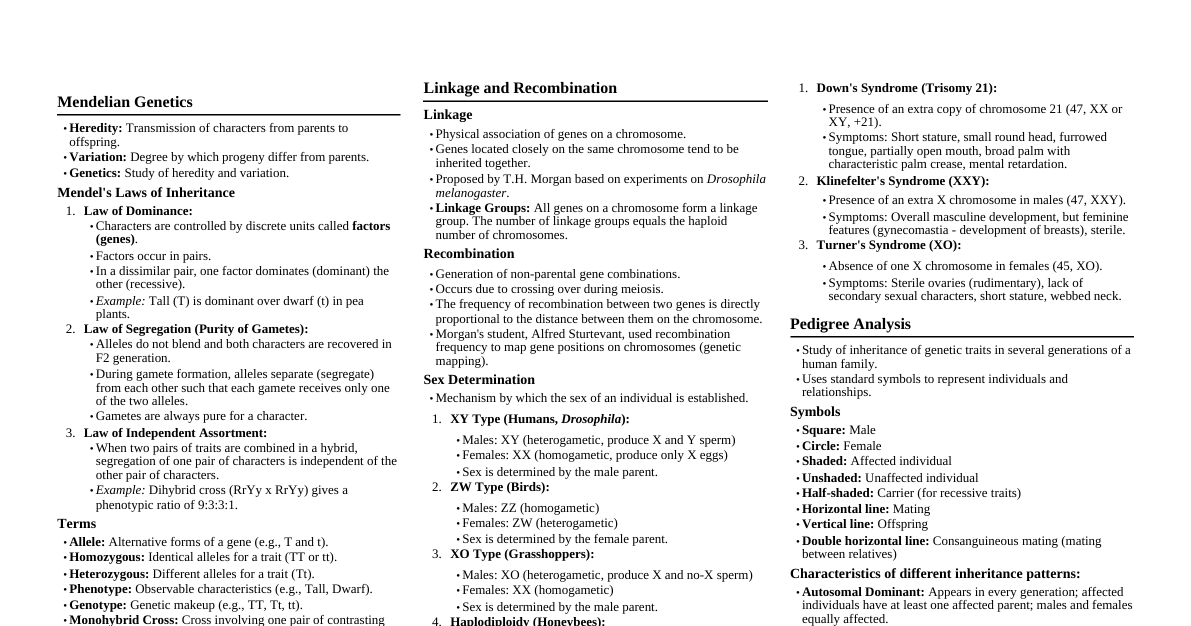
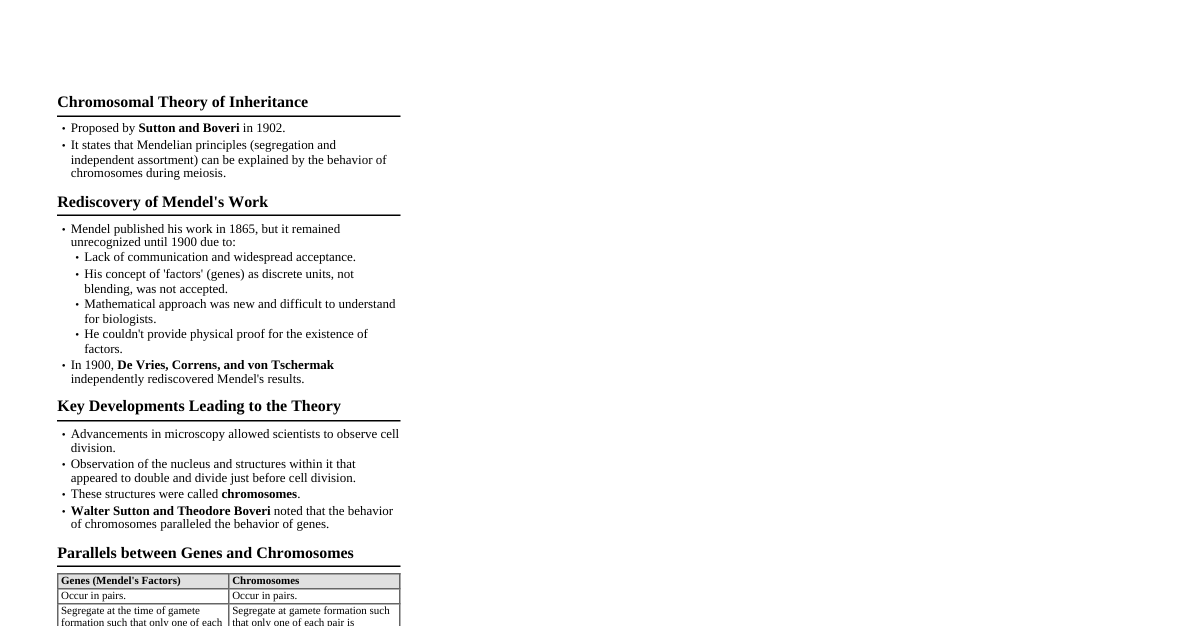
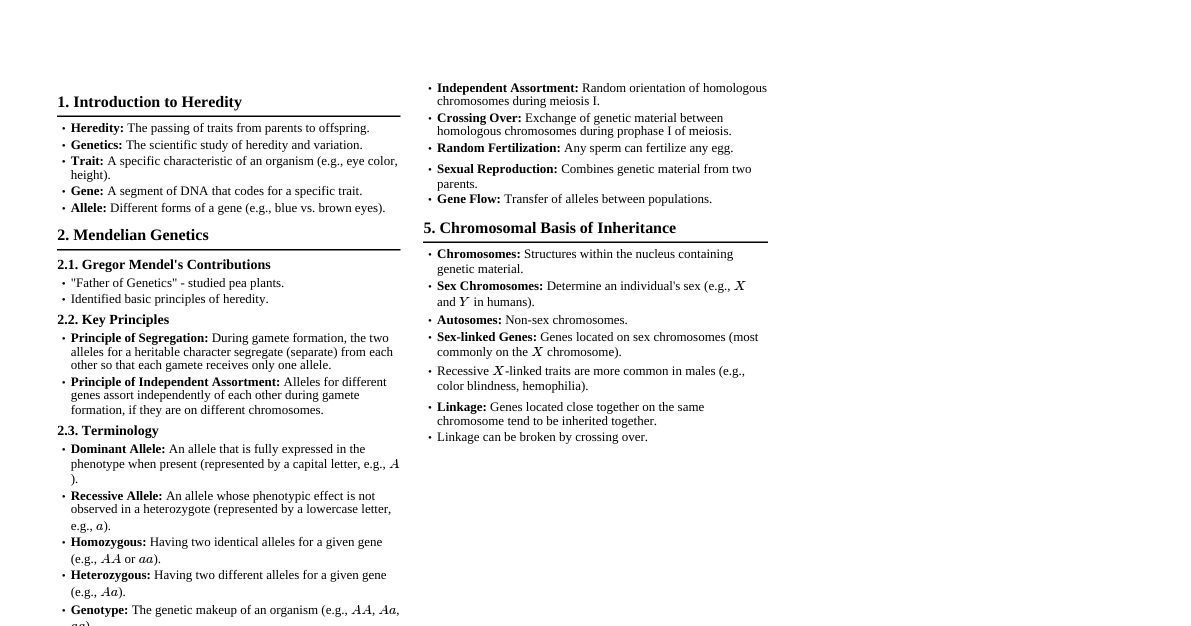
### Genetics: Introduction - **Genetics:** Branch of biology dealing with inheritance and variation of characters. - **Inheritance (Heredity):** Process by which characters (traits) are passed from parents to offspring. It's the basis of heredity. - **Variation:** Degree by which progeny (offspring) differ from their parents. - **Factors (Genes):** Discrete units that control traits, passed unchanged from parent to offspring via gametes. - Now called **genes**. - Contain information to express a particular trait. - **Alleles:** Slightly different forms of the same gene, coding for a pair of contrasting traits (e.g., T and t for height). ### Mendel's Laws of Inheritance Gregor Mendel conducted hybridization experiments on garden peas (1856-1863). - Applied statistical analysis and mathematical logic to biology for the first time. - Used **true-breeding lines:** Plants that show stable trait inheritance through continuous self-pollination for several generations. - Studied 14 true-breeding pea plant varieties with contrasting traits (e.g., tall/dwarf, yellow/green seeds). #### Key Terms - **Genotype:** The genetic makeup of an organism (e.g., TT, Tt, tt). - **Phenotype:** The observable physical characteristics of an organism (e.g., Tall, Dwarf). - **Homozygous:** Having two identical alleles for a trait (e.g., TT, tt). - **Heterozygous:** Having two different alleles for a trait (e.g., Tt). - **Dominant Trait:** The trait expressed in the F1 generation (e.g., Tall in Tt). Represented by a capital letter (T). - **Recessive Trait:** The trait that is not expressed in the F1 generation but reappears in F2 (e.g., Dwarf in Tt). Represented by a small letter (t). #### 1. Law of Dominance - **Statement:** 1. Characters are controlled by discrete units called factors (genes). 2. Factors occur in pairs (alleles). 3. In a dissimilar pair of factors (heterozygous), one member (dominant) dominates the other (recessive). - **Explanation:** Explains why only one parental character is seen in F1 monohybrid cross and the 3:1 ratio in F2. #### 2. Law of Segregation (Law of Purity of Gametes) - **Statement:** The alleles for each gene segregate (separate) from each other during gamete formation, so that each gamete receives only one allele. - **Explanation:** - Alleles do not blend. - Each gamete receives only one of the two alleles. - Homozygous parents produce identical gametes; heterozygous parents produce two types of gametes in equal proportion. #### Monohybrid Cross (Inheritance of One Gene) - Cross between parents differing in one trait (e.g., Tall TT x Dwarf tt). - **F1 Generation:** All offspring show the dominant phenotype (e.g., All Tall Tt). - **F2 Generation:** Produced by self-pollinating F1. - **Phenotypic Ratio:** 3 (Dominant) : 1 (Recessive) (e.g., 3 Tall : 1 Dwarf). - **Genotypic Ratio:** 1 (Homozygous Dominant) : 2 (Heterozygous) : 1 (Homozygous Recessive) (e.g., 1 TT : 2 Tt : 1 tt). #### Punnett Square - Graphical representation to calculate the probability of all possible genotypes of offspring in a genetic cross. - Developed by Reginald C. Punnett. - Gametes from parents are placed on top and side, combinations fill the squares. #### Test Cross - **Definition:** Crossing an organism with a dominant phenotype (unknown genotype) with a recessive parent. - **Purpose:** To determine the genotype of the dominant phenotype individual (whether homozygous dominant or heterozygous). - **Outcome:** - If all offspring show dominant phenotype, the unknown parent is homozygous dominant. - If offspring show both dominant and recessive phenotypes in 1:1 ratio, the unknown parent is heterozygous. ### Beyond Mendelian Genetics #### Incomplete Dominance - **Definition:** F1 phenotype does not resemble either parent, but is an intermediate (in-between) of the two. - **Example:** Flower color in Snapdragon (dog flower). - Red (RR) x White (rr) → F1 Pink (Rr). - F2 Ratio: 1 Red (RR) : 2 Pink (Rr) : 1 White (rr). - Genotypic ratio is 1:2:1, but phenotypic ratio changes from 3:1. - The dominant allele (R) is not completely dominant over the recessive allele (r). #### Co-dominance - **Definition:** F1 generation resembles both parents; both alleles express themselves fully. - **Example:** ABO blood grouping in humans. - Gene I has three alleles: Iᴬ, Iᴮ, i. - Iᴬ and Iᴮ are dominant over i. - When Iᴬ and Iᴮ are present together, they both express their specific sugars, resulting in AB blood type. - **Multiple Alleles:** More than two alleles govern the same character (e.g., Iᴬ, Iᴮ, i for blood groups). #### Pleiotropy - **Definition:** A single gene can exhibit multiple phenotypic expressions (multiple effects). - **Mechanism:** Effect of a gene on metabolic pathways that contribute to different phenotypes. - **Example:** Phenylketonuria (PKU). - Caused by mutation in a single gene coding for the enzyme phenyl alanine hydroxylase. - Leads to mental retardation, and reduced hair and skin pigmentation. - **Example:** Starch synthesis in pea seeds. - One gene with two alleles (B and b). - BB: Large starch grains, round seeds. - bb: Small starch grains, wrinkled seeds. - Bb: Intermediate starch grain size, round seeds (B is dominant for seed shape, but incomplete dominant for starch grain size). #### Polygenic Inheritance - **Definition:** Traits controlled by three or more genes, often influenced by the environment. - **Characteristics:** - Phenotype reflects the additive contribution of each allele. - Traits show a continuous gradient (not distinct alternate forms). - **Example:** Human skin color, human height. - Assume 3 genes (A, B, C) for skin color. Dominant alleles (A, B, C) for dark skin, recessive (a, b, c) for light skin. - AABBCC: Darkest skin. - aabbcc: Lightest skin. - Intermediate genotypes have intermediate skin colors. ### Inheritance of Two Genes (Dihybrid Cross) - Cross between parents differing in two traits (e.g., Round Yellow RRYY x Wrinkled Green rryy). - **F1 Generation:** All offspring show dominant phenotypes for both traits (e.g., All Round Yellow RrYy). - **F2 Generation:** Produced by self-pollinating F1. - **Phenotypic Ratio:** 9 (Round Yellow) : 3 (Wrinkled Yellow) : 3 (Round Green) : 1 (Wrinkled Green). #### Law of Independent Assortment - **Statement:** When two pairs of traits are combined in a hybrid, segregation of one pair of characters is independent of the other pair of characters. - **Explanation:** During gamete formation, the alleles for different genes assort independently of each other. - **Example:** In a dihybrid cross (RrYy), the segregation of R and r is independent of the segregation of Y and y. - **Gametes produced by F1 (RrYy):** RY, Ry, rY, ry (each 25% or 1/4th). - **Genotypic Ratio in F2:** Not 9:3:3:1 (it's more complex, 1:2:1:2:4:2:1:2:1), but the phenotypic ratio is 9:3:3:1. ### Chromosomal Theory of Inheritance - Proposed by Walter Sutton and Theodore Boveri (1902). - **Background:** Mendel's work was rediscovered in 1900 by de Vries, Correns, and von Tschermak. Advancements in microscopy allowed observation of chromosomes. - **Key Ideas:** - Chromosomes, like genes, occur in pairs. - Segregation of chromosomes during meiosis parallels the segregation of genes. - The two alleles of a gene pair are located on homologous sites on homologous chromosomes. - **Conclusion:** Sutton united chromosomal segregation with Mendelian principles, stating that chromosomes are the carriers of genetic material. #### Experimental Verification: T.H. Morgan - Worked with fruit flies, *Drosophila melanogaster*. - **Advantages of Drosophila:** - Short life cycle (2 weeks). - Large number of progeny. - Easy to grow on simple synthetic medium. - Clear differentiation of sexes. - Many hereditary variations visible under low power microscope. #### Linkage and Recombination - Morgan studied sex-linked genes in Drosophila. - **Observation:** When two genes were located on the same chromosome, the F2 ratio deviated significantly from the 9:3:3:1 ratio (expected for independent assortment). - **Linkage:** Physical association of genes on the same chromosome. These genes do not assort independently. - **Recombination:** Generation of non-parental gene combinations. - **Strength of Linkage:** - **Tight Linkage:** Genes are very close, show very low recombination (e.g., white and yellow genes in Drosophila, 1.3% recombination). - **Loose Linkage:** Genes are far apart, show higher recombination (e.g., white and miniature wing genes, 37.2% recombination). - **Genetic Mapping:** Alfred Sturtevant (Morgan's student) used recombination frequency to measure the distance between genes and map their positions on chromosomes. ### Sex Determination - **Mechanism:** Genetic/chromosomal basis of sex. #### Types of Sex Determination Systems | Type | Chromosomes in Female | Chromosomes in Male | Example | Notes TABLE 4.1: Contrasting Traits Studied by Mendel in Pea | S.No. | Characters | Contrasting Traits | |-------|------------------|--------------------| | 1. | Stem height | Tall/dwarf | | 2. | Flower colour | Violet/white | | 3. | Flower position | Axial/terminal | | 4. | Pod shape | Inflated/constricted | | 5. | Pod colour | Green/yellow | | 6. | Seed shape | Round/wrinkled | | 7. | Seed colour | Yellow/green | TABLE 4.2: Genetic Basis of ABO Blood Groups in Human Population | Allele from Parent 1 | Allele from Parent 2 | Genotype of offspring | Blood Types of offspring | |----------------------|----------------------|-----------------------|--------------------------| | Iᴬ | Iᴬ | IᴬIᴬ | A | | Iᴬ | Iᴮ | IᴬIᴮ | AB | | Iᴬ | i | Iᴬi | A | | Iᴮ | Iᴬ | IᴬIᴮ | AB | | Iᴮ | Iᴮ | IᴮIᴮ | B | | Iᴮ | i | Iᴮi | B | | i | i | ii | O | #### Sex Determination in Humans (XY Type) - **Chromosomes:** 23 pairs total. - 22 pairs: Autosomes (same in males and females). - 1 pair: Sex chromosomes (XX in females, XY in males). - **Female (XX):** Produces only one type of ovum (egg) with an X chromosome. - **Male (XY):** Produces two types of sperm: 50% with X, 50% with Y. - **Fertilization:** - Ovum (X) + Sperm (X) → Zygote (XX) → Female offspring. - Ovum (X) + Sperm (Y) → Zygote (XY) → Male offspring. - **Conclusion:** The genetic makeup of the sperm determines the sex of the child. There's always a 50% chance for a male or female child. #### Sex Determination in Honey Bee (Haplodiploid System) - **Mechanism:** Based on the number of chromosome sets an individual receives. - **Female (Queen/Worker):** Diploid (32 chromosomes). Develops from a fertilized egg (union of sperm and egg). - **Male (Drone):** Haploid (16 chromosomes). Develops from an unfertilized egg via parthenogenesis. - **Unique Characteristics of Males:** - Produce sperm by mitosis (not meiosis). - Do not have a father (unfertilized egg). - Cannot have sons. - Have a grandfather. - Can have grandsons. TABLE 4.3: Comparison between the Behaviour of Chromosomes and Genes | Chromosomes (A) | Genes (B) | |---------------------------------------------------------------|-------------------------------------------------------------------------| | Occur in pairs. | Occur in pairs. | | Segregate at the time of gamete formation such that only one of each pair is transmitted to a gamete. | Segregate at gamete formation and only one of each pair is transmitted to a gamete. | | Independent pairs segregate independently of each other. | One pair segregates independently of another pair. | ### Mutation - **Definition:** Phenomenon resulting in alteration of DNA sequences, leading to changes in genotype and phenotype. - **Causes Variation:** Along with recombination, mutation is a source of variation in DNA. - **Types of Mutations:** - **Chromosomal Aberrations:** Loss (deletions) or gain (insertion/duplication) of a segment of DNA, altering chromosome structure. Commonly seen in cancer cells. - **Point Mutation:** Change in a single base pair of DNA. - **Example:** Sickle-cell anemia. - **Frame-shift Mutations:** Deletions and insertions of base pairs of DNA (changing the reading frame). - **Mutagens:** Chemical and physical factors that induce mutations (e.g., UV radiations). ### Genetic Disorders - Disorders associated with inheritance of changed or altered genes or chromosomes. #### Pedigree Analysis - **Definition:** Analysis of inheritance pattern of traits in a family across several generations, represented in a family tree. - **Purpose:** To trace the inheritance of specific traits, abnormalities, or diseases in humans (since controlled crosses are not possible). #### Mendelian Disorders - **Definition:** Disorders mainly determined by alteration or mutation in a single gene. - **Inheritance:** Follows Mendelian principles; pattern can be traced by pedigree analysis. - **Types:** Can be dominant or recessive, and autosomal or sex-linked. - **Examples:** - **Colour Blindness:** - **Type:** Sex-linked recessive disorder. - **Cause:** Defect in red or green cone of eye due to mutation in genes on the X chromosome. - **Symptoms:** Failure to discriminate between red and green color. - **Occurrence:** ~8% males, ~0.4% females (males have only one X chromosome). - **Haemophilia:** - **Type:** Sex-linked recessive disease. - **Cause:** Defect in a single protein involved in blood clotting cascade. - **Symptoms:** Non-stop bleeding from a simple cut. - **Transmission:** From unaffected carrier female to male progeny. Female haemophilic is extremely rare. - **Sickle-cell Anaemia:** - **Type:** Autosome-linked recessive trait. - **Cause:** Single pair of allele (Hbᴬ and Hbˢ). Homozygous (HbˢHbˢ) show disease. Heterozygous (HbᴬHbˢ) are carriers. - **Defect:** Substitution of Glutamic acid (Glu) by Valine (Val) at the 6th position of the beta globin chain of hemoglobin. This is due to a single base substitution (GAG to GUG) in the gene. - **Symptoms:** Mutant hemoglobin polymerizes under low oxygen, changing RBC shape from biconcave disc to elongated sickle-like structure. - **Phenylketonuria (PKU):** - **Type:** Autosomal recessive trait (inborn error of metabolism). - **Cause:** Affected individual lacks an enzyme that converts phenylalanine into tyrosine. - **Symptoms:** Phenylalanine accumulates and is converted to phenylpyruvic acid and other derivatives, leading to mental retardation. Excreted in urine due to poor kidney absorption. - **Thalassemia:** - **Type:** Autosome-linked recessive blood disease. - **Cause:** Mutation or deletion leading to reduced synthesis of one of the globin chains (α or β) of hemoglobin. - **Symptoms:** Formation of abnormal hemoglobin molecules, causing anaemia. - **Types:** - **α Thalassemia:** Affects α globin chain; controlled by HBA1 and HBA2 genes on chromosome 16. - **β Thalassemia:** Affects β globin chain; controlled by HBB gene on chromosome 11. - **Difference from Sickle-cell Anemia:** Thalassemia is a *quantitative* problem (too few globin molecules), while sickle-cell anemia is a *qualitative* problem (incorrectly functioning globin). #### Chromosomal Disorders - **Definition:** Caused by absence, excess, or abnormal arrangement of one or more chromosomes. - **Aneuploidy:** Gain or loss of a chromosome(s) due to failure of chromatid segregation during cell division. - **Trisomy:** Presence of an additional copy of a chromosome (e.g., Trisomy 21 in Down's Syndrome). - **Monosomy:** Absence of one chromosome from a pair (e.g., Monosomy X in Turner's Syndrome). - **Polyploidy:** Increase in a whole set of chromosomes (failure of cytokinesis after telophase). Common in plants. - **Examples:** - **Down's Syndrome:** - **Cause:** Presence of an additional copy of chromosome 21 (Trisomy 21). - **Symptoms:** Short stature, small round head, furrowed tongue, partially open mouth, broad palm with characteristic crease, retarded physical, psychomotor, and mental development. - **Klinefelter's Syndrome:** - **Cause:** Presence of an additional X chromosome (karyotype: 47, XXY). - **Symptoms:** Overall masculine development, but also feminine development (gynaecomastia - development of breasts). Individuals are sterile. - **Turner's Syndrome:** - **Cause:** Absence of one X chromosome (karyotype: 45, X0). - **Symptoms:** Sterile females with rudimentary (underdeveloped) ovaries, lack of other secondary sexual characters.