Universal Human Values - Quick Guide
Cheatsheet Content
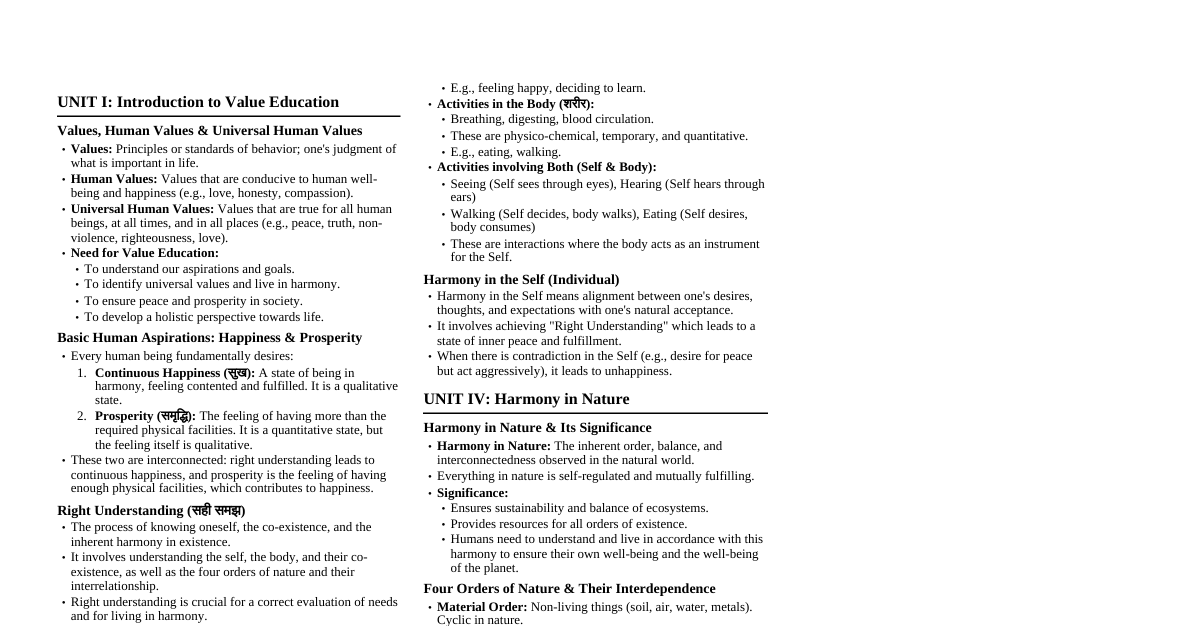
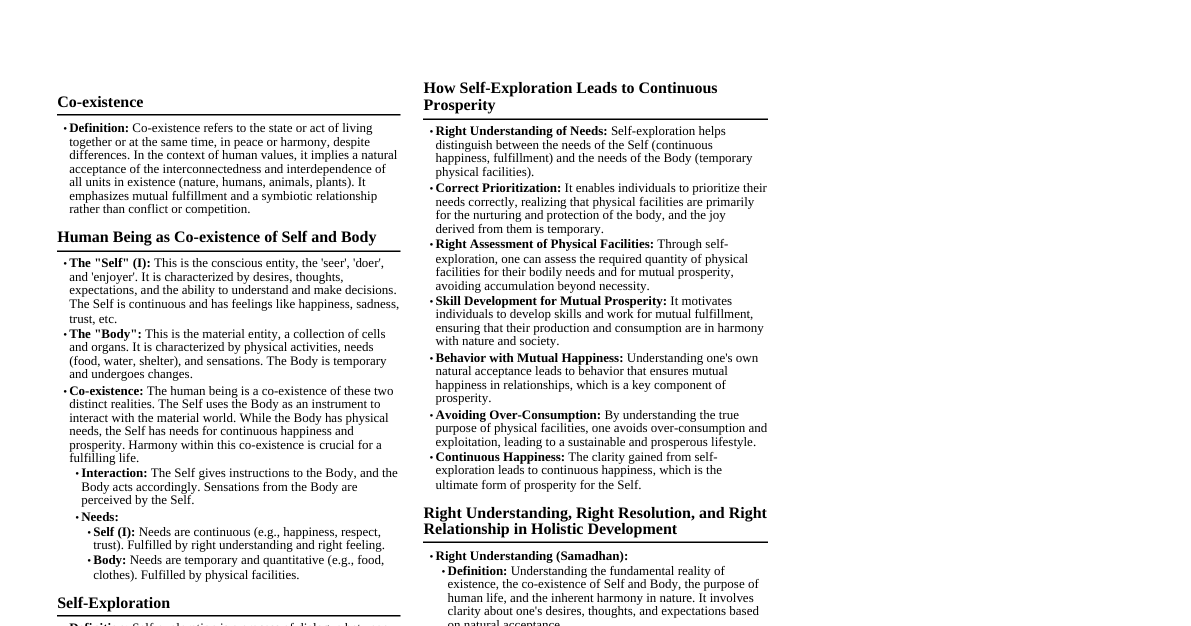
1. Human Values: Introduction and Self-Exploration Need for Value Education: To understand human aspirations and how to fulfill them. It addresses "what to do" (values) and "how to do" (skills). Self-Exploration: A process of self-discovery through dialogue between "what I am" and "what is naturally acceptable to me." Process: Verify proposals based on natural acceptance. Experiential Validation: Live according to the proposal and observe its outcome (mutual happiness/prosperity). Natural Acceptance: Universal, rational, verifiable, innate, and definite. It does not change with time, place, or individual. Basic Aspiration of Human Beings: Continuous happiness and prosperity. Living Harmony at Four Levels: Individual, Family, Society, Nature/Existence. SBD, SSD, SSS: SBD (Sensing, Being, Doing): Activities of the Body. SSD (Seer, Doer, Enjoyer): Activities of the Self (I). SSS (Sum, Substance, System): Holistic perception of existence. 2. Harmony in the Human Being (Self and Body) Sukh (Happiness) vs. Suvidha (Physical Facility): Sukh: A state of harmony; continuous and qualitative, need of the Self. Suvidha: Physical facility; temporary and quantitative, need of the Body. Misunderstanding: Assuming physical facility leads to continuous happiness. Difference between Self (I) and Body: Aspect Self (I) Body Needs Happiness (Sukh) Physical Facility (Suvidha) In Time Continuous Temporary In Quantity Qualitative Quantitative Activities Desire, Thought, Expectation Eating, Walking, Breathing Response Knowing, Assuming, Recognizing, Fulfilling Recognizing, Fulfilling Harmony in the Self: When desire, thought, and expectation are in line with natural acceptance. I am Seer, Doer, and Enjoyer: The Self is the Seer (knows), Doer (takes decisions), and Enjoyer (experiences feelings) of activities. 3. Harmony in the Family and Society Family Harmony: Fulfilment of relationship between one human being and another, based on definite feelings. Nine Feelings (Values): Trust (foundation), Respect, Affection, Care, Guidance, Reverence, Glory, Gratitude, Love (complete). Mutual Happiness: Achieved when feelings are rightly evaluated and fulfilled. Intention and Competence: Intention: Natural acceptance to make self and other happy (always positive). Competence: Ability to fulfill the intention (may be lacking). Trust is on intention, not competence. Respect: Right evaluation. Disrespect arises from over/under/otherwise evaluation or differentiation based on body, physical facility, or beliefs. Universal Human Order: Extension of family order to world family, ensuring harmony at all levels. World Family Society: A society where every human being lives in harmony with every other human being and with nature. 4. Harmony in Nature and Existence Nature as Collection of Units: Classified into four orders: Physical Order (Padarth Avastha): Soil, air, water, metals. Bio Order (Pran Avastha): Plants, trees. Animal Order (Jeev Avastha): Animals, birds. Human Order (Gyan Avastha): Human beings. Harmony in Nature: Mutual fulfillment and interconnectedness among the first three orders (e.g., soil-plant interaction). Human beings have a role to fulfill this harmony. Recyclability and Self-Regulation: Nature is self-regulated (e.g., forest ecosystem) and processes are cyclic (e.g., water cycle) leading to balance. Conformity (Anu-Sangita): Inherent orderliness in nature. Physical Order: Constitution conformity (e.g., water always flows down). Bio Order: Seed conformity (e.g., a neem seed always grows into a neem tree). Animal Order: Breed conformity (e.g., a cow gives birth to a calf). Human Order: Right understanding conformity (e.g., human beings naturally aspire for happiness through right understanding). Co-existence (Sah-astitva): Existence is in the form of units submerged in space. Units: Limited in size, active, energized, self-organized. Space: Unlimited, all-pervading, no activity. Passive and Active Co-existence: Passive: Units existing in space. Active: Units interacting with each other in harmony. Holistic Technology: Living in harmony with nature by developing and using technology that is mutually enriching and eco-friendly. 5. Implications for Human Society Natural Acceptance and Experiential Validation (Revisited): The core process for understanding and living Universal Human Values. Professional Ethics: Competence in Professional Ethics: Clarity about comprehensive human goal. Confidence to live in accordance with the comprehensive human goal. Competence to help others live in accordance with the comprehensive human goal. Competence to evaluate and facilitate the fulfillment of the comprehensive human goal in the society. Humanistic Education: Education that focuses on developing right understanding and feelings, leading to humanistic conduct. Humanistic Constitution: A societal framework based on humanistic principles, ensuring justice, production, and exchange for all. Sustainable Development: Development that meets the needs of the present without compromising the ability of future generations to meet their own needs, ensuring mutual enrichment of all orders of nature.