Continuity & Differentiability
Cheatsheet Content
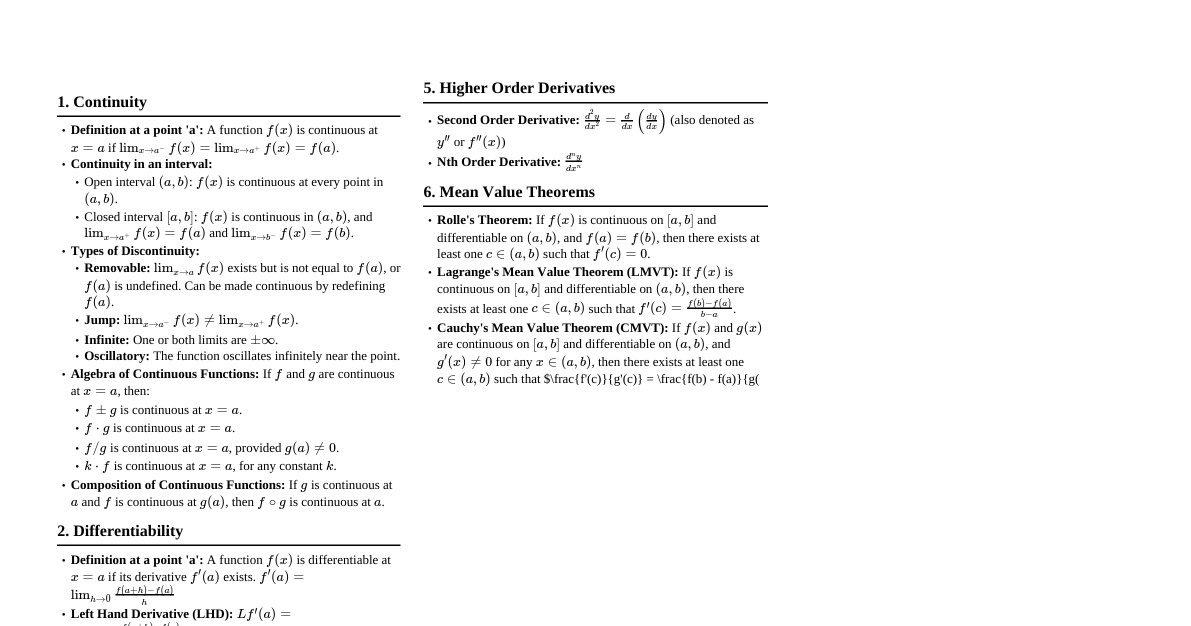
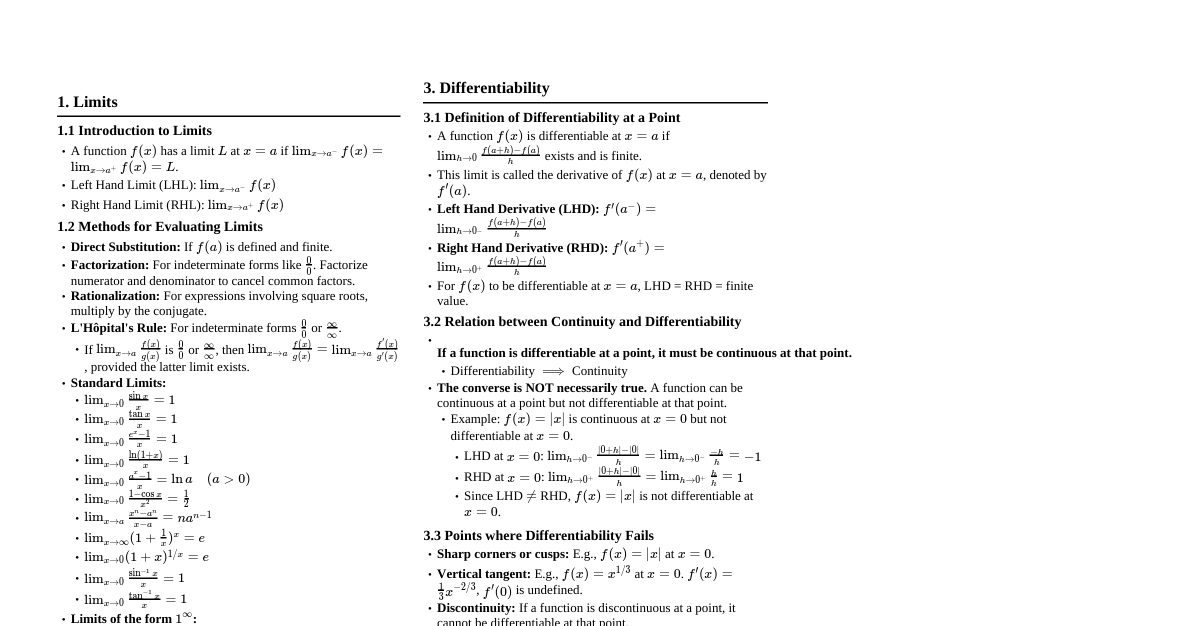
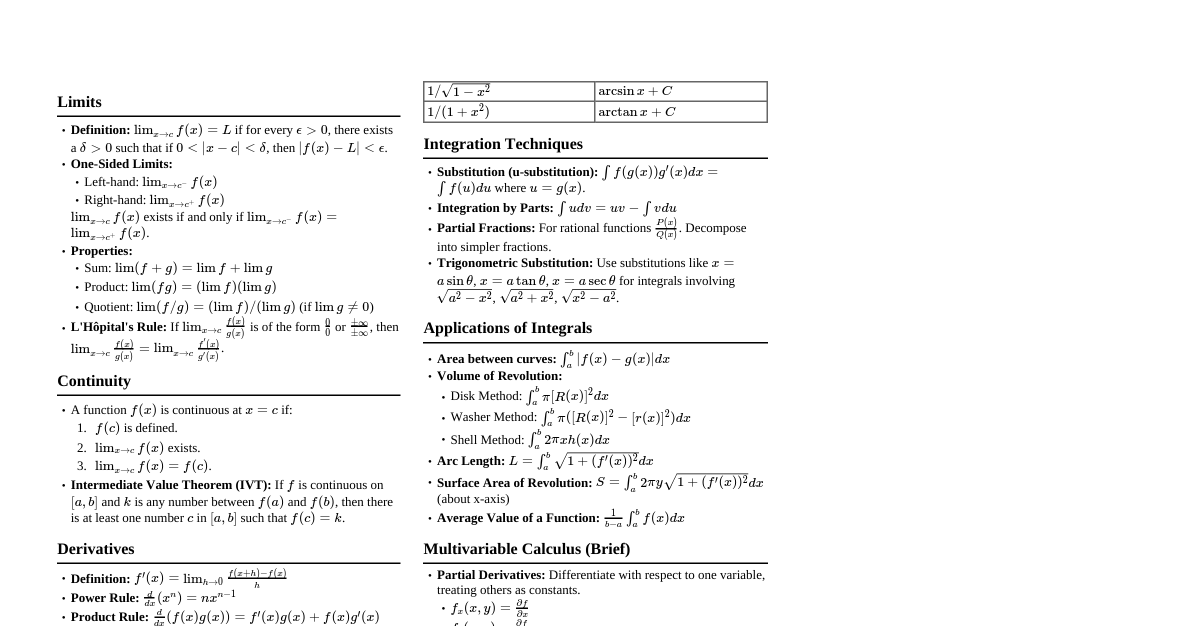
### Continuity: Basics & JEE Specifics - A function $f(x)$ is **continuous** at $x=a$ if: 1. $f(a)$ is defined. 2. $\lim_{x \to a} f(x)$ exists (i.e., $\lim_{x \to a^-} f(x) = \lim_{x \to a^+} f(x)$). 3. $\lim_{x \to a} f(x) = f(a)$. - **JEE Focus:** - **Piecewise Functions:** Check continuity at the "break points" where the definition changes. - **Common Continuous Functions:** Polynomials, exponential ($a^x$), logarithmic ($\log_a x$ for $x>0$), trigonometric (sin, cos), inverse trigonometric functions (within their domains). - **Modulus Function:** $|x|$ is continuous everywhere. $|f(x)|$ is continuous if $f(x)$ is continuous. - **Greatest Integer Function (G.I.F):** $[x]$ is discontinuous at all integers. - **Fractional Part Function:** $\{x\}$ is discontinuous at all integers. - **Signum Function:** $\text{sgn}(x)$ is discontinuous at $x=0$. - **Types of Discontinuity (Graphical Interpretation):** - **Removable:** A "hole" in the graph. $\lim_{x \to a} f(x)$ exists but $\neq f(a)$ or $f(a)$ is undefined. Can be made continuous by redefining $f(a)$. - **Jump:** A "break" in the graph. $\lim_{x \to a^-} f(x) \neq \lim_{x \to a^+} f(x)$. - **Infinite:** Vertical asymptote. $\lim_{x \to a} f(x) = \pm \infty$. - **Oscillatory:** Function oscillates infinitely near the point (e.g., $\sin(1/x)$ at $x=0$). - **Continuity in an Interval:** - **Open interval $(a,b)$:** Continuous at every point in $(a,b)$. - **Closed interval $[a,b]$:** Continuous on $(a,b)$, continuous from the right at $a$ ($\lim_{x \to a^+} f(x) = f(a)$), and continuous from the left at $b$ ($\lim_{x \to b^-} f(x) = f(b)$). ### Continuity: Theorems & Tricks for JEE - **Properties:** - If $f$ and $g$ are continuous at $x=a$, then $f \pm g$, $f \cdot g$, and $f/g$ (if $g(a) \neq 0$) are continuous at $x=a$. - If $f$ is continuous at $x=a$ and $g$ is continuous at $f(a)$, then $g(f(x))$ is continuous at $x=a$. - **Intermediate Value Theorem (IVT):** - If $f$ is continuous on $[a, b]$ and $f(a)$ and $f(b)$ have opposite signs, then there exists at least one $c \in (a, b)$ such that $f(c) = 0$ (i.e., at least one root). - **JEE Use:** Proving existence of roots for equations. - **Extreme Value Theorem (EVT):** - If $f$ is continuous on a closed interval $[a, b]$, then $f$ attains both a maximum and minimum value on that interval. - **JEE Trick: Finding Constants for Continuity:** - For piecewise functions, set the limits from left and right equal to the function value at the break point to find unknown constants. - Example: For $f(x) = \begin{cases} ax+1 & x \le 1 \\ bx^2+1 & x > 1 \end{cases}$ to be continuous at $x=1$, $a(1)+1 = b(1)^2+1 \implies a=b$. ### Differentiability: Definition & JEE Implications - A function $f(x)$ is **differentiable** at $x=a$ if $f'(a)$ exists. - **Definition of Derivative:** $$f'(a) = \lim_{h \to 0} \frac{f(a+h) - f(a)}{h} \quad \text{or} \quad f'(a) = \lim_{x \to a} \frac{f(x) - f(a)}{x - a}$$ - **Left Hand Derivative (LHD) at $x=a$:** $f'(a^-) = \lim_{h \to 0^-} \frac{f(a+h) - f(a)}{h}$ - **Right Hand Derivative (RHD) at $x=a$:** $f'(a^+) = \lim_{h \to 0^+} \frac{f(a+h) - f(a)}{h}$ - For $f(x)$ to be differentiable at $x=a$, LHD = RHD = finite value. - **Geometric Interpretation:** $f(x)$ has a unique tangent at $(a, f(a))$. Graph must be "smooth" (no sharp corners, cusps, or vertical tangents). - **JEE Focus:** - **Relation to Continuity:** If $f(x)$ is differentiable at $x=a$, then it MUST be continuous at $x=a$. (Differentiability $\implies$ Continuity) - **Converse is FALSE:** A function can be continuous but NOT differentiable (e.g., $f(x)=|x|$ at $x=0$). - **Points of Non-differentiability:** 1. **Discontinuity:** If $f(x)$ is not continuous at $x=a$, it cannot be differentiable at $x=a$. 2. **Sharp Corner/Cusp:** (e.g., $f(x)=|x|$ at $x=0$, $f(x)=|x-a|$ at $x=a$). LHD $\neq$ RHD. 3. **Vertical Tangent:** (e.g., $f(x)=x^{1/3}$ at $x=0$). LHD and RHD are infinite. 4. **Oscillatory Behavior:** (e.g., $x \sin(1/x)$ at $x=0$ is continuous but not differentiable). ### Differentiability: Techniques & JEE Problem Solving - **Checking Differentiability of Piecewise Functions:** 1. First check continuity at the break point. If not continuous, not differentiable. 2. If continuous, calculate LHD and RHD using the limit definition (or by differentiating each piece and taking limits). - Example: For $f(x) = \begin{cases} g(x) & x \le a \\ h(x) & x > a \end{cases}$ - $f'(a^-) = g'(a)$ (if $g'(x)$ exists at $a$ and is continuous) - $f'(a^+) = h'(a)$ (if $h'(x)$ exists at $a$ and is continuous) - If $g'(a) = h'(a)$, then $f(x)$ is differentiable at $x=a$. - **Differentiability of $|f(x)|$:** - If $f(x)$ is differentiable, $|f(x)|$ is generally differentiable, EXCEPT at points where $f(x)=0$ and $f'(x) \neq 0$. These points are typically sharp corners. - If $f(x)=0$ and $f'(x)=0$ at a point, then $|f(x)|$ might be differentiable there (e.g., $f(x)=x^2$, $|x^2|=x^2$ is differentiable at $x=0$). - **Differentiability of $\max(f(x), g(x))$ or $\min(f(x), g(x))$:** - Non-differentiable at points where $f(x)=g(x)$ and $f'(x) \neq g'(x)$. These are sharp corners. - **JEE Trick: Using the Definition for Limits:** - Recognize limits of the form $\lim_{h \to 0} \frac{f(a+h) - f(a)}{h}$ as $f'(a)$. - Or $\lim_{x \to a} \frac{f(x) - f(a)}{x - a}$ as $f'(a)$. - Example: $\lim_{x \to 0} \frac{\sin x - \sin 0}{x-0} = \cos(0) = 1$. - **Special Case: $f(x) = x^n \sin(1/x)$ for $x \neq 0, f(0)=0$** - For $n=1$: Continuous at $x=0$, but not differentiable. - For $n=2$: Both continuous and differentiable at $x=0$. - Generally, for differentiability at $x=0$, $n$ must be greater than 1. ### Differentiation Rules & Advanced Techniques for JEE - **Basic Rules (Recap):** - $\frac{d}{dx}(c) = 0$ - $\frac{d}{dx}(x^n) = nx^{n-1}$ - $\frac{d}{dx}(f \pm g) = f' \pm g'$ - $\frac{d}{dx}(cf) = cf'$ - **Product Rule:** $(fg)' = f'g + fg'$ - **Quotient Rule:** $(f/g)' = \frac{f'g - fg'}{g^2}$ - **Chain Rule:** $\frac{d}{dx}(f(g(x))) = f'(g(x))g'(x)$ - **Derivatives of Standard Functions (JEE must-know):** - $\frac{d}{dx}(\sin x) = \cos x$, $\frac{d}{dx}(\cos x) = -\sin x$ - $\frac{d}{dx}(\tan x) = \sec^2 x$, $\frac{d}{dx}(\cot x) = -\csc^2 x$ - $\frac{d}{dx}(\sec x) = \sec x \tan x$, $\frac{d}{dx}(\csc x) = -\csc x \cot x$ - $\frac{d}{dx}(e^x) = e^x$, $\frac{d}{dx}(a^x) = a^x \ln a$ - $\frac{d}{dx}(\ln x) = 1/x$, $\frac{d}{dx}(\log_a x) = \frac{1}{x \ln a}$ - $\frac{d}{dx}(\sin^{-1} x) = \frac{1}{\sqrt{1-x^2}}$ - $\frac{d}{dx}(\cos^{-1} x) = \frac{-1}{\sqrt{1-x^2}}$ - $\frac{d}{dx}(\tan^{-1} x) = \frac{1}{1+x^2}$ - **Implicit Differentiation:** - Used when $y$ cannot be easily expressed as a function of $x$ (e.g., $x^2 + y^2 = r^2$). Differentiate both sides w.r.t $x$, treating $y$ as $f(x)$ and using chain rule for $y$ terms (e.g., $\frac{d}{dx}(y^2) = 2y \frac{dy}{dx}$). - **Parametric Differentiation:** - If $x=f(t)$ and $y=g(t)$, then $\frac{dy}{dx} = \frac{dy/dt}{dx/dt}$. - **Logarithmic Differentiation:** - Useful for functions of the form $f(x)^{g(x)}$ or complex products/quotients. - Steps: Take $\ln$ on both sides, differentiate implicitly, then solve for $\frac{dy}{dx}$. - Example: $y = x^x \implies \ln y = x \ln x \implies \frac{1}{y}\frac{dy}{dx} = 1 \cdot \ln x + x \cdot \frac{1}{x} \implies \frac{dy}{dx} = x^x(1+\ln x)$. - **Higher-Order Derivatives:** - $f''(x) = \frac{d}{dx}(f'(x))$, $f'''(x) = \frac{d}{dx}(f''(x))$, etc. - Used for concavity, points of inflection, and in applications like acceleration (second derivative of position). ### Theorems of Differentiability for JEE - **Rolle's Theorem:** - If $f$ is continuous on $[a, b]$, differentiable on $(a, b)$, and $f(a) = f(b)$, then there exists at least one $c \in (a, b)$ such that $f'(c) = 0$. - **JEE Use:** Proving existence of horizontal tangents, proving existence of roots for $f'(x)=0$. - **Mean Value Theorem (MVT):** - If $f$ is continuous on $[a, b]$ and differentiable on $(a, b)$, then there exists at least one $c \in (a, b)$ such that: $$f'(c) = \frac{f(b) - f(a)}{b - a}$$ - **Geometric Interpretation:** There is at least one point $c$ where the tangent is parallel to the secant line joining $(a, f(a))$ and $(b, f(b))$. - **JEE Use:** - Proving inequalities. - Showing existence of points with specific derivative values. - As a basis for L'Hopital's Rule. - If $f'(x)=0$ for all $x$ in an interval, then $f(x)$ is constant in that interval. - If $f'(x)>0$, $f(x)$ is strictly increasing; if $f'(x) ### Applications & Common JEE Questions - **Finding parameters for continuity/differentiability:** Given a piecewise function, find constants ($a, b, c$) that make it continuous and/or differentiable at specific points. - **Differentiability of functions involving modulus, max/min, G.I.F.:** These are frequent traps. Analyze points where arguments of these functions become zero or integers. - **Using IVT/Rolle's/MVT to prove existence of roots or properties of functions.** - **Graphical analysis:** Interpreting graphs for continuity (no breaks) and differentiability (no sharp corners, cusps, vertical tangents). - **Limits using L'Hopital's Rule (derived from MVT):** - If $\lim_{x \to a} \frac{f(x)}{g(x)}$ is of the form $0/0$ or $\infty/\infty$, then $\lim_{x \to a} \frac{f(x)}{g(x)} = \lim_{x \to a} \frac{f'(x)}{g'(x)}$, provided the latter limit exists. Apply repeatedly if necessary. - **Caution:** Only apply for indeterminate forms.