Dynamics: Ch 16-17.4
Cheatsheet Content
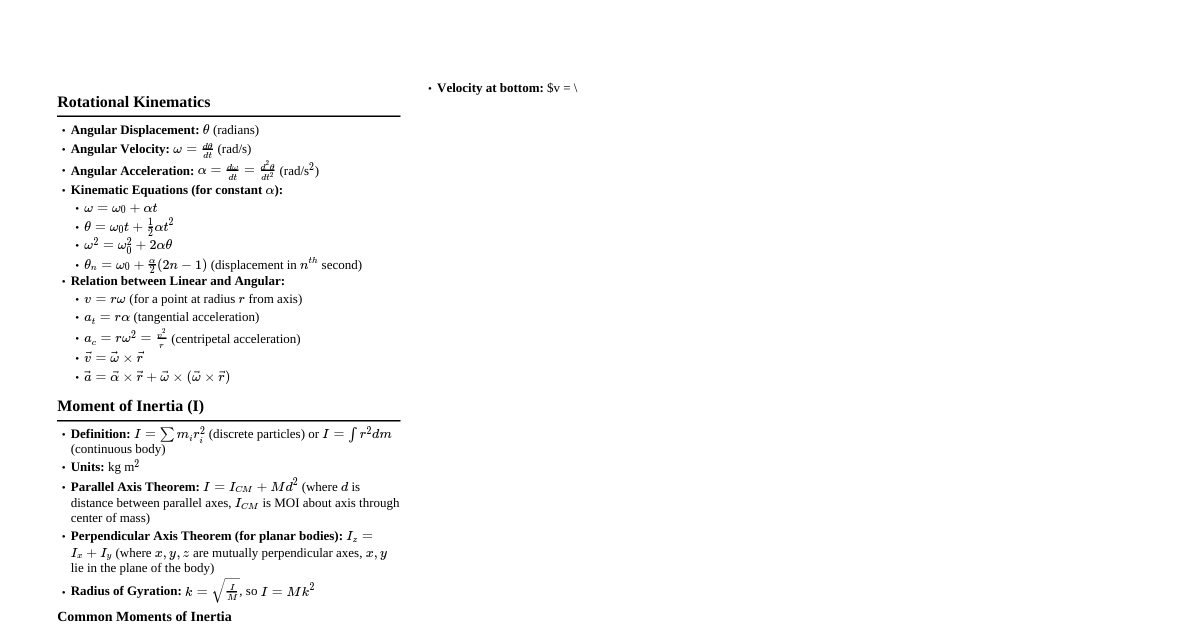
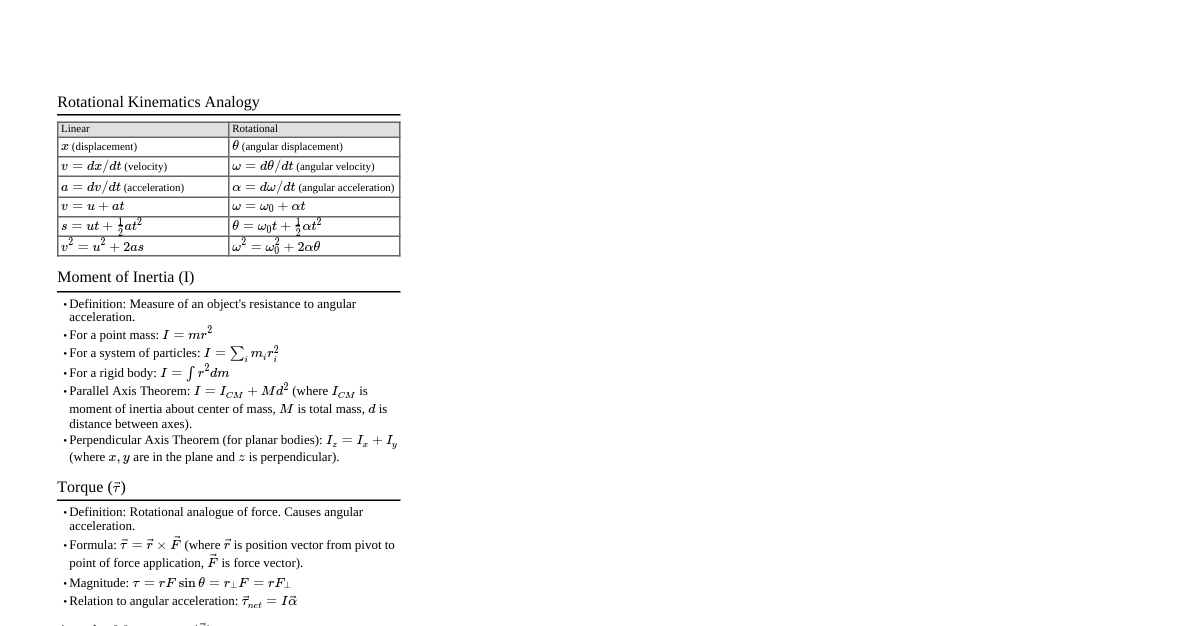
### Chapter 16: Planar Kinematics of a Rigid Body #### 16.1 Planar Rigid-Body Motion - **Translation:** All particles have same velocity & acceleration. - Rectilinear: Straight line path. - Curvilinear: Curved path. - **Rotation about a Fixed Axis:** All particles move in concentric circles. - **General Plane Motion:** Combination of translation and rotation. #### 16.2 Translation - **Velocity:** $\vec{v}_B = \vec{v}_A$ - **Acceleration:** $\vec{a}_B = \vec{a}_A$ - All points on the body have the same velocity and acceleration. #### 16.3 Rotation about a Fixed Axis - **Angular Velocity:** $\omega = \frac{d\theta}{dt}$ (rad/s) - **Angular Acceleration:** $\alpha = \frac{d\omega}{dt} = \frac{d^2\theta}{dt^2}$ (rad/s²) - **Constant Angular Acceleration:** - $\omega = \omega_0 + \alpha_c t$ - $\theta = \theta_0 + \omega_0 t + \frac{1}{2}\alpha_c t^2$ - $\omega^2 = \omega_0^2 + 2\alpha_c (\theta - \theta_0)$ - **Velocity of a Point P:** $\vec{v}_P = \vec{\omega} \times \vec{r}_P$ or $v_P = \omega r_P$ (tangential) - **Acceleration of a Point P:** $\vec{a}_P = \vec{\alpha} \times \vec{r}_P - \omega^2 \vec{r}_P$ - Tangential component: $a_t = \alpha r_P$ - Normal component: $a_n = \omega^2 r_P = v_P^2 / r_P$ #### Example 16.3: Rotating Disk A disk rotates with $\omega = (3t^2 + 2)$ rad/s, where $t$ is in seconds. Determine the angular acceleration and the number of revolutions after $t=2$ s, starting from rest. **Solution:** 1. **Angular Acceleration:** $\alpha = \frac{d\omega}{dt} = \frac{d}{dt}(3t^2 + 2) = 6t$ rad/s². At $t=2$ s, $\alpha = 6(2) = 12$ rad/s². 2. **Angular Position:** $\theta = \int \omega dt = \int (3t^2 + 2) dt = t^3 + 2t + C$. Since it starts from rest ($\theta_0 = 0$ at $t=0$), $C=0$. At $t=2$ s, $\theta = (2)^3 + 2(2) = 8 + 4 = 12$ rad. 3. **Revolutions:** $12 \text{ rad} \times \frac{1 \text{ rev}}{2\pi \text{ rad}} \approx 1.91$ revolutions. #### 16.4 Absolute General Plane Motion Analysis - Uses position vectors to define motion. - **Velocity:** $\vec{v}_P = \frac{d\vec{r}_P}{dt}$ - **Acceleration:** $\vec{a}_P = \frac{d\vec{v}_P}{dt}$ - Requires careful differentiation of complex position vectors. Often cumbersome. #### 16.5 Relative-Motion Analysis: Velocity - **Relative Velocity Equation:** $\vec{v}_B = \vec{v}_A + \vec{v}_{B/A}$ - $\vec{v}_{B/A}$ is the velocity of B relative to A, as seen by an observer fixed on A. - For a rigid body, $\vec{v}_{B/A} = \vec{\omega} \times \vec{r}_{B/A}$, where $\vec{r}_{B/A}$ is the position vector from A to B. - **Equation for Rigid Body:** $\vec{v}_B = \vec{v}_A + \vec{\omega} \times \vec{r}_{B/A}$ - **Instantaneous Center (IC) of Zero Velocity:** A point on the body (or its extension) that has zero velocity at a specific instant. - $\vec{v}_P = \omega r_P$ (where $r_P$ is distance from IC to P). - Locating IC: 1. If $\vec{v}_A$ and $\vec{v}_B$ are known and parallel, IC is at infinity (pure translation). 2. If $\vec{v}_A$ and $\vec{v}_B$ are known and non-parallel, draw perpendiculars from A and B to their velocities. IC is at intersection. 3. If $\vec{v}_A$ and $\omega$ are known, IC is at a distance $r_{IC} = |\vec{v}_A|/|\omega|$ from A, perpendicular to $\vec{v}_A$ in the direction opposite to $\omega$. #### Example 16.5: Connecting Rod The crankshaft AB rotates at a constant angular velocity of $\omega_{AB} = 50$ rad/s. Determine the velocity of the piston at C and the angular velocity of the connecting rod BC. **Given:** $r_{AB} = 0.1$ m, $r_{BC} = 0.3$ m. Assume AB is horizontal at this instant. **Solution (using IC):** 1. **Velocity of B:** Since A is fixed, $v_B = \omega_{AB} r_{AB} = 50 \text{ rad/s} \times 0.1 \text{ m} = 5 \text{ m/s}$. Direction of $\vec{v}_B$ is vertically downwards (if $\omega_{AB}$ is clockwise). 2. **Velocity of C:** Piston C moves horizontally, so $\vec{v}_C$ is horizontal. 3. **Locate IC for rod BC:** - Draw a line perpendicular to $\vec{v}_B$ from B (horizontal). - Draw a line perpendicular to $\vec{v}_C$ from C (vertical). - The intersection of these lines is the IC for rod BC. - From geometry (assume specific angles for clarity, e.g., if BC is at 30 degrees to horizontal), calculate distances from IC to B and IC to C. - Let's assume (for this example, typically given or solved with geometry) that IC is such that $r_{IC-B} = 0.2$ m and $r_{IC-C} = 0.4$ m. 4. **Angular velocity of BC:** $\omega_{BC} = v_B / r_{IC-B} = 5 \text{ m/s} / 0.2 \text{ m} = 25$ rad/s (clockwise, consistent with $v_B$). 5. **Velocity of C:** $v_C = \omega_{BC} r_{IC-C} = 25 \text{ rad/s} \times 0.4 \text{ m} = 10$ m/s (to the right). #### 16.6 Relative-Motion Analysis: Acceleration - **Relative Acceleration Equation:** $\vec{a}_B = \vec{a}_A + \vec{a}_{B/A}$ - $\vec{a}_{B/A}$ is the acceleration of B relative to A, as seen by an observer fixed on A. - For a rigid body, $\vec{a}_{B/A} = (\vec{\alpha} \times \vec{r}_{B/A}) - (\omega^2 \vec{r}_{B/A})$ - **Equation for Rigid Body:** $\vec{a}_B = \vec{a}_A + \vec{\alpha} \times \vec{r}_{B/A} - \omega^2 \vec{r}_{B/A}$ - $\vec{\alpha} \times \vec{r}_{B/A}$ is the tangential component ($a_{B/A})_t$. - $-\omega^2 \vec{r}_{B/A}$ is the normal component ($a_{B/A})_n$. #### Example 16.6: Reciprocating Engine The piston at C has a velocity of 2 m/s to the right and an acceleration of 10 m/s² to the left. Determine the angular acceleration of the connecting rod BC and the angular acceleration of the crankshaft AB. **Given:** At this instant, AB is vertical ($r_{AB}=0.05$ m) and BC is horizontal ($r_{BC}=0.2$ m). **Solution:** 1. **Kinematics of A, B, C:** - A is fixed. $\vec{v}_A = 0$, $\vec{a}_A = 0$. - C moves horizontally: $\vec{v}_C = 2\hat{i}$ m/s, $\vec{a}_C = -10\hat{i}$ m/s². - B moves in a circle around A. 2. **Velocity Analysis (first, to find $\omega_{AB}$ and $\omega_{BC}$):** - $\vec{v}_B = \vec{v}_A + \vec{\omega}_{AB} \times \vec{r}_{B/A} = \vec{\omega}_{AB} \times (0.05\hat{j})$. Let $\vec{\omega}_{AB} = -\omega_{AB}\hat{k}$ (clockwise). $\vec{v}_B = (-\omega_{AB}\hat{k}) \times (0.05\hat{j}) = 0.05\omega_{AB}\hat{i}$. - $\vec{v}_C = \vec{v}_B + \vec{\omega}_{BC} \times \vec{r}_{C/B}$. Let $\vec{\omega}_{BC} = \omega_{BC}\hat{k}$ (counter-clockwise). $\vec{r}_{C/B} = -0.2\hat{i}$. $2\hat{i} = 0.05\omega_{AB}\hat{i} + (\omega_{BC}\hat{k}) \times (-0.2\hat{i}) = 0.05\omega_{AB}\hat{i} - 0.2\omega_{BC}\hat{j}$. - Comparing components: $\hat{i}: 2 = 0.05\omega_{AB} \Rightarrow \omega_{AB} = 40$ rad/s. $\hat{j}: 0 = -0.2\omega_{BC} \Rightarrow \omega_{BC} = 0$ rad/s. - So, $\vec{\omega}_{AB} = -40\hat{k}$ rad/s, $\vec{\omega}_{BC} = 0$ rad/s. 3. **Acceleration Analysis:** - $\vec{a}_B = \vec{a}_A + \vec{\alpha}_{AB} \times \vec{r}_{B/A} - \omega_{AB}^2 \vec{r}_{B/A}$. $\vec{a}_B = 0 + (\alpha_{AB}\hat{k}) \times (0.05\hat{j}) - (40)^2 (0.05\hat{j})$. Let $\vec{\alpha}_{AB} = \alpha_{AB}\hat{k}$. $\vec{a}_B = -0.05\alpha_{AB}\hat{i} - 80\hat{j}$. - $\vec{a}_C = \vec{a}_B + \vec{\alpha}_{BC} \times \vec{r}_{C/B} - \omega_{BC}^2 \vec{r}_{C/B}$. $\vec{a}_C = (-0.05\alpha_{AB}\hat{i} - 80\hat{j}) + (\alpha_{BC}\hat{k}) \times (-0.2\hat{i}) - (0)^2 (-0.2\hat{i})$. Let $\vec{\alpha}_{BC} = \alpha_{BC}\hat{k}$. $-10\hat{i} = -0.05\alpha_{AB}\hat{i} - 80\hat{j} - 0.2\alpha_{BC}\hat{j}$. - Comparing components: $\hat{i}: -10 = -0.05\alpha_{AB} \Rightarrow \alpha_{AB} = 200$ rad/s². ($\vec{\alpha}_{AB} = 200\hat{k}$ rad/s²) $\hat{j}: 0 = -80 - 0.2\alpha_{BC} \Rightarrow \alpha_{BC} = -400$ rad/s². ($\vec{\alpha}_{BC} = -400\hat{k}$ rad/s²) ### Chapter 17: Planar Kinetics of a Rigid Body #### 17.1 Mass Moment of Inertia - **Definition:** $I = \int r^2 dm$ - **Parallel-Axis Theorem:** $I = I_G + md^2$ - $I_G$: mass moment of inertia about mass center G. - $m$: total mass. - $d$: distance between parallel axes. - **Radius of Gyration:** $k = \sqrt{I/m}$ so $I = mk^2$. #### 17.2 Equations of Motion: Translation - If a rigid body undergoes translation, $\alpha = 0$. - $\sum \vec{F} = m\vec{a}_G$ - $\sum M_G = I_G \alpha = 0$ (since $\alpha=0$) - $\sum M_P = (I_G + md^2)\alpha = 0$ if P is any point. #### 17.3 Equations of Motion: Fixed-Axis Rotation - If a rigid body rotates about a fixed axis O, $\vec{a}_G$ has normal and tangential components. - $\sum \vec{F} = m\vec{a}_G$ - $\sum M_O = I_O \alpha$ - Where $I_O$ is the mass moment of inertia about the fixed axis O. $I_O = I_G + md^2$. - **Components:** - $\sum F_n = m(a_G)_n = m\omega^2 r_G$ - $\sum F_t = m(a_G)_t = m\alpha r_G$ - $\sum M_O = I_O \alpha$ #### Example 17.3: Rotating Bar A uniform slender bar of mass $m=10$ kg and length $L=2$ m is pinned at one end O. It is released from rest in the horizontal position. Determine the angular acceleration and the reaction forces at O at the instant of release. **Solution:** 1. **Free-Body Diagram:** Forces are weight $mg$ acting at G (center of bar, $L/2$ from O), and reaction forces $O_x, O_y$ at the pin. 2. **Kinematics:** At instant of release, $\omega=0$. The bar rotates about O. - $\vec{a}_G = (a_G)_t \hat{e}_t + (a_G)_n \hat{e}_n$. Since $\omega=0$, $(a_G)_n = \omega^2 (L/2) = 0$. - $(a_G)_t = \alpha (L/2)$. Direction is initially downwards. 3. **Mass Moment of Inertia:** For a slender bar about its end, $I_O = \frac{1}{3}mL^2$. $I_O = \frac{1}{3}(10 \text{ kg})(2 \text{ m})^2 = \frac{40}{3} \text{ kg} \cdot \text{m}^2$. 4. **Equations of Motion:** - $\sum M_O = I_O \alpha$ $mg(L/2) = I_O \alpha$ $(10 \text{ kg})(9.81 \text{ m/s}^2)(1 \text{ m}) = (\frac{40}{3} \text{ kg} \cdot \text{m}^2) \alpha$ $98.1 = \frac{40}{3}\alpha \Rightarrow \alpha = \frac{3 \times 98.1}{40} = 7.3575$ rad/s². - $\sum F_x = m(a_G)_x$ $O_x = m(0) = 0$ (since $(a_G)_t$ is vertical, and $(a_G)_n=0$) - $\sum F_y = m(a_G)_y$ $O_y - mg = m(a_G)_y$. Here, $(a_G)_y = -(a_G)_t = -\alpha(L/2)$. $O_y - (10)(9.81) = (10)(-7.3575)(1)$ $O_y - 98.1 = -73.575$ $O_y = 98.1 - 73.575 = 24.525$ N. - **Result:** $\alpha = 7.36$ rad/s² (clockwise), $O_x = 0$, $O_y = 24.5$ N (upwards). #### 17.4 Equations of Motion: General Plane Motion - **Three independent equations:** - $\sum F_x = m(a_G)_x$ - $\sum F_y = m(a_G)_y$ - $\sum M_G = I_G \alpha$ - **Alternative Moment Summation:** Sum moments about any arbitrary point P. - $\sum M_P = I_G \alpha + m(a_G)_x d_y - m(a_G)_y d_x$ - Where $d_x, d_y$ are components of $\vec{r}_{G/P}$. - If P is a point of zero acceleration (IC of acceleration), then $\sum M_P = I_P \alpha$. This is rare. - **Most common approach:** Use $\sum M_G = I_G \alpha$ because it simplifies the moment equation by removing terms involving $a_G$. #### Example 17.4: Rolling Wheel A 10 kg wheel has a radius of gyration $k_G = 0.2$ m and a radius $R = 0.3$ m. It rolls without slipping down a 30° incline. Determine the acceleration of its center G and the angular acceleration of the wheel. **Solution:** 1. **Free-Body Diagram:** Forces are weight $mg$ (down), normal force $N$ (perpendicular to incline), and friction force $F_f$ (up the incline). 2. **Kinematics (No-Slip Condition):** - $a_G = R\alpha$ 3. **Mass Moment of Inertia:** $I_G = mk_G^2 = (10 \text{ kg})(0.2 \text{ m})^2 = 0.4 \text{ kg} \cdot \text{m}^2$. 4. **Equations of Motion:** - **Coordinate System:** x-axis down the incline, y-axis perpendicular to incline. - $\sum F_x = m(a_G)_x$: $mg \sin 30^\circ - F_f = m a_G$ $(10)(9.81)(0.5) - F_f = 10 a_G$ $49.05 - F_f = 10 a_G$ (Eq 1) - $\sum F_y = m(a_G)_y$: $N - mg \cos 30^\circ = 0$ (no acceleration perpendicular to incline) $N = (10)(9.81)(\sqrt{3}/2) = 84.95$ N - $\sum M_G = I_G \alpha$: $F_f R = I_G \alpha$ (friction creates clockwise moment, if $\alpha$ is clockwise) $F_f (0.3) = 0.4 \alpha$ (Eq 2) 5. **Solve System of Equations:** - From kinematics: $\alpha = a_G / R = a_G / 0.3$. Substitute into Eq 2. $F_f (0.3) = 0.4 (a_G / 0.3)$ $F_f = \frac{0.4}{0.09} a_G = \frac{40}{9} a_G \approx 4.444 a_G$ - Substitute $F_f$ into Eq 1: $49.05 - \frac{40}{9} a_G = 10 a_G$ $49.05 = (10 + \frac{40}{9}) a_G = (\frac{90+40}{9}) a_G = \frac{130}{9} a_G$ $a_G = \frac{49.05 \times 9}{130} = 3.397$ m/s². - $\alpha = a_G / 0.3 = 3.397 / 0.3 = 11.32$ rad/s². - **Result:** $a_G = 3.40$ m/s² (down incline), $\alpha = 11.3$ rad/s² (clockwise). - Check friction: $F_f = 4.444(3.397) = 15.1$ N. This is less than $\mu_s N$ (if $\mu_s$ is reasonable, e.g., $\mu_s N = 0.3 \times 84.95 = 25.5$ N), so no-slip assumption is valid.