Fundamentals of Flight
Cheatsheet Content
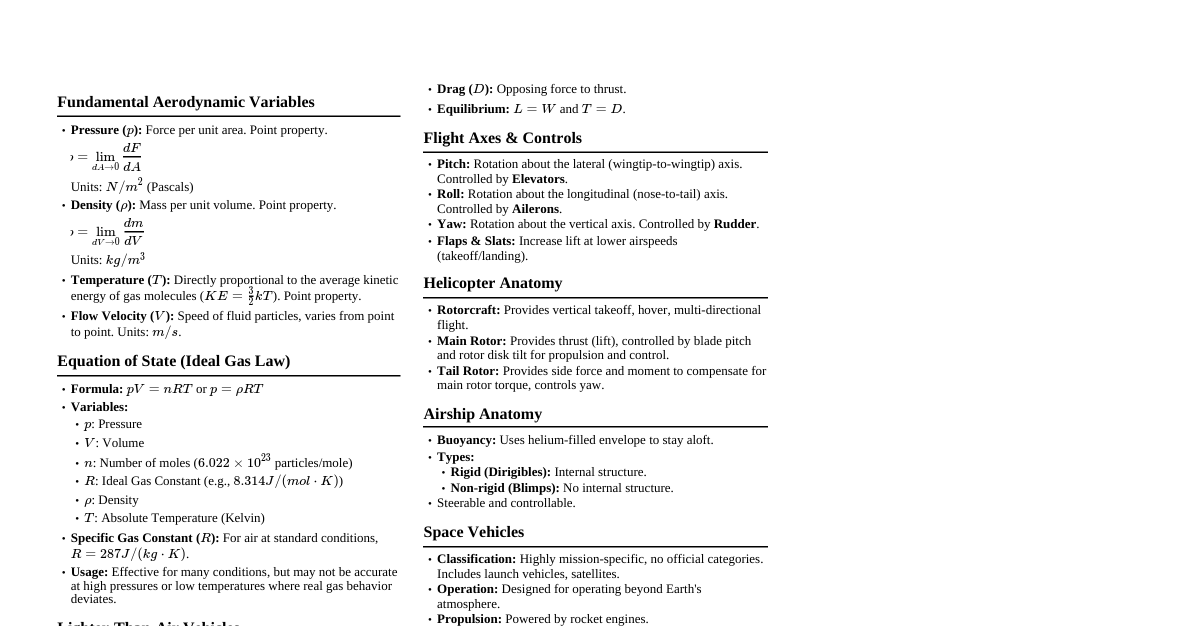
Fundamentals of Aeronautics Physical Properties of Flowing Gas: Pressure, Density, Temperature, Flow Velocity Standard Atmosphere: Pressure, Temperature, Density variations with altitude Ideal Gas Law: Equation of State, Gas Constants Aerospace Vehicle Anatomy: Wings, Fuselage, Tail, Propulsion, Navigation, Life Support Systems Aerodynamic Variables Pressure ($P$) Definition: Force per unit area. $P = \lim_{dA \to 0} \frac{dF}{dA}$ (N/m$^2$) Point Property: Varies from point to point in a fluid. Density ($\rho$) Definition: Mass per unit volume. $\rho = \lim_{dv \to 0} \frac{dm}{dv}$ (kg/m$^3$) Point Property: Varies from point to point. Temperature ($T$) Relationship with Kinetic Energy: $KE = \frac{3}{2}kT$, where $k$ is Boltzmann constant. Directly proportional to the average kinetic energy of molecules. Point Property: Varies from point to point. Flow Velocity ($V$) Expressed in m/s. Varies from point to point in a fluid. Equation of State for a Perfect Gas Ideal Gas Law: $PV = nRT$ or $P = \rho RT$ $P$: Pressure (Pa) $V$: Volume (m$^3$) $n$: Number of moles $R$: Ideal Gas Constant (8.314 J/(mol·K) or 0.0821 L·atm/(mol·K)) $\rho$: Density (kg/m$^3$) $T$: Absolute Temperature (K) Specific Gas Constant for Air: $R = 287$ J/(kg·K) at standard conditions. Real Gas Behavior: Ideal gas law is effective for many conditions but may not be accurate at high pressures or low temperatures due to intermolecular forces and finite molecular volume. Lighter-Than-Air Vehicles Principle: Buoyancy: Upward force exerted by a fluid is equal to the weight of the fluid displaced. Lifting Gases: Hydrogen, Helium, or heated air (less dense than surrounding atmosphere). Types: Balloons: Simple, unpowered, rely solely on buoyancy (hot air or gas-filled). Airships (Dirigibles): Powered, steerable, use lighter-than-air gas for lift and engines for propulsion. Applications: Surveillance, transportation, scientific research. Types of Aircraft Airplanes: Fixed wings for lift, propulsion systems (piston, turboprop, jet). Commercial Airliners, Military Aircraft, Private Jets, Cargo Planes. Single-engine vs. Multi-engine. Land vs. Sea (Amphibious). Rotorcraft: Use rotating blades (rotors) for lift (e.g., helicopters, gyroplanes, tiltrotors). Anatomy of an Aeroplane Fuselage: Main body, houses essential systems, payload (passengers, cargo). Wings: Aerodynamically shaped structures producing lift. Empennage (Tail): Vertical Stabilizer: Provides directional (yaw) stability. Rudder: Controls directional yaw. Horizontal Stabilizer: Balances aircraft's pitch. Elevator: Controls pitch. Flight Control Surfaces: Ailerons: Controls roll. Flaps: Enhances lift at low speeds (takeoff/landing). Slats: Movable panels on leading edge, increase lift. Spoilers: Reduce lift, increase drag (braking). Trim Tabs: Small adjustable surfaces on control surfaces, stabilize aircraft. Undercarriage (Landing Gear): Allows ground movement. Propeller/Engines: Generates forward propulsion. Cockpit: Controls aircraft, contains instruments, avionics. Engine Cowling: Reduces drag and noise from engine. Pylons: Attaches engines to wings. Wing Design Principles Functions: Lift generation, drag minimization, stability, control. Structure (Semi-monocoque stressed-skin design): Spars and Stringers: Spanwise elements carrying shear forces and bending moments. Ribs: Crosswise elements defining wing shape and torsion loads. Skin: Thin outer layer riveted to internal structure. Rivets: Fasteners securing structure. Also houses fuel tanks and systems. Empennage (Tail) Designs Conventional: Standard stability. T-Tail: Enhanced stability, reduced drag. V-Tail: Unique aerodynamic benefits. H-Tail: Balances stability and control. Flying Wings: Lack traditional tails, achieve stability via blended wing-body design, reflexed airfoils, balanced pitching moments. Fuselage Commercial Airliners: Primarily carries payload (passengers, cargo). Pressurized for comfort. Functions as a large pressure vessel. Fighter Aircraft: Accommodates engines and fuel. Often use jettisonable external fuel tanks. Large, powerful stabilizers for maneuverability. Ballistic protection adds weight. Engines & Powerplants Turbofan Engine Operation Fan: Accelerates large air mass, low change in flow velocity, results in low exit ("jet") velocity. Increases propulsive efficiency. Core: Air compressed, mixed with fuel, ignited. Hot gases drive power turbine. Thrust Production: Fan contributes majority of thrust. Jet velocity from core is substantially higher than bypass jet. Forces of Flight & Flight Axes Four Forces in Steady, Equilibrium Flight Weight: Downward force due due to gravity. Lift: Upward aerodynamic force, primarily from wings. Drag: Resistance force opposing motion. Thrust: Forward force generated by propulsion. Equilibrium Conditions: Lift = Weight, Thrust = Drag. Lift Generation Airflow accelerates over upper wing surface $\implies$ lower pressure. Pressure difference between upper and lower surfaces creates lift. Lift generation always incurs drag. Flight Axes Pitch: Rotation about the lateral axis (wingtip to wingtip), controlled by elevator. Roll: Rotation about the longitudinal axis (nose to tail), controlled by ailerons. Yaw: Rotation about the vertical axis (top to bottom), controlled by rudder. Anatomy of a Helicopter Rotorcraft: Provides vertical takeoff, hover, and flight in any direction. Main Rotor: Provides thrust (lift) by changing blade pitch. Also used for control and forward propulsion by cyclically adjusting blade angle and tilting rotor disk. Tail Rotor: Provides side force and moment to compensate for main rotor torque. Modulating its thrust provides directional (yaw) control. Anatomy of an Airship Uses buoyancy to stay aloft, large helium-filled envelope, steerable. Types: Rigid Airships (Dirigibles): Internal structure. Non-rigid Airships (Blimps): No internal structure. Anatomy of Space Vehicles Highly mission-specific, no official categories. Includes launch vehicles, satellites, any object leaving Earth's atmosphere. Powered by rocket engines to operate beyond Earth's atmosphere. Launchers: Can be reconfigurable with different stages or boosters depending on mission/payload. Saturn V Example (Multi-stage Rocket) First Stage: Initial launch, jettisoned after fuel exhaustion. Second Stage: Propels to higher altitude, jettisoned. Third Stage: Accelerates payload to orbital velocity, may be jettisoned. Rocket Engine Operation Propellant (fuel and oxidizer) flows into combustion chamber. Turbopumps driven by upstream combustion chambers supply fuel/oxidizer. Regenerative Cooling: Fuel circulated around nozzle to keep it cool and preheat it, increasing combustion efficiency and thrust. Other Spacecraft Examples SpaceX Falcon 9 (reusable first stage). NASA Space Shuttle (from 1981 to 2011). Voyager Deep Space Probe. Hubble Space Telescope. Earth's Atmosphere Layers Troposphere: Up to 11 km from Mean Sea Level. Oxygen: 21% by Vol., Nitrogen: 78% by Vol. Pressure decreases with altitude. Temperature decreases $6.5^\circ C$ per km. Stratosphere: Up to 32 km. Temperature constant at $216.5$ K ($-56.65^\circ C$). Mesosphere: 32 km to 76 km. Ozone Layer absorbs UV radiation. Temperature rises then decreases. Ionosphere: Up to 640 km. Exosphere: Outermost layer. International Standard Atmosphere (ISA) A reference atmosphere defined by ICAO to standardize atmospheric properties. Sea Level Conditions ($Z=0$): Pressure ($P_0$): $1.01325 \times 10^5$ N/m$^2$ Temperature ($T_0$): $288.2$ K Density ($\rho_0$): $1.225$ kg/m$^3$ Velocity of sound ($C$): $340.3$ m/s Gas Constant for air ($R$): $287$ J/kg·K Lapse rate ($\alpha$): $6.5^\circ C$ per $1000$ m Troposphere Properties (Sea Level to 11 km): Temperature: $T = T_0 - \alpha Z$ Pressure ratio: $\frac{P}{P_0} = \left(\frac{T}{T_0}\right)^{\frac{g}{\alpha R}}$ At $Z=11000$ m: $P = 0.227 \times 10^5$ N/m$^2$, $T = 216.5$ K, $\rho = 0.365$ kg/m$^3$. High Altitude Effects: Negligible aerodynamic resistance (drag) due to low density, reduces frictional heating. For aircraft, this advantage is offset by decreased lift and engine airflow. Rocket engines are unaffected by low air density as they carry their own oxidizers.