Fundamentals of Flight (Chap 1)
Cheatsheet Content
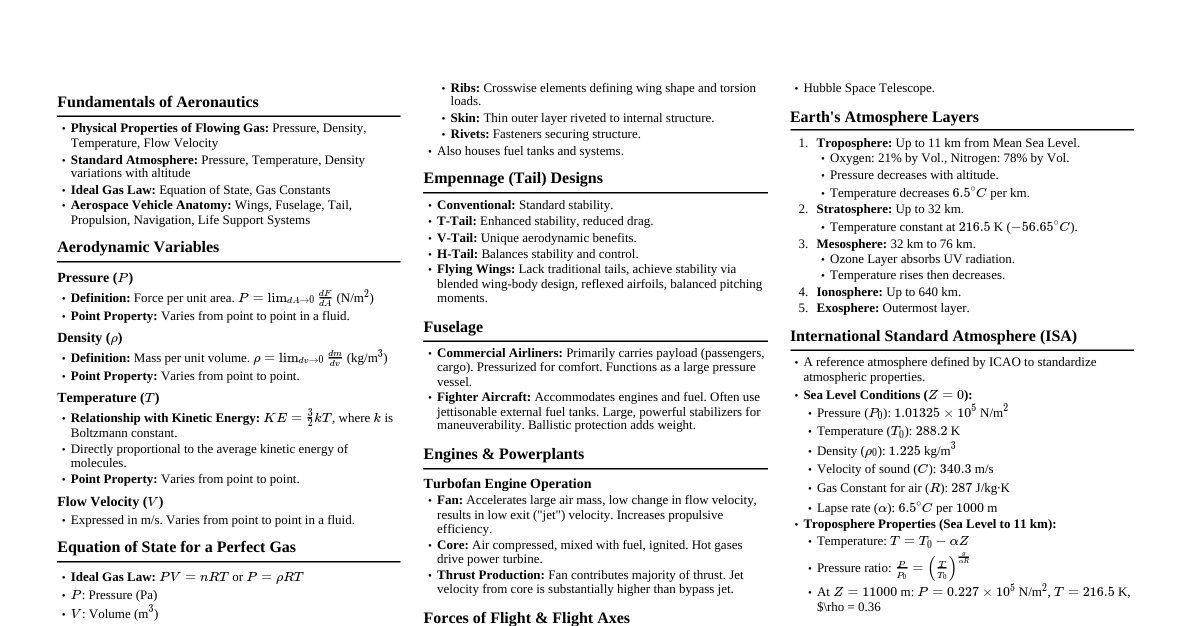
Fundamental Aerodynamic Variables Pressure ($p$): Force per unit area. Point property. $$p = \lim_{dA \to 0} \frac{dF}{dA}$$ Units: $N/m^2$ (Pascals) Density ($\rho$): Mass per unit volume. Point property. $$\rho = \lim_{dV \to 0} \frac{dm}{dV}$$ Units: $kg/m^3$ Temperature ($T$): Directly proportional to the average kinetic energy of gas molecules ($KE = \frac{3}{2}kT$). Point property. Flow Velocity ($V$): Speed of fluid particles, varies from point to point. Units: $m/s$. Equation of State (Ideal Gas Law) Formula: $pV = nRT$ or $p = \rho RT$ Variables: $p$: Pressure $V$: Volume $n$: Number of moles ($6.022 \times 10^{23}$ particles/mole) $R$: Ideal Gas Constant (e.g., $8.314 J/(mol \cdot K)$) $\rho$: Density $T$: Absolute Temperature (Kelvin) Specific Gas Constant ($R$): For air at standard conditions, $R = 287 J/(kg \cdot K)$. Usage: Effective for many conditions, but may not be accurate at high pressures or low temperatures where real gas behavior deviates. Lighter-Than-Air Vehicles Principle: Buoyancy - Upward force exerted by a fluid is equal to the weight of the fluid displaced. Lifting Gases: Hydrogen, Helium, or heated air (less dense than surrounding atmosphere). Types: Balloons: Simple, unpowered (hot air or gas-filled). Airships (Dirigibles): Powered, steerable, gas-filled. Applications: Surveillance, transportation, scientific research. Anatomy of an Aeroplane Fuselage: Main body, houses payload, systems. Commercial: Pressurized, carries passengers/cargo. Fighter: Accommodates engine(s), fuel, ballistic protection. Wings: Aerodynamically shaped structures producing lift. Empennage (Tail): Consists of horizontal and vertical stabilizers. Vertical Stabilizer: Provides directional (yaw) stability. Rudder: Controls directional yaw. Horizontal Stabilizer: Balances pitch. Elevator: Controls pitch. Undercarriage (Landing Gear): Allows ground movement. Propeller/Engines: Generate forward propulsion. Flight Control Surfaces: Ailerons, elevator, rudder, flaps, slats, spoilers. Cockpit: Where flight crew controls aircraft. Aeroplane Wing Design Functions: Lift generation, drag minimization, stability, control, structural efficiency, weight reduction. Construction: Semi-monocoque stressed-skin design. Spars: Spanwise elements, carry shear forces and bending moments. Ribs: Crosswise elements, define wing shape, carry torsion loads. Stringers: Longitudinal stiffeners. Skin: Thin outer layer, riveted to internal structure. Fuel Tanks: Hollow structures within wings. Aeroplane Empennage (Tail) Types Conventional: Standard configuration for stability. T-Tail: Horizontal stabilizer mounted on top of vertical stabilizer; enhanced stability, reduced drag. V-Tail: Two surfaces forming a 'V'; combines functions of horizontal and vertical stabilizers. H-Tail: Twin vertical stabilizers with a horizontal stabilizer between them. Turbofan Engine Principle Fan: Accelerates large mass of air, low change in flow velocity, low exit velocity, increases propulsive efficiency. Core: Air compressed, mixed with fuel, ignited; hot gases drive power turbine. Thrust: Majority produced by the fan (bypass jet). Core jet is substantially higher velocity. Forces of Flight (Steady, Equilibrium Flight) Lift ($L$): Upward force, generated by wings. From pressure difference: Faster airflow over upper surface $\implies$ lower pressure. Weight ($W$): Downward force due to gravity. Thrust ($T$): Forward force, generated by engines/propellers. Drag ($D$): Opposing force to thrust. Equilibrium: $L = W$ and $T = D$. Flight Axes & Controls Pitch: Rotation about the lateral (wingtip-to-wingtip) axis. Controlled by Elevators . Roll: Rotation about the longitudinal (nose-to-tail) axis. Controlled by Ailerons . Yaw: Rotation about the vertical axis. Controlled by Rudder . Flaps & Slats: Increase lift at lower airspeeds (takeoff/landing). Helicopter Anatomy Rotorcraft: Provides vertical takeoff, hover, multi-directional flight. Main Rotor: Provides thrust (lift), controlled by blade pitch and rotor disk tilt for propulsion and control. Tail Rotor: Provides side force and moment to compensate for main rotor torque, controls yaw. Airship Anatomy Buoyancy: Uses helium-filled envelope to stay aloft. Types: Rigid (Dirigibles): Internal structure. Non-rigid (Blimps): No internal structure. Steerable and controllable. Space Vehicles Classification: Highly mission-specific, no official categories. Includes launch vehicles, satellites. Operation: Designed for operating beyond Earth's atmosphere. Propulsion: Powered by rocket engines. Multi-stage Rockets (e.g., Saturn V): Stages jettisoned after fuel exhaustion to reduce weight. Rocket Engine Propellant Flow: Fuel and oxidizer flow into combustion chamber. Thrust: Generated by high-velocity exhaust from nozzle. Turbopumps: Driven by upstream combustion chambers to supply high flow rates. Regenerative Cooling: Fuel circulated around nozzle to keep it cool and preheat it, increasing efficiency. Earth's Atmosphere Layers Troposphere: Up to 11 km. Temperature decreases $6.5^\circ C$ per km. Oxygen (21%), Nitrogen (78%). Stratosphere: Up to 32 km. Temperature constant ($216.5 K$). Mesosphere: 32 km to 76 km. Ozone layer (absorbs UV). Ionosphere: Up to 640 km. Exosphere: Outermost layer. International Standard Atmosphere (ISA) Purpose: Reference atmosphere to standardize properties at various altitudes. Sea Level Conditions ($\mathbf{Z=0}$): Pressure ($p_0$): $1.01325 \times 10^5 N/m^2$ Temperature ($T_0$): $288.2 K$ Density ($\rho_0$): $1.225 kg/m^3$ Velocity of Sound ($C$): $340.3 m/s$ Gas Constant for air ($R$): $287 J/(kg \cdot K)$ Lapse Rate ($\alpha$): $6.5^\circ C$ per $1000 m$ Troposphere Properties (Sea Level to 11 km): Temperature: $T = T_0 - \alpha Z$ Pressure: $\frac{p}{p_0} = \left(\frac{T}{T_0}\right)^{\frac{g}{\alpha R}}$ At $Z=11000m$: $p = 0.227 \times 10^5 N/m^2$, $T = 216.5 K$, $\rho = 0.365 kg/m^3$. High Altitude Effects: Negligible aerodynamic resistance (drag) due to low density, reduced frictional heating. However, aircraft lift decreases significantly. Rocket engines are unaffected as they carry oxidizers.