Math for Little Ones
Cheatsheet Content
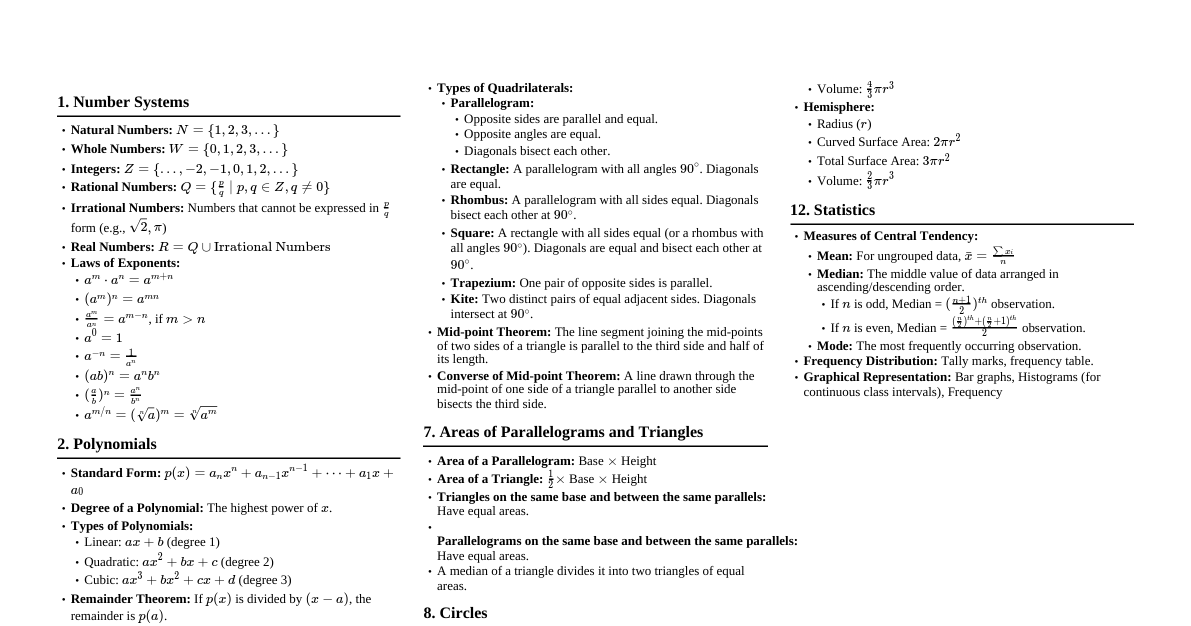
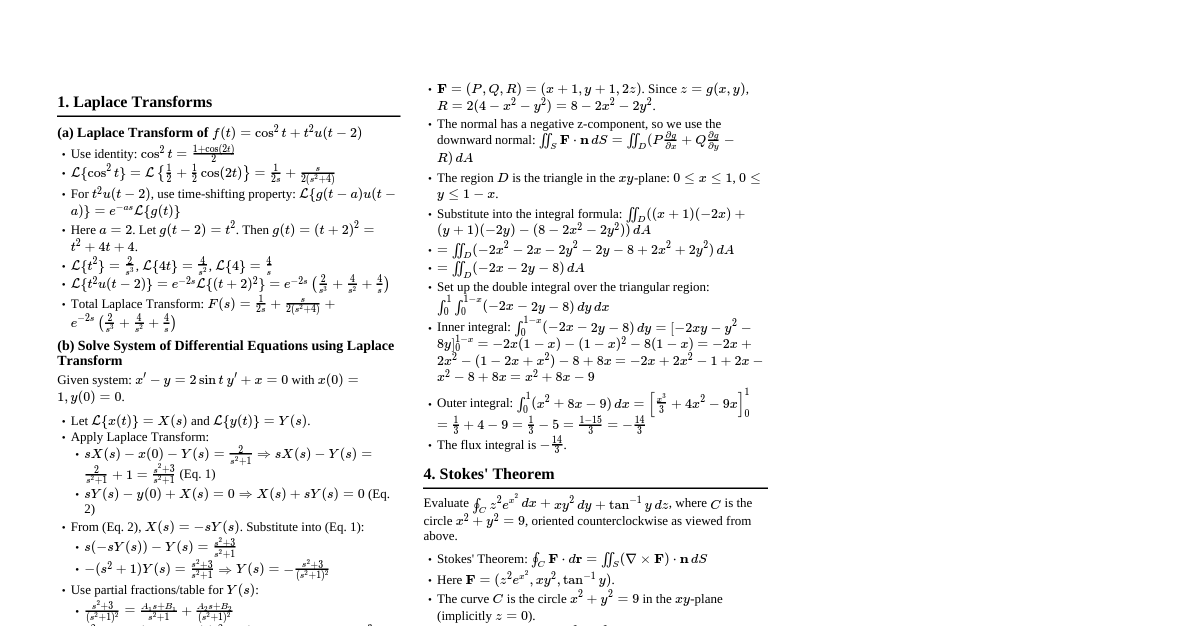
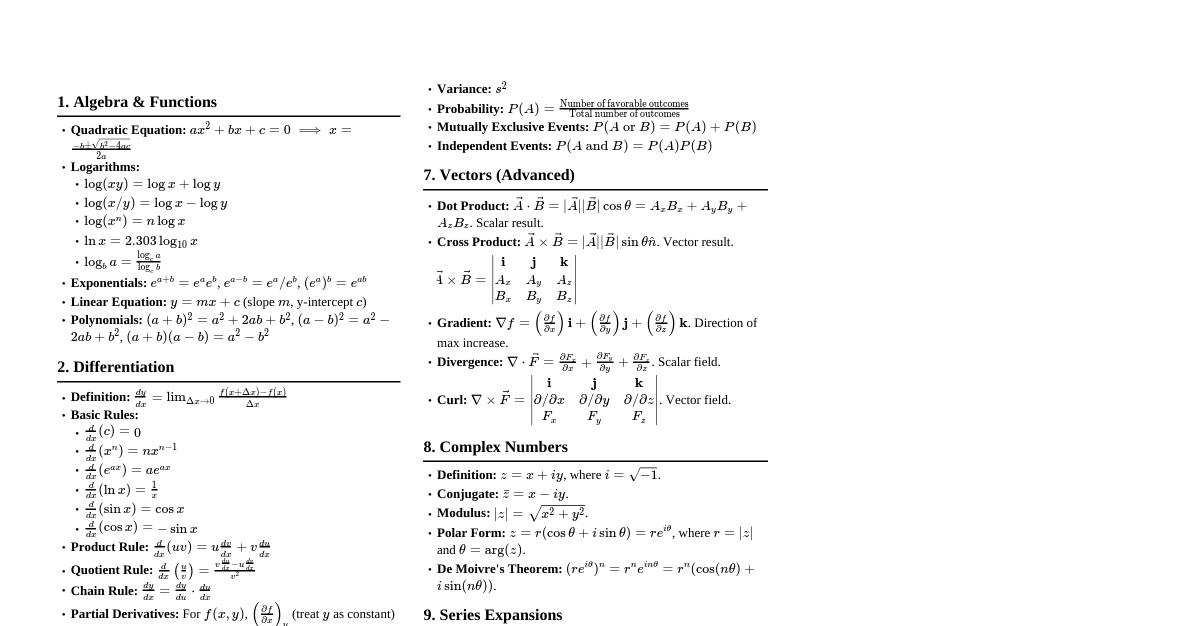
### Basic Arithmetic - **Addition:** Combining quantities. $a + b = c$. - *Example:* $2 + 3 = 5$. If you have 2 apples and get 3 more, you have 5 apples. - **Subtraction:** Finding the difference. $a - b = c$. - *Example:* $5 - 2 = 3$. If you have 5 apples and eat 2, you have 3 left. - **Multiplication:** Repeated addition. $a \times b = c$ or $a \cdot b = c$. - *Example:* $3 \times 4 = 12$. If you have 3 groups of 4 apples, you have 12 apples in total. - **Division:** Splitting into equal parts. $a \div b = c$ or $\frac{a}{b} = c$. - *Example:* $12 \div 3 = 4$. If you have 12 apples and share them among 3 friends, each gets 4. **Order of Operations (PEMDAS/BODMAS):** 1. Parentheses/Brackets 2. Exponents/Orders 3. Multiplication and Division (from left to right) 4. Addition and Subtraction (from left to right) - *Example:* $3 + 4 \times 2 = 3 + 8 = 11$. (Multiply before adding) ### Algebra Basics - **Variables:** Letters representing unknown values (e.g., $x, y, a$). - **Equations:** Statements that two expressions are equal. - *Example:* $x + 5 = 10$. To solve for $x$, subtract 5 from both sides: $x = 10 - 5 \implies x = 5$. - **Inequalities:** Statements comparing expressions (e.g., $ , \le, \ge$). - *Example:* $x + 2 > 7$. Subtract 2 from both sides: $x > 5$. - **Exponents:** $a^n = a \times a \times ... \times a$ (n times). - *Rules:* - $a^m \cdot a^n = a^{m+n}$ - $\frac{a^m}{a^n} = a^{m-n}$ - $(a^m)^n = a^{mn}$ - $a^0 = 1$ (for $a \neq 0$) - $a^{-n} = \frac{1}{a^n}$ - *Example:* $2^3 \cdot 2^2 = 2^{3+2} = 2^5 = 32$. - **Radicals (Roots):** $\sqrt[n]{a}$ means a number that, when multiplied by itself $n$ times, equals $a$. - $\sqrt{a} = a^{1/2}$ (square root) - $\sqrt[3]{a} = a^{1/3}$ (cube root) - *Example:* $\sqrt{9} = 3$ because $3 \times 3 = 9$. - **Factoring Formulas:** - **Difference of Squares:** $a^2 - b^2 = (a-b)(a+b)$ - **Perfect Square Trinomials:** - $a^2 + 2ab + b^2 = (a+b)^2$ - $a^2 - 2ab + b^2 = (a-b)^2$ - *Example:* $x^2 - 4 = (x-2)(x+2)$. - **Quadratic Formula:** For $ax^2 + bx + c = 0$, the solutions for $x$ are: $$x = \frac{-b \pm \sqrt{b^2 - 4ac}}{2a}$$ - *Example:* For $x^2 - 5x + 6 = 0$, $a=1, b=-5, c=6$. $x = \frac{-(-5) \pm \sqrt{(-5)^2 - 4(1)(6)}}{2(1)} = \frac{5 \pm \sqrt{25 - 24}}{2} = \frac{5 \pm \sqrt{1}}{2} = \frac{5 \pm 1}{2}$ So, $x = \frac{5+1}{2} = 3$ or $x = \frac{5-1}{2} = 2$. ### Geometry (2D Shapes) - **Perimeter:** The total distance around the outside of a shape. - **Area:** The amount of surface a shape covers. | Shape | Perimeter (P) | Area (A) | Example (if side=2) | |-------------|-----------------------|----------------------|----------------------------------| | **Square** | $P = 4s$ | $A = s^2$ | $P=4(2)=8$, $A=2^2=4$ | | **Rectangle** | $P = 2l + 2w$ | $A = lw$ | $P=2(3)+2(2)=10$, $A=3(2)=6$ | | **Triangle** | $P = a+b+c$ | $A = \frac{1}{2}bh$ | $b=4, h=3 \implies A=\frac{1}{2}(4)(3)=6$ | | **Circle** | $C = 2\pi r$ or $C = \pi d$ | $A = \pi r^2$ | $r=1 \implies C=2\pi$, $A=\pi$ | - **Pythagorean Theorem (for right triangles):** $a^2 + b^2 = c^2$, where $a, b$ are legs and $c$ is the hypotenuse. - *Example:* If legs are 3 and 4, $3^2 + 4^2 = c^2 \implies 9 + 16 = c^2 \implies 25 = c^2 \implies c = 5$. ### Geometry (3D Solids) - **Surface Area (SA):** The total area of all the surfaces of a 3D object. - **Volume (V):** The amount of space a 3D object occupies. | Solid | Surface Area (SA) | Volume (V) | |---------------|--------------------------|------------------------------| | **Cube** | $SA = 6s^2$ | $V = s^3$ | | **Rectangular Prism** | $SA = 2(lw + lh + wh)$ | $V = lwh$ | | **Cylinder** | $SA = 2\pi r^2 + 2\pi rh$ | $V = \pi r^2 h$ | | **Sphere** | $SA = 4\pi r^2$ | $V = \frac{4}{3}\pi r^3$ | | **Cone** | $SA = \pi r^2 + \pi rL$ | $V = \frac{1}{3}\pi r^2 h$ | - *Example (Cube):* If side $s=2$, $SA=6(2^2)=24$, $V=2^3=8$. ### Trigonometry - **SOH CAH TOA (for right triangles):** - $\sin(\theta) = \frac{\text{Opposite}}{\text{Hypotenuse}}$ - $\cos(\theta) = \frac{\text{Adjacent}}{\text{Hypotenuse}}$ - $\tan(\theta) = \frac{\text{Opposite}}{\text{Adjacent}}$ - **Reciprocal Identities:** - $\csc(\theta) = \frac{1}{\sin(\theta)}$ - $\sec(\theta) = \frac{1}{\cos(\theta)}$ - $\cot(\theta) = \frac{1}{\tan(\theta)}$ - **Pythagorean Identity:** $\sin^2(\theta) + \cos^2(\theta) = 1$ - **Law of Sines:** $\frac{a}{\sin A} = \frac{b}{\sin B} = \frac{c}{\sin C}$ - **Law of Cosines:** $c^2 = a^2 + b^2 - 2ab \cos C$ - *Example:* In a right triangle with angle $30^\circ$ and hypotenuse 10, $\sin(30^\circ) = \frac{\text{Opposite}}{10}$. Since $\sin(30^\circ) = 0.5$, $\text{Opposite} = 0.5 \times 10 = 5$. ### Functions - **Definition:** A rule that assigns each input (domain) exactly one output (range). $y = f(x)$. - *Example:* If $f(x) = x^2 + 1$, then $f(2) = 2^2 + 1 = 5$. - **Types of Functions:** - **Linear:** $f(x) = mx + b$ (straight line) - **Quadratic:** $f(x) = ax^2 + bx + c$ (parabola) - **Polynomial:** $f(x) = a_n x^n + ... + a_1 x + a_0$ - **Exponential:** $f(x) = a^x$ (rapid growth/decay) - **Logarithmic:** $f(x) = \log_b(x)$ (inverse of exponential) - **Logarithm Rules:** - $\log_b(MN) = \log_b M + \log_b N$ - $\log_b(\frac{M}{N}) = \log_b M - \log_b N$ - $\log_b(M^p) = p \log_b M$ - $\log_b b = 1$ - $\log_b 1 = 0$ - *Example:* $\log_2(8) = 3$ because $2^3 = 8$. ### Limits (Calculus Intro) - **Definition:** What a function "approaches" as the input approaches a certain value. Written as $\lim_{x \to c} f(x) = L$. - *Rule:* If $f(x)$ is a polynomial or rational function, and $c$ is in the domain, then $\lim_{x \to c} f(x) = f(c)$. - *Example:* $\lim_{x \to 2} (x^2 + 1) = 2^2 + 1 = 5$. - *Rule (Indeterminate Form):* If you get $\frac{0}{0}$, try factoring or rationalizing. - *Example:* $\lim_{x \to 2} \frac{x^2 - 4}{x - 2} = \lim_{x \to 2} \frac{(x-2)(x+2)}{x-2} = \lim_{x \to 2} (x+2) = 2+2 = 4$. ### Derivatives (Rates of Change) - **Definition:** The instantaneous rate of change of a function. Geometrically, it's the slope of the tangent line to the graph. $f'(x)$ or $\frac{dy}{dx}$. - **Basic Rules:** - **Constant Rule:** $\frac{d}{dx}(c) = 0$ - **Power Rule:** $\frac{d}{dx}(x^n) = nx^{n-1}$ - **Constant Multiple Rule:** $\frac{d}{dx}(cf(x)) = c f'(x)$ - **Sum/Difference Rule:** $\frac{d}{dx}(f(x) \pm g(x)) = f'(x) \pm g'(x)$ - **Product Rule:** $\frac{d}{dx}(f(x)g(x)) = f'(x)g(x) + f(x)g'(x)$ - **Quotient Rule:** $\frac{d}{dx}\left(\frac{f(x)}{g(x)}\right) = \frac{f'(x)g(x) - f(x)g'(x)}{(g(x))^2}$ - **Chain Rule:** $\frac{d}{dx}(f(g(x))) = f'(g(x))g'(x)$ - **Common Derivatives:** - $\frac{d}{dx}(\sin x) = \cos x$ - $\frac{d}{dx}(\cos x) = -\sin x$ - $\frac{d}{dx}(e^x) = e^x$ - $\frac{d}{dx}(\ln x) = \frac{1}{x}$ - *Example (Power Rule):* If $f(x) = x^3$, then $f'(x) = 3x^{3-1} = 3x^2$. - *Example (Product Rule):* If $f(x) = x \sin x$, then $f'(x) = (1)\sin x + x(\cos x) = \sin x + x \cos x$. ### Integrals (Accumulation) - **Definition:** The "opposite" of differentiation. Finds the area under a curve. $\int f(x) dx$. - **Indefinite Integral (Antiderivative):** $\int f(x) dx = F(x) + C$, where $F'(x) = f(x)$ and $C$ is the constant of integration. - **Power Rule:** $\int x^n dx = \frac{x^{n+1}}{n+1} + C$ (for $n \neq -1$) - **Constant Multiple Rule:** $\int c f(x) dx = c \int f(x) dx$ - **Sum/Difference Rule:** $\int (f(x) \pm g(x)) dx = \int f(x) dx \pm \int g(x) dx$ - **Common Integrals:** - $\int \cos x dx = \sin x + C$ - $\int \sin x dx = -\cos x + C$ - $\int e^x dx = e^x + C$ - $\int \frac{1}{x} dx = \ln|x| + C$ - *Example (Power Rule):* $\int x^2 dx = \frac{x^{2+1}}{2+1} + C = \frac{x^3}{3} + C$. - **Definite Integral:** $\int_a^b f(x) dx = F(b) - F(a)$. Represents the net area between $f(x)$ and the x-axis from $a$ to $b$. - **Fundamental Theorem of Calculus:** Links differentiation and integration. - *Example:* $\int_0^1 x^2 dx = \left[\frac{x^3}{3}\right]_0^1 = \frac{1^3}{3} - \frac{0^3}{3} = \frac{1}{3}$. ### Differential Equations - **Definition:** Equations involving an unknown function and its derivatives. - **First-Order Linear:** $\frac{dy}{dx} + P(x)y = Q(x)$. Solved using an integrating factor $e^{\int P(x)dx}$. - **Separable:** If $\frac{dy}{dx} = f(x)g(y)$, then $\int \frac{1}{g(y)} dy = \int f(x) dx$. - *Example (Separable):* $\frac{dy}{dx} = xy$. $\int \frac{1}{y} dy = \int x dx \implies \ln|y| = \frac{x^2}{2} + C \implies y = A e^{x^2/2}$.