Implicit Differentiation
Cheatsheet Content
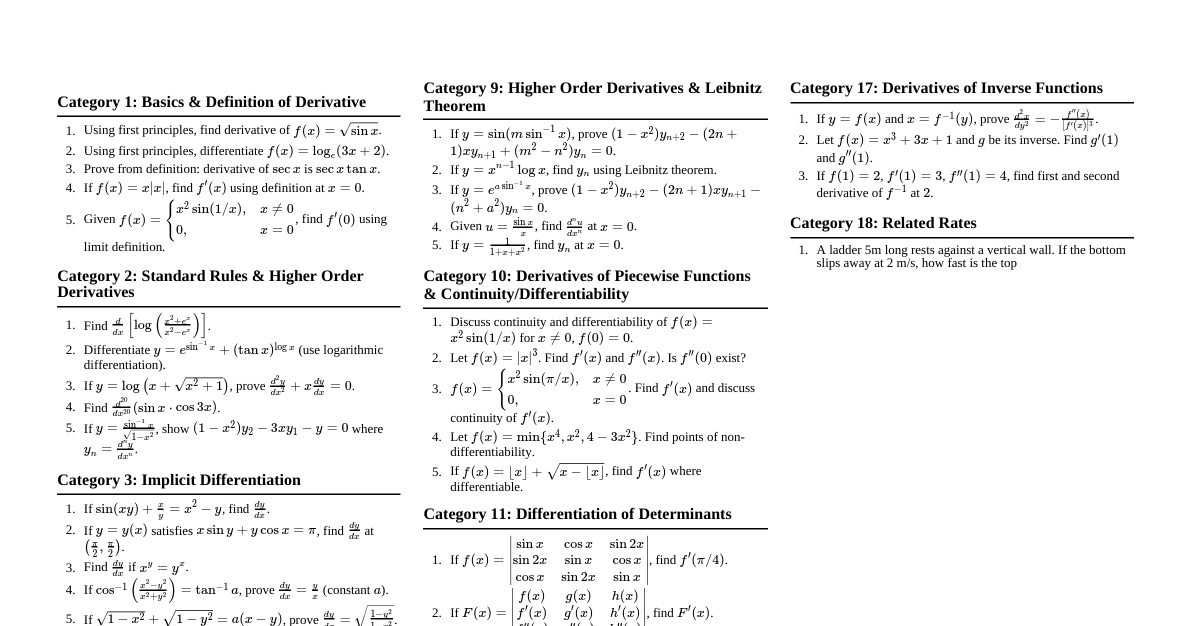
What is Implicit Differentiation? Implicit differentiation is a technique used to find the derivative of an implicitly defined function. An implicitly defined function is one where $y$ is not explicitly expressed as a function of $x$ (e.g., $y=f(x)$), but rather $x$ and $y$ are mixed in an equation. For example, $x^2 + y^2 = 25$ is an implicit function, while $y = \sqrt{25 - x^2}$ is an explicit function. When to Use It? When it's difficult or impossible to solve for $y$ explicitly in terms of $x$. When dealing with equations involving circles, ellipses, hyperbolas, or other complex curves. The Chain Rule is Key The core idea is to differentiate both sides of the equation with respect to $x$, treating $y$ as a function of $x$ (i.e., $y(x)$). This means whenever you differentiate a term involving $y$, you must apply the Chain Rule: If $F(y)$ is a function of $y$, then $\frac{d}{dx}[F(y)] = F'(y) \cdot \frac{dy}{dx}$ Commonly, $\frac{dy}{dx}$ is denoted as $y'$. Steps for Implicit Differentiation Differentiate both sides of the equation with respect to $x$. Remember to treat $y$ as a function of $x$ and apply the Chain Rule when differentiating terms involving $y$. Collect all terms containing $\frac{dy}{dx}$ (or $y'$) on one side of the equation and all other terms on the other side. Factor out $\frac{dy}{dx}$ from the terms on that side. Solve for $\frac{dy}{dx}$. Example 1: Basic Circle Problem: Find $\frac{dy}{dx}$ for $x^2 + y^2 = 25$. Differentiate both sides with respect to $x$: $\frac{d}{dx}(x^2) + \frac{d}{dx}(y^2) = \frac{d}{dx}(25)$ $2x + 2y \cdot \frac{dy}{dx} = 0$ (applying Chain Rule to $y^2$) Collect terms with $\frac{dy}{dx}$: $2y \frac{dy}{dx} = -2x$ Solve for $\frac{dy}{dx}$: $\frac{dy}{dx} = \frac{-2x}{2y}$ $\frac{dy}{dx} = -\frac{x}{y}$ Example 2: Mixed Terms Problem: Find $\frac{dy}{dx}$ for $x^3 + y^3 = 6xy$. Differentiate both sides with respect to $x$: $\frac{d}{dx}(x^3) + \frac{d}{dx}(y^3) = \frac{d}{dx}(6xy)$ $3x^2 + 3y^2 \frac{dy}{dx} = 6 \left( 1 \cdot y + x \cdot \frac{dy}{dx} \right)$ (Product Rule for $6xy$) $3x^2 + 3y^2 \frac{dy}{dx} = 6y + 6x \frac{dy}{dx}$ Collect terms with $\frac{dy}{dx}$: $3y^2 \frac{dy}{dx} - 6x \frac{dy}{dx} = 6y - 3x^2$ Factor out $\frac{dy}{dx}$: $\frac{dy}{dx}(3y^2 - 6x) = 6y - 3x^2$ Solve for $\frac{dy}{dx}$: $\frac{dy}{dx} = \frac{6y - 3x^2}{3y^2 - 6x}$ $\frac{dy}{dx} = \frac{3(2y - x^2)}{3(y^2 - 2x)}$ $\frac{dy}{dx} = \frac{2y - x^2}{y^2 - 2x}$ Example 3: Trigonometric Functions Problem: Find $\frac{dy}{dx}$ for $\sin(x+y) = y^2 \cos x$. Differentiate both sides with respect to $x$: $\frac{d}{dx}[\sin(x+y)] = \frac{d}{dx}[y^2 \cos x]$ $\cos(x+y) \cdot \frac{d}{dx}(x+y) = \frac{d}{dx}(y^2) \cdot \cos x + y^2 \cdot \frac{d}{dx}(\cos x)$ (Chain Rule on LHS, Product Rule on RHS) $\cos(x+y) \cdot (1 + \frac{dy}{dx}) = (2y \frac{dy}{dx}) \cos x + y^2 (-\sin x)$ $\cos(x+y) + \cos(x+y)\frac{dy}{dx} = 2y \cos x \frac{dy}{dx} - y^2 \sin x$ Collect terms with $\frac{dy}{dx}$: $\cos(x+y)\frac{dy}{dx} - 2y \cos x \frac{dy}{dx} = -y^2 \sin x - \cos(x+y)$ Factor out $\frac{dy}{dx}$: $\frac{dy}{dx}(\cos(x+y) - 2y \cos x) = -(y^2 \sin x + \cos(x+y))$ Solve for $\frac{dy}{dx}$: $\frac{dy}{dx} = \frac{-(y^2 \sin x + \cos(x+y))}{\cos(x+y) - 2y \cos x}$ $\frac{dy}{dx} = \frac{y^2 \sin x + \cos(x+y)}{2y \cos x - \cos(x+y)}$ Higher Order Derivatives To find $\frac{d^2y}{dx^2}$ (the second derivative), you differentiate $\frac{dy}{dx}$ with respect to $x$ again, remembering to substitute the expression for $\frac{dy}{dx}$ into your result. Example: For $x^2 + y^2 = 25$, we found $\frac{dy}{dx} = -\frac{x}{y}$. Differentiate $\frac{dy}{dx}$ with respect to $x$: $\frac{d^2y}{dx^2} = \frac{d}{dx}\left(-\frac{x}{y}\right)$ Apply the Quotient Rule: $\frac{d^2y}{dx^2} = -\frac{\frac{d}{dx}(x) \cdot y - x \cdot \frac{d}{dx}(y)}{y^2}$ $\frac{d^2y}{dx^2} = -\frac{1 \cdot y - x \cdot \frac{dy}{dx}}{y^2}$ Substitute the known $\frac{dy}{dx} = -\frac{x}{y}$: $\frac{d^2y}{dx^2} = -\frac{y - x \left(-\frac{x}{y}\right)}{y^2}$ $\frac{d^2y}{dx^2} = -\frac{y + \frac{x^2}{y}}{y^2}$ Simplify: $\frac{d^2y}{dx^2} = -\frac{\frac{y^2+x^2}{y}}{y^2}$ $\frac{d^2y}{dx^2} = -\frac{y^2+x^2}{y^3}$ Since $x^2+y^2=25$ from the original equation: $\frac{d^2y}{dx^2} = -\frac{25}{y^3}$