Ray Optics
Cheatsheet Content
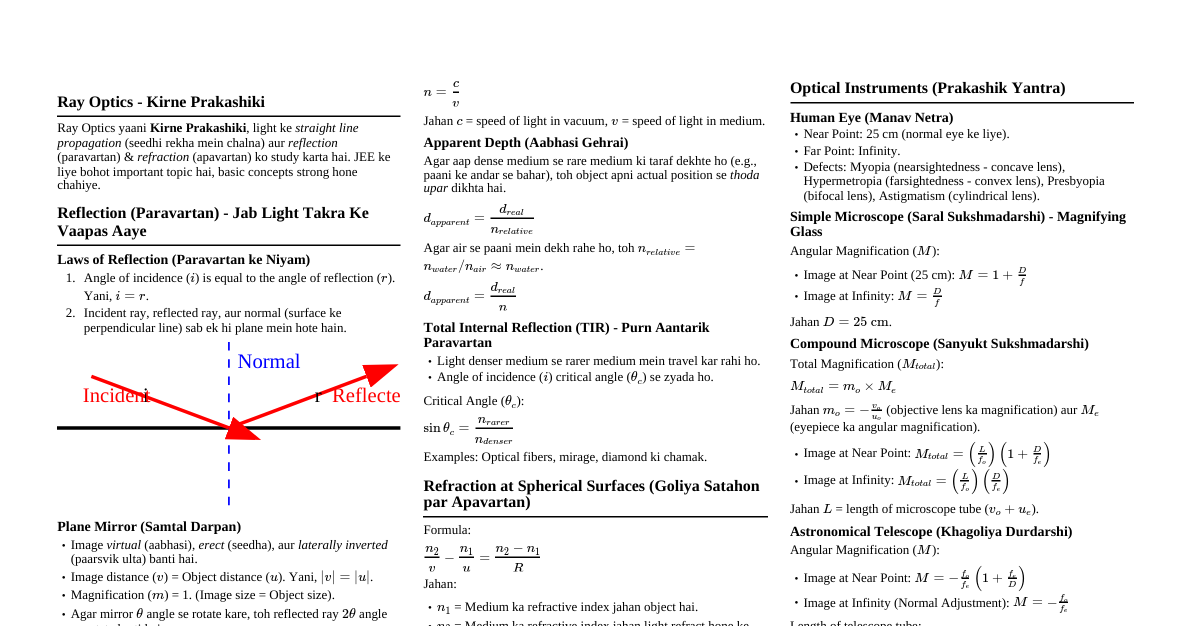
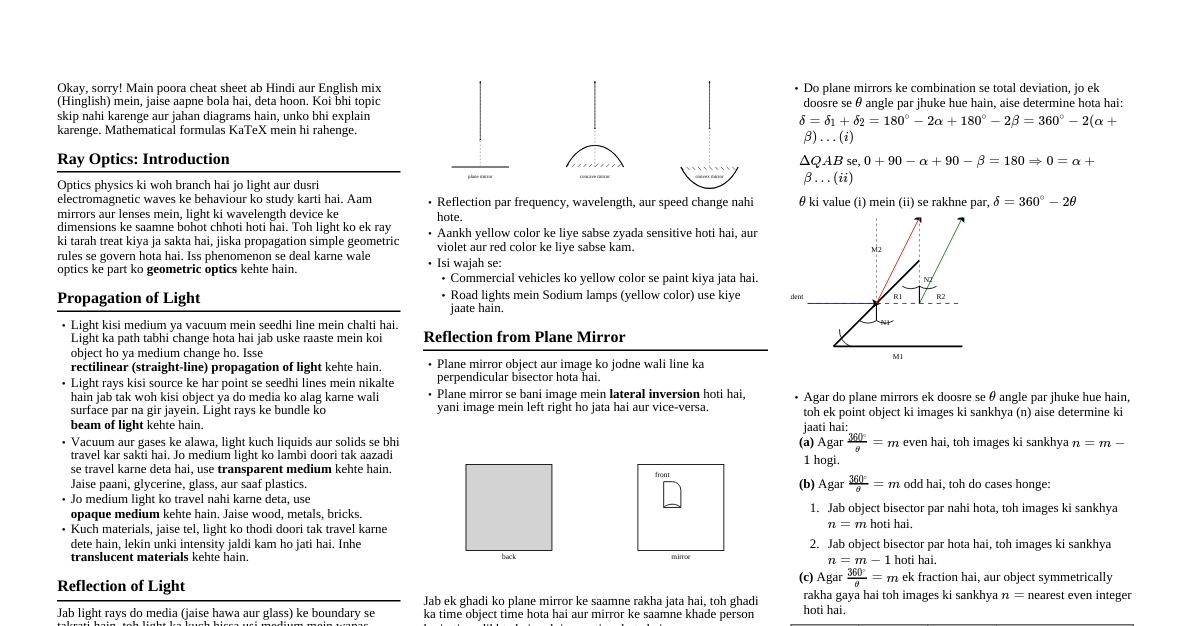
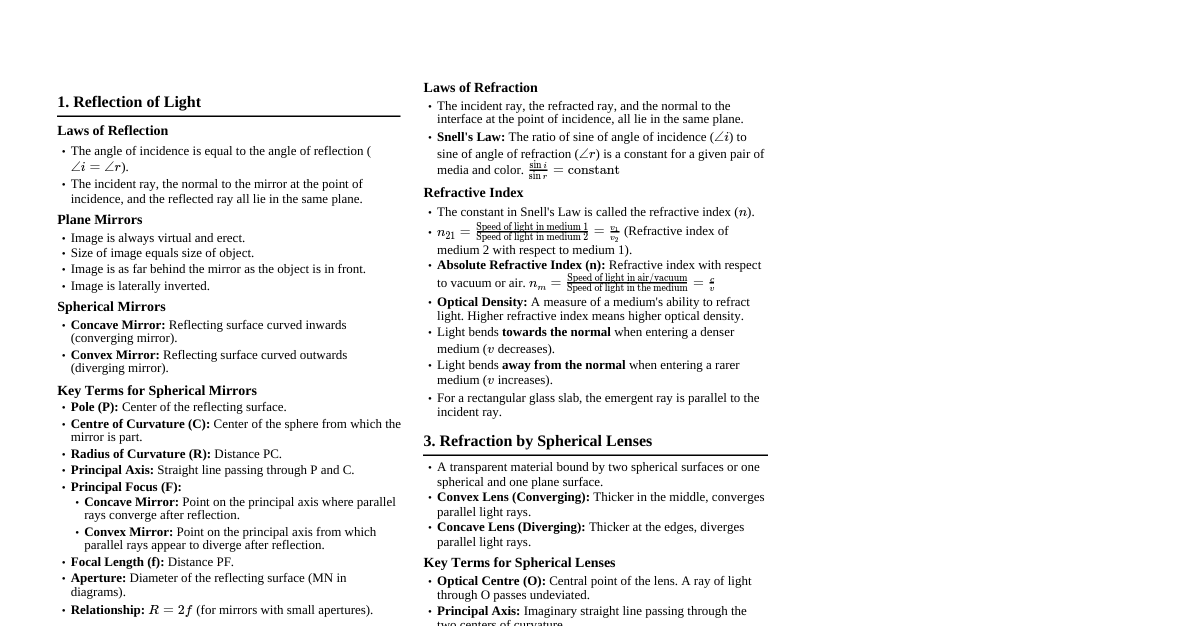
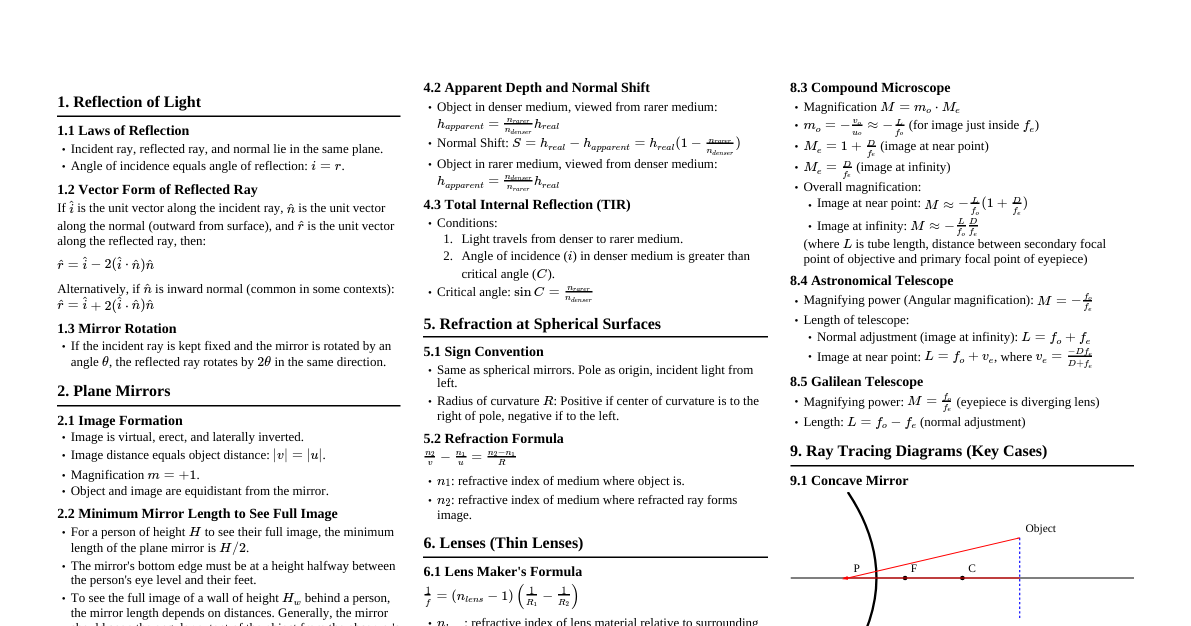
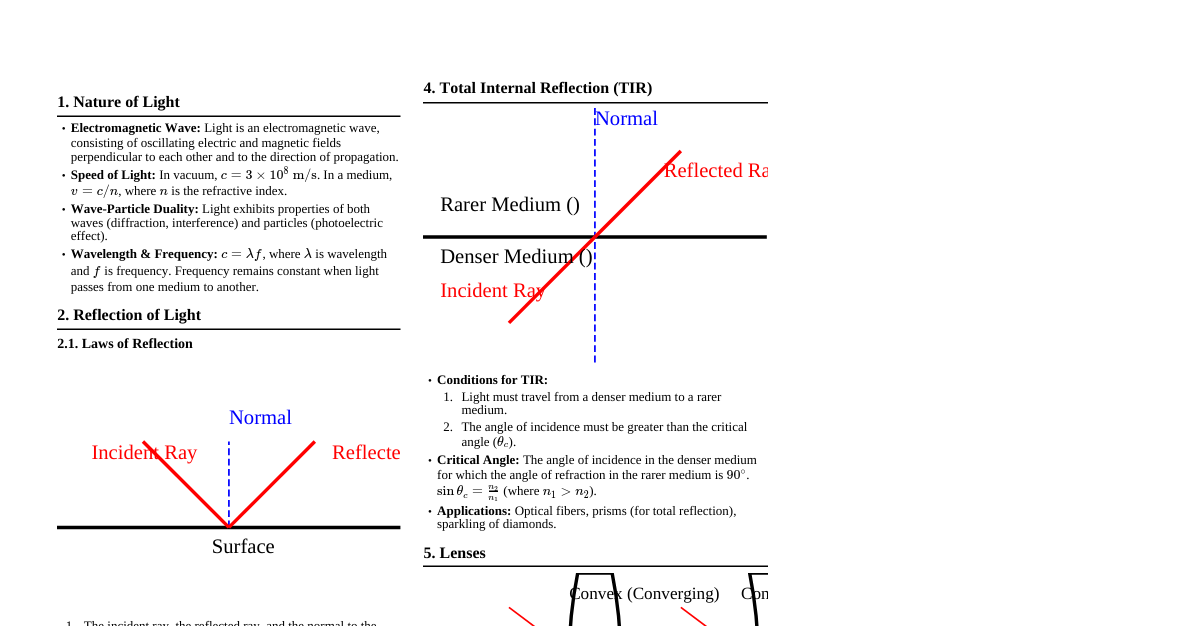
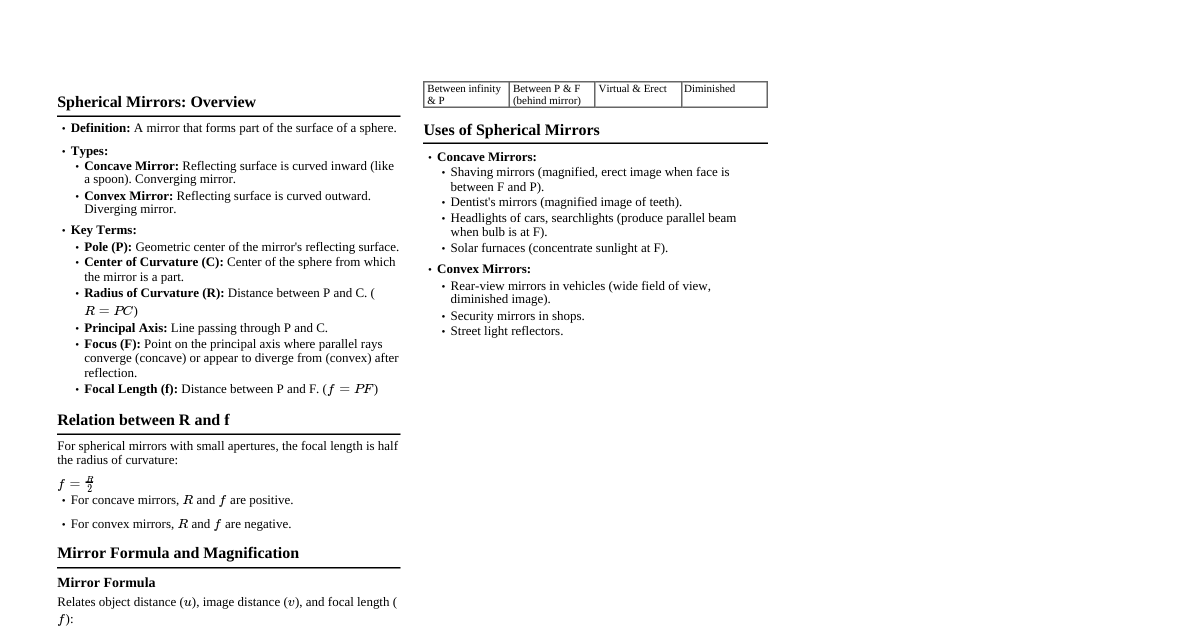
### Introduction to Ray Optics Ray optics, or geometrical optics, describes light propagation in terms of rays. A ray is an idealized narrow beam of light that travels in a straight line in a homogeneous medium. This approximation is valid when the wavelength of light is much smaller than the dimensions of the optical components. #### Key Principles 1. **Rectilinear Propagation:** Light travels in straight lines in a uniform medium. 2. **Reflection:** Light bounces off a surface. 3. **Refraction:** Light bends as it passes from one medium to another. 4. **Principle of Reversibility:** If a ray of light, after suffering any number of reflections and/or refractions, has its path reversed, it will retrace its original path. ### Reflection Reflection is the phenomenon where light rays bounce off a surface. #### Laws of Reflection 1. The incident ray, the reflected ray, and the normal to the surface at the point of incidence all lie in the same plane. 2. The angle of incidence ($\theta_i$) is equal to the angle of reflection ($\theta_r$). $$\theta_i = \theta_r$$ (Angles are measured with respect to the normal.) #### Types of Reflection - **Specular Reflection:** Occurs from smooth surfaces (e.g., mirrors), producing clear images. - **Diffuse Reflection:** Occurs from rough surfaces (e.g., paper), scattering light in many directions. #### Plane Mirrors - **Image Characteristics:** Virtual, erect (upright), laterally inverted, same size as object, and same distance behind the mirror as the object is in front. - **Magnification (M):** $M = \frac{h_i}{h_o} = 1$ (for plane mirrors, image height $h_i$ equals object height $h_o$). #### Spherical Mirrors (Concave & Convex) - **Terminology:** - **Pole (P):** Center of the mirror's reflecting surface. - **Center of Curvature (C):** Center of the sphere from which the mirror is a part. - **Radius of Curvature (R):** Distance PC. - **Principal Axis:** Line passing through P and C. - **Focus (F):** Point on the principal axis where parallel rays converge (concave) or appear to diverge from (convex) after reflection. - **Focal Length (f):** Distance PF. $f = R/2$. - **Mirror Formula:** $$\frac{1}{f} = \frac{1}{v} + \frac{1}{u}$$ Where: - $f$ = focal length - $v$ = image distance - $u$ = object distance - **Magnification (M):** $$M = \frac{h_i}{h_o} = -\frac{v}{u}$$ Where: - $h_i$ = image height - $h_o$ = object height - **Sign Conventions (Cartesian):** - Pole (P) is origin. - Incident light travels from left to right. - Distances measured along principal axis: - Right of P: positive - Left of P: negative - Distances measured perpendicular to principal axis: - Above axis: positive - Below axis: negative - Concave mirror: $f$ is negative. - Convex mirror: $f$ is positive. - Real image: $v$ is negative (formed on left). - Virtual image: $v$ is positive (formed on right). - Real object: $u$ is negative (always on left). | Mirror Type | Object Position | Image Characteristics | |-------------|-----------------|-----------------------| | Concave | At $\infty$ | Real, inverted, point | | | Beyond C | Real, inverted, diminished, between F & C | | | At C | Real, inverted, same size, at C | | | Between C & F | Real, inverted, magnified, beyond C | | | At F | Real, inverted, highly magnified, at $\infty$ | | | Between F & P | Virtual, erect, magnified, behind mirror | | Convex | Anywhere | Virtual, erect, diminished, behind mirror | ### Refraction Refraction is the bending of light as it passes from one transparent medium to another. #### Laws of Refraction (Snell's Law) 1. The incident ray, the refracted ray, and the normal to the interface at the point of incidence all lie in the same plane. 2. The ratio of the sine of the angle of incidence ($\theta_1$) to the sine of the angle of refraction ($\theta_2$) is constant for a given pair of media. $$n_1 \sin\theta_1 = n_2 \sin\theta_2$$ Where: - $n_1$ = refractive index of medium 1 - $n_2$ = refractive index of medium 2 - $\theta_1$ = angle of incidence - $\theta_2$ = angle of refraction - **Refractive Index (n):** $n = \frac{c}{v}$, where $c$ is speed of light in vacuum and $v$ is speed of light in the medium. - **Optical Density:** Denser medium has higher 'n'. Light bends towards normal when entering denser medium ($n_1 \theta_2$). Light bends away from normal when entering rarer medium ($n_1 > n_2 \Rightarrow \theta_1 n_2)$$ - **Conditions for TIR:** 1. Light must travel from a denser medium to a rarer medium. 2. The angle of incidence must be greater than the critical angle ($\theta_i > \theta_c$). - **Applications:** Optical fibers, prisms (for binoculars, periscopes). ### Lenses (Thin Lenses) Lenses are transparent optical devices that refract light to form images. #### Types of Lenses - **Convex (Converging) Lens:** Thicker in the middle, converges parallel rays to a real focus. Positive focal length ($f > 0$). - **Concave (Diverging) Lens:** Thinner in the middle, diverges parallel rays appearing to come from a virtual focus. Negative focal length ($f ### Prisms A prism is a transparent optical element with flat, polished surfaces that refract light. #### Deviation by a Prism - **Angle of Deviation ($\delta$):** The angle between the incident ray and the emergent ray. - **Prism Angle (A):** The angle between the two refracting surfaces. - **Minimum Deviation:** For a given prism, there is a minimum angle of deviation ($\delta_{min}$) when the angle of incidence equals the angle of emergence ($i_1 = i_2$) and the refracted ray inside the prism is parallel to the base. $$n = \frac{\sin\left(\frac{A + \delta_{min}}{2}\right)}{\sin\left(\frac{A}{2}\right)}$$ Where $n$ is the refractive index of the prism material. #### Dispersion - The splitting of white light into its constituent colors (spectrum) when passing through a prism. - Occurs because the refractive index ($n$) of the prism material is different for different wavelengths (colors) of light. Violet light deviates the most (highest $n$), red light the least (lowest $n$). ### Optical Instruments #### The Human Eye - **Cornea:** Foremost transparent part, provides most of the refraction. - **Iris:** Controls pupil size, regulating light entry. - **Pupil:** Aperture for light to enter. - **Eye Lens:** Fine-tunes focal length by changing curvature (accommodation). - **Retina:** Light-sensitive surface where image is formed. - **Near Point:** Closest distance for clear vision (typically 25 cm for normal eye). - **Far Point:** Farthest distance for clear vision ($\infty$ for normal eye). #### Defects of Vision & Correction - **Myopia (Nearsightedness):** - Image forms in front of retina. - Far point is closer than $\infty$. - Correction: Concave lens. - **Hypermetropia (Farsightedness):** - Image forms behind retina. - Near point is farther than 25 cm. - Correction: Convex lens. - **Presbyopia:** - Loss of accommodation due to aging. - Correction: Bifocal lenses. - **Astigmatism:** - Different focal points in different planes. - Correction: Cylindrical lenses. #### Simple Microscope (Magnifying Glass) - **Principle:** Convex lens used to produce a magnified, virtual, and erect image. - **Magnifying Power (M):** - When image is at near point (most strained vision): $M = 1 + \frac{D}{f}$ - When image is at infinity (normal adjustment, least strained vision): $M = \frac{D}{f}$ Where $D$ is the near point distance (25 cm) and $f$ is the focal length of the lens. #### Compound Microscope - **Components:** Objective lens (short focal length, forms real, inverted, magnified image) and Eyepiece (acts as a simple microscope, magnifies objective's image). - **Magnifying Power (M):** $$M = M_o \times M_e = \left(\frac{L}{f_o}\right) \left(1 + \frac{D}{f_e}\right)$$ Where $L$ is the distance between the focal points of objective and eyepiece, $f_o$ and $f_e$ are focal lengths of objective and eyepiece. (Formula for image at near point) #### Astronomical Telescope - **Components:** Objective lens (large aperture, large focal length) and Eyepiece (small aperture, small focal length). - **Magnifying Power (M):** - Normal adjustment (image at infinity): $M = -\frac{f_o}{f_e}$ (negative sign indicates inverted image). - Length of telescope: $L = f_o + f_e$. - **Terrestrial Telescope:** Uses an additional erecting lens to produce an erect final image.