Light Reflection & Refraction
Cheatsheet Content
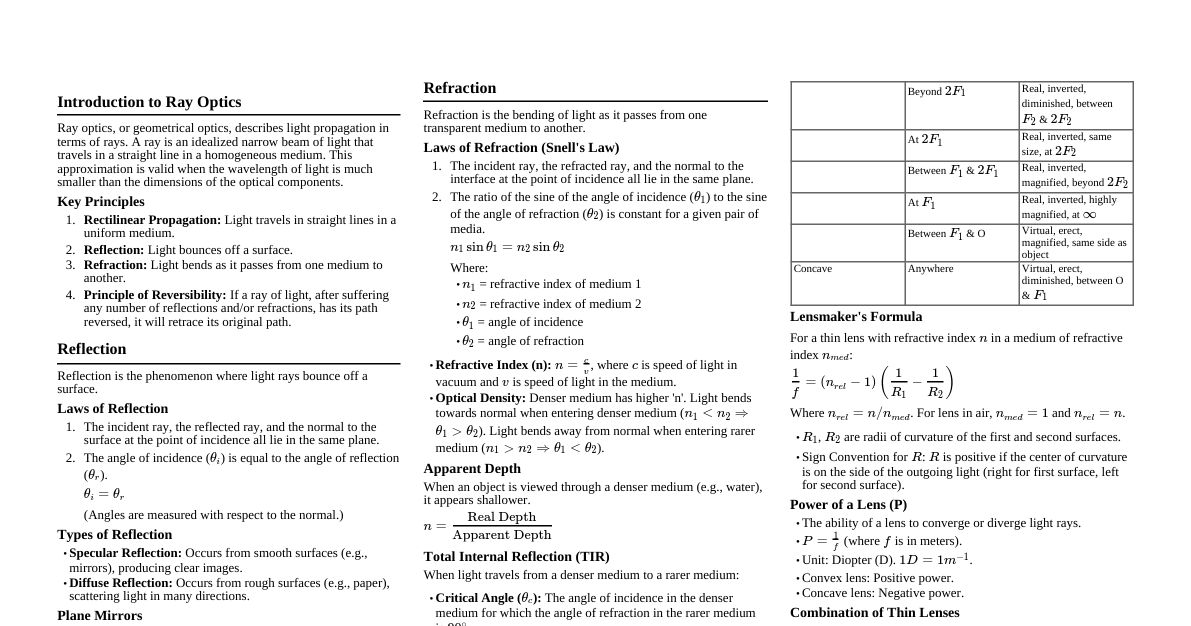
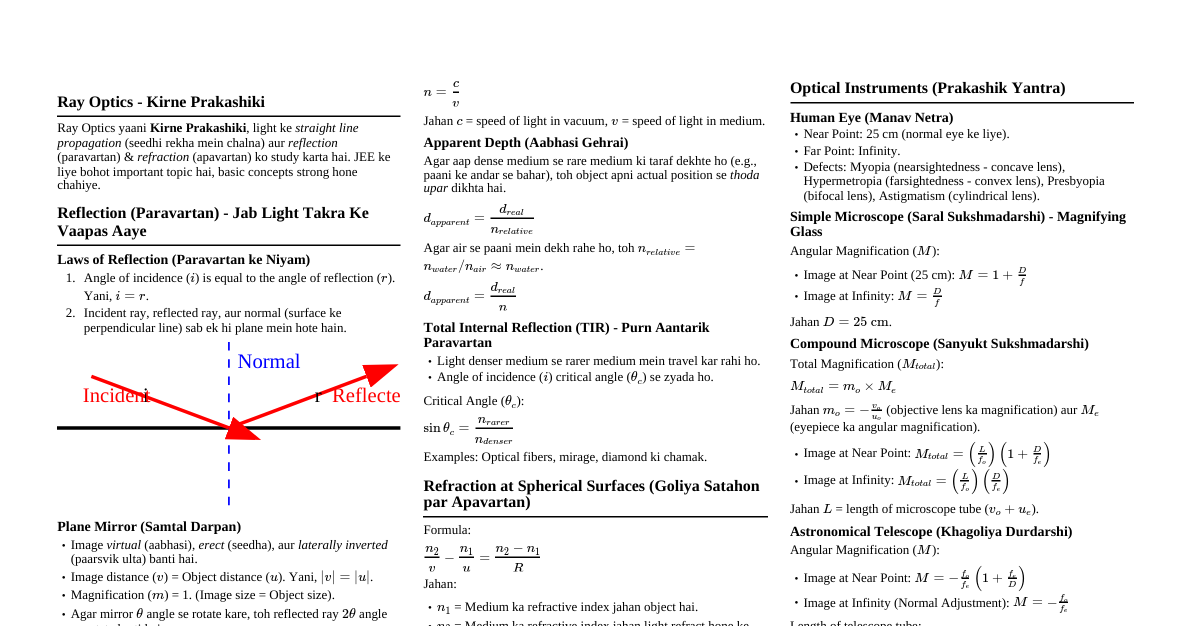
1. Nature of Light Electromagnetic Wave: Light is an electromagnetic wave, consisting of oscillating electric and magnetic fields perpendicular to each other and to the direction of propagation. Speed of Light: In vacuum, $c = 3 \times 10^8 \text{ m/s}$. In a medium, $v = c/n$, where $n$ is the refractive index. Wave-Particle Duality: Light exhibits properties of both waves (diffraction, interference) and particles (photoelectric effect). Wavelength & Frequency: $c = \lambda f$, where $\lambda$ is wavelength and $f$ is frequency. Frequency remains constant when light passes from one medium to another. 2. Reflection of Light 2.1. Laws of Reflection $\theta_i$ $\theta_r$ Normal Incident Ray Reflected Ray Surface The incident ray, the reflected ray, and the normal to the surface at the point of incidence all lie in the same plane. The angle of incidence ($\theta_i$) is equal to the angle of reflection ($\theta_r$): $\theta_i = \theta_r$. 2.2. Types of Reflection Specular Reflection: Occurs from smooth surfaces (e.g., mirrors), producing clear images. Diffuse Reflection: Occurs from rough surfaces, scattering light in many directions, preventing image formation. 2.3. Mirrors Plane Mirror: Image is virtual, erect, and laterally inverted. Image distance equals object distance ($|v| = |u|$). Magnification $M = 1$. Spherical Mirrors (Concave & Convex): Concave Mirror: Converging mirror. Forms real and virtual images depending on object position. Convex Mirror: Diverging mirror. Always forms virtual, erect, and diminished images. Mirror Formula: $\frac{1}{f} = \frac{1}{u} + \frac{1}{v}$ Magnification: $M = \frac{h_i}{h_o} = -\frac{v}{u}$ Radius of Curvature: $R = 2f$ Sign Convention: Cartesian sign convention (object usually to the left, distances measured from pole). 3. Refraction of Light 3.1. Laws of Refraction (Snell's Law) $\theta_1$ $\theta_2$ Normal Incident Ray ($n_1$) Refracted Ray ($n_2$) Medium 1 Medium 2 The incident ray, the refracted ray, and the normal to the interface at the point of incidence all lie in the same plane. For a given pair of media and for light of a given wavelength, the ratio of the sine of the angle of incidence to the sine of the angle of refraction is a constant: $n_1 \sin\theta_1 = n_2 \sin\theta_2$. 3.2. Refractive Index ($n$) Definition: Ratio of speed of light in vacuum to speed of light in medium ($n = c/v$). Relative Refractive Index: $n_{21} = \frac{n_2}{n_1} = \frac{v_1}{v_2}$. When light enters a denser medium ($n_2 > n_1$), it bends towards the normal. When light enters a rarer medium ($n_2 Apparent Depth: $d_{app} = d_{real} / n$. 4. Total Internal Reflection (TIR) $\theta_i > \theta_c$ Normal Incident Ray Reflected Ray Denser Medium ($n_1$) Rarer Medium ($n_2$) Conditions for TIR: Light must travel from a denser medium to a rarer medium. The angle of incidence must be greater than the critical angle ($\theta_c$). Critical Angle: The angle of incidence in the denser medium for which the angle of refraction in the rarer medium is $90^\circ$. $\sin\theta_c = \frac{n_2}{n_1}$ (where $n_1 > n_2$). Applications: Optical fibers, prisms (for total reflection), sparkling of diamonds. 5. Lenses Convex (Converging) Concave (Diverging) Converging Lens (Convex): Thicker in the middle. Converges parallel rays of light. Diverging Lens (Concave): Thinner in the middle. Diverges parallel rays of light. Lens Maker's Formula: $\frac{1}{f} = (n-1) \left(\frac{1}{R_1} - \frac{1}{R_2}\right)$ Lens Formula: $\frac{1}{f} = \frac{1}{v} - \frac{1}{u}$ Magnification: $M = \frac{h_i}{h_o} = \frac{v}{u}$ Power of a Lens ($P$): $P = 1/f$ (in meters). Unit is Diopter (D). Converging lenses have positive power, diverging lenses have negative power. Combination of Lenses: For thin lenses in contact, $P_{eq} = P_1 + P_2 + ...$ and $\frac{1}{f_{eq}} = \frac{1}{f_1} + \frac{1}{f_2} + ...$ 6. Dispersion of Light White Light Red Violet Prism Definition: The phenomenon of splitting of white light into its constituent colors (VIBGYOR) when it passes through a transparent medium (like a prism). Cause: Different colors of light travel at different speeds in a medium, hence have different refractive indices ($n_{red} Angular Dispersion: $\delta_v - \delta_r = (n_v - n_r)A$ for a prism of angle $A$. Rainbow: Caused by dispersion, refraction, and total internal reflection of sunlight by water droplets. 7. Optical Instruments (Brief) Human Eye: Lens forms real, inverted image on retina. Accommodation by ciliary muscles. Simple Microscope (Magnifying Glass): Convex lens, forms virtual, erect, magnified image. Magnification $M = 1 + D/f$ (image at near point), $M = D/f$ (image at infinity). Compound Microscope: Uses objective and eyepiece lenses for higher magnification. Telescope: Used to view distant objects. Objective lens has large focal length and aperture.