Calculus Formulas
Shared 5/16/2026•19 views
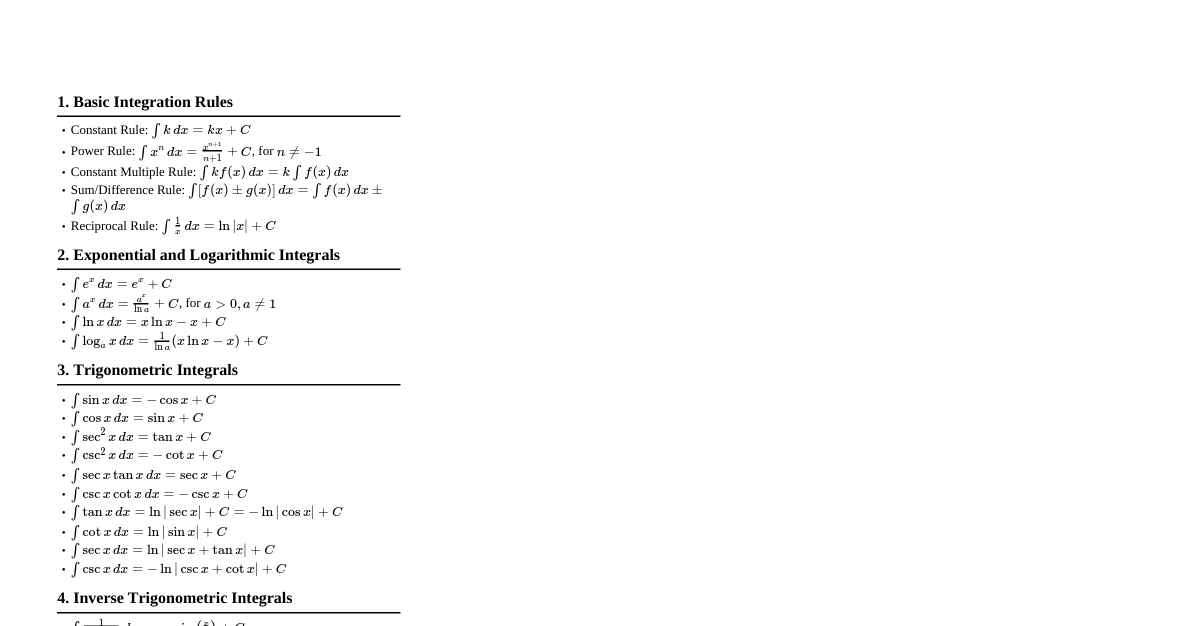
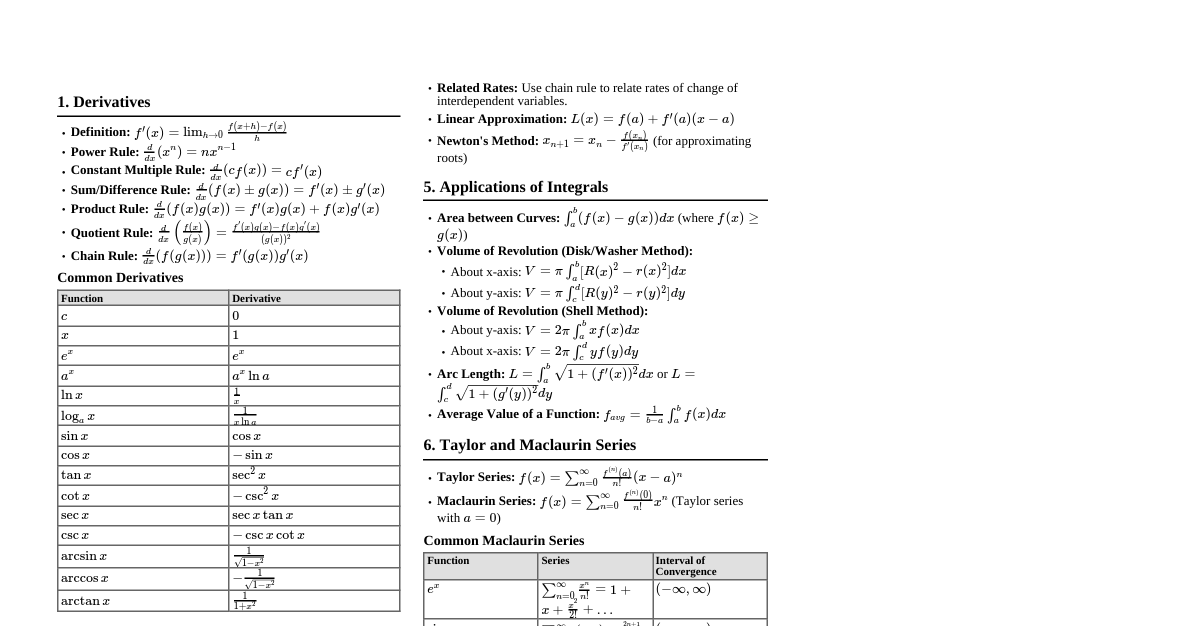
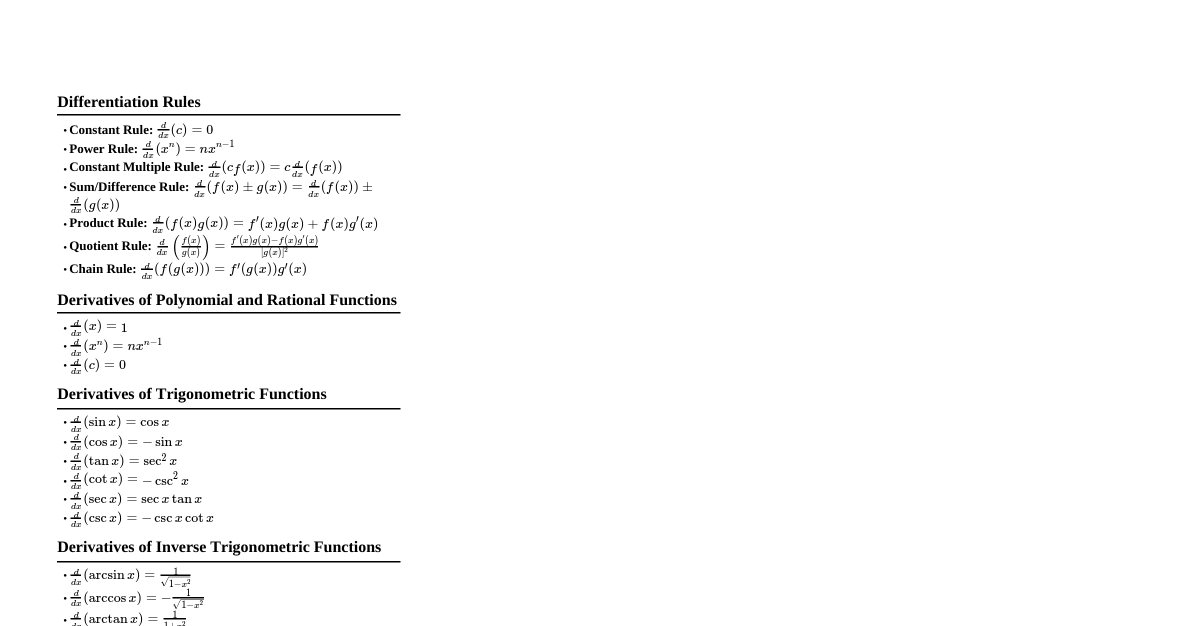
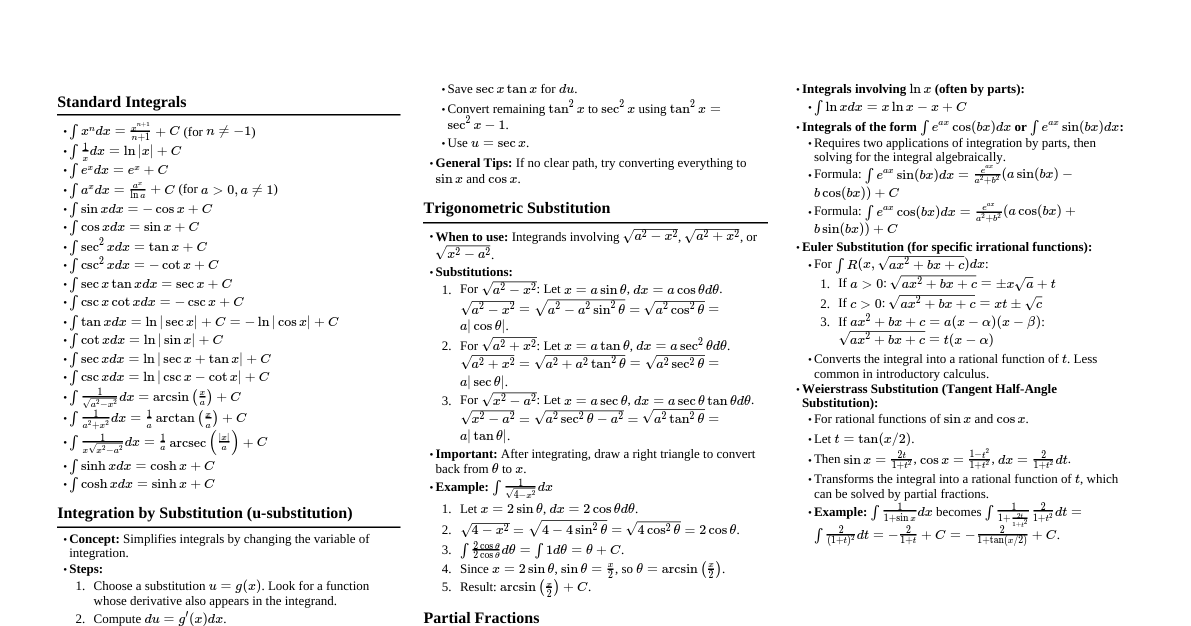
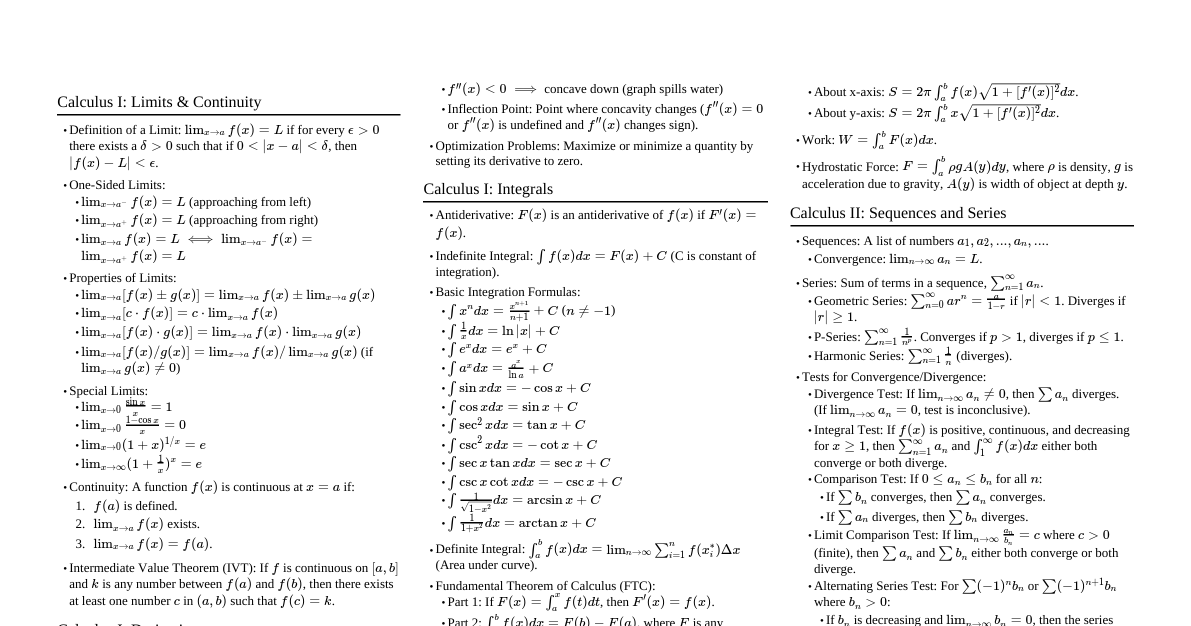
### Limits - **Definition:** $\lim_{x \to a} f(x) = L$ if $f(x)$ approaches $L$ as $x$ approaches $a$. - **Limit Laws:** - $\lim_{x \to a} [f(x) \pm g(x)] = \lim_{x \to a} f(x) \pm \lim_{x \to a} g(x)$ - $\lim_{x \to a} [c \cdot f(x)] = c \cdot \lim_{x \to a} f(x)$ - $\lim_{x \to a} [f(x) \cdot g(x)] = \lim_{x \to a} f(x) \cdot \lim_{x \to a} g(x)$ - $\lim_{x \to a} [f(x) / g(x)] = \lim_{x \to a} f(x) / \lim_{x \to a} g(x)$, if $\lim_{x \to a} g(x) \neq 0$ - **Special Limits:** - $\lim_{x \to 0} \frac{\sin x}{x} = 1$ - $\lim_{x \to 0} \frac{1 - \cos x}{x} = 0$ - $\lim_{x \to \infty} (1 + \frac{1}{x})^x = e$ ### Basic Derivatives - **Constant Rule:** $\frac{d}{dx}(c) = 0$ - **Power Rule:** $\frac{d}{dx}(x^n) = nx^{n-1}$ - **Constant Multiple Rule:** $\frac{d}{dx}(cf(x)) = c\frac{d}{dx}(f(x))$ - **Sum/Difference Rule:** $\frac{d}{dx}(f(x) \pm g(x)) = f'(x) \pm g'(x)$ - **Product Rule:** $\frac{d}{dx}(f(x)g(x)) = f'(x)g(x) + f(x)g'(x)$ - **Quotient Rule:** $\frac{d}{dx}\left(\frac{f(x)}{g(x)}\right) = \frac{f'(x)g(x) - f(x)g'(x)}{[g(x)]^2}$ - **Chain Rule:** $\frac{d}{dx}(f(g(x))) = f'(g(x))g'(x)$ ### Derivatives of Trigonometric Functions - $\frac{d}{dx}(\sin x) = \cos x$ - $\frac{d}{dx}(\cos x) = -\sin x$ - $\frac{d}{dx}(\tan x) = \sec^2 x$ - $\frac{d}{dx}(\cot x) = -\csc^2 x$ - $\frac{d}{dx}(\sec x) = \sec x \tan x$ - $\frac{d}{dx}(\csc x) = -\csc x \cot x$ ### Derivatives of Exponential & Logarithmic Functions - $\frac{d}{dx}(e^x) = e^x$ - $\frac{d}{dx}(a^x) = a^x \ln a$ - $\frac{d}{dx}(\ln x) = \frac{1}{x}$ - $\frac{d}{dx}(\log_a x) = \frac{1}{x \ln a}$ ### Derivatives of Inverse Trigonometric Functions - $\frac{d}{dx}(\arcsin x) = \frac{1}{\sqrt{1-x^2}}$ - $\frac{d}{dx}(\arccos x) = -\frac{1}{\sqrt{1-x^2}}$ - $\frac{d}{dx}(\arctan x) = \frac{1}{1+x^2}$ ### Basic Integrals - **Power Rule:** $\int x^n dx = \frac{x^{n+1}}{n+1} + C$, for $n \neq -1$ - $\int \frac{1}{x} dx = \ln|x| + C$ - $\int e^x dx = e^x + C$ - $\int a^x dx = \frac{a^x}{\ln a} + C$ - **Constant Multiple Rule:** $\int cf(x) dx = c\int f(x) dx$ - **Sum/Difference Rule:** $\int [f(x) \pm g(x)] dx = \int f(x) dx \pm \int g(x) dx$ ### Integrals of Trigonometric Functions - $\int \cos x dx = \sin x + C$ - $\int \sin x dx = -\cos x + C$ - $\int \sec^2 x dx = \tan x + C$ - $\int \csc^2 x dx = -\cot x + C$ - $\int \sec x \tan x dx = \sec x + C$ - $\int \csc x \cot x dx = -\csc x + C$ - $\int \tan x dx = \ln|\sec x| + C$ - $\int \cot x dx = \ln|\sin x| + C$ - $\int \sec x dx = \ln|\sec x + \tan x| + C$ - $\int \csc x dx = \ln|\csc x - \cot x| + C$ ### Integrals Leading to Inverse Trigonometric Functions - $\int \frac{1}{\sqrt{a^2-x^2}} dx = \arcsin\left(\frac{x}{a}\right) + C$ - $\int \frac{1}{a^2+x^2} dx = \frac{1}{a}\arctan\left(\frac{x}{a}\right) + C$ - $\int \frac{1}{x\sqrt{x^2-a^2}} dx = \frac{1}{a}\operatorname{arcsec}\left(\frac{|x|}{a}\right) + C$ ### Integration Techniques - **U-Substitution:** $\int f(g(x))g'(x) dx = \int f(u) du$ where $u = g(x)$. - **Integration by Parts:** $\int u dv = uv - \int v du$ - Choose $u$ using LIATE (Log, Inverse Trig, Algebraic, Trig, Exp) - **Partial Fractions:** For rational functions $\frac{P(x)}{Q(x)}$. - Decompose into simpler fractions (e.g., $\frac{A}{ax+b} + \frac{B}{(ax+b)^2} + \frac{Cx+D}{ax^2+bx+c}$). - **Trigonometric Substitution:** - For $\sqrt{a^2-x^2}$, let $x = a\sin\theta$. - For $\sqrt{a^2+x^2}$, let $x = a\tan\theta$. - For $\sqrt{x^2-a^2}$, let $x = a\sec\theta$. ### Fundamental Theorems of Calculus - **FTC Part 1:** If $F(x) = \int_a^x f(t) dt$, then $F'(x) = f(x)$. - **FTC Part 2:** $\int_a^b f(x) dx = F(b) - F(a)$, where $F$ is any antiderivative of $f$. ### Applications of Calculus - **Area between curves:** $\int_a^b |f(x) - g(x)| dx$ - **Volume of Revolution:** - **Disk/Washer Method:** $\int_a^b \pi (R(x)^2 - r(x)^2) dx$ or $\int_c^d \pi (R(y)^2 - r(y)^2) dy$ - **Shell Method:** $\int_a^b 2\pi x f(x) dx$ or $\int_c^d 2\pi y f(y) dy$ - **Arc Length:** $\int_a^b \sqrt{1 + [f'(x)]^2} dx$ or $\int_c^d \sqrt{1 + [g'(y)]^2} dy$ - **Surface Area of Revolution:** $\int_a^b 2\pi f(x) \sqrt{1 + [f'(x)]^2} dx$ - **L'Hôpital's Rule:** If $\lim_{x \to a} \frac{f(x)}{g(x)}$ is of the form $\frac{0}{0}$ or $\frac{\infty}{\infty}$, then $\lim_{x \to a} \frac{f(x)}{g(x)} = \lim_{x \to a} \frac{f'(x)}{g'(x)}$.