Newton
Cheatsheet Content
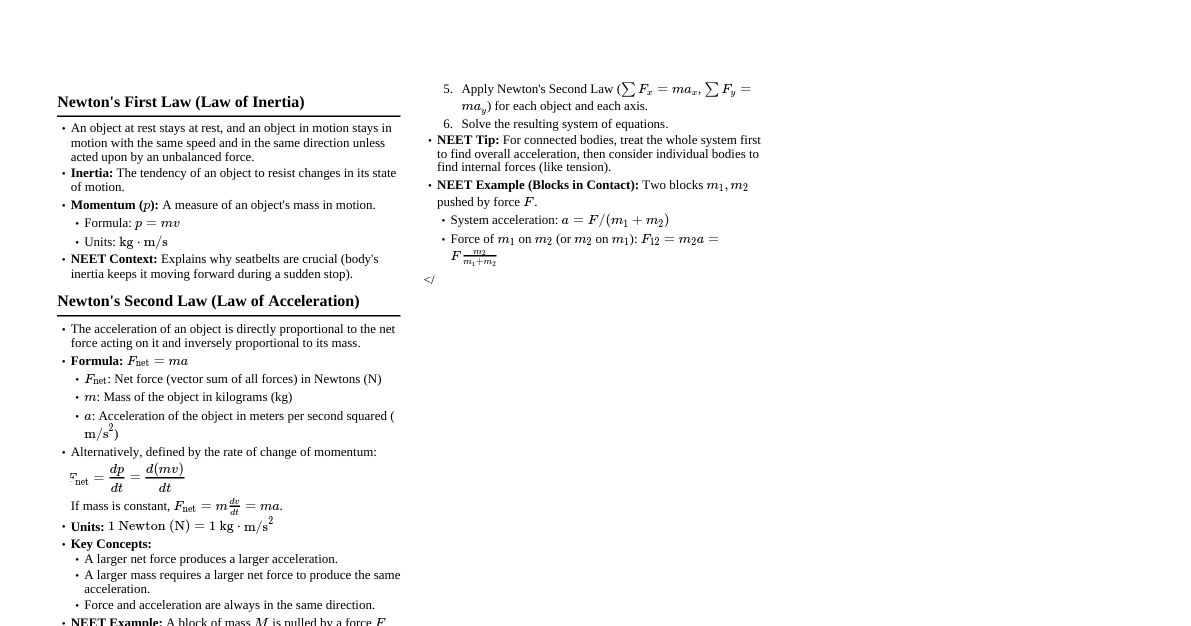
1. The Concept of Force Definition: A force is an interaction that, when unopposed, will change the motion of an object. Forces can be classified as: Contact Force: Results from physical contact between objects (e.g., friction, normal force). Field Force: Does not require physical contact (e.g., gravitational force, electromagnetic force). Units: SI unit: Newton (N) cgs unit: dyne British unit: pound (lb) Force is a vector quantity . 2. Mass, Inertia & Weight Inertia: Property of matter that resists changes in its state of motion. Mass: A measure of an object's inertia. It is an inherent property, independent of surroundings or measurement method. Scalar quantity. SI unit: kilogram (kg). cgs unit: gram (g). Weight: The force exerted by gravity on an object. Vector quantity, directed vertically downward. Depends on the body's position (gravitational field strength). Formula: $F_g = mg$ Remark: Mass and weight are different quantities. Mass is constant; weight varies with gravity. 3. Newton's Laws of Motion 3.1 Newton's First Law (Law of Inertia) An object continues in its state of rest or uniform motion in a straight line unless acted upon by an external force. Inertial Frame: A reference frame in which Newton's first law is valid. All accelerated frames are non-inertial. 3.2 Newton's Second Law The acceleration of an object is directly proportional to the net force acting on it and inversely proportional to its mass. Formula: $\sum \vec{F} = m\vec{a}$ Component form: $\sum F_x = ma_x$ $\sum F_y = ma_y$ $\sum F_z = ma_z$ 3.3 Newton's Third Law For every action, there is an equal and opposite reaction. If body 1 exerts a force $\vec{F}_{12}$ on body 2, then body 2 exerts a force $\vec{F}_{21}$ on body 1, such that $\vec{F}_{21} = -\vec{F}_{12}$. Action and reaction forces act on different bodies . 3.4 Gravitational Force and Normal Force Gravitational Force ($F_g$): The attractive force exerted by the Earth on an object, directed towards the center of the Earth. Magnitude is the object's weight ($F_g = mg$). Normal Force ($n$): The force exerted by a surface on an object in contact with it, acting perpendicular to the surface. It is a non-zero, positive value. 4. Force of Friction Frictional forces oppose the sliding of one surface over another. They are independent of the contact area but proportional to the normal force. Static Friction ($f_s$): Opposes the tendency of motion when surfaces are at rest relative to each other. $f_s \le \mu_s n$ $\mu_s$ is the coefficient of static friction. Kinetic Friction ($f_k$): Opposes motion when surfaces are sliding relative to each other. $f_k = \mu_k n$ $\mu_k$ is the coefficient of kinetic friction. Generally, $\mu_s > \mu_k$. Frictional force is always parallel to the surfaces in contact. 5. Problem-Solving Strategy (Newton's Laws) Choose a suitable coordinate system. Align one axis with the direction of acceleration. Draw a free-body diagram for each body in the system, showing all forces acting on it. Resolve each force into its components according to the chosen coordinates. Identify known and unknown quantities. Apply Newton's Second Law ($\sum F = ma$) for each body and each component direction to set up equations. Solve the system of equations for the unknowns. 6. Quick Quizzes Quick Quiz 1 Which statement is correct? It is possible for an object to have motion in the absence of forces on the object. It is possible to have forces on an object in the absence of motion of the object. Both of them. None of them. Answer: c) Both of them. (An object in uniform motion has no net force; static objects can have balanced forces). Quick Quiz 2 An object experiences no acceleration. Which of the following cannot be true for the object? A single force acts on the object. No forces act on the object. Forces act on the object, but the forces cancel. None of them. Answer: a) A single force acts on the object. (A single force would cause acceleration). Quick Quiz 3 If a fly collides with the windshield of a fast-moving bus, which experiences an impact force with a larger magnitude? The fly. The bus. Both experience the same force. Can't be known. Answer: c) Both experience the same force. (Newton's Third Law). Quick Quiz 4 If a fly collides with the windshield of a fast-moving bus, which experiences the greater acceleration? The fly. The bus. Both have the same acceleration. Can't be known. Answer: a) The fly. (Same force, but the fly has much smaller mass, so $a=F/m$ is larger). Quick Quiz 5 You press your book against a vertical wall with your hand. What is the direction of the friction force by the wall on the book? Upward. Downward. Out from the wall. Into the wall. Answer: a) Upward. (Friction opposes the tendency of the book to slide down due to gravity). Quick Quiz 6 A crate is in the center of a flatbed truck. The truck accelerates to the east, and the crate moves with it without sliding. Which is correct concerning the friction force exerted by the truck on the crate? It is static and directed to the west. It is static and directed to the east. It is kinetic and directed to the west. It is kinetic and directed to the east. Answer: b) It is static and directed to the east. (Static friction because no sliding, and it's in the direction of acceleration).