Newton
Cheatsheet Content
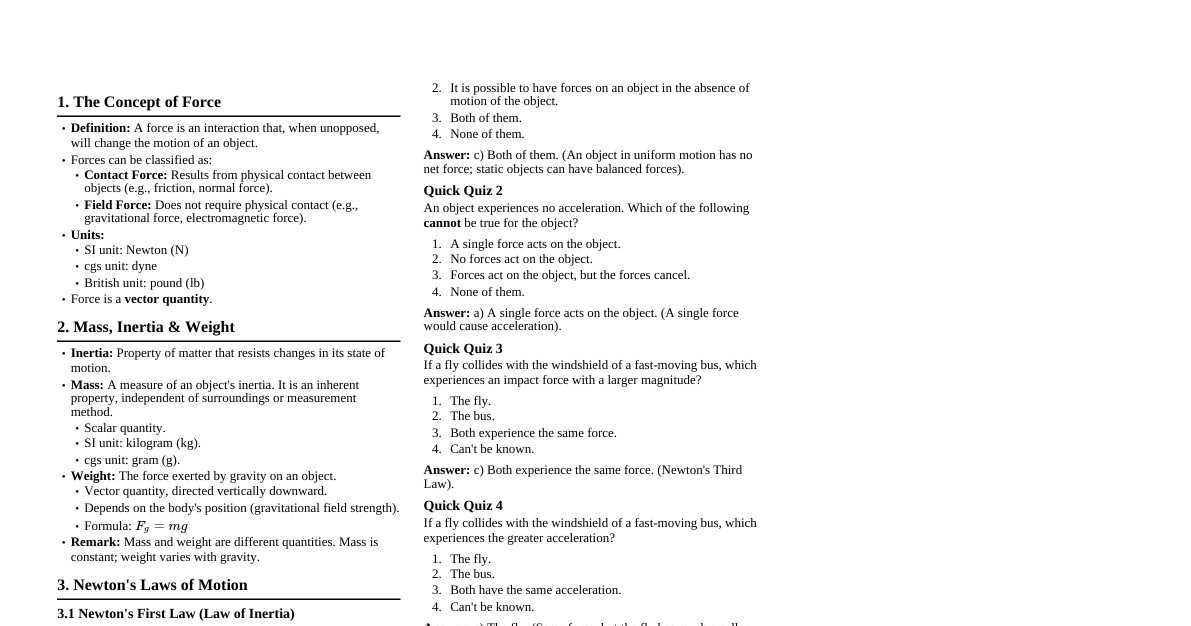
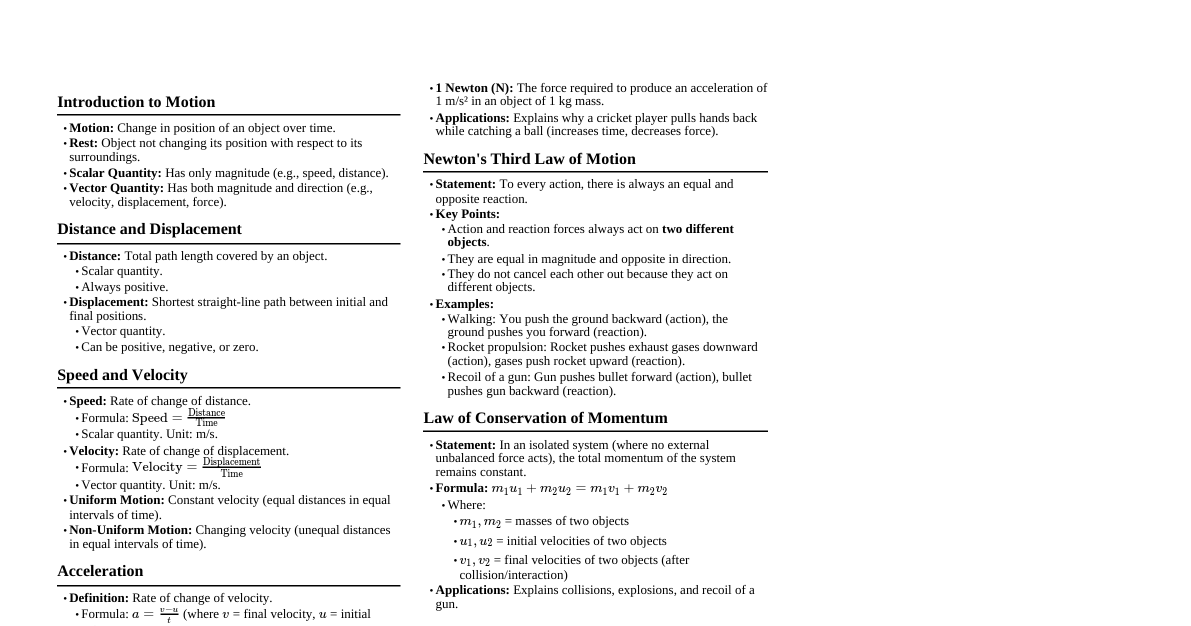
Newton's First Law (Law of Inertia) An object at rest stays at rest, and an object in motion stays in motion with the same speed and in the same direction unless acted upon by an unbalanced force. Inertia: The tendency of an object to resist changes in its state of motion. Momentum ($p$): A measure of an object's mass in motion. Formula: $p = mv$ Units: $\text{kg} \cdot \text{m/s}$ Newton's Second Law (Law of Acceleration) The acceleration of an object is directly proportional to the net force acting on it and inversely proportional to its mass. Formula: $F_{\text{net}} = ma$ $F_{\text{net}}$: Net force (vector sum of all forces) in Newtons (N) $m$: Mass of the object in kilograms (kg) $a$: Acceleration of the object in meters per second squared ($\text{m/s}^2$) Alternatively, defined by the rate of change of momentum: $$F_{\text{net}} = \frac{dp}{dt} = \frac{d(mv)}{dt}$$ If mass is constant, $F_{\text{net}} = m \frac{dv}{dt} = ma$. Units: $1 \text{ Newton (N)} = 1 \text{ kg} \cdot \text{m/s}^2$ Key Concepts: A larger net force produces a larger acceleration. A larger mass requires a larger net force to produce the same acceleration. Force and acceleration are always in the same direction. Newton's Third Law (Law of Action-Reaction) For every action, there is an equal and opposite reaction. When object A exerts a force on object B ($F_{AB}$), object B simultaneously exerts an equal and opposite force on object A ($F_{BA}$). Formula: $F_{AB} = -F_{BA}$ Characteristics of Action-Reaction Pairs: Act on different objects. Are equal in magnitude. Are opposite in direction. Occur simultaneously. Examples: A person pushes a wall, and the wall pushes back on the person. The Earth pulls on the Moon, and the Moon pulls on the Earth. A rocket expels gas downward, and the gas pushes the rocket upward. Common Forces Weight ($W$): Force due to gravity. Formula: $W = mg$ $g$: acceleration due to gravity ($\approx 9.8 \text{ m/s}^2$ on Earth) Normal Force ($N$): Force exerted by a surface perpendicular to the surface, preventing an object from passing through it. Friction Force ($f$): Force that opposes motion or attempted motion between surfaces in contact. Static friction ($f_s \le \mu_s N$): Prevents motion. Kinetic friction ($f_k = \mu_k N$): Opposes existing motion. $\mu_s$: coefficient of static friction $\mu_k$: coefficient of kinetic friction ($\mu_k Tension ($T$): Force transmitted through a string, rope, cable, or wire when pulled tight. Air Resistance/Drag ($F_D$): Force opposing the motion of an object through a fluid (like air). Often proportional to $v$ or $v^2$. Free-Body Diagrams A diagram showing all forces acting on a single object. Steps: Isolate the object of interest. Identify all forces acting ON the object. Draw vectors for each force, originating from the object's center. Choose a coordinate system and resolve forces into components. Apply Newton's Second Law ($\sum F_x = ma_x$, $\sum F_y = ma_y$).