Fluid Mechanics - Practice Qs
Shared 5/6/2026•1 views
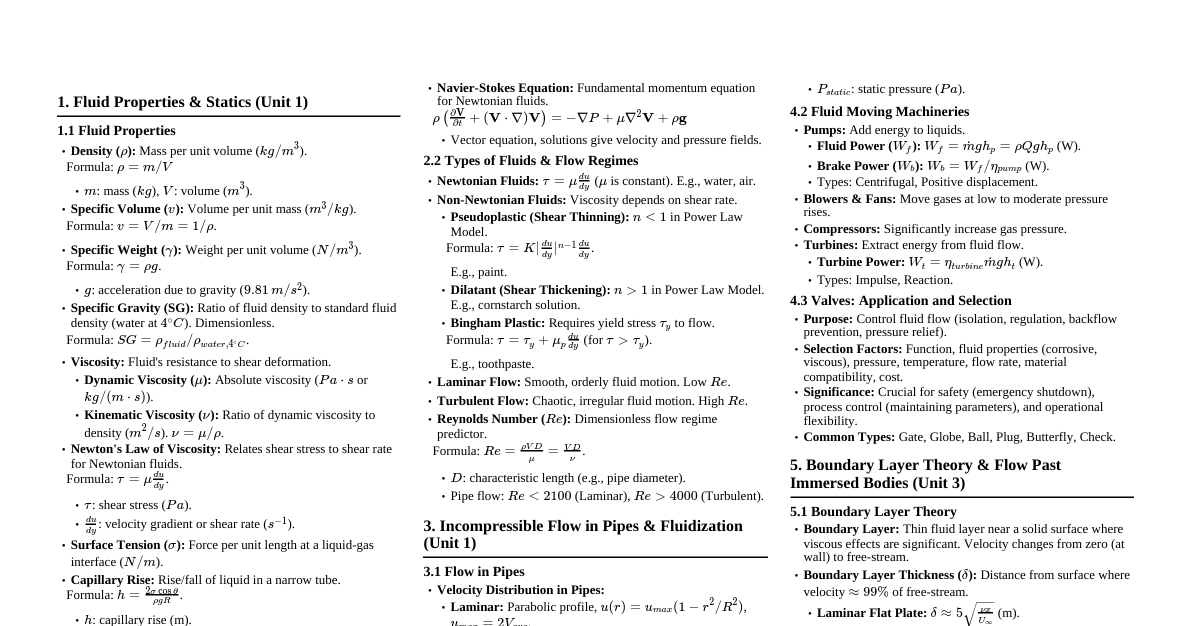
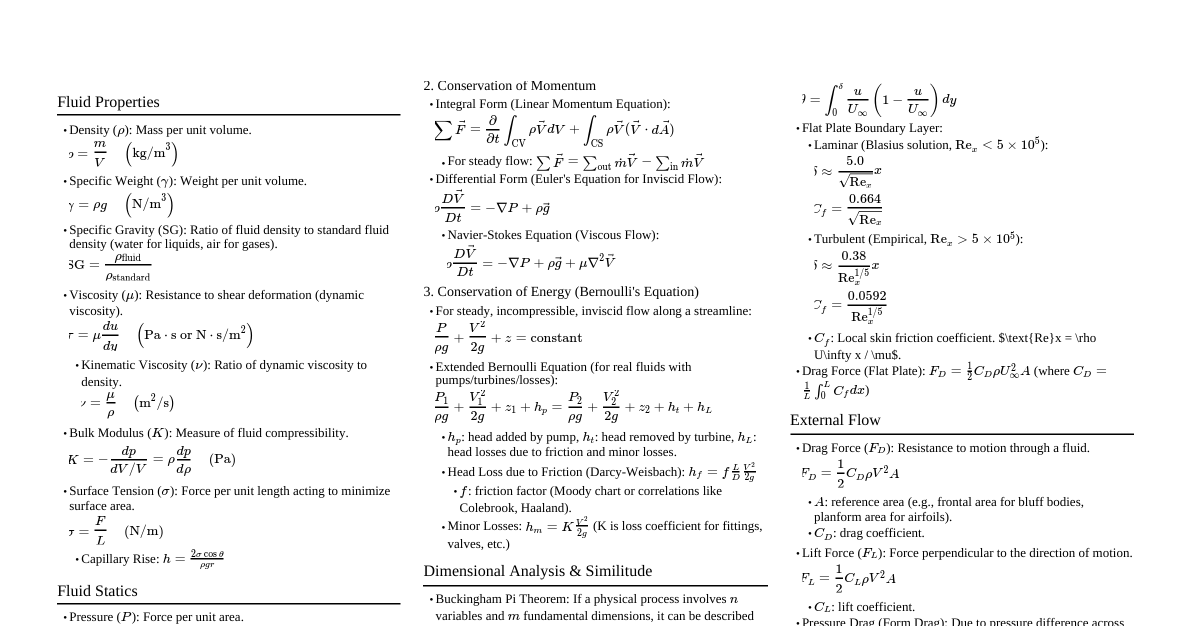
### 1. Density and Specific Gravity 1. A block of wood has a mass of 1500 g and dimensions of 10 cm x 20 cm x 5 cm. What is its density in g/cm³? 2. If the density of water is 1 g/cm³, what is the specific gravity of the wood block from Question 1? 3. An object has a volume of 250 cm³ and a density of 0.8 g/cm³. Calculate its mass. 4. A liquid has a specific gravity of 1.25. What is its density in kg/m³? (Density of water = 1000 kg/m³) 5. Two liquids, A and B, have densities of 0.9 g/cm³ and 1.1 g/cm³ respectively. If equal volumes of both are mixed, what is the average density of the mixture? (Assume no volume change on mixing). **Solutions:** 1. Volume = 10 cm * 20 cm * 5 cm = 1000 cm³. Density = Mass / Volume = 1500 g / 1000 cm³ = 1.5 g/cm³. 2. Specific Gravity = Density of substance / Density of water = 1.5 g/cm³ / 1 g/cm³ = 1.5. 3. Mass = Density * Volume = 0.8 g/cm³ * 250 cm³ = 200 g. 4. Density of liquid = Specific Gravity * Density of water = 1.25 * 1000 kg/m³ = 1250 kg/m³. 5. Let V be the volume of each liquid. Mass A = 0.9V, Mass B = 1.1V. Total Mass = 0.9V + 1.1V = 2V. Total Volume = V + V = 2V. Average Density = Total Mass / Total Volume = 2V / 2V = 1.0 g/cm³. ### 2. Pressure Formula P=F/A 1. A force of 500 N is applied uniformly over an area of 0.5 m². Calculate the pressure exerted. 2. A person weighing 60 kg stands on one foot. If the area of their foot is 150 cm², what pressure do they exert on the ground in Pascals? (g = 9.8 m/s²) 3. A hydraulic press has a small piston with an area of 5 cm² and a large piston with an area of 100 cm². If a force of 100 N is applied to the small piston, what is the pressure generated? 4. If the pressure exerted by a fluid is 20,000 Pa over an area of 0.1 m², what is the total force applied? 5. A block with dimensions 20 cm x 10 cm x 5 cm and a mass of 2 kg rests on its largest face. What pressure does it exert on the surface? (g = 9.8 m/s²) **Solutions:** 1. Pressure = Force / Area = 500 N / 0.5 m² = 1000 Pa. 2. Force = mass * g = 60 kg * 9.8 m/s² = 588 N. Area = 150 cm² = 0.015 m². Pressure = 588 N / 0.015 m² = 39,200 Pa. 3. Pressure = Force / Area = 100 N / (5 * 10⁻⁴ m²) = 200,000 Pa. 4. Force = Pressure * Area = 20,000 Pa * 0.1 m² = 2000 N. 5. Force = mass * g = 2 kg * 9.8 m/s² = 19.6 N. Largest face area = 20 cm * 10 cm = 200 cm² = 0.02 m². Pressure = 19.6 N / 0.02 m² = 980 Pa. ### 3. Floatation 1. A wooden block floats in water with 60% of its volume submerged. What is the density of the wood? (Density of water = 1000 kg/m³) 2. An object has a density of 800 kg/m³. Will it float or sink in a liquid with a density of 900 kg/m³? Justify your answer. 3. A ship has a total mass of 100,000 kg. What volume of water must it displace to float? (Density of water = 1000 kg/m³) 4. A balloon filled with helium weighs 100 N. The buoyant force acting on it is 120 N. Will the balloon rise, fall, or stay suspended? 5. An ice cube (density = 917 kg/m³) floats in water (density = 1000 kg/m³). What percentage of the ice cube's volume is submerged? **Solutions:** 1. For flotation, Buoyant Force = Weight of object. (Volume submerged * Density of water * g) = (Total Volume * Density of wood * g). 0.6 * V * 1000 kg/m³ * g = V * Density of wood * g. Density of wood = 0.6 * 1000 kg/m³ = 600 kg/m³. 2. It will float because its density (800 kg/m³) is less than the density of the liquid (900 kg/m³). 3. To float, the buoyant force must equal the weight of the ship. Weight of ship = 100,000 kg * 9.8 m/s² = 980,000 N. Buoyant force = Volume displaced * Density of water * g. 980,000 N = V * 1000 kg/m³ * 9.8 m/s². V = 100 m³. 4. The balloon will rise because the buoyant force (120 N) is greater than its weight (100 N). 5. Percentage submerged = (Density of ice / Density of water) * 100% = (917 kg/m³ / 1000 kg/m³) * 100% = 91.7%. ### 4. Apparent Weight 1. A 5 kg block is submerged in water. If the buoyant force acting on it is 30 N, what is its apparent weight? (g = 9.8 m/s²) 2. An object weighs 100 N in air and 70 N when fully submerged in a liquid. Calculate the buoyant force acting on the object. 3. A rock with a volume of 0.002 m³ is submerged in oil (density = 800 kg/m³). If the rock's mass is 6 kg, what is its apparent weight in the oil? (g = 9.8 m/s²) 4. An object has an apparent weight of 50 N in water. If its actual weight in air is 80 N, what is the volume of the object? (Density of water = 1000 kg/m³, g = 9.8 m/s²) 5. A fish weighs 2 N in air. When it is in water, it experiences a buoyant force of 2 N. What is its apparent weight in water? Will it sink, float, or be suspended? **Solutions:** 1. Actual weight = mass * g = 5 kg * 9.8 m/s² = 49 N. Apparent weight = Actual weight - Buoyant force = 49 N - 30 N = 19 N. 2. Buoyant force = Weight in air - Weight in liquid = 100 N - 70 N = 30 N. 3. Actual weight = mass * g = 6 kg * 9.8 m/s² = 58.8 N. Buoyant force = Volume * Density of oil * g = 0.002 m³ * 800 kg/m³ * 9.8 m/s² = 15.68 N. Apparent weight = 58.8 N - 15.68 N = 43.12 N. 4. Buoyant force = Weight in air - Apparent weight = 80 N - 50 N = 30 N. Buoyant force = Volume * Density of water * g. 30 N = V * 1000 kg/m³ * 9.8 m/s². V = 30 / 9800 ≈ 0.00306 m³. 5. Apparent weight = Actual weight - Buoyant force = 2 N - 2 N = 0 N. It will be suspended (neutrally buoyant). ### 5. Atmospheric Pressure 1. What is the approximate atmospheric pressure at sea level in Pascals and atmospheres? 2. Why does atmospheric pressure decrease as altitude increases? 3. A barometer reads 760 mmHg. Convert this pressure to Pascals. (Density of mercury = 13600 kg/m³, g = 9.8 m/s²) 4. If the atmospheric pressure is 101,325 Pa and the area of your palm is 0.01 m², what is the force exerted by the atmosphere on your palm? Why don't you feel this enormous force? 5. An airplane cabin is pressurized to 0.8 atm. If the outside pressure is 0.3 atm, what is the pressure difference across the cabin walls? **Solutions:** 1. Approximately 101,325 Pa or 1 atmosphere (atm). 2. Atmospheric pressure is caused by the weight of the air column above a point. As altitude increases, the height of the air column above decreases, and thus its weight decreases, leading to lower pressure. 3. Pressure = ρgh = 13600 kg/m³ * 9.8 m/s² * 0.760 m = 101,292.8 Pa. (Note: 760 mmHg = 0.760 m of mercury). 4. Force = Pressure * Area = 101,325 Pa * 0.01 m² = 1013.25 N. We don't feel this force because the pressure is exerted equally from all directions, and our bodies are also filled with fluids that exert outward pressure, balancing the inward atmospheric pressure. 5. Pressure difference = Inside pressure - Outside pressure = 0.8 atm - 0.3 atm = 0.5 atm. ### 6. Pressure due to Depth/Height (P = ρgh) 1. Calculate the pressure exerted by a column of water 10 meters deep. (Density of water = 1000 kg/m³, g = 9.8 m/s²) 2. A submarine dives to a depth of 50 meters in seawater (density = 1025 kg/m³). What is the gauge pressure at this depth? 3. If the pressure at the bottom of a liquid column is 15,000 Pa (gauge pressure) and the liquid has a density of 900 kg/m³, what is the height of the liquid column? (g = 9.8 m/s²) 4. Two points in a liquid are separated by a vertical distance of 2 meters. If the pressure difference between these points is 19,600 Pa, what is the density of the liquid? (g = 9.8 m/s²) 5. A tank contains oil (density 800 kg/m³) to a height of 3 m. What is the pressure at the bottom of the tank due to the oil? (g = 9.8 m/s²) **Solutions:** 1. Pressure = ρgh = 1000 kg/m³ * 9.8 m/s² * 10 m = 98,000 Pa. 2. Gauge Pressure = ρgh = 1025 kg/m³ * 9.8 m/s² * 50 m = 502,250 Pa. 3. h = Pressure / (ρg) = 15,000 Pa / (900 kg/m³ * 9.8 m/s²) ≈ 1.70 m. 4. Pressure difference = ρgh. ρ = Pressure difference / (gh) = 19,600 Pa / (9.8 m/s² * 2 m) = 1000 kg/m³. 5. Pressure = ρgh = 800 kg/m³ * 9.8 m/s² * 3 m = 23,520 Pa. ### 7. Manometer (Gauge Pressure, Absolute Pressure) 1. A U-tube manometer filled with mercury (density = 13600 kg/m³) shows a height difference of 10 cm when connected to a gas tank. What is the gauge pressure of the gas in Pascals? (g = 9.8 m/s²) 2. If the atmospheric pressure is 101,325 Pa, what is the absolute pressure of the gas in Question 1? 3. A manometer connected to a pipe containing water (density = 1000 kg/m³) shows the water level in the limb open to the atmosphere is 20 cm higher than in the limb connected to the pipe. What is the gauge pressure in the pipe? 4. A gas container has an absolute pressure of 150,000 Pa. If the atmospheric pressure is 100,000 Pa, what is the gauge pressure? 5. In a closed-tube manometer, the trapped air has a pressure of 5000 Pa. If the mercury level in the closed end is 5 cm higher than the level connected to the unknown pressure, what is the unknown pressure? (Density of mercury = 13600 kg/m³, g = 9.8 m/s²) **Solutions:** 1. Gauge Pressure = ρgh = 13600 kg/m³ * 9.8 m/s² * 0.10 m = 13,328 Pa. 2. Absolute Pressure = Gauge Pressure + Atmospheric Pressure = 13,328 Pa + 101,325 Pa = 114,653 Pa. 3. Gauge Pressure = ρgh = 1000 kg/m³ * 9.8 m/s² * 0.20 m = 1960 Pa. 4. Gauge Pressure = Absolute Pressure - Atmospheric Pressure = 150,000 Pa - 100,000 Pa = 50,000 Pa. 5. The unknown pressure is lower than the trapped air pressure. Pressure difference due to mercury column = ρgh = 13600 kg/m³ * 9.8 m/s² * 0.05 m = 6664 Pa. Unknown Pressure = Trapped air pressure - Pressure difference = 5000 Pa - 6664 Pa = -1664 Pa. (This indicates a vacuum or pressure less than trapped air). ### 8. Pascal's Principle 1. In a hydraulic system, a force of 100 N is applied to a piston with an area of 0.01 m². If the output piston has an area of 0.5 m², what is the force exerted on the output piston? 2. A car weighing 15,000 N is lifted by a hydraulic lift. If the small piston has an area of 0.02 m² and the large piston has an area of 0.8 m², what minimum force must be applied to the small piston? 3. Explain Pascal's principle in your own words. 4. If the input piston of a hydraulic jack moves down by 10 cm, and its area is 10 cm² while the output piston has an area of 100 cm², how far does the output piston move up? 5. A pressure of 500 kPa is applied to a fluid in a closed container. What is the pressure increase at every point within the fluid? **Solutions:** 1. Pressure (input) = Force (input) / Area (input) = 100 N / 0.01 m² = 10,000 Pa. By Pascal's principle, Pressure (output) = Pressure (input) = 10,000 Pa. Force (output) = Pressure (output) * Area (output) = 10,000 Pa * 0.5 m² = 5000 N. 2. Pressure (large) = Force (car) / Area (large) = 15,000 N / 0.8 m² = 18,750 Pa. By Pascal's principle, Pressure (small) = Pressure (large) = 18,750 Pa. Force (small) = Pressure (small) * Area (small) = 18,750 Pa * 0.02 m² = 375 N. 3. Pascal's principle states that a pressure change at any point in a confined incompressible fluid is transmitted undiminished to every portion of the fluid and to the walls of the containing vessel. 4. Volume displaced by input piston = Volume displaced by output piston. Area1 * Distance1 = Area2 * Distance2. 10 cm² * 10 cm = 100 cm² * Distance2. Distance2 = (10 cm² * 10 cm) / 100 cm² = 1 cm. 5. According to Pascal's principle, the pressure increase will be transmitted undiminished throughout the fluid, so the pressure increase at every point will be 500 kPa. ### 9. Archimedes' Principle 1. State Archimedes' Principle. 2. A block of metal has a volume of 0.005 m³ and a mass of 40 kg. When submerged in water (density = 1000 kg/m³), what is the buoyant force acting on it? (g = 9.8 m/s²) 3. An object weighs 20 N in air and 15 N when fully submerged in water. What is the volume of the object? (Density of water = 1000 kg/m³, g = 9.8 m/s²) 4. A boat displaces 2 m³ of water. What is the mass of the boat? (Density of water = 1000 kg/m³) 5. A 1 kg object with a volume of 0.0015 m³ is placed in a liquid with a density of 800 kg/m³. Will it float or sink? If it sinks, what is the buoyant force? If it floats, what is the buoyant force? (g = 9.8 m/s²) **Solutions:** 1. Archimedes' Principle states that the buoyant force on an object submerged in a fluid is equal to the weight of the fluid displaced by the object. 2. Buoyant force = Volume displaced * Density of water * g = 0.005 m³ * 1000 kg/m³ * 9.8 m/s² = 49 N. 3. Buoyant force = Weight in air - Weight in water = 20 N - 15 N = 5 N. Buoyant force = Volume * Density of water * g. 5 N = V * 1000 kg/m³ * 9.8 m/s². V = 5 / 9800 ≈ 0.00051 m³. 4. For flotation, Weight of boat = Buoyant force. Buoyant force = Volume displaced * Density of water * g = 2 m³ * 1000 kg/m³ * 9.8 m/s² = 19,600 N. Mass of boat = Weight / g = 19,600 N / 9.8 m/s² = 2000 kg. 5. Density of object = Mass / Volume = 1 kg / 0.0015 m³ ≈ 666.67 kg/m³. Since the density of the object (666.67 kg/m³) is less than the density of the liquid (800 kg/m³), the object will float. When floating, Buoyant force = Weight of object = 1 kg * 9.8 m/s² = 9.8 N. ### 10. Surface Tension & Capillary Action 1. Explain what surface tension is in simple terms. 2. Why does a small needle float on water, even though steel is denser than water? 3. Define capillary action. 4. Why does water rise in a narrow glass tube (capillary tube), while mercury in a similar tube is depressed? 5. List two everyday examples of surface tension or capillary action. **Solutions:** 1. Surface tension is the tendency of liquid surfaces to shrink into the minimum surface area possible. It acts like a thin, elastic skin on the surface of the liquid, caused by the cohesive forces between liquid molecules at the surface being stronger than the forces between liquid and air. 2. The needle floats due to surface tension. The surface tension of the water creates a 'skin' strong enough to support the small weight of the needle, as long as the needle does not break the surface. 3. Capillary action is the ability of a liquid to flow in narrow spaces without the assistance of, or even in opposition to, external forces like gravity. It results from the combination of cohesive forces (within the liquid) and adhesive forces (between the liquid and the solid surface). 4. Water rises in a glass tube because the adhesive forces between water molecules and glass molecules are stronger than the cohesive forces between water molecules. This causes the water to 'wet' the glass and climb up. Conversely, for mercury, the cohesive forces between mercury atoms are much stronger than the adhesive forces between mercury and glass, causing the mercury to avoid contact with the glass and be depressed. 5. Examples: * Water strider insects walking on water. * Drops of water forming a spherical shape. * Absorption of water by a sponge or paper towel. * Plant roots drawing water up from the soil. * Wax paper repelling water.