Mechanics (DSC-2) Formula Sheet
Cheatsheet Content
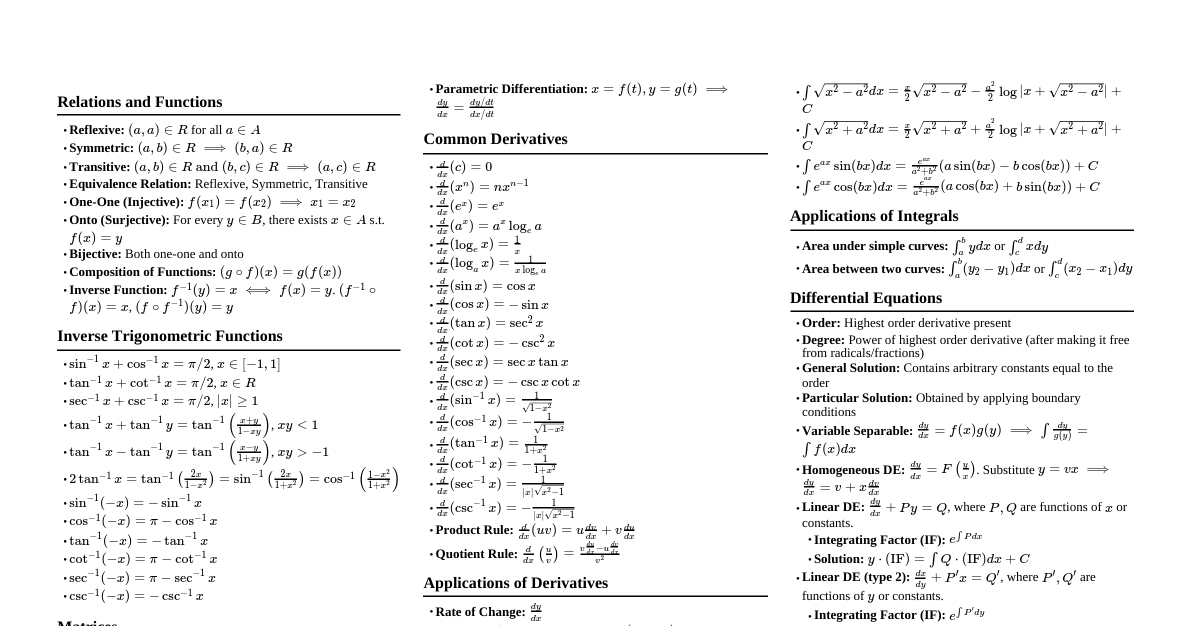
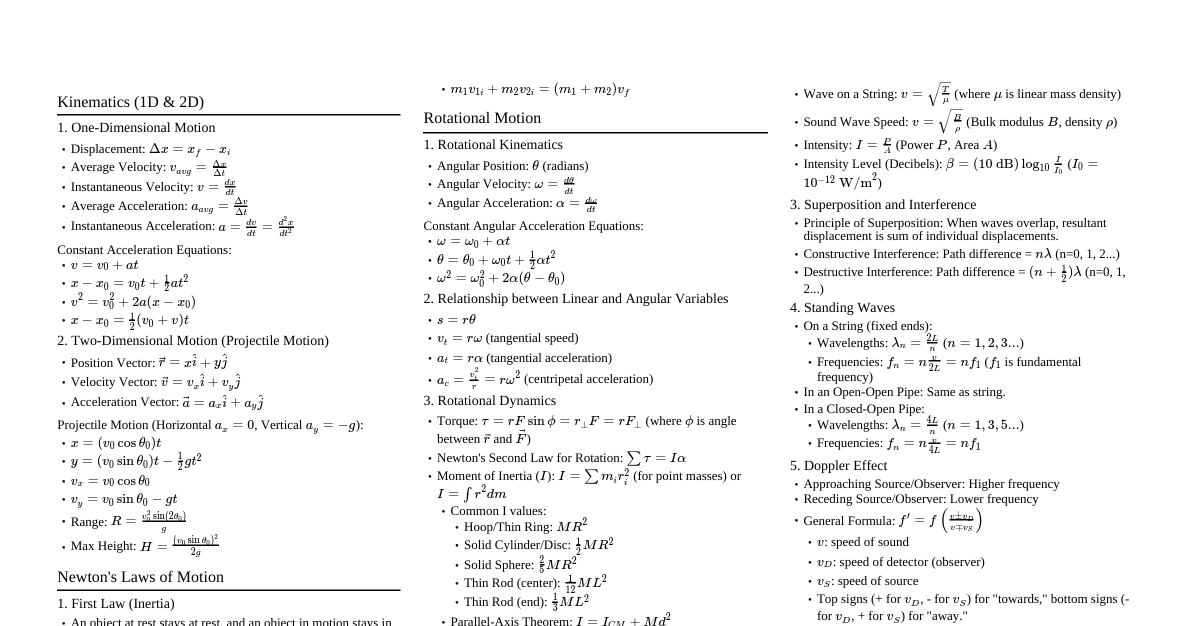
UNIT 1: FUNDAMENTALS OF DYNAMICS, WORK–ENERGY & COLLISIONS Newton’s Laws Force: $\vec{F} = m\vec{a}$ Galilean Transformation Coordinates: $x' = x - vt, \quad y' = y, \quad z' = z, \quad t' = t$ Velocity: $\vec{u}' = \vec{u} - \vec{v}$ Rocket Motion (Variable Mass System) Velocity: $v = v_e \ln \left(\frac{M_0}{M}\right)$ $v_e$: exhaust velocity $M_0$: initial mass $M$: mass at time $t$ Work–Energy Theorem Work done: $W = \Delta K = \frac{1}{2}m(v^2 - u^2)$ Conservative Force Relation to potential energy: $\vec{F} = - \nabla V$ Work done in closed loop: $\oint \vec{F} \cdot d\vec{r} = 0$ Equilibrium Conditions Stable equilibrium: $\frac{dV}{dx} = 0$, $\frac{d^2V}{dx^2} > 0$ Unstable equilibrium: $\frac{dV}{dx} = 0$, $\frac{d^2V}{dx^2} Neutral equilibrium: $\frac{dV}{dx} = 0$, $\frac{d^2V}{dx^2} = 0$ Collisions Momentum conservation: $m_1 u_1 + m_2 u_2 = m_1 v_1 + m_2 v_2$ Coefficient of restitution: $e = \frac{v_2 - v_1}{u_1 - u_2}$ UNIT 2: ROTATIONAL DYNAMICS & NON-INERTIAL FRAMES Angular Quantities Angular momentum: $\vec{L} = \vec{r} \times \vec{p}$ Torque: $\vec{\tau} = \frac{d\vec{L}}{dt}$ Moment of Inertia Discrete masses: $I = \sum m r^2$ Continuous mass: $I = \int r^2 \, dm$ Standard Moments of Inertia Rod (centre): $I = \frac{1}{12}ML^2$ Solid sphere: $I = \frac{2}{5}MR^2$ Solid cylinder/disc: $I = \frac{1}{2}MR^2$ Hollow cylinder (thin wall): $I = MR^2$ Parallel Axis Theorem $I = I_{cm} + Md^2$ Radius of Gyration $I = Mk^2$ Rolling Motion Velocity relation: $v = \omega R$ Total kinetic energy: $K = \frac{1}{2}Mv^2 + \frac{1}{2}I\omega^2$ Acceleration on incline: $a = \frac{g\sin\theta}{1 + \frac{I}{MR^2}}$ Non-Inertial Frames Centrifugal force: $F_c = m\omega^2 r$ Coriolis force: $\vec{F}_{cor} = -2m(\vec{\omega} \times \vec{v})$ UNIT 3: CENTRAL FORCE MOTION Central Force Definition: $\vec{F}(r) = f(r)\hat{r}$ Conservation of Angular Momentum For central force: $\vec{L} = \text{constant}$ Effective Potential $V_{eff}(r) = V(r) + \frac{L^2}{2mr^2}$ Condition for Circular Orbit Equilibrium: $\frac{dV_{eff}}{dr} = 0$ Stability: $\frac{d^2V_{eff}}{dr^2} > 0$ Gravitational Potential $V(r) = -\frac{GMm}{r}$ Orbital Velocity For circular orbit: $v = \sqrt{\frac{GM}{r}}$ Time Period of Satellite $T = 2\pi \sqrt{\frac{r^3}{GM}}$ Kepler’s Third Law $T^2 \propto r^3$ UNIT 4: SPECIAL THEORY OF RELATIVITY Lorentz Factor $\gamma = \frac{1}{\sqrt{1 - \frac{v^2}{c^2}}}$ Lorentz Transformations Position: $x' = \gamma (x - vt)$ Time: $t' = \gamma \left(t - \frac{vx}{c^2}\right)$ Time Dilation $\Delta t = \gamma \Delta t_0$ Length Contraction $L = \frac{L_0}{\gamma}$ Relativistic Velocity Addition $u = \frac{u' + v}{1 + \frac{u'v}{c^2}}$ Relativistic Momentum $p = \gamma mv$ Relativistic Energy Total energy: $E = \gamma mc^2$ Kinetic energy: $K = (\gamma - 1)mc^2$ Mass–Energy Equivalence $E = mc^2$