UNILAG-213 Formula Cheatsheet
Shared 3/30/2026•51 views
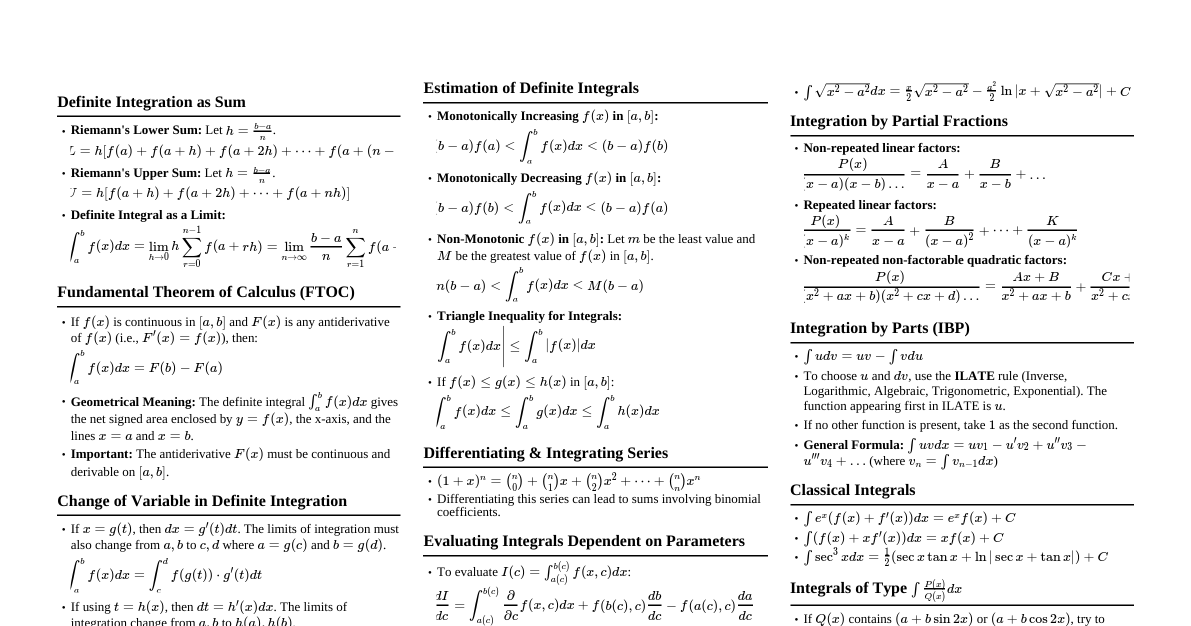
### Integral Calculus for Business & Economics - **Indefinite Integral:** $\int f(x) dx = F(x) + C$ - **Definite Integral:** $\int_a^b f(x) dx = F(b) - F(a)$ - **Consumer Surplus (CS):** $CS = \int_0^{Q_e} D(Q) dQ - P_e Q_e$ - **Producer Surplus (PS):** $PS = P_e Q_e - \int_0^{Q_e} S(Q) dQ$ - **Total Cost from Marginal Cost:** $TC(Q) = \int MC(Q) dQ + FC$ (FC = Fixed Cost) - **Total Revenue from Marginal Revenue:** $TR(Q) = \int MR(Q) dQ$ ### Algebraic, Logarithmic, and Exponential Functions #### Algebraic Functions - **Linear:** $y = mx + b$ - **Quadratic:** $y = ax^2 + bx + c$ - **Polynomial:** $P(x) = a_n x^n + ... + a_1 x + a_0$ #### Logarithmic Functions - **Definition:** $y = \log_b x \iff b^y = x$ - **Natural Logarithm:** $y = \ln x \iff e^y = x$ - **Properties:** - $\ln(xy) = \ln x + \ln y$ - $\ln(x/y) = \ln x - \ln y$ - $\ln(x^p) = p \ln x$ - $\ln e = 1, \ln 1 = 0$ #### Exponential Functions - **General Form:** $y = ab^x$ - **Natural Exponential:** $y = ae^{kx}$ - **Compound Interest (Discrete):** $A = P(1 + r/n)^{nt}$ - **Compound Interest (Continuous):** $A = Pe^{rt}$ - **Growth/Decay Model:** $N(t) = N_0 e^{kt}$ ### Optimization, Marginal Analysis, and Growth Models - **Optimization:** Find maximum or minimum of a function $f(x)$ - Set first derivative to zero: $f'(x) = 0$ - Use second derivative test: $f''(x) > 0$ for min, $f''(x) 0$) - **Exponential Decay Model:** $P(t) = P_0 e^{-kt}$ (where $k > 0$) ### Applications of Differential Calculus - **Demand Function:** $Q = f(P)$ - **Supply Function:** $Q = g(P)$ - **Cost Function:** $C(Q) = FC + VC(Q)$ - **Revenue Function:** $R(Q) = P \cdot Q$ - **Profit Function:** $\Pi(Q) = R(Q) - C(Q)$ - **Break-even Point:** $R(Q) = C(Q)$ - **Derivative as Rate of Change:** $\frac{dy}{dx}$ - **Partial Derivatives:** For functions of multiple variables (e.g., $f(x, y)$) - $\frac{\partial f}{\partial x}$ (treat $y$ as constant) - $\frac{\partial f}{\partial y}$ (treat $x$ as constant) ### Mathematics and Finance - **Simple Interest:** $I = Prt$, $A = P(1 + rt)$ - **Compound Interest:** $A = P(1 + r/n)^{nt}$ - **Continuous Compounding:** $A = Pe^{rt}$ - **Effective Annual Rate (EAR):** $EAR = (1 + r/n)^n - 1$ - **Present Value (PV):** $PV = FV(1 + r)^{-n}$ - **Future Value (FV):** $FV = PV(1 + r)^n$ - **Annuity Future Value:** $FV_A = PMT \frac{(1+r)^n - 1}{r}$ - **Annuity Present Value:** $PV_A = PMT \frac{1 - (1+r)^{-n}}{r}$ ### Vectors and Matrices #### Vectors - **Vector Notation:** $\vec{v} = \begin{pmatrix} v_1 \\ v_2 \end{pmatrix}$ or $\vec{v} = (v_1, v_2)$ - **Magnitude:** $|\vec{v}| = \sqrt{v_1^2 + v_2^2}$ - **Dot Product:** $\vec{a} \cdot \vec{b} = a_1b_1 + a_2b_2 = |\vec{a}||\vec{b}|\cos\theta$ - **Unit Vector:** $\hat{u} = \frac{\vec{u}}{|\vec{u}|}$ #### Matrices - **Matrix Addition/Subtraction:** Element-wise - **Scalar Multiplication:** $c A = (c a_{ij})$ - **Matrix Multiplication:** $(AB)_{ij} = \sum_k A_{ik}B_{kj}$ - **Transpose:** $(A^T)_{ij} = A_{ji}$ - **Determinant (2x2):** $\det \begin{pmatrix} a & b \\ c & d \end{pmatrix} = ad - bc$ - **Determinant (3x3):** $a(ei - fh) - b(di - fg) + c(dh - eg)$ - **Inverse (2x2):** $A^{-1} = \frac{1}{\det A} \begin{pmatrix} d & -b \\ -c & a \end{pmatrix}$ - **Identity Matrix:** $I = \begin{pmatrix} 1 & 0 \\ 0 & 1 \end{pmatrix}$ ### Sequence, Series, and Set Theory #### Sequences and Series - **Arithmetic Sequence:** $a_n = a_1 + (n-1)d$ - **Arithmetic Series Sum:** $S_n = \frac{n}{2}(a_1 + a_n) = \frac{n}{2}(2a_1 + (n-1)d)$ - **Geometric Sequence:** $a_n = a_1 r^{n-1}$ - **Geometric Series Sum:** $S_n = a_1 \frac{1-r^n}{1-r}$ (for $r \neq 1$) - **Infinite Geometric Series Sum:** $S = \frac{a_1}{1-r}$ (for $|r| ### Consumption and Market Penetration - **Consumption Function:** $C = a + bY_d$ (where $C$ is consumption, $a$ is autonomous consumption, $b$ is MPC, $Y_d$ is disposable income) - **Marginal Propensity to Consume (MPC):** $MPC = \frac{\Delta C}{\Delta Y_d}$ - **Marginal Propensity to Save (MPS):** $MPS = \frac{\Delta S}{\Delta Y_d} = 1 - MPC$ - **Market Penetration Rate:** $\frac{\text{Number of users}}{\text{Total target market size}} \times 100\%$ - **Diffusion of Innovations (e.g., Bass Model):** $S(t) = p N + q (N - F(t))$ (where $S(t)$ is sales at time t, $p$ is coefficient of innovation, $q$ is coefficient of imitation, $N$ is ultimate market potential, $F(t)$ is cumulative sales)