Second Law of Thermodynamics
Cheatsheet Content
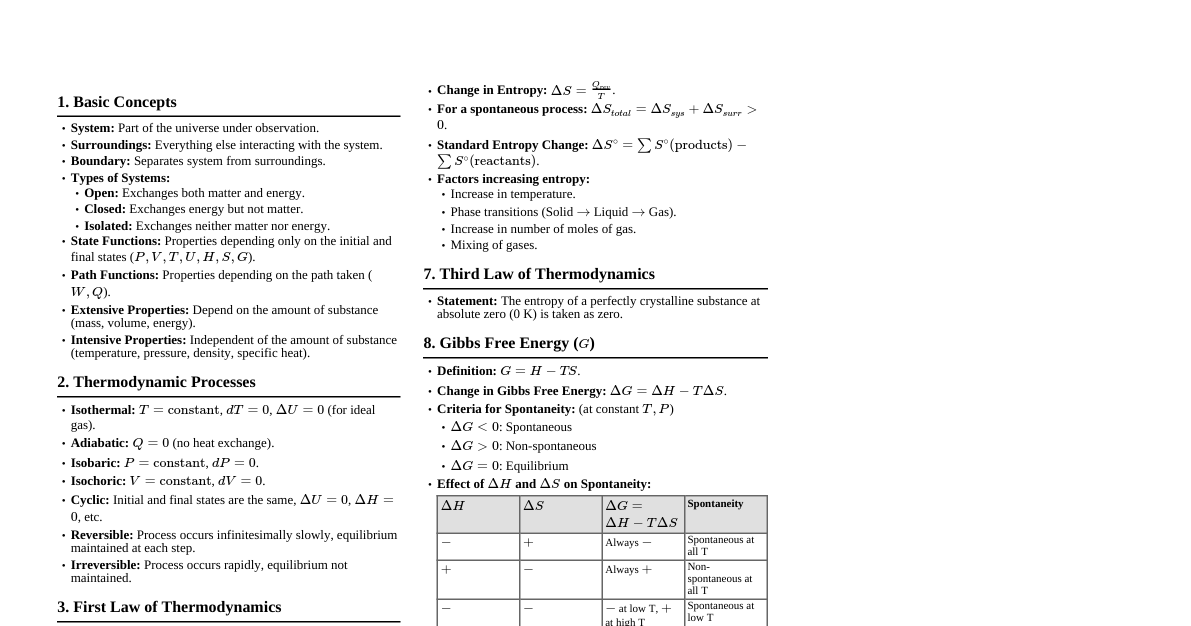
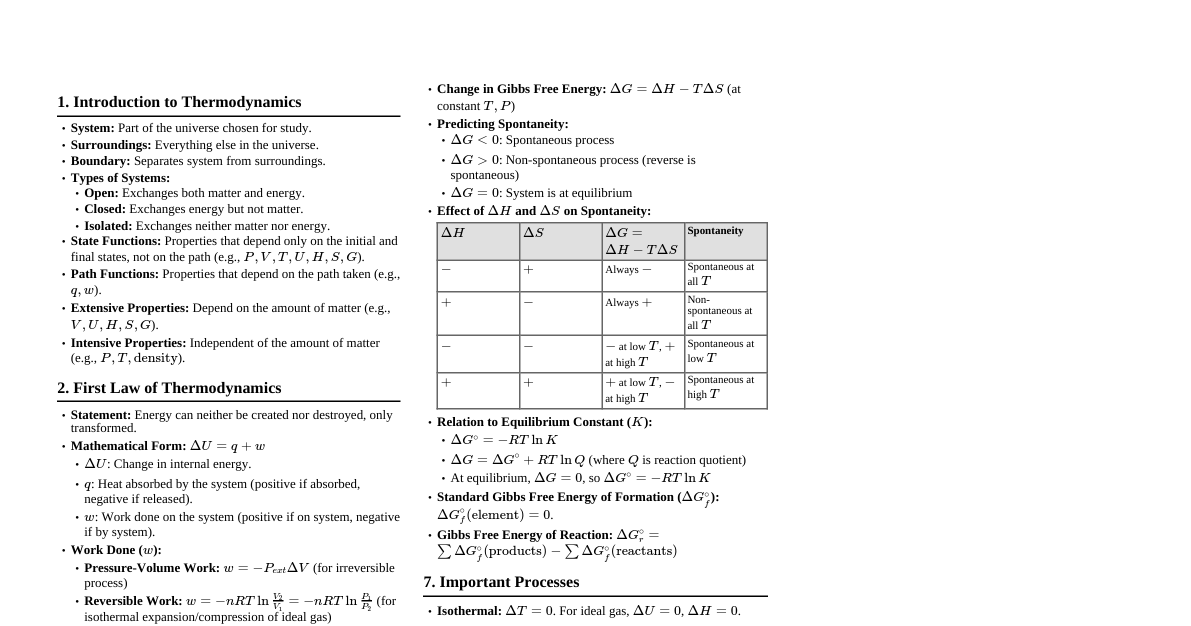
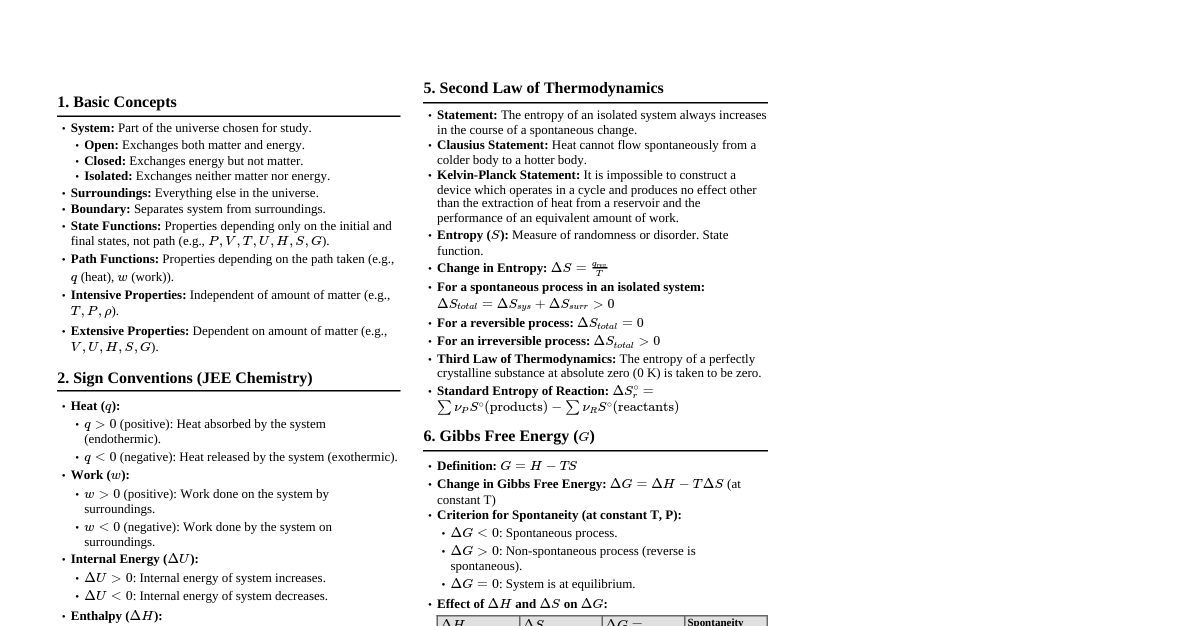
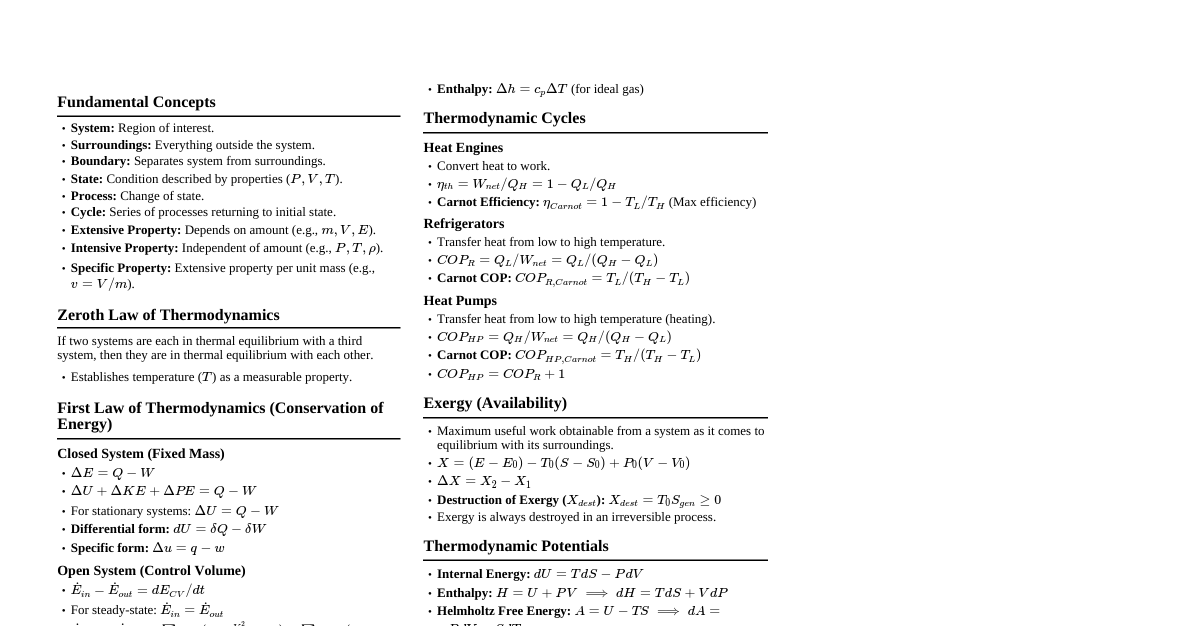
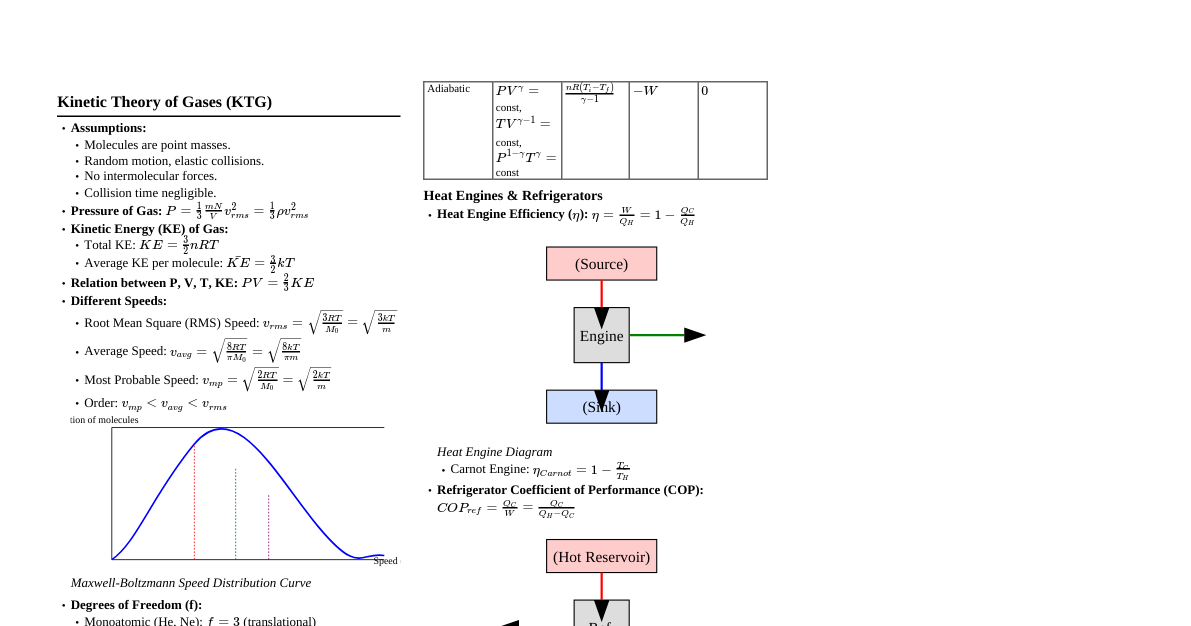
1. Introduction to Entropy Definition: A measure of the disorder or randomness of a system. Statistical Mechanics Perspective: $S = k_B \ln W$ $S$: Entropy (J/K) $k_B$: Boltzmann constant ($1.38 \times 10^{-23}$ J/K) $W$: Number of microstates corresponding to a given macrostate 2. The Second Law of Thermodynamics Clausius Statement: Heat cannot spontaneously flow from a colder body to a hotter body. Kelvin-Planck Statement: It is impossible to construct a device that operates in a cycle and produces no effect other than the transfer of heat from a single thermal reservoir and the production of an equivalent amount of work. Entropy Statement: The total entropy of an isolated system can only increase over time, or remain constant in ideal cases where the system is in a steady state or undergoing a reversible process. It can never decrease. For an isolated system: $\Delta S_{sys} \ge 0$ For any process: $\Delta S_{total} = \Delta S_{sys} + \Delta S_{surr} \ge 0$ 3. Entropy Change for Reversible Processes General Formula: $dS = \frac{\delta Q_{rev}}{T}$ $dS$: Infinitesimal change in entropy $\delta Q_{rev}$: Infinitesimal amount of heat transferred reversibly $T$: Absolute temperature (K) Integrated Form: $\Delta S = \int \frac{\delta Q_{rev}}{T}$ Isothermal Process ($T$ = constant): $\Delta S = \frac{Q_{rev}}{T}$ Phase Change (at constant T and P): $\Delta S = \frac{\Delta H_{phase}}{T_{phase}}$ $\Delta H_{phase}$: Latent heat of phase change (e.g., $\Delta H_{vap}$, $\Delta H_{fus}$) Constant Volume ($V$ = constant, for ideal gas): $\Delta S = n C_v \ln \left(\frac{T_2}{T_1}\right)$ Constant Pressure ($P$ = constant, for ideal gas): $\Delta S = n C_p \ln \left(\frac{T_2}{T_1}\right)$ General Process for Ideal Gas: $\Delta S = n C_v \ln \left(\frac{T_2}{T_1}\right) + n R \ln \left(\frac{V_2}{V_1}\right)$ or $\Delta S = n C_p \ln \left(\frac{T_2}{T_1}\right) - n R \ln \left(\frac{P_2}{P_1}\right)$ 4. Entropy Change for Irreversible Processes General Inequality: $dS \ge \frac{\delta Q}{T}$ For an isolated system: $\Delta S > 0$ for irreversible processes, $\Delta S = 0$ for reversible processes. Mixing of Ideal Gases: $\Delta S_{mix} = -R \sum_i n_i \ln x_i$ $n_i$: Moles of component $i$ $x_i$: Mole fraction of component $i$ 5. Carnot Cycle and Heat Engines Efficiency of a Heat Engine: $\eta = \frac{W_{net}}{Q_H} = 1 - \frac{Q_L}{Q_H}$ $W_{net}$: Net work output $Q_H$: Heat absorbed from hot reservoir $Q_L$: Heat rejected to cold reservoir Carnot Efficiency (Ideal Engine): $\eta_{Carnot} = 1 - \frac{T_L}{T_H}$ $T_H$: Absolute temperature of hot reservoir $T_L$: Absolute temperature of cold reservoir Carnot Principle: No heat engine operating between two reservoirs can be more efficient than a Carnot engine operating between the same two reservoirs. 6. Refrigerators and Heat Pumps Coefficient of Performance (COP) - Refrigerator: $COP_{ref} = \frac{Q_L}{W_{net}} = \frac{Q_L}{Q_H - Q_L}$ Ideal Carnot Refrigerator: $COP_{ref,Carnot} = \frac{T_L}{T_H - T_L}$ Coefficient of Performance (COP) - Heat Pump: $COP_{hp} = \frac{Q_H}{W_{net}} = \frac{Q_H}{Q_H - Q_L}$ Ideal Carnot Heat Pump: $COP_{hp,Carnot} = \frac{T_H}{T_H - T_L}$ Relationship: $COP_{hp} = COP_{ref} + 1$ 7. Third Law of Thermodynamics Statement: The entropy of a perfect crystal at absolute zero (0 K) is exactly zero. Implication: It is impossible to reach absolute zero temperature in a finite number of steps. 8. Availability (Exergy) Definition: The maximum useful work that can be obtained from a system as it comes into equilibrium with its surroundings. For a closed system: $A = U - T_0 S + P_0 V$ $U$: Internal energy $S$: Entropy $V$: Volume $T_0, P_0$: Temperature and pressure of the surroundings Change in Availability: $\Delta A = (U_2 - U_1) - T_0(S_2 - S_1) + P_0(V_2 - V_1)$ Irreversibility (Lost Work): $I = W_{rev} - W_{actual} = T_0 \Delta S_{total}$ $I$: Lost work due to irreversibilities $\Delta S_{total}$: Total entropy generation for the process and surroundings