Engineering Mathematics I
Cheatsheet Content
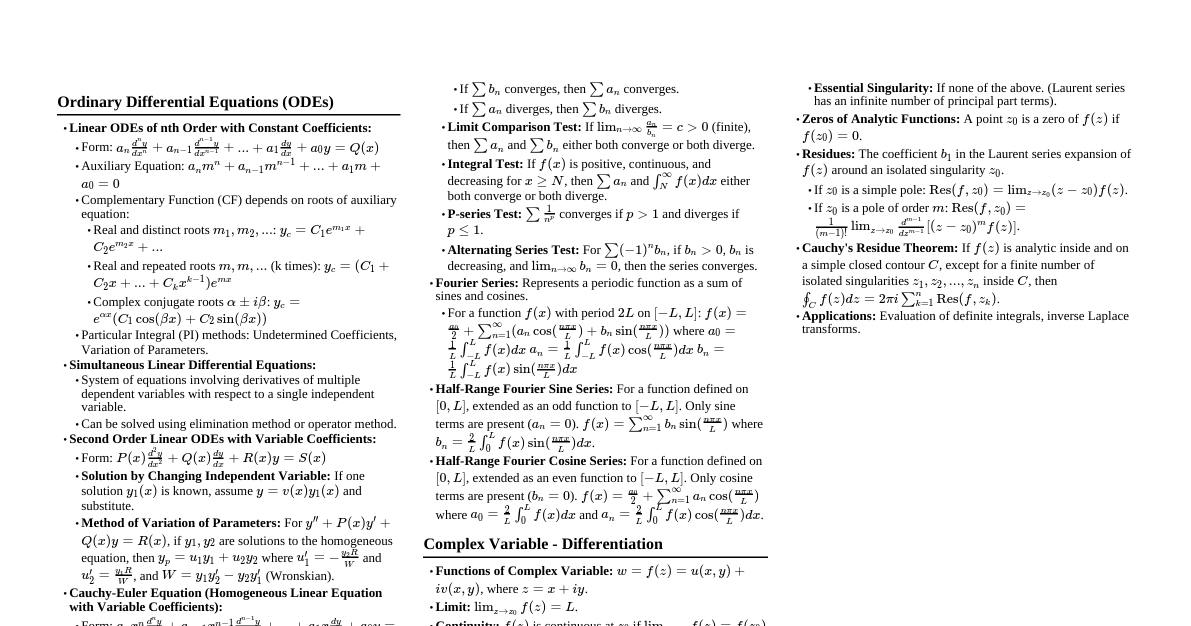
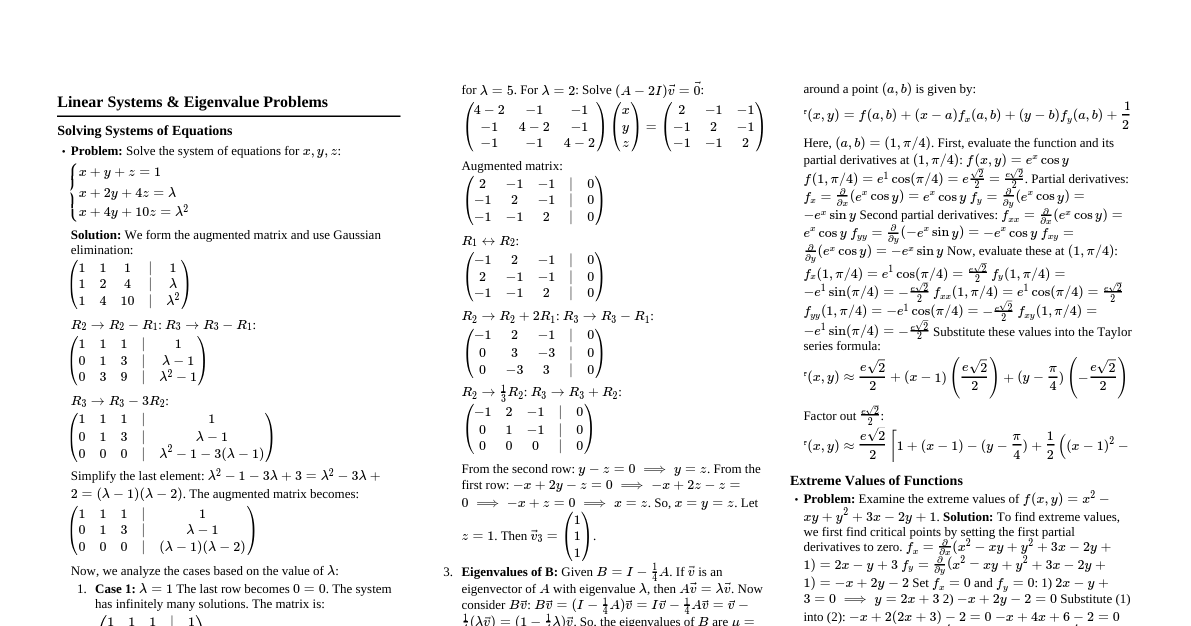
### Matrices and Determinants - **Similar Matrices**: Have same eigenvalues. - **Matrix Multiplication**: $(AB)_{ij} = \sum_k A_{ik}B_{kj}$. - **Transpose**: $(A^T)_{ij} = A_{ji}$. - **Inverse**: $AA^{-1} = A^{-1}A = I$. - **Characteristic Equation**: $\det(A - \lambda I) = 0$. Solutions for $\lambda$ are eigenvalues. - **Cayley-Hamilton Theorem**: Every square matrix satisfies its own characteristic equation. - **Rank of a Matrix**: - The rank of an $m \times n$ matrix is $r$. The columns form a set of $m$ vectors, and this set has $r$ linearly independent vectors. - Can be found by reducing to normal form or row echelon form. - **Eigenvalues and Eigenvectors**: Given $A\vec{v} = \lambda\vec{v}$, $\lambda$ is an eigenvalue and $\vec{v}$ is an eigenvector. - **Diagonalization**: $A = PDP^{-1}$ where $D$ is a diagonal matrix of eigenvalues. - **System of Linear Equations**: - $Ax=b$. Investigate consistency for no solution, unique solution, or infinite solutions. - Gauss elimination method for solving linear equations. ### Vector Spaces - **Vector Space**: A set $V$ over a field $R$ with addition and scalar multiplication satisfying specific axioms. - **Subspace**: A subset of a vector space that is itself a vector space. - For $V$ of $2 \times 2$ real matrices, $W$ (matrices with determinant zero) is generally not a subspace. - **Basis**: A set of linearly independent vectors that span the entire vector space. - **Dimension**: The number of vectors in a basis for a vector space. - **Linear Dependence**: Vectors $\vec{v_1}, \vec{v_2}, ..., \vec{v_k}$ are linearly dependent if $c_1\vec{v_1} + c_2\vec{v_2} + ... + c_k\vec{v_k} = 0$ for non-zero scalars $c_i$. ### Differential Calculus - **Partial Derivatives**: - If $x = r \cos\theta, y = r \sin\theta$, then $\frac{\partial(x,y)}{\partial(r,\theta)}$ is the Jacobian. - For $u(x,y) = \tan^{-1}\left(\frac{y}{x}\right)$, then $x\frac{\partial u}{\partial x} + y\frac{\partial u}{\partial y}$ (Euler's Theorem for Homogeneous Functions). - If $f(x,y) = 0$, then $\frac{dy}{dx} = -\frac{f_x}{f_y}$. - If $u = x^2y^3$, then $x\frac{\partial u}{\partial x} + y\frac{\partial u}{\partial y}$. - **Total Differential**: For $u(r,t)$, $x(r,t)$, $y(r,t)$, $\frac{\partial u}{\partial r} = \frac{\partial u}{\partial x}\frac{\partial x}{\partial r} + \frac{\partial u}{\partial y}\frac{\partial y}{\partial r}$. - **Higher Order Partial Derivatives**: $\frac{\partial^2 u}{\partial x^2}$, $\frac{\partial^2 u}{\partial y^2}$, $\frac{\partial^2 u}{\partial x \partial y}$. - **Taylor Series Expansion**: Expanding $f(x,y)$ about a point $(a,b)$. - **Maclaurin's Series**: Expansion of a function about $x=0$. - **Stationary Points**: For $f(x,y)$, points where $\frac{\partial f}{\partial x} = 0$ and $\frac{\partial f}{\partial y} = 0$. - **Maximum/Minimum**: Necessary condition for a point $(a,b)$ to be a stationary point of $f(x,y)$ is $f_x(a,b) = 0$ and $f_y(a,b) = 0$. - **Vector Operator $\nabla^2$ (Laplacian)**: $\nabla^2 = \frac{\partial^2}{\partial x^2} + \frac{\partial^2}{\partial y^2} + \frac{\partial^2}{\partial z^2}$. - **Exact Differential Equation**: $M(x,y)dx + N(x,y)dy = 0$ is exact if $\frac{\partial M}{\partial y} = \frac{\partial N}{\partial x}$. ### Integral Calculus - **Beta Function**: $\beta(m,n) = \int_0^1 x^{m-1}(1-x)^{n-1}dx = \frac{\Gamma(m)\Gamma(n)}{\Gamma(m+n)}$. - **Gamma Function**: $\Gamma(z) = \int_0^\infty t^{z-1}e^{-t}dt$. - $\Gamma(1/2) = \sqrt{\pi}$. - **Double and Triple Integrals**: - $\iint r dr d\theta$. - $\iint \int dxdydz$. - Changing order of integration. - **Line Integrals**: $\int_C \vec{F} \cdot d\vec{r}$. - **Surface Integrals**: Green's Theorem, Stoke's Theorem. - **Volume of Revolution**: Using double integration. - **Area Enclosed by Curves**: Using integration (e.g., polar coordinates $r=a\sin\theta$). ### Differential Equations - **Integrating Factor**: For $\frac{dy}{dx} + P(x)y = Q(x)$, integrating factor is $e^{\int P(x)dx}$. - **First Order ODEs**: Solutions for various forms like $\tan y \frac{dy}{dx} + \tan x = \cos y \cos^2 x$. - **General and Singular Solutions**: For equations like $p = \log(px-y)$. ### Sequences and Series - **Convergence/Divergence Tests**: - For $\sum \frac{1}{n^p}$, converges if $p>1$. - For series like $\sum \frac{1}{\sqrt{n+1} + \sqrt{n}}$, $\sum \frac{1}{1 \cdot 2 \cdot 3} + \frac{1}{2 \cdot 3 \cdot 4} + \dots$. - For $\sum (\frac{n-\log n}{2n})^n$. - For $\sum x^n$, diverges for $x \ge 1$. - **nth Derivative**: Formula for $\frac{d^n}{dx^n} (\log(ax+b))$. ### Vector Calculus - **Divergence**: $\nabla \cdot \vec{F}$. If $\nabla \cdot \vec{F} = 0$, the vector field is solenoidal. - **Curl**: $\nabla \times \vec{F}$. - **Work Done**: By a force $\vec{F}$ along a curve. - **Green's Theorem**: Relates a line integral around a simple closed curve $C$ to a double integral over the plane region $D$ bounded by $C$. - **Stoke's Theorem**: Relates the surface integral of the curl of a vector field over a surface $S$ to the line integral of the vector field over the surface's boundary $\partial S$. ### Complex Numbers - **Cauchy-Riemann Equations**: For a complex function $f(z) = u(x,y) + iv(x,y)$ to be analytic, $\frac{\partial u}{\partial x} = \frac{\partial v}{\partial y}$ and $\frac{\partial u}{\partial y} = -\frac{\partial v}{\partial x}$.