Electrostatic Potential & Capacitance
Cheatsheet Content
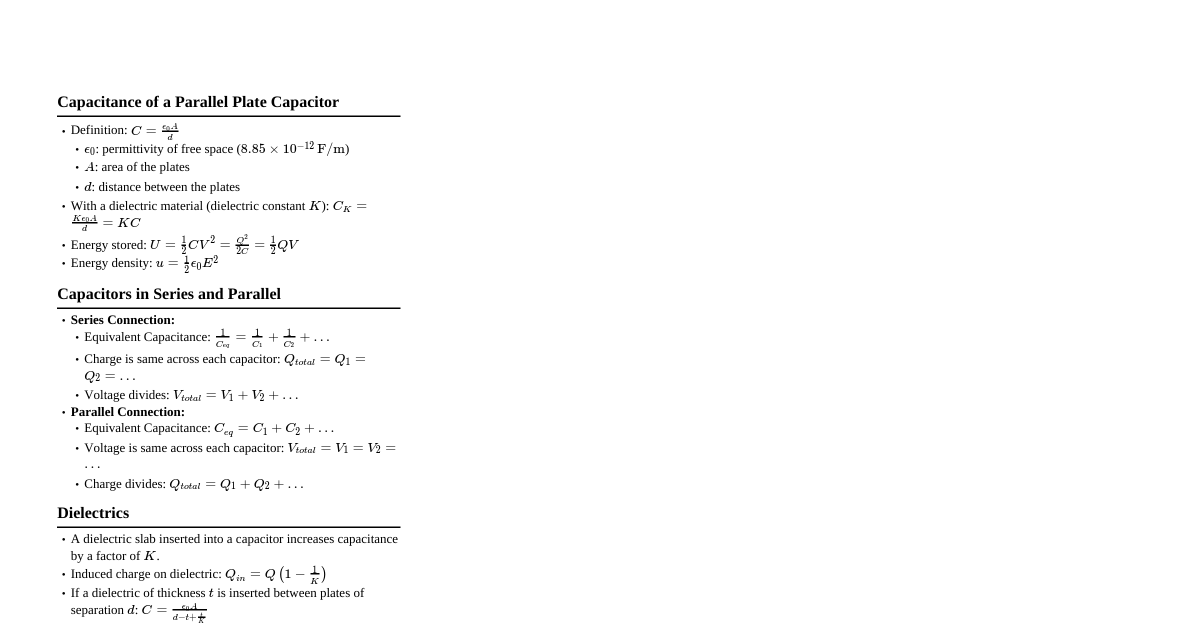
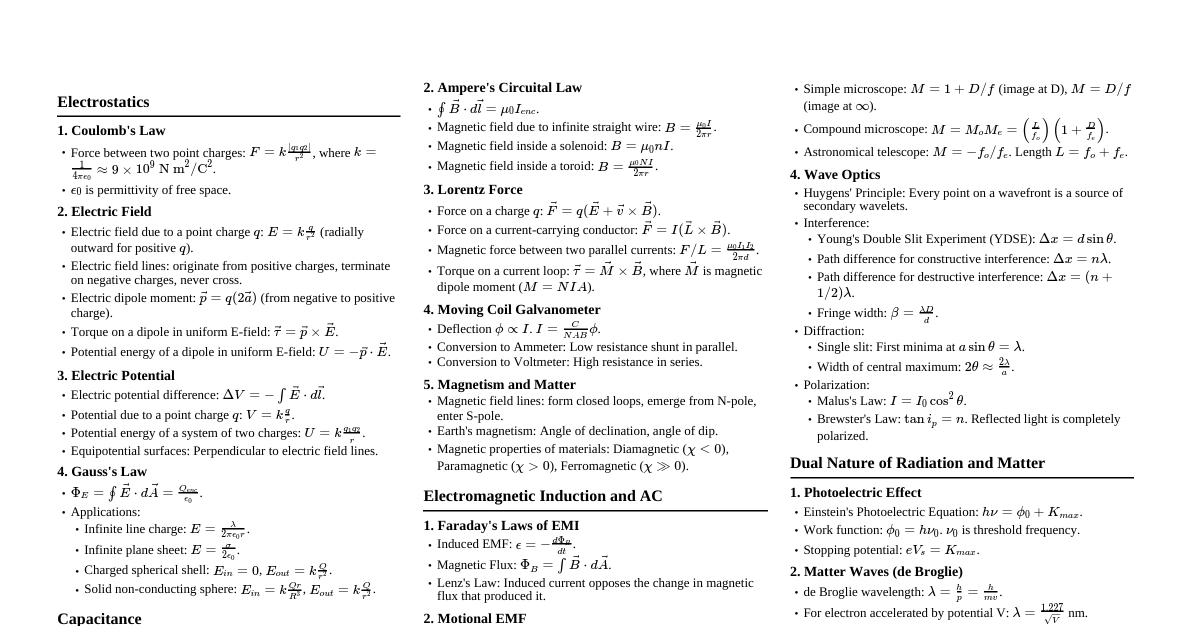
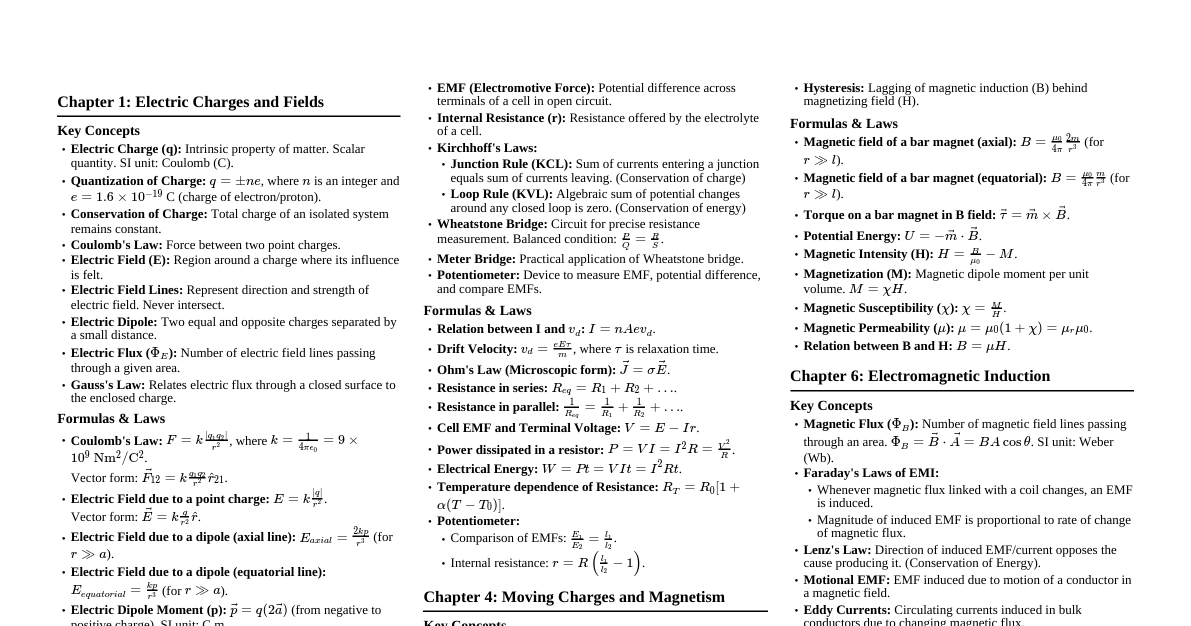
1. Electrostatic Potential 1.1 Potential due to a Point Charge Potential $V$ at a distance $r$ from a point charge $q$: $$V = \frac{1}{4\pi\epsilon_0} \frac{q}{r}$$ where $\epsilon_0$ is the permittivity of free space. Potential is a scalar quantity. 1.2 Potential due to a System of Charges For a system of $n$ point charges $q_1, q_2, \ldots, q_n$ at distances $r_1, r_2, \ldots, r_n$ from a point P: $$V_P = \sum_{i=1}^{n} \frac{1}{4\pi\epsilon_0} \frac{q_i}{r_i}$$ 1.3 Potential Difference Potential difference between two points A and B: $$V_B - V_A = -\int_A^B \vec{E} \cdot d\vec{l}$$ where $\vec{E}$ is the electric field. Work done to move a charge $q_0$ from A to B: $W_{AB} = q_0(V_B - V_A)$. 1.4 Equipotential Surfaces Surfaces with constant electrostatic potential at all points. Electric field lines are always perpendicular to equipotential surfaces. No work is done in moving a charge along an equipotential surface. 1.5 Potential Energy of a System of Charges For two point charges $q_1, q_2$ separated by $r$: $$U = \frac{1}{4\pi\epsilon_0} \frac{q_1 q_2}{r}$$ For $n$ charges, sum the potential energy for all unique pairs. 2. Capacitance 2.1 Definition of Capacitance The ability of a conductor to store electric charge. $$C = \frac{Q}{V}$$ where $Q$ is the charge stored and $V$ is the potential difference across the conductor. Unit: Farad (F). $1 \text{ F} = 1 \text{ C/V}$. 2.2 Parallel Plate Capacitor Capacitance: $$C = \frac{\epsilon_0 A}{d}$$ where $A$ is the area of each plate and $d$ is the separation between plates. Electric field between plates: $E = \frac{\sigma}{\epsilon_0} = \frac{Q}{\epsilon_0 A}$. 2.3 Capacitors in Series Total capacitance $C_S$: $$\frac{1}{C_S} = \frac{1}{C_1} + \frac{1}{C_2} + \ldots + \frac{1}{C_n}$$ Charge on each capacitor is the same: $Q_1 = Q_2 = \ldots = Q_n = Q_{total}$. Voltage divides: $V_{total} = V_1 + V_2 + \ldots + V_n$. 2.4 Capacitors in Parallel Total capacitance $C_P$: $$C_P = C_1 + C_2 + \ldots + C_n$$ Voltage across each capacitor is the same: $V_1 = V_2 = \ldots = V_n = V_{total}$. Charge divides: $Q_{total} = Q_1 + Q_2 + \ldots + Q_n$. 2.5 Energy Stored in a Capacitor Energy $U$: $$U = \frac{1}{2} C V^2 = \frac{1}{2} \frac{Q^2}{C} = \frac{1}{2} Q V$$ Energy density $u$ (energy per unit volume) in electric field $E$: $$u = \frac{1}{2} \epsilon_0 E^2$$ 3. Dielectrics 3.1 Dielectric Constant When a dielectric material is inserted between the plates of a capacitor, the capacitance increases by a factor $K$ (dielectric constant). $$C' = K C_0$$ where $C_0$ is the capacitance without dielectric. For a parallel plate capacitor with dielectric: $$C = \frac{K \epsilon_0 A}{d}$$ The electric field inside the dielectric is reduced: $E' = E_0/K$. 3.2 Polarization When a dielectric is placed in an external electric field, its constituent molecules become polarized (induced dipoles or alignment of permanent dipoles). This creates an internal electric field opposite to the external field, reducing the net electric field. 4. Other Capacitor Geometries 4.1 Spherical Capacitor For two concentric spherical shells with radii $a$ (inner) and $b$ (outer): $$C = 4\pi\epsilon_0 \frac{ab}{b-a}$$ For an isolated sphere of radius $R$: $C = 4\pi\epsilon_0 R$. 4.2 Cylindrical Capacitor For two concentric cylinders of length $L$ and radii $a$ (inner) and $b$ (outer): $$C = \frac{2\pi\epsilon_0 L}{\ln(b/a)}$$