Differential Equations & Vecto
Shared 5/5/2026•1 views
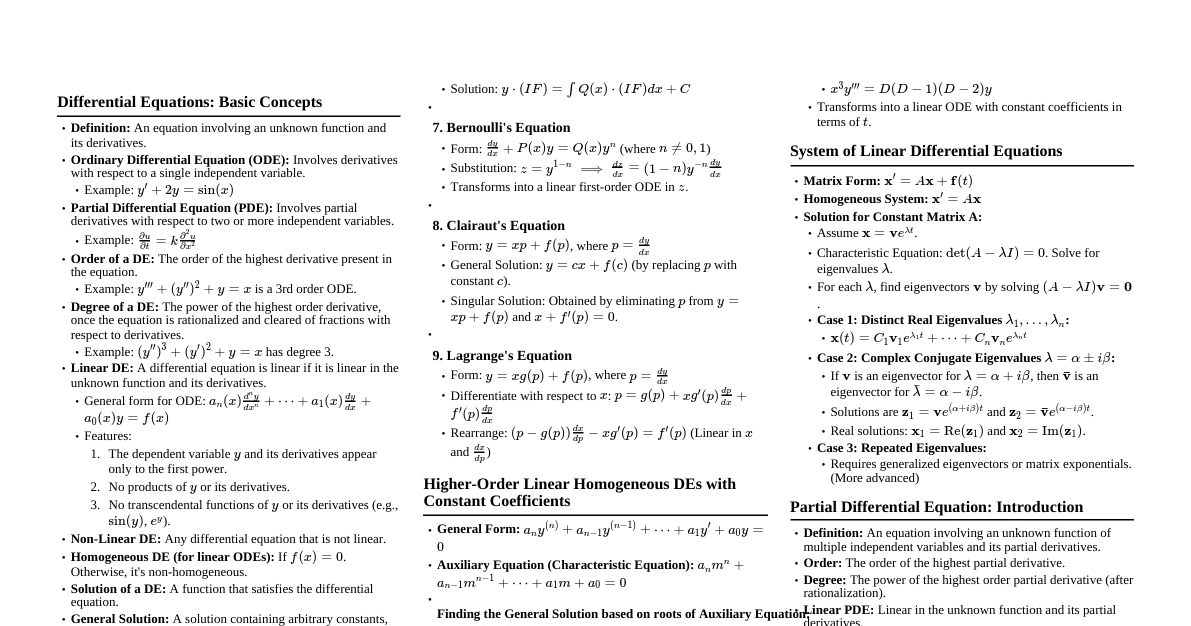
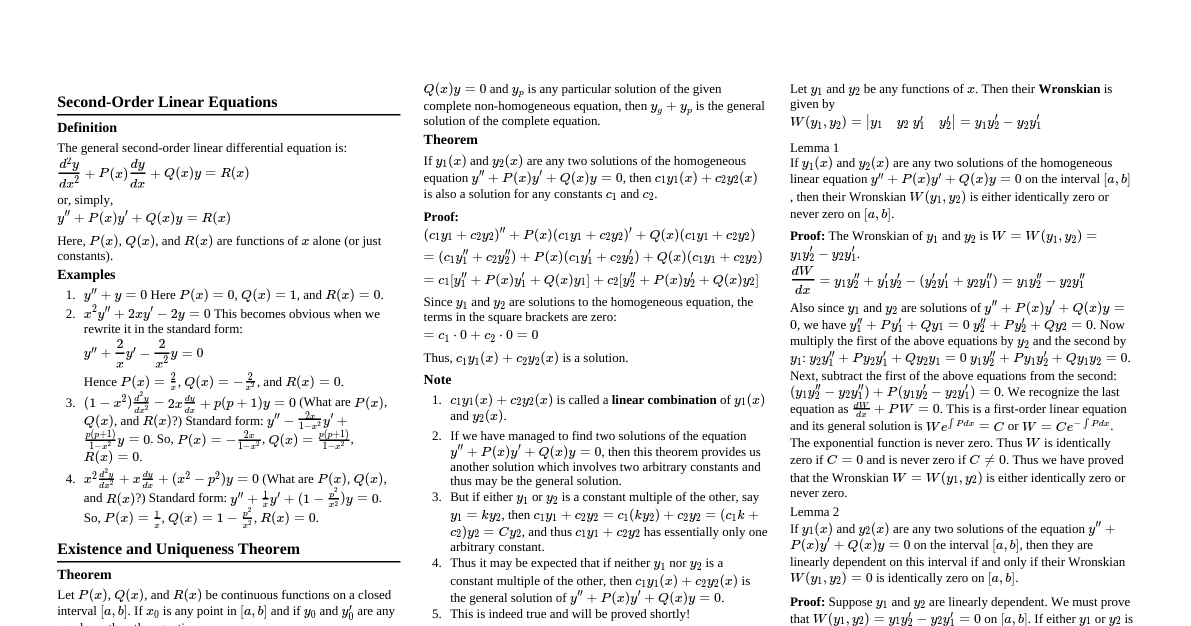
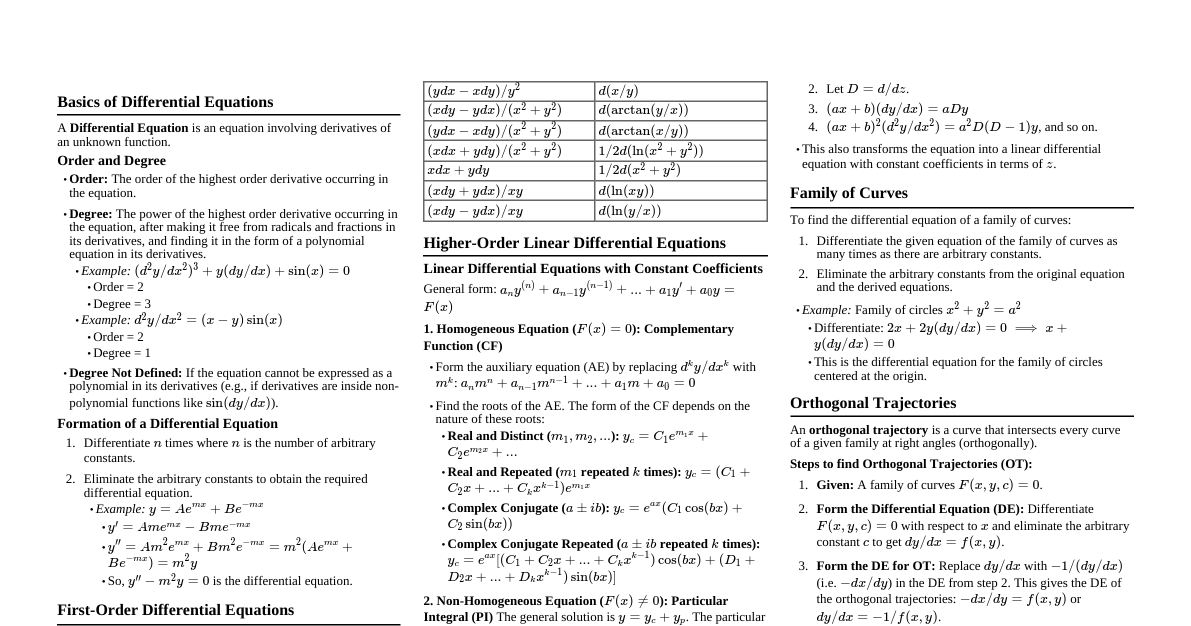
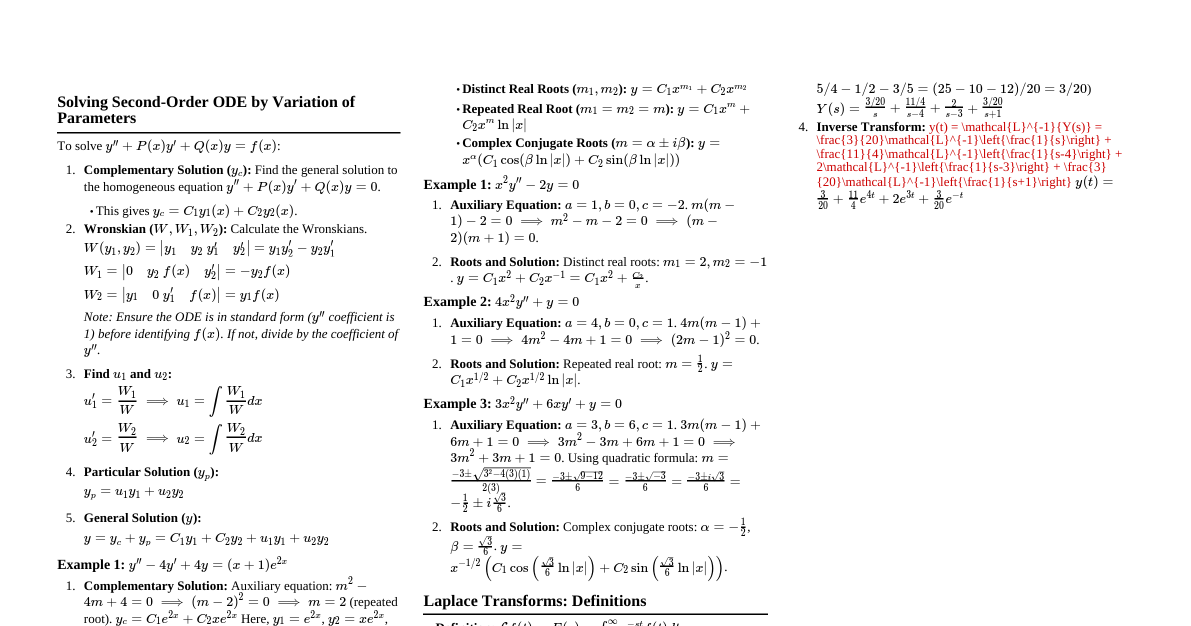
### Green's Theorem Green's Theorem relates a line integral around a simple closed curve C to a double integral over the plane region D bounded by C. $$\oint_C (P dx + Q dy) = \iint_D \left(\frac{\partial Q}{\partial x} - \frac{\partial P}{\partial y}\right) dA$$ **Conditions:** - C is a positively oriented, piecewise smooth, simple closed curve. - D is the region bounded by C. - P and Q have continuous partial derivatives on an open region containing D. **Applications:** - Calculating area: - $\text{Area}(D) = \oint_C x \, dy = -\oint_C y \, dx = \frac{1}{2} \oint_C (x \, dy - y \, dx)$ - Evaluating line integrals more easily by converting to double integrals. - Checking for conservative vector fields (if $\frac{\partial Q}{\partial x} = \frac{\partial P}{\partial y}$, then the line integral is path independent). **Example:** Evaluate $\oint_C (x^2 y \, dx + x \, dy)$ where C is the unit circle $x^2 + y^2 = 1$. Here, $P = x^2 y$ and $Q = x$. $\frac{\partial Q}{\partial x} = 1$ $\frac{\partial P}{\partial y} = x^2$ By Green's Theorem: $$\oint_C (x^2 y \, dx + x \, dy) = \iint_D (1 - x^2) \, dA$$ Converting to polar coordinates ($x = r \cos \theta$, $dA = r \, dr \, d\theta$): $$\int_0^{2\pi} \int_0^1 (1 - (r \cos \theta)^2) r \, dr \, d\theta$$ $$= \int_0^{2\pi} \int_0^1 (r - r^3 \cos^2 \theta) \, dr \, d\theta$$ $$= \int_0^{2\pi} \left[ \frac{r^2}{2} - \frac{r^4}{4} \cos^2 \theta \right]_0^1 \, d\theta$$ $$= \int_0^{2\pi} \left( \frac{1}{2} - \frac{1}{4} \cos^2 \theta \right) \, d\theta$$ Using $\cos^2 \theta = \frac{1 + \cos(2\theta)}{2}$: $$= \int_0^{2\pi} \left( \frac{1}{2} - \frac{1}{4} \left(\frac{1 + \cos(2\theta)}{2}\right) \right) \, d\theta$$ $$= \int_0^{2\pi} \left( \frac{1}{2} - \frac{1}{8} - \frac{1}{8} \cos(2\theta) \right) \, d\theta$$ $$= \left[ \frac{3}{8}\theta - \frac{1}{16} \sin(2\theta) \right]_0^{2\pi} = \frac{3}{8}(2\pi) - 0 = \frac{3\pi}{4}$$ ### Second-Order Linear Differential Equations A second-order linear differential equation has the form: $$ay'' + by' + cy = g(x)$$ where $a, b, c$ are constants. #### Homogeneous Equation ($g(x) = 0$) $$ay'' + by' + cy = 0$$ **Characteristic Equation:** $ar^2 + br + c = 0$ **Cases for Roots (r):** 1. **Distinct Real Roots ($r_1 \neq r_2$):** $y_c(x) = C_1 e^{r_1 x} + C_2 e^{r_2 x}$ 2. **Repeated Real Roots ($r_1 = r_2 = r$):** $y_c(x) = C_1 e^{r x} + C_2 x e^{r x}$ 3. **Complex Conjugate Roots ($r = \alpha \pm i\beta$):** $y_c(x) = e^{\alpha x} (C_1 \cos(\beta x) + C_2 \sin(\beta x))$ #### Non-Homogeneous Equation ($g(x) \neq 0$) The general solution is $y(x) = y_c(x) + y_p(x)$, where $y_c(x)$ is the complementary solution (from the homogeneous equation) and $y_p(x)$ is a particular solution. ##### Method of Undetermined Coefficients Used when $g(x)$ is a combination of polynomials, exponentials, sines, and cosines. **Form of $y_p(x)$ based on $g(x)$:** | $g(x)$ | Form of $y_p(x)$ (Initial Guess) | Modification if guess is part of $y_c(x)$ | | :----- | :------------------------------- | :---------------------------------------- | | $P_n(x)$ (polynomial of degree n) | $A_n x^n + ... + A_0$ | Multiply by $x^s$ where $s$ is the smallest integer such that no term in $y_p$ is a solution to the homogeneous equation. | | $Ce^{kx}$ | $Ae^{kx}$ | | | $C \sin(kx)$ or $C \cos(kx)$ | $A \cos(kx) + B \sin(kx)$ | | | $P_n(x)e^{kx}$ | $(A_n x^n + ... + A_0)e^{kx}$ | | | $P_n(x)\sin(kx)$ or $P_n(x)\cos(kx)$ | $(A_n x^n + ... + A_0)\cos(kx) + (B_n x^n + ... + B_0)\sin(kx)$ | | | $e^{kx}\sin(mx)$ or $e^{kx}\cos(mx)$ | $e^{kx}(A \cos(mx) + B \sin(mx))$ | | **Steps:** 1. Find $y_c(x)$ by solving the homogeneous equation. 2. Guess the form of $y_p(x)$ based on $g(x)$, applying the modification rule if there's overlap with $y_c(x)$. 3. Calculate $y_p'(x)$ and $y_p''(x)$. 4. Substitute $y_p, y_p', y_p''$ into the non-homogeneous equation $ay'' + by' + cy = g(x)$. 5. Equate coefficients of like terms to solve for the undetermined coefficients. 6. Write the general solution $y(x) = y_c(x) + y_p(x)$. ##### Variation of Parameters More general method, applicable when $g(x)$ is not in the forms above, or when coefficients $a,b,c$ are not constant. Given $y_c(x) = C_1 y_1(x) + C_2 y_2(x)$, assume $y_p(x) = u_1(x) y_1(x) + u_2(x) y_2(x)$. The functions $u_1'(x)$ and $u_2'(x)$ are given by: $$u_1'(x) = -\frac{y_2(x) g(x)}{a W(y_1, y_2)(x)}$$ $$u_2'(x) = \frac{y_1(x) g(x)}{a W(y_1, y_2)(x)}$$ where $W(y_1, y_2)(x)$ is the Wronskian of $y_1$ and $y_2$: $$W(y_1, y_2)(x) = \det \begin{pmatrix} y_1 & y_2 \\ y_1' & y_2' \end{pmatrix} = y_1 y_2' - y_2 y_1'$$ **Steps:** 1. Find $y_c(x) = C_1 y_1(x) + C_2 y_2(x)$. 2. Calculate the Wronskian $W(y_1, y_2)(x)$. 3. Calculate $u_1'(x)$ and $u_2'(x)$. 4. Integrate $u_1'(x)$ and $u_2'(x)$ to find $u_1(x)$ and $u_2(x)$ (constants of integration can be omitted). 5. Substitute $u_1(x)$ and $u_2(x)$ into $y_p(x) = u_1(x) y_1(x) + u_2(x) y_2(x)$. 6. Write the general solution $y(x) = y_c(x) + y_p(x)$. ### Basic Derivatives and Integrals Let $u$ and $v$ be differentiable functions of $x$, and $k, n$ be constants. | Function | Derivative ($d/dx$) | Integral ($\int ... dx$) | | :------- | :------------------ | :----------------------- | | $k$ | $0$ | $kx + C$ | | $x^n$ | $nx^{n-1}$ | $\frac{x^{n+1}}{n+1} + C$ (for $n \neq -1$) | | $u^n$ | $nu^{n-1} \frac{du}{dx}$ | $\int u^n \frac{du}{dx} dx = \frac{u^{n+1}}{n+1} + C$ (for $n \neq -1$) | | $e^x$ | $e^x$ | $e^x + C$ | | $e^u$ | $e^u \frac{du}{dx}$ | $\int e^u \frac{du}{dx} dx = e^u + C$ | | $a^x$ | $a^x \ln a$ | $\frac{a^x}{\ln a} + C$ | | $a^u$ | $a^u \ln a \frac{du}{dx}$ | $\int a^u \frac{du}{dx} dx = \frac{a^u}{\ln a} + C$ | | $\ln x$ | $\frac{1}{x}$ | $x \ln x - x + C$ | | $\ln u$ | $\frac{1}{u} \frac{du}{dx}$ | $\int \frac{1}{u} \frac{du}{dx} dx = \ln|u| + C$ | | $\sin x$ | $\cos x$ | $-\cos x + C$ | | $\sin u$ | $\cos u \frac{du}{dx}$ | $\int \sin u \frac{du}{dx} dx = -\cos u + C$ | | $\cos x$ | $-\sin x$ | $\sin x + C$ | | $\cos u$ | $-\sin u \frac{du}{dx}$ | $\int \cos u \frac{du}{dx} dx = \sin u + C$ | | $\tan x$ | $\sec^2 x$ | $\ln|\sec x| + C$ or $-\ln|\cos x| + C$ | | $\tan u$ | $\sec^2 u \frac{du}{dx}$ | $\int \tan u \frac{du}{dx} dx = \ln|\sec u| + C$ | | $\sec x$ | $\sec x \tan x$ | $\ln|\sec x + \tan x| + C$ | | $\sec u$ | $\sec u \tan u \frac{du}{dx}$ | $\int \sec u \frac{du}{dx} dx = \ln|\sec u + \tan u| + C$ | | $\arcsin x$ | $\frac{1}{\sqrt{1-x^2}}$ | | | $\arctan x$ | $\frac{1}{1+x^2}$ | | | $u \pm v$ | $u' \pm v'$ | $\int (u \pm v) dx = \int u dx \pm \int v dx$ | | $ku$ | $ku'$ | $\int ku dx = k \int u dx$ | | $uv$ | $u'v + uv'$ | $\int u \, dv = uv - \int v \, du$ (Integration by Parts) | | $u/v$ | $\frac{u'v - uv'}{v^2}$ | |