Class XII Physics: E-Charges
Cheatsheet Content
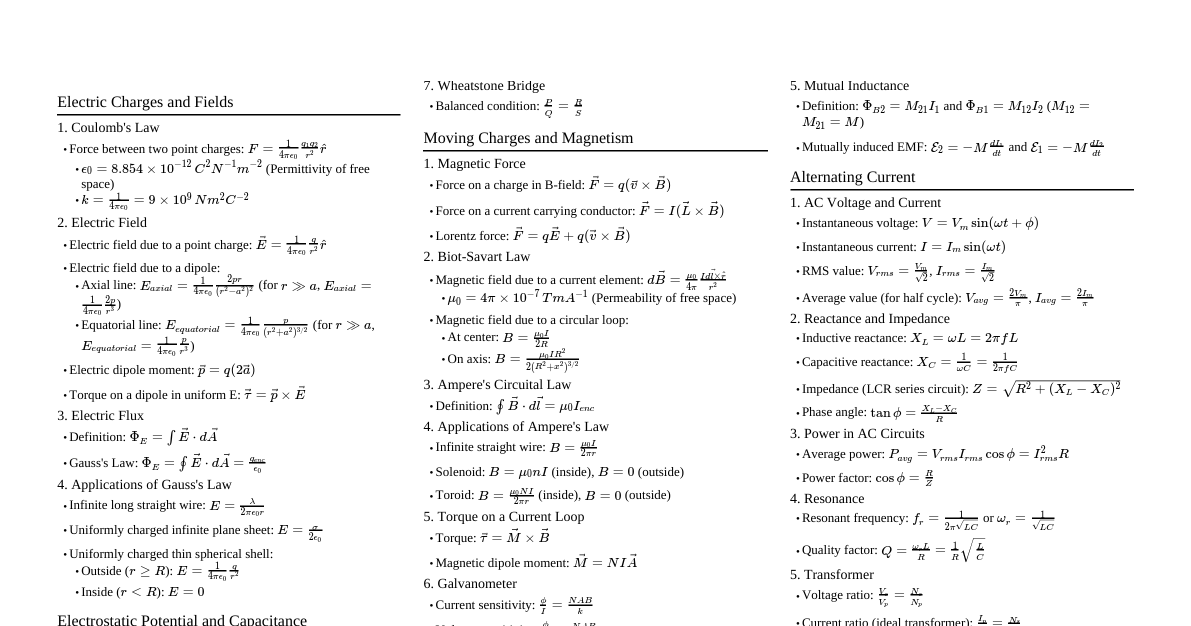
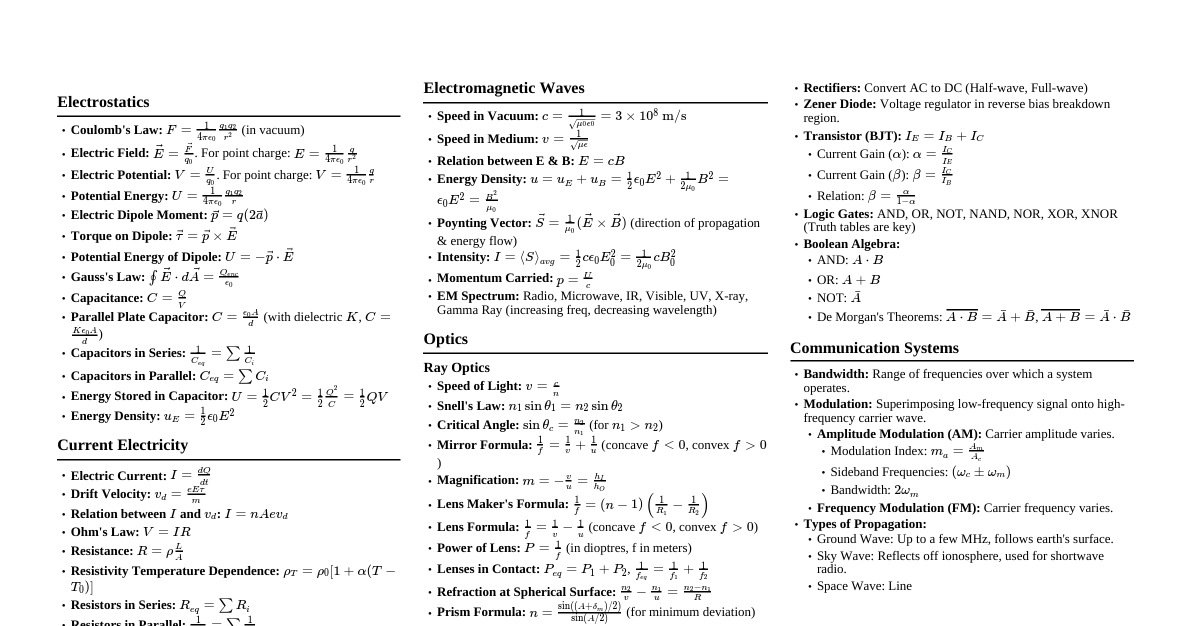
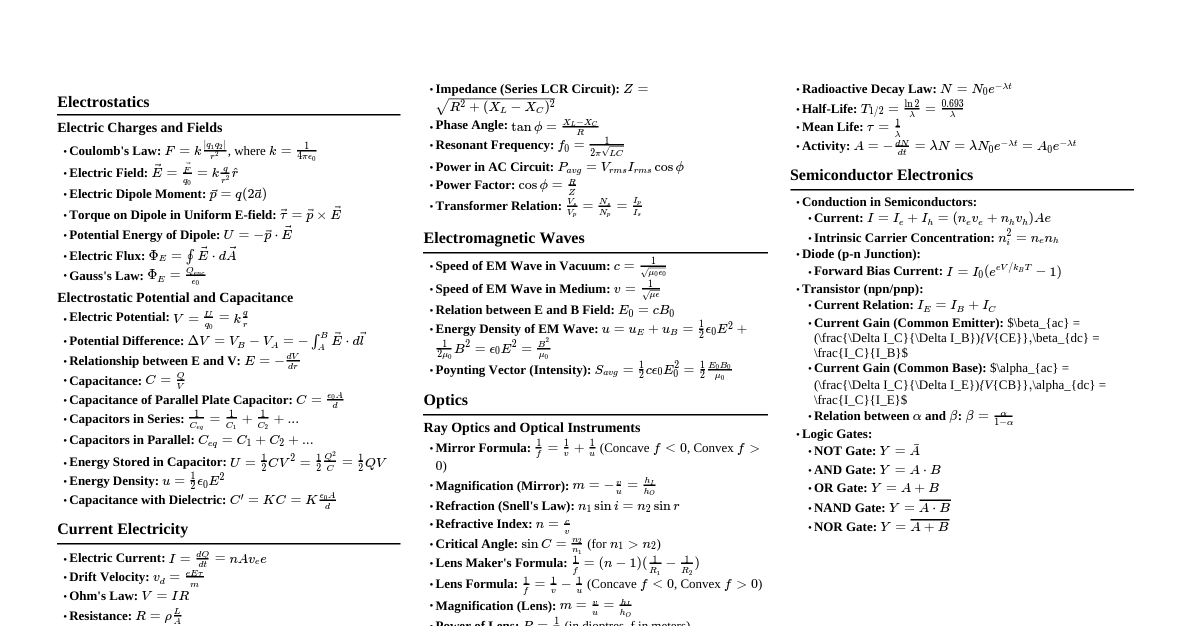
### Coulomb's Law - **Magnitude of force between two point charges:** $$F = k \frac{|q_1 q_2|}{r^2}$$ where $k = \frac{1}{4\pi\epsilon_0} = 9 \times 10^9 \text{ N m}^2\text{ C}^{-2}$ - **Permittivity of free space:** $\epsilon_0 = 8.854 \times 10^{-12} \text{ C}^2\text{ N}^{-1}\text{ m}^{-2}$ - **Vector form:** $$\vec{F}_{12} = \frac{1}{4\pi\epsilon_0} \frac{q_1 q_2}{r_{21}^2} \hat{r}_{21}$$ or $$\vec{F}_{12} = \frac{1}{4\pi\epsilon_0} \frac{q_1 q_2}{|\vec{r}_1 - \vec{r}_2|^3} (\vec{r}_1 - \vec{r}_2)$$ ### Electric Field - **Electric field due to a point charge Q:** $$\vec{E} = \frac{\vec{F}}{q_0} = \frac{1}{4\pi\epsilon_0} \frac{Q}{r^2} \hat{r}$$ Magnitude: $E = \frac{1}{4\pi\epsilon_0} \frac{Q}{r^2}$ - **Electric field lines properties:** - Start from positive charge and end on negative charge. - Tangent at any point gives direction of E-field. - Never intersect. - In a charge-free region, field lines are continuous. - The relative closeness of field lines indicates the relative strength of the electric field. #### Electric Field due to a System of Charges - Using superposition principle: $$\vec{E} = \sum_{i=1}^{n} \vec{E}_i = \sum_{i=1}^{n} \frac{1}{4\pi\epsilon_0} \frac{q_i}{r_i^2} \hat{r}_i$$ #### Electric Field due to a Continuous Charge Distribution - **Line charge:** $\lambda = \frac{q}{L}$ (charge per unit length) - **Surface charge:** $\sigma = \frac{q}{A}$ (charge per unit area) - **Volume charge:** $\rho = \frac{q}{V}$ (charge per unit volume) - $\vec{E} = \int d\vec{E} = \frac{1}{4\pi\epsilon_0} \int \frac{dq}{r^2} \hat{r}$ ### Electric Dipole - **Electric dipole moment:** $$\vec{p} = q \cdot (2\vec{a})$$ Magnitude: $p = q \cdot (2a)$ (from -q to +q) - **Electric field on axial line (end-on position):** $$E_{axial} = \frac{1}{4\pi\epsilon_0} \frac{2pr}{(r^2 - a^2)^2}$$ For $r \gg a$: $E_{axial} \approx \frac{1}{4\pi\epsilon_0} \frac{2p}{r^3}$ - **Electric field on equatorial line (broadside-on position):** $$E_{equatorial} = \frac{1}{4\pi\epsilon_0} \frac{p}{(r^2 + a^2)^{3/2}}$$ For $r \gg a$: $E_{equatorial} \approx \frac{1}{4\pi\epsilon_0} \frac{p}{r^3}$ (opposite direction to $\vec{p}$) - **Torque on an electric dipole in a uniform electric field:** $$\vec{\tau} = \vec{p} \times \vec{E}$$ Magnitude: $\tau = pE \sin\theta$ - **Potential Energy of a dipole in a uniform electric field:** $$U = -\vec{p} \cdot \vec{E} = -pE \cos\theta$$ ### Gauss's Theorem - **Electric Flux:** $\Phi_E = \vec{E} \cdot \vec{A} = EA \cos\theta$ For a non-uniform field or complex surface: $\Phi_E = \int \vec{E} \cdot d\vec{A}$ - **Gauss's Law:** The total electric flux through any closed surface (Gaussian surface) is equal to $\frac{1}{\epsilon_0}$ times the total charge enclosed by that surface. $$\oint \vec{E} \cdot d\vec{A} = \frac{Q_{enc}}{\epsilon_0}$$ #### Applications of Gauss's Law - **Electric field due to an infinitely long straight uniformly charged wire:** $$E = \frac{\lambda}{2\pi\epsilon_0 r}$$ - **Electric field due to a uniformly charged infinite plane sheet:** $$E = \frac{\sigma}{2\pi\epsilon_0}$$ - **Electric field due to a uniformly charged thin spherical shell:** - **Outside the shell ($r > R$):** $E = \frac{1}{4\pi\epsilon_0} \frac{Q}{r^2}$ - **On the surface ($r = R$):** $E = \frac{1}{4\pi\epsilon_0} \frac{Q}{R^2}$ - **Inside the shell ($r R$):** $E = \frac{1}{4\pi\epsilon_0} \frac{Q}{r^2}$ - **On the surface ($r = R$):** $E = \frac{1}{4\pi\epsilon_0} \frac{Q}{R^2}$ - **Inside the sphere ($r ### Basic Properties of Electric Charges - **Quantization of charge:** $Q = \pm ne$, where $n$ is an integer and $e = 1.602 \times 10^{-19} \text{ C}$ (charge of electron/proton). - **Conservation of charge:** Total charge of an isolated system remains constant. - **Additivity of charges:** Total charge is the algebraic sum of individual charges.