Polynomials (Chapter 2)
Cheatsheet Content
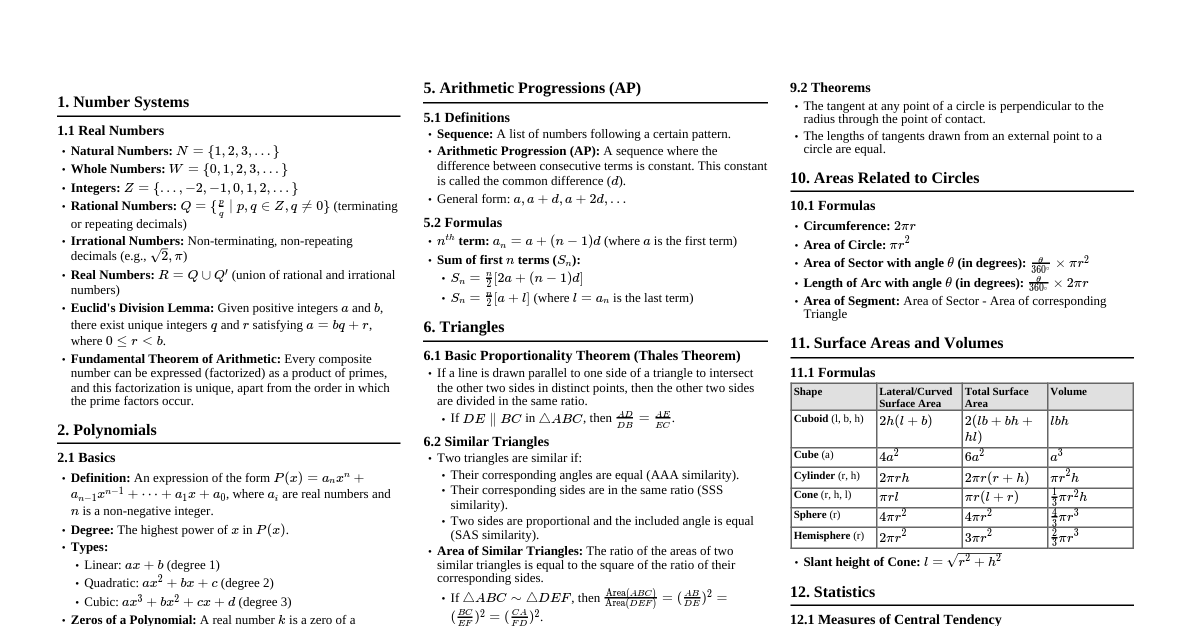
### Introduction - **Polynomials**: Algebraic expressions where exponents of variables are whole numbers. - **Terms**: Parts of a polynomial separated by addition/subtraction. - **Coefficient**: Numerical factor of a term. - **Constant Polynomial**: A polynomial with only a constant term (e.g., 2, -5). Degree is 0. - **Zero Polynomial**: The constant polynomial 0. Its degree is undefined. - **Not a Polynomial**: Expressions with fractional or negative exponents (e.g., $\sqrt{x}+3$, $x^{-1}$). ### Types of Polynomials - **Monomial**: 1 term (e.g., $2x$, $5x^3$) - **Binomial**: 2 terms (e.g., $x+1$, $y^3+1$) - **Trinomial**: 3 terms (e.g., $x+x^2+\pi$, $y^4+y+5$) #### By Degree - **Degree**: Highest power of the variable in a polynomial. - **Linear Polynomial**: Degree 1 (e.g., $ax+b$, $a \ne 0$). Max 2 terms. - **Quadratic Polynomial**: Degree 2 (e.g., $ax^2+bx+c$, $a \ne 0$). Max 3 terms. - **Cubic Polynomial**: Degree 3 (e.g., $ax^3+bx^2+cx+d$, $a \ne 0$). Max 4 terms. ### Zeroes of Polynomials - **Definition**: A real number 'c' is a zero of polynomial $p(x)$ if $p(c) = 0$. Also called a root of the equation $p(x)=0$. - **Finding Zeroes**: - For linear $p(x) = ax+b$, the zero is $x = -b/a$. A linear polynomial has exactly one zero. - Constant non-zero polynomials have no zeroes. - The zero polynomial (0) has every real number as a zero. - A polynomial can have more than one zero (e.g., $x^2-2x$ has zeroes 0 and 2). #### Example: Find zero of $p(x) = 2x+1$ - Set $p(x) = 0 \Rightarrow 2x+1=0 \Rightarrow 2x=-1 \Rightarrow x = -1/2$. ### Factor Theorem - **Statement**: If $p(x)$ is a polynomial of degree $n \ge 1$ and 'a' is any real number: 1. If $p(a) = 0$, then $(x-a)$ is a factor of $p(x)$. 2. If $(x-a)$ is a factor of $p(x)$, then $p(a) = 0$. - **Use**: To factorise polynomials. If $p(a)=0$, then $p(x) = (x-a)q(x)$ for some polynomial $q(x)$. #### Factorisation by Splitting the Middle Term (for $ax^2+bx+c$) - Find two numbers $p$ and $q$ such that $p+q=b$ and $pq=ac$. - Rewrite $bx$ as $px+qx$. - Group terms and factor out common factors. - **Example**: Factorise $6x^2 + 17x + 5$ - $p+q=17$, $pq=6 \times 5 = 30$. Numbers are 2 and 15. - $6x^2 + 2x + 15x + 5 = 2x(3x+1) + 5(3x+1) = (3x+1)(2x+5)$. ### Algebraic Identities - Equations true for all variable values. #### Basic Identities 1. $(x+y)^2 = x^2 + 2xy + y^2$ 2. $(x-y)^2 = x^2 - 2xy + y^2$ 3. $x^2 - y^2 = (x+y)(x-y)$ 4. $(x+a)(x+b) = x^2 + (a+b)x + ab$ #### Extended Identities 5. $(x+y+z)^2 = x^2 + y^2 + z^2 + 2xy + 2yz + 2zx$ 6. $(x+y)^3 = x^3 + y^3 + 3xy(x+y) = x^3 + 3x^2y + 3xy^2 + y^3$ 7. $(x-y)^3 = x^3 - y^3 - 3xy(x-y) = x^3 - 3x^2y + 3xy^2 - y^3$ 8. $x^3 + y^3 + z^3 - 3xyz = (x+y+z)(x^2+y^2+z^2-xy-yz-zx)$ #### Special Case of Identity 8 - If $x+y+z=0$, then $x^3+y^3+z^3 = 3xyz$.