RD Sharma Mathematics Essentials
Cheatsheet Content
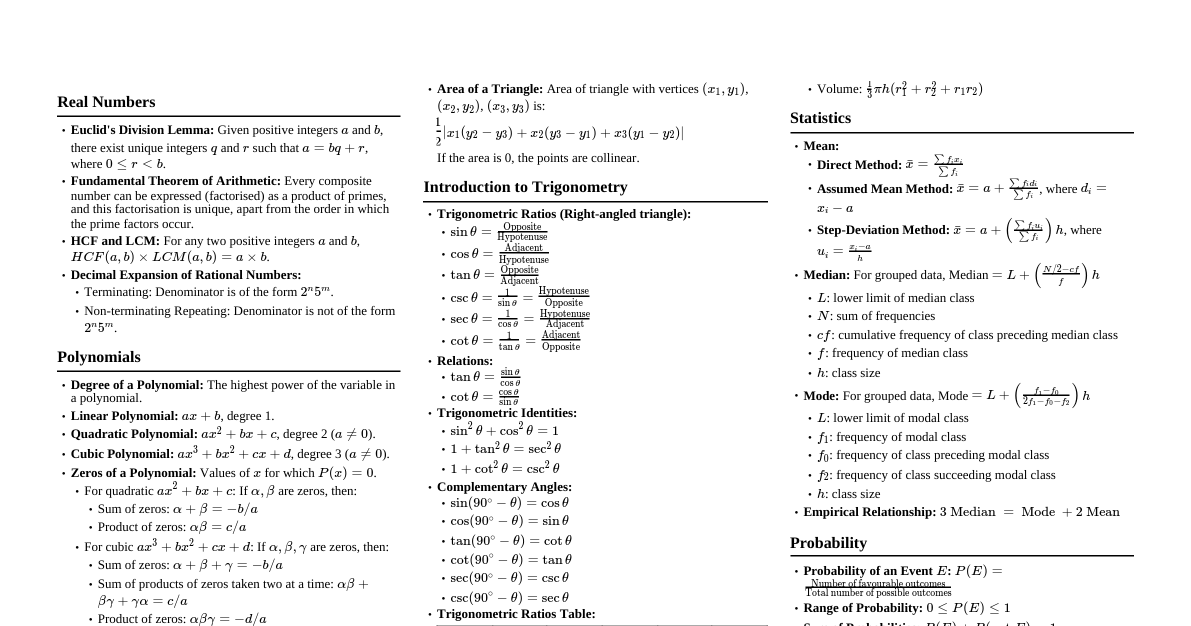
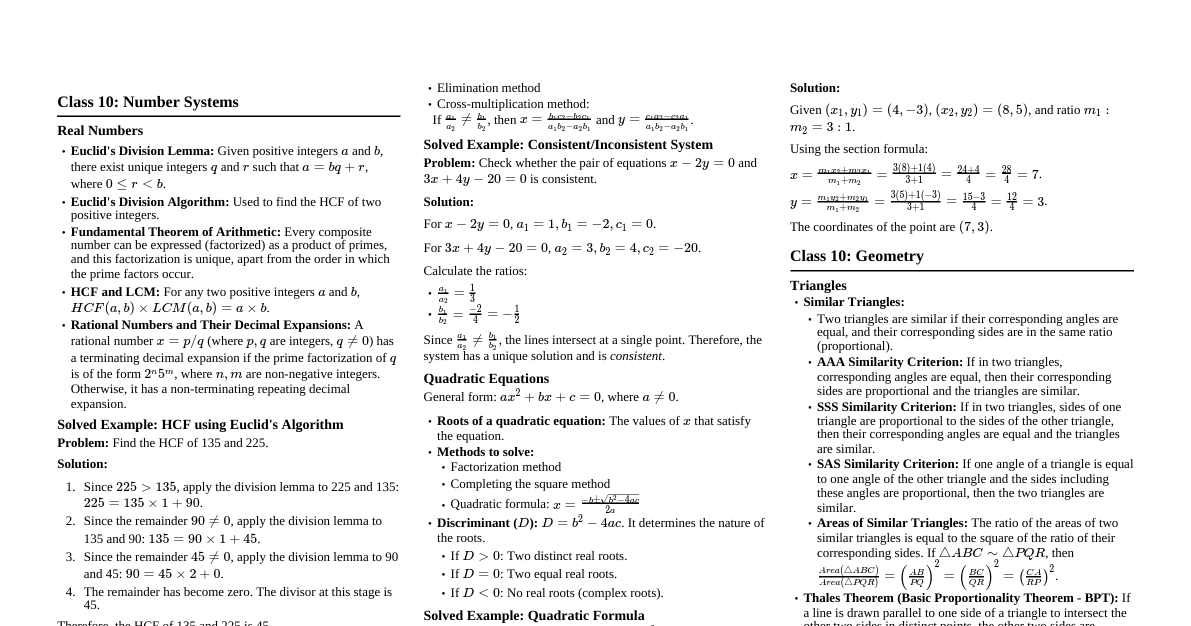
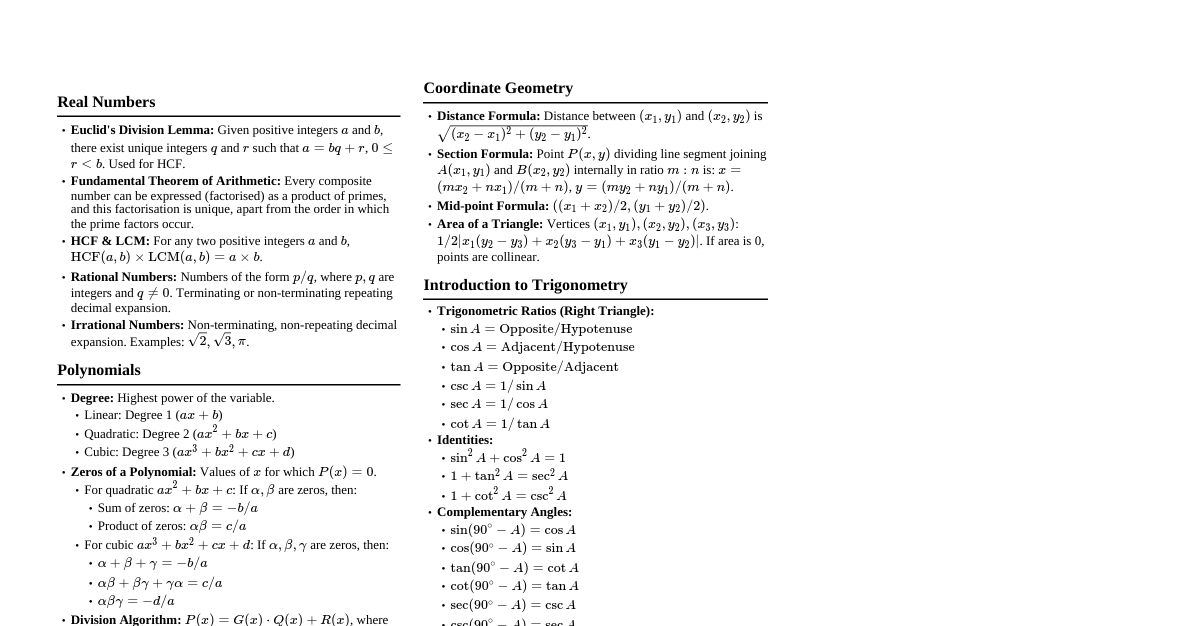
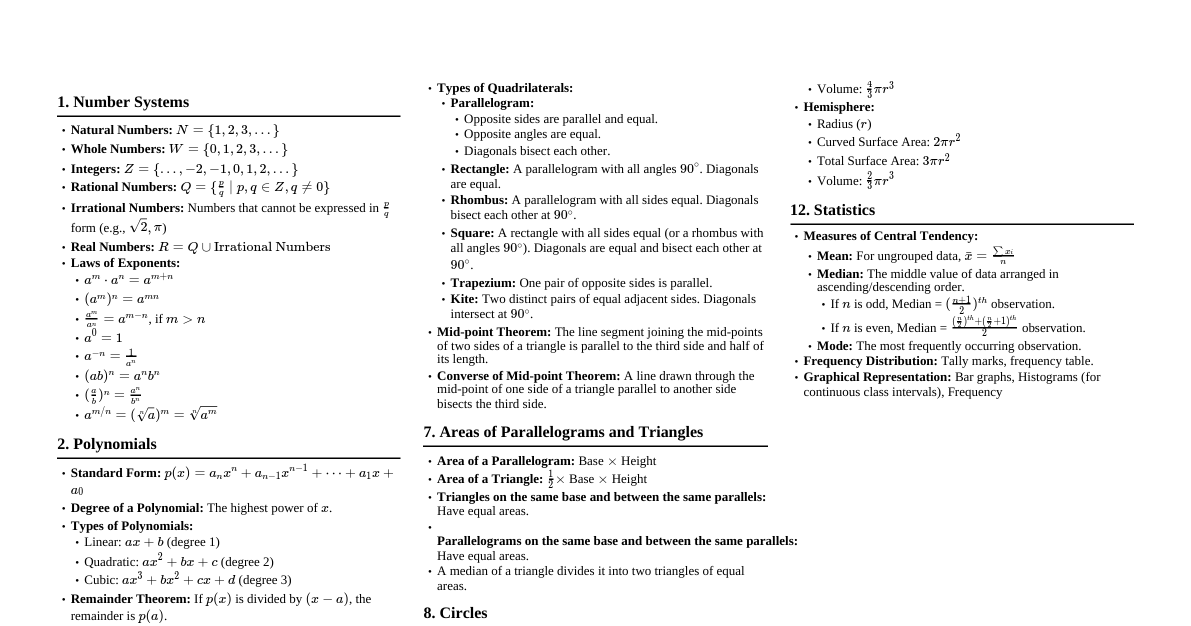
1. Number Systems 1.1 Real Numbers Natural Numbers: $N = \{1, 2, 3, \dots\}$ Whole Numbers: $W = \{0, 1, 2, 3, \dots\}$ Integers: $Z = \{\dots, -2, -1, 0, 1, 2, \dots\}$ Rational Numbers: $Q = \{\frac{p}{q} \mid p, q \in Z, q \neq 0\}$ (terminating or repeating decimals) Irrational Numbers: Non-terminating, non-repeating decimals (e.g., $\sqrt{2}, \pi$) Real Numbers: $R = Q \cup Q'$ (union of rational and irrational numbers) Euclid's Division Lemma: Given positive integers $a$ and $b$, there exist unique integers $q$ and $r$ satisfying $a = bq + r$, where $0 \le r Fundamental Theorem of Arithmetic: Every composite number can be expressed (factorized) as a product of primes, and this factorization is unique, apart from the order in which the prime factors occur. 2. Polynomials 2.1 Basics Definition: An expression of the form $P(x) = a_n x^n + a_{n-1} x^{n-1} + \dots + a_1 x + a_0$, where $a_i$ are real numbers and $n$ is a non-negative integer. Degree: The highest power of $x$ in $P(x)$. Types: Linear: $ax+b$ (degree 1) Quadratic: $ax^2+bx+c$ (degree 2) Cubic: $ax^3+bx^2+cx+d$ (degree 3) Zeros of a Polynomial: A real number $k$ is a zero of a polynomial $P(x)$ if $P(k)=0$. Graphically, these are the x-intercepts. 2.2 Relationship between Zeros and Coefficients Quadratic Polynomial $ax^2+bx+c$: If $\alpha, \beta$ are zeros, then $\alpha + \beta = -\frac{b}{a}$ $\alpha \beta = \frac{c}{a}$ Polynomial can be written as $k(x^2 - (\alpha+\beta)x + \alpha\beta)$ Cubic Polynomial $ax^3+bx^2+cx+d$: If $\alpha, \beta, \gamma$ are zeros, then $\alpha + \beta + \gamma = -\frac{b}{a}$ $\alpha\beta + \beta\gamma + \gamma\alpha = \frac{c}{a}$ $\alpha\beta\gamma = -\frac{d}{a}$ 2.3 Division Algorithm for Polynomials If $P(x)$ and $G(x)$ are any two polynomials with $G(x) \neq 0$, then we can find polynomials $Q(x)$ and $R(x)$ such that $P(x) = G(x) \cdot Q(x) + R(x)$, where $R(x)=0$ or degree of $R(x)$ 3. Pair of Linear Equations in Two Variables 3.1 General Form $a_1 x + b_1 y + c_1 = 0$ $a_2 x + b_2 y + c_2 = 0$ 3.2 Graphical Representation and Conditions for Solvability Condition Graphical Representation Algebraic Interpretation $\frac{a_1}{a_2} \neq \frac{b_1}{b_2}$ Intersecting lines Exactly one solution (consistent) $\frac{a_1}{a_2} = \frac{b_1}{b_2} = \frac{c_1}{c_2}$ Coincident lines Infinitely many solutions (consistent, dependent) $\frac{a_1}{a_2} = \frac{b_1}{b_2} \neq \frac{c_1}{c_2}$ Parallel lines No solution (inconsistent) 3.3 Methods of Solving Substitution Method: Express one variable in terms of the other from one equation, then substitute into the second equation. Elimination Method: Multiply equations by suitable constants to make the coefficients of one variable numerically equal, then add or subtract. Cross-Multiplication Method: $x = \frac{b_1 c_2 - b_2 c_1}{a_1 b_2 - a_2 b_1}$, $y = \frac{c_1 a_2 - c_2 a_1}{a_1 b_2 - a_2 b_1}$ (if $a_1 b_2 - a_2 b_1 \neq 0$) 4. Quadratic Equations 4.1 Standard Form $ax^2 + bx + c = 0$, where $a \neq 0$. 4.2 Methods of Solving Factorization Method: Split the middle term $bx$ into two terms such that their product is $ac$ and their sum is $b$. Completing the Square: Convert $ax^2 + bx + c = 0$ into the form $(x+k)^2 = d$. Quadratic Formula: $x = \frac{-b \pm \sqrt{b^2 - 4ac}}{2a}$ 4.3 Discriminant $D = b^2 - 4ac$ Nature of Roots: If $D > 0$: Two distinct real roots. If $D = 0$: Two equal real roots. If $D 5. Arithmetic Progressions (AP) 5.1 Definitions Sequence: A list of numbers following a certain pattern. Arithmetic Progression (AP): A sequence where the difference between consecutive terms is constant. This constant is called the common difference ($d$). General form: $a, a+d, a+2d, \dots$ 5.2 Formulas $n^{th}$ term: $a_n = a + (n-1)d$ (where $a$ is the first term) Sum of first $n$ terms ($S_n$): $S_n = \frac{n}{2}[2a + (n-1)d]$ $S_n = \frac{n}{2}[a + l]$ (where $l = a_n$ is the last term) 6. Triangles 6.1 Basic Proportionality Theorem (Thales Theorem) If a line is drawn parallel to one side of a triangle to intersect the other two sides in distinct points, then the other two sides are divided in the same ratio. If $DE \parallel BC$ in $\triangle ABC$, then $\frac{AD}{DB} = \frac{AE}{EC}$. 6.2 Similar Triangles Two triangles are similar if: Their corresponding angles are equal (AAA similarity). Their corresponding sides are in the same ratio (SSS similarity). Two sides are proportional and the included angle is equal (SAS similarity). Area of Similar Triangles: The ratio of the areas of two similar triangles is equal to the square of the ratio of their corresponding sides. If $\triangle ABC \sim \triangle DEF$, then $\frac{\text{Area}(ABC)}{\text{Area}(DEF)} = (\frac{AB}{DE})^2 = (\frac{BC}{EF})^2 = (\frac{CA}{FD})^2$. 6.3 Pythagoras Theorem In a right-angled triangle, the square of the hypotenuse is equal to the sum of the squares of the other two sides. $c^2 = a^2 + b^2$ Converse: If in a triangle, the square of one side is equal to the sum of the squares of the other two sides, then the angle opposite the first side is a right angle. 7. Coordinate Geometry 7.1 Distance Formula Distance between $P(x_1, y_1)$ and $Q(x_2, y_2)$: $\sqrt{(x_2-x_1)^2 + (y_2-y_1)^2}$ 7.2 Section Formula Internal Division: Point $P(x,y)$ dividing the line segment joining $A(x_1, y_1)$ and $B(x_2, y_2)$ in the ratio $m:n$: $x = \frac{mx_2 + nx_1}{m+n}$ $y = \frac{my_2 + ny_1}{m+n}$ Mid-point Formula: $\left(\frac{x_1+x_2}{2}, \frac{y_1+y_2}{2}\right)$ 7.3 Area of a Triangle Vertices $(x_1, y_1)$, $(x_2, y_2)$, $(x_3, y_3)$: Area $= \frac{1}{2} |x_1(y_2-y_3) + x_2(y_3-y_1) + x_3(y_1-y_2)|$ Collinearity: Three points are collinear if the area of the triangle formed by them is zero. 8. Introduction to Trigonometry 8.1 Trigonometric Ratios (Right Triangle) $\sin A = \frac{\text{Opposite}}{\text{Hypotenuse}}$ $\cos A = \frac{\text{Adjacent}}{\text{Hypotenuse}}$ $\tan A = \frac{\text{Opposite}}{\text{Adjacent}}$ $\csc A = \frac{1}{\sin A}$, $\sec A = \frac{1}{\cos A}$, $\cot A = \frac{1}{\tan A}$ 8.2 Trigonometric Identities $\sin^2 A + \cos^2 A = 1$ $1 + \tan^2 A = \sec^2 A$ $1 + \cot^2 A = \csc^2 A$ 8.3 Complementary Angles $\sin(90^\circ - A) = \cos A$ $\cos(90^\circ - A) = \sin A$ $\tan(90^\circ - A) = \cot A$ $\cot(90^\circ - A) = \tan A$ $\sec(90^\circ - A) = \csc A$ $\csc(90^\circ - A) = \sec A$ 8.4 Specific Angle Values Angle ($\theta$) $0^\circ$ $30^\circ$ $45^\circ$ $60^\circ$ $90^\circ$ $\sin \theta$ $0$ $\frac{1}{2}$ $\frac{1}{\sqrt{2}}$ $\frac{\sqrt{3}}{2}$ $1$ $\cos \theta$ $1$ $\frac{\sqrt{3}}{2}$ $\frac{1}{\sqrt{2}}$ $\frac{1}{2}$ $0$ $\tan \theta$ $0$ $\frac{1}{\sqrt{3}}$ $1$ $\sqrt{3}$ Undefined 9. Circles 9.1 Definitions Tangent: A line that intersects the circle at exactly one point. Radius: The line segment from the center to any point on the circle. Chord: A line segment joining any two points on the circle. 9.2 Theorems The tangent at any point of a circle is perpendicular to the radius through the point of contact. The lengths of tangents drawn from an external point to a circle are equal. 10. Areas Related to Circles 10.1 Formulas Circumference: $2\pi r$ Area of Circle: $\pi r^2$ Area of Sector with angle $\theta$ (in degrees): $\frac{\theta}{360^\circ} \times \pi r^2$ Length of Arc with angle $\theta$ (in degrees): $\frac{\theta}{360^\circ} \times 2\pi r$ Area of Segment: Area of Sector - Area of corresponding Triangle 11. Surface Areas and Volumes 11.1 Formulas Shape Lateral/Curved Surface Area Total Surface Area Volume Cuboid (l, b, h) $2h(l+b)$ $2(lb+bh+hl)$ $lbh$ Cube (a) $4a^2$ $6a^2$ $a^3$ Cylinder (r, h) $2\pi rh$ $2\pi r(r+h)$ $\pi r^2 h$ Cone (r, h, l) $\pi rl$ $\pi r(l+r)$ $\frac{1}{3}\pi r^2 h$ Sphere (r) $4\pi r^2$ $4\pi r^2$ $\frac{4}{3}\pi r^3$ Hemisphere (r) $2\pi r^2$ $3\pi r^2$ $\frac{2}{3}\pi r^3$ Slant height of Cone: $l = \sqrt{r^2+h^2}$ 12. Statistics 12.1 Measures of Central Tendency Mean ($\bar{x}$): Direct Method: $\bar{x} = \frac{\sum f_i x_i}{\sum f_i}$ Assumed Mean Method: $\bar{x} = A + \frac{\sum f_i d_i}{\sum f_i}$ where $d_i = x_i - A$ Step-Deviation Method: $\bar{x} = A + \left(\frac{\sum f_i u_i}{\sum f_i}\right) h$ where $u_i = \frac{x_i - A}{h}$ Median: The middle-most value when data is arranged in ascending/descending order. For grouped data: Median $= L + \left(\frac{\frac{n}{2} - cf}{f}\right) h$ $L$: lower limit of median class $n$: total frequency $cf$: cumulative frequency of class preceding median class $f$: frequency of median class $h$: class size Mode: The value that appears most frequently. For grouped data: Mode $= L + \left(\frac{f_1 - f_0}{2f_1 - f_0 - f_2}\right) h$ $L$: lower limit of modal class $f_1$: frequency of modal class $f_0$: frequency of class preceding modal class $f_2$: frequency of class succeeding modal class $h$: class size Empirical Relationship: $3 \text{ Median } = \text{ Mode } + 2 \text{ Mean }$ 12.2 Ogive (Cumulative Frequency Curve) "Less than" Ogive: Plots upper class limits vs. less than cumulative frequencies. "More than" Ogive: Plots lower class limits vs. more than cumulative frequencies. The median can be found graphically as the x-coordinate of the intersection of the "less than" and "more than" ogives. 13. Probability 13.1 Basic Concepts Experiment: An operation which can produce some well-defined outcomes. Random Experiment: An experiment whose outcome cannot be predicted with certainty. Event: A possible outcome or a collection of outcomes of an experiment. Elementary Event: An event having only one outcome of the experiment. Compound Event: An event having more than one outcome. 13.2 Probability Formula $P(E) = \frac{\text{Number of favourable outcomes}}{\text{Total number of possible outcomes}}$ 13.3 Properties of Probability $0 \le P(E) \le 1$ Sum of probabilities of all elementary events is 1. Complementary Events: $P(\text{not } E) = 1 - P(E)$ or $P(\bar{E}) = 1 - P(E)$ Impossible Event: An event that cannot occur. Its probability is 0. Sure Event: An event that is certain to occur. Its probability is 1.