Maths Formulas 6-10
Cheatsheet Content
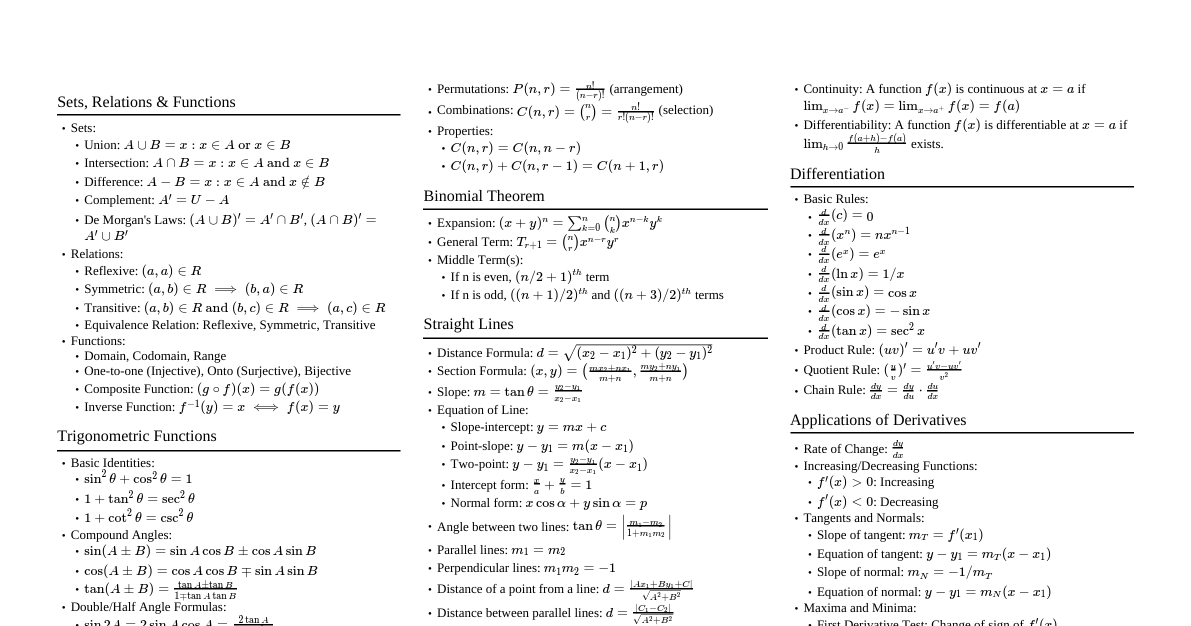
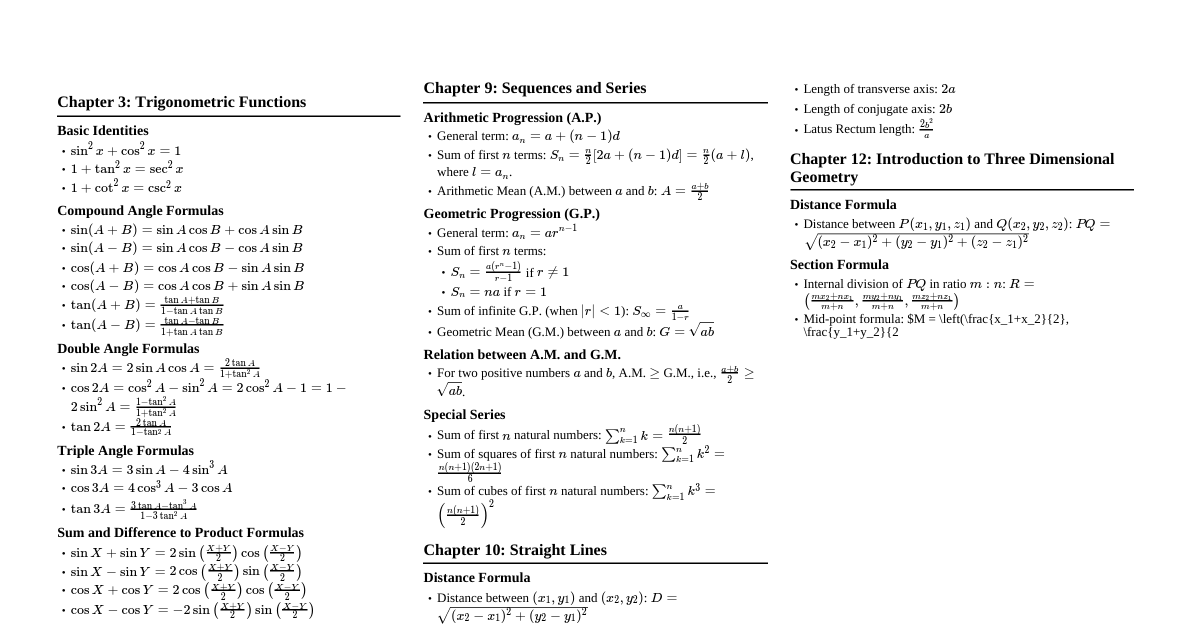
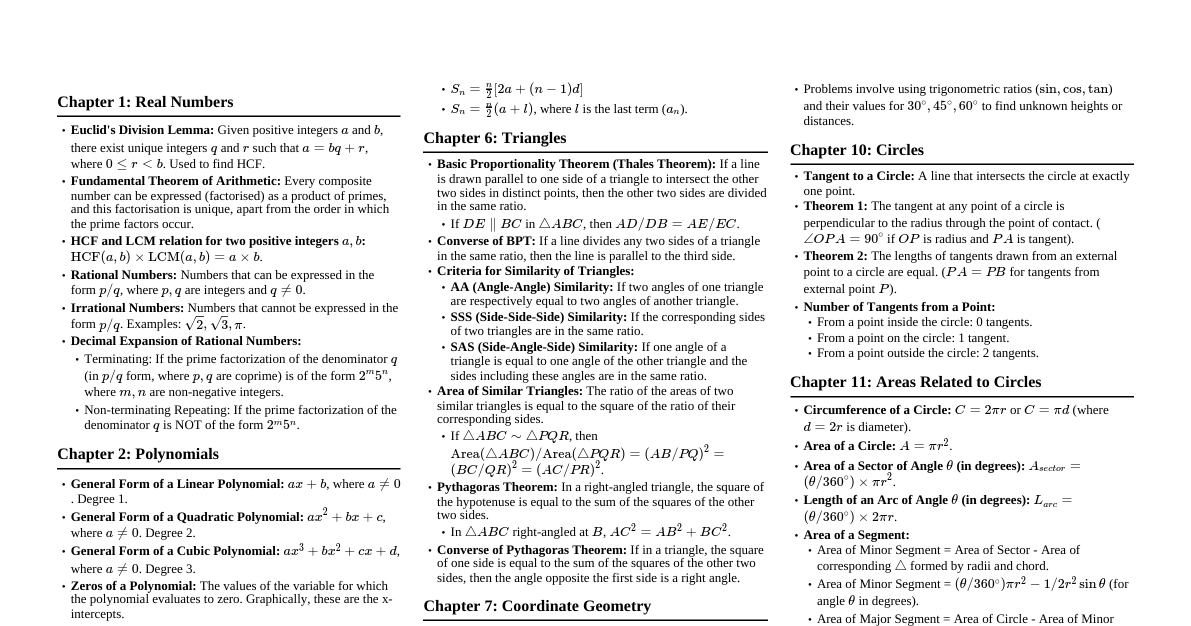
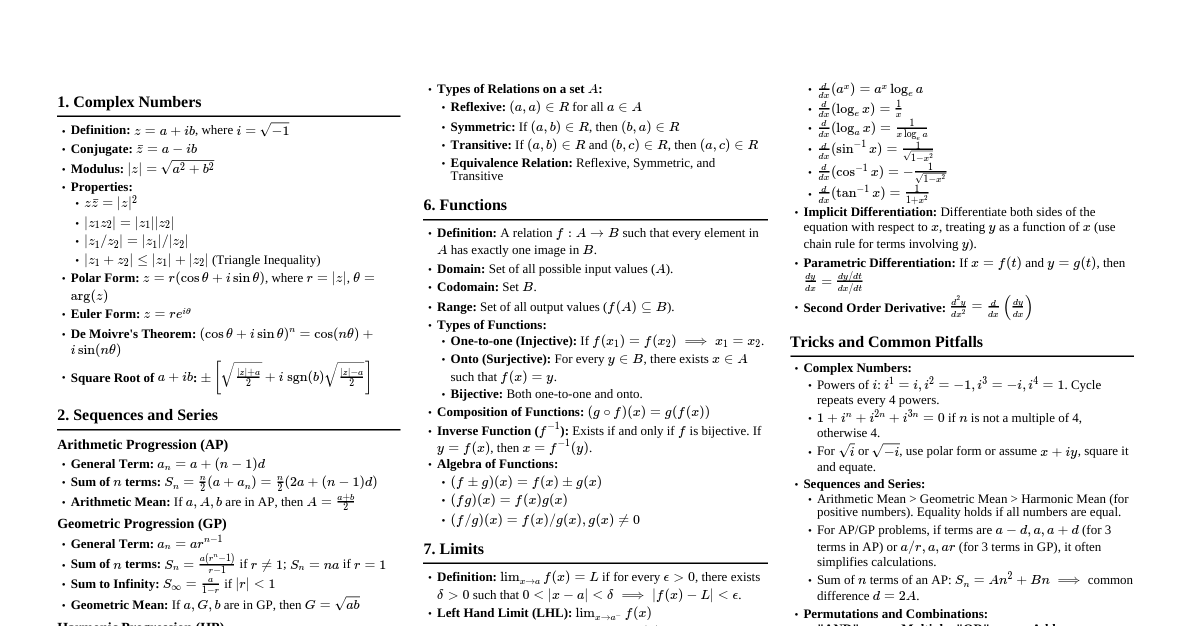
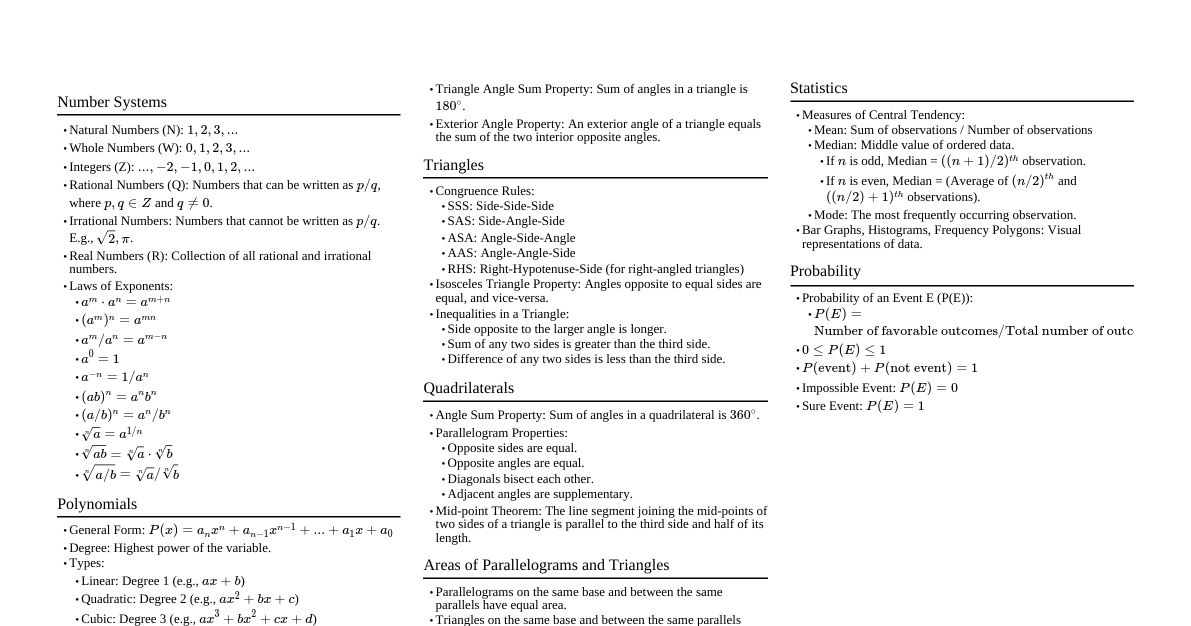
### 1. Numbers & Basic Operations - **Natural Numbers:** $\mathbb{N} = \{1, 2, 3, ...\}$ - **Whole Numbers:** $\mathbb{W} = \{0, 1, 2, 3, ...\}$ - **Integers:** $\mathbb{Z} = \{..., -2, -1, 0, 1, 2, ...\}$ - **Rational Numbers:** $\mathbb{Q} = \{p/q \mid p,q \in \mathbb{Z}, q \neq 0\}$ - **Real Numbers:** $\mathbb{R}$ (all rational and irrational numbers) - **Place Value:** Understanding the value of each digit in a number (e.g., in 345, 3 is in hundreds place). - **Number Names:** Indian and International Systems. - **Order of Operations (BODMAS/PEMDAS):** Brackets/Parentheses, Orders/Exponents, Division/Multiplication, Addition/Subtraction - **Divisibility Rules:** - By 2: Last digit is even. - By 3: Sum of digits is divisible by 3. - By 4: Last two digits are divisible by 4. - By 5: Last digit is 0 or 5. - By 6: Divisible by both 2 and 3. - By 9: Sum of digits is divisible by 9. - By 10: Last digit is 0. - **Prime Numbers:** Numbers greater than 1 with only two factors: 1 and itself. - **Composite Numbers:** Numbers greater than 1 that are not prime. - **HCF (Highest Common Factor) / GCD (Greatest Common Divisor):** Largest number that divides two or more numbers. - **LCM (Lowest Common Multiple):** Smallest number that is a multiple of two or more numbers. ### 2. Algebraic Identities - $(a+b)^2 = a^2 + 2ab + b^2$ - $(a-b)^2 = a^2 - 2ab + b^2$ - $a^2 - b^2 = (a-b)(a+b)$ - $(x+a)(x+b) = x^2 + (a+b)x + ab$ - $(a+b+c)^2 = a^2 + b^2 + c^2 + 2ab + 2bc + 2ca$ - $(a+b)^3 = a^3 + b^3 + 3ab(a+b) = a^3 + 3a^2b + 3ab^2 + b^3$ - $(a-b)^3 = a^3 - b^3 - 3ab(a-b) = a^3 - 3a^2b + 3ab^2 - b^3$ - $a^3 + b^3 = (a+b)(a^2 - ab + b^2)$ - $a^3 - b^3 = (a-b)(a^2 + ab + b^2)$ ### 3. Linear Equations - **Standard Form:** $ax + by + c = 0$ - **Solving:** - **Substitution Method:** Express one variable in terms of the other, substitute into the second equation. - **Elimination Method:** Multiply equations by constants to make coefficients of one variable equal, then add/subtract equations. - **Cross-Multiplication Method:** For $a_1x + b_1y + c_1 = 0$ and $a_2x + b_2y + c_2 = 0$: $$\frac{x}{b_1c_2 - b_2c_1} = \frac{y}{c_1a_2 - c_2a_1} = \frac{1}{a_1b_2 - a_2b_1}$$ - **Conditions for Solutions:** - Unique Solution: $\frac{a_1}{a_2} \neq \frac{b_1}{b_2}$ (Intersecting lines) - No Solution: $\frac{a_1}{a_2} = \frac{b_1}{b_2} \neq \frac{c_1}{c_2}$ (Parallel lines) - Infinitely Many Solutions: $\frac{a_1}{a_2} = \frac{b_1}{b_2} = \frac{c_1}{c_2}$ (Coincident lines) ### 4. Quadratic Equations - **Standard Form:** $ax^2 + bx + c = 0$ (where $a \neq 0$) - **Quadratic Formula:** $x = \frac{-b \pm \sqrt{b^2 - 4ac}}{2a}$ - **Discriminant ($\Delta$ or D):** $D = b^2 - 4ac$ - $D > 0$: Two distinct real roots. - $D = 0$: Two equal real roots. - $D ### 5. Arithmetic Progressions (AP) - **General Form:** $a, a+d, a+2d, ...$ - **$n^{th}$ term:** $a_n = a + (n-1)d$ - **Sum of first $n$ terms:** $S_n = \frac{n}{2}(a + a_n)$ or $S_n = \frac{n}{2}(2a + (n-1)d)$ ### 6. Geometry - Shapes & Areas #### 6.1. Triangles - **Area:** $\frac{1}{2} \times \text{base} \times \text{height}$ - **Equilateral Triangle:** - Area: $\frac{\sqrt{3}}{4} a^2$ - Height: $\frac{\sqrt{3}}{2} a$ - **Pythagorean Theorem (Right-angled triangle):** $a^2 + b^2 = c^2$ #### 6.2. Quadrilaterals - **Rectangle:** Area = $l \times w$, Perimeter = $2(l+w)$ - **Square:** Area = $s^2$, Perimeter = $4s$ - **Parallelogram:** Area = $\text{base} \times \text{height}$ - **Rhombus:** Area = $\frac{1}{2} d_1 d_2$ - **Trapezium:** Area = $\frac{1}{2}(a+b)h$ (where $a, b$ are parallel sides) #### 6.3. Circle - **Circumference:** $2\pi r$ or $\pi d$ - **Area:** $\pi r^2$ - **Area of Sector:** $\frac{\theta}{360^\circ} \times \pi r^2$ - **Length of Arc:** $\frac{\theta}{360^\circ} \times 2\pi r$ ### 7. Surface Areas & Volumes #### 7.1. Cuboid - **Volume:** $l \times w \times h$ - **Lateral Surface Area (LSA):** $2h(l+w)$ - **Total Surface Area (TSA):** $2(lw + wh + hl)$ #### 7.2. Cube - **Volume:** $a^3$ - **LSA:** $4a^2$ - **TSA:** $6a^2$ #### 7.3. Cylinder - **Volume:** $\pi r^2 h$ - **Curved Surface Area (CSA):** $2\pi r h$ - **TSA:** $2\pi r (r+h)$ #### 7.4. Cone - **Volume:** $\frac{1}{3} \pi r^2 h$ - **Slant Height ($l$):** $l = \sqrt{r^2 + h^2}$ - **CSA:** $\pi r l$ - **TSA:** $\pi r (l+r)$ #### 7.5. Sphere - **Volume:** $\frac{4}{3} \pi r^3$ - **Surface Area:** $4\pi r^2$ #### 7.6. Hemisphere - **Volume:** $\frac{2}{3} \pi r^3$ - **CSA:** $2\pi r^2$ - **TSA:** $3\pi r^2$ ### 8. Trigonometry - **Basic Ratios (SOH CAH TOA):** - $\sin \theta = \frac{\text{Opposite}}{\text{Hypotenuse}}$ - $\cos \theta = \frac{\text{Adjacent}}{\text{Hypotenuse}}$ - $\tan \theta = \frac{\text{Opposite}}{\text{Adjacent}} = \frac{\sin \theta}{\cos \theta}$ - **Reciprocal Ratios:** - $\csc \theta = \frac{1}{\sin \theta}$ - $\sec \theta = \frac{1}{\cos \theta}$ - $\cot \theta = \frac{1}{\tan \theta}$ - **Identities:** - $\sin^2 \theta + \cos^2 \theta = 1$ - $1 + \tan^2 \theta = \sec^2 \theta$ - $1 + \cot^2 \theta = \csc^2 \theta$ - **Complementary Angles:** - $\sin(90^\circ - \theta) = \cos \theta$ - $\cos(90^\circ - \theta) = \sin \theta$ - $\tan(90^\circ - \theta) = \cot \theta$ - $\cot(90^\circ - \theta) = \tan \theta$ - $\sec(90^\circ - \theta) = \csc \theta$ - $\csc(90^\circ - \theta) = \sec \theta$ ### 9. Coordinate Geometry - **Distance Formula:** Between $(x_1, y_1)$ and $(x_2, y_2)$ is $\sqrt{(x_2-x_1)^2 + (y_2-y_1)^2}$ - **Section Formula:** - **Internal Division:** $P(x,y)$ divides line segment joining $A(x_1, y_1)$ and $B(x_2, y_2)$ in ratio $m:n$: $$x = \frac{mx_2 + nx_1}{m+n}, \quad y = \frac{my_2 + ny_1}{m+n}$$ - **Midpoint Formula:** $\left(\frac{x_1+x_2}{2}, \frac{y_1+y_2}{2}\right)$ - **Area of a Triangle:** With vertices $(x_1, y_1)$, $(x_2, y_2)$, $(x_3, y_3)$: $$ \frac{1}{2} |x_1(y_2-y_3) + x_2(y_3-y_1) + x_3(y_1-y_2)| $$ - **Slope of a Line (m):** $\frac{y_2-y_1}{x_2-x_1}$ or $\tan \theta$ - **Equation of a Line:** - **Slope-Intercept Form:** $y = mx + c$ - **Point-Slope Form:** $y - y_1 = m(x - x_1)$ - **Two-Point Form:** $y - y_1 = \frac{y_2-y_1}{x_2-x_1}(x - x_1)$ ### Statistics - **Mean (Average):** $\bar{x} = \frac{\sum x_i}{n}$ - **Mean for grouped data:** $\bar{x} = \frac{\sum f_i x_i}{\sum f_i}$ (Direct Method) - **Median:** - For odd $n$: Middle value after arranging data. - For even $n$: Average of the two middle values. - **Mode:** The value that appears most frequently in a data set. - **Summation (Sigma Notation):** $\sum_{i=1}^{n} x_i = x_1 + x_2 + \dots + x_n$ - Represents the sum of a sequence of terms. - **Probability:** $P(E) = \frac{\text{Number of favorable outcomes}}{\text{Total number of possible outcomes}}$ - $0 \le P(E) \le 1$ - $P(\text{not } E) = 1 - P(E)$