Functions: Varsity Level Intro
Shared 3/29/2026•55 views
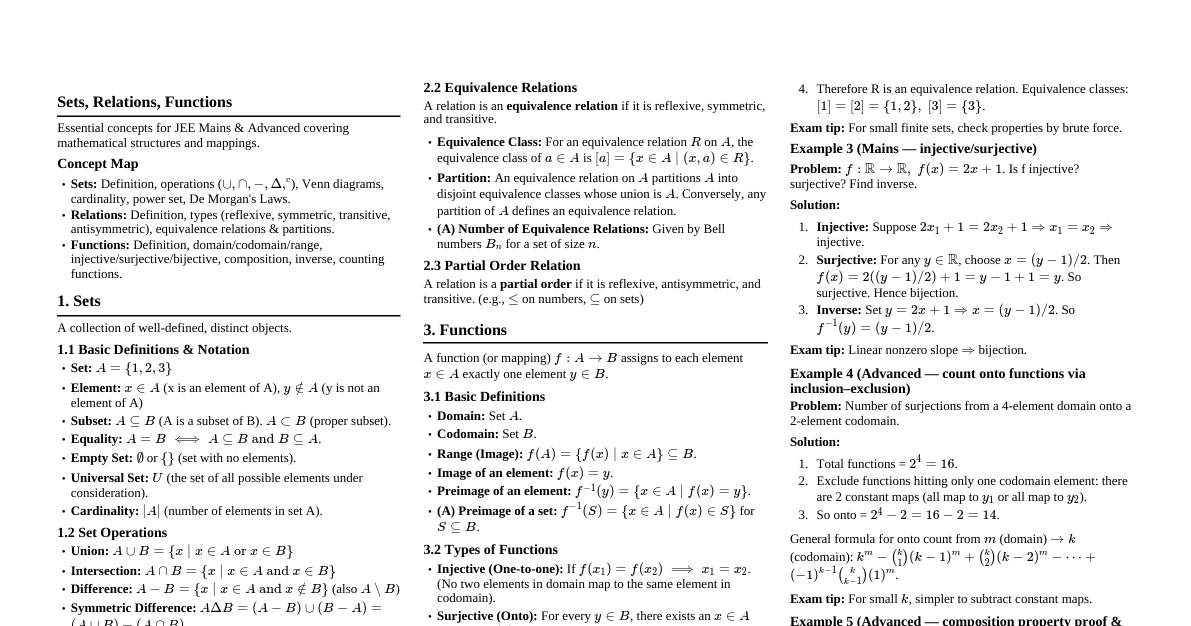
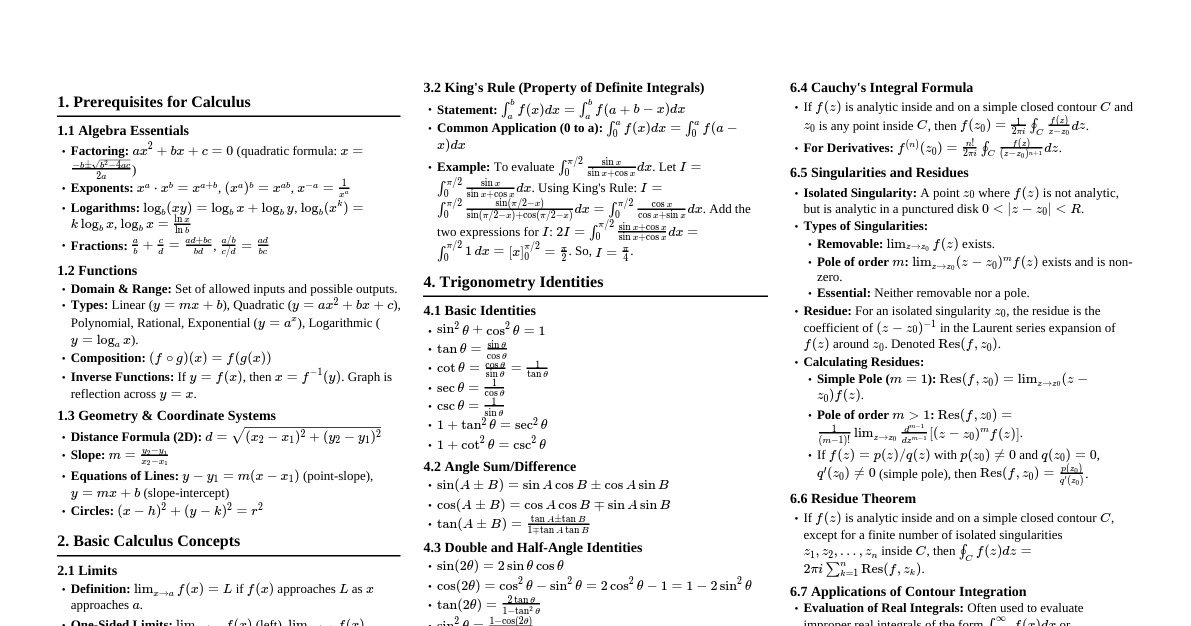
### Functions: An Introduction A function is a relation between a set of inputs (the domain) and a set of permissible outputs (the codomain) with the property that each input is related to exactly one output. - **Notation:** $y = f(x)$, where $x$ is the independent variable (input) and $y$ is the dependent variable (output). - **Domain:** The set of all possible input values for which the function is defined. - **Range:** The set of all actual output values produced by the function. - **Vertical Line Test:** A graph represents a function if and only if no vertical line intersects the graph more than once. - **One-to-One Function:** Each output corresponds to exactly one input. Passes the Horizontal Line Test. - **Onto Function:** Every element in the codomain is mapped to by at least one element in the domain. - **Inverse Function:** If $f(x)$ is one-to-one, its inverse $f^{-1}(x)$ exists such that $f(f^{-1}(x)) = x$ and $f^{-1}(f(x)) = x$. ### Linear Functions Describe a straight line. Constant rate of change. - **Equation Forms:** - **Slope-Intercept Form:** $y = mx + b$ - $m$: slope (rate of change) - $b$: y-intercept - **Point-Slope Form:** $y - y_1 = m(x - x_1)$ - $(x_1, y_1)$: a point on the line - $m$: slope - **Standard Form:** $Ax + By = C$ - $A, B, C$: constants - **Key Concepts:** - **Slope:** $m = \frac{\Delta y}{\Delta x} = \frac{y_2 - y_1}{x_2 - x_1}$ - **Parallel Lines:** Have the same slope ($m_1 = m_2$). - **Perpendicular Lines:** Slopes are negative reciprocals ($m_1 \cdot m_2 = -1$). - **Graph:** A straight line. ### Quadratic Functions Describe a parabola. Highest power of $x$ is 2. - **Equation Forms:** - **Standard Form:** $f(x) = ax^2 + bx + c$ - $a, b, c$: constants, $a \neq 0$ - **Vertex Form:** $f(x) = a(x - h)^2 + k$ - $(h, k)$: vertex of the parabola - **Factored Form:** $f(x) = a(x - r_1)(x - r_2)$ - $r_1, r_2$: roots (x-intercepts) - **Key Concepts:** - **Parabola:** U-shaped graph. Opens up if $a > 0$, down if $a 0$: Two distinct real roots. - $\Delta = 0$: One real root (repeated). - $\Delta ### Polynomial Functions Generalization of linear and quadratic functions. - **Equation Form:** $f(x) = a_n x^n + a_{n-1} x^{n-1} + ... + a_1 x + a_0$ - $a_n, ..., a_0$: coefficients, $a_n \neq 0$ - $n$: degree of the polynomial (highest exponent, a non-negative integer) - **Key Concepts:** - **Degree:** Determines the maximum number of roots and turning points. - **Leading Term:** $a_n x^n$. Determines end behavior. - **End Behavior:** What $f(x)$ does as $x \to \infty$ and $x \to -\infty$. Depends on degree and leading coefficient. - **Roots/Zeros:** Values of $x$ for which $f(x) = 0$. - **Rational Root Theorem:** Helps find potential rational roots. - **Factor Theorem:** If $x-c$ is a factor, then $f(c)=0$. - **Remainder Theorem:** If $f(x)$ is divided by $x-c$, the remainder is $f(c)$. - **Turning Points:** Points where the graph changes direction (local maxima or minima). A polynomial of degree $n$ has at most $n-1$ turning points. - **Multiplicity of Roots:** If a root $c$ has multiplicity $k$: - If $k$ is odd, the graph crosses the x-axis at $c$. - If $k$ is even, the graph touches (is tangent to) the x-axis at $c$. - **Cubic Functions ($n=3$):** A specific type of polynomial function. - **Standard Form:** $f(x) = ax^3 + bx^2 + cx + d$ - Can have up to 3 real roots and up to 2 turning points. - Always have at least one real root. ### Rational Functions Ratio of two polynomial functions. - **Equation Form:** $f(x) = \frac{P(x)}{Q(x)}$ where $P(x)$ and $Q(x)$ are polynomials and $Q(x) \neq 0$. - **Key Concepts:** - **Domain:** All real numbers except where $Q(x) = 0$. - **Vertical Asymptotes (VA):** Occur at $x$-values where $Q(x) = 0$ and $P(x) \neq 0$. - **Horizontal Asymptotes (HA):** - If $\text{deg}(P) < \text{deg}(Q)$, then $y = 0$. - If $\text{deg}(P) = \text{deg}(Q)$, then $y = \frac{\text{leading coefficient of } P}{\text{leading coefficient of } Q}$. - If $\text{deg}(P) > \text{deg}(Q)$, no HA. - **Slant/Oblique Asymptotes (SA):** Occur if $\text{deg}(P) = \text{deg}(Q) + 1$. Found by polynomial long division; the quotient (without remainder) is the equation of the SA. - **Holes (Removable Discontinuities):** Occur at $x$-values where both $P(x) = 0$ and $Q(x) = 0$ (i.e., common factors). - **x-intercepts:** Where $P(x) = 0$ (and $Q(x) \neq 0$). - **y-intercept:** $f(0)$, if $0$ is in the domain. ### Exponential Functions Variable is in the exponent. Describes rapid growth or decay. - **Equation Form:** $f(x) = ab^x$ or $f(x) = ae^{kx}$ - $a$: initial value (y-intercept when $x=0$) - $b$: base, growth/decay factor ($b > 0, b \neq 1$) - $e$: Euler's number ($\approx 2.718$) - $k$: growth/decay constant - **Key Concepts:** - **Domain:** $(-\infty, \infty)$. - **Range:** $(0, \infty)$ if $a>0$. - **Horizontal Asymptote:** $y=0$ (unless shifted vertically). - **Growth:** If $b > 1$ or $k > 0$. - **Decay:** If $0 < b < 1$ or $k < 0$. - **Compound Interest:** $A = P(1 + r/n)^{nt}$ (discrete) or $A = Pe^{rt}$ (continuous). ### Logarithmic Functions Inverse of exponential functions. Used to solve for exponents. - **Equation Forms:** - $y = \log_b(x) \iff b^y = x$ - **Common Logarithm:** $y = \log(x) = \log_{10}(x)$ - **Natural Logarithm:** $y = \ln(x) = \log_e(x)$ - **Key Concepts:** - **Domain:** $(0, \infty)$. (Argument must be positive). - **Range:** $(-\infty, \infty)$. - **Vertical Asymptote:** $x=0$ (unless shifted horizontally). - **Logarithm Properties:** - $\log_b(MN) = \log_b(M) + \log_b(N)$ - $\log_b(M/N) = \log_b(M) - \log_b(N)$ - $\log_b(M^p) = p \log_b(M)$ - $\log_b(b) = 1$ - $\log_b(1) = 0$ - **Change of Base Formula:** $\log_b(x) = \frac{\log_c(x)}{\log_c(b)}$ ### Trigonometric Functions Relate angles of a right triangle to ratios of its sides. - **Basic Functions (SOH CAH TOA):** - $\sin(\theta) = \frac{\text{Opposite}}{\text{Hypotenuse}}$ - $\cos(\theta) = \frac{\text{Adjacent}}{\text{Hypotenuse}}$ - $\tan(\theta) = \frac{\text{Opposite}}{\text{Adjacent}} = \frac{\sin(\theta)}{\cos(\theta)}$ - **Reciprocal Functions:** - $\csc(\theta) = \frac{1}{\sin(\theta)}$ - $\sec(\theta) = \frac{1}{\cos(\theta)}$ - $\cot(\theta) = \frac{1}{\tan(\theta)}$ - **Key Concepts:** - **Unit Circle:** A circle with radius 1 centered at the origin. Points $(x,y)$ on the circle correspond to $(\cos\theta, \sin\theta)$. - **Periodicity:** Functions repeat their values in regular intervals. - $\sin(x), \cos(x), \csc(x), \sec(x)$: Period $2\pi$. - $\tan(x), \cot(x)$: Period $\pi$. - **Amplitude:** Half the difference between max and min values for sine and cosine. - **Phase Shift:** Horizontal shift. - **Vertical Shift:** Vertical displacement of the graph. - **Identities (Examples):** - $\sin^2(\theta) + \cos^2(\theta) = 1$ - $\tan^2(\theta) + 1 = \sec^2(\theta)$ - $\sin(2\theta) = 2\sin(\theta)\cos(\theta)$ - $\cos(2\theta) = \cos^2(\theta) - \sin^2(\theta)$ - **Inverse Trigonometric Functions:** $\arcsin(x), \arccos(x), \arctan(x)$, etc. Used to find angles.