Gravitation
Cheatsheet Content
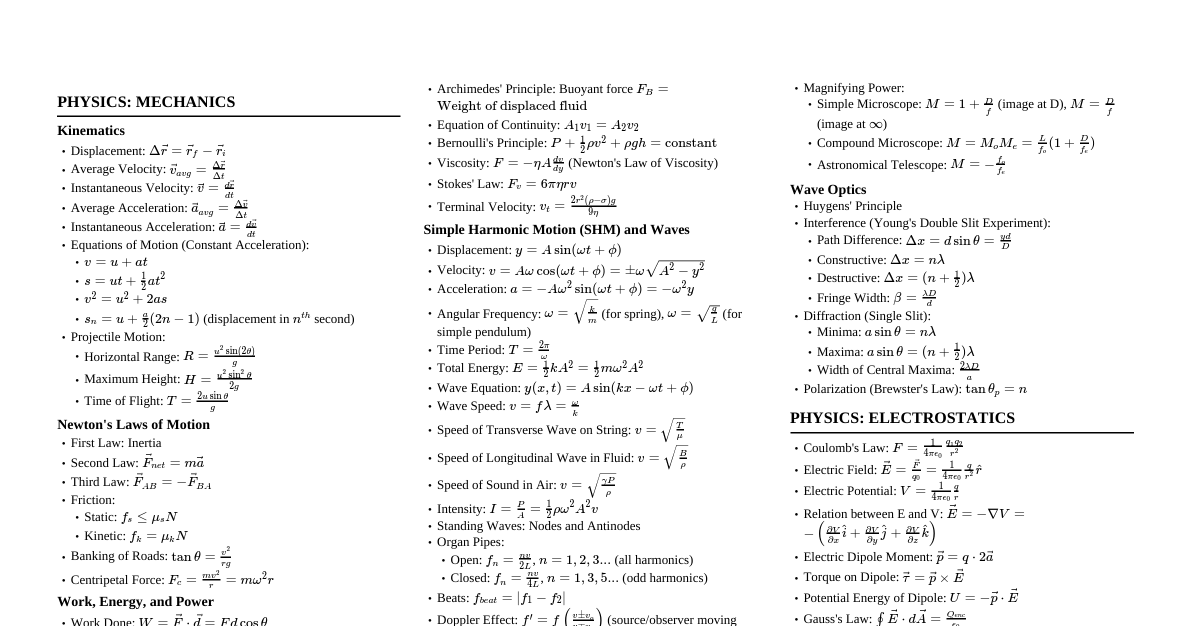
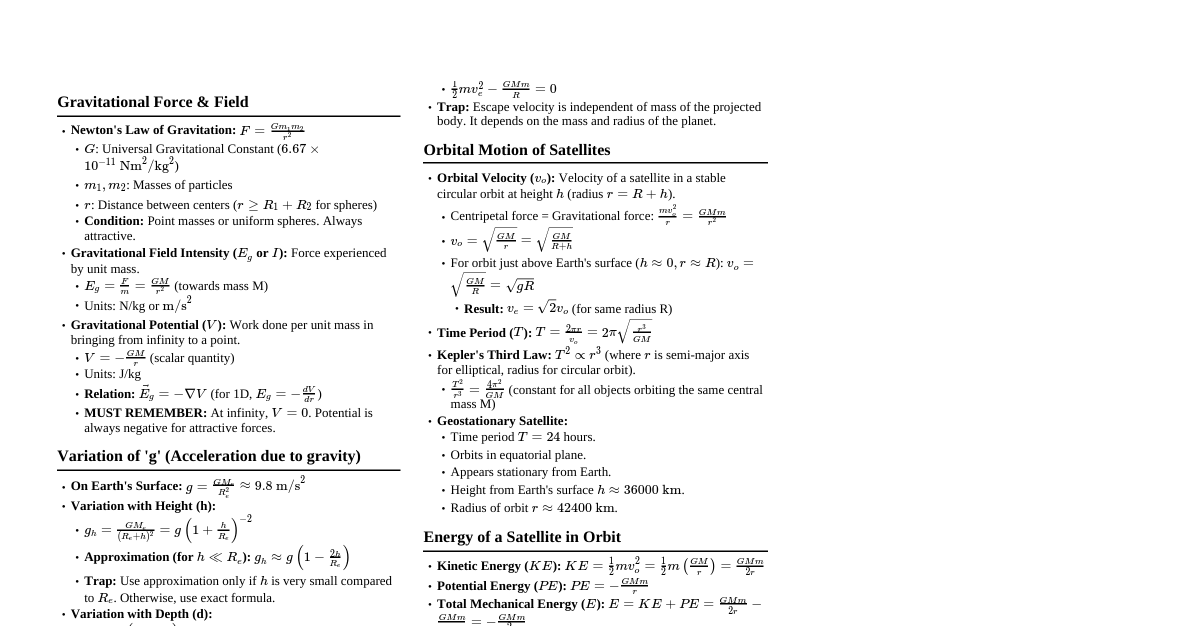
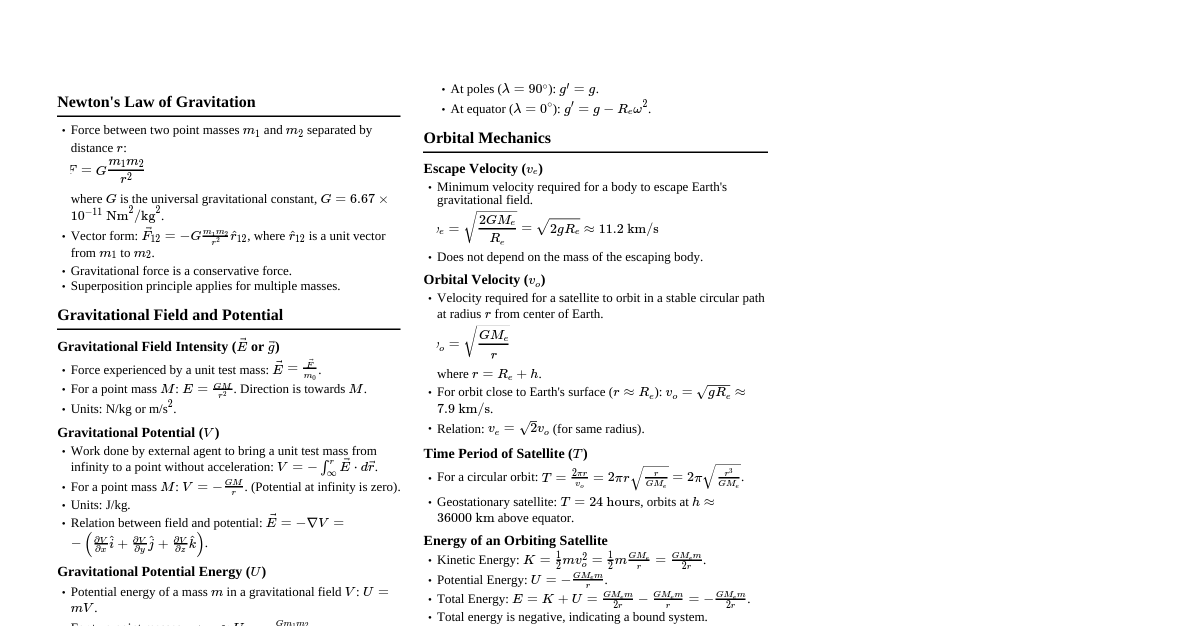
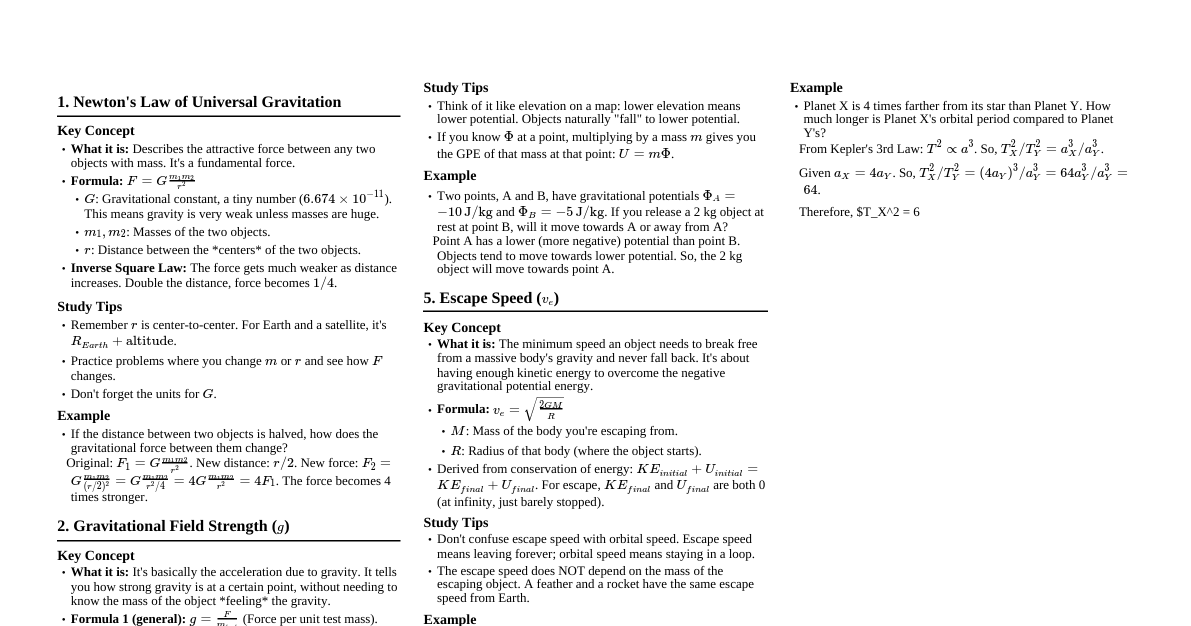
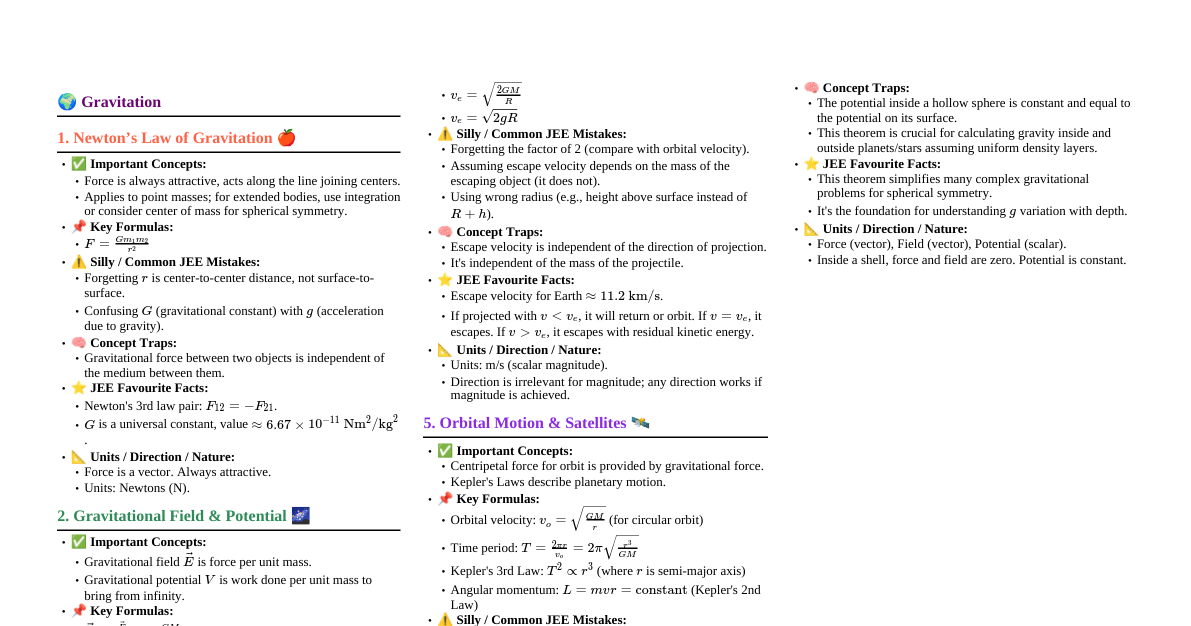
### Newton's Law of Gravitation - **Statement:** Every particle in the universe attracts every other particle with a force that is directly proportional to the product of their masses and inversely proportional to the square of the distance between their centers. - **Formula:** $$F = G \frac{m_1 m_2}{r^2}$$ - $F$: Gravitational force - $G$: Universal Gravitational Constant ($6.67 \times 10^{-11} \text{ Nm}^2/\text{kg}^2$) - $m_1, m_2$: Masses of the two particles - $r$: Distance between the centers of the two particles - **Vector Form:** $$\vec{F}_{12} = -G \frac{m_1 m_2}{r^2} \hat{r}_{12}$$ - $\vec{F}_{12}$: Force on mass $m_1$ due to $m_2$ - $\hat{r}_{12}$: Unit vector from $m_1$ to $m_2$ - **Properties:** - Independent of intervening medium. - Conservative force. - Central force (acts along the line joining the centers). - Obeys Newton's third law (action-reaction pair). - Valid for point masses, spherical shells, and solid spheres. #### Principle of Superposition - Total gravitational force on a particle due to multiple other particles is the vector sum of individual forces. - $$\vec{F}_{net} = \vec{F}_1 + \vec{F}_2 + \vec{F}_3 + ...$$ ### Acceleration Due to Gravity ($g$) - **Definition:** The acceleration experienced by an object due to the Earth's gravitational pull. - **Formula (on Earth's surface):** $$g = \frac{GM_e}{R_e^2}$$ - $M_e$: Mass of Earth ($5.97 \times 10^{24} \text{ kg}$) - $R_e$: Radius of Earth ($6.37 \times 10^6 \text{ m}$) - Approximate value: $9.8 \text{ m/s}^2$ #### Variation of $g$ - **1. Due to Altitude (Height $h$):** - For $h \ll R_e$: $$g_h = g \left(1 - \frac{2h}{R_e}\right)$$ - General formula: $$g_h = \frac{GM_e}{(R_e + h)^2} = g \left(\frac{R_e}{R_e + h}\right)^2$$ - **2. Due to Depth (Depth $d$):** - $$g_d = g \left(1 - \frac{d}{R_e}\right)$$ - At the center of Earth ($d=R_e$), $g_d = 0$. - **3. Due to Shape of Earth:** - Earth is an oblate spheroid (bulges at equator, flattened at poles). - $R_{equator} > R_{pole}$ - Since $g = \frac{GM_e}{R_e^2}$, $g_{pole} > g_{equator}$. - **4. Due to Rotation of Earth:** - Apparent weight of a body at latitude $\lambda$ is $mg' = mg - mR_e\omega^2 \cos^2\lambda$. - Effective $g'$ at latitude $\lambda$: $$g' = g - R_e\omega^2 \cos^2\lambda$$ - At poles ($\lambda = 90^\circ$): $g' = g$ - At equator ($\lambda = 0^\circ$): $g' = g - R_e\omega^2$ - If Earth stops rotating ($\omega=0$), $g' = g$ everywhere. ### Gravitational Field - **Definition:** The space around a mass where its gravitational influence can be experienced by other masses. - **Gravitational Field Intensity ($\vec{E}$ or $\vec{I}$):** - **Definition:** Gravitational force experienced per unit test mass placed at that point. - **Formula:** $$\vec{E} = \frac{\vec{F}}{m_0}$$ - **Units:** N/kg or m/s$^2$ (same as acceleration due to gravity). - **Due to a point mass $M$ at distance $r$:** $$E = \frac{GM}{r^2}$$ - **Due to a spherical shell:** - Outside ($r \ge R$): $E = \frac{GM}{r^2}$ - Inside ($r ### Gravitational Potential ($V$) - **Definition:** The work done per unit test mass by an external agent in bringing a test mass from infinity to a point in the gravitational field without acceleration. - **Formula:** $$V = \frac{W}{m_0}$$ - **Units:** J/kg - **Relation to field intensity:** $$\vec{E} = -\frac{dV}{dr}\hat{r}$$ - **Due to a point mass $M$ at distance $r$:** $$V = -\frac{GM}{r}$$ - Potential at infinity is zero. - **Due to a spherical shell:** - Outside ($r \ge R$): $V = -\frac{GM}{r}$ - Inside ($r ### Gravitational Potential Energy ($U$) - **Definition:** The work done by an external agent in bringing a given mass $m$ from infinity to a point in the gravitational field of mass $M$ without acceleration. - **Formula:** $$U = Vm = -\frac{GMm}{r}$$ - **Units:** Joules (J) - **Change in Potential Energy:** $\Delta U = U_f - U_i$ - **Work done by gravity:** $W_g = -\Delta U$ - **Work done by external force:** $W_{ext} = \Delta U$ - **Binding Energy:** The energy required to move a body from its current position in the gravitational field to infinity. It is the negative of the potential energy: $E_{binding} = -U = \frac{GMm}{r}$. ### Escape Velocity ($v_e$) - **Definition:** The minimum velocity with which a body must be projected vertically upwards from the surface of a planet so that it just escapes the gravitational field of the planet and never returns. - **Formula:** $$v_e = \sqrt{\frac{2GM}{R}} = \sqrt{2gR}$$ - For Earth: $v_e \approx 11.2 \text{ km/s}$ - **Dependence:** - Independent of the mass of the projected body. - Independent of the angle of projection (assuming no atmospheric resistance). - Depends on the mass and radius of the planet. - **If $v v_e$:** Body escapes to infinity with some kinetic energy. ### Orbital Velocity ($v_o$) - **Definition:** The velocity required for a satellite to orbit a planet in a stable circular path at a certain height. - **Formula:** $$v_o = \sqrt{\frac{GM}{R+h}}$$ - $R$: Radius of planet - $h$: Height of satellite above surface - **For orbit close to Earth's surface ($h \ll R$):** $$v_o = \sqrt{\frac{GM}{R}} = \sqrt{gR}$$ - For Earth: $v_o \approx 7.92 \text{ km/s}$ - **Relation to escape velocity:** $v_e = \sqrt{2} v_o$ - **Time Period of Satellite (T):** - $$T = \frac{2\pi(R+h)}{v_o} = 2\pi \sqrt{\frac{(R+h)^3}{GM}}$$ - Also, $T^2 \propto (R+h)^3$ (Kepler's Third Law). - **Energy of an Orbiting Satellite:** - **Kinetic Energy:** $K = \frac{1}{2}mv_o^2 = \frac{GMm}{2(R+h)}$ - **Potential Energy:** $U = -\frac{GMm}{(R+h)}$ - **Total Energy:** $E = K + U = -\frac{GMm}{2(R+h)}$ - Total energy is negative, indicating a bound system. - **Binding Energy of Satellite:** $-E = \frac{GMm}{2(R+h)}$ ### Geostationary Satellite - **Conditions:** - Orbits in the equatorial plane. - Period of revolution is 24 hours (same as Earth's rotation). - Rotates in the same direction as Earth (west to east). - Appears stationary from Earth's surface. - **Height from Earth's surface:** Approximately $36,000 \text{ km}$. - **Orbital radius from Earth's center:** Approximately $42,400 \text{ km}$. - **Orbital velocity:** Approximately $3.08 \text{ km/s}$. ### Kepler's Laws of Planetary Motion - **1. Law of Orbits:** - All planets move in elliptical orbits with the Sun at one of the foci. - **2. Law of Areas:** - The line joining a planet to the Sun sweeps out equal areas in equal intervals of time. - This implies that the areal velocity ($dA/dt$) is constant. - **Consequence:** Planet moves faster when closer to the Sun (perihelion) and slower when farther (aphelion). - This law is a consequence of conservation of angular momentum. - **3. Law of Periods:** - The square of the orbital period ($T$) of any planet is proportional to the cube of the semi-major axis ($a$) of its elliptical orbit. - **Formula:** $$T^2 \propto a^3$$ or $$\frac{T^2}{a^3} = \text{constant} = \frac{4\pi^2}{GM_{sun}}$$ - For circular orbits, $a=r$. ### Weightlessness - **Definition:** A state where an object experiences no apparent weight. - **Conditions:** - **Free fall:** Objects inside a freely falling elevator or spacecraft experience weightlessness because both the object and the reference frame are accelerating downwards at $g$. - **Orbiting satellite:** A satellite in orbit is continuously in free fall around the Earth. The gravitational force provides the necessary centripetal force, so there's no normal force or tension to create a sensation of weight. - **Key point:** Gravitational force is still acting, but the apparent weight (due to normal force or tension) is zero. ### Miscellaneous Concepts - **Gravitational Self-Energy:** The work done to assemble a system of masses from infinity to their current configuration. - For two point masses $m_1, m_2$: $U = -\frac{Gm_1m_2}{r}$ - For a system of $N$ particles, sum up potential energy for each pair. - **Black Holes:** Regions of spacetime where gravity is so strong that nothing, not even light, can escape. - **Schwarzschild Radius ($R_s$):** The radius around a singularity where the escape velocity equals the speed of light. - $$R_s = \frac{2GM}{c^2}$$