Physics Fluids Formulas
Cheatsheet Content
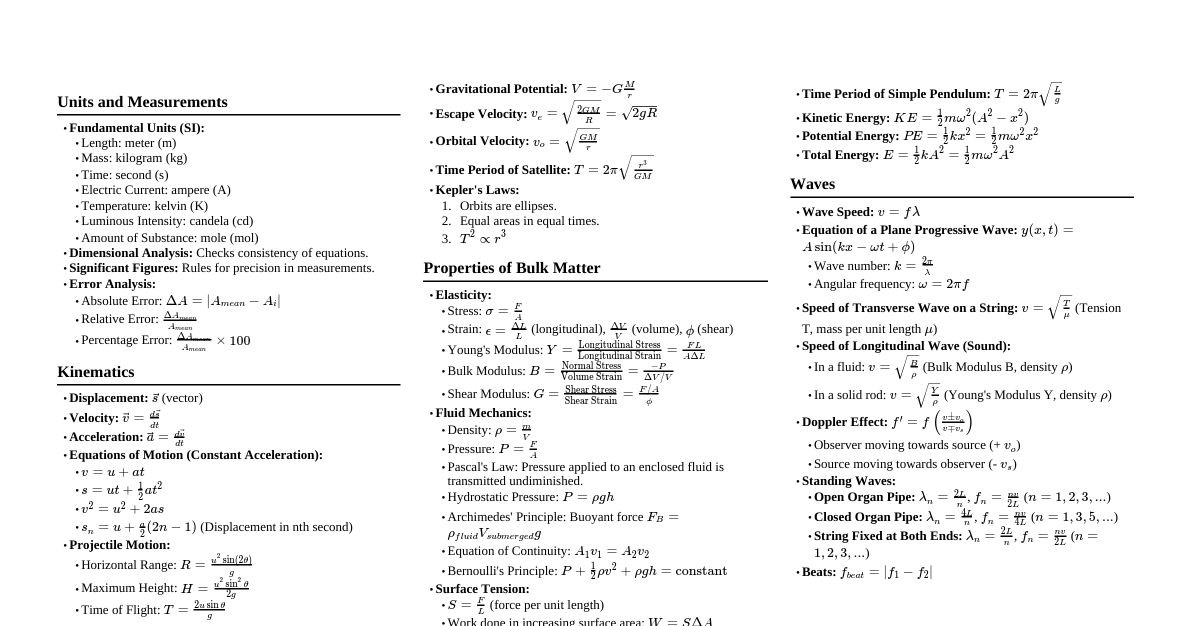
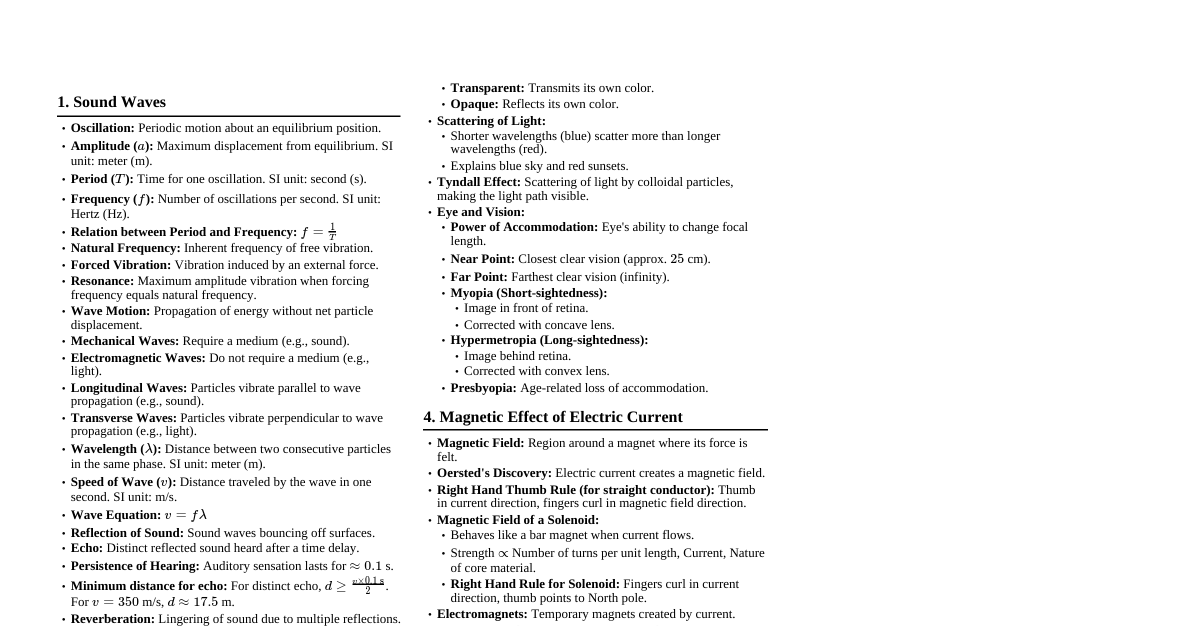
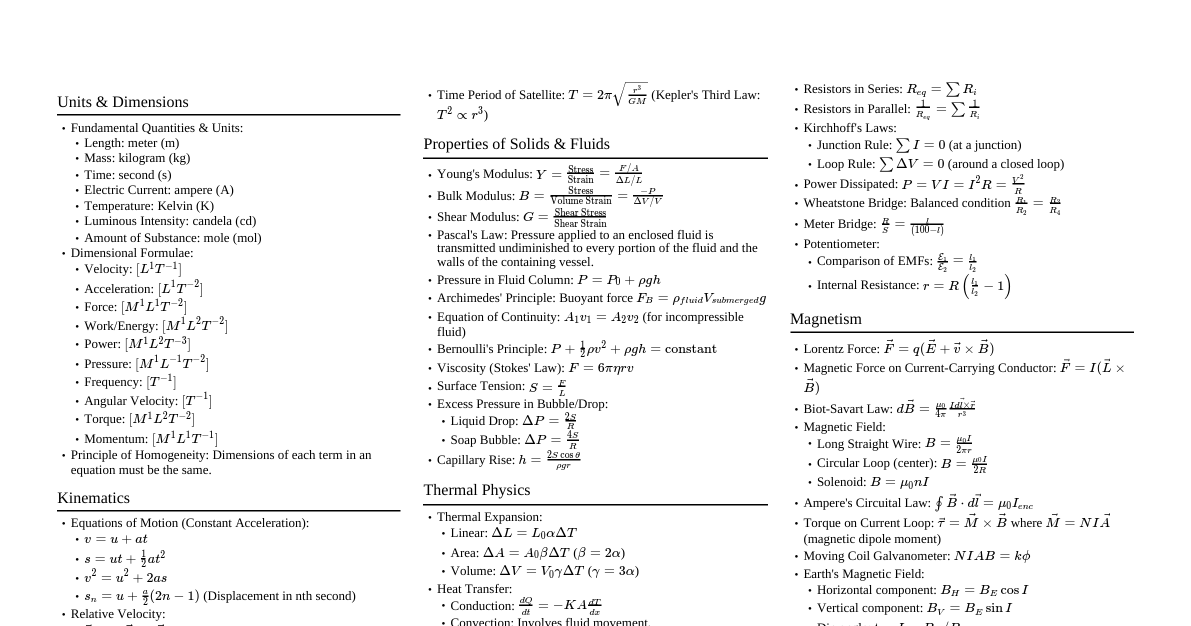
### Fluid Properties - **Density ($\rho$):** Mass per unit volume. $$\rho = \frac{m}{V}$$ - Units: $\text{kg/m}^3$ - Tip: Crucial for buoyancy and pressure calculations. For NEET, remember $\rho_{water} = 1000 \text{ kg/m}^3$. - **Specific Gravity (SG):** Ratio of fluid density to standard fluid density (usually water at $4^\circ\text{C}$). $$\text{SG} = \frac{\rho_{\text{fluid}}}{\rho_{\text{water}}}$$ - Units: Dimensionless - Tip: $\text{SG} > 1$ means denser than water, $\text{SG} < 1$ means less dense. Directly gives ratio of densities. - **Pressure (P):** Force per unit area. $$P = \frac{F}{A}$$ - Units: Pascals ($\text{Pa} = \text{N/m}^2$) - Tip: Pressure acts equally in all directions in a static fluid. Remember $1 \text{ atm} \approx 10^5 \text{ Pa}$. ### Fluid Statics - **Pressure at Depth (h):** $$P = P_0 + \rho gh$$ - $P_0$: surface pressure (often atmospheric pressure) - Tip: Pressure increases linearly with depth. - **Pascal's Principle:** Pressure applied to an enclosed incompressible fluid is transmitted undiminished to every portion of the fluid and the walls of the containing vessel. $$\frac{F_1}{A_1} = \frac{F_2}{A_2}$$ - Tip: Basis for hydraulic systems (e.g., hydraulic lift, brakes). - **Archimedes' Principle (Buoyancy Force, $F_B$):** Upward buoyant force exerted on a body immersed in a fluid, whether fully or partially submerged, is equal to the weight of the fluid that the body displaces. $$F_B = \rho_{\text{fluid}} V_{\text{submerged}} g$$ - Tip: If $F_B > \text{Weight}$, object floats. If $F_B < \text{Weight}$, object sinks. If $F_B = \text{Weight}$, object is suspended. - Floating object: $\rho_{\text{object}} V_{\text{object}} g = \rho_{\text{fluid}} V_{\text{submerged}} g \implies \frac{V_{\text{submerged}}}{V_{\text{object}}} = \frac{\rho_{\text{object}}}{\rho_{\text{fluid}}}$ ### Fluid Dynamics - **Continuity Equation (Incompressible Fluid):** For steady flow in a tube, the mass flow rate is constant. $$A_1 v_1 = A_2 v_2$$ - $A$: cross-sectional area, $v$: fluid speed - Tip: Narrower pipe means faster fluid flow. - **Bernoulli's Equation (Ideal Fluid Flow):** Conservation of energy for ideal fluid flow. $$P_1 + \frac{1}{2}\rho v_1^2 + \rho gh_1 = P_2 + \frac{1}{2}\rho v_2^2 + \rho gh_2$$ - $P$: pressure, $\rho$: density, $v$: speed, $h$: height - Tip: Applies to incompressible, non-viscous, steady, laminar flow. Higher speed means lower pressure (and vice-versa) if height is constant. - **Torricelli's Law:** Speed of efflux from a hole at depth $h$ below the free surface. $$v = \sqrt{2gh}$$ - Tip: Similar to free-fall velocity. Derived from Bernoulli's equation. - **Viscosity ($\eta$):** Internal friction of a fluid. Not explicitly a formula, but a property. - Units: Pascal-second ($\text{Pa} \cdot \text{s}$) or Poise ($\text{P} = \text{g/(cm} \cdot \text{s)}$) - Tip: High viscosity fluids flow slowly (e.g., honey). - **Poiseuille's Law (Flow Rate in Viscous Fluid):** For laminar flow through a cylindrical pipe. $$Q = \frac{\pi R^4 \Delta P}{8 \eta L}$$ - $Q$: volume flow rate, $R$: pipe radius, $\Delta P$: pressure difference, $\eta$: viscosity, $L$: pipe length - Tip: Flow rate is highly sensitive to radius ($R^4$). - **Reynolds Number ($Re$):** Dimensionless quantity used to predict flow patterns in different fluid flow situations. $$Re = \frac{\rho v D}{\eta}$$ - $\rho$: density, $v$: flow speed, $D$: characteristic linear dimension (e.g., pipe diameter), $\eta$: dynamic viscosity - Tip: $Re < 2000$ (laminar flow), $2000 < Re < 3000$ (transitional), $Re > 3000$ (turbulent flow). ### Constant Terms - **Acceleration due to gravity (g):** - Value: $9.8 \text{ m/s}^2$ (often approximated as $10 \text{ m/s}^2$ for quick calculations) - Units: $\text{m/s}^2$ - **Density of water ($\rho_{\text{water}}$):** - Value: $1000 \text{ kg/m}^3$ or $1 \text{ g/cm}^3$ - Units: $\text{kg/m}^3$ - **Atmospheric Pressure ($P_{\text{atm}}$):** - Value: $1.013 \times 10^5 \text{ Pa}$ or $1 \text{ atm}$ - Units: Pascals ($\text{Pa}$) or atmospheres ($\text{atm}$)