CIE AS Physics
Cheatsheet Content
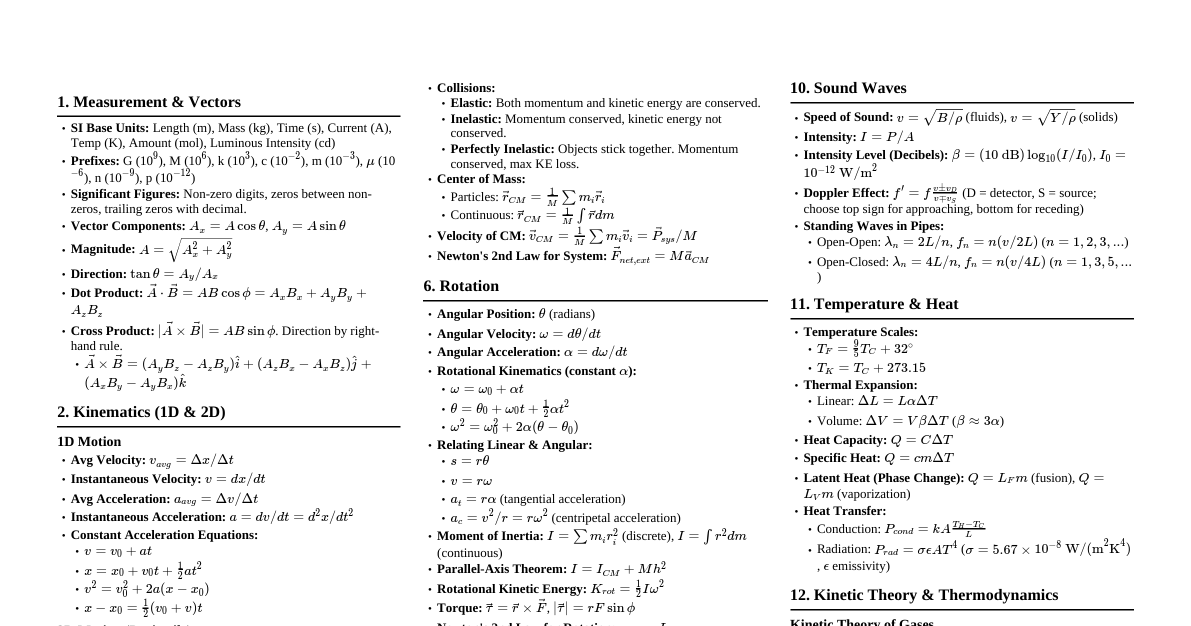
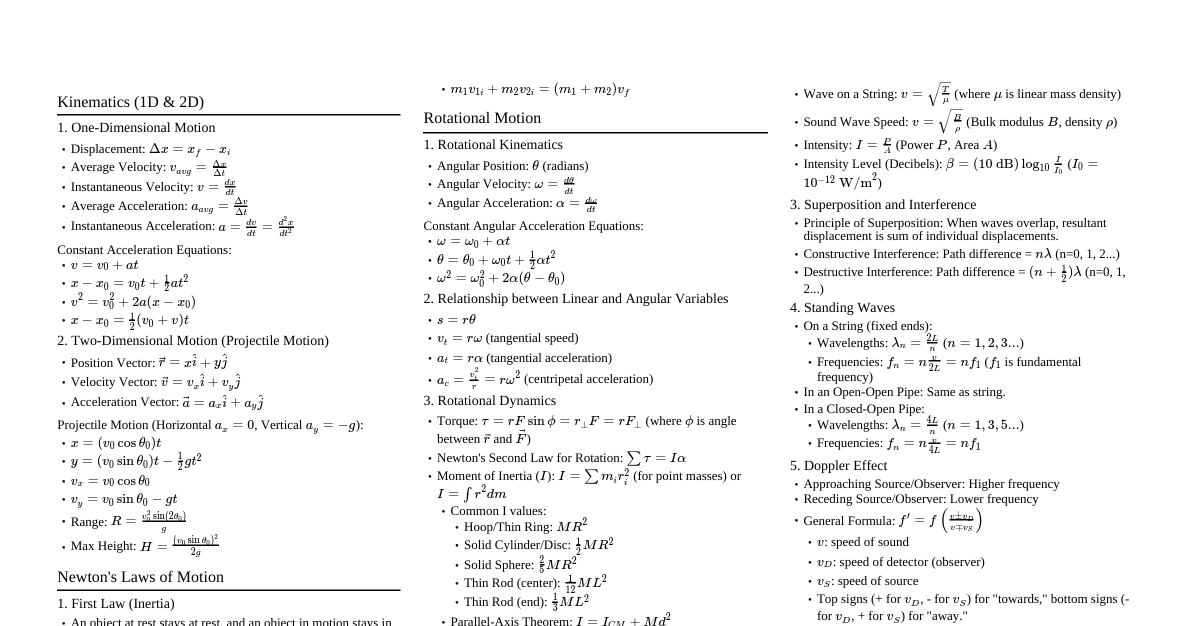
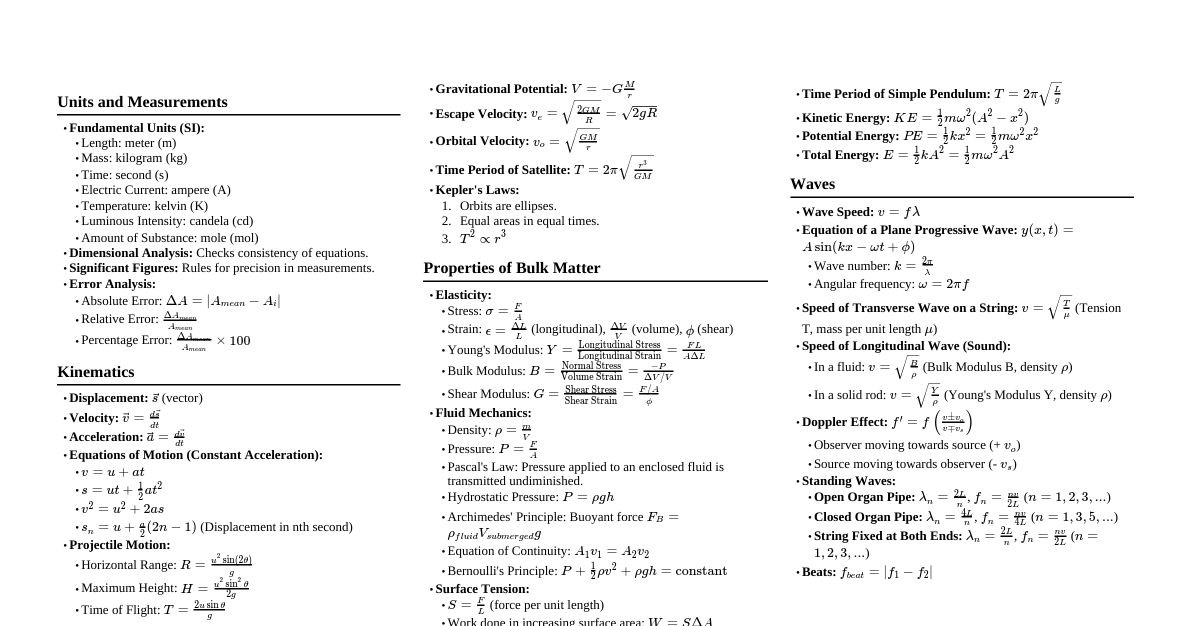
### Physical Quantities & Units - **Base Quantities (SI):** - Mass (kg) - Length (m) - Time (s) - Current (A) - Temperature (K) - Amount of Substance (mol) - Luminous Intensity (cd) - **Derived Quantities:** Combinations of base quantities (e.g., Force = kg m s$^{-2}$) - **Prefixes:** - Giga (G): $10^9$ - Mega (M): $10^6$ - Kilo (k): $10^3$ - Centi (c): $10^{-2}$ - Milli (m): $10^{-3}$ - Micro ($\mu$): $10^{-6}$ - Nano (n): $10^{-9}$ - **Scalars:** Magnitude only (e.g., mass, time, energy) - **Vectors:** Magnitude and direction (e.g., displacement, velocity, force, momentum) - **Vector Addition:** Head-to-tail method or component method. - **Resolution of Vectors:** Resolving a vector into perpendicular components ($F_x = F \cos\theta$, $F_y = F \sin\theta$). ### Kinematics - **Displacement (s):** Change in position (vector) - **Distance:** Total path length (scalar) - **Speed:** $\frac{\text{Distance}}{\text{Time}}$ (scalar) - **Velocity (v):** $\frac{\text{Displacement}}{\text{Time}}$ (vector) - **Acceleration (a):** $\frac{\text{Change in Velocity}}{\text{Time}}$ (vector) - **Equations of Motion (SUVAT):** For constant acceleration - $v = u + at$ - $s = ut + \frac{1}{2}at^2$ - $v^2 = u^2 + 2as$ - $s = \frac{(u+v)}{2}t$ - Where $u$ = initial velocity, $v$ = final velocity, $a$ = acceleration, $t$ = time, $s$ = displacement. - **Graphical Analysis:** - Displacement-time graph: Gradient = velocity - Velocity-time graph: Gradient = acceleration, Area under graph = displacement ### Dynamics - **Newton's Laws of Motion:** 1. **Inertia:** An object remains in its state of rest or uniform motion unless acted upon by a net force. 2. **F = ma:** Net force is directly proportional to the rate of change of momentum, and acts in the same direction. For constant mass, $F = ma$. 3. **Action-Reaction:** If object A exerts a force on object B, then object B exerts an equal and opposite force on object A. - **Momentum (p):** $p = mv$ (vector). - **Impulse (J):** $J = F\Delta t = \Delta p = mv - mu$ (vector). - **Conservation of Momentum:** In a closed system, the total momentum before collision/explosion equals the total momentum after. - **Elastic Collision:** Kinetic energy is conserved. - **Inelastic Collision:** Kinetic energy is NOT conserved. ### Forces, Density & Pressure - **Weight (W):** $W = mg$ (force due to gravity) - **Friction:** Force opposing motion. - **Drag:** Resistance force in fluids (air resistance, water resistance). - **Moments (Torque):** Turning effect of a force. Moment = Force $\times$ Perpendicular distance from pivot. - **Principle of Moments:** For equilibrium, sum of clockwise moments = sum of anticlockwise moments. - **Centre of Gravity:** Point where the entire weight of an object appears to act. - **Density ($\rho$):** $\rho = \frac{\text{Mass}}{\text{Volume}}$ - **Pressure (P):** $P = \frac{\text{Force}}{\text{Area}}$ (for solids) - **Pressure in Fluids:** $P = \rho gh$ (where $h$ is depth) ### Work, Energy & Power - **Work Done (W):** $W = Fd \cos\theta$ (scalar). Energy transferred. - **Kinetic Energy (K.E.):** $K.E. = \frac{1}{2}mv^2$ - **Gravitational Potential Energy (G.P.E.):** $G.P.E. = mgh$ - **Elastic Potential Energy (E.P.E.):** $E.P.E. = \frac{1}{2}kx^2$ (for a spring with constant $k$ and extension $x$) - **Principle of Conservation of Energy:** Energy cannot be created or destroyed, only transformed from one form to another. - **Power (P):** Rate of doing work or transferring energy. $P = \frac{\text{Work Done}}{\text{Time}} = Fv$ - **Efficiency:** $\frac{\text{Useful Output Energy}}{\text{Total Input Energy}} \times 100\%$ OR $\frac{\text{Useful Output Power}}{\text{Total Input Power}} \times 100\%$ ### Deformation of Solids - **Hooke's Law:** $F = kx$ (Force is proportional to extension, $x$ is extension, $k$ is spring constant). Valid up to the limit of proportionality. - **Stress ($\sigma$):** $\sigma = \frac{\text{Force}}{\text{Cross-sectional Area}}$ (Pa) - **Strain ($\epsilon$):** $\epsilon = \frac{\text{Extension}}{\text{Original Length}}$ (dimensionless) - **Young Modulus (E):** $E = \frac{\text{Stress}}{\text{Strain}} = \frac{FL}{Ax}$ (Pa). Measure of stiffness. - **Elastic Deformation:** Material returns to original shape after force is removed. - **Plastic Deformation:** Material does not return to original shape after force is removed. - **Ultimate Tensile Strength:** Maximum stress a material can withstand before breaking. ### Waves - **Transverse Waves:** Oscillations perpendicular to wave direction (e.g., light, EM waves). - **Longitudinal Waves:** Oscillations parallel to wave direction (e.g., sound). - **Wave Equation:** $v = f\lambda$ (speed = frequency $\times$ wavelength) - **Frequency (f):** Number of oscillations per second (Hz). $f = \frac{1}{T}$ (where T is period). - **Period (T):** Time for one complete oscillation. - **Amplitude:** Maximum displacement from equilibrium. - **Intensity:** $I \propto A^2$. Power per unit area. - **Electromagnetic Spectrum (decreasing wavelength, increasing frequency):** - Radio, Microwave, Infrared, Visible Light, Ultraviolet, X-ray, Gamma Ray. All travel at speed of light in vacuum ($c = 3 \times 10^8 \text{ m/s}$). - **Superposition Principle:** When two or more waves meet, the resultant displacement is the vector sum of individual displacements. - **Interference:** - **Constructive:** Crest meets crest, trough meets trough (larger amplitude). Path difference = $n\lambda$. - **Destructive:** Crest meets trough (smaller/zero amplitude). Path difference = $(n + \frac{1}{2})\lambda$. - **Diffraction:** Spreading of waves as they pass through an aperture or around an obstacle. Significant when slit width $\approx \lambda$. - **Stationary (Standing) Waves:** Formed by superposition of two identical progressive waves travelling in opposite directions. - **Nodes:** Points of zero displacement. - **Antinodes:** Points of maximum displacement. ### Light - **Refraction:** Bending of light as it passes from one medium to another. - **Snell's Law:** $n_1 \sin\theta_1 = n_2 \sin\theta_2$ - **Refractive Index (n):** $n = \frac{\text{Speed of light in vacuum}}{\text{Speed of light in medium}}$ - **Critical Angle ($c$):** $\sin c = \frac{n_2}{n_1}$ (where $n_1 > n_2$). Angle of incidence for which angle of refraction is 90$^\circ$. - **Total Internal Reflection (TIR):** Occurs when angle of incidence > critical angle, and light travels from denser to less dense medium. - **Diffraction Grating:** $d \sin\theta = n\lambda$ (where $d$ is grating spacing, $n$ is order number). ### Sound - **Nature:** Longitudinal wave. - **Speed:** Faster in solids > liquids > gases. - **Pitch:** Determined by frequency. - **Loudness:** Determined by amplitude. - **Echoes:** Reflection of sound waves. ### Electric Current - **Electric Current (I):** Rate of flow of charge. $I = \frac{\Delta Q}{\Delta t}$ (Amperes, A). - **Charge (Q):** Quantized, $Q = ne$ (where $n$ is integer, $e$ is elementary charge $1.6 \times 10^{-19}$ C). - **Potential Difference (V):** Work done per unit charge. $V = \frac{\Delta W}{\Delta Q}$ (Volts, V). - **Resistance (R):** Opposition to current flow. $R = \frac{V}{I}$ (Ohms, $\Omega$). - **Ohm's Law:** $V = IR$ (for ohmic conductors, R is constant). - **Resistivity ($\rho$):** $\rho = \frac{RA}{L}$ (Ohm-meter, $\Omega$ m). - **Power (P):** $P = VI = I^2R = \frac{V^2}{R}$ (Watts, W). - **Energy (E):** $E = Pt = VIt = I^2Rt = \frac{V^2}{R}t$ (Joules, J). ### DC Circuits - **Series Circuit:** - Current is same everywhere: $I_T = I_1 = I_2 = ...$ - Total voltage = sum of individual voltages: $V_T = V_1 + V_2 + ...$ - Total resistance = sum of individual resistances: $R_T = R_1 + R_2 + ...$ - **Parallel Circuit:** - Total current = sum of individual currents: $I_T = I_1 + I_2 + ...$ - Voltage is same across each branch: $V_T = V_1 = V_2 = ...$ - Reciprocal of total resistance = sum of reciprocals of individual resistances: $\frac{1}{R_T} = \frac{1}{R_1} + \frac{1}{R_2} + ...$ - **Kirchhoff's Laws:** 1. **Current Law (KCL):** Sum of currents entering a junction = sum of currents leaving the junction (conservation of charge). 2. **Voltage Law (KVL):** Sum of e.m.f.s in a closed loop = sum of potential drops (conservation of energy). - **Electromotive Force (e.m.f., $\epsilon$):** Total energy supplied per unit charge by the source. $\epsilon = I(R+r)$ where $r$ is internal resistance. - **Potential Divider:** Used to divide a voltage into smaller parts. $V_{out} = V_{in} \frac{R_2}{R_1+R_2}$. ### Particle Physics - **Atomic Structure:** Nucleus (protons, neutrons) and electrons. - **Proton Number (Z):** Number of protons. Determines element. - **Nucleon Number (A):** Total number of protons and neutrons. - **Isotopes:** Atoms of the same element (same Z) but different number of neutrons (different A). - **Fundamental Forces:** - **Strong Nuclear Force:** Holds nucleons together in the nucleus (short range). - **Weak Nuclear Force:** Responsible for beta decay. - **Electromagnetic Force:** Between charged particles. - **Gravitational Force:** Between masses. - **Leptons:** Fundamental particles (e.g., electron, neutrino). Not subject to strong force. - **Hadrons:** Particles subject to strong force. Made of quarks. - **Baryons:** 3 quarks (e.g., proton, neutron). - **Mesons:** Quark-antiquark pair (e.g., pion). - **Quarks:** Up (u), Down (d), Strange (s), Charm (c), Bottom (b), Top (t). - Proton: uud - Neutron: udd - **Antiparticles:** Same mass, opposite charge (e.g., positron for electron).