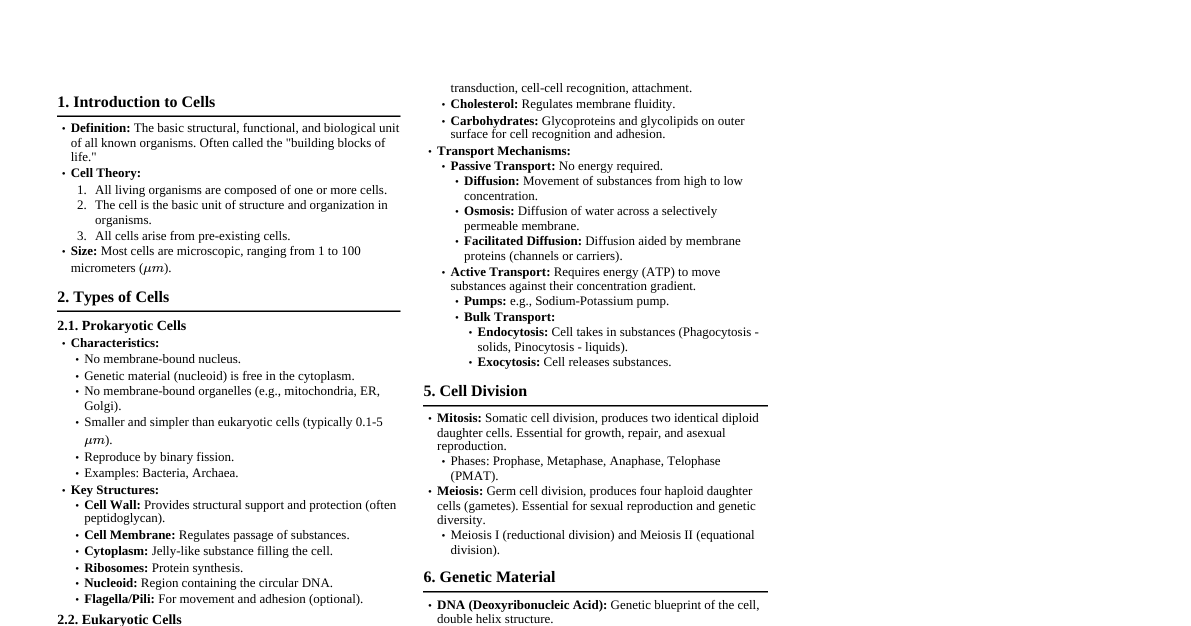
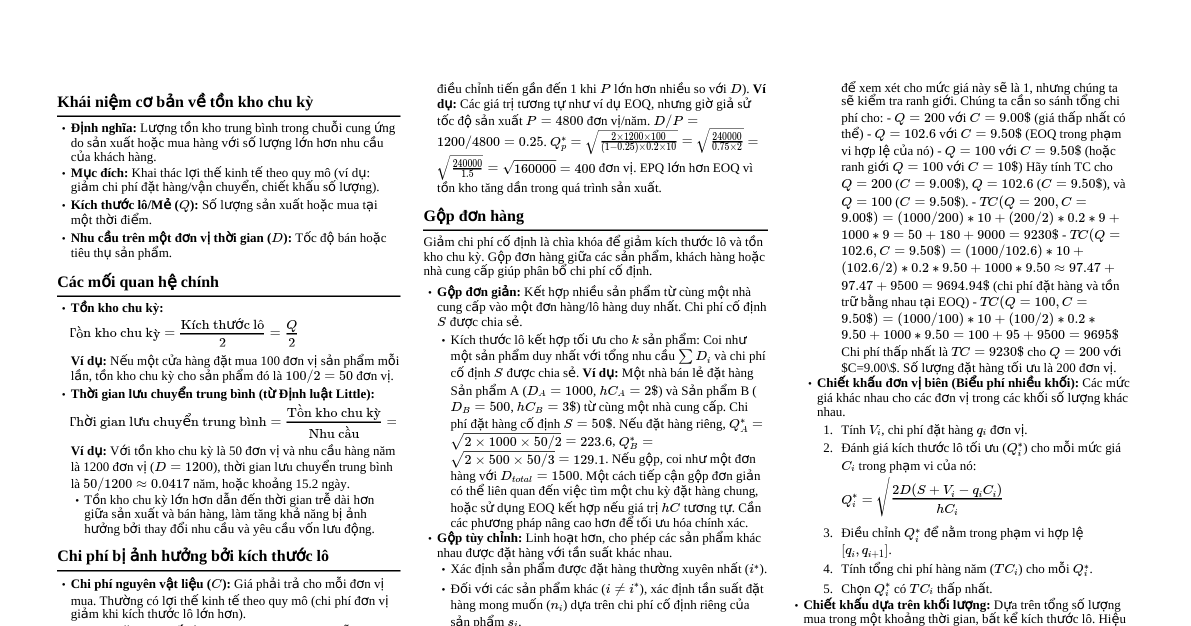
Cell Division & Cycle (NEET)
Shared 5/15/2026•18 views
### Digestive System - **Alimentary Canal:** Mouth $\rightarrow$ Pharynx $\rightarrow$ Oesophagus $\rightarrow$ Stomach $\rightarrow$ Small Intestine $\rightarrow$ Large Intestine $\rightarrow$ Anus. - **Accessory Glands:** Salivary glands, Liver, Pancreas. - **Digestion:** - **Mouth:** Salivary amylase (ptyalin) acts on starch. - **Stomach:** Pepsin (protein), Rennin (milk protein in infants), HCl. - **Small Intestine:** - **Pancreatic Juice:** Trypsin, Chymotrypsin (proteins), Amylase (carbohydrates), Lipase (fats), Nucleases. - **Bile (from Liver):** Emulsifies fats. - **Intestinal Juice (Succus Entericus):** Disaccharidases, Dipeptidases, Lipase, Nucleosidases. - **Absorption:** Primarily in small intestine (villi and microvilli increase surface area). - Glucose, amino acids, fatty acids, glycerol, vitamins, minerals, water. - **Disorders:** Jaundice, Vomiting, Diarrhoea, Constipation, Indigestion. ### Breathing and Exchange of Gases - **Respiratory Organs:** Nostrils $\rightarrow$ Pharynx $\rightarrow$ Larynx $\rightarrow$ Trachea $\rightarrow$ Bronchi $\rightarrow$ Bronchioles $\rightarrow$ Alveoli. - **Mechanism of Breathing:** - **Inspiration:** Diaphragm contracts, external intercostals contract, increase thoracic volume, decrease pressure, air enters. - **Expiration:** Diaphragm relaxes, internal intercostals contract, decrease thoracic volume, increase pressure, air exits. - **Exchange of Gases:** Occurs at alveoli and tissues. - **Alveoli:** High PO2, low PCO2 $\rightarrow$ O2 diffuses into blood, CO2 into alveoli. - **Tissues:** Low PO2, high PCO2 $\rightarrow$ O2 diffuses into tissues, CO2 into blood. - **Transport of Gases:** - **Oxygen:** Primarily by haemoglobin (oxyhaemoglobin). - **Carbon Dioxide:** Bicarbonate (70%), Carbamino-haemoglobin (20-25%), dissolved in plasma (7%). - **Regulation:** Medulla oblongata (respiratory rhythm centre), Pons (pneumotaxic centre). - **Disorders:** Asthma, Emphysema, Occupational respiratory disorders. ### Body Fluids and Circulation - **Blood:** Plasma (55%) + Formed Elements (45%). - **Plasma:** Water, proteins (albumin, globulin, fibrinogen), glucose, amino acids, salts. - **Formed Elements:** - **RBCs (Erythrocytes):** Biconcave, anucleated, contain haemoglobin. - **WBCs (Leukocytes):** Granulocytes (Neutrophils, Eosinophils, Basophils), Agranulocytes (Lymphocytes, Monocytes). - **Platelets (Thrombocytes):** Blood clotting. - **Blood Groups:** A, B, AB, O (AB universal recipient, O universal donor). Rh factor. - **Coagulation of Blood:** Cascade involving platelets, clotting factors, fibrinogen $\rightarrow$ fibrin. - **Lymph:** Tissue fluid, similar to plasma but no large proteins. Involved in immunity and fat absorption. - **Heart:** Four-chambered (2 atria, 2 ventricles). - **Double Circulation:** Pulmonary and Systemic. - **Cardiac Cycle:** Atrial systole $\rightarrow$ Ventricular systole $\rightarrow$ Joint diastole. - **ECG:** P wave (atrial depolarization), QRS complex (ventricular depolarization), T wave (ventricular repolarization). - **Disorders:** Hypertension, Coronary Artery Disease (CAD), Angina Pectoris, Heart Failure. ### Excretory Products and Their Elimination - **Excretory Organs:** Kidneys, Ureters, Bladder, Urethra. - **Nephron:** Structural and functional unit of kidney. - **Components:** Glomerulus, Bowman's capsule, PCT, Henle's loop, DCT, Collecting duct. - **Urine Formation:** 1. **Glomerular Filtration:** Filtration of blood in glomerulus to form ultrafiltrate. 2. **Reabsorption:** Selective reabsorption of useful substances (glucose, amino acids, Na+, water) in PCT, Henle's loop, DCT. 3. **Tubular Secretion:** Secretion of waste products (K+, H+, creatinine) into filtrate. - **Regulation:** - **ADH (Vasopressin):** Increases water reabsorption in DCT & collecting duct. - **RAAS (Renin-Angiotensin-Aldosterone System):** Increases Na+ and water reabsorption, vasoconstriction, increases BP. - **ANF (Atrial Natriuretic Factor):** Decreases Na+ and water reabsorption, vasodilation, decreases BP. - **Disorders:** Renal calculi (kidney stones), Glomerulonephritis, Renal failure. ### Locomotion and Movement - **Types of Movement:** Amoeboid, Ciliary, Muscular. - **Muscles:** - **Skeletal (Striated):** Voluntary, attached to bones. - **Smooth (Non-striated):** Involuntary, visceral organs. - **Cardiac:** Involuntary, heart. - **Muscle Contraction (Sliding Filament Theory):** - Actin and Myosin filaments slide past each other. - **Sarcomere:** Functional unit of muscle contraction. - Role of Ca2+ and ATP. - **Skeletal System:** 206 bones. - **Axial Skeleton:** Skull, Vertebral column, Ribs, Sternum. - **Appendicular Skeleton:** Pectoral girdle, Pelvic girdle, Limb bones. - **Joints:** Fibrous (immovable), Cartilaginous (partially movable), Synovial (freely movable). - **Disorders:** Myasthenia Gravis, Muscular Dystrophy, Arthritis, Osteoporosis, Gout. ### Neural Control and Coordination - **Nervous System:** - **CNS (Central Nervous System):** Brain, Spinal cord. - **PNS (Peripheral Nervous System):** Somatic (voluntary), Autonomic (involuntary - Sympathetic & Parasympathetic). - **Neuron:** Structural and functional unit. Dendrites $\rightarrow$ Cell body $\rightarrow$ Axon $\rightarrow$ Synaptic knob. - **Nerve Impulse:** Generation and conduction (action potential). - **Synapse:** Junction between two neurons. - **Brain:** - **Forebrain:** Cerebrum (thought, memory), Thalamus (relay station), Hypothalamus (homeostasis, hunger, thirst). - **Midbrain:** Reflexes involving eyes and ears. - **Hindbrain:** Pons (respiration), Cerebellum (balance, coordination), Medulla oblongata (vital functions - heart rate, breathing). - **Reflex Arc:** Stimulus $\rightarrow$ Receptor $\rightarrow$ Afferent neuron $\rightarrow$ CNS (interneuron) $\rightarrow$ Efferent neuron $\rightarrow$ Effector $\rightarrow$ Response. - **Sense Organs:** - **Eye:** Retina (rods for dim light, cones for color vision). - **Ear:** Cochlea (hearing), Vestibular apparatus (balance). ### Chemical Coordination and Integration - **Endocrine Glands:** Ductless glands, secrete hormones directly into blood. - **Hormones:** Chemical messengers. - **Major Endocrine Glands:** - **Hypothalamus:** Releasing and Inhibiting hormones. - **Pituitary Gland:** "Master Gland" - GH, TSH, ACTH, FSH, LH, Prolactin, ADH, Oxytocin. - **Pineal Gland:** Melatonin (sleep-wake cycle). - **Thyroid Gland:** Thyroxine (metabolism). - **Parathyroid Gland:** PTH (calcium homeostasis). - **Thymus:** Thymosins (immunity). - **Adrenal Gland:** Adrenaline, Noradrenaline (fight or flight), Corticosteroids. - **Pancreas:** Insulin (decreases blood glucose), Glucagon (increases blood glucose). - **Gonads:** Testes (Testosterone), Ovaries (Estrogen, Progesterone). - **Mechanism of Hormone Action:** Receptor binding (intracellular or membrane-bound). - **Disorders:** Diabetes, Goitre, Dwarfism, Gigantism, Acromegaly. ### Morphology of Flowering Plants - **Root:** - **Types:** Tap root, Fibrous root. - **Regions:** Root cap, Region of meristematic activity, Region of elongation, Region of maturation. - **Modifications:** Storage (carrot, turnip), Prop roots (banyan), Stilt roots (maize), Pneumatophores (mangroves). - **Stem:** - **Characteristics:** Bears nodes and internodes, buds. - **Modifications:** Storage (potato, ginger), Tendrils (cucumber), Thorns (citrus), Phylloclade (Opuntia). - **Leaf:** - **Parts:** Leaf base, Petiole, Lamina. - **Venation:** Reticulate, Parallel. - **Phyllotaxy:** Alternate, Opposite, Whorled. - **Modifications:** Tendrils (pea), Spines (cactus), Storage (onion), Pitcher (Nepenthes). - **Inflorescence:** Arrangement of flowers on floral axis. - **Racemose:** Indefinite growth, acropetal succession. - **Cymose:** Definite growth, basipetal succession. - **Flower:** Reproductive unit. - **Parts:** Calyx (sepals), Corolla (petals), Androecium (stamens), Gynoecium (pistil/carpels). - **Placentation:** Marginal, Axile, Parietal, Free central, Basal. - **Fruit:** Mature or ripened ovary. - **True fruit:** Develops from ovary. - **False fruit:** Develops from other floral parts (e.g., apple from thalamus). - **Seed:** Fertilized ovule. - **Parts:** Seed coat, Embryo. - **Types:** Albuminous (endosperm present), Non-albuminous (endosperm absent). ### Anatomy of Flowering Plants - **Plant Tissues:** - **Meristematic Tissues:** Apical, Intercalary, Lateral (responsible for growth). - **Permanent Tissues:** - **Simple:** Parenchyma (storage, photosynthesis), Collenchyma (mechanical support - young stems), Sclerenchyma (mechanical support - mature parts). - **Complex:** Xylem (water and mineral transport), Phloem (food transport). - **Tissue Systems:** - **Epidermal Tissue System:** Epidermis, Stomata, Epidermal appendages (trichomes, root hairs). - **Ground Tissue System:** Cortex, Pericycle, Pith. - **Vascular Tissue System:** Xylem, Phloem (vascular bundles). - **Anatomy of Dicot vs. Monocot:** - **Root:** - **Dicot:** Tap root, 2-6 xylem bundles, pith small/absent. - **Monocot:** Fibrous root, >6 xylem bundles, large central pith. - **Stem:** - **Dicot:** Vascular bundles arranged in a ring, open (cambium present). - **Monocot:** Scattered vascular bundles, closed (cambium absent). - **Leaf:** - **Dicot (Dorsiventral):** Stomata mainly on lower epidermis, mesophyll differentiated into palisade and spongy. - **Monocot (Isobilateral):** Stomata on both surfaces, mesophyll undifferentiated. - **Secondary Growth:** Increase in girth due to activity of vascular cambium and cork cambium. - **Vascular Cambium:** Forms secondary xylem (wood) and secondary phloem. - **Cork Cambium (Phellogen):** Forms cork (phellem) and secondary cortex (phelloderm). - **Bark:** All tissues exterior to vascular cambium.