Quantum Mechanics
Cheatsheet Content
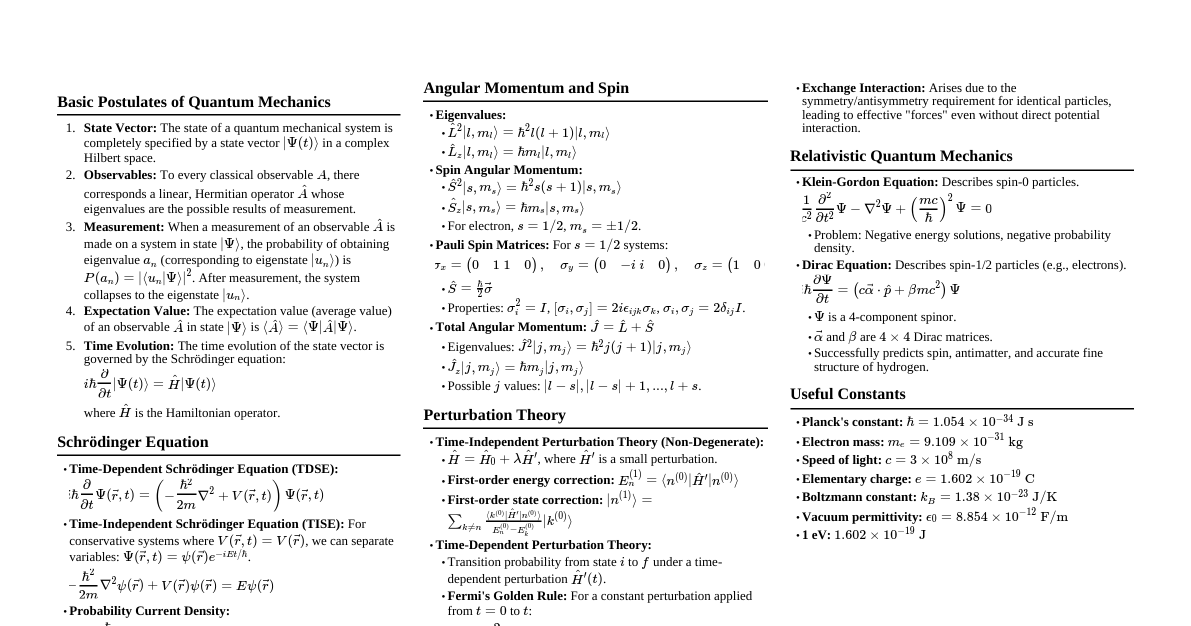
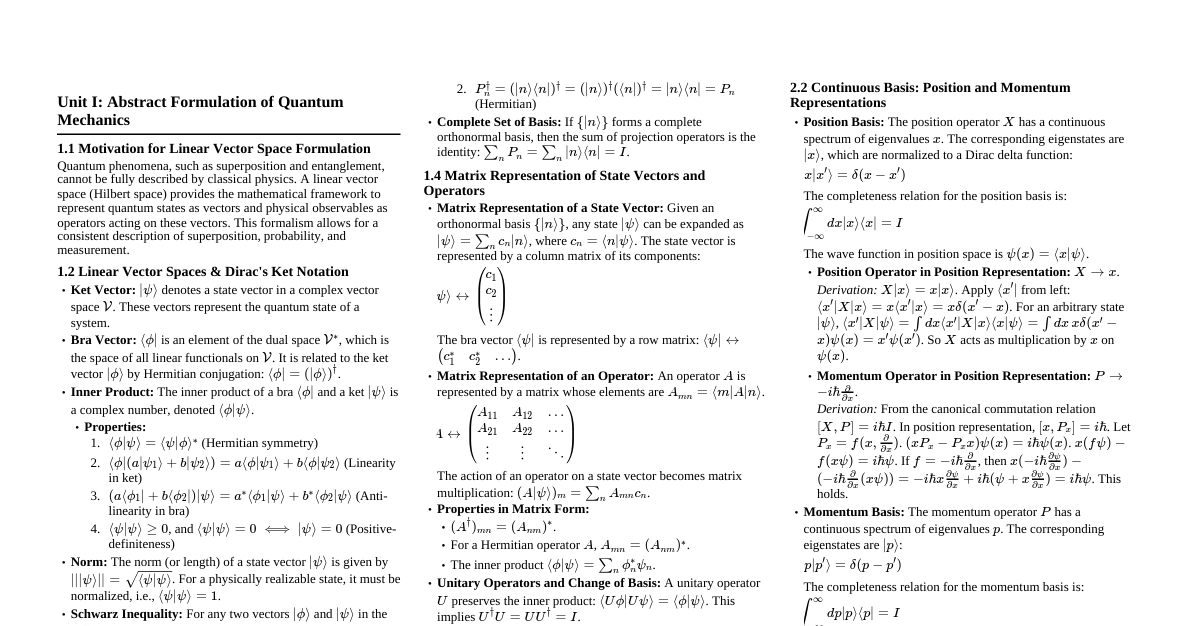
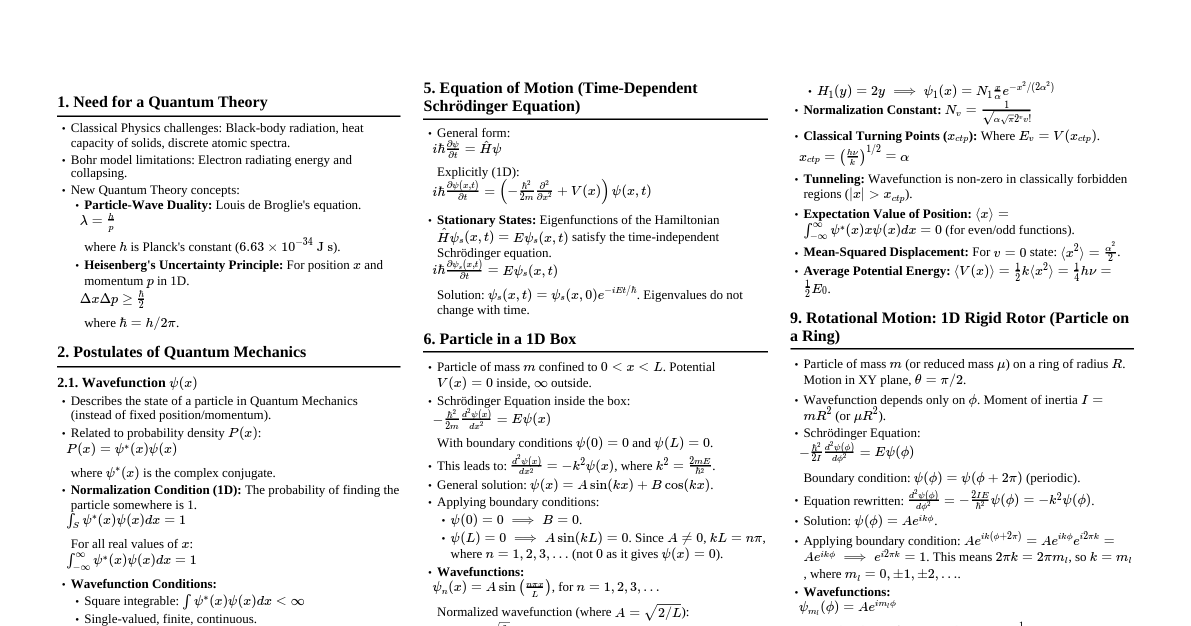
### Postulates of Quantum Mechanics 1. **State Space:** The state of a quantum mechanical system is completely specified by a complex, square-integrable wave function $\Psi(\vec{r}, t)$, also called the state vector, which lives in a Hilbert space. 2. **Observables:** To every measurable physical quantity (observable) there corresponds a linear, Hermitian operator $\hat{A}$. 3. **Measurement:** The only possible values that can result from a measurement of an observable $A$ are the eigenvalues $a_n$ of the operator $\hat{A}$. 4. **Probability:** If a system is in a state $\Psi$, the probability of obtaining $a_n$ in a measurement of $A$ is given by $P(a_n) = |\langle \phi_n | \Psi \rangle|^2$, where $\phi_n$ are the eigenfunctions corresponding to $a_n$. If the spectrum is continuous, $P(a \in [a, a+da]) = |\langle \phi_a | \Psi \rangle|^2 da$. 5. **Wave function collapse:** Immediately after the measurement yielding $a_n$, the state of the system collapses to the corresponding eigenstate $\phi_n$. 6. **Time Evolution:** The time evolution of the state vector is governed by the time-dependent Schrödinger equation: $i\hbar \frac{\partial}{\partial t} \Psi(\vec{r}, t) = \hat{H} \Psi(\vec{r}, t)$, where $\hat{H}$ is the Hamiltonian operator. ### Operators and Observables - **Position Operator:** $\hat{X} = x$ - **Momentum Operator:** $\hat{P}_x = -i\hbar \frac{\partial}{\partial x}$ - **Kinetic Energy Operator:** $\hat{T} = -\frac{\hbar^2}{2m} \nabla^2$ - **Potential Energy Operator:** $\hat{V} = V(\vec{r}, t)$ - **Hamiltonian Operator:** $\hat{H} = \hat{T} + \hat{V} = -\frac{\hbar^2}{2m} \nabla^2 + V(\vec{r}, t)$ - **Angular Momentum Operator:** $\hat{L} = \vec{r} \times \hat{P} = -i\hbar (\vec{r} \times \nabla)$ - **Expectation Value:** $\langle \hat{A} \rangle = \int \Psi^* \hat{A} \Psi d\tau$ (bra-ket notation: $\langle \Psi | \hat{A} | \Psi \rangle$) - **Uncertainty:** $\Delta A = \sqrt{\langle \hat{A}^2 \rangle - \langle \hat{A} \rangle^2}$ ### Schrödinger Equations #### Time-Dependent Schrödinger Eq. (TDSE) $$i\hbar \frac{\partial}{\partial t} \Psi(\vec{r}, t) = \hat{H} \Psi(\vec{r}, t)$$ #### Time-Independent Schrödinger Eq. (TISE) For stationary states where $V(\vec{r})$ is time-independent, $\Psi(\vec{r}, t) = \psi(\vec{r}) e^{-iEt/\hbar}$: $$\hat{H} \psi(\vec{r}) = E \psi(\vec{r})$$ $$-\frac{\hbar^2}{2m} \nabla^2 \psi(\vec{r}) + V(\vec{r}) \psi(\vec{r}) = E \psi(\vec{r})$$ ### Commutation Relations - **Position-Momentum:** $[\hat{X}, \hat{P}_x] = i\hbar$ - **Generalized:** $[\hat{A}, \hat{B}] = \hat{A}\hat{B} - \hat{B}\hat{A}$ - **Uncertainty Principle:** $\Delta A \Delta B \ge \frac{1}{2} |\langle [\hat{A}, \hat{B}] \rangle|$ - For position and momentum: $\Delta x \Delta p_x \ge \frac{\hbar}{2}$ - For energy and time: $\Delta E \Delta t \ge \frac{\hbar}{2}$ (not an operator relation) ### Quantum States & Representations - **Wave Function $\Psi(\vec{r}, t)$:** Describes the state of a particle in position space. $|\Psi(\vec{r}, t)|^2$ is the probability density. - **Normalization:** $\int |\Psi(\vec{r}, t)|^2 d\tau = 1$ - **Bra-Ket Notation:** - Ket vector: $|\Psi\rangle$ (state vector in Hilbert space) - Bra vector: $\langle \Psi|$ (dual vector) - Inner product: $\langle \phi | \Psi \rangle = \int \phi^* \Psi d\tau$ - Outer product: $|\Psi \rangle \langle \phi |$ (operator) - **Completeness Relation:** $\sum_n |n\rangle \langle n| = \hat{I}$ (for discrete basis) or $\int |p\rangle \langle p| dp = \hat{I}$ (for continuous basis) - **Momentum Space Wave Function:** $\Phi(\vec{p}, t) = \frac{1}{(2\pi\hbar)^{3/2}} \int e^{-i\vec{p}\cdot\vec{r}/\hbar} \Psi(\vec{r}, t) d\tau$ ### 1D Potential Problems #### Free Particle - $V(x) = 0$ - **Solutions:** $\Psi(x, t) = A e^{i(kx - \omega t)} + B e^{-i(kx + \omega t)}$ - **Dispersion Relation:** $E = \hbar\omega = \frac{\hbar^2 k^2}{2m}$ #### Particle in a Box (Infinite Square Well) - $V(x) = 0$ for $0 V_0$). - Bound state solutions involve solving transcendental equations. #### Harmonic Oscillator - $V(x) = \frac{1}{2} m \omega^2 x^2$ - **Eigenenergies:** $E_n = \left(n + \frac{1}{2}\right) \hbar\omega$ for $n=0, 1, 2, ...$ - **Ground State Wave Function:** $\psi_0(x) = \left(\frac{m\omega}{\pi\hbar}\right)^{1/4} e^{-\frac{m\omega}{2\hbar}x^2}$ - **Annihilation Operator:** $\hat{a} = \sqrt{\frac{m\omega}{2\hbar}}\left(\hat{X} + \frac{i}{m\omega}\hat{P}\right)$ - **Creation Operator:** $\hat{a}^\dagger = \sqrt{\frac{m\omega}{2\hbar}}\left(\hat{X} - \frac{i}{m\omega}\hat{P}\right)$ - **Number Operator:** $\hat{N} = \hat{a}^\dagger \hat{a}$ - **Commutation:** $[\hat{a}, \hat{a}^\dagger] = 1$ ### Angular Momentum - **Operators:** $\hat{L}_x, \hat{L}_y, \hat{L}_z$ - **Commutation Relations:** $[\hat{L}_x, \hat{L}_y] = i\hbar \hat{L}_z$ (and cyclic permutations) - **Total Angular Momentum Squared:** $\hat{L}^2 = \hat{L}_x^2 + \hat{L}_y^2 + \hat{L}_z^2$ - **Eigenvalues:** - $\hat{L}^2 |l, m_l\rangle = \hbar^2 l(l+1) |l, m_l\rangle$, where $l = 0, 1, 2, ...$ - $\hat{L}_z |l, m_l\rangle = \hbar m_l |l, m_l\rangle$, where $m_l = -l, -l+1, ..., l-1, l$ - **Ladder Operators:** - $\hat{L}_+ = \hat{L}_x + i\hat{L}_y$ (raises $m_l$) - $\hat{L}_- = \hat{L}_x - i\hat{L}_y$ (lowers $m_l$) ### Spin - **Intrinsic Angular Momentum:** Not due to spatial motion. - **Spin Quantum Number:** $s$ (e.g., $s=1/2$ for electrons, protons, neutrons). - **Spin Projection Quantum Number:** $m_s = -s, -s+1, ..., s-1, s$. - **Spin Operators:** $\hat{S}_x, \hat{S}_y, \hat{S}_z, \hat{S}^2$. - **Commutation Relations (same as orbital angular momentum):** $[\hat{S}_x, \hat{S}_y] = i\hbar \hat{S}_z$ - **Eigenvalues:** - $\hat{S}^2 |s, m_s\rangle = \hbar^2 s(s+1) |s, m_s\rangle$ - $\hat{S}_z |s, m_s\rangle = \hbar m_s |s, m_s\rangle$ - **Pauli Spin Matrices (for spin-1/2 particles):** $$\sigma_x = \begin{pmatrix} 0 & 1 \\ 1 & 0 \end{pmatrix}, \quad \sigma_y = \begin{pmatrix} 0 & -i \\ i & 0 \end{pmatrix}, \quad \sigma_z = \begin{pmatrix} 1 & 0 \\ 0 & -1 \end{pmatrix}$$ $\hat{S}_x = \frac{\hbar}{2}\sigma_x, \hat{S}_y = \frac{\hbar}{2}\sigma_y, \hat{S}_z = \frac{\hbar}{2}\sigma_z$ ### Hydrogen Atom - **Potential:** $V(r) = -\frac{ke^2}{r}$ - **Quantized Energy Levels:** $E_n = -\frac{13.6 \text{ eV}}{n^2}$, where $n=1, 2, 3, ...$ (principal quantum number) - **Degeneracy:** $n^2$ for a given $n$ (ignoring spin) - **Wave Functions:** $\psi_{nlm_l}(r, \theta, \phi) = R_{nl}(r) Y_{l m_l}(\theta, \phi)$ - $R_{nl}(r)$: Radial wave function, depends on $n, l$. - $Y_{l m_l}(\theta, \phi)$: Spherical harmonics, are eigenfunctions of $\hat{L}^2$ and $\hat{L}_z$. - **Quantum Numbers:** - $n$: Principal quantum number ($1, 2, 3, ...$) - $l$: Orbital angular momentum quantum number ($0, 1, ..., n-1$) - $m_l$: Magnetic quantum number ($-l, ..., l$) - $m_s$: Spin magnetic quantum number ($\pm 1/2$) ### Perturbation Theory #### Time-Independent Perturbation Theory - Used for small perturbations to solvable Hamiltonians: $\hat{H} = \hat{H}_0 + \hat{H}'$ - **First-order energy correction:** $E_n^{(1)} = \langle n_0 | \hat{H}' | n_0 \rangle$ - **First-order wave function correction (non-degenerate):** $$|\psi_n^{(1)}\rangle = \sum_{m \ne n} \frac{\langle m_0 | \hat{H}' | n_0 \rangle}{E_n^{(0)} - E_m^{(0)}} |m_0\rangle$$ #### Time-Dependent Perturbation Theory - System subject to a time-dependent perturbation $\hat{H}'(t)$. - **Transition Probability (Fermi's Golden Rule):** $$P_{i \to f} = \frac{2\pi}{\hbar} |\langle \phi_f | \hat{H}' | \phi_i \rangle|^2 \rho(E_f)$$ where $\rho(E_f)$ is the density of final states. ### Identical Particles - **Indistinguishability:** Identical particles cannot be distinguished. - **Symmetry Principle:** - **Bosons:** Integer spin ($s=0, 1, ...$). Wave function must be symmetric under particle exchange: $\Psi(x_1, x_2) = \Psi(x_2, x_1)$. - **Fermions:** Half-integer spin ($s=1/2, 3/2, ...$). Wave function must be antisymmetric under particle exchange: $\Psi(x_1, x_2) = -\Psi(x_2, x_1)$. - **Pauli Exclusion Principle (for fermions):** No two identical fermions can occupy the same quantum state.