Std 9 Maths Formulae
Cheatsheet Content
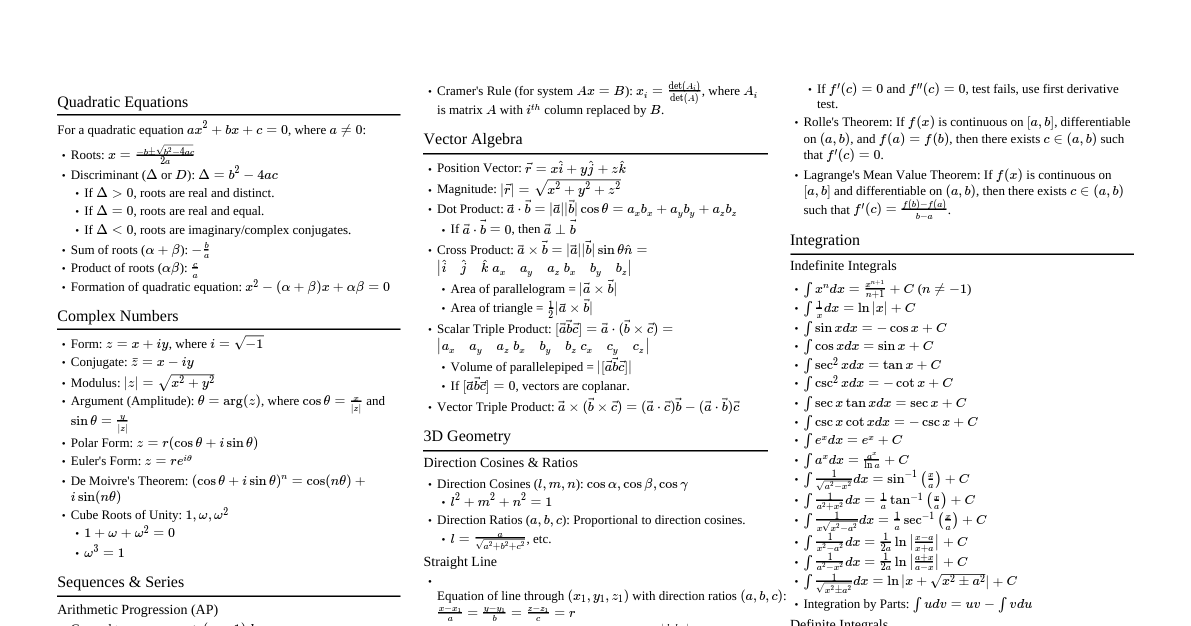
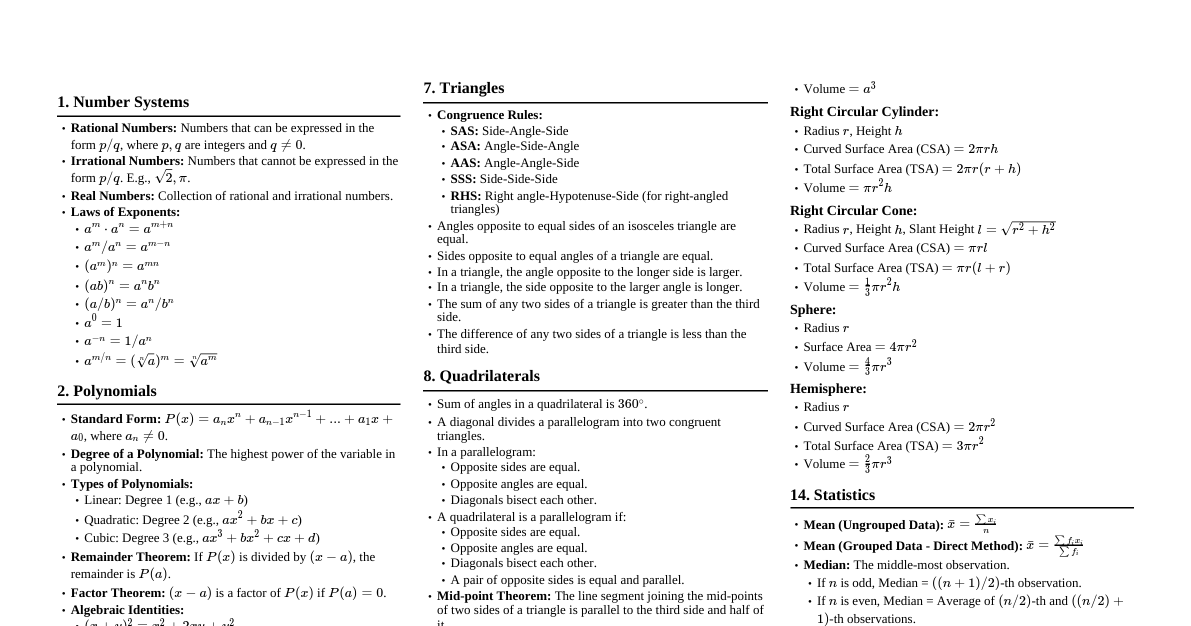
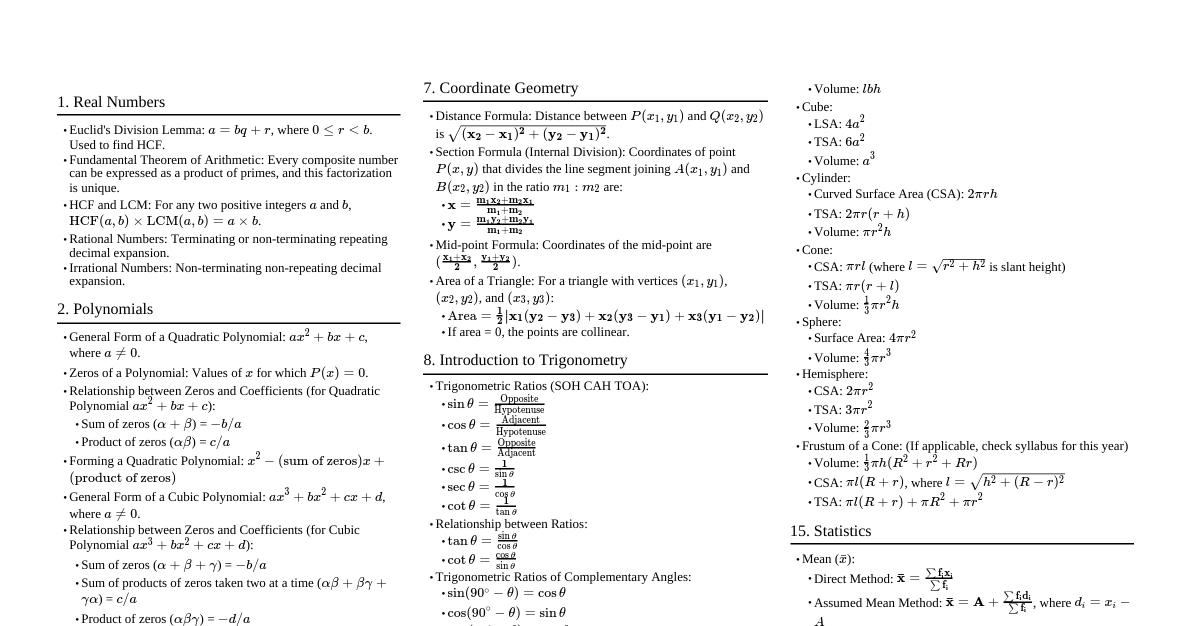
### Real Numbers - **Natural Numbers (N):** {1, 2, 3, ...} - **Whole Numbers (W):** {0, 1, 2, 3, ...} - **Integers (Z):** {..., -2, -1, 0, 1, 2, ...} - **Rational Numbers (Q):** Numbers that can be expressed as $p/q$, where $p, q \in Z$ and $q \ne 0$. - **Irrational Numbers:** Numbers that cannot be expressed in the form $p/q$, e.g., $\sqrt{2}, \pi$. - **Real Numbers (R):** Collection of all rational and irrational numbers. #### Laws of Exponents for Real Numbers - $a^m \cdot a^n = a^{m+n}$ - $(a^m)^n = a^{mn}$ - $a^m / a^n = a^{m-n}$ - $a^0 = 1$ - $a^{-n} = 1/a^n$ - $(ab)^n = a^n b^n$ - $(a/b)^n = a^n / b^n$ ### Polynomials - **Degree of a Polynomial:** The highest power of the variable in the polynomial. - **Linear Polynomial:** Degree 1 (e.g., $ax+b$) - **Quadratic Polynomial:** Degree 2 (e.g., $ax^2+bx+c$) - **Cubic Polynomial:** Degree 3 (e.g., $ax^3+bx^2+cx+d$) #### Identities - $(x+y)^2 = x^2 + 2xy + y^2$ - $(x-y)^2 = x^2 - 2xy + y^2$ - $x^2 - y^2 = (x+y)(x-y)$ - $(x+a)(x+b) = x^2 + (a+b)x + ab$ - $(x+y+z)^2 = x^2 + y^2 + z^2 + 2xy + 2yz + 2zx$ - $(x+y)^3 = x^3 + y^3 + 3xy(x+y) = x^3 + y^3 + 3x^2y + 3xy^2$ - $(x-y)^3 = x^3 - y^3 - 3xy(x-y) = x^3 - y^3 - 3x^2y + 3xy^2$ - $x^3 + y^3 = (x+y)(x^2 - xy + y^2)$ - $x^3 - y^3 = (x-y)(x^2 + xy + y^2)$ - $x^3 + y^3 + z^3 - 3xyz = (x+y+z)(x^2+y^2+z^2-xy-yz-zx)$ - If $x+y+z=0$, then $x^3+y^3+z^3 = 3xyz$ #### Remainder Theorem If $P(x)$ is a polynomial of degree greater than or equal to one and $P(x)$ is divided by the linear polynomial $x-a$, then the remainder is $P(a)$. #### Factor Theorem $x-a$ is a factor of the polynomial $P(x)$ if $P(a)=0$. Conversely, if $x-a$ is a factor of $P(x)$, then $P(a)=0$. ### Coordinate Geometry - **Coordinates of a point:** $(x, y)$ - **Distance Formula (between $(x_1, y_1)$ and $(x_2, y_2)$):** $$D = \sqrt{(x_2-x_1)^2 + (y_2-y_1)^2}$$ - **Midpoint Formula (of a line segment joining $(x_1, y_1)$ and $(x_2, y_2)$):** $$M = \left(\frac{x_1+x_2}{2}, \frac{y_1+y_2}{2}\right)$$ ### Linear Equations in Two Variables - **General form:** $ax+by+c=0$, where $a,b,c$ are real numbers, and $a,b \ne 0$. - A linear equation in two variables has infinitely many solutions. - The graph of every linear equation in two variables is a straight line. ### Triangles - **Area of a Triangle:** - $\text{Area} = \frac{1}{2} \times \text{base} \times \text{height}$ - **Heron's Formula:** For a triangle with sides $a,b,c$ and semi-perimeter $s = (a+b+c)/2$: $$\text{Area} = \sqrt{s(s-a)(s-b)(s-c)}$$ - **Congruence Rules:** - **SSS:** Side-Side-Side - **SAS:** Side-Angle-Side - **ASA:** Angle-Side-Angle - **AAS:** Angle-Angle-Side - **RHS:** Right-Hypotenuse-Side (for right-angled triangles) - **Properties:** - Sum of angles in a triangle is $180^\circ$. - The angle opposite to the longest side is the largest. - The sum of any two sides of a triangle is greater than the third side. - An exterior angle of a triangle is equal to the sum of the two interior opposite angles. ### Quadrilaterals - **Sum of angles:** $360^\circ$. - **Parallelogram:** - Opposite sides are parallel and equal. - Opposite angles are equal. - Diagonals bisect each other. - Area = base $\times$ height - **Rectangle:** A parallelogram with all angles $90^\circ$. Diagonals are equal. - **Rhombus:** A parallelogram with all sides equal. Diagonals bisect each other at $90^\circ$. - **Square:** A rhombus with all angles $90^\circ$. Diagonals are equal and bisect each other at $90^\circ$. - **Trapezium:** One pair of opposite sides is parallel. - Area = $\frac{1}{2} \times (\text{sum of parallel sides}) \times \text{height}$ ### Circles - **Circumference:** $C = 2\pi r = \pi d$ - **Area:** $A = \pi r^2$ - **Properties:** - Equal chords subtend equal angles at the centre. - The perpendicular from the centre to a chord bisects the chord. - Equal chords are equidistant from the centre. - Angles subtended by an arc at the centre is double the angle subtended by it at any point on the remaining part of the circle. - Angles in the same segment of a circle are equal. - The angle in a semi-circle is a right angle ($90^\circ$). - Opposite angles of a cyclic quadrilateral are supplementary (sum to $180^\circ$). ### Surface Areas and Volumes - **Cuboid:** - Lateral Surface Area (LSA) = $2h(l+b)$ - Total Surface Area (TSA) = $2(lb+bh+hl)$ - Volume = $l \times b \times h$ - **Cube:** - LSA = $4a^2$ - TSA = $6a^2$ - Volume = $a^3$ - **Cylinder:** - Curved Surface Area (CSA) = $2\pi rh$ - TSA = $2\pi r(r+h)$ - Volume = $\pi r^2 h$ - **Cone:** - Slant height ($l$) = $\sqrt{r^2+h^2}$ - CSA = $\pi rl$ - TSA = $\pi r(r+l)$ - Volume = $\frac{1}{3}\pi r^2 h$ - **Sphere:** - Surface Area = $4\pi r^2$ - Volume = $\frac{4}{3}\pi r^3$ - **Hemisphere:** - CSA = $2\pi r^2$ - TSA = $3\pi r^2$ - Volume = $\frac{2}{3}\pi r^3$ ### Statistics - **Mean (for ungrouped data):** $\bar{x} = \frac{\sum x_i}{n}$ - **Mean (for grouped data):** $\bar{x} = \frac{\sum f_i x_i}{\sum f_i}$ - **Median:** The middle value of the data when arranged in ascending or descending order. - If $n$ is odd, Median = $((n+1)/2)^{\text{th}}$ observation. - If $n$ is even, Median = average of $(n/2)^{\text{th}}$ and $((n/2)+1)^{\text{th}}$ observations. - **Mode:** The observation that occurs most frequently in the data. ### Probability - **Probability of an Event (E):** $$P(E) = \frac{\text{Number of favourable outcomes}}{\text{Total number of possible outcomes}}$$ - $0 \le P(E) \le 1$ - $P(\text{certain event}) = 1$ - $P(\text{impossible event}) = 0$ - $P(E) + P(\text{not } E) = 1$