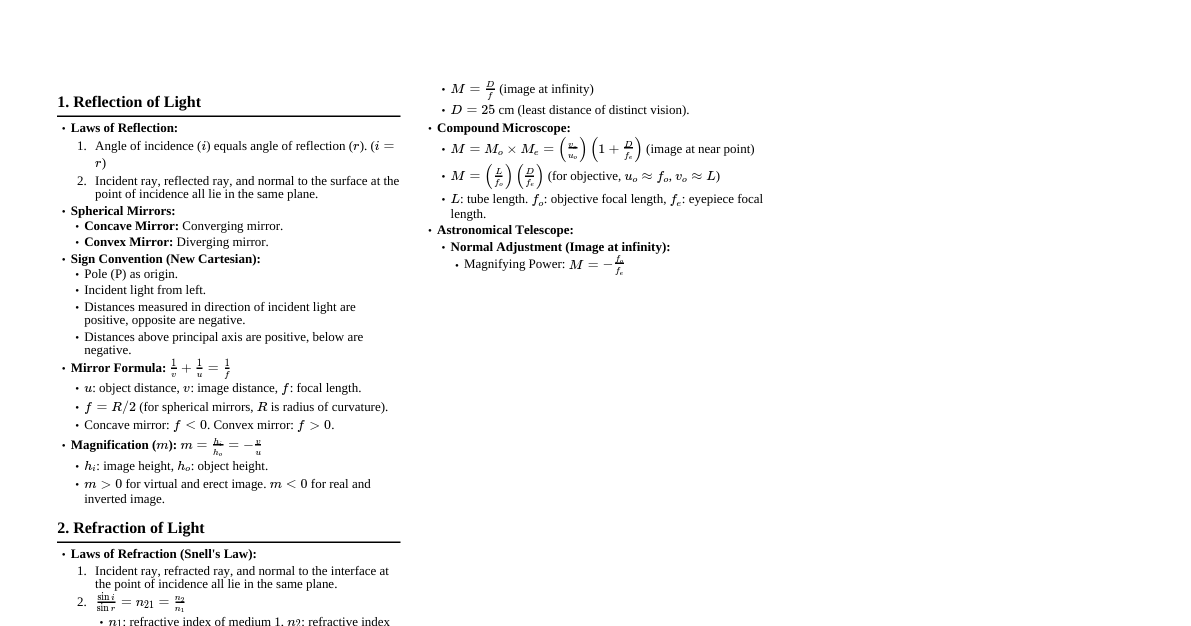
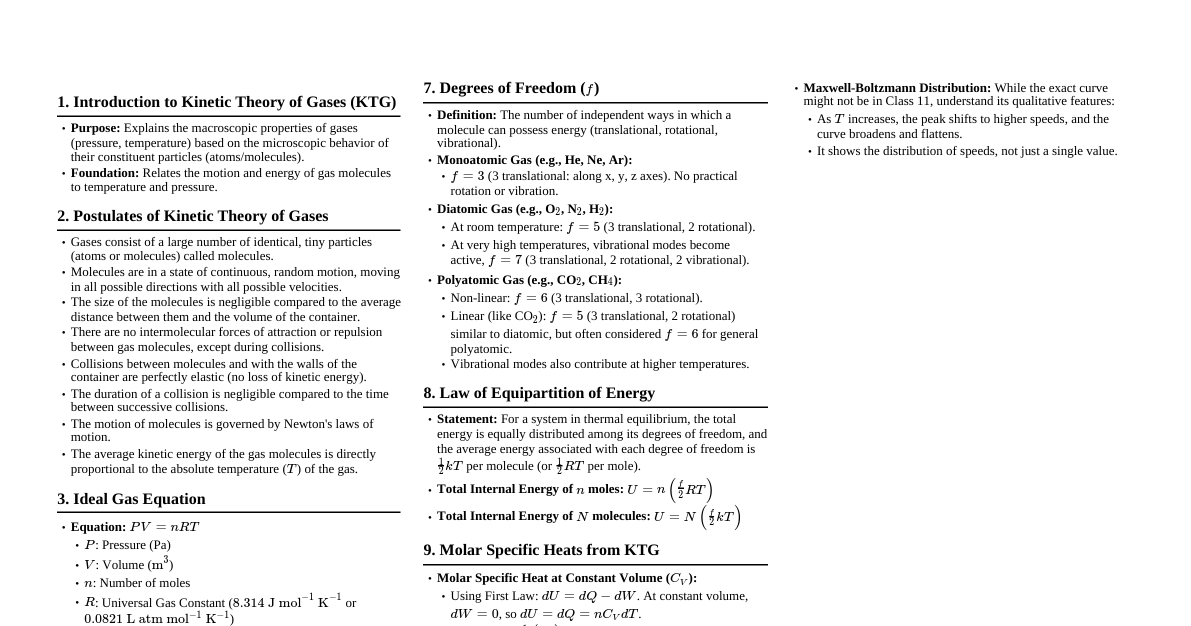
Class 12 STEM Mastery Roadmap
Cheatsheet Content
### Introduction: Your Path to STEM Mastery Welcome to your comprehensive self-study system designed to rebuild and master Mathematics, Physics, and Chemistry from the ground up, leading to full Class 12 proficiency. This roadmap is structured to provide clarity, logical progression, and detailed guidance, ensuring you develop deep conceptual understanding, strong problem-solving skills, and analytical thinking. #### How to Use This System 1. **Follow the Class-Wise Roadmap (Part 1):** Understand the progression of topics for each subject. 2. **Dive into Chapter Breakdowns (Part 2):** Get detailed insights into each chapter's content, skills, and problem types. 3. **Utilize Formula Sheets (Part 3):** Regularly consult and memorize essential formulas. 4. **Master Core Topics (Part 4):** Ensure comprehensive coverage of all fundamental concepts. 5. **Conquer the Periodic Table (Part 5):** Learn systematic approaches to understanding chemical elements. 6. **Develop Problem-Solving Prowess (Part 6):** Follow a structured approach to tackle any problem. 7. **Optimize Memory (Part 7):** Employ scientifically proven techniques for formula retention. 8. **Study Smart (Part 8):** Integrate effective study methods into your routine. 9. **Structure Your Day (Part 9):** Implement a balanced daily study schedule. 10. **Choose the Right Resources (Part 10):** Select recommended books for each stage of your learning. 11. **Plan Your Journey (Part 11):** Set realistic timelines for your mastery. 12. **Avoid Pitfalls (Part 12):** Learn from common mistakes to optimize your learning curve. ### Part 1: Complete Class-Wise Roadmap This section outlines the progression of topics from Class 1 to Class 12 for Mathematics, Physics, and Chemistry. #### CLASS 1 ##### Subject: Mathematics ###### Chapter 1: Numbers - **Topics:** Counting, Number recognition, Number writing, Comparing numbers - **Subtopics:** Counting objects (1-100), Number sequences, Greater than / Less than, Before/After/Between - **Core Concepts:** Understanding quantity, ordinality, and number order. - **Skills to Master:** Recognizing, writing, and comparing numbers up to 100. ###### Chapter 2: Addition and Subtraction - **Topics:** Single-digit addition, Single-digit subtraction, Word problems - **Subtopics:** Adding by counting forward, Subtracting by counting backward, Sums up to 20 - **Core Concepts:** Combining and separating quantities. - **Skills to Master:** Performing basic addition and subtraction operations. ###### Chapter 3: Shapes and Patterns - **Topics:** Basic 2D shapes (circle, square, triangle), Patterns - **Subtopics:** Identifying shapes, Completing simple patterns - **Core Concepts:** Recognizing geometric forms and logical sequences. - **Skills to Master:** Identifying common shapes, extending simple patterns. ##### Subject: Physics (Integrated with General Science) ###### Chapter 1: Our Surroundings - **Topics:** Living and Non-living things, Our body parts, Plants and Animals - **Subtopics:** Identifying basic characteristics of living/non-living, Functions of body parts (simple) - **Core Concepts:** Observing the natural world, basic classification. - **Skills to Master:** Differentiating living from non-living, naming body parts. ###### Chapter 2: Light and Sound - **Topics:** Sources of light (sun, bulb), Sources of sound (bell, voice) - **Subtopics:** Identifying bright/dim, loud/soft sounds - **Core Concepts:** Basic sensory input from the environment. - **Skills to Master:** Recognizing common light and sound sources. ##### Subject: Chemistry (Integrated with General Science) ###### Chapter 1: Materials Around Us - **Topics:** Different types of materials (wood, plastic, cloth), Properties (hard, soft, smooth, rough) - **Subtopics:** Sorting objects by material, describing basic properties - **Core Concepts:** Understanding the physical world through observation. - **Skills to Master:** Classifying objects based on material and simple properties. ###### Chapter 2: Water and Air - **Topics:** Uses of water, Sources of water, Importance of air - **Subtopics:** Identifying uses of water, recognizing clean/dirty air - **Core Concepts:** Essential natural resources. - **Skills to Master:** Understanding the necessity of water and air. #### CLASS 2 ##### Subject: Mathematics ###### Chapter 1: Numbers (up to 1000) - **Topics:** Place value, Number names, Comparing and ordering numbers - **Subtopics:** Hundreds, Tens, Ones; Ascending/Descending order - **Core Concepts:** Extending number sense to three digits. - **Skills to Master:** Reading, writing, and comparing numbers up to 1000. ###### Chapter 2: Four Basic Operations - **Topics:** Addition, Subtraction, Multiplication (up to 10), Division (simple) - **Subtopics:** Addition with regrouping, Subtraction with borrowing, Multiplication tables (2-10) - **Core Concepts:** Mastery of fundamental arithmetic operations. - **Skills to Master:** Performing multi-digit addition/subtraction, basic multiplication/division. ###### Chapter 3: Money and Time - **Topics:** Identifying currency, Telling time (hours, half-hours) - **Subtopics:** Counting money, Reading analog clocks - **Core Concepts:** Practical application of numbers in daily life. - **Skills to Master:** Handling money, reading time accurately. ##### Subject: Physics (Integrated with General Science) ###### Chapter 1: Movement and Force - **Topics:** Push and Pull, Different types of movement (slide, roll, spin) - **Subtopics:** Identifying actions as push/pull, observing object motion - **Core Concepts:** Introduction to forces causing motion. - **Skills to Master:** Recognizing forces, describing simple movements. ###### Chapter 2: Weather and Seasons - **Topics:** Different types of weather, Seasons and their characteristics - **Subtopics:** Identifying sunny, rainy, cloudy days; Seasonal activities - **Core Concepts:** Observing and understanding natural cycles. - **Skills to Master:** Describing weather, naming seasons. ##### Subject: Chemistry (Integrated with General Science) ###### Chapter 1: Properties of Materials - **Topics:** Sink or float, Transparency, Magnetism (simple) - **Subtopics:** Experimenting with objects in water, identifying magnetic objects - **Core Concepts:** Observing and classifying materials based on physical properties. - **Skills to Master:** Predicting sink/float, identifying magnetic materials. ###### Chapter 2: States of Water - **Topics:** Solid, Liquid, Gas (ice, water, steam) - **Subtopics:** Observing changes in water (melting, boiling) - **Core Concepts:** Introduction to states of matter through water. - **Skills to Master:** Identifying different states of water. #### CLASS 3 ##### Subject: Mathematics ###### Chapter 1: Numbers (up to 10,000) - **Topics:** Place value, Expanded form, Rounding off - **Subtopics:** Four-digit numbers, Nearest 10, 100, 1000 - **Core Concepts:** Extending number system and approximation. - **Skills to Master:** Working with larger numbers, basic estimation. ###### Chapter 2: Multiplication and Division - **Topics:** Multiplication by 2-digit numbers, Long division (simple) - **Subtopics:** Properties of multiplication, Division with remainder - **Core Concepts:** Mastering multiplication and division algorithms. - **Skills to Master:** Performing multi-digit multiplication and division. ###### Chapter 3: Fractions - **Topics:** Understanding parts of a whole, Equivalent fractions (simple) - **Subtopics:** Halves, quarters, thirds; Visual representation of fractions - **Core Concepts:** Introduction to fractional numbers. - **Skills to Master:** Identifying and representing simple fractions. ###### Chapter 4: Geometry - **Topics:** Lines, Line segments, Rays, Angles (right, acute, obtuse) - **Subtopics:** Drawing lines, identifying types of angles - **Core Concepts:** Basic geometric elements and their properties. - **Skills to Master:** Recognizing and drawing basic geometric shapes and angles. ##### Subject: Physics (Integrated with General Science) ###### Chapter 1: Force and Work - **Topics:** Types of forces (push, pull, gravity), Simple machines (lever, pulley) - **Subtopics:** Observing effects of force, identifying simple machines - **Core Concepts:** Introduction to force as an agent of change, basic mechanical advantage. - **Skills to Master:** Explaining how forces work, recognizing simple machines. ###### Chapter 2: Light and Shadows - **Topics:** Sources of light, Formation of shadows, Transparency/Opacity - **Subtopics:** Experimenting with light sources and objects - **Core Concepts:** Light travels in straight lines, interaction of light with matter. - **Skills to Master:** Explaining shadow formation, classifying materials by transparency. ###### Chapter 3: Sound - **Topics:** How sound is produced (vibration), Loudness and pitch (simple) - **Subtopics:** Identifying vibrating objects, differentiating loud/soft sounds - **Core Concepts:** Sound as vibration, basic properties of sound. - **Skills to Master:** Explaining sound production, identifying sound characteristics. ##### Subject: Chemistry (Integrated with General Science) ###### Chapter 1: Matter and Its States - **Topics:** Solids, Liquids, Gases and their properties - **Subtopics:** Describing characteristics of each state, examples - **Core Concepts:** Detailed understanding of the three states of matter. - **Skills to Master:** Differentiating and describing properties of solids, liquids, and gases. ###### Chapter 2: Mixtures and Solutions - **Topics:** Simple mixtures (sand and sugar), Solutions (sugar in water) - **Subtopics:** Separating simple mixtures (sieving, handpicking) - **Core Concepts:** Introduction to heterogeneous and homogeneous mixtures. - **Skills to Master:** Identifying mixtures and solutions, basic separation techniques. ###### Chapter 3: Air and Water - **Topics:** Composition of air (simple), Water cycle - **Subtopics:** Importance of air, stages of water cycle - **Core Concepts:** Understanding the components of air and the natural water cycle. - **Skills to Master:** Explaining the water cycle, listing uses of air. #### CLASS 4 ##### Subject: Mathematics ###### Chapter 1: Large Numbers - **Topics:** Indian and International place value system, Estimation - **Subtopics:** Numbers up to lakhs/millions, Rounding off to nearest thousands/lakhs - **Core Concepts:** Handling and approximating larger numbers. - **Skills to Master:** Reading, writing, and estimating numbers up to 7 digits. ###### Chapter 2: Factors and Multiples - **Topics:** Factors, Multiples, Prime and Composite numbers, HCF, LCM - **Subtopics:** Prime factorization, Finding common factors/multiples - **Core Concepts:** Divisibility rules, number theory basics. - **Skills to Master:** Identifying factors/multiples, calculating HCF and LCM. ###### Chapter 3: Fractions and Decimals - **Topics:** Types of fractions (proper, improper, mixed), Addition/Subtraction of like fractions, Introduction to decimals - **Subtopics:** Converting mixed to improper, decimal place value - **Core Concepts:** Expanding understanding of rational numbers. - **Skills to Master:** Performing operations with fractions, basic decimal understanding. ###### Chapter 4: Measurement - **Topics:** Length, Mass, Capacity (metric system), Time (duration) - **Subtopics:** Converting units (km to m, kg to g), Calculating duration - **Core Concepts:** Standard units of measurement and conversion. - **Skills to Master:** Measuring and converting units, calculating time intervals. ##### Subject: Physics (Integrated with General Science) ###### Chapter 1: Energy - **Topics:** Forms of energy (heat, light, sound, mechanical), Sources of energy - **Subtopics:** Identifying different energy forms, renewable vs. non-renewable (simple) - **Core Concepts:** Energy exists in various forms and can be transformed. - **Skills to Master:** Recognizing different energy forms and their sources. ###### Chapter 2: Electricity - **Topics:** Simple electric circuit, Conductors and Insulators - **Subtopics:** Making a simple circuit with a bulb, identifying materials as conductor/insulator - **Core Concepts:** Flow of electric current, materials' ability to conduct electricity. - **Skills to Master:** Building a basic circuit, classifying materials by conductivity. ###### Chapter 3: Magnets - **Topics:** Properties of magnets, Magnetic and Non-magnetic materials - **Subtopics:** Poles of a magnet, attraction/repulsion - **Core Concepts:** Introduction to magnetism and its effects. - **Skills to Master:** Identifying magnetic objects, understanding magnetic poles. ##### Subject: Chemistry (Integrated with General Science) ###### Chapter 1: Separation of Substances - **Topics:** Methods of separation (filtration, evaporation, decantation) - **Subtopics:** Applying appropriate methods for different mixtures - **Core Concepts:** Principles behind separating components of a mixture. - **Skills to Master:** Choosing and applying separation techniques. ###### Chapter 2: Changes Around Us - **Topics:** Physical and Chemical changes (simple examples) - **Subtopics:** Reversible and irreversible changes - **Core Concepts:** Introduction to different types of changes in matter. - **Skills to Master:** Differentiating physical and chemical changes. ###### Chapter 3: Soil - **Topics:** Types of soil, Importance of soil - **Subtopics:** Properties of different soil types (clay, sand, loam) - **Core Concepts:** Understanding soil as a vital natural resource. - **Skills to Master:** Identifying soil types, explaining soil importance. #### CLASS 5 ##### Subject: Mathematics ###### Chapter 1: Operations on Large Numbers - **Topics:** Addition, Subtraction, Multiplication, Division with large numbers - **Subtopics:** Problem solving involving all four operations - **Core Concepts:** Mastery of arithmetic operations with numbers up to 9 digits. - **Skills to Master:** Accurately performing all four operations on large numbers. ###### Chapter 2: Fractions and Decimals (Advanced) - **Topics:** Addition/Subtraction of unlike fractions, Multiplication/Division of fractions, Operations with decimals - **Subtopics:** Converting fractions to decimals and vice-versa, Solving word problems - **Core Concepts:** Deepening understanding and application of rational numbers. - **Skills to Master:** Performing all operations with fractions and decimals, solving related problems. ###### Chapter 3: Percentage and Its Applications - **Topics:** Introduction to percentage, Percentage as fraction/decimal, Simple applications - **Subtopics:** Calculating percentage of a number, finding percentage increase/decrease - **Core Concepts:** Understanding percentage as a ratio out of 100. - **Skills to Master:** Calculating percentages, solving basic percentage problems. ###### Chapter 4: Geometry (Advanced) - **Topics:** Types of angles (complementary, supplementary), Types of triangles (by sides, by angles), Types of quadrilaterals - **Subtopics:** Drawing angles, identifying properties of polygons - **Core Concepts:** Detailed classification and properties of geometric figures. - **Skills to Master:** Classifying angles, triangles, and quadrilaterals, understanding their properties. ##### Subject: Physics (Integrated with General Science) ###### Chapter 1: Simple Machines - **Topics:** Lever, Pulley, Wheel and Axle, Inclined Plane, Wedge, Screw - **Subtopics:** Identifying parts and working of each machine, examples in daily life - **Core Concepts:** How simple machines make work easier. - **Skills to Master:** Explaining the function of each simple machine. ###### Chapter 2: Light and Optical Instruments - **Topics:** Reflection, Refraction (simple), Pinhole camera - **Subtopics:** Laws of reflection (qualitative), how a pinhole camera works - **Core Concepts:** Basic principles of light behavior. - **Skills to Master:** Explaining reflection, understanding pinhole camera. ###### Chapter 3: Air and Water Pressure - **Topics:** Air pressure, Water pressure, Buoyancy - **Subtopics:** Demonstrating air pressure (e.g., syringe), objects floating/sinking - **Core Concepts:** Fluids exert pressure, Archimedes' principle (qualitative). - **Skills to Master:** Explaining pressure concepts, understanding buoyancy. ##### Subject: Chemistry (Integrated with General Science) ###### Chapter 1: Elements and Compounds (Introduction) - **Topics:** What are elements, what are compounds, examples - **Subtopics:** Common elements (Oxygen, Hydrogen), Common compounds (Water, Salt) - **Core Concepts:** Basic building blocks of matter. - **Skills to Master:** Differentiating elements and compounds, naming common ones. ###### Chapter 2: Rocks and Minerals - **Topics:** Types of rocks (igneous, sedimentary, metamorphic - simple), Minerals - **Subtopics:** Identifying common rocks, uses of minerals - **Core Concepts:** Understanding the composition of the Earth's crust. - **Skills to Master:** Classifying basic rock types, identifying uses of minerals. ###### Chapter 3: Pollution - **Topics:** Air pollution, Water pollution, Soil pollution - **Subtopics:** Causes and effects of different types of pollution, simple solutions - **Core Concepts:** Impact of human activities on the environment. - **Skills to Master:** Identifying pollution sources, suggesting mitigation measures. #### CLASS 6 ##### Subject: Mathematics ###### Chapter 1: Knowing Our Numbers - **Topics:** Large numbers in Indian and International systems, Estimation, Roman numerals - **Subtopics:** Place value, Comparing and ordering, Rounding off - **Core Concepts:** Reinforcing number sense and approximation. - **Skills to Master:** Operations with large numbers, estimation, reading Roman numerals. ###### Chapter 2: Whole Numbers - **Topics:** Properties of whole numbers (closure, commutative, associative, distributive), Number line - **Subtopics:** Operations on whole numbers, patterns - **Core Concepts:** Fundamental properties of whole numbers. - **Skills to Master:** Applying properties to simplify calculations, representing numbers on a number line. ###### Chapter 3: Integers - **Topics:** Introduction to negative numbers, Representation on number line, Operations (addition, subtraction) - **Subtopics:** Comparing integers, absolute value - **Core Concepts:** Extending the number system to include negative numbers. - **Skills to Master:** Performing operations with integers, understanding their order. ###### Chapter 4: Fractions and Decimals - **Topics:** Proper, improper, mixed fractions, Equivalent fractions, Comparison, Addition, Subtraction, Multiplication, Division of fractions. Decimals: Place value, Comparison, Operations. - **Subtopics:** Word problems involving fractions and decimals - **Core Concepts:** Mastery of rational numbers and their operations. - **Skills to Master:** All arithmetic operations with fractions and decimals, solving real-world problems. ###### Chapter 5: Introduction to Algebra - **Topics:** Variables, Expressions, Equations, Simple linear equations - **Subtopics:** Forming expressions from statements, solving simple equations by trial and error - **Core Concepts:** Using symbols to represent unknown quantities. - **Skills to Master:** Writing algebraic expressions, solving basic equations. ###### Chapter 6: Basic Geometrical Ideas - **Topics:** Point, Line, Line segment, Ray, Plane, Curves, Polygons, Angles, Triangles, Quadrilaterals, Circles - **Subtopics:** Classifying shapes, identifying parts of a circle - **Core Concepts:** Foundation of Euclidean geometry. - **Skills to Master:** Identifying and defining basic geometric figures. ###### Chapter 7: Mensuration - **Topics:** Perimeter and Area of simple plane figures (square, rectangle) - **Subtopics:** Calculating perimeter and area, word problems - **Core Concepts:** Quantifying geometric figures. - **Skills to Master:** Calculating perimeter and area of basic shapes. ###### Chapter 8: Data Handling - **Topics:** Recording data, Pictographs, Bar graphs - **Subtopics:** Interpreting data, drawing simple graphs - **Core Concepts:** Organizing and representing information. - **Skills to Master:** Collecting, organizing, and displaying data using simple graphs. ##### Subject: Physics ###### Chapter 1: Motion and Measurement of Distances - **Topics:** Types of motion (rectilinear, circular, periodic), Units of measurement, Measuring length - **Subtopics:** Standard units, conversion of units, measuring curved lines - **Core Concepts:** Understanding different types of movement and quantifying distance. - **Skills to Master:** Identifying types of motion, accurate length measurement, unit conversion. ###### Chapter 2: Light, Shadows and Reflections - **Topics:** Sources of light, Transparent, opaque, translucent, Shadows, Pinhole camera, Reflection from plane mirrors - **Subtopics:** Ray paths, image formation by plane mirror - **Core Concepts:** Properties of light, formation of shadows and images. - **Skills to Master:** Explaining shadow formation, describing image formation by plane mirrors. ###### Chapter 3: Electricity and Circuits - **Topics:** Electric cell, Bulb, Electric circuit, Conductors and Insulators, Switches - **Subtopics:** Open and closed circuits, symbols of circuit components - **Core Concepts:** Flow of electric current, circuit completion. - **Skills to Master:** Constructing simple circuits, identifying conductors/insulators. ###### Chapter 4: Fun with Magnets - **Topics:** Magnetic and non-magnetic materials, Poles of a magnet, Finding directions, Making your own magnet - **Subtopics:** Magnetic field (qualitative), uses of magnets - **Core Concepts:** Properties and applications of magnets. - **Skills to Master:** Identifying magnetic materials, understanding magnetic poles. ##### Subject: Chemistry ###### Chapter 1: Separation of Substances - **Topics:** Handpicking, Threshing, Winnowing, Sieving, Evaporation, Condensation, Decantation, Filtration, Sublimation - **Subtopics:** Choosing appropriate method for different mixtures - **Core Concepts:** Principles of separation based on physical properties. - **Skills to Master:** Applying various separation techniques to mixtures. ###### Chapter 2: Changes Around Us - **Topics:** Physical and chemical changes, Reversible and irreversible changes - **Subtopics:** Examples from daily life, identifying characteristics of each change - **Core Concepts:** Distinguishing between changes in form and changes in composition. - **Skills to Master:** Classifying changes as physical/chemical, reversible/irreversible. ###### Chapter 3: Water - **Topics:** Sources of water, Water cycle, Uses of water, Conservation of water - **Subtopics:** Impurities in water, methods of purification (boiling, filtration - simple) - **Core Concepts:** Importance of water, its natural cycle, and conservation. - **Skills to Master:** Explaining the water cycle, identifying water purification methods. ###### Chapter 4: Air Around Us - **Topics:** Composition of air, Properties of air, Importance of air - **Subtopics:** Experiments to show air occupies space, air has weight, air is needed for burning - **Core Concepts:** Air as a mixture of gases with specific properties. - **Skills to Master:** Demonstrating properties of air, explaining its importance. #### CLASS 7 ##### Subject: Mathematics ###### Chapter 1: Integers - **Topics:** Review of integers, Multiplication and Division of integers, Properties of operations - **Subtopics:** Distributive property, order of operations (BODMAS/PEMDAS) - **Core Concepts:** Mastery of integer arithmetic and their properties. - **Skills to Master:** Performing all operations with integers, applying properties. ###### Chapter 2: Fractions and Decimals - **Topics:** Review of operations, Word problems, Reciprocal of a fraction - **Subtopics:** Solving complex problems involving fractions and decimals - **Core Concepts:** Advanced application of rational numbers. - **Skills to Master:** Solving multi-step problems with fractions and decimals. ###### Chapter 3: Rational Numbers - **Topics:** Definition, Representation on number line, Comparison, Operations, Equivalent rational numbers - **Subtopics:** Standard form of rational numbers, finding rational numbers between two given rational numbers - **Core Concepts:** Formal introduction to rational numbers as p/q form. - **Skills to Master:** Identifying, comparing, and operating with rational numbers. ###### Chapter 4: Exponents and Powers - **Topics:** Laws of exponents, Expressing large numbers in standard form - **Subtopics:** Negative exponents, zero exponent - **Core Concepts:** Understanding repeated multiplication and scientific notation. - **Skills to Master:** Applying exponent laws, converting numbers to standard form. ###### Chapter 5: Algebraic Expressions - **Topics:** Terms, Factors, Coefficients, Like and Unlike terms, Addition and Subtraction of algebraic expressions - **Subtopics:** Identifying parts of an expression, combining like terms - **Core Concepts:** Building blocks of algebraic equations. - **Skills to Master:** Manipulating algebraic expressions, simplifying them. ###### Chapter 6: Simple Equations - **Topics:** Forming equations, Solving equations (transposing method), Applications - **Subtopics:** Solving equations with variables on one side, word problems - **Core Concepts:** Isolating variables to find unknown values. - **Skills to Master:** Solving linear equations, translating word problems into equations. ###### Chapter 7: Lines and Angles - **Topics:** Pairs of angles (complementary, supplementary, adjacent, linear pair, vertically opposite), Parallel lines and a transversal - **Subtopics:** Properties of angles formed by transversal - **Core Concepts:** Relationships between different types of angles. - **Skills to Master:** Identifying angle pairs, using properties of parallel lines. ###### Chapter 8: The Triangle and Its Properties - **Topics:** Median, Altitude, Exterior angle property, Angle sum property, Congruence of triangles (SSS, SAS, ASA, RHS) - **Subtopics:** Pythagoras property, inequalities in a triangle - **Core Concepts:** Deep dive into triangle properties and congruence criteria. - **Skills to Master:** Applying triangle properties, proving congruence. ###### Chapter 9: Mensuration - **Topics:** Area of parallelogram, triangle, circle, Circumference of a circle - **Subtopics:** Area of composite figures, converting units of area - **Core Concepts:** Calculating areas of complex 2D shapes. - **Skills to Master:** Computing areas and perimeters of various shapes. ###### Chapter 10: Symmetry - **Topics:** Line symmetry, Rotational symmetry - **Subtopics:** Identifying lines of symmetry, order of rotational symmetry - **Core Concepts:** Geometric transformations and balanced forms. - **Skills to Master:** Recognizing and creating symmetrical figures. ###### Chapter 11: Visualizing Solid Shapes - **Topics:** 3D shapes (cuboid, cube, cylinder, cone, sphere), Nets for 3D shapes - **Subtopics:** Views of 3D objects (front, side, top) - **Core Concepts:** Understanding three-dimensional geometry. - **Skills to Master:** Identifying 3D shapes, drawing their nets and views. ##### Subject: Physics ###### Chapter 1: Heat - **Topics:** Hot and cold, Temperature, Clinical thermometer, Laboratory thermometer, Heat transfer (conduction, convection, radiation) - **Subtopics:** Conductors and insulators of heat, Sea breeze and Land breeze - **Core Concepts:** Nature of heat, measurement of temperature, modes of heat transfer. - **Skills to Master:** Measuring temperature, explaining heat transfer mechanisms. ###### Chapter 2: Motion and Time - **Topics:** Speed, Measuring time, Distance-time graph - **Subtopics:** Uniform and non-uniform motion, units of speed - **Core Concepts:** Quantifying motion, relationship between distance, speed, and time. - **Skills to Master:** Calculating speed, interpreting distance-time graphs. ###### Chapter 3: Electric Current and Its Effects - **Topics:** Heating effect of electric current, Magnetic effect of electric current, Electromagnet, Electric bell - **Subtopics:** Fuses, circuit breakers, working of an electromagnet - **Core Concepts:** Effects produced by electric current. - **Skills to Master:** Explaining heating and magnetic effects, understanding electromagnets. ###### Chapter 4: Light - **Topics:** Reflection of light, Spherical mirrors (concave, convex), Image formation by spherical mirrors, Lenses (concave, convex), Dispersion of light, Colours of rainbow - **Subtopics:** Real and virtual images, applications of mirrors and lenses - **Core Concepts:** Advanced concepts of light, reflection, refraction, and dispersion. - **Skills to Master:** Drawing ray diagrams for mirrors/lenses, explaining dispersion. ##### Subject: Chemistry ###### Chapter 1: Acids, Bases and Salts - **Topics:** Indicators, Properties of acids and bases, Neutralisation, Salts - **Subtopics:** Natural indicators, pH scale (qualitative), everyday examples of neutralisation - **Core Concepts:** Chemical properties of common substances, acid-base reactions. - **Skills to Master:** Identifying acids/bases using indicators, explaining neutralisation. ###### Chapter 2: Physical and Chemical Changes - **Topics:** Detailed study of physical and chemical changes, Rusting of iron, Crystallisation - **Subtopics:** Conditions for rusting, examples of crystallisation - **Core Concepts:** Deeper understanding of matter transformation. - **Skills to Master:** Differentiating changes, explaining rusting and crystallisation. ###### Chapter 3: Fibre to Fabric & Plastics - **Topics:** Animal fibres (wool, silk), Plant fibres (cotton), Synthetic fibres (nylon, rayon), Plastics: types and uses - **Subtopics:** Properties of different fibres, environmental impact of plastics - **Core Concepts:** Understanding natural and synthetic materials. - **Skills to Master:** Classifying fibres, understanding plastic properties and issues. #### CLASS 8 ##### Subject: Mathematics ###### Chapter 1: Rational Numbers - **Topics:** Properties of rational numbers (closure, commutative, associative, distributive), Additive and multiplicative inverse - **Subtopics:** Representation on number line, finding rational numbers between two given rational numbers - **Core Concepts:** Formalizing the properties of rational numbers. - **Skills to Master:** Applying properties to simplify calculations, solving problems involving rational numbers. ###### Chapter 2: Linear Equations in One Variable - **Topics:** Solving equations with variables on both sides, Reducing equations to simpler form, Applications - **Subtopics:** Equations reducible to linear form, word problems - **Core Concepts:** Advanced techniques for solving linear equations. - **Skills to Master:** Solving more complex linear equations, setting up equations from word problems. ###### Chapter 3: Understanding Quadrilaterals - **Topics:** Types of quadrilaterals (trapezium, parallelogram, rhombus, rectangle, square, kite), Properties - **Subtopics:** Angle sum property of polygons, special properties of each quadrilateral - **Core Concepts:** Classification and characteristics of polygons. - **Skills to Master:** Identifying and using properties of various quadrilaterals. ###### Chapter 4: Practical Geometry - **Topics:** Construction of quadrilaterals (given sides, diagonals, angles) - **Subtopics:** Using compass and ruler for precise constructions - **Core Concepts:** Applying geometric properties to construct figures. - **Skills to Master:** Constructing various quadrilaterals accurately. ###### Chapter 5: Data Handling - **Topics:** Grouped data, Histograms, Circle graphs (Pie charts), Probability (experimental) - **Subtopics:** Frequency distribution, drawing and interpreting graphs, calculating simple probabilities - **Core Concepts:** Advanced data representation and introduction to chance. - **Skills to Master:** Creating and analyzing histograms/pie charts, calculating basic probabilities. ###### Chapter 6: Squares and Square Roots, Cubes and Cube Roots - **Topics:** Properties of square numbers, Finding square roots (prime factorization, division method), Properties of cube numbers, Finding cube roots - **Subtopics:** Pythagorean triplets, perfect cubes - **Core Concepts:** Understanding inverse operations of squaring and cubing. - **Skills to Master:** Calculating square roots and cube roots of numbers. ###### Chapter 7: Comparing Quantities - **Topics:** Ratios, Percentages, Profit and Loss, Simple and Compound Interest, Discount, Sales Tax (GST) - **Subtopics:** Calculating percentage increase/decrease, successive discounts - **Core Concepts:** Applications of ratios and percentages in financial contexts. - **Skills to Master:** Solving problems related to profit/loss, interest, and taxes. ###### Chapter 8: Algebraic Expressions and Identities - **Topics:** Multiplication of algebraic expressions, Standard identities $((a+b)^2, (a-b)^2, a^2-b^2)$, Factorization - **Subtopics:** Factoring by common factors, regrouping, using identities - **Core Concepts:** Manipulating and simplifying algebraic expressions using identities. - **Skills to Master:** Multiplying expressions, applying identities, basic factorization. ###### Chapter 9: Mensuration - **Topics:** Area of trapezium, rhombus, Surface area and Volume of cuboid, cube, cylinder - **Subtopics:** Area of general quadrilaterals, volume of composite solids - **Core Concepts:** Calculating surface areas and volumes of 3D shapes. - **Skills to Master:** Computing surface areas and volumes of cuboids, cubes, and cylinders. ###### Chapter 10: Exponents and Powers - **Topics:** Negative exponents, Laws of exponents, Use of exponents to express small numbers in standard form - **Subtopics:** Reciprocal of a base with negative exponent - **Core Concepts:** Extending exponent rules to negative powers and scientific notation. - **Skills to Master:** Applying all exponent laws, converting small numbers to standard form. ###### Chapter 11: Direct and Inverse Proportions - **Topics:** Direct proportion, Inverse proportion, Applications - **Subtopics:** Solving problems using unitary method and proportional reasoning - **Core Concepts:** Understanding relationships between quantities. - **Skills to Master:** Identifying and solving direct/inverse proportion problems. ###### Chapter 12: Introduction to Graphs - **Topics:** Bar graphs, Pie graphs, Histograms, Line graphs, Linear graphs, Coordinates - **Subtopics:** Plotting points, reading graphs, dependent and independent variables - **Core Concepts:** Visual representation of data and relationships. - **Skills to Master:** Plotting points on a graph, interpreting different types of graphs. ##### Subject: Physics ###### Chapter 1: Force and Pressure - **Topics:** Force (push/pull), Effects of force, Types of forces (muscular, friction, gravitational, electrostatic), Pressure, Pressure exerted by liquids and gases, Atmospheric pressure - **Subtopics:** Contact and non-contact forces, factors affecting pressure - **Core Concepts:** Understanding force as an interaction and pressure as force per unit area. - **Skills to Master:** Differentiating types of forces, calculating simple pressure. ###### Chapter 2: Friction - **Topics:** Causes of friction, Types of friction (static, sliding, rolling), Advantages and disadvantages of friction, Methods to increase/decrease friction - **Subtopics:** Factors affecting friction, lubricants - **Core Concepts:** Resistance to motion, its importance and control. - **Skills to Master:** Explaining causes and effects of friction, methods to control it. ###### Chapter 3: Sound - **Topics:** Production of sound, Propagation of sound, Characteristics of sound (loudness, pitch), Audible and inaudible sounds, Noise pollution - **Subtopics:** Medium for sound propagation, amplitude and frequency - **Core Concepts:** Sound as a wave produced by vibrations, its properties and effects. - **Skills to Master:** Explaining sound production and propagation, identifying sound characteristics. ###### Chapter 4: Chemical Effects of Electric Current - **Topics:** Conductors and insulators, Electrolysis, Electroplating - **Subtopics:** LED, uses of electroplating - **Core Concepts:** Chemical changes caused by electric current. - **Skills to Master:** Explaining electrolysis and electroplating processes. ###### Chapter 5: Light - **Topics:** Law of reflection, Image formation by plane mirror, Multiple images, Dispersion of light, Human eye, Care of eyes - **Subtopics:** Braille system, defects of vision (qualitative) - **Core Concepts:** Principles of reflection, light's interaction with the eye. - **Skills to Master:** Drawing reflected rays, explaining human eye function. ###### Chapter 6: Stars and the Solar System - **Topics:** Celestial objects, Phases of the moon, Stars, Constellations, Solar system (planets, asteroids, meteors, comets), Artificial satellites - **Subtopics:** Earth's motion, seasons - **Core Concepts:** Our place in the universe, astronomical phenomena. - **Skills to Master:** Identifying celestial bodies, explaining phases of the moon. ##### Subject: Chemistry ###### Chapter 1: Synthetic Fibres and Plastics - **Topics:** Types of synthetic fibres (rayon, nylon, polyester, acrylic), Characteristics and uses, Plastics (thermosetting, thermoplastics), Environmental impact of plastics - **Subtopics:** Polymerization (simple), biodegradability - **Core Concepts:** Properties and uses of man-made materials, environmental responsibility. - **Skills to Master:** Classifying synthetic materials, understanding their advantages/disadvantages. ###### Chapter 2: Materials: Metals and Non-metals - **Topics:** Physical properties of metals and non-metals, Chemical properties (reaction with oxygen, water, acids, bases), Displacement reactions - **Subtopics:** Reactivity series (qualitative), uses of metals/non-metals - **Core Concepts:** Classification of elements based on properties, basic chemical reactions. - **Skills to Master:** Differentiating metals and non-metals, predicting simple reactions. ###### Chapter 3: Coal and Petroleum - **Topics:** Fossil fuels, Formation of coal and petroleum, Products from coal and petroleum, Natural gas - **Subtopics:** Conservation of fossil fuels, renewable/non-renewable energy sources - **Core Concepts:** Energy resources and their importance, environmental concerns. - **Skills to Master:** Explaining formation of fossil fuels, identifying their products. ###### Chapter 4: Combustion and Flame - **Topics:** Combustion, Ignition temperature, Types of combustion, Flame, Fire control, Fuels - **Subtopics:** Conditions for combustion, structure of a flame - **Core Concepts:** Chemical process of burning, characteristics of flame. - **Skills to Master:** Explaining combustion, identifying types of fuels. ###### Chapter 5: Pollution of Air and Water - **Topics:** Air pollution (pollutants, acid rain, greenhouse effect), Water pollution (causes, effects, purification) - **Subtopics:** Ganga Action Plan, potable water - **Core Concepts:** Environmental impact of human activities, solutions for pollution. - **Skills to Master:** Identifying pollutants, explaining environmental phenomena. #### CLASS 9 ##### Subject: Mathematics ###### Chapter 1: Number Systems - **Topics:** Rational and Irrational numbers, Real numbers, Operations on real numbers, Laws of exponents for real numbers - **Subtopics:** Representing irrational numbers on number line, rationalizing denominators - **Core Concepts:** Expanding the number system to include irrational numbers. - **Skills to Master:** Classifying numbers, performing operations with real numbers, rationalizing. ###### Chapter 2: Polynomials - **Topics:** Types of polynomials, Zeros of a polynomial, Remainder Theorem, Factor Theorem, Factorization of polynomials (using identities), Algebraic identities - **Subtopics:** Division algorithm for polynomials, factoring quadratic polynomials - **Core Concepts:** Understanding polynomial expressions and their properties. - **Skills to Master:** Factoring polynomials, applying remainder and factor theorems. ###### Chapter 3: Coordinate Geometry - **Topics:** Cartesian system, Plotting points, Quadrants - **Subtopics:** Axes, origin, coordinates of a point - **Core Concepts:** Representing points in a 2D plane. - **Skills to Master:** Plotting points, identifying coordinates. ###### Chapter 4: Linear Equations in Two Variables - **Topics:** Introduction, Solutions of a linear equation, Graph of a linear equation, Equations of lines parallel to x-axis and y-axis - **Subtopics:** Unique solution, infinitely many solutions - **Core Concepts:** Representing linear relationships graphically. - **Skills to Master:** Finding solutions, plotting graphs of linear equations. ###### Chapter 5: Introduction to Euclid's Geometry - **Topics:** Euclid's definitions, axioms and postulates - **Subtopics:** Historical context, logical reasoning - **Core Concepts:** Foundations of deductive geometry. - **Skills to Master:** Understanding basic geometric assumptions. ###### Chapter 6: Lines and Angles - **Topics:** Intersecting and non-intersecting lines, Pairs of angles, Parallel lines and a transversal, Angle sum property of a triangle - **Subtopics:** Vertically opposite angles, corresponding angles, alternate interior angles - **Core Concepts:** Advanced properties of lines and angles. - **Skills to Master:** Proving angle relationships, solving problems using angle properties. ###### Chapter 7: Triangles - **Topics:** Congruence of triangles (ASA, SAS, SSS, RHS), Properties of a triangle, Inequalities in a triangle - **Subtopics:** Isosceles triangle properties, angle-side relationships - **Core Concepts:** Deep understanding of triangle congruence and properties. - **Skills to Master:** Proving triangle congruence, applying inequality theorems. ###### Chapter 8: Quadrilaterals - **Topics:** Angle sum property, Types of quadrilaterals, Properties of a parallelogram, Conditions for a quadrilateral to be a parallelogram - **Subtopics:** Mid-point theorem - **Core Concepts:** Properties and classification of quadrilaterals. - **Skills to Master:** Proving quadrilateral properties, applying mid-point theorem. ###### Chapter 9: Areas of Parallelograms and Triangles - **Topics:** Figures on the same base and between the same parallels, Parallelograms on the same base and between the same parallels, Triangles on the same base and between the same parallels - **Subtopics:** Area relationships, theorems and proofs - **Core Concepts:** Geometric theorems relating areas of figures. - **Skills to Master:** Proving area theorems, solving area-related problems. ###### Chapter 10: Circles - **Topics:** Chord, Arc, Angle subtended by a chord at a point, Perpendicular from the centre to a chord, Equal chords and their distances from the centre, Angle subtended by an arc at the centre, Cyclic quadrilaterals - **Subtopics:** Theorems related to circles, properties of cyclic quadrilaterals - **Core Concepts:** Properties and theorems related to circles. - **Skills to Master:** Proving circle theorems, solving problems using circle properties. ###### Chapter 11: Constructions - **Topics:** Basic constructions (bisectors, perpendiculars), Construction of triangles (given specific conditions) - **Subtopics:** Using compass and ruler for accurate constructions - **Core Concepts:** Applying geometric principles to construct figures. - **Skills to Master:** Constructing basic geometric figures and triangles. ###### Chapter 12: Heron's Formula - **Topics:** Area of a triangle using Heron's formula, Applications in finding areas of quadrilaterals - **Subtopics:** Calculating semi-perimeter - **Core Concepts:** Alternative method for finding triangle area. - **Skills to Master:** Applying Heron's formula to find areas. ###### Chapter 13: Surface Areas and Volumes - **Topics:** Surface areas and volumes of cuboid, cube, cylinder, cone, sphere, hemisphere - **Subtopics:** Combined solids, frustum (qualitative) - **Core Concepts:** Calculating areas and volumes of 3D objects. - **Skills to Master:** Solving problems involving surface area and volume of basic 3D shapes. ###### Chapter 14: Statistics - **Topics:** Collection, Presentation of data, Graphical representation (bar graphs, histograms, frequency polygons), Measures of central tendency (mean, median, mode) - **Subtopics:** Ungrouped data, frequency tables - **Core Concepts:** Organizing and analyzing data. - **Skills to Master:** Creating various graphs, calculating mean, median, mode for ungrouped data. ###### Chapter 15: Probability - **Topics:** Experimental probability, Basic definitions - **Subtopics:** Calculating probability of events based on trials - **Core Concepts:** Introduction to the likelihood of events. - **Skills to Master:** Calculating empirical probability. ##### Subject: Physics ###### Chapter 1: Motion - **Topics:** Distance, Displacement, Speed, Velocity, Acceleration, Uniform and Non-uniform motion, Equations of motion by graphical method, Uniform circular motion - **Subtopics:** Scalars and vectors (introduction), free fall - **Core Concepts:** Describing motion using kinematic variables. - **Skills to Master:** Solving problems using equations of motion, interpreting graphs of motion. ###### Chapter 2: Force and Laws of Motion - **Topics:** Balanced and Unbalanced forces, Newton's First Law of Motion (Inertia), Newton's Second Law of Motion (Momentum, F=ma), Newton's Third Law of Motion, Conservation of Momentum - **Subtopics:** Impulse, applications of laws of motion - **Core Concepts:** Relationship between force, mass, and acceleration, principle of conservation. - **Skills to Master:** Applying Newton's laws to solve problems, understanding momentum conservation. ###### Chapter 3: Gravitation - **Topics:** Universal Law of Gravitation, Free fall, Acceleration due to gravity (g), Mass and Weight, Thrust and Pressure, Buoyancy, Archimedes' Principle, Relative Density - **Subtopics:** Kepler's laws (qualitative), factors affecting 'g' - **Core Concepts:** Gravitational force, its effects, and fluid mechanics. - **Skills to Master:** Calculating gravitational force, understanding buoyancy and density. ###### Chapter 4: Work and Energy - **Topics:** Work done by a force, Energy (Kinetic, Potential), Forms of energy, Law of Conservation of Energy, Power - **Subtopics:** Work-energy theorem (qualitative), commercial unit of energy - **Core Concepts:** Definition of work, different forms of energy, energy conservation. - **Skills to Master:** Calculating work, kinetic energy, potential energy, and power. ###### Chapter 5: Sound - **Topics:** Production of sound, Propagation of sound, Characteristics of sound (loudness, pitch, quality), Reflection of sound (Echo, Reverberation), Range of hearing, Applications of ultrasound (SONAR) - **Subtopics:** Wavelength, frequency, amplitude, speed of sound in different media - **Core Concepts:** Sound as a wave, its properties, and applications. - **Skills to Master:** Explaining sound phenomena, solving basic sound wave problems. ##### Subject: Chemistry ###### Chapter 1: Matter in Our Surroundings (Nature and Behavior) - **Topics:** States of matter (Solid, Liquid, Gas), Interconversion of states, Evaporation, Sublimation, Plasma, Bose-Einstein Condensate - **Subtopics:** Latent heat, factors affecting evaporation, kinetic theory of matter - **Core Concepts:** Particle nature of matter, phase transitions. - **Skills to Master:** Explaining phase changes, kinetic model of matter. ###### Chapter 2: Is Matter Around Us Pure? - **Topics:** Mixtures (homogeneous, heterogeneous), Solutions (properties, concentration), Suspensions, Colloids (Tyndall effect, Brownian motion), Separating components of a mixture - **Subtopics:** Filtration, distillation, chromatography, crystallization - **Core Concepts:** Classification of matter, separation techniques. - **Skills to Master:** Differentiating mixtures, applying separation methods. ###### Chapter 3: Atoms and Molecules - **Topics:** Laws of Chemical Combination (Law of Conservation of Mass, Law of Constant Proportions), Dalton's Atomic Theory, Atom, Molecule, Ion, Chemical formulae, Molecular mass, Mole concept, Molar mass - **Subtopics:** Atomic mass unit, polyatomic ions, writing chemical formulas - **Core Concepts:** Fundamental laws of chemistry, atomic and molecular structure. - **Skills to Master:** Applying chemical laws, writing formulas, solving mole concept problems. ###### Chapter 4: Structure of the Atom - **Topics:** Electron, Proton, Neutron (discovery, properties), Thomson's model, Rutherford's model, Bohr's model, Atomic number, Mass number, Isotopes, Isobars - **Subtopics:** Valency, electronic configuration, atomic orbitals (qualitative) - **Core Concepts:** Evolution of atomic models, subatomic particles. - **Skills to Master:** Explaining atomic models, determining valency, understanding isotopes. #### CLASS 10 ##### Subject: Mathematics ###### Chapter 1: Real Numbers - **Topics:** Euclid's Division Lemma (for finding HCF), Fundamental Theorem of Arithmetic (for finding HCF, LCM), Irrational numbers (proof of irrationality), Rational numbers and their decimal expansions - **Subtopics:** Revisiting properties of real numbers - **Core Concepts:** Advanced number theory concepts related to real numbers. - **Skills to Master:** Applying Euclid's Lemma, proving irrationality, understanding decimal expansions. ###### Chapter 2: Polynomials - **Topics:** Geometrical meaning of the zeroes of a polynomial, Relationship between zeroes and coefficients of a quadratic polynomial, Division algorithm for polynomials - **Subtopics:** Forming quadratic polynomials, finding zeroes using factorization - **Core Concepts:** Interrelation between roots, coefficients, and graphs of polynomials. - **Skills to Master:** Finding zeroes, applying relationship between zeroes and coefficients. ###### Chapter 3: Pair of Linear Equations in Two Variables - **Topics:** Graphical method of solution, Algebraic methods (Substitution, Elimination, Cross-multiplication), Consistency/Inconsistency, Applications - **Subtopics:** Condition for unique, no, or infinitely many solutions - **Core Concepts:** Solving systems of linear equations. - **Skills to Master:** Solving linear equations using various methods, interpreting graphical solutions. ###### Chapter 4: Quadratic Equations - **Topics:** Standard form of a quadratic equation, Solution by factorization, Solution by completing the square, Quadratic formula, Nature of roots (discriminant), Applications - **Subtopics:** Word problems leading to quadratic equations - **Core Concepts:** Solving second-degree polynomial equations. - **Skills to Master:** Solving quadratic equations via different methods, analyzing nature of roots. ###### Chapter 5: Arithmetic Progressions (AP) - **Topics:** Introduction to AP, nth term of an AP, Sum of first n terms of an AP, Applications - **Subtopics:** Identifying common difference, finding missing terms - **Core Concepts:** Sequences with a constant difference. - **Skills to Master:** Finding nth term and sum of AP, solving AP problems. ###### Chapter 6: Triangles - **Topics:** Similar triangles, Criteria for similarity (AAA, SSS, SAS), Areas of similar triangles, Pythagoras Theorem (proof and applications) - **Subtopics:** Basic Proportionality Theorem (Thales Theorem), converse of BPT - **Core Concepts:** Properties of similar triangles and right-angled triangles. - **Skills to Master:** Proving similarity, applying Pythagoras and BPT theorems. ###### Chapter 7: Coordinate Geometry - **Topics:** Distance Formula, Section Formula (internal division), Area of a Triangle - **Subtopics:** Mid-point formula, collinearity of points - **Core Concepts:** Applying algebraic methods to geometric problems. - **Skills to Master:** Calculating distance, finding coordinates of a point dividing a segment. ###### Chapter 8: Introduction to Trigonometry - **Topics:** Trigonometric ratios of acute angles (sin, cos, tan, cosec, sec, cot), Trigonometric ratios of specific angles (0°, 30°, 45°, 60°, 90°), Trigonometric identities (sin²A + cos²A = 1, etc.), Complementary angles - **Subtopics:** Deriving identities, solving basic trigonometric equations - **Core Concepts:** Relationship between angles and sides of a right-angled triangle. - **Skills to Master:** Calculating trigonometric ratios, applying identities. ###### Chapter 9: Some Applications of Trigonometry (Heights and Distances) - **Topics:** Angle of elevation, Angle of depression, Solving problems involving heights and distances - **Subtopics:** Using trigonometric ratios to find unknown lengths/angles - **Core Concepts:** Real-world applications of trigonometry. - **Skills to Master:** Solving problems involving angles of elevation/depression. ###### Chapter 10: Circles - **Topics:** Tangent to a circle, Number of tangents from a point to a circle, Properties of tangents (radius is perpendicular to tangent, length of tangents from external point are equal) - **Subtopics:** Theorems and proofs related to tangents - **Core Concepts:** Properties of tangents and their relationship with the circle. - **Skills to Master:** Proving tangent theorems, solving related problems. ###### Chapter 11: Constructions - **Topics:** Division of a line segment in a given ratio, Construction of tangents to a circle, Construction of a triangle similar to a given triangle - **Subtopics:** Step-by-step construction procedures - **Core Concepts:** Geometric constructions using ruler and compass. - **Skills to Master:** Executing accurate geometric constructions. ###### Chapter 12: Areas Related to Circles - **Topics:** Area of a sector and segment of a circle, Areas of combinations of plane figures - **Subtopics:** Length of an arc, calculating areas of complex shapes - **Core Concepts:** Calculating areas involving circular shapes. - **Skills to Master:** Computing areas of sectors, segments, and combined figures. ###### Chapter 13: Surface Areas and Volumes - **Topics:** Surface areas and volumes of combinations of two basic solids (cuboid, cylinder, cone, sphere, hemisphere), Frustum of a cone - **Subtopics:** Conversion of solid from one shape to another - **Core Concepts:** Advanced calculations of surface areas and volumes of composite solids. - **Skills to Master:** Solving problems involving combined solids and frustum. ###### Chapter 14: Statistics - **Topics:** Mean of grouped data (Direct, Assumed Mean, Step-deviation methods), Mode of grouped data, Median of grouped data, Cumulative frequency distribution, Ogive - **Subtopics:** Choosing appropriate method for mean, interpreting ogives - **Core Concepts:** Advanced techniques for analyzing grouped data. - **Skills to Master:** Calculating mean, median, and mode for grouped data, drawing ogives. ###### Chapter 15: Probability - **Topics:** Theoretical probability, Event, Compound events, Elementary events - **Subtopics:** Complementary events, impossible and sure events - **Core Concepts:** Formal definition and calculation of probability. - **Skills to Master:** Calculating probabilities of various events. ##### Subject: Physics ###### Chapter 1: Light – Reflection and Refraction - **Topics:** Reflection by spherical mirrors (concave, convex), Mirror formula, Magnification, Refraction of light, Refractive index, Spherical lenses (concave, convex), Lens formula, Magnification, Power of a lens - **Subtopics:** Ray diagrams for mirrors and lenses, sign conventions - **Core Concepts:** Laws of reflection and refraction, image formation by mirrors and lenses. - **Skills to Master:** Drawing accurate ray diagrams, solving numerical problems using formulas. ###### Chapter 2: The Human Eye and the Colourful World - **Topics:** Human eye (structure, working), Defects of vision (myopia, hypermetropia, presbyopia) and their correction, Dispersion of light (prism), Atmospheric refraction (twinkling of stars, sunrise/sunset), Scattering of light (Tyndall effect, colour of sky/ocean) - **Subtopics:** Accommodation of eye, total internal reflection - **Core Concepts:** Functioning of the human eye and various atmospheric optical phenomena. - **Skills to Master:** Explaining eye defects and corrections, demonstrating dispersion and scattering. ###### Chapter 3: Electricity - **Topics:** Electric current, Electric potential and potential difference, Ohm's Law, Resistance, Factors affecting resistance, Series and parallel combination of resistors, Heating effect of electric current (Joule's Law), Electric power, Commercial unit of electrical energy - **Subtopics:** Circuit diagrams, resistivity, applications of heating effect - **Core Concepts:** Fundamental concepts of electric circuits and their applications. - **Skills to Master:** Solving numerical problems on Ohm's Law, series/parallel circuits, power. ###### Chapter 4: Magnetic Effects of Electric Current - **Topics:** Magnetic field and field lines, Magnetic field due to a straight current-carrying conductor, Magnetic field due to a circular loop and solenoid, Force on a current-carrying conductor in a magnetic field, Fleming's Left-Hand Rule, Electric motor, Electromagnetic induction, Fleming's Right-Hand Rule, Electric generator, Domestic electric circuits - **Subtopics:** Right-Hand Thumb Rule, AC/DC current - **Core Concepts:** Interrelationship between electricity and magnetism. - **Skills to Master:** Explaining motor/generator principle, drawing magnetic field lines. ###### Chapter 5: Sources of Energy - **Topics:** Conventional sources (fossil fuels, thermal power, hydro power, biomass, wind), Non-conventional sources (solar energy, ocean thermal energy, geothermal energy, nuclear energy), Environmental consequences, Ideal fuel - **Subtopics:** Advantages and disadvantages of different energy sources - **Core Concepts:** Diverse energy sources and their impact. - **Skills to Master:** Comparing different energy sources, discussing their pros and cons. ##### Subject: Chemistry ###### Chapter 1: Chemical Reactions and Equations - **Topics:** Chemical equation writing, Balancing chemical equations, Types of chemical reactions (combination, decomposition, displacement, double displacement, redox), Corrosion, Rancidity - **Subtopics:** Exothermic and endothermic reactions, precipitation reactions - **Core Concepts:** Representation of chemical changes, classification of reactions. - **Skills to Master:** Balancing equations, identifying reaction types, explaining corrosion. ###### Chapter 2: Acids, Bases and Salts - **Topics:** Properties of acids and bases (chemical), pH scale, Importance of pH, Salts, Chemical from common salt (NaOH, bleaching powder, baking soda, washing soda, plaster of Paris), Water of crystallisation - **Subtopics:** Strong/weak acids/bases, indicators, preparation and uses of salts - **Core Concepts:** Advanced understanding of acid-base chemistry and salt formation. - **Skills to Master:** Explaining pH, preparing and identifying important salts. ###### Chapter 3: Metals and Non-metals - **Topics:** Physical and chemical properties, Reactivity series, Ionic compounds (formation, properties), Metallurgy (extraction of metals, refining), Corrosion and its prevention - **Subtopics:** Reactions with oxygen, water, acids; thermite reaction - **Core Concepts:** Detailed study of metallic and non-metallic elements. - **Skills to Master:** Explaining reactivity, formation of ionic compounds, preventing corrosion. ###### Chapter 4: Carbon and Its Compounds - **Topics:** Covalent bonding in carbon, Versatile nature of carbon (catenation, tetravalency), Hydrocarbons (saturated, unsaturated), Functional groups (alcohols, aldehydes, ketones, carboxylic acids), Nomenclature (simple), Chemical properties of carbon compounds (combustion, oxidation, addition, substitution), Ethanol, Ethanoic acid, Soaps and Detergents - **Subtopics:** Allotropes of carbon, isomers (simple) - **Core Concepts:** Organic chemistry basics, unique properties of carbon. - **Skills to Master:** Drawing structures, writing names, predicting reactions of simple organic compounds. ###### Chapter 5: Periodic Classification of Elements - **Topics:** Early attempts (Dobereiner's Triads, Newlands' Law of Octaves), Mendeleev's Periodic Table, Modern Periodic Table (groups, periods, trends in valency, atomic size, metallic/non-metallic character) - **Subtopics:** Merits/demerits of early classifications, reasons for trends - **Core Concepts:** Systematic arrangement of elements based on properties. - **Skills to Master:** Explaining periodic trends, understanding basis of classification. #### CLASS 11 ##### Subject: Mathematics ###### Chapter 1: Sets - **Topics:** Sets and their representations, The empty set, Finite and infinite sets, Equal sets, Subsets, Power set, Universal set, Venn diagrams, Operations on sets (union, intersection, difference, complement), Properties of union and intersection - **Subtopics:** Cardinality of a set, disjoint sets - **Core Concepts:** Fundamental concept of sets and their operations. - **Skills to Master:** Representing sets, performing set operations, drawing Venn diagrams. ###### Chapter 2: Relations and Functions - **Topics:** Cartesian product of sets, Relations, Functions (domain, codomain, range), Types of functions (identity, constant, polynomial, rational, modulus, signum, greatest integer), Algebra of real functions - **Subtopics:** Representing relations, graphical representation of functions - **Core Concepts:** Understanding relationships and mappings between sets. - **Skills to Master:** Identifying types of functions, performing function operations. ###### Chapter 3: Trigonometric Functions - **Topics:** Angles (degree and radian measure), Trigonometric functions, Sign of trigonometric functions, Trigonometric functions of sum and difference of two angles, Transformation formulae, Trigonometric equations - **Subtopics:** General solutions of trigonometric equations, inverse trigonometric functions (introduction) - **Core Concepts:** Expanding trigonometry beyond right triangles, periodic nature of functions. - **Skills to Master:** Converting angle measures, applying trigonometric identities, solving equations. ###### Chapter 4: Principle of Mathematical Induction - **Topics:** The concept of mathematical induction, Applications - **Subtopics:** Proving statements involving integers - **Core Concepts:** A method for proving statements about natural numbers. - **Skills to Master:** Applying the principle to prove mathematical statements. ###### Chapter 5: Complex Numbers and Quadratic Equations - **Topics:** Complex numbers (imaginary unit 'i'), Algebra of complex numbers, Argand plane, Polar representation, Quadratic equations with complex roots - **Subtopics:** Modulus and argument of a complex number, square root of a complex number - **Core Concepts:** Extending the number system to complex numbers. - **Skills to Master:** Performing operations with complex numbers, solving quadratic equations with complex roots. ###### Chapter 6: Linear Inequalities - **Topics:** Algebraic solutions of linear inequalities in one variable, Graphical solution of linear inequalities in two variables, Solution of system of linear inequalities in two variables - **Subtopics:** Interval notation, feasible region - **Core Concepts:** Solving inequalities and representing their solutions graphically. - **Skills to Master:** Solving linear inequalities, graphing solution sets. ###### Chapter 7: Permutations and Combinations - **Topics:** Fundamental Principle of Counting, Permutation (with and without repetition), Combination, Derivations of formulae - **Subtopics:** Factorial notation, selecting and arranging objects - **Core Concepts:** Counting techniques for arrangements and selections. - **Skills to Master:** Applying permutation and combination formulae to solve counting problems. ###### Chapter 8: Binomial Theorem - **Topics:** Binomial Theorem for positive integral indices, General and middle terms, Pascal's Triangle - **Subtopics:** Expanding binomial expressions, properties of binomial coefficients - **Core Concepts:** Expanding expressions of the form $(a+b)^n$. - **Skills to Master:** Applying binomial theorem to expand expressions and find specific terms. ###### Chapter 9: Sequences and Series - **Topics:** Arithmetic Progression (AP), Geometric Progression (GP), Sum to n terms of special series ($\sum n, \sum n^2, \sum n^3$) - **Subtopics:** Arithmetic Mean, Geometric Mean, relationship between AM and GM - **Core Concepts:** Properties of arithmetic and geometric sequences. - **Skills to Master:** Finding terms and sums of AP and GP, solving problems involving series. ###### Chapter 10: Straight Lines - **Topics:** Slope of a line, Various forms of the equation of a line (point-slope, two-point, slope-intercept, intercept, normal), Distance of a point from a line - **Subtopics:** Parallel and perpendicular lines, angle between two lines - **Core Concepts:** Analytical geometry of straight lines. - **Skills to Master:** Finding equations of lines, calculating distances and angles. ###### Chapter 11: Conic Sections - **Topics:** Sections of a cone, Circle, Parabola, Ellipse, Hyperbola (standard equations and basic properties) - **Subtopics:** Foci, directrix, eccentricity, latus rectum - **Core Concepts:** Geometric shapes formed by intersecting a cone with a plane. - **Skills to Master:** Identifying conic sections, writing their equations, finding key features. ###### Chapter 12: Introduction to Three Dimensional Geometry - **Topics:** Coordinate axes and planes in three dimensions, Coordinates of a point in space, Distance between two points, Section formula - **Subtopics:** Octants, projection of a point - **Core Concepts:** Extending coordinate geometry to three dimensions. - **Skills to Master:** Locating points in 3D, calculating distances, applying section formula. ###### Chapter 13: Limits and Derivatives - **Topics:** Limits of functions, Algebra of limits, Derivatives (definition), Derivatives of polynomial and trigonometric functions - **Subtopics:** Left-hand limit, right-hand limit, rules of differentiation (sum, difference, product, quotient) - **Core Concepts:** Foundation of calculus, instantaneous rate of change. - **Skills to Master:** Evaluating limits, finding derivatives of basic functions. ###### Chapter 14: Mathematical Reasoning - **Topics:** Statements, Logical connectives, Quantifiers, Validating statements - **Subtopics:** Truth tables, tautology, contradiction - **Core Concepts:** Principles of logic in mathematics. - **Skills to Master:** Analyzing and validating mathematical statements. ###### Chapter 15: Statistics - **Topics:** Measures of dispersion (Range, Quartile Deviation, Mean Deviation, Variance, Standard Deviation) for ungrouped and grouped data - **Subtopics:** Coefficient of variation, comparing data sets - **Core Concepts:** Quantifying the spread of data. - **Skills to Master:** Calculating various measures of dispersion. ###### Chapter 16: Probability - **Topics:** Random experiments, Sample space, Events, Types of events, Mutually exclusive events, Exhaustive events, Axiomatic approach to probability, Probability of an event, Conditional probability - **Subtopics:** Union and intersection of events, complement of an event - **Core Concepts:** Formal definition and calculation of probability for various scenarios. - **Skills to Master:** Calculating probabilities of simple and compound events. ##### Subject: Physics ###### Chapter 1: Physical World and Measurement - **Topics:** Physics - scope and excitement, Nature of physical laws, Units of measurement (SI units), significant figures, Dimensions of physical quantities, Dimensional analysis and its applications - **Subtopics:** Error analysis, precision and accuracy - **Core Concepts:** Introduction to physics, fundamental units, and dimensional consistency. - **Skills to Master:** Performing dimensional analysis, converting units, understanding measurement errors. ###### Chapter 2: Kinematics (Motion in a Straight Line, Motion in a Plane) - **Topics:** Frame of reference, Position, Path length, Displacement, Speed, Velocity, Acceleration, Equations of uniformly accelerated motion, Relative velocity, Projectile motion, Uniform circular motion - **Subtopics:** Vectors and scalars, vector addition (triangle, parallelogram law), resolution of vectors - **Core Concepts:** Describing motion, vector algebra. - **Skills to Master:** Solving problems using kinematic equations, analyzing projectile and circular motion. ###### Chapter 3: Laws of Motion - **Topics:** Newton's Laws of Motion, Inertia, Momentum, Force, Impulse, Conservation of Linear Momentum, Equilibrium of concurrent forces, Friction, Dynamics of uniform circular motion, Banking of roads - **Subtopics:** Free body diagrams, apparent weight - **Core Concepts:** Fundamental principles governing motion and forces. - **Skills to Master:** Applying Newton's laws, solving problems involving friction and circular motion. ###### Chapter 4: Work, Energy and Power - **Topics:** Work done by a constant and variable force, Kinetic energy, Work-Energy Theorem, Potential energy of a spring, Gravitational potential energy, Conservation of Mechanical Energy, Power, Collisions (elastic and inelastic) - **Subtopics:** Conservative and non-conservative forces, potential energy curves - **Core Concepts:** Energy forms, work-energy relationship, conservation laws. - **Skills to Master:** Calculating work, energy, and power; analyzing collisions. ###### Chapter 5: System of Particles and Rotational Motion - **Topics:** Centre of mass, Motion of center of mass, Torque, Angular momentum, Conservation of angular momentum, Moment of inertia, Radius of gyration, Rotational kinetic energy, Rolling motion - **Subtopics:** Vector product, theorems of parallel and perpendicular axes - **Core Concepts:** Dynamics of rigid bodies and rotational motion. - **Skills to Master:** Calculating torque and angular momentum, understanding moment of inertia. ###### Chapter 6: Gravitation - **Topics:** Universal law of gravitation, Acceleration due to gravity, Gravitational potential energy, Escape speed, Orbital velocity, Geostationary satellites, Kepler's laws of planetary motion - **Subtopics:** Gravitational field, variation of 'g' with altitude and depth - **Core Concepts:** Gravitational interactions and planetary motion. - **Skills to Master:** Applying law of gravitation, calculating escape/orbital velocities. ###### Chapter 7: Properties of Bulk Matter (Mechanical Properties of Solids, Fluids, Thermal Properties) - **Topics:** Elasticity (stress, strain, Hooke's Law, Young's modulus), Pressure in fluids, Pascal's Law, Archimedes' Principle, Viscosity (Stokes' Law), Surface tension, Heat, Temperature, Thermal expansion, Specific heat capacity, Calorimetry, Change of state, Heat transfer (conduction, convection, radiation) - **Subtopics:** Bernoulli's principle, capillary action, blackbody radiation - **Core Concepts:** Behavior of solids, liquids, and gases under various forces and thermal conditions. - **Skills to Master:** Solving problems on elasticity, fluid dynamics, and heat transfer. ###### Chapter 8: Thermodynamics - **Topics:** Thermal equilibrium, Zeroth Law of Thermodynamics, Heat, Work, Internal energy, First Law of Thermodynamics, Isothermal and Adiabatic processes, Second Law of Thermodynamics (qualitative), Heat engines and Refrigerators (qualitative) - **Subtopics:** Reversible and irreversible processes, Carnot engine - **Core Concepts:** Energy transformations and efficiency. - **Skills to Master:** Applying the First Law of Thermodynamics, understanding basic thermodynamic processes. ###### Chapter 9: Kinetic Theory - **Topics:** Kinetic theory of gases, Pressure exerted by a gas, Kinetic interpretation of temperature, Degrees of freedom, Law of equipartition of energy, Specific heats of gases, Mean free path - **Subtopics:** Ideal gas equation, Maxwell's distribution of speeds - **Core Concepts:** Microscopic explanation of gas behavior. - **Skills to Master:** Relating microscopic properties to macroscopic gas behavior. ###### Chapter 10: Oscillations and Waves - **Topics:** Periodic motion, Simple Harmonic Motion (SHM), Energy in SHM, Simple pendulum, Free, forced and damped oscillations, Resonance, Wave motion, Transverse and Longitudinal waves, Speed of wave, Principle of superposition of waves, Reflection and Refraction of waves, Standing waves, Beats, Doppler effect (qualitative) - **Subtopics:** Phase, amplitude, frequency, wavelength - **Core Concepts:** Vibrational and wave phenomena. - **Skills to Master:** Analyzing SHM, understanding wave properties and phenomena. ##### Subject: Chemistry ###### Chapter 1: Some Basic Concepts of Chemistry - **Topics:** Importance of chemistry, Nature of matter, Laws of chemical combination, Dalton's atomic theory, Atomic and molecular masses, Mole concept and molar mass, Percentage composition, Stoichiometry, Limiting reagent, Concentration terms (mass percent, mole fraction, molarity, molality) - **Subtopics:** Significant figures, scientific notation, precision and accuracy - **Core Concepts:** Fundamental laws and quantitative aspects of chemistry. - **Skills to Master:** Solving stoichiometric problems, calculating concentrations. ###### Chapter 2: Structure of Atom - **Topics:** Discovery of electron, proton, neutron, Atomic models (Thomson, Rutherford, Bohr), Dual nature of matter and light, Heisenberg's Uncertainty Principle, Quantum mechanical model of atom, Orbitals and quantum numbers, Electronic configuration, Pauli's Exclusion Principle, Hund's Rule, Aufbau Principle - **Subtopics:** Photoelectric effect, spectrum of hydrogen, shapes of orbitals - **Core Concepts:** Advanced atomic structure and quantum mechanics. - **Skills to Master:** Writing electronic configurations, understanding quantum numbers. ###### Chapter 3: Classification of Elements and Periodicity in Properties - **Topics:** Genesis of periodic classification, Modern Periodic Law, Long form of periodic table, Periodic trends (atomic radii, ionic radii, ionization enthalpy, electron gain enthalpy, electronegativity) - **Subtopics:** Effective nuclear charge, shielding effect, diagonal relationship - **Core Concepts:** Detailed understanding of the periodic table and its trends. - **Skills to Master:** Explaining periodic trends, predicting properties of elements. ###### Chapter 4: Chemical Bonding and Molecular Structure - **Topics:** Kossel-Lewis approach (Octet Rule), Ionic bond, Covalent bond (Lewis structures, formal charge, resonance), VSEPR theory, Valence Bond Theory (hybridization, sigma and pi bonds), Molecular Orbital Theory (homonuclear diatomic molecules), Hydrogen bonding - **Subtopics:** Dipole moment, bond parameters - **Core Concepts:** Forces holding atoms together, molecular geometries. - **Skills to Master:** Drawing Lewis structures, predicting shapes, understanding hybridization. ###### Chapter 5: States of Matter: Gases and Liquids - **Topics:** Intermolecular forces, Gaseous state (Gas laws - Boyle's, Charles', Gay-Lussac's, Avogadro's, Ideal gas equation, Dalton's Law of Partial Pressures, Graham's Law of Diffusion), Kinetic energy and molecular speeds, Liquid state (Vapor pressure, Surface tension, Viscosity) - **Subtopics:** Real gases, deviation from ideal behavior, critical temperature - **Core Concepts:** Behavior of gases and liquids based on molecular interactions. - **Skills to Master:** Applying gas laws, solving problems related to gas properties. ###### Chapter 6: Thermodynamics - **Topics:** Systems and surroundings, Types of systems, State functions, Extensive and Intensive properties, Internal energy, Enthalpy, Heat capacity, Hess's Law, Spontaneity (Entropy, Gibbs Free Energy - qualitative) - **Subtopics:** First Law of Thermodynamics, Enthalpies of formation, combustion, neutralization - **Core Concepts:** Energy changes in chemical reactions, spontaneity. - **Skills to Master:** Calculating enthalpy changes, applying Hess's Law. ###### Chapter 7: Equilibrium - **Topics:** Equilibrium in physical and chemical processes, Law of Chemical Equilibrium, Equilibrium constant ($K_c, K_p$), Le Chatelier's Principle, Acids and Bases (Arrhenius, Brønsted-Lowry, Lewis concepts), Ionization of acids and bases, pH scale, Hydrolysis of salts, Buffer solutions (qualitative), Solubility product - **Subtopics:** Common ion effect, factors affecting equilibrium - **Core Concepts:** Reversible reactions, acid-base theories, ionic equilibrium. - **Skills to Master:** Calculating equilibrium constants, applying Le Chatelier's Principle, solving pH problems. ###### Chapter 8: Redox Reactions - **Topics:** Oxidation and Reduction (classical and electronic concepts), Oxidation number, Balancing redox reactions (oxidation number method, half-reaction method), Applications of redox reactions - **Subtopics:** Electrochemical cells (introduction) - **Core Concepts:** Electron transfer reactions. - **Skills to Master:** Assigning oxidation numbers, balancing redox equations. ###### Chapter 9: Hydrogen - **Topics:** Position in periodic table, Isotopes of hydrogen, Preparation of dihydrogen, Properties of dihydrogen, Hydrides, Water (physical and chemical properties, heavy water), Hydrogen peroxide, Hydrogen as a fuel - **Subtopics:** Hard and soft water, industrial production of hydrogen - **Core Concepts:** Chemistry of the simplest element. - **Skills to Master:** Explaining properties and uses of hydrogen and its compounds. ###### Chapter 10: s-Block Elements (Alkali and Alkaline Earth Metals) & p-Block Elements (Boron, Carbon, Nitrogen, Oxygen Families) - **Topics:** General characteristics, Electronic configuration, Trends in physical and chemical properties, Important compounds (e.g., Sodium Carbonate, Calcium Oxide, Boric Acid, Graphite, Silicones, Ammonia, Oxides of Nitrogen, Sulphuric Acid) - **Subtopics:** Diagonal relationship, anomalous behavior - **Core Concepts:** Group-wise study of representative elements. - **Skills to Master:** Explaining group trends, understanding properties of key compounds. ###### Chapter 11: Organic Chemistry - Some Basic Principles and Techniques - **Topics:** General introduction, Classification of organic compounds, Nomenclature (IUPAC), Isomerism, Fundamental concepts in organic reaction mechanisms (inductive effect, resonance, hyperconjugation, electromeric effect, carbocations, carbanions, free radicals), Purification of organic compounds, Qualitative and quantitative analysis - **Subtopics:** Homologous series, types of bonds (sigma, pi) - **Core Concepts:** Foundation of organic chemistry, reaction intermediates. - **Skills to Master:** Naming organic compounds, identifying isomers, understanding electronic effects. ###### Chapter 12: Hydrocarbons - **Topics:** Alkanes, Alkenes, Alkynes (Nomenclature, Isomerism, Preparation, Physical and Chemical properties), Aromatic hydrocarbons (Benzene - structure, resonance, electrophilic substitution reactions) - **Subtopics:** Markovnikov's rule, anti-Markovnikov's rule, Wurtz reaction, Friedel-Crafts reaction - **Core Concepts:** Major classes of organic compounds and their reactions. - **Skills to Master:** Writing reaction mechanisms, predicting products of hydrocarbon reactions. ###### Chapter 13: Environmental Chemistry - **Topics:** Environmental pollution (air, water, soil), Atmospheric pollution (tropospheric, stratospheric), Green chemistry - **Subtopics:** Ozone depletion, greenhouse effect, acid rain, biodegradability - **Core Concepts:** Chemical aspects of environmental issues and sustainable solutions. - **Skills to Master:** Explaining causes and effects of pollution, understanding green chemistry principles. #### CLASS 12 ##### Subject: Mathematics ###### Chapter 1: Relations and Functions - **Topics:** Types of relations (reflexive, symmetric, transitive, equivalence), Types of functions (one-to-one, onto, bijective), Composition of functions, Inverse of a function, Binary operations - **Subtopics:** Examples and counter-examples for relation types - **Core Concepts:** Advanced concepts of relations and functions. - **Skills to Master:** Identifying types of relations/functions, finding inverse and composition. ###### Chapter 2: Inverse Trigonometric Functions - **Topics:** Definition, Domain, Range, Principal value branch, Properties of inverse trigonometric functions - **Subtopics:** Graphs of inverse trigonometric functions - **Core Concepts:** Inverse of trigonometric functions and their properties. - **Skills to Master:** Evaluating inverse trigonometric functions, applying their properties. ###### Chapter 3: Matrices - **Topics:** Definition, Types of matrices, Operations on matrices (addition, multiplication, scalar multiplication), Transpose of a matrix, Symmetric and skew-symmetric matrices, Elementary row and column operations, Inverse of a matrix by elementary operations - **Subtopics:** Order of a matrix, properties of matrix operations - **Core Concepts:** Fundamental concepts of matrices and their algebra. - **Skills to Master:** Performing matrix operations, finding inverse using elementary operations. ###### Chapter 4: Determinants - **Topics:** Determinant of a square matrix, Properties of determinants, Minors and Cofactors, Adjoint and Inverse of a matrix, Applications of determinants and matrices (solving system of linear equations, area of a triangle) - **Subtopics:** Consistency of system of equations, Cramer's Rule (optional) - **Core Concepts:** Scalar value associated with a square matrix, its properties and applications. - **Skills to Master:** Calculating determinants, finding inverse using adjoint, solving linear equations. ###### Chapter 5: Continuity and Differentiability - **Topics:** Continuity of a function at a point and in an interval, Differentiability, Derivatives of composite functions (Chain Rule), Derivatives of implicit functions, Inverse trigonometric functions, Exponential and logarithmic functions, Logarithmic differentiation, Derivatives of functions in parametric form, Second order derivatives, Mean Value Theorems (Rolle's, Lagrange's) - **Subtopics:** Geometric meaning of derivative, continuity of elementary functions - **Core Concepts:** Foundation of differential calculus. - **Skills to Master:** Checking continuity, finding derivatives using various rules. ###### Chapter 6: Applications of Derivatives - **Topics:** Rate of change of quantities, Increasing and decreasing functions, Tangents and Normals, Approximations, Maxima and Minima (first and second derivative test) - **Subtopics:** Optimization problems, critical points - **Core Concepts:** Using derivatives to analyze function behavior. - **Skills to Master:** Solving problems involving rates of change, tangents, and optimization. ###### Chapter 7: Integrals - **Topics:** Integration as inverse process of differentiation, Methods of integration (substitution, partial fractions, by parts), Definite integrals, Fundamental Theorem of Calculus, Evaluation of definite integrals - **Subtopics:** Properties of definite integrals - **Core Concepts:** Foundation of integral calculus. - **Skills to Master:** Integrating various types of functions, evaluating definite integrals. ###### Chapter 8: Applications of Integrals - **Topics:** Area under simple curves (lines, circles, parabolas, ellipses in standard form), Area between two curves - **Subtopics:** Using definite integrals to calculate areas - **Core Concepts:** Using integration to calculate areas. - **Skills to Master:** Calculating areas under curves and between curves. ###### Chapter 9: Differential Equations - **Topics:** Definition, Order and Degree of a differential equation, Formation of differential equations, Solution of differential equations by method of separation of variables, Homogeneous differential equations, Linear differential equations - **Subtopics:** General and particular solutions - **Core Concepts:** Equations involving derivatives. - **Skills to Master:** Solving first-order differential equations using various methods. ###### Chapter 10: Vector Algebra - **Topics:** Vectors and scalars, Magnitude and direction of a vector, Types of vectors, Addition of vectors, Multiplication of a vector by a scalar, Position vector, Direction cosines and direction ratios, Scalar (dot) product of vectors, Vector (cross) product of vectors - **Subtopics:** Components of a vector, projection of a vector - **Core Concepts:** Operations with vectors in 2D and 3D space. - **Skills to Master:** Performing vector operations, calculating dot and cross products. ###### Chapter 11: Three Dimensional Geometry - **Topics:** Direction cosines and direction ratios of a line, Equation of a line in space (vector and Cartesian form), Angle between two lines, Shortest distance between two skew lines, Equation of a plane (normal form, intercept form, plane passing through three non-collinear points), Angle between two planes, Distance of a point from a plane - **Subtopics:** Coplanarity of two lines, angle between a line and a plane - **Core Concepts:** Geometry of lines and planes in 3D. - **Skills to Master:** Finding equations of lines and planes, calculating distances and angles. ###### Chapter 12: Linear Programming - **Topics:** Linear programming problem (LPP), Mathematical formulation of LPP, Graphical method of solving LPP (two variables), Feasible and infeasible regions, Optimal (feasible) solution - **Subtopics:** Objective function, constraints, corner point method - **Core Concepts:** Optimization technique for linear functions. - **Skills to Master:** Formulating LPPs, solving them graphically. ###### Chapter 13: Probability - **Topics:** Conditional Probability, Multiplication Theorem on Probability, Independent events, Bayes' Theorem, Random variable and its probability distribution, Mean and Variance of a random variable, Bernoulli trials and Binomial distribution - **Subtopics:** Total probability theorem - **Core Concepts:** Advanced probability theory, discrete probability distributions. - **Skills to Master:** Solving problems using conditional probability, Bayes' Theorem, and binomial distribution. ##### Subject: Physics ###### Chapter 1: Electrostatics (Electric Charges and Fields, Electrostatic Potential and Capacitance) - **Topics:** Electric charges, Coulomb's Law, Electric field, Electric field lines, Electric dipole, Electric flux, Gauss's Theorem and its applications, Electric potential, Potential difference, Equipotential surfaces, Electric potential energy, Capacitors and Capacitance, Series and parallel combination of capacitors, Energy stored in a capacitor, Dielectrics - **Subtopics:** Uniformly charged thin spherical shell, Van de Graaff generator - **Core Concepts:** Stationary electric charges and their interactions. - **Skills to Master:** Applying Coulomb's and Gauss's laws, calculating capacitance and potential. ###### Chapter 2: Current Electricity - **Topics:** Electric current, Drift velocity, Ohm's Law, Electrical resistance, Resistivity, Series and parallel combination of resistors, Internal resistance of a cell, Kirchhoff's Laws, Wheatstone bridge, Meter Bridge, Potentiometer - **Subtopics:** Carbon resistors, temperature dependence of resistance - **Core Concepts:** Flow of electric current and circuit analysis. - **Skills to Master:** Solving complex circuits using Kirchhoff's laws, using Wheatstone bridge and potentiometer. ###### Chapter 3: Magnetic Effects of Current and Magnetism - **Topics:** Biot-Savart Law, Ampere's Circuital Law and its applications, Force on a current-carrying conductor in a magnetic field, Force between two parallel current-carrying conductors, Torque on a current loop, Moving coil galvanometer, Earth's magnetism, Magnetic properties of materials (dia, para, ferro) - **Subtopics:** Cyclotron, magnetic field lines, hysteresis loop - **Core Concepts:** Production of magnetic fields by currents and magnetic properties of matter. - **Skills to Master:** Applying Biot-Savart and Ampere's laws, understanding galvanometer principle. ###### Chapter 4: Electromagnetic Induction and Alternating Current - **Topics:** Electromagnetic induction, Faraday's Laws, Lenz's Law, Eddy currents, Self and Mutual inductance, Alternating current (AC) and Voltage, Peak and RMS values, Reactance and Impedance, LCR series circuit, Resonance, AC generator, Transformer - **Subtopics:** LC oscillations, power in AC circuits - **Core Concepts:** Generation of electricity from magnetism, AC circuits. - **Skills to Master:** Applying Faraday's and Lenz's laws, analyzing AC circuits. ###### Chapter 5: Electromagnetic Waves - **Topics:** Characteristics of electromagnetic waves, Electromagnetic spectrum (radio, microwave, infrared, visible, UV, X-rays, gamma rays) - **Subtopics:** Displacement current (qualitative) - **Core Concepts:** Nature and properties of light and other electromagnetic radiation. - **Skills to Master:** Understanding spectrum, properties of EM waves. ###### Chapter 6: Optics (Ray Optics and Optical Instruments, Wave Optics) - **Topics:** Reflection, Refraction, Total Internal Reflection, Refraction at spherical surfaces, Lens Maker's Formula, Combination of lenses, Prism, Dispersion by prism, Scattering of light, Optical instruments (microscope, telescope), Wavefront, Huygens' Principle, Interference (Young's double-slit experiment), Diffraction (single slit), Polarization - **Subtopics:** Coherent sources, Brewster's law, resolving power - **Core Concepts:** Behavior of light as rays and waves. - **Skills to Master:** Drawing ray diagrams, solving lens/mirror problems, explaining interference/diffraction. ###### Chapter 7: Dual Nature of Radiation and Matter - **Topics:** Photoelectric effect, Einstein's photoelectric equation, Particle nature of light (photons), Wave nature of matter (de Broglie hypothesis), Davisson-Germer experiment - **Subtopics:** Work function, Heisenberg's uncertainty principle (qualitative) - **Core Concepts:** Light and matter exhibiting both wave and particle properties. - **Skills to Master:** Explaining photoelectric effect, solving related problems. ###### Chapter 8: Atoms and Nuclei - **Topics:** Alpha-particle scattering experiment, Rutherford's model of atom, Bohr model of hydrogen atom, Line spectra of hydrogen, Composition and size of nucleus, Mass-energy relation, Mass defect, Nuclear fission and fusion, Radioactivity (alpha, beta, gamma decay) - **Subtopics:** Half-life, binding energy, nuclear forces - **Core Concepts:** Structure of atoms and nuclei, nuclear reactions. - **Skills to Master:** Explaining atomic models, solving problems on radioactivity and mass defect. ###### Chapter 9: Electronic Devices (Semiconductor Electronics) - **Topics:** Energy bands in solids (conductors, semiconductors, insulators), Intrinsic and extrinsic semiconductors (n-type, p-type), p-n junction diode (forward and reverse bias), Diode as a rectifier, Zener diode, LED, Photodiode, Solar cell, Junction transistor (NPN, PNP), Transistor as an amplifier and oscillator (qualitative), Logic gates (OR, AND, NOT, NAND, NOR) - **Subtopics:** Depletion region, characteristic curves - **Core Concepts:** Working principles of semiconductor devices. - **Skills to Master:** Explaining diode/transistor operation, constructing basic logic gates. ###### Chapter 10: Communication Systems - **Topics:** Elements of a communication system, Bandwidth of signals, Bandwidth of transmission medium, Propagation of electromagnetic waves (ground, sky, space waves), Modulation (amplitude, frequency), Demodulation - **Subtopics:** Analog and digital signals, basic block diagram of communication system - **Core Concepts:** Principles of transmitting and receiving information. - **Skills to Master:** Understanding different types of modulation, explaining wave propagation. ##### Subject: Chemistry ###### Chapter 1: The Solid State - **Topics:** General characteristics of solid state, Amorphous and crystalline solids, Classification of crystalline solids (ionic, covalent, molecular, metallic), Crystal lattice and unit cell, Packing in solids (bcc, fcc, hcp), Voids, Density of unit cell, Imperfections in solids (point defects), Electrical and magnetic properties - **Subtopics:** Close packing, band theory of metals, semiconductors - **Core Concepts:** Structure and properties of solids. - **Skills to Master:** Calculating density of unit cell, identifying types of defects. ###### Chapter 2: Solutions - **Topics:** Types of solutions, Expressing concentration of solutions (mass %, volume %, molarity, molality, mole fraction), Solubility of gases and solids in liquids, Henry's Law, Vapor pressure of liquid solutions, Raoult's Law, Ideal and non-ideal solutions, Colligative properties (relative lowering of vapor pressure, elevation of boiling point, depression of freezing point, osmotic pressure), Van't Hoff factor - **Subtopics:** Azeotropes, abnormal molar masses - **Core Concepts:** Homogeneous mixtures and their properties. - **Skills to Master:** Calculating various concentration terms, solving colligative property problems. ###### Chapter 3: Electrochemistry - **Topics:** Electrochemical cells (Galvanic cells, Electrolytic cells), Galvanic cell representation, EMF of a cell, Standard electrode potential, Nernst equation, Conductance in electrolytic solutions (conductivity, molar conductivity), Kohlrausch's Law, Electrolysis, Batteries (primary, secondary), Fuel cells, Corrosion - **Subtopics:** Relationship between Gibbs energy and EMF, effect of dilution on conductivity - **Core Concepts:** Interconversion of chemical and electrical energy. - **Skills to Master:** Calculating cell EMF, applying Nernst equation, understanding electrolysis. ###### Chapter 4: Chemical Kinetics - **Topics:** Rate of a chemical reaction, Factors influencing rate of reaction, Rate law and rate constant, Order of reaction, Molecularity, Integrated rate equations (zero and first order), Half-life of a reaction, Activation energy, Arrhenius equation - **Subtopics:** Pseudo first-order reactions, collision theory (qualitative) - **Core Concepts:** Study of reaction rates and mechanisms. - **Skills to Master:** Determining order of reaction, calculating rate constants and half-life. ###### Chapter 5: Surface Chemistry - **Topics:** Adsorption (physisorption, chemisorption), Factors affecting adsorption, Catalysis (homogeneous, heterogeneous, enzyme catalysis), Colloids (classification, preparation, properties - Tyndall effect, Brownian movement, electrophoresis, coagulation), Emulsions - **Subtopics:** Freundlich and Langmuir isotherms (qualitative), micelle formation - **Core Concepts:** Phenomena occurring at surfaces and properties of colloids. - **Skills to Master:** Differentiating adsorption types, explaining colloidal properties. ###### Chapter 6: General Principles and Processes of Isolation of Elements - **Topics:** Occurrence of metals, Concentration of ores, Extraction of crude metal from concentrated ore (calcination, roasting, reduction), Refining of crude metals, Thermodynamics of metallurgy (Ellingham diagram - qualitative), Electrochemical principles of metallurgy - **Subtopics:** Flux, slag, specific methods for iron, copper, zinc, aluminum - **Core Concepts:** Principles behind extracting metals from their ores. - **Skills to Master:** Explaining various metallurgical processes. ###### Chapter 7: p-Block Elements - **Topics:** Group 15 (Nitrogen family), Group 16 (Oxygen family), Group 17 (Halogen family), Group 18 (Noble gases) - General introduction, Electronic configuration, Occurrence, Trends in physical and chemical properties, Important compounds (preparation, properties, uses - e.g., Ammonia, Sulphuric acid, Halogen acids, Xenon compounds) - **Subtopics:** Allotropes, interhalogen compounds - **Core Concepts:** Detailed study of important p-block elements. - **Skills to Master:** Explaining group trends, understanding properties of key compounds. ###### Chapter 8: d- and f-Block Elements - **Topics:** General introduction, Electronic configuration, Characteristics of transition elements (d-block) - occurrence, properties (metallic character, ionization enthalpy, oxidation states, magnetic properties, catalytic properties, interstitial compounds, alloy formation, colour), Lanthanoids and Actinoids (electronic configuration, oxidation states, chemical reactivity, lanthanoid contraction) - **Subtopics:** Preparation and properties of K₂Cr₂O₇ and KMnO₄ - **Core Concepts:** Chemistry of transition and inner-transition elements. - **Skills to Master:** Explaining characteristics of d- and f-block elements, understanding lanthanoid contraction. ###### Chapter 9: Coordination Compounds - **Topics:** Werner's theory, Definitions (ligands, coordination number, coordination entity, central metal ion, oxidation state, homoleptic/heteroleptic), Nomenclature (IUPAC), Isomerism (structural, stereoisomerism), Bonding in coordination compounds (VBT, CFT - qualitative), Stability of coordination compounds, Importance and applications - **Subtopics:** Chelation, crystal field splitting (octahedral, tetrahedral) - **Core Concepts:** Chemistry of complex metal compounds. - **Skills to Master:** Naming coordination compounds, explaining isomerism and bonding. ###### Chapter 10: Haloalkanes and Haloarenes - **Topics:** Classification, Nomenclature, Nature of C-X bond, Preparation, Physical properties, Chemical reactions (nucleophilic substitution, elimination, reactions with metals), Mechanism of SN1 and SN2 reactions, Electrophilic substitution in haloarenes, Uses and environmental effects - **Subtopics:** Saytzeff rule, Grignard reagents - **Core Concepts:** Organic compounds with halogen substituents, reaction mechanisms. - **Skills to Master:** Writing reaction mechanisms, predicting products, understanding stereochemistry. ###### Chapter 11: Alcohols, Phenols and Ethers - **Topics:** Classification, Nomenclature, Preparation, Physical and Chemical properties, Acidity of alcohols and phenols, Esterification, Williamson synthesis - **Subtopics:** Hydrogen bonding, reactions involving C-O bond cleavage - **Core Concepts:** Oxygen-containing organic functional groups. - **Skills to Master:** Writing reactions, comparing acidity, understanding synthesis methods. ###### Chapter 12: Aldehydes, Ketones and Carboxylic Acids - **Topics:** Nomenclature, Structure of carbonyl group, Preparation, Physical and Chemical properties, Nucleophilic addition reactions (aldehyde/ketone), Reactivity of alpha hydrogen, Aldol condensation, Cannizzaro reaction, Acidity of carboxylic acids, Preparation and reactions of carboxylic acid derivatives - **Subtopics:** Grignard reagent reactions, Hell-Volhard-Zelinsky reaction - **Core Concepts:** Carbonyl chemistry and carboxylic acid derivatives. - **Skills to Master:** Writing reaction mechanisms, predicting products, understanding acidity. ###### Chapter 13: Amines - **Topics:** Classification, Nomenclature, Structure, Preparation, Physical properties, Chemical reactions (basicity, acylation, carbylamine reaction, reactions with nitrous acid, electrophilic substitution), Diazonium salts (preparation, reactions) - **Subtopics:** Gabriel phthalimide synthesis, Hofmann bromamide degradation - **Core Concepts:** Nitrogen-containing organic compounds. - **Skills to Master:** Comparing basicity, writing reactions of amines and diazonium salts. ###### Chapter 14: Biomolecules - **Topics:** Carbohydrates (classification, glucose, fructose, disaccharides, polysaccharides), Proteins (amino acids, peptide bond, structure, denaturation), Enzymes, Vitamins (classification, deficiency diseases), Nucleic acids (DNA, RNA - structure, functions) - **Subtopics:** Mutarotation, essential amino acids, genetic code - **Core Concepts:** Chemistry of life's essential molecules. - **Skills to Master:** Classifying biomolecules, understanding their structures and functions. ###### Chapter 15: Polymers - **Topics:** Classification, Types of polymerization (addition, condensation), Copolymerization, Important polymers (polyethene, teflon, polyacrylonitrile, natural rubber, nylon, polyesters, bakelite, melamine), Biodegradable polymers - **Subtopics:** Monomers, vulcanization - **Core Concepts:** Macromolecules formed by repeating units. - **Skills to Master:** Classifying polymers, identifying monomers, understanding properties. ###### Chapter 16: Chemistry in Everyday Life - **Topics:** Drugs and their classification, Drug-target interaction, Therapeutic action of different classes of drugs (antacids, antihistamines, analgesics, tranquilisers, antiseptics, disinfectants, antibiotics, antifertility drugs), Chemicals in food (preservatives, artificial sweeteners, antioxidants), Cleansing agents (soaps, detergents) - **Subtopics:** Broad-spectrum antibiotics, mechanism of cleansing action - **Core Concepts:** Applications of chemistry in health and daily life. - **Skills to Master:** Identifying different drug classes, understanding chemical additives in food. ### Part 2: Complete Chapter Breakdown (Example) This section provides a detailed breakdown of a sample chapter, outlining its topics, subtopics, key concepts, skills to master, and typical problems. This structure should be applied to *every* chapter in your self-study. #### Subject: Mathematics ###### Chapter: Algebra (Class 6-8 foundational) - **Topics** - Variables and Constants - Algebraic Expressions (Monomials, Binomials, Polynomials) - Forming Algebraic Expressions - Evaluating Algebraic Expressions - Addition and Subtraction of Algebraic Expressions - Multiplication of Algebraic Expressions (Monomial by Monomial, Monomial by Polynomial, Polynomial by Polynomial) - Standard Algebraic Identities: $(a+b)^2$, $(a-b)^2$, $a^2-b^2$ - Factorization of Algebraic Expressions (Common factors, Grouping, Using identities) - Linear Equations in One Variable - Applications of Linear Equations (Word Problems) - **Subtopics** - Meaning of a variable (unknown quantity) - Terms, factors, coefficients - Like and unlike terms - Combining like terms - Distributive property in multiplication - Solving equations by balancing method (transposition) - Setting up equations from verbal statements - **Key Concepts** - **Generalization:** Algebra is the generalization of arithmetic, using letters (variables) to represent numbers. - **Expression vs. Equation:** An expression is a combination of variables and constants, while an equation sets two expressions equal. - **Identity:** An equation that is true for all values of its variables. - **Solution of an Equation:** The value(s) of the variable(s) that make the equation true. - **Inverse Operations:** Using addition/subtraction and multiplication/division to isolate variables. - **Skills to Master** - Translating verbal statements into algebraic expressions and equations. - Simplifying algebraic expressions by combining like terms. - Performing addition, subtraction, and multiplication of polynomials. - Applying algebraic identities to expand and factorize expressions efficiently. - Solving linear equations in one variable accurately and systematically. - Formulating and solving real-world word problems using linear equations. - Checking solutions to equations by substitution. - **Typical Problems Students Must Solve** 1. **Expression Formation:** Write an algebraic expression for "3 times a number increased by 5." 2. **Expression Evaluation:** If $x = 2$ and $y = -3$, evaluate $2x^2 - 3xy + y^2$. 3. **Simplification:** Simplify $(5a - 3b) + (2a + 7b) - (4a - 2b)$. 4. **Multiplication:** Multiply $(2x + 3)(x - 5)$. 5. **Identity Application:** Expand $(3y + 4)^2$ and factorize $9m^2 - 16n^2$. 6. **Factorization:** Factorize $x^2 + 5x + 6$. 7. **Solving Linear Equations:** Solve $3(x - 2) + 5 = 2x - 1$. 8. **Word Problem (Age):** The sum of the ages of a father and his son is 45 years. Five years ago, the product of their ages was 124. Find their present ages. (This would be a Class 10 problem involving quadratic equations, showing progression). 9. **Word Problem (Number):** A number is such that when it is multiplied by 5 and 24 is added to the product, the result is 99. Find the number. 10. **Problem Solving (Perimeter):** The perimeter of a rectangle is 60 cm. If its length is 4 cm more than its width, find the dimensions of the rectangle. ### Part 3: Master Formula Sheets Comprehensive formula sheets are crucial for effective revision and memorization. Create a dedicated notebook or digital flashcards for these. #### Mathematics Formulas ###### Arithmetic - **Percentage:** - Percentage = (Part / Whole) × 100 - Percentage Change = ((New Value - Old Value) / Old Value) × 100 - **Ratio and Proportion:** - If $a:b = c:d$, then $ad = bc$ - **Profit and Loss:** - Profit = SP - CP; Loss = CP - SP - Profit % = (Profit / CP) × 100; Loss % = (Loss / CP) × 100 - SP = CP × (100 + Profit%) / 100; SP = CP × (100 - Loss%) / 100 - **Simple Interest (SI):** - SI = (P × R × T) / 100 - Amount = P + SI - **Compound Interest (CI):** - Amount = P (1 + R/100)$^n$ - CI = Amount - P ###### Algebra - **Basic Identities:** - $(a + b)^2 = a^2 + 2ab + b^2$ - $(a - b)^2 = a^2 - 2ab + b^2$ - $a^2 - b^2 = (a + b)(a - b)$ - $(a + b)^3 = a^3 + b^3 + 3ab(a + b)$ - $(a - b)^3 = a^3 - b^3 - 3ab(a - b)$ - $a^3 + b^3 = (a + b)(a^2 - ab + b^2)$ - $a^3 - b^3 = (a - b)(a^2 + ab + b^2)$ - $(a + b + c)^2 = a^2 + b^2 + c^2 + 2ab + 2bc + 2ca$ - **Quadratic Equation:** - For $ax^2 + bx + c = 0$, roots are $x = (-b \pm \sqrt{b^2 - 4ac}) / 2a$ - Discriminant $D = b^2 - 4ac$ - **Arithmetic Progression (AP):** - $n^{th}$ term: $a_n = a + (n-1)d$ - Sum of $n$ terms: $S_n = n/2 [2a + (n-1)d]$ or $S_n = n/2 (a + a_n)$ - **Geometric Progression (GP):** - $n^{th}$ term: $a_n = ar^{n-1}$ - Sum of $n$ terms: $S_n = a(r^n - 1) / (r - 1)$ (if $r > 1$) or $S_n = a(1 - r^n) / (1 - r)$ (if $r ###### Geometry - **Perimeter:** - Square: $4s$ - Rectangle: $2(l+w)$ - Circle (Circumference): $2\pi r$ or $\pi d$ - **Area:** - Square: $s^2$ - Rectangle: $l \times w$ - Triangle: $1/2 \times \text{base} \times \text{height}$ - Circle: $\pi r^2$ - Parallelogram: $\text{base} \times \text{height}$ - Trapezium: $1/2 \times (\text{sum of parallel sides}) \times \text{height}$ - Rhombus: $1/2 \times d_1 \times d_2$ - **Volume:** - Cube: $s^3$ - Cuboid: $l \times w \times h$ - Cylinder: $\pi r^2 h$ - Cone: $1/3 \pi r^2 h$ - Sphere: $4/3 \pi r^3$ - **Surface Area:** - Cube (TSA): $6s^2$ - Cuboid (TSA): $2(lw + lh + wh)$ - Cylinder (CSA): $2\pi rh$; (TSA): $2\pi r(r+h)$ - Cone (CSA): $\pi rl$; (TSA): $\pi r(r+l)$ (where $l = \sqrt{r^2 + h^2}$) - Sphere (TSA): $4\pi r^2$ ###### Trigonometry - **Basic Ratios:** - $\sin\theta = \text{Opposite} / \text{Hypotenuse}$ - $\cos\theta = \text{Adjacent} / \text{Hypotenuse}$ - $\tan\theta = \text{Opposite} / \text{Adjacent} = \sin\theta / \cos\theta$ - $\csc\theta = 1/\sin\theta$ - $\sec\theta = 1/\cos\theta$ - $\cot\theta = 1/\tan\theta$ - **Identities:** - $\sin^2\theta + \cos^2\theta = 1$ - $1 + \tan^2\theta = \sec^2\theta$ - $1 + \cot^2\theta = \csc^2\theta$ - **Sum and Difference Formulas:** - $\sin(A \pm B) = \sin A \cos B \pm \cos A \sin B$ - $\cos(A \pm B) = \cos A \cos B \mp \sin A \sin B$ - $\tan(A \pm B) = (\tan A \pm \tan B) / (1 \mp \tan A \tan B)$ - **Double Angle Formulas:** - $\sin 2A = 2 \sin A \cos A$ - $\cos 2A = \cos^2 A - \sin^2 A = 2\cos^2 A - 1 = 1 - 2\sin^2 A$ - $\tan 2A = 2\tan A / (1 - \tan^2 A)$ - **Inverse Trigonometric Functions:** - $\sin^{-1}x + \cos^{-1}x = \pi/2$ - $\tan^{-1}x + \cot^{-1}x = \pi/2$ ###### Coordinate Geometry - **Distance Formula:** $\sqrt{(x_2 - x_1)^2 + (y_2 - y_1)^2}$ - **Section Formula:** - Internal: $((m_1x_2 + m_2x_1) / (m_1 + m_2), (m_1y_2 + m_2y_1) / (m_1 + m_2))$ - Mid-point: $((x_1 + x_2) / 2, (y_1 + y_2) / 2)$ - **Slope Formula:** $m = (y_2 - y_1) / (x_2 - x_1) = \tan\theta$ - **Equation of a Line:** - Slope-intercept form: $y = mx + c$ - Point-slope form: $y - y_1 = m(x - x_1)$ - Two-point form: $(y - y_1) = ((y_2 - y_1) / (x_2 - x_1)) (x - x_1)$ - **Area of Triangle (coordinates):** $1/2 |x_1(y_2 - y_3) + x_2(y_3 - y_1) + x_3(y_1 - y_2)|$ ###### Calculus - **Limits:** - $\lim_{x \to a} f(x)$ - **Derivatives:** - Power Rule: $d/dx (x^n) = nx^{n-1}$ - Sum/Difference Rule: $d/dx (u \pm v) = du/dx \pm dv/dx$ - Product Rule: $d/dx (uv) = u(dv/dx) + v(du/dx)$ - Quotient Rule: $d/dx (u/v) = (v(du/dx) - u(dv/dx)) / v^2$ - Chain Rule: $d/dx (f(g(x))) = f'(g(x)) \cdot g'(x)$ - $d/dx (\sin x) = \cos x$ - $d/dx (\cos x) = -\sin x$ - $d/dx (\tan x) = \sec^2 x$ - $d/dx (e^x) = e^x$ - $d/dx (\ln x) = 1/x$ - **Integrals:** - $\int x^n dx = x^{n+1} / (n+1) + C$ (for $n \ne -1$) - $\int 1/x dx = \ln|x| + C$ - $\int \sin x dx = -\cos x + C$ - $\int \cos x dx = \sin x + C$ - $\int e^x dx = e^x + C$ - Definite Integral: $\int_a^b f(x) dx = F(b) - F(a)$ ###### Statistics and Probability - **Mean (for ungrouped data):** $\bar{x} = \sum x_i / n$ - **Mean (for grouped data):** $\bar{x} = \sum f_i x_i / \sum f_i$ - **Median:** Middle value of sorted data (formulas for even/odd $n$) - **Mode:** Most frequent value - **Variance:** $\sigma^2 = \sum (x_i - \bar{x})^2 / n$ - **Standard Deviation:** $\sigma = \sqrt{\text{Variance}}$ - **Probability of an Event E:** $P(E) = (\text{Number of favorable outcomes}) / (\text{Total number of outcomes})$ - **Conditional Probability:** $P(A|B) = P(A \cap B) / P(B)$ - **Bayes' Theorem:** $P(A|B) = (P(B|A) P(A)) / P(B)$ - **Binomial Probability:** $P(X=k) = \binom{n}{k} p^k (1-p)^{n-k}$ ###### Vectors - **Magnitude:** $|\vec{a}| = \sqrt{a_x^2 + a_y^2 + a_z^2}$ - **Dot Product:** $\vec{a} \cdot \vec{b} = |\vec{a}| |\vec{b}| \cos\theta = a_x b_x + a_y b_y + a_z b_z$ - **Cross Product:** $\vec{a} \times \vec{b} = (a_y b_z - a_z b_y)\hat{i} + (a_z b_x - a_x b_z)\hat{j} + (a_x b_y - a_y b_x)\hat{k}$ - $|\vec{a} \times \vec{b}| = |\vec{a}| |\vec{b}| \sin\theta$ ###### Matrices - **Matrix Multiplication:** $(AB)_{ij} = \sum_k A_{ik}B_{kj}$ - **Determinant of 2x2:** $\det \begin{pmatrix} a & b \\ c & d \end{pmatrix} = ad - bc$ - **Inverse of 2x2:** $A^{-1} = 1/\det(A) \begin{pmatrix} d & -b \\ -c & a \end{pmatrix}$ - **Adjoint of A:** $\text{adj}(A) = (C_{ij})^T$ (transpose of cofactor matrix) - **Inverse of A:** $A^{-1} = (1/\det(A)) \text{adj}(A)$ #### Physics Formula Sheet ###### Mechanics - **Motion:** - Speed = Distance / Time ($\text{v} = d/t$) - Velocity = Displacement / Time ($\vec{\text{v}} = \vec{\text{s}}/t$) - Acceleration = Change in Velocity / Time ($\vec{\text{a}} = (\vec{\text{v}} - \vec{\text{u}})/t$) - Equations of Motion (for constant acceleration): - $\text{v} = \text{u} + \text{at}$ - $\text{s} = \text{ut} + 1/2 \text{at}^2$ - $\text{v}^2 = \text{u}^2 + 2\text{as}$ - **Force and Newton's Laws:** - Newton's Second Law: $\vec{F} = m\vec{a}$ - Momentum: $\vec{p} = m\vec{v}$ - Impulse: $\vec{J} = \vec{F} \Delta t = \Delta \vec{p}$ - **Work, Energy, Power:** - Work Done: $W = F \cdot s \cos\theta$ - Kinetic Energy: $KE = 1/2 mv^2$ - Potential Energy (Gravitational): $PE = mgh$ - Potential Energy (Spring): $PE = 1/2 kx^2$ - Power: $P = W/t = F \cdot v$ - **Rotational Motion:** - Torque: $\vec{\tau} = \vec{r} \times \vec{F}$ - Angular Momentum: $\vec{L} = \vec{r} \times \vec{p} = I\vec{\omega}$ - Moment of Inertia: $I = \sum mr^2$ ###### Gravitation - **Universal Law of Gravitation:** $F = G m_1 m_2 / r^2$ - **Acceleration due to gravity:** $g = GM/R^2$ - **Escape Velocity:** $v_e = \sqrt{2GM/R}$ - **Orbital Velocity:** $v_o = \sqrt{GM/r}$ ###### Properties of Matter - **Pressure:** $P = F/A$ - **Pressure in fluids:** $P = \rho gh$ - **Archimedes' Principle:** Buoyant Force $F_B = \rho_{fluid} V_{submerged} g$ - **Young's Modulus:** $Y = (\text{Stress}) / (\text{Strain}) = (F/A) / (\Delta L/L)$ - **Bernoulli's Equation:** $P + \rho gh + 1/2 \rho v^2 = \text{constant}$ ###### Thermodynamics - **First Law of Thermodynamics:** $\Delta U = Q - W$ - **Ideal Gas Law:** $PV = nRT$ - **Work done by gas (isobaric):** $W = P \Delta V$ - **Specific Heat Capacity:** $Q = mc\Delta T$ - **Latent Heat:** $Q = mL$ ###### Waves and Sound - **Wave Speed:** $v = f\lambda$ - **Period:** $T = 1/f$ - **Speed of sound:** $v = \sqrt{\gamma P / \rho}$ (for gases) - **Doppler Effect (source moving towards observer):** $f' = f (v / (v - v_s))$ ###### Optics - **Mirror Formula:** $1/f = 1/v + 1/u$ - **Lens Formula:** $1/f = 1/v - 1/u$ - **Magnification:** $m = -v/u = h_i/h_o$ - **Refractive Index:** $n = c/v = \sin i / \sin r$ - **Lens Power:** $P = 1/f$ (in meters) - **Snell's Law:** $n_1 \sin\theta_1 = n_2 \sin\theta_2$ - **Critical Angle:** $\sin C = n_2 / n_1$ (for $n_1 > n_2$) ###### Electricity and Magnetism - **Coulomb's Law:** $F = k q_1 q_2 / r^2$ ($k = 1/(4\pi\epsilon_0)$) - **Electric Field:** $E = F/q = k Q / r^2$ - **Electric Potential:** $V = W/q = k Q / r$ - **Electric Current:** $I = Q/t$ - **Ohm's Law:** $V = IR$ - **Resistance:** $R = \rho L/A$ - **Resistors in Series:** $R_{eq} = R_1 + R_2 + ...$ - **Resistors in Parallel:** $1/R_{eq} = 1/R_1 + 1/R_2 + ...$ - **Electrical Power:** $P = VI = I^2 R = V^2/R$ - **Capacitance:** $C = Q/V$ - **Capacitors in Series:** $1/C_{eq} = 1/C_1 + 1/C_2 + ...$ - **Capacitors in Parallel:** $C_{eq} = C_1 + C_2 + ...$ - **Energy stored in Capacitor:** $U = 1/2 C V^2 = 1/2 Q V = 1/2 Q^2/C$ - **Magnetic Force on Charge:** $\vec{F} = q(\vec{v} \times \vec{B})$ - **Magnetic Force on Current:** $\vec{F} = I(\vec{L} \times \vec{B})$ - **Lorentz Force:** $\vec{F} = q\vec{E} + q(\vec{v} \times \vec{B})$ - **Biot-Savart Law (magnitude):** $dB = (\mu_0 / 4\pi) (I dl \sin\theta / r^2)$ - **Ampere's Circuital Law:** $\oint \vec{B} \cdot d\vec{l} = \mu_0 I_{enc}$ - **Faraday's Law of EMI:** $\mathcal{E} = -d\Phi_B/dt$ ###### Modern Physics - **Photoelectric Effect:** $KE_{max} = hf - \Phi_0 = hf - hf_0$ - **Photon Energy:** $E = hf = hc/\lambda$ - **de Broglie Wavelength:** $\lambda = h/p = h/(mv)$ - **Mass-Energy Equivalence:** $E = mc^2$ - **Radioactive Decay Law:** $N = N_0 e^{-\lambda t}$ - **Half-life:** $T_{1/2} = \ln(2) / \lambda = 0.693 / \lambda$ #### Chemistry Formula Sheet ###### Mole Concept - **Number of moles:** $n = \text{mass (g)} / \text{molar mass (g/mol)}$ - **Number of particles:** $N = n \times N_A$ (where $N_A = 6.022 \times 10^{23} \text{mol}^{-1}$) - **Molar volume of gas at STP:** $22.4 \text{ L/mol}$ ###### Gas Laws - **Boyle's Law:** $P_1V_1 = P_2V_2$ (at constant T, n) - **Charles' Law:** $V_1/T_1 = V_2/T_2$ (at constant P, n) - **Gay-Lussac's Law:** $P_1/T_1 = P_2/T_2$ (at constant V, n) - **Combined Gas Law:** $P_1V_1/T_1 = P_2V_2/T_2$ - **Ideal Gas Equation:** $PV = nRT$ (where $R = 0.0821 \text{ L atm mol}^{-1} \text{ K}^{-1}$ or $8.314 \text{ J mol}^{-1} \text{ K}^{-1}$) - **Dalton's Law of Partial Pressures:** $P_{total} = P_A + P_B + ...$ - **Graham's Law of Diffusion:** $r_1/r_2 = \sqrt{M_2/M_1}$ ###### Solutions and Concentration - **Mass percentage:** $(\text{Mass of solute} / \text{Mass of solution}) \times 100$ - **Volume percentage:** $(\text{Volume of solute} / \text{Volume of solution}) \times 100$ - **Molarity (M):** $\text{Moles of solute} / \text{Volume of solution (L)}$ - **Molality (m):** $\text{Moles of solute} / \text{Mass of solvent (kg)}$ - **Mole fraction ($\chi$):** $\text{Moles of component} / \text{Total moles}$ - **Raoult's Law (for volatile solute):** $P_A = \chi_A P_A^0$ - **Raoult's Law (for non-volatile solute):** $P_s = \chi_{solvent} P_{solvent}^0$ - **Relative Lowering of Vapor Pressure (RLVP):** $(P^0 - P_s) / P^0 = \chi_{solute}$ - **Elevation in Boiling Point ($\Delta T_b$):** $\Delta T_b = K_b m$ - **Depression in Freezing Point ($\Delta T_f$):** $\Delta T_f = K_f m$ - **Osmotic Pressure ($\Pi$):** $\Pi = iCRT$ - **Van't Hoff factor (i):** $i = (\text{Normal molar mass}) / (\text{Observed molar mass})$ ###### Thermodynamics - **First Law:** $\Delta U = Q + W$ (or $\Delta U = Q - W$ depending on work convention) - **Enthalpy:** $H = U + PV$ - **Standard Enthalpy of Reaction:** $\Delta H_{rxn}^0 = \sum \Delta H_f^0 (\text{products}) - \sum \Delta H_f^0 (\text{reactants})$ - **Gibbs Free Energy:** $\Delta G = \Delta H - T\Delta S$ - **Relationship between $\Delta G^0$ and K:** $\Delta G^0 = -RT \ln K$ ###### Equilibrium - **Equilibrium Constant ($K_c$):** For $aA + bB \rightleftharpoons cC + dD$, $K_c = [C]^c [D]^d / ([A]^a [B]^b)$ - **Relationship between $K_p$ and $K_c$:** $K_p = K_c (RT)^{\Delta n_g}$ - **Ionic Product of Water:** $K_w = [H^+][OH^-] = 10^{-14}$ at 298 K - **pH:** $-\log[H^+]$ - **pOH:** $-\log[OH^-]$ - **Relationship between pH and pOH:** $pH + pOH = 14$ - **Henderson-Hasselbalch Equation:** $pH = pK_a + \log([\text{salt}]/[\text{acid}])$ - **Solubility Product:** $K_{sp}$ (e.g., for $AB(s) \rightleftharpoons A^+(aq) + B^-(aq)$, $K_{sp} = [A^+][B^-]$) ###### Electrochemistry - **Nernst Equation:** $E_{cell} = E_{cell}^0 - (RT/nF) \ln Q$ - **Relationship between $E_{cell}^0$ and $K_c$:** $E_{cell}^0 = (RT/nF) \ln K_c$ - **Relationship between $\Delta G^0$ and $E_{cell}^0$:** $\Delta G^0 = -nFE_{cell}^0$ - **Conductivity ($\kappa$):** $G \times l/A$ - **Molar Conductivity ($\Lambda_m$):** $\kappa / C$ - **Kohlrausch's Law:** $\Lambda_m^0 = x\lambda_A^0 + y\lambda_B^0$ - **Faraday's Laws of Electrolysis:** - $m = ZIt = (E/F)It$ (where $E$ is equivalent weight, $F$ is Faraday constant) ###### Chemical Kinetics - **Rate Law:** $\text{Rate} = k[A]^x[B]^y$ - **Integrated Rate Equation (Zero Order):** $[A]_t = -kt + [A]_0$ - **Half-life (Zero Order):** $t_{1/2} = [A]_0 / 2k$ - **Integrated Rate Equation (First Order):** $\ln[A]_t = -kt + \ln[A]_0$ or $k = (2.303/t) \log([A]_0 / [A]_t)$ - **Half-life (First Order):** $t_{1/2} = 0.693 / k$ - **Arrhenius Equation:** $k = A e^{-E_a/RT}$ or $\ln k = \ln A - E_a / RT$ ###### Organic Chemistry - **Degrees of Unsaturation (DU):** $\text{DU} = C + 1 - H/2 - X/2 + N/2$ - **Functional Groups:** (No specific formula, but understanding structure and reactivity is key) - Alcohols (-OH) - Aldehydes (-CHO) - Ketones (>C=O) - Carboxylic Acids (-COOH) - Esters (-COOR) - Amines (-NH2, -NHR, -NR2) ### Part 4: Complete Topic Coverage This section ensures that all major topics across Mathematics, Physics, and Chemistry are addressed, providing a checklist for your learning journey towards Class 12 mastery. #### Mathematics - **Number Systems:** Natural, Whole, Integers, Rational, Irrational, Real, Complex Numbers. Properties and operations. - **Algebra:** Polynomials (operations, factorization, theorems), Linear Equations (one and two variables, systems), Quadratic Equations (solving methods, nature of roots), Arithmetic and Geometric Progressions, Binomial Theorem, Linear Inequalities. - **Coordinate Geometry:** Cartesian system, Distance, Section, Area formulas, Straight Lines (various forms, parallel/perpendicular), Conic Sections (Circle, Parabola, Ellipse, Hyperbola - standard equations and properties). - **Trigonometry:** Ratios, Identities, Equations, Inverse Trigonometric Functions, Heights and Distances. - **Calculus:** - **Limits and Continuity:** Definition, properties, types of discontinuities. - **Differentiation:** Definition, rules (product, quotient, chain), derivatives of elementary functions, implicit/parametric differentiation, higher-order derivatives, applications (rate of change, tangents, normals, maxima/minima, approximations). - **Integration:** Indefinite and definite integrals, methods (substitution, parts, partial fractions), applications (area under curves, area between curves). - **Differential Equations:** Order, degree, formation, solution methods (variable separable, homogeneous, linear). - **Vectors:** Types, operations (addition, scalar multiplication), position vector, direction cosines/ratios, scalar (dot) product, vector (cross) product, applications. - **Matrices and Determinants:** Types, operations, transpose, inverse, adjoint, properties of determinants, solving systems of linear equations. - **Three-Dimensional Geometry:** Coordinates, distance, direction cosines/ratios, lines in space (vector and Cartesian forms), planes (various forms), angle between lines/planes, shortest distance between skew lines. - **Probability:** Basic concepts, conditional probability, multiplication theorem, independent events, Bayes' Theorem, random variables, probability distributions (binomial). - **Statistics:** Measures of central tendency (mean, median, mode), measures of dispersion (range, variance, standard deviation), grouped data analysis, graphical representation (histograms, ogives). - **Mathematical Reasoning:** Statements, logical connectives, quantifiers. - **Relations and Functions:** Types of relations (equivalence), types of functions (one-to-one, onto), composition, inverse functions, binary operations. - **Principle of Mathematical Induction:** Proof technique. - **Linear Programming:** Formulation, graphical solution for two variables. #### Physics - **Physical World and Measurement:** Units, dimensions, error analysis, significant figures. - **Kinematics:** Motion in 1D and 2D, vectors, relative velocity, projectile motion, uniform circular motion. - **Laws of Motion:** Newton's laws, inertia, momentum, impulse, conservation of momentum, friction, banking of roads. - **Work, Energy, and Power:** Work-energy theorem, potential and kinetic energy, conservation of mechanical energy, collisions. - **System of Particles and Rotational Motion:** Centre of mass, torque, angular momentum, moment of inertia, rolling motion. - **Gravitation:** Universal law, acceleration due to gravity, gravitational potential energy, escape/orbital velocity, Kepler's laws. - **Properties of Bulk Matter:** - **Mechanical Properties of Solids:** Elasticity, stress, strain, Hooke's law. - **Mechanical Properties of Fluids:** Pressure, Pascal's law, Archimedes' principle, fluid dynamics (Bernoulli's), viscosity, surface tension. - **Thermal Properties of Matter:** Heat, temperature, thermal expansion, specific heat, calorimetry, phase changes, heat transfer. - **Thermodynamics:** Zeroth, First, and Second Laws of Thermodynamics, thermodynamic processes, heat engines, refrigerators. - **Kinetic Theory:** Ideal gas equation, kinetic interpretation of temperature, degrees of freedom, specific heats of gases. - **Oscillations:** Periodic motion, Simple Harmonic Motion (SHM), damped/forced oscillations, resonance. - **Waves:** Wave motion, transverse/longitudinal waves, superposition, reflection, refraction, standing waves, beats, Doppler effect. - **Electrostatics:** Charges, Coulomb's law, electric field, electric potential, Gauss's law, capacitors, dielectrics. - **Current Electricity:** Current, Ohm's law, resistance, resistivity, series/parallel circuits, Kirchhoff's laws, Wheatstone bridge, potentiometer. - **Magnetic Effects of Current and Magnetism:** Biot-Savart law, Ampere's law, force on current/charge in magnetic field, galvanometers, Earth's magnetism, magnetic properties of materials. - **Electromagnetic Induction and Alternating Current:** Faraday's laws, Lenz's law, self/mutual inductance, AC circuits (LCR), resonance, transformers, generators. - **Electromagnetic Waves:** Characteristics, spectrum. - **Optics:** - **Ray Optics:** Reflection, refraction, total internal reflection, mirrors, lenses, optical instruments. - **Wave Optics:** Huygens' principle, interference, diffraction, polarization. - **Dual Nature of Radiation and Matter:** Photoelectric effect, de Broglie hypothesis, Davisson-Germer experiment. - **Atoms and Nuclei:** Atomic models (Rutherford, Bohr), hydrogen spectrum, nucleus composition, mass defect, nuclear reactions (fission, fusion), radioactivity. - **Electronic Devices:** Energy bands, semiconductors (p-n junction, diodes, transistors), logic gates. - **Communication Systems:** Elements, modulation, transmission. #### Chemistry - **Some Basic Concepts of Chemistry:** Mole concept, stoichiometry, laws of chemical combination, concentration terms. - **Structure of Atom:** Atomic models, subatomic particles, quantum numbers, electronic configuration, Aufbau, Pauli, Hund's rules. - **Classification of Elements and Periodicity in Properties:** Modern periodic table, periodic trends (atomic/ionic radii, ionization enthalpy, electron gain enthalpy, electronegativity). - **Chemical Bonding and Molecular Structure:** Ionic and covalent bonds, Lewis structures, VSEPR, Valence Bond Theory (hybridization), Molecular Orbital Theory (diatomic molecules), hydrogen bonding. - **States of Matter:** Gas laws (Boyle's, Charles', etc.), ideal gas equation, kinetic theory of gases, real gases, intermolecular forces, liquid properties (vapor pressure, surface tension, viscosity). - **Thermodynamics:** First Law, enthalpy, Hess's law, spontaneity (entropy, Gibbs free energy). - **Equilibrium:** Chemical and ionic equilibrium, law of mass action, $K_c, K_p$, Le Chatelier's principle, acids and bases (theories, pH), buffer solutions, solubility product. - **Redox Reactions:** Oxidation numbers, balancing redox equations, electrochemical cells (introduction). - **Hydrogen:** Isotopes, preparation, properties, hydrides, water, hydrogen peroxide. - **s-Block Elements:** Group 1 and 2 elements (trends, important compounds). - **p-Block Elements:** Group 13 to 18 elements (trends, important compounds like boranes, silicones, ammonia, oxides of nitrogen, sulphuric acid, halogens, noble gases). - **d- and f-Block Elements:** Transition and inner-transition elements (electronic configuration, properties, lanthanoid contraction, important compounds like K₂Cr₂O₇, KMnO₄). - **Coordination Compounds:** Werner's theory, nomenclature, isomerism, bonding theories (VBT, CFT), stability, applications. - **Organic Chemistry - Some Basic Principles and Techniques:** IUPAC nomenclature, isomerism, electronic effects (inductive, resonance, hyperconjugation), reaction intermediates, purification, qualitative/quantitative analysis. - **Hydrocarbons:** Alkanes, alkenes, alkynes (preparation, properties, reactions), aromatic hydrocarbons (benzene, electrophilic substitution). - **Haloalkanes and Haloarenes:** Preparation, properties, nucleophilic substitution (SN1, SN2), elimination reactions. - **Alcohols, Phenols, and Ethers:** Preparation, properties, acidity, reactions. - **Aldehydes, Ketones, and Carboxylic Acids:** Preparation, properties, nucleophilic addition, alpha-hydrogen reactions (Aldol, Cannizzaro), acidity of carboxylic acids, derivatives. - **Amines:** Classification, preparation, properties (basicity), reactions, diazonium salts. - **Biomolecules:** Carbohydrates, proteins, enzymes, vitamins, nucleic acids (DNA, RNA). - **Polymers:** Classification, types of polymerization, important examples, biodegradable polymers. - **Chemistry in Everyday Life:** Drugs (classification, action), chemicals in food, cleansing agents. - **Environmental Chemistry:** Pollution (air, water, soil), greenhouse effect, ozone depletion. ### Part 5: Periodic Table Learning System Mastering the Periodic Table is foundational for Chemistry. It's not just memorization, but understanding the underlying patterns. #### 1. Group-Wise Understanding - **Focus:** Elements in the same group (vertical column) have the same number of valence electrons and thus similar chemical properties. - **Technique:** Dedicate time to each major group. - **Group 1 (Alkali Metals):** Highly reactive, form +1 ions, soft metals. - **Group 2 (Alkaline Earth Metals):** Reactive, form +2 ions. - **Group 13 (Boron Family):** Tendency to form +3 ions. - **Group 14 (Carbon Family):** Tetravalent, forms many covalent compounds. - **Group 15 (Nitrogen Family):** Forms -3 ions, variable oxidation states. - **Group 16 (Oxygen Family / Chalcogens):** Forms -2 ions. - **Group 17 (Halogens):** Highly reactive non-metals, form -1 ions, strong oxidizing agents. - **Group 18 (Noble Gases):** Very stable, unreactive (full valence shell). - **Transition Metals (d-block):** Variable oxidation states, colored compounds, catalytic properties. - **Inner Transition Metals (f-block):** Lanthanides and Actinides, specific properties. - **Memory Technique:** Create mnemonics for each group (e.g., for Group 1: "Hali ne ki rab se fariyad" for H, Li, Na, K, Rb, Cs, Fr). #### 2. Period-Wise Trends - **Focus:** Elements in the same period (horizontal row) have the same number of electron shells. Properties change gradually across a period. - **Technique:** Systematically move from left to right, noting changes. - Metals on the left, non-metals on the right, metalloids in between. - Increasing nuclear charge, increasing valence electrons. - Change in metallic character (decreases across a period). #### 3. Understanding Key Trends These are the most critical patterns to internalize: Property Trend Down a Group Trend Across a Period (L to R) Reasoning **Atomic Radius** Increases Decreases Down: New shells added. Across: Increased nuclear charge pulls electrons closer. **Ionic Radius** Increases Cations decrease, Anions decrease (general trend) Similar to atomic radius, but consider charge effects (cations smaller, anions larger than parent atoms). **Ionization Energy** (Energy to remove e-) Decreases Increases Down: Valence e- further from nucleus, less attraction. Across: Increased nuclear charge holds e- tighter. **Electron Gain Enthalpy** (Energy released when e- added) Generally less negative (less affinity) Generally more negative (more affinity) Down: Larger atoms, less attraction for incoming e-. Across: Increased nuclear charge, stronger attraction. (Halogens highest). **Electronegativity** (Ability to attract shared e-) Decreases Increases Down: Valence e- further, less pull. Across: Increased nuclear charge, stronger pull. (Fluorine most electronegative). **Metallic Character** Increases Decreases Down: Easier to lose e-. Across: Harder to lose e-. **Non-Metallic Character** Decreases Increases Opposite of metallic character. **Reactivity** Alkali Metals: Increases Halogens: Decreases Metals: Decreases Non-metals: Increases Metals: ease of losing electrons. Non-metals: ease of gaining electrons. #### 4. Reactivity Patterns - **Metals:** Reactivity generally **increases down a group** (easier to lose valence electrons due to larger atomic size and shielding effect) and **decreases across a period** (harder to lose electrons). - *Example:* K > Na > Li (reactivity of alkali metals) - **Non-metals:** Reactivity generally **decreases down a group** (harder to gain electrons due to larger atomic size) and **increases across a period** (easier to gain electrons). - *Example:* F > Cl > Br > I (reactivity of halogens) #### 5. Memory Techniques and Pattern Recognition - **Visual Memory:** Use a colorful periodic table. Draw arrows indicating trends. - **Flashcards:** Create flashcards for each element (Symbol, Atomic Number, Group, Period, Key Properties). - **Pattern Association:** - "Fat people are lazy" (F for Fluorine, most electronegative, smallest atomic radius in its period, etc. - associate with extreme properties). - "Ionization energy is like trying to pull a child from its parents. The further away, the easier to pull." - "Electronegativity is like a magnet's strength for shared electrons. Smaller atoms with more nuclear pull are stronger." - **Practice Questions:** Regularly solve problems asking to compare properties of elements. "Which has higher ionization energy, Na or Mg?" - **Relate to Electronic Configuration:** Always go back to the number of valence electrons and the number of shells to explain any trend. This is the root cause. - **Focus on Exceptions:** Note down important exceptions to trends (e.g., stability of half-filled/fully-filled orbitals affecting ionization energy). ### Part 6: Problem Solving Training System Developing strong problem-solving ability is the ultimate goal. This multi-stage system guides you from foundational understanding to advanced analytical thinking. #### Stage 1: Concept Understanding (The "Why" and "What") - **Objective:** Ensure a deep, intuitive grasp of the theoretical basis before attempting problems. - **Activities:** - **Active Reading:** Read textbook chapters, highlighting key definitions, principles, and assumptions. - **Lecture Review:** Re-watch or re-read explanations from teachers/online resources. - **Concept Mapping:** Create visual maps linking related concepts. - **Feynman Technique:** Explain the concept in your own words as if teaching someone else. Identify gaps in your understanding. - **Questioning:** Ask "Why does this happen?" "What are the conditions for this rule to apply?" "How is this related to [previous concept]?" - **Output:** You should be able to articulate the concept clearly, define all terms, and explain the underlying principles without looking at notes. #### Stage 2: Solving Simple Examples (Guided Practice) - **Objective:** Apply the understood concepts to straightforward problems with direct application of formulas/principles. - **Activities:** - **Worked Examples:** Carefully follow the step-by-step solutions of examples provided in textbooks or by instructors. - **Re-solve Worked Examples:** Cover the solution and try to re-solve it yourself. Uncover and analyze any discrepancies. - **Basic Practice Problems:** Solve problems that are direct applications of a single formula or concept. These problems often appear at the beginning of exercise sets. - **Focus:** Emphasize correct formula selection, unit consistency, and algebraic manipulation. - **Output:** Ability to correctly solve basic problems by directly applying the learned concepts and formulas. #### Stage 3: Standard Textbook Problems (Independent Application) - **Objective:** Independently solve a variety of problems that require selecting the correct concept/formula and applying it, possibly with one or two logical steps. - **Activities:** - **End-of-Chapter Exercises:** Work through the standard problems in your textbook. - **Categorization:** Try to categorize problems by the concepts they test (e.g., "This is a Newton's Second Law problem," "This requires the ideal gas equation"). - **Identify Knowns and Unknowns:** For each problem, clearly list what information is given and what needs to be found. - **Plan:** Briefly outline the steps you intend to take before diving into calculations. - **Self-Correction:** If you get stuck, re-read the relevant section of the textbook or review a similar worked example. Don't immediately look at the solution. - **Focus:** Developing independent problem identification and solution planning. - **Output:** Consistent success in solving standard problems, with minimal reliance on external help. #### Stage 4: Advanced Problems (Multi-Concept Integration & Critical Thinking) - **Objective:** Solve problems that integrate multiple concepts, require deeper analytical reasoning, or involve non-obvious solution paths. - **Activities:** - **Challenging Problems:** Tackle problems marked as "challenging," "advanced," or from competitive exam preparation materials. - **Break Down Complex Problems:** Deconstruct complex problems into smaller, manageable sub-problems (e.g., "First find the force, then use it to find acceleration, then use acceleration in kinematics"). - **Alternative Approaches:** For some problems, try to find more than one way to solve them. This enhances flexibility in thinking. - **Error Analysis:** When you make a mistake, analyze *why* you made it. Was it a conceptual error, a calculation mistake, or a misunderstanding of the problem statement? - **Peer Discussion:** Discuss challenging problems with peers or mentors. Explaining your thought process and listening to others can reveal new insights. - **Focus:** Developing the ability to synthesize information, think critically, and devise creative solutions. - **Output:** Confidence in tackling unseen and complex problems, demonstrating strong analytical skills. #### Stage 5: Mixed Concept Problems (Holistic Mastery) - **Objective:** Solve problems that draw from different chapters or even different subjects, simulating real-world and exam scenarios. - **Activities:** - **Full-Length Practice Tests:** Solve papers that cover a broad range of topics. - **Interdisciplinary Problems:** Look for problems that combine physics and math, or chemistry and physics. - **Random Selection:** Pick problems randomly from different chapters to ensure you don't fall into the trap of knowing the topic beforehand. - **Time Management:** Practice solving problems under timed conditions. - **Focus:** Reinforcing the ability to quickly identify relevant concepts from a vast knowledge base and apply them under pressure. - **Output:** High performance on comprehensive assessments, demonstrating true mastery and independent problem-solving. #### How Analytical Thinking Develops Through Problem Solving Analytical thinking is the process of breaking down complex information into smaller parts to understand it better. Problem-solving is its direct application: 1. **Decomposition:** Each stage requires breaking down the problem (identifying knowns/unknowns, sub-problems). 2. **Pattern Recognition:** As you solve more problems, you start recognizing common structures and solution patterns. 3. **Logical Reasoning:** You apply principles and theorems in a logical sequence to reach a solution. 4. **Critical Evaluation:** You assess the validity of your steps and the reasonableness of your answer. 5. **Synthesis:** In advanced stages, you synthesize knowledge from different areas to form a complete solution. Consistent, deliberate practice across these stages will naturally hone your analytical and scientific thinking abilities. ### Part 7: Memory System for Formulas Effective retention of formulas is critical. This system combines proven cognitive science techniques to ensure long-term memory. #### 1. Spaced Repetition - **Concept:** Reviewing information at increasing intervals over time. This leverages the "spacing effect," where learning is more effective when spread out. - **Application:** - **Immediate Review:** Review new formulas within hours of learning them. - **Daily Review:** Review all formulas learned in the last 24 hours. - **Weekly Review:** Review all formulas learned in the last week. - **Monthly Review:** Review all formulas learned in the last month. - **Customize Intervals:** Use tools like Anki (digital flashcard software) or simple paper flashcards with a "Leitner system" to automate spacing. If you recall a formula easily, review it in a longer interval. If you struggle, review it sooner. #### 2. Active Recall - **Concept:** Instead of passively re-reading, actively retrieve information from memory. This strengthens neural pathways. - **Application:** - **Flashcards:** Write the formula name/concept on one side and the formula on the other. Test yourself. - **Blank Sheet Method:** After studying a chapter, take a blank sheet of paper and write down all the formulas you remember. Then check against your notes. - **Self-Quizzing:** Ask yourself, "What is the formula for kinetic energy?" and try to recall it before looking it up. - **Problem Solving:** Every time you solve a problem, recall the formula from scratch rather than just copying it from a sheet. #### 3. Formula Notebooks (The "Formula Bible") - **Concept:** A dedicated, organized repository for all formulas, created and maintained by you. The act of writing aids memory. - **Application:** - **Categorization:** Organize formulas by subject, then by chapter, then by topic. - **Context:** For each formula, include: - The formula itself (clearly written, perhaps in color). - What each symbol means (e.g., $m$ = mass, $h$ = height). - Units for each variable. - Conditions for its application (e.g., "valid for constant acceleration," "for ideal gases"). - A simple example problem where it's used. - **Personalization:** Add your own notes, common mistakes, or mnemonics. - **Regular Update:** As you learn new formulas, add them. As you master old ones, mark them. #### 4. Weekly and Monthly Revision Cycles - **Concept:** Structured, periodic review sessions to consolidate learning and prevent forgetting. - **Application:** - **Weekly Review (e.g., Sunday mornings):** - Spend 1-2 hours going through your formula notebook for all subjects. - Focus on actively recalling formulas for chapters covered that week and previous weeks. - Solve 1-2 mixed problems from different chapters to see how formulas interact. - **Monthly Review (e.g., first Saturday of the month):** - A longer session (3-4 hours or more) covering all formulas learned to date. - Attempt a small "mock test" of formula recall. - Revisit any formulas you consistently struggle with. #### 5. Mnemonics and Visualizations - **Concept:** Using memory aids to link new information to existing knowledge or create memorable associations. - **Application:** - **Pneumonics:** "Please Excuse My Dear Aunt Sally" (PEMDAS/BODMAS) for order of operations. - **Visual Imagery:** Imagine an object falling for $PE = mgh$, or a spring compressing for $PE = 1/2 kx^2$. - **Songs/Rhymes:** Convert complex sequences or lists into catchy tunes. - **Storytelling:** Create a short story that incorporates the elements of a formula or concept. #### 6. Teach It to Learn It - **Concept:** Explaining a concept or formula to someone else (or even an imaginary person/pet) forces you to articulate it clearly and identify gaps in your understanding. - **Application:** - **Study Group:** Take turns explaining formulas to each other. - **Self-Explanation:** Pretend you are teaching a class. Write out or speak aloud the derivation and application of a formula. By consistently integrating these techniques, you'll move formulas from short-term to long-term memory, making them readily available for problem-solving and exams. ### Part 8: Best Scientific Study Methods To maximize your learning efficiency and retention, integrate these scientifically-backed study techniques into your routine. #### 1. Active Recall - **What it is:** Instead of passively re-reading notes or textbooks, actively try to retrieve information from your memory. - **How to apply:** - **Flashcards:** Create physical or digital flashcards for key terms, definitions, formulas, and concepts. - **Self-Quizzing:** After reading a section, close your book/notes and try to summarize what you've just learned. Ask yourself questions about the material. - **Practice Problems:** Attempting problems is a powerful form of active recall. - **Blank Sheet Method:** As described in Part 7, write down everything you remember about a topic on a blank sheet of paper. - **Why it works:** It strengthens memory traces and helps you identify what you actually know versus what you *think* you know. #### 2. Spaced Repetition - **What it is:** Reviewing material at increasing intervals over time, rather than cramming. - **How to apply:** - **Schedule Reviews:** Plan your study sessions to revisit topics days, weeks, and months after initial learning. - **Anki/Quizlet:** Use spaced repetition software for flashcards. - **Formula Notebook (Part 7):** Integrate your formula reviews into a spaced schedule. - **Weekly/Monthly Cycles (Part 7):** These are structured applications of spaced repetition. - **Why it works:** It combats the "forgetting curve," making memories more durable over time. #### 3. Feynman Technique - **What it is:** Learn by teaching. Explain a concept in simple terms as if to a child, identifying gaps in your understanding. - **How to apply:** 1. **Choose a Concept:** Select a topic you want to understand deeply. 2. **Teach It:** Write down or verbally explain the concept as simply as possible, without jargon. 3. **Identify Gaps:** When you get stuck or realize your explanation is unclear, that's a knowledge gap. 4. **Go Back & Review:** Revisit your source material to fill those gaps. 5. **Simplify & Organize:** Refine your explanation, making it even simpler and more logical. Use analogies. - **Why it works:** It forces you to simplify, synthesize, and truly understand the material at a fundamental level. #### 4. Deep Practice - **What it is:** Engaging with the material in a highly focused and deliberate way, pushing past comfort zones, and learning from mistakes. - **How to apply:** - **Embrace Difficulty:** Don't shy away from challenging problems. View them as opportunities to learn. - **Focus on Mistakes:** Analyze *why* you made an error. Don't just correct it; understand the underlying misconception. - **Deliberate Effort:** Don't just "do" problems; actively think about the process, the concepts, and alternative solutions. - **Feedback Loop:** Seek feedback on your problem-solving process from teachers or peers. - **Why it works:** It builds stronger neural connections and develops resilience in learning. #### 5. Concept Mapping / Mind Mapping - **What it is:** A visual representation of knowledge, showing relationships between ideas, concepts, and facts. - **How to apply:** - **Central Idea:** Start with a central topic. - **Branches:** Draw branches for sub-topics. - **Keywords & Images:** Use keywords, symbols, and images rather than long sentences. - **Connections:** Draw lines and arrows to show relationships between different concepts, labeling the nature of the relationship. - **Color-Coding:** Use different colors for different themes or subjects. - **Why it works:** It helps you see the "big picture," organize complex information, and improve comprehension and recall. #### 6. Interleaving Study - **What it is:** Mixing different subjects or topics within a single study session, rather than blocking out long periods for one topic (e.g., "Mon-Math, Tue-Physics"). - **How to apply:** - **Mix Subjects:** Study Math for an hour, then Physics, then Chemistry. - **Mix Topics within Subject:** Instead of doing all of "Kinematics" in one sitting, interleave it with "Laws of Motion" and "Work & Energy." - **Problem Variety:** Solve a mixed set of problems from different chapters. - **Why it works:** It improves your ability to differentiate between concepts, select the correct solution strategy, and enhances long-term retention. It makes learning more challenging but more effective. By consciously incorporating these methods, you will transform your study habits from passive consumption to active, strategic learning, leading to deeper understanding and lasting mastery. ### Part 9: Daily Study System A structured daily routine provides consistency and ensures comprehensive coverage. This is a template; adjust it to your personal energy levels and schedule, but maintain the core principles. **Total Daily Study Time:** ~4-6 hours (flexible, quality over quantity) #### Morning (High Focus & New Learning) - **Time:** 1.5 - 2 hours (e.g., 8:00 AM - 10:00 AM) - **Focus:** **Concept Learning & Deep Understanding** - This is when your mind is freshest and most receptive to new, complex information. - Choose **one** new topic from your current subject (e.g., a new chapter in Physics or a complex math concept). - **Activities:** - **Active Reading/Lecture Review:** Read the textbook section, watch a video lecture, or review notes. - **Concept Mapping:** Create a mind map or concept summary of the new material. - **Feynman Technique:** Try to explain the new concept in your own words. - **Initial Practice (Stage 1 & 2 Problems):** Solve 2-3 simple, conceptual problems related to the new topic. - **Goal:** Understand the "why" and "how" of the concept, not just memorize. #### Afternoon (Application & Problem Solving) - **Time:** 1.5 - 2 hours (e.g., 2:00 PM - 4:00 PM) - **Focus:** **Practice Problems & Application (Stage 3 & 4 Problems)** - Apply the concepts learned in the morning or from previous days. - Choose another subject or a different topic within the same subject. - **Activities:** - **Targeted Practice:** Work through a set of standard to advanced problems from a specific chapter or topic. - **Interleaving:** Mix problems from 2-3 different but related chapters/subjects if you're comfortable. - **Mistake Analysis:** Review any incorrect answers. Understand the error (conceptual, calculation, formula application). - **Seek Help:** If stuck for more than 15-20 minutes on a problem, consult solutions or ask for help, then re-solve later. - **Goal:** Develop problem-solving skills and solidify understanding through application. #### Evening (Revision & Formula Memorization) - **Time:** 1 - 1.5 hours (e.g., 7:00 PM - 8:30 PM) - **Focus:** **Active Recall & Spaced Repetition (Formula & Key Concepts)** - This session is about reinforcing previously learned material. - **Activities:** - **Formula Recall (Part 7):** Use your formula notebook or flashcards. Actively test yourself. - **Concept Review:** Quickly review key definitions, diagrams, and processes from topics studied earlier in the week/month. - **Short Quizzes:** Take online quizzes or use textbook self-assessment questions. - **Teach It:** Briefly explain a concept or formula to an imaginary student. - **Goal:** Move information from short-term to long-term memory, ensuring formulas and core concepts are readily accessible. #### Night (Quick Concept Review & Planning) - **Time:** 15-30 minutes (e.g., 10:00 PM - 10:30 PM) - **Focus:** **Consolidation & Preparation** - A brief, light review before sleep helps consolidate memories. - **Activities:** - **Mental Walkthrough:** Briefly recall the main concepts or problems you learned/solved today. - **High-Level Scan:** Glance at your concept maps or chapter summaries. - **Plan for Tomorrow:** Jot down the topics you intend to cover in your morning session. - **Goal:** Enhance memory consolidation and set clear objectives for the next day. #### Weekly Structure (Example) - **Monday - Friday:** Follow the daily routine, focusing on one subject per morning/afternoon block (e.g., Mon: Math New/Physics Practice; Tue: Chem New/Math Practice; Wed: Physics New/Chem Practice, etc.). - **Saturday:** - **Morning (2-3 hours):** Mixed Problem Solving (Stage 5) from all subjects. Simulate a mini-exam. - **Afternoon (1-2 hours):** In-depth review of mistakes from the morning session and any challenging topics from the week. - **Sunday:** - **Morning (1-2 hours):** Comprehensive Formula & Concept Review (Part 7 Weekly Cycle) for all subjects. - **Afternoon (Flexible):** Light review, planning for the upcoming week, or rest/recharge. **Key Principles for Success:** - **Consistency:** Adhere to the routine as much as possible. - **Flexibility:** Adjust times and subjects based on your needs, but don't skip entire sections. - **Breaks:** Incorporate short breaks (5-10 minutes) every 45-60 minutes of study to maintain focus. - **Sleep:** Ensure 7-9 hours of quality sleep; it's crucial for memory consolidation. - **Nutrition & Hydration:** Fuel your brain effectively. - **Avoid Distractions:** Create a dedicated, distraction-free study environment. ### Part 10: Book Recommendations Choosing the right resources is vital. This list provides a progression from beginner to advanced for each subject, focusing on conceptual clarity and problem-solving. #### Mathematics 1. **Foundational (Class 6-10):** * **NCERT Mathematics Textbooks (Class 6-10):** Absolutely essential. Start here. They build concepts systematically. * **RS Aggarwal / RD Sharma (for Class 9-10):** Excellent for practice problems, especially for algebra, geometry, and trigonometry. RD Sharma is more exhaustive. * *Focus:* Build a rock-solid foundation in arithmetic, algebra, basic geometry, and mensuration. 2. **Intermediate (Class 11-12 Board Level):** * **NCERT Mathematics Textbooks (Class 11-12):** Mandatory. Covers the syllabus precisely and conceptually. * **RD Sharma (Class 11-12):** Very comprehensive for practice, derivations, and examples for calculus, coordinate geometry, algebra. Highly recommended for thorough practice. * **ML Khanna (for Vectors, 3D Geometry, Probability):** Good for specialized topics. * *Focus:* Master calculus, vector algebra, 3D geometry, probability, and advanced algebra as per the Class 12 board syllabus. 3. **Advanced (Competitive Exam Prep / Deep Mastery):** * **Arihant Series by SK Goyal, Amit M Agarwal, etc. (for JEE Main & Advanced):** Excellent for problem-solving techniques and advanced concepts across all topics. Each book focuses on a specific branch (e.g., Algebra, Calculus, Coordinate Geometry). * **Hall & Knight - Higher Algebra:** A classic for developing strong algebraic manipulation skills. * **S.L. Loney - Plane Trigonometry / Coordinate Geometry:** Classic texts for deep conceptual understanding. * *Focus:* Develop advanced problem-solving strategies, speed, and accuracy for competitive exams. #### Physics 1. **Foundational (Class 6-10):** * **NCERT Science Textbooks (Class 6-10):** Start here to understand basic concepts of force, energy, light, sound, electricity in a simple manner. * **Concise Physics by Selina Publishers (ICSE Board):** Often praised for conceptual clarity at the middle school level. * *Focus:* Develop an intuitive understanding of basic physical phenomena. 2. **Intermediate (Class 11-12 Board Level):** * **NCERT Physics Textbooks (Class 11-12):** Essential. Provides the theoretical framework and conceptual questions. * **Concepts of Physics by H.C. Verma (Volume 1 & 2):** **Highly Recommended.** This is often considered the "bible" for JEE preparation but is equally valuable for developing deep conceptual understanding for board exams. It has excellent theory and thought-provoking problems. * **Pradeep's Fundamental Physics (Class 11-12):** Good for detailed theory and a large number of solved and unsolved problems. * *Focus:* Build a strong conceptual and mathematical understanding of mechanics, thermodynamics, waves, optics, electromagnetism, and modern physics. 3. **Advanced (Competitive Exam Prep / Deep Mastery):** * **Resnick, Halliday, Walker - Fundamentals of Physics:** A globally recognized university-level textbook, excellent for challenging problems and rigorous treatment of topics. * **I.E. Irodov - Problems in General Physics:** For those aiming for the highest level (e.g., JEE Advanced physics), this book is a treasure trove of extremely challenging problems. * **D.C. Pandey - Objective Physics (for JEE Main & Advanced):** Excellent for objective problem practice. * *Focus:* Master complex problem-solving, analytical reasoning, and application of principles to novel situations. #### Chemistry 1. **Foundational (Class 6-10):** * **NCERT Science Textbooks (Class 6-10):** Essential for basic concepts of matter, chemical changes, elements, compounds, mixtures, acids/bases, and periodic table introduction. * **Concise Chemistry by Selina Publishers (ICSE Board):** Good for clear explanations and structured learning. * *Focus:* Rebuild from the basics: states of matter, basic reactions, elements/compounds. 2. **Intermediate (Class 11-12 Board Level):** * **NCERT Chemistry Textbooks (Class 11-12):** Absolutely critical. Covers the syllabus comprehensively. Pay close attention to in-text questions and examples. * **Modern's ABC of Chemistry (Class 11-12):** Provides detailed theory, solved examples, and practice questions for board exams. * **O.P. Tandon (Physical Chemistry):** For a more comprehensive look at physical chemistry concepts and problems. * **P. Bahadur (Physical Chemistry):** Another good option for physical chemistry. * **Morrison & Boyd (Organic Chemistry - selected chapters):** While a university textbook, certain chapters can be selectively used for deeper understanding of organic reaction mechanisms if you find NCERT lacking. * *Focus:* Master mole concept, atomic structure, bonding, states of matter, thermodynamics, equilibrium, organic reaction mechanisms, and inorganic element properties. 3. **Advanced (Competitive Exam Prep / Deep Mastery):** * **Physical Chemistry:** **P.W. Atkins - Physical Chemistry** (university level, for very deep understanding); **Narendra Awasthi - Problems in Physical Chemistry.** * **Inorganic Chemistry:** **J.D. Lee - Concise Inorganic Chemistry** (excellent for deeper understanding of concepts beyond NCERT); **V.K. Jaiswal - Problems in Inorganic Chemistry.** * **Organic Chemistry:** **Solomons & Fryhle - Organic Chemistry** (university level, for comprehensive mechanisms); **M.S. Chauhan - Problems in Organic Chemistry.** * *Focus:* Develop advanced problem-solving skills for complex chemical reactions, quantitative analysis, and theoretical concepts. **General Advice for Using Books:** - **Start with NCERT:** Always begin with NCERT books. They form the backbone of the curriculum and are designed for conceptual development. - **Progress Gradually:** Don't jump to advanced books if your foundation isn't strong. - **Practice is Key:** Textbooks with many solved and unsolved problems are invaluable. - **Don't Buy Everything:** Choose one or two supplementary books per subject based on your learning style and specific needs. - **Online Resources:** Supplement with online lectures (Khan Academy, NPTEL, dedicated coaching channels), practice platforms, and conceptual videos. ### Part 11: Complete Learning Timeline This section provides realistic timelines to achieve Class 12 mastery from the absolute beginning. Choose the plan that best fits your commitment and urgency. #### Assumptions for All Plans: - **Starting Point:** Rebuilding from Class 5-10 level (as per student background). - **Daily Study:** Consistent daily effort as outlined in Part 9. - **Dedicated Focus:** Minimal distractions, high motivation. - **Quality over Speed:** Understanding is prioritized over rushing. --- #### Fast Track Plan: 1.5 - 2 Years *This plan is intense and requires high discipline and consistent daily effort.* - **Target Audience:** Highly motivated students who can dedicate 6-8+ hours daily, have strong foundations in core arithmetic, and can pick up concepts quickly. - **Phase 1: Foundational Boost (Months 1-3)** - **Mathematics:** Rapid review of Class 6-8 Algebra, Geometry, Arithmetic. Focus on HCF/LCM, fractions, decimals, percentages, basic equations. *Use NCERT & RS Aggarwal/RD Sharma Class 9-10 selectively.* - **Physics/Chemistry:** Rapid review of Class 6-8 general science topics to establish basic vocabulary and phenomena. Focus on matter, force, energy, light, basic reactions. *Use NCERT Class 6-8 Science.* - **Goal:** Solidify pre-Class 9 understanding across all subjects. - **Phase 2: Class 9-10 Mastery (Months 4-9)** - **Mathematics:** Cover entire Class 9-10 syllabus (Number Systems, Polynomials, Linear Equations, Quadratic Equations, Coordinate Geometry, Triangles, Circles, Mensuration, Trigonometry, Statistics, Probability). *Use NCERT + RD Sharma Class 9-10.* - **Physics:** Cover entire Class 9-10 syllabus (Motion, Force, Gravitation, Work/Energy, Sound, Light, Electricity, Magnetic Effects, Sources of Energy). *Use NCERT + HC Verma (selected easy problems).* - **Chemistry:** Cover entire Class 9-10 syllabus (Matter, Atoms/Molecules, Structure of Atom, Chemical Reactions, Acid/Base/Salt, Metals/Non-metals, Carbon Compounds, Periodic Classification). *Use NCERT + Modern's ABC.* - **Goal:** Achieve strong Class 9-10 understanding, with good problem-solving skills. - **Phase 3: Class 11 Mastery (Months 10-15)** - **Mathematics:** Cover entire Class 11 syllabus (Sets, Relations/Functions, Trig Functions, Complex Numbers, Linear Inequalities, P&C, Binomial, Sequences, Straight Lines, Conics, Limits/Derivatives). *Use NCERT + RD Sharma Class 11.* - **Physics:** Cover entire Class 11 syllabus (Kinematics, Laws of Motion, Work/Energy, Rotational Motion, Gravitation, Properties of Matter, Thermodynamics, Kinetic Theory, Oscillations/Waves). *Use NCERT + HC Verma Vol 1.* - **Chemistry:** Cover entire Class 11 syllabus (Basic Concepts, Atomic Structure, Periodicity, Bonding, States of Matter, Thermodynamics, Equilibrium, Redox, Hydrogen, s/p-Block, Organic Basics, Hydrocarbons, Environmental). *Use NCERT + OP Tandon/P Bahadur (Physical), JD Lee (Inorganic), Solomons/M.S. Chauhan (Organic, selected).* - **Goal:** Complete Class 11 syllabus with conceptual clarity and problem-solving ability. - **Phase 4: Class 12 Mastery & Revision (Months 16-24)** - **Months 16-21:** Cover entire Class 12 syllabus across all subjects. - **Months 22-24:** Intensive revision of Class 11 & 12 topics, solving past papers, mock tests, addressing weak areas. *Use NCERT + advanced books/problem sets.* - **Goal:** Full Class 12 mastery, ready for board exams and competitive exams. --- #### Balanced Plan: 3 Years *This plan allows for deeper understanding and more practice time, suitable for most dedicated students.* - **Target Audience:** Students who can dedicate 4-6 hours daily, prefer a steady pace, and aim for deep conceptual understanding alongside mastery. - **Year 1: Foundational & Class 9-10 Mastery** - **Months 1-3:** Foundational Boost (as in Fast Track). - **Months 4-12:** Thorough coverage of Class 9-10 syllabus for all subjects. Focus on solving a wide variety of problems and ensuring conceptual clarity before moving on. Ample time for practice and revision. - **Goal:** Excellent command over Class 9-10 concepts and problem-solving. - **Year 2: Class 11 Mastery** - **Months 1-9:** Dedicated coverage of Class 11 syllabus for all subjects. Allocate more time per chapter for deep dives into theory and extensive problem practice. - **Months 10-12:** Revision of Class 11 topics, addressing weak areas, and preparing for Class 12. - **Goal:** Master Class 11 syllabus comprehensively. - **Year 3: Class 12 Mastery & Advanced Revision** - **Months 1-7:** Dedicated coverage of Class 12 syllabus for all subjects. - **Months 8-12:** Intensive revision of both Class 11 and Class 12 syllabi. Focus on integrated problems, mock tests, competitive exam patterns, and refining problem-solving strategies. - **Goal:** Achieve full Class 12 mastery with strong analytical and problem-solving skills for any challenge. --- #### Deep Mastery Plan: 4 Years *This plan is for students who want to build an exceptionally strong foundation, explore topics beyond the syllabus (if interested), and truly internalize the scientific way of thinking.* - **Target Audience:** Students who prioritize profound understanding, enjoy intellectual exploration, and are not constrained by immediate timelines. Can dedicate 3-5 hours daily. - **Year 1: Foundational & Class 9 Thoroughness** - **Months 1-6:** Foundational Boost and gradual transition to Class 9 concepts. - **Months 7-12:** Deep dive into Class 9 syllabus for all subjects. More focus on derivations, proofs, and exploring "why" behind concepts. Extensive problem-solving. - **Goal:** Exceptional understanding of Class 9 material. - **Year 2: Class 10 & Introduction to Class 11 Concepts** - **Months 1-9:** Thorough coverage of Class 10 syllabus. Simultaneously, introduce *selected* Class 11 foundational concepts that build upon Class 10 (e.g., set theory before functions, vectors before 3D geometry from Class 11). - **Months 10-12:** Revision of Class 9-10, and initial conceptual understanding of early Class 11 topics. - **Goal:** Master Class 10 and build a bridge to Class 11. - **Year 3: Class 11 Deep Mastery** - **Months 1-9:** Comprehensive and in-depth study of Class 11 syllabus. Spend extra time on challenging topics, work through advanced problems (HC Verma for Physics, RD Sharma for Math, detailed organic mechanisms for Chemistry). - **Months 10-12:** Intensive revision of Class 11, focusing on inter-chapter connections and advanced problem types. - **Goal:** Achieve profound mastery of Class 11 concepts. - **Year 4: Class 12 Deep Mastery & Integrated Revision** - **Months 1-7:** Comprehensive and in-depth study of Class 12 syllabus. - **Months 8-12:** Grand revision of Class 11 and 12. Focus on integrated problem-solving, competitive exam strategies, conceptual linkages across subjects, and continuous mock testing. Refine weak areas to perfection. - **Goal:** Attain complete Class 12 mastery with exceptional analytical thinking, independent problem-solving, and a strong readiness for any higher-level academic challenge. **General Timeline Considerations:** - **Breaks:** Incorporate short breaks throughout the day and longer breaks (e.g., a few days) after completing major milestones (like a full class syllabus). - **Flexibility:** These are guidelines. Some chapters might take longer, some shorter. Adjust as needed, but always strive for mastery. - **Self-Assessment:** Regularly assess your progress. If you're consistently struggling with a topic, allocate more time. If you're breezing through, challenge yourself with harder problems. ### Part 12: Common Mistakes to Avoid Avoiding these pitfalls will significantly improve your learning journey and efficiency. #### 1. Memorizing Without Understanding - **Mistake:** Rote memorization of formulas, definitions, or steps without grasping the underlying concepts. - **Why it's bad:** You won't be able to apply knowledge to new problems, adapt to slight variations, or solve multi-concept questions. Your understanding will be fragile. - **How to avoid:** - Always ask "why?" and "how?" - Use the Feynman Technique (Part 8) to test your conceptual understanding. - Try to derive formulas or explain principles in your own words. - Focus on the first two stages of problem-solving (Concept Understanding, Simple Examples) rigorously. #### 2. Skipping Basic Mathematics - **Mistake:** Underestimating the importance of foundational math (arithmetic, algebra, basic geometry) and rushing to higher-level topics. - **Why it's bad:** Mathematics is the language of Physics and Chemistry. Weakness in basics will cripple your ability to solve numerical problems, understand derivations, and manipulate equations in all three subjects. - **How to avoid:** - Be honest about your math gaps and address them systematically (Class 6-10 Math review is crucial). - Practice mental math and algebraic manipulation regularly. - Don't use calculators for basic calculations when practicing. #### 3. Not Practicing Enough Problems - **Mistake:** Believing that understanding the theory is sufficient. Passive learning (reading, watching lectures) without active application. - **Why it's bad:** Problem-solving is where true understanding is forged. Without practice, your knowledge remains theoretical and fragmented. You'll struggle with exams. - **How to avoid:** - Follow the Problem-Solving Training System (Part 6) rigorously. - Dedicate at least 50-60% of your study time to solving problems. - Work through a variety of problems from different sources and difficulty levels. #### 4. Ignoring Formula Revision - **Mistake:** Learning a formula once and assuming you'll remember it, or only reviewing it right before an exam. - **Why it's bad:** Formulas are the tools. If you can't recall them quickly and accurately, problem-solving becomes slow and error-prone. - **How to avoid:** - Implement the Memory System for Formulas (Part 7) with spaced repetition and active recall. - Maintain a dedicated formula notebook. - Regularly test yourself on formula recall. #### 5. Passive Studying - **Mistake:** Reading textbooks without engagement, highlighting entire paragraphs, just watching video lectures without taking notes or pausing. - **Why it's bad:** Passive learning creates an illusion of competence. Your brain isn't forming strong connections, and retention will be poor. - **How to avoid:** - Actively engage with all material: take detailed notes, summarize in your own words, ask questions, draw diagrams. - Use active recall techniques (Part 8) constantly. - Turn headings into questions and try to answer them before reading. #### 6. Not Analyzing Mistakes - **Mistake:** Simply correcting a wrong answer and moving on, without understanding the root cause of the error. - **Why it's bad:** You'll keep making the same types of mistakes. Learning from errors is one of the most powerful ways to improve. - **How to avoid:** - Keep an "Error Log" or "Mistake Journal." - For every incorrect problem: - Identify the type of mistake (conceptual, calculation, formula, silly error, interpretation). - Write down the correct solution and the concept needed. - Review the related theory. - Re-solve the problem (or a similar one) after some time. #### 7. Cramming - **Mistake:** Trying to learn a large volume of material in a short period just before an exam. - **Why it's bad:** Cramming leads to superficial learning and rapid forgetting. It's stressful and ineffective for long-term mastery. - **How to avoid:** - Follow a consistent daily study system (Part 9). - Implement spaced repetition and regular review cycles. - Start your revision early. #### 8. Neglecting Weak Areas - **Mistake:** Continuously studying topics you're good at, while avoiding subjects or chapters you find difficult. - **Why it's bad:** Your weak areas will remain weak, creating critical gaps in your foundation and limiting your overall score. - **How to avoid:** - Regularly assess your understanding (quizzes, practice tests). - Allocate more study time to your weakest subjects/topics. - Seek extra help (teacher, tutor, online resources) for challenging areas. - Break down difficult topics into smaller, manageable chunks. #### 9. Lack of Consistency and Discipline - **Mistake:** Sporadic study sessions, easily distracted, procrastination. - **Why it's bad:** Learning is a cumulative process. Inconsistent effort leads to forgetting and constantly having to relearn material. - **How to avoid:** - Stick to your daily study routine (Part 9). - Create a dedicated, distraction-free study environment. - Use productivity techniques (e.g., Pomodoro Technique). - Set clear, achievable daily and weekly goals. - Reward yourself for meeting goals. By being aware of these common pitfalls and actively working to avoid them, you will significantly enhance the effectiveness of your self-study and ensure a smoother path to Class 12 mastery.