AP Precalculus Cheatsheet
Cheatsheet Content
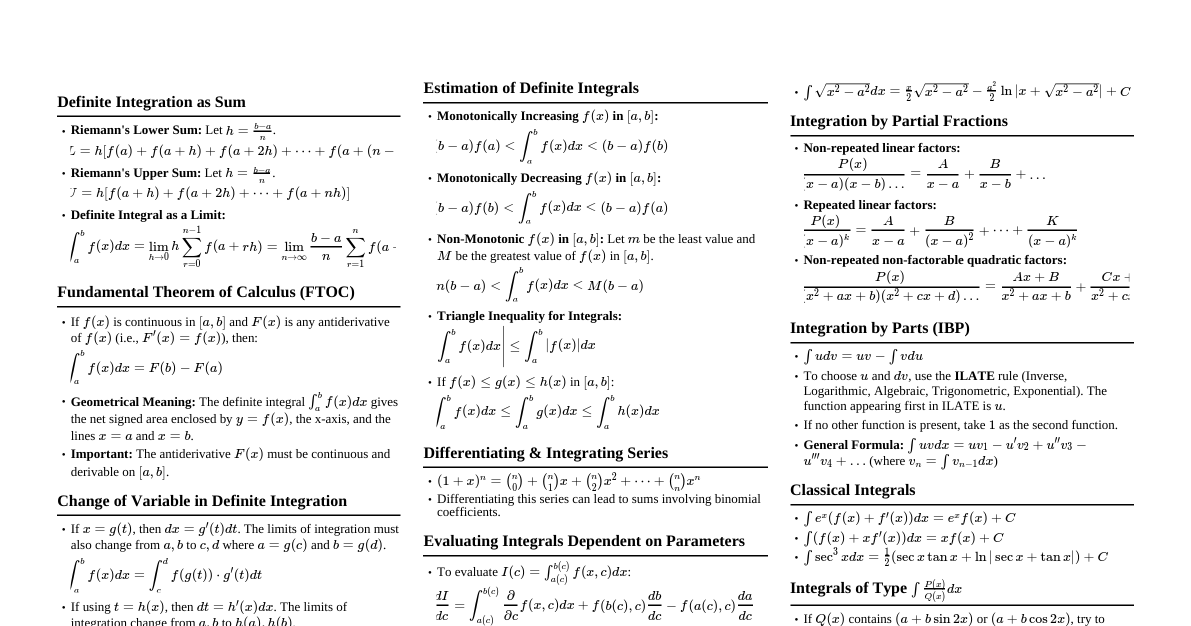
### Functions and Graphs - **Function Definition:** A relation where each input $x$ has exactly one output $y$. - **Domain:** Set of all possible input values ($x$). - **Range:** Set of all possible output values ($y$). - **Vertical Line Test:** Used to determine if a graph represents a function. - **Even Function:** $f(-x) = f(x)$ (symmetric about y-axis). - **Odd Function:** $f(-x) = -f(x)$ (symmetric about origin). - **Transformations:** - Vertical Shift: $f(x) + c$ (up), $f(x) - c$ (down) - Horizontal Shift: $f(x+c)$ (left), $f(x-c)$ (right) - Vertical Stretch/Compress: $c \cdot f(x)$ ($|c|>1$ stretch, $0 1$ compress, $0 ### Polynomial and Rational Functions - **Polynomial Form:** $P(x) = a_n x^n + a_{n-1} x^{n-1} + ... + a_1 x + a_0$ - **Degree:** Highest exponent $n$. - **Leading Coefficient:** $a_n$. - **End Behavior:** Determined by degree and leading coefficient. - Even degree, $a_n > 0$: Both ends up ($\uparrow \dots \uparrow$) - Even degree, $a_n 0$: Left down, right up ($\downarrow \dots \uparrow$) - Odd degree, $a_n degree of $Q(x)$, no HA (may have slant asymptote). ### Exponential and Logarithmic Functions - **Exponential Function:** $f(x) = a^x$, where $a>0, a \neq 1$. - Domain: $(-\infty, \infty)$, Range: $(0, \infty)$. - Horizontal Asymptote: $y=0$. - **Logarithmic Function:** $f(x) = \log_a x$, where $a>0, a \neq 1$. - Inverse of $a^x$. - Domain: $(0, \infty)$, Range: $(-\infty, \infty)$. - Vertical Asymptote: $x=0$. - **Logarithm Properties:** - $\log_a (xy) = \log_a x + \log_a y$ - $\log_a (\frac{x}{y}) = \log_a x - \log_a y$ - $\log_a (x^p) = p \log_a x$ - $\log_a a = 1$, $\log_a 1 = 0$ - **Change of Base:** $\log_a x = \frac{\log_b x}{\log_b a}$ - **Natural Logarithm:** $\ln x = \log_e x$. - **Euler's Number:** $e \approx 2.718$. - **Growth/Decay Model:** $A = P e^{rt}$ or $A = P(1+r)^t$ (for discrete compounding). ### Trigonometric Functions - **Unit Circle Definitions:** - $\sin \theta = y$ - $\cos \theta = x$ - $\tan \theta = \frac{y}{x}$ - $\csc \theta = \frac{1}{y}$ - $\sec \theta = \frac{1}{x}$ - $\cot \theta = \frac{x}{y}$ - **Radians to Degrees:** $\text{degrees} = \text{radians} \cdot \frac{180^\circ}{\pi}$ - **Degrees to Radians:** $\text{radians} = \text{degrees} \cdot \frac{\pi}{180^\circ}$ - **Graphs:** - **Sine:** Period $2\pi$, Range $[-1,1]$ - **Cosine:** Period $2\pi$, Range $[-1,1]$ - **Tangent:** Period $\pi$, Vertical Asymptotes at $\frac{\pi}{2} + n\pi$ - **Amplitude:** $|A|$ for $A \sin(Bx+C)+D$. - **Period:** $\frac{2\pi}{|B|}$ for sine/cosine, $\frac{\pi}{|B|}$ for tangent/cotangent. - **Phase Shift:** $-\frac{C}{B}$. - **Vertical Shift:** $D$. - **Identities:** - **Pythagorean:** $\sin^2 \theta + \cos^2 \theta = 1$ - $\tan^2 \theta + 1 = \sec^2 \theta$ - $1 + \cot^2 \theta = \csc^2 \theta$ - **Reciprocal:** $\tan \theta = \frac{\sin \theta}{\cos \theta}$, $\cot \theta = \frac{\cos \theta}{\sin \theta}$ ### Conic Sections - **Parabola:** $y=a(x-h)^2+k$ or $x=a(y-k)^2+h$. - Vertex $(h,k)$. - **Circle:** $(x-h)^2 + (y-k)^2 = r^2$. - Center $(h,k)$, Radius $r$. - **Ellipse:** $\frac{(x-h)^2}{a^2} + \frac{(y-k)^2}{b^2} = 1$. - Center $(h,k)$. Major axis length $2a$ or $2b$. Foci $c^2 = |a^2-b^2|$. - **Hyperbola:** $\frac{(x-h)^2}{a^2} - \frac{(y-k)^2}{b^2} = 1$ (horizontal transverse axis) or $\frac{(y-k)^2}{a^2} - \frac{(x-h)^2}{b^2} = 1$ (vertical transverse axis). - Center $(h,k)$. Asymptotes $y-k = \pm \frac{b}{a}(x-h)$ or $y-k = \pm \frac{a}{b}(x-h)$. - Foci $c^2 = a^2+b^2$. ### Sequences and Series - **Arithmetic Sequence:** $a_n = a_1 + (n-1)d$. - Sum: $S_n = \frac{n}{2}(a_1 + a_n)$ or $S_n = \frac{n}{2}(2a_1 + (n-1)d)$. - **Geometric Sequence:** $a_n = a_1 r^{n-1}$. - Sum (finite): $S_n = \frac{a_1(1-r^n)}{1-r}$. - Sum (infinite, $|r| ### Parametric and Polar Equations - **Parametric Equations:** $x=f(t)$, $y=g(t)$. - To convert to rectangular: eliminate parameter $t$. - **Polar Coordinates:** $(r, \theta)$. - $r$: distance from origin. $\theta$: angle from positive x-axis. - **Conversion Formulas:** - $x = r \cos \theta$ - $y = r \sin \theta$ - $r^2 = x^2 + y^2$ - $\tan \theta = \frac{y}{x}$ ### Vectors - **Component Form:** $\vec{v} = \langle x, y \rangle$. - **Magnitude:** $|\vec{v}| = \sqrt{x^2+y^2}$. - **Unit Vector:** $\hat{u} = \frac{\vec{v}}{|\vec{v}|}$. - **Dot Product:** $\vec{u} \cdot \vec{v} = u_1 v_1 + u_2 v_2 = |\vec{u}||\vec{v}|\cos\theta$. - **Angle between Vectors:** $\cos\theta = \frac{\vec{u} \cdot \vec{v}}{|\vec{u}||\vec{v}|}$. - **Orthogonal Vectors:** $\vec{u} \cdot \vec{v} = 0$.