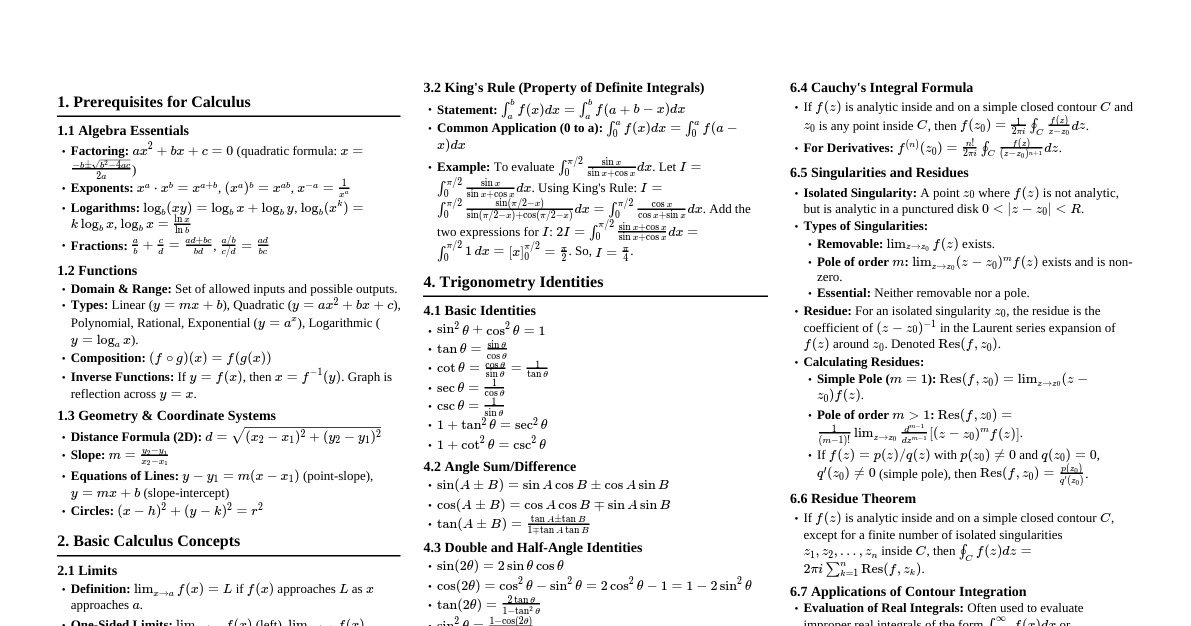
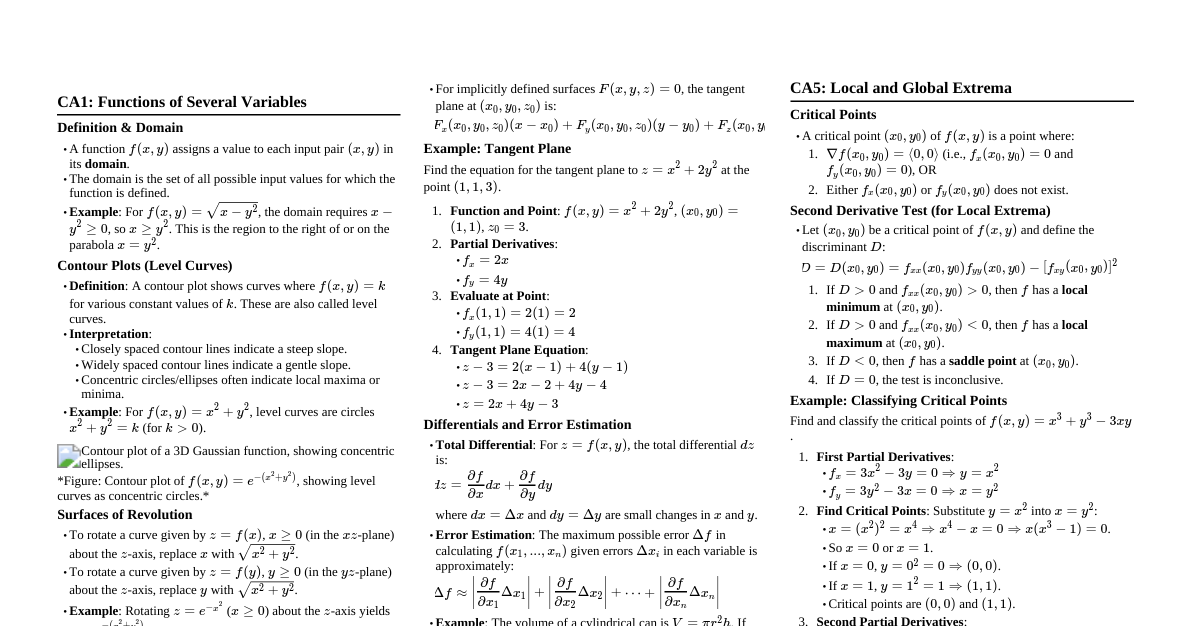
Pre-Calculus & Calculus I-II
Shared 5/15/2026•22 views
### PART 1 — PRÉ-CÁLCULO ### 1. Sets (Conjuntos) #### Intuition Sets are fundamental building blocks in mathematics, like containers for objects. They allow us to group related items and discuss their properties and relationships systematically. Think of a set as a well-defined collection of distinct objects. #### Formal Definition A **set** is a well-defined collection of distinct objects, called **elements** or **members**. - Notation: Sets are usually denoted by capital letters (e.g., $A, B, C$), and elements by lowercase letters (e.g., $a, b, c$). - Membership: If $x$ is an element of set $A$, we write $x \in A$. If $x$ is not an element of $A$, we write $x \notin A$. - Ways to describe a set: 1. **Roster method (list method):** Listing all elements, e.g., $A = \{1, 2, 3, 4\}$. 2. **Set-builder notation:** Describing the properties of elements, e.g., $B = \{x \mid x \text{ is an even integer and } x This is false. Using sets: $C \subseteq M$ and $D \subseteq M$. This does not imply $C \subseteq D$. Cats and dogs are both subsets of mammals, but they are distinct sets. #### Operations: Union, Intersection, Difference ##### Intuition Set operations allow us to combine or compare sets to form new sets based on shared or unique elements. - **Union:** "OR" - combines all elements from both sets. - **Intersection:** "AND" - finds elements common to both sets. - **Difference:** "NOT" - finds elements in one set but not the other. ##### Formal Definitions Let $A$ and $B$ be sets. 1. **Union ($A \cup B$):** The set of all elements that are in $A$ OR in $B$ (or both). $A \cup B = \{x \mid x \in A \text{ or } x \in B\}$ 2. **Intersection ($A \cap B$):** The set of all elements that are in $A$ AND in $B$. $A \cap B = \{x \mid x \in A \text{ and } x \in B\}$ - If $A \cap B = \emptyset$, then $A$ and $B$ are **disjoint** sets. 3. **Difference ($A - B$ or $A \setminus B$):** The set of all elements that are in $A$ BUT NOT in $B$. $A - B = \{x \mid x \in A \text{ and } x \notin B\}$ 4. **Complement ($A^c$ or $A'$):** The set of all elements in the universal set $U$ that are NOT in $A$. $A^c = \{x \mid x \in U \text{ and } x \notin A\} = U - A$ ##### Examples Let $U = \{1, 2, 3, ..., 10\}$, $A = \{1, 2, 3, 4, 5\}$, $B = \{4, 5, 6, 7\}$, $C = \{8, 9, 10\}$. - $A \cup B = \{1, 2, 3, 4, 5, 6, 7\}$ - $A \cap B = \{4, 5\}$ - $A - B = \{1, 2, 3\}$ - $B - A = \{6, 7\}$ - $A^c = \{6, 7, 8, 9, 10\}$ - $A \cap C = \emptyset$ (A and C are disjoint) #### Multiple Unions/Intersections (Finite and Infinite) ##### Intuition We can extend union and intersection to more than two sets, even infinitely many. - Finite: $\bigcup_{i=1}^n A_i = A_1 \cup A_2 \cup ... \cup A_n$ - Infinite: $\bigcup_{i=1}^\infty A_i = A_1 \cup A_2 \cup A_3 \cup ...$ ##### Formal Definition - **Finite Union:** $\bigcup_{i=1}^n A_i = \{x \mid x \in A_i \text{ for at least one } i \in \{1, ..., n\}\}$ - **Finite Intersection:** $\bigcap_{i=1}^n A_i = \{x \mid x \in A_i \text{ for all } i \in \{1, ..., n\}\}$ - **Infinite Union:** $\bigcup_{i=1}^\infty A_i = \{x \mid x \in A_i \text{ for at least one } i \in \mathbb{N}\}$ - **Infinite Intersection:** $\bigcap_{i=1}^\infty A_i = \{x \mid x \in A_i \text{ for all } i \in \mathbb{N}\}$ ##### Examples 1. Let $A_1 = \{1, 2\}$, $A_2 = \{2, 3\}$, $A_3 = \{3, 4\}$. $\bigcup_{i=1}^3 A_i = \{1, 2, 3, 4\}$ $\bigcap_{i=1}^3 A_i = \emptyset$ (since no element is in all three sets) 2. Let $B_n = \{n, n+1, n+2, ...\}$ for $n \in \mathbb{N}$. $\bigcup_{n=1}^\infty B_n = \{1, 2, 3, ...\} = \mathbb{N}$ $\bigcap_{n=1}^\infty B_n = \emptyset$ (no element is in all sets, as any given number $k$ is not in $B_{k+1}$) #### Nested Intervals ##### Intuition Nested intervals are sequences of intervals where each subsequent interval is contained within the previous one, like Russian nesting dolls. They are crucial for understanding concepts like real number completeness and limits. ##### Formal Definition A sequence of intervals $[a_n, b_n]$ is **nested** if $[a_{n+1}, b_{n+1}] \subseteq [a_n, b_n]$ for all $n$. This implies $a_1 \le a_2 \le ... \le a_n \le b_n \le ... \le b_2 \le b_1$. ##### Key Property (Nested Interval Theorem - related to completeness axiom) For a sequence of closed and bounded nested intervals $[a_n, b_n]$, the intersection $\bigcap_{n=1}^\infty [a_n, b_n]$ is non-empty. If, in addition, $\lim_{n \to \infty} (b_n - a_n) = 0$, then the intersection contains exactly one point. ##### Examples 1. Consider the intervals $I_n = [0, 1/n]$ for $n \in \mathbb{N}$. $I_1 = [0, 1]$ $I_2 = [0, 1/2]$ $I_3 = [0, 1/3]$ ... This is a nested sequence of intervals: $I_{n+1} \subseteq I_n$. The intersection is $\bigcap_{n=1}^\infty [0, 1/n] = \{0\}$. (Only 0 is in all intervals). 2. Consider $J_n = (0, 1/n]$ (open on the left). $J_1 = (0, 1]$ $J_2 = (0, 1/2]$ ... The intersection is $\bigcap_{n=1}^\infty (0, 1/n] = \emptyset$. This highlights the importance of closed intervals for the Nested Interval Theorem. #### Properties of Set Operations ##### Intuition Set operations behave in predictable ways, similar to arithmetic operations. These properties allow us to simplify expressions and prove relationships between sets. ##### Key Properties Let $A, B, C$ be sets and $U$ be the universal set. 1. **Commutative Laws:** - $A \cup B = B \cup A$ - $A \cap B = B \cap A$ 2. **Associative Laws:** - $(A \cup B) \cup C = A \cup (B \cup C)$ - $(A \cap B) \cap C = A \cap (B \cap C)$ 3. **Distributive Laws:** - $A \cup (B \cap C) = (A \cup B) \cap (A \cup C)$ - $A \cap (B \cup C) = (A \cap B) \cup (A \cap C)$ 4. **Identity Laws:** - $A \cup \emptyset = A$ - $A \cap U = A$ - $A \cup U = U$ - $A \cap \emptyset = \emptyset$ 5. **Complement Laws:** - $A \cup A^c = U$ - $A \cap A^c = \emptyset$ - $(A^c)^c = A$ - $U^c = \emptyset$ - $\emptyset^c = U$ 6. **Idempotent Laws:** - $A \cup A = A$ - $A \cap A = A$ 7. **De Morgan's Laws:** - $(A \cup B)^c = A^c \cap B^c$ - $(A \cap B)^c = A^c \cup B^c$ ##### Proof Example (De Morgan's Law: $(A \cup B)^c = A^c \cap B^c$) To prove set equality, we show that each set is a subset of the other. 1. **Show $(A \cup B)^c \subseteq A^c \cap B^c$:** - Let $x \in (A \cup B)^c$. - By definition of complement, $x \notin (A \cup B)$. - By definition of union, this means $x \notin A$ AND $x \notin B$. (If $x$ were in $A$ or $B$, it would be in their union). - By definition of complement, $x \in A^c$ AND $x \in B^c$. - By definition of intersection, $x \in A^c \cap B^c$. - Thus, $(A \cup B)^c \subseteq A^c \cap B^c$. 2. **Show $A^c \cap B^c \subseteq (A \cup B)^c$:** - Let $x \in A^c \cap B^c$. - By definition of intersection, $x \in A^c$ AND $x \in B^c$. - By definition of complement, $x \notin A$ AND $x \notin B$. - This means $x$ is not in $A$ and $x$ is not in $B$. Therefore, $x$ is not in their union. - So, $x \notin (A \cup B)$. - By definition of complement, $x \in (A \cup B)^c$. - Thus, $A^c \cap B^c \subseteq (A \cup B)^c$. Since both inclusions hold, $(A \cup B)^c = A^c \cap B^c$. #### Common Mistakes - Confusing $\in$ (element of) with $\subseteq$ (subset of). E.g., $1 \in \{1, 2\}$ is true, but $1 \subseteq \{1, 2\}$ is false. $\{1\} \subseteq \{1, 2\}$ is true. - Incorrectly applying De Morgan's laws (e.g., $(A \cup B)^c = A^c \cup B^c$ is wrong). - Assuming disjointness when not stated. - Forgetting that the empty set is a subset of every set. #### Applications - **Database queries:** Filtering data often uses set operations (e.g., customers who bought X AND Y, or X OR Z). - **Computer science:** Data structures like hash sets, algorithms for graph theory. - **Logic:** Formalizing arguments and proofs. - **Probability:** Events are sets, and probabilities are assigned to these sets. - **Mathematical analysis:** Defining domains, ranges, and properties of functions and sequences. #### Exercises (Sets) 1. Let $U = \{1, 2, 3, 4, 5, 6, 7, 8, 9, 10\}$. Let $A = \{x \mid x \text{ is an even number}\}$. Let $B = \{x \mid x \text{ is a prime number}\}$. Let $C = \{x \mid x \text{ is a multiple of } 3\}$. Find: a) $A \cup B$ b) $A \cap C$ c) $B - C$ d) $A^c$ e) $(A \cap B)^c$ f) $A \cup (B \cap C)$ 2. Determine if the following statements are true or false: a) $\emptyset \in \{\emptyset, \{1\}\}$ b) $\emptyset \subseteq \{\emptyset, \{1\}\}$ c) $\{1\} \in \{\emptyset, \{1\}\}$ d) $\{1\} \subseteq \{\emptyset, \{1\}\}$ e) $\{1, 2\} \subseteq \{1, 2, \{3, 4\}\}$ f) $\{3, 4\} \in \{1, 2, \{3, 4\}\}$ 3. Prove the distributive law: $A \cup (B \cap C) = (A \cup B) \cap (A \cup C)$. 4. Let $I_n = [-1/n, 1/n]$ for $n \in \mathbb{N}$. Find $\bigcap_{n=1}^\infty I_n$. ##### Answers (Sets) 1. Given $U = \{1, ..., 10\}$, $A = \{2, 4, 6, 8, 10\}$, $B = \{2, 3, 5, 7\}$, $C = \{3, 6, 9\}$. a) $A \cup B = \{2, 3, 4, 5, 6, 7, 8, 10\}$ b) $A \cap C = \{6\}$ c) $B - C = \{2, 5, 7\}$ d) $A^c = \{1, 3, 5, 7, 9\}$ e) $A \cap B = \{2\}$. So $(A \cap B)^c = \{1, 3, 4, 5, 6, 7, 8, 9, 10\}$ f) $B \cap C = \{3\}$. So $A \cup (B \cap C) = \{2, 4, 6, 8, 10\} \cup \{3\} = \{2, 3, 4, 6, 8, 10\}$ 2. a) True (The empty set is an element of the given set) b) True (The empty set is a subset of every set) c) True (The set $\{1\}$ is an element of the given set) d) False (The element $1$ is not in the set, only the set $\{1\}$ is) e) False ($2$ is in the first set, but not in the second) f) True (The set $\{3, 4\}$ is an element of the given set) 3. **Proof of $A \cup (B \cap C) = (A \cup B) \cap (A \cup C)$:** **Part 1: Show $A \cup (B \cap C) \subseteq (A \cup B) \cap (A \cup C)$** Let $x \in A \cup (B \cap C)$. By definition of union, this means $x \in A$ or $x \in (B \cap C)$. - Case 1: $x \in A$. If $x \in A$, then $x \in A \cup B$ and $x \in A \cup C$. Therefore, $x \in (A \cup B) \cap (A \cup C)$. - Case 2: $x \in (B \cap C)$. If $x \in (B \cap C)$, then $x \in B$ and $x \in C$. Since $x \in B$, it follows that $x \in A \cup B$. Since $x \in C$, it follows that $x \in A \cup C$. Therefore, $x \in (A \cup B) \cap (A \cup C)$. In both cases, we conclude $x \in (A \cup B) \cap (A \cup C)$. Thus, $A \cup (B \cap C) \subseteq (A \cup B) \cap (A \cup C)$. **Part 2: Show $(A \cup B) \cap (A \cup C) \subseteq A \cup (B \cap C)$** Let $x \in (A \cup B) \cap (A \cup C)$. By definition of intersection, this means $x \in (A \cup B)$ AND $x \in (A \cup C)$. - From $x \in (A \cup B)$, we know $x \in A$ or $x \in B$. - From $x \in (A \cup C)$, we know $x \in A$ or $x \in C$. We consider two cases for $x$: - Case 1: $x \in A$. If $x \in A$, then $x \in A \cup (B \cap C)$ is automatically true. - Case 2: $x \notin A$. If $x \notin A$, then from $x \in (A \cup B)$, it must be that $x \in B$. Also, if $x \notin A$, then from $x \in (A \cup C)$, it must be that $x \in C$. So, if $x \notin A$, then $x \in B$ AND $x \in C$. This means $x \in (B \cap C)$. Therefore, $x \in A \cup (B \cap C)$. In both cases, we conclude $x \in A \cup (B \cap C)$. Thus, $(A \cup B) \cap (A \cup C) \subseteq A \cup (B \cap C)$. Since both inclusions hold, $A \cup (B \cap C) = (A \cup B) \cap (A \cup C)$. 4. $\bigcap_{n=1}^\infty [-1/n, 1/n] = \{0\}$. For any $x \neq 0$, there exists an $N$ such that $1/N ### 2. Numbers (Números) #### Intuition Numbers are the language of quantity and order. We start with counting numbers, then expand to include negatives, fractions, and eventually all points on a continuous line. Each expansion solves problems that previous number systems couldn't handle. #### Natural Numbers and Algebraic Properties ##### Intuition Natural numbers are the most basic numbers, used for counting. They are the positive whole numbers. ##### Formal Definition The set of **natural numbers**, denoted by $\mathbb{N}$, is $\mathbb{N} = \{1, 2, 3, ...\}$. (Sometimes $\mathbb{N}$ includes $0$, so $\mathbb{N}_0 = \{0, 1, 2, ...\}$ is used to be unambiguous if $0$ is included). ##### Algebraic Properties (under addition and multiplication) Let $a, b, c \in \mathbb{N}$. - **Closure:** $a+b \in \mathbb{N}$ and $a \cdot b \in \mathbb{N}$. (The sum and product of two natural numbers are natural numbers). - **Commutativity:** $a+b = b+a$ and $a \cdot b = b \cdot a$. (Order doesn't matter for addition/multiplication). - **Associativity:** $(a+b)+c = a+(b+c)$ and $(a \cdot b) \cdot c = a \cdot (b \cdot c)$. (Grouping doesn't matter for addition/multiplication). - **Distributivity:** $a \cdot (b+c) = a \cdot b + a \cdot c$. (Multiplication distributes over addition). - **Identity Elements:** - Additive identity: There is no additive identity in $\mathbb{N}$ if $0 \notin \mathbb{N}$. If $0 \in \mathbb{N}$, then $a+0 = a$. - Multiplicative identity: $1 \in \mathbb{N}$ such that $a \cdot 1 = a$. ##### Examples - Closure: $3+5=8 \in \mathbb{N}$, $3 \cdot 5 = 15 \in \mathbb{N}$. - Commutativity: $3+5=8$, $5+3=8$. $3 \cdot 5 = 15$, $5 \cdot 3 = 15$. - Associativity: $(2+3)+4 = 5+4 = 9$, $2+(3+4) = 2+7 = 9$. - Distributivity: $2 \cdot (3+4) = 2 \cdot 7 = 14$, and $2 \cdot 3 + 2 \cdot 4 = 6+8 = 14$. #### Division Algorithm and Divisibility ##### Intuition The division algorithm formalizes the process of dividing one number by another to get a quotient and a remainder. Divisibility is a special case where the remainder is zero. ##### Formal Definition **Division Algorithm:** For any integers $a$ (dividend) and $b$ (divisor) with $b > 0$, there exist unique integers $q$ (quotient) and $r$ (remainder) such that $a = bq + r$, where $0 \le r , \ge$) that is compatible with arithmetic operations. #### Fraction Operations ##### Intuition Fractions represent parts of a whole. Operations on fractions follow specific rules to ensure consistency with their meaning. ##### Operations Let $a/b$ and $c/d$ be rational numbers, where $b, d \neq 0$. - **Addition/Subtraction:** To add or subtract, find a common denominator (e.g., $bd$). $a/b + c/d = (ad + bc) / bd$ $a/b - c/d = (ad - bc) / bd$ - **Multiplication:** Multiply numerators and denominators. $(a/b) \cdot (c/d) = (a \cdot c) / (b \cdot d)$ - **Division:** Multiply by the reciprocal of the divisor. $(a/b) / (c/d) = (a/b) \cdot (d/c) = (a \cdot d) / (b \cdot c)$, for $c \neq 0$. ##### Examples - Addition: $1/3 + 2/5 = (1 \cdot 5 + 2 \cdot 3) / (3 \cdot 5) = (5+6)/15 = 11/15$. - Subtraction: $3/4 - 1/6 = (3 \cdot 6 - 1 \cdot 4) / (4 \cdot 6) = (18-4)/24 = 14/24 = 7/12$. - Multiplication: $(2/3) \cdot (4/5) = (2 \cdot 4) / (3 \cdot 5) = 8/15$. - Division: $(3/7) / (2/5) = (3/7) \cdot (5/2) = 15/14$. #### Why Division by Zero is Undefined ##### Intuition Division by zero leads to logical contradictions or undefined quantities, making it impossible to assign a consistent value. ##### Explanation Consider the definition of division: $a/b = c$ means $a = b \cdot c$. 1. **Case 1: Non-zero number divided by zero (e.g., $5/0$)** If $5/0 = c$, then $5 = 0 \cdot c$. However, $0 \cdot c = 0$ for any number $c$. So we would have $5 = 0$, which is a contradiction. Therefore, a non-zero number divided by zero has no solution. 2. **Case 2: Zero divided by zero (e.g., $0/0$)** If $0/0 = c$, then $0 = 0 \cdot c$. This equation is true for ANY value of $c$. For instance, if $c=1$, $0=0 \cdot 1$ is true. If $c=5$, $0=0 \cdot 5$ is true. Since $c$ could be any number, $0/0$ is **indeterminate**; it does not have a unique value. Because division by zero either leads to a contradiction or an indeterminate value, it is formally **undefined**. #### Equality Properties and Cancellation Laws ##### Intuition Equality means two expressions represent the same value. Properties of equality allow us to manipulate equations while preserving their truth. Cancellation laws are specific rules for "undoing" operations. ##### Equality Properties For real numbers $a, b, c$: - **Reflexive:** $a = a$. - **Symmetric:** If $a = b$, then $b = a$. - **Transitive:** If $a = b$ and $b = c$, then $a = c$. - **Addition Property:** If $a = b$, then $a+c = b+c$. - **Subtraction Property:** If $a = b$, then $a-c = b-c$. - **Multiplication Property:** If $a = b$, then $a \cdot c = b \cdot c$. - **Division Property:** If $a = b$ and $c \neq 0$, then $a/c = b/c$. - **Substitution Property:** If $a = b$, then $a$ can be replaced by $b$ in any expression or equation. ##### Cancellation Laws - **Additive Cancellation:** If $a+c = b+c$, then $a=b$. (Subtract $c$ from both sides). - **Multiplicative Cancellation:** If $a \cdot c = b \cdot c$ AND $c \neq 0$, then $a=b$. (Divide by $c$ from both sides). - **Important Note:** The condition $c \neq 0$ is crucial for multiplicative cancellation. For example, $5 \cdot 0 = 3 \cdot 0$ is true, but $5 \neq 3$. #### Exponents ##### Intuition Exponents provide a shorthand for repeated multiplication. They generalize to represent roots and more complex operations. ##### Natural Exponents - **Definition:** For a real number $a$ and a natural number $n$, $a^n = a \cdot a \cdot ... \cdot a$ (n times). - **Properties:** - $a^m \cdot a^n = a^{m+n}$ - $(a^m)^n = a^{mn}$ - $(ab)^n = a^n b^n$ - $(a/b)^n = a^n / b^n$ (for $b \neq 0$) - $a^1 = a$ ##### Integer Exponents - **Definition:** For $a \neq 0$: - $a^0 = 1$ - $a^{-n} = 1/a^n$ (for natural number $n$) - **Properties:** All properties from natural exponents extend to integer exponents. ##### Rational Exponents (Roots) - **Definition:** For real $a \ge 0$ (or $a \in \mathbb{R}$ if $n$ is odd) and rational $m/n$ (where $n$ is a natural number): - $a^{1/n} = \sqrt[n]{a}$ (the $n$-th root of $a$) - $a^{m/n} = (\sqrt[n]{a})^m = \sqrt[n]{a^m}$ - **Properties:** All previous properties extend. Note: $\sqrt{a^2} = |a|$, not just $a$. ##### Real Exponents - **Intuition:** For an irrational exponent like $2^{\sqrt{2}}$, we define it by approximating $\sqrt{2}$ with rational numbers. For example, $2^{1.4}, 2^{1.41}, 2^{1.414}, ...$ will approach a specific real value. - **Formal Definition:** Requires limits and completeness of real numbers (covered later). For $a > 0$ and $x \in \mathbb{R}$, $a^x$ is defined as the limit of $a^r$ as rational $r$ approaches $x$. - **Properties:** All previous properties extend. - If $a > 1$, $a^x$ is increasing. If $0 ### 3. Mathematical Induction (*) #### Intuition Mathematical induction is a powerful proof technique used to establish that a statement is true for all natural numbers (or for all numbers from some starting point). Think of it like a chain reaction or a line of dominoes: if you can knock over the first domino, and if knocking over any domino ensures the next one falls, then all dominoes will fall. #### Principle of Induction ##### Formal Definition Let $P(n)$ be a statement about a natural number $n$. If: 1. **Base Case:** $P(1)$ is true. (The first domino falls). 2. **Inductive Step:** For every natural number $k \ge 1$, if $P(k)$ is true, then $P(k+1)$ is true. (If any domino falls, the next one falls). Then $P(n)$ is true for all natural numbers $n \ge 1$. **Strong Induction:** A variation where the inductive step assumes $P(j)$ is true for ALL $j$ such that $1 \le j \le k$ (not just $P(k)$) to prove $P(k+1)$. This is sometimes more convenient for certain proofs, but it is logically equivalent to regular induction. #### Proof Examples ##### Example 1: Sum of the first $n$ natural numbers Prove that for all $n \in \mathbb{N}$, $1 + 2 + ... + n = n(n+1)/2$. 1. **Base Case ($P(1)$):** For $n=1$, the left side is $1$. The right side is $1(1+1)/2 = 1(2)/2 = 1$. Since $1=1$, $P(1)$ is true. 2. **Inductive Hypothesis ($P(k)$):** Assume that $P(k)$ is true for some arbitrary natural number $k \ge 1$. That is, assume $1 + 2 + ... + k = k(k+1)/2$. 3. **Inductive Step ($P(k+1)$):** We need to show that $P(k+1)$ is true, i.e., $1 + 2 + ... + k + (k+1) = (k+1)((k+1)+1)/2 = (k+1)(k+2)/2$. Start with the left side of $P(k+1)$: $1 + 2 + ... + k + (k+1)$ $= (1 + 2 + ... + k) + (k+1)$ By the Inductive Hypothesis, we can substitute $k(k+1)/2$ for the sum of the first $k$ terms: $= k(k+1)/2 + (k+1)$ Factor out $(k+1)$: $= (k+1) [k/2 + 1]$ $= (k+1) [(k+2)/2]$ $= (k+1)(k+2)/2$ This is exactly the right side of $P(k+1)$. Thus, $P(k+1)$ is true. 4. **Conclusion:** By the Principle of Mathematical Induction, the statement $1 + 2 + ... + n = n(n+1)/2$ is true for all natural numbers $n \ge 1$. ##### Example 2: Divisibility Prove that $3^{2n} - 1$ is divisible by $8$ for all $n \in \mathbb{N}$. 1. **Base Case ($P(1)$):** For $n=1$, $3^{2(1)} - 1 = 3^2 - 1 = 9 - 1 = 8$. Since $8$ is divisible by $8$, $P(1)$ is true. 2. **Inductive Hypothesis ($P(k)$):** Assume that $P(k)$ is true for some arbitrary natural number $k \ge 1$. That is, assume $3^{2k} - 1$ is divisible by $8$. This means $3^{2k} - 1 = 8m$ for some integer $m$. From this, we can write $3^{2k} = 8m + 1$. 3. **Inductive Step ($P(k+1)$):** We need to show that $P(k+1)$ is true, i.e., $3^{2(k+1)} - 1$ is divisible by $8$. Start with the expression for $P(k+1)$: $3^{2(k+1)} - 1$ $= 3^{2k+2} - 1$ $= 3^{2k} \cdot 3^2 - 1$ $= 9 \cdot 3^{2k} - 1$ Now, substitute $3^{2k} = 8m + 1$ from the inductive hypothesis: $= 9 \cdot (8m + 1) - 1$ $= 72m + 9 - 1$ $= 72m + 8$ Factor out $8$: $= 8(9m + 1)$ Since $(9m+1)$ is an integer, $8(9m+1)$ is divisible by $8$. Thus, $P(k+1)$ is true. 4. **Conclusion:** By the Principle of Mathematical Induction, $3^{2n} - 1$ is divisible by $8$ for all $n \in \mathbb{N}$. ##### Example 3: Inequality Prove that $2^n 2$. Therefore, $k! \cdot 2 ### 4. Summation Notation #### Intuition Summation notation, or sigma notation ($\Sigma$), is a concise way to represent the sum of a sequence of numbers. Instead of writing out a long sum like $1+2+3+...+100$, we can use a compact symbol. #### Sigma Notation ##### Formal Definition The sum of $n$ terms $a_1, a_2, ..., a_n$ is written as: $$\sum_{i=1}^{n} a_i = a_1 + a_2 + ... + a_n$$ - $\Sigma$ (capital Greek letter sigma) denotes summation. - $i$ is the **index of summation** (or dummy variable). It can be any letter, but $i, j, k$ are common. - $1$ is the **lower limit** of summation (starting value of $i$). - $n$ is the **upper limit** of summation (ending value of $i$). - $a_i$ is the **summand** (the expression being summed). ##### Examples 1. $\sum_{i=1}^{5} i = 1 + 2 + 3 + 4 + 5 = 15$. 2. $\sum_{j=0}^{3} (2j+1) = (2 \cdot 0 + 1) + (2 \cdot 1 + 1) + (2 \cdot 2 + 1) + (2 \cdot 3 + 1) = 1 + 3 + 5 + 7 = 16$. 3. $\sum_{k=1}^{4} k^2 = 1^2 + 2^2 + 3^2 + 4^2 = 1 + 4 + 9 + 16 = 30$. 4. $\sum_{m=2}^{5} (m-1) = (2-1) + (3-1) + (4-1) + (5-1) = 1 + 2 + 3 + 4 = 10$. #### Properties ##### Intuition Summation notation follows rules similar to arithmetic, allowing us to manipulate sums algebraically. ##### Key Properties Let $c$ be a constant. 1. **Constant Multiple:** $\sum_{i=1}^{n} c \cdot a_i = c \sum_{i=1}^{n} a_i$. (A constant factor can be pulled out of the summation). 2. **Sum/Difference Rule:** $\sum_{i=1}^{n} (a_i \pm b_i) = \sum_{i=1}^{n} a_i \pm \sum_{i=1}^{n} b_i$. (The sum of sums/differences is the sum/difference of the sums). 3. **Sum of a Constant:** $\sum_{i=1}^{n} c = c + c + ... + c \text{ (n times)} = nc$. 4. **Splitting the Sum:** If $1 \le m ### 5. Binomial Theorem & Special Products #### Intuition The Binomial Theorem provides a formula for expanding expressions of the form $(a+b)^n$ without having to multiply them out term by term. Special algebraic identities are specific patterns for multiplying polynomials that are useful shortcuts. #### Factorial ##### Formal Definition For any non-negative integer $n$, the **factorial** of $n$, denoted $n!$, is defined as: - $0! = 1$ - $n! = n \cdot (n-1) \cdot (n-2) \cdot ... \cdot 3 \cdot 2 \cdot 1$ for $n \ge 1$. ##### Examples - $1! = 1$ - $2! = 2 \cdot 1 = 2$ - $3! = 3 \cdot 2 \cdot 1 = 6$ - $4! = 4 \cdot 3 \cdot 2 \cdot 1 = 24$ - $5! = 5 \cdot 4! = 5 \cdot 24 = 120$ #### Binomial Coefficients ##### Formal Definition The **binomial coefficient**, denoted $\binom{n}{k}$ (read as "n choose k"), represents the number of ways to choose $k$ elements from a set of $n$ distinct elements, without regard to order. It is defined as: $$\binom{n}{k} = \frac{n!}{k!(n-k)!}$$ where $n$ is a non-negative integer and $k$ is an integer such that $0 \le k \le n$. ##### Key Properties - $\binom{n}{0} = 1$ - $\binom{n}{n} = 1$ - $\binom{n}{1} = n$ - $\binom{n}{k} = \binom{n}{n-k}$ (Symmetry property) - **Pascal's Identity:** $\binom{n}{k} + \binom{n}{k+1} = \binom{n+1}{k+1}$ ##### Examples - $\binom{4}{0} = \frac{4!}{0!(4-0)!} = \frac{24}{1 \cdot 24} = 1$. - $\binom{4}{1} = \frac{4!}{1!(4-1)!} = \frac{24}{1 \cdot 6} = 4$. - $\binom{4}{2} = \frac{4!}{2!(4-2)!} = \frac{24}{2 \cdot 2} = 6$. - $\binom{4}{3} = \frac{4!}{3!(4-3)!} = \frac{24}{6 \cdot 1} = 4$. - $\binom{4}{4} = \frac{4!}{4!(4-4)!} = \frac{24}{24 \cdot 1} = 1$. #### Pascal’s Triangle ##### Intuition Pascal's Triangle is a triangular array of binomial coefficients. Each number in the triangle is the sum of the two numbers directly above it. It provides a visual and easy way to generate binomial coefficients. ##### Construction Row 0: 1 Row 1: 1 1 Row 2: 1 2 1 Row 3: 1 3 3 1 Row 4: 1 4 6 4 1 ... and so on. The $n$-th row (starting from row 0) contains the binomial coefficients $\binom{n}{0}, \binom{n}{1}, ..., \binom{n}{n}$. ##### Examples - Row 0: $\binom{0}{0} = 1$ - Row 1: $\binom{1}{0}=1, \binom{1}{1}=1$ - Row 2: $\binom{2}{0}=1, \binom{2}{1}=2, \binom{2}{2}=1$ - Row 3: $\binom{3}{0}=1, \binom{3}{1}=3, \binom{3}{2}=3, \binom{3}{3}=1$ #### Binomial Expansion ##### Formal Definition (Binomial Theorem) For any non-negative integer $n$, the expansion of $(a+b)^n$ is given by: $$(a+b)^n = \sum_{k=0}^{n} \binom{n}{k} a^{n-k} b^k$$ This can be written out as: $$(a+b)^n = \binom{n}{0}a^n b^0 + \binom{n}{1}a^{n-1}b^1 + \binom{n}{2}a^{n-2}b^2 + ... + \binom{n}{n-1}a^1 b^{n-1} + \binom{n}{n}a^0 b^n$$ ##### Key Features of the Expansion - There are $n+1$ terms. - The sum of the exponents in each term is $n$. - The powers of $a$ decrease from $n$ to $0$. - The powers of $b$ increase from $0$ to $n$. - The coefficients are the binomial coefficients from the $n$-th row of Pascal's Triangle. ##### Examples 1. **Expand $(x+y)^3$:** Using Row 3 of Pascal's Triangle (1, 3, 3, 1): $(x+y)^3 = \binom{3}{0}x^3 y^0 + \binom{3}{1}x^2 y^1 + \binom{3}{2}x^1 y^2 + \binom{3}{3}x^0 y^3$ $= 1x^3 + 3x^2 y + 3xy^2 + 1y^3$ $= x^3 + 3x^2 y + 3xy^2 + y^3$. 2. **Expand $(2x-1)^4$:** Here $a=2x$, $b=-1$, $n=4$. Using Row 4 of Pascal's Triangle (1, 4, 6, 4, 1): $(2x-1)^4 = \binom{4}{0}(2x)^4(-1)^0 + \binom{4}{1}(2x)^3(-1)^1 + \binom{4}{2}(2x)^2(-1)^2 + \binom{4}{3}(2x)^1(-1)^3 + \binom{4}{4}(2x)^0(-1)^4$ $= 1(16x^4)(1) + 4(8x^3)(-1) + 6(4x^2)(1) + 4(2x)(-1) + 1(1)(1)$ $= 16x^4 - 32x^3 + 24x^2 - 8x + 1$. #### Proof of Binomial Theorem (*) ##### Intuition The proof relies on combinatorial arguments. When expanding $(a+b)^n = (a+b)(a+b)...(a+b)$, each term in the final sum is formed by choosing either $a$ or $b$ from each of the $n$ factors. A term of the form $a^{n-k}b^k$ arises when $b$ is chosen $k$ times (and $a$ is chosen $n-k$ times). The number of ways to choose $k$ factors from which to take $b$ is exactly $\binom{n}{k}$. ##### Formal Proof (Combinatorial Argument) Consider the expansion of $(a+b)^n = (a+b)(a+b)...(a+b)$ ($n$ times). When we multiply this out, each term in the expansion is formed by choosing either $a$ or $b$ from each of the $n$ factors. For example, to get a term $a^{n-k}b^k$, we must choose $b$ from exactly $k$ of the $n$ factors, and $a$ from the remaining $(n-k)$ factors. The number of ways to choose $k$ positions (factors) out of $n$ positions from which to take $b$ is given by the binomial coefficient $\binom{n}{k}$. Once we have chosen these $k$ positions for $b$, the remaining $n-k$ positions must contribute $a$. Since the order of selection doesn't matter for the final product, each unique combination of $k$ $b$'s and $n-k$ $a$'s will result in the term $a^{n-k}b^k$. Therefore, the coefficient of $a^{n-k}b^k$ in the expansion of $(a+b)^n$ is $\binom{n}{k}$. Summing over all possible values of $k$ (from $0$ to $n$), we get the full expansion: $$(a+b)^n = \sum_{k=0}^{n} \binom{n}{k} a^{n-k} b^k$$ ##### Alternative Proof (By Induction) **Base Case ($n=0$):** $(a+b)^0 = 1$. $\sum_{k=0}^{0} \binom{0}{k} a^{0-k} b^k = \binom{0}{0} a^0 b^0 = 1 \cdot 1 \cdot 1 = 1$. The formula holds for $n=0$. **Inductive Hypothesis ($P(m)$):** Assume the theorem holds for some non-negative integer $m$. This means $(a+b)^m = \sum_{k=0}^{m} \binom{m}{k} a^{m-k} b^k$. **Inductive Step ($P(m+1)$):** We want to show $(a+b)^{m+1} = \sum_{k=0}^{m+1} \binom{m+1}{k} a^{m+1-k} b^k$. Start with the LHS: $(a+b)^{m+1} = (a+b)(a+b)^m$ Using the Inductive Hypothesis for $(a+b)^m$: $= (a+b) \sum_{k=0}^{m} \binom{m}{k} a^{m-k} b^k$ $= a \sum_{k=0}^{m} \binom{m}{k} a^{m-k} b^k + b \sum_{k=0}^{m} \binom{m}{k} a^{m-k} b^k$ $= \sum_{k=0}^{m} \binom{m}{k} a^{m-k+1} b^k + \sum_{k=0}^{m} \binom{m}{k} a^{m-k} b^{k+1}$ Let's adjust the index in the second sum. Let $j = k+1$, so $k = j-1$. When $k=0, j=1$. When $k=m, j=m+1$. The second sum becomes $\sum_{j=1}^{m+1} \binom{m}{j-1} a^{m-(j-1)} b^j = \sum_{j=1}^{m+1} \binom{m}{j-1} a^{m-j+1} b^j$. Now replace $j$ with $k$ for consistency: $= \sum_{k=0}^{m} \binom{m}{k} a^{m-k+1} b^k + \sum_{k=1}^{m+1} \binom{m}{k-1} a^{m-k+1} b^k$ Separate the $k=0$ term from the first sum and the $k=m+1$ term from the second sum: $= \binom{m}{0} a^{m+1} b^0 + \sum_{k=1}^{m} \binom{m}{k} a^{m-k+1} b^k + \sum_{k=1}^{m} \binom{m}{k-1} a^{m-k+1} b^k + \binom{m}{m} a^0 b^{m+1}$ Combine the two sums: $= \binom{m}{0} a^{m+1} + \sum_{k=1}^{m} \left[ \binom{m}{k} + \binom{m}{k-1} \right] a^{m-k+1} b^k + \binom{m}{m} b^{m+1}$ Using Pascal's Identity, $\binom{m}{k} + \binom{m}{k-1} = \binom{m+1}{k}$. Also, $\binom{m}{0} = 1 = \binom{m+1}{0}$, and $\binom{m}{m} = 1 = \binom{m+1}{m+1}$. So the expression becomes: $= \binom{m+1}{0} a^{m+1} + \sum_{k=1}^{m} \binom{m+1}{k} a^{m+1-k} b^k + \binom{m+1}{m+1} b^{m+1}$ This is exactly $\sum_{k=0}^{m+1} \binom{m+1}{k} a^{m+1-k} b^k$. Thus, $P(m+1)$ is true. **Conclusion:** By mathematical induction, the Binomial Theorem is true for all non-negative integers $n$. #### Special Algebraic Identities ##### Intuition These are common polynomial multiplication patterns that are worth memorizing as they appear frequently and simplify calculations. ##### Key Identities 1. **Difference of Squares:** $(x-y)(x+y) = x^2 - y^2$ 2. **Perfect Square Trinomials:** $(x+y)^2 = x^2 + 2xy + y^2$ $(x-y)^2 = x^2 - 2xy + y^2$ 3. **Sum/Difference of Cubes:** $x^3 + y^3 = (x+y)(x^2 - xy + y^2)$ $x^3 - y^3 = (x-y)(x^2 + xy + y^2)$ 4. **Cube of Binomials (from Binomial Theorem for n=3):** $(x+y)^3 = x^3 + 3x^2 y + 3xy^2 + y^3$ $(x-y)^3 = x^3 - 3x^2 y + 3xy^2 - y^3$ 5. **General Quadratic Expansion:** $(ax+b)(cx+d) = acx^2 + (ad+bc)x + bd$ ##### Examples - Difference of Squares: $(2x-3)(2x+3) = (2x)^2 - 3^2 = 4x^2 - 9$. - Perfect Square: $(x+5)^2 = x^2 + 2(x)(5) + 5^2 = x^2 + 10x + 25$. - Sum of Cubes: $8x^3 + 27 = (2x)^3 + 3^3 = (2x+3)((2x)^2 - (2x)(3) + 3^2) = (2x+3)(4x^2 - 6x + 9)$. #### Common Mistakes - **Forgetting $0! = 1$**: This is a common source of errors in binomial coefficient calculations. - **Incorrectly calculating binomial coefficients:** Ensure correct use of the formula or Pascal's Triangle. - **Order of terms in Binomial Theorem:** The powers of $a$ decrease, powers of $b$ increase. - **Sign errors:** Especially with $(a-b)^n$, remember that $b$ is replaced by $-b$. - **Confusing $(x+y)^2$ with $x^2+y^2$**: $(x+y)^2 = x^2+2xy+y^2$. - **Confusing $(x^3+y^3)$ with $(x+y)^3$**: These are distinct identities. #### Applications - **Probability:** Calculating probabilities in binomial distributions. - **Statistics:** Understanding combinations and permutations. - **Algebra:** Expanding polynomials, factoring expressions. - **Calculus:** Taylor series expansions (generalized binomial theorem for non-integer exponents). - **Computer Science:** Analyzing algorithms involving selection or combinations. #### Exercises (Binomial Theorem & Special Products) 1. Calculate: a) $\binom{7}{3}$ b) $\binom{10}{2}$ c) $\binom{5}{5}$ 2. Expand the following using the Binomial Theorem: a) $(x+2)^4$ b) $(3a-b)^3$ 3. Find the coefficient of $x^3 y^5$ in the expansion of $(2x+y)^8$. 4. Simplify using special algebraic identities: a) $(3x-4)(3x+4)$ b) $(5y+2)^2$ c) $z^3 - 64$ ##### Answers (Binomial Theorem & Special Products) 1. a) $\binom{7}{3} = \frac{7!}{3!(7-3)!} = \frac{7!}{3!4!} = \frac{7 \cdot 6 \cdot 5 \cdot 4!}{3 \cdot 2 \cdot 1 \cdot 4!} = \frac{7 \cdot 6 \cdot 5}{6} = 35$. b) $\binom{10}{2} = \frac{10!}{2!8!} = \frac{10 \cdot 9}{2 \cdot 1} = 45$. c) $\binom{5}{5} = 1$. 2. a) $(x+2)^4 = \binom{4}{0}x^4 2^0 + \binom{4}{1}x^3 2^1 + \binom{4}{2}x^2 2^2 + \binom{4}{3}x^1 2^3 + \binom{4}{4}x^0 2^4$ $= 1x^4(1) + 4x^3(2) + 6x^2(4) + 4x(8) + 1(1)(16)$ $= x^4 + 8x^3 + 24x^2 + 32x + 16$. b) $(3a-b)^3 = \binom{3}{0}(3a)^3(-b)^0 + \binom{3}{1}(3a)^2(-b)^1 + \binom{3}{2}(3a)^1(-b)^2 + \binom{3}{3}(3a)^0(-b)^3$ $= 1(27a^3)(1) + 3(9a^2)(-b) + 3(3a)(b^2) + 1(1)(-b^3)$ $= 27a^3 - 27a^2 b + 9ab^2 - b^3$. 3. In the expansion of $(2x+y)^8$, the general term is $\binom{8}{k} (2x)^{8-k} y^k$. We want the term with $x^3 y^5$. This means $k=5$. So, the term is $\binom{8}{5} (2x)^{8-5} y^5 = \binom{8}{5} (2x)^3 y^5$. $\binom{8}{5} = \binom{8}{3} = \frac{8 \cdot 7 \cdot 6}{3 \cdot 2 \cdot 1} = 56$. The term is $56 \cdot (8x^3) y^5 = 448x^3 y^5$. The coefficient is $448$. 4. a) $(3x-4)(3x+4) = (3x)^2 - 4^2 = 9x^2 - 16$. (Difference of Squares) b) $(5y+2)^2 = (5y)^2 + 2(5y)(2) + 2^2 = 25y^2 + 20y + 4$. (Perfect Square Trinomial) c) $z^3 - 64 = z^3 - 4^3 = (z-4)(z^2 + z \cdot 4 + 4^2) = (z-4)(z^2 + 4z + 16)$. (Difference of Cubes) ### 6. Sequences, Arithmetic (PA) & Geometric (PG) Progressions #### Intuition A sequence is an ordered list of numbers. Arithmetic Progressions (AP or PA) and Geometric Progressions (GP or PG) are special types of sequences where terms follow a consistent pattern of addition or multiplication, respectively. #### Definitions ##### Formal Definition A **sequence** is a function whose domain is the set of natural numbers (or a subset of them, like $\{0, 1, 2, ...\}$) and whose range is a set of numbers. - Terms are denoted $a_1, a_2, a_3, ...$ or $\{a_n\}_{n=1}^\infty$. - Explicit formula: $a_n = f(n)$. - Recursive formula: $a_n = f(a_{n-1}, a_{n-2}, ...)$. An **Arithmetic Progression (AP)** is a sequence where the difference between consecutive terms is constant. This constant difference is called the **common difference**, denoted $d$. - $a_n = a_{n-1} + d$ for $n > 1$. A **Geometric Progression (GP)** is a sequence where the ratio between consecutive terms is constant. This constant ratio is called the **common ratio**, denoted $r$. - $a_n = a_{n-1} \cdot r$ for $n > 1$. #### Formulas ##### Arithmetic Progression (AP) - **$n$-th term:** $a_n = a_1 + (n-1)d$ (where $a_1$ is the first term, $d$ is the common difference) - **Sum of the first $n$ terms ($S_n$):** $S_n = \frac{n}{2}(a_1 + a_n)$ or $S_n = \frac{n}{2}(2a_1 + (n-1)d)$ ##### Geometric Progression (GP) - **$n$-th term:** $a_n = a_1 \cdot r^{n-1}$ (where $a_1$ is the first term, $r$ is the common ratio) - **Sum of the first $n$ terms ($S_n$):** $S_n = a_1 \frac{1-r^n}{1-r}$ (for $r \neq 1$) If $r=1$, then $S_n = n \cdot a_1$. #### Examples ##### Arithmetic Progression (AP) 1. **Sequence:** $2, 5, 8, 11, ...$ - $a_1 = 2$, $d = 3$. - Find the 10th term: $a_{10} = a_1 + (10-1)d = 2 + 9(3) = 2 + 27 = 29$. - Find the sum of the first 10 terms: $S_{10} = \frac{10}{2}(a_1 + a_{10}) = 5(2+29) = 5(31) = 155$. Alternatively, $S_{10} = \frac{10}{2}(2(2) + (10-1)3) = 5(4 + 9 \cdot 3) = 5(4+27) = 5(31) = 155$. ##### Geometric Progression (GP) 1. **Sequence:** $3, 6, 12, 24, ...$ - $a_1 = 3$, $r = 2$. - Find the 5th term: $a_5 = a_1 \cdot r^{5-1} = 3 \cdot 2^4 = 3 \cdot 16 = 48$. - Find the sum of the first 5 terms: $S_5 = 3 \frac{1-2^5}{1-2} = 3 \frac{1-32}{-1} = 3 \frac{-31}{-1} = 3 \cdot 31 = 93$. #### Infinite Geometric Series ##### Intuition If the common ratio of a geometric series is between -1 and 1, the terms get smaller and smaller, approaching zero. In this case, the sum of infinitely many terms can converge to a finite value. ##### Formal Definition For a geometric series $a_1 + a_1 r + a_1 r^2 + ...$, if $|r| ### 7. Inequalities, Intervals, Absolute Value #### Intuition Inequalities describe relationships where one quantity is greater or less than another, rather than equal. Intervals are convenient ways to represent sets of real numbers. Absolute value measures distance from zero, ignoring direction. These concepts are crucial for understanding ranges, limits, and many real-world constraints. #### Real Line and Inequalities ##### Intuition The real line is a visual representation of all real numbers. Inequalities allow us to compare numbers and define ranges on this line. ##### Formal Definition The **real number line** is a geometric representation of the set of real numbers $\mathbb{R}$, where each point corresponds to a unique real number. **Inequalities** are mathematical statements comparing two expressions using symbols: - $a b$: $a$ is greater than $b$. - $a \le b$: $a$ is less than or equal to $b$. - $a \ge b$: $a$ is greater than or equal to $b$. ##### Properties of Inequalities Let $a, b, c$ be real numbers. 1. **Additive Property:** If $a 0$, then $ac bc$. (Multiplying by a negative number **reverses** the inequality direction). This is a common source of error. 3. **Transitive Property:** If $a 0$, then $1/a > 0$. If $a 1/b$. ##### Examples - $x -2$. #### AM-GM Inequality (*) ##### Intuition The Arithmetic Mean-Geometric Mean (AM-GM) inequality states that for a set of non-negative numbers, the arithmetic mean is always greater than or equal to the geometric mean. It's a powerful tool for proving other inequalities and finding minimum/maximum values. ##### Formal Definition For any non-negative real numbers $x_1, x_2, ..., x_n$: $$\frac{x_1 + x_2 + ... + x_n}{n} \ge \sqrt[n]{x_1 x_2 ... x_n}$$ Equality holds if and only if $x_1 = x_2 = ... = x_n$. ##### Proof for $n=2$ (Intuitive and Formal) **Intuition:** For two positive numbers $a, b$, we want to show $(a+b)/2 \ge \sqrt{ab}$. This means the average is always at least as big as the square root of their product. Consider a rectangle with sides $a,b$. Its area is $ab$. A square with the same area would have side length $\sqrt{ab}$. The perimeter of the rectangle is $2(a+b)$, half of which is $a+b$. The average side length is $(a+b)/2$. The inequality states that the square (equal sides) is the "most efficient" shape in terms of perimeter for a given area, or that for a fixed sum, the product is maximized when numbers are equal. **Formal Proof for $n=2$:** Let $a, b$ be non-negative real numbers. We know that the square of any real number is non-negative: $(\sqrt{a} - \sqrt{b})^2 \ge 0$ Expand the square: $(\sqrt{a})^2 - 2\sqrt{a}\sqrt{b} + (\sqrt{b})^2 \ge 0$ $a - 2\sqrt{ab} + b \ge 0$ Add $2\sqrt{ab}$ to both sides: $a + b \ge 2\sqrt{ab}$ Divide by $2$: $\frac{a+b}{2} \ge \sqrt{ab}$ Equality holds if and only if $\sqrt{a} - \sqrt{b} = 0$, which means $\sqrt{a} = \sqrt{b}$, or $a=b$. ##### Examples 1. Find the minimum value of $x + 1/x$ for $x > 0$. Using AM-GM for $x$ and $1/x$: $\frac{x + 1/x}{2} \ge \sqrt{x \cdot (1/x)}$ $\frac{x + 1/x}{2} \ge \sqrt{1}$ $\frac{x + 1/x}{2} \ge 1$ $x + 1/x \ge 2$. The minimum value is $2$, and it occurs when $x = 1/x \Rightarrow x^2 = 1 \Rightarrow x=1$. 2. Prove that for positive $a, b, c$, $(a+b+c)/3 \ge \sqrt[3]{abc}$. (This requires a more advanced proof for $n>2$, often done by induction or Cauchy's proof). #### Absolute Value ##### Intuition Absolute value tells us how far a number is from zero on the number line, regardless of whether it's positive or negative. It's always a non-negative value. ##### Formal Definition The **absolute value** of a real number $x$, denoted $|x|$, is defined as: $$|x| = \begin{cases} x & \text{if } x \ge 0 \\ -x & \text{if } x 0$). - $|x| > c \iff x c$ (for $c > 0$). - Similar for $\le$ and $\ge$. ##### Examples - $|5| = 5$. - $|-5| = 5$. - $|x|=3 \Rightarrow x=3$ or $x=-3$. - $|x| 3 \Rightarrow x 3$. #### Distance ##### Intuition The distance between two points on the number line is found by taking the absolute value of their difference. It doesn't matter which point you subtract from which, as absolute value handles the sign. ##### Formal Definition The **distance** between two real numbers $a$ and $b$ on the number line is given by $|a-b|$. Note that $|a-b| = |b-a|$. ##### Examples - Distance between $5$ and $2$: $|5-2| = |3| = 3$. - Distance between $-3$ and $4$: $|-3-4| = |-7| = 7$. - Distance between $x$ and $0$: $|x-0| = |x|$. #### Triangle Inequality ##### Intuition The triangle inequality is a fundamental principle relating the sum of absolute values. Geometrically, it states that the shortest distance between two points is a straight line. If you go from $0$ to $a$, then from $a$ to $b$, the total distance traveled is $|a| + |b|$. The direct distance from $0$ to $a+b$ is $|a+b|$. The inequality states that the direct path is always shorter or equal to the indirect path. ##### Formal Definition For any real numbers $a$ and $b$: $$|a+b| \le |a| + |b|$$ Equality holds if and only if $a$ and $b$ have the same sign (or one or both are zero). ##### Variants - $|a-b| \le |a| + |-b| = |a| + |b|$ - $|a| - |b| \le |a-b|$ (sometimes called the reverse triangle inequality) ##### Proof The proof relies on the property that $-|x| \le x \le |x|$ for any real $x$. 1. We know that $-|a| \le a \le |a|$ 2. And $-|b| \le b \le |b|$ 3. Adding these two inequalities: $-|a| - |b| \le a + b \le |a| + |b|$ $-( |a| + |b| ) \le a + b \le |a| + |b|$ 4. This is equivalent to the definition of absolute value: $|a+b| \le |a| + |b|$. ##### Examples - Let $a=3, b=5$: $|3+5| = |8|=8$. $|3|+|5|=3+5=8$. So $8 \le 8$. (Equality holds) - Let $a=-3, b=-5$: $|-3-5| = |-8|=8$. $|-3|+|-5|=3+5=8$. So $8 \le 8$. (Equality holds) - Let $a=3, b=-5$: $|3-5| = |-2|=2$. $|3|+|-5|=3+5=8$. So $2 \le 8$. (Strict inequality) #### Solving Inequalities ##### Intuition Solving inequalities means finding the range of values for a variable that make the inequality true. The process is similar to solving equations, but with a crucial rule: multiplying or dividing by a negative number reverses the inequality sign. ##### Steps 1. **Simplify:** Combine like terms. 2. **Isolate the variable:** Use inverse operations. 3. **Remember the sign flip:** If you multiply or divide by a negative number, reverse the inequality sign. 4. **Handle absolute values:** Use the definitions $|x| c \iff x c$. 5. **For polynomial/rational inequalities:** - Move all terms to one side, leaving $0$ on the other. - Find the roots (where the expression equals $0$) and undefined points (for rational expressions). - These points divide the number line into intervals. - Test a value in each interval to determine the sign of the expression in that interval. - Select the intervals that satisfy the inequality. ##### Examples 1. **Linear Inequality:** $3x - 5 a\}$ - $[a, \infty) = \{x \mid x \ge a\}$ - $(-\infty, b) = \{x \mid x 5$: $(5, \infty)$. - $x \le -2$: $(-\infty, -2]$. - $1 4$ means $x > 2$**: This is wrong. It means $x > 2$ OR $x c$ is two separate intervals. #### Applications - **Calculus:** Defining domains of functions, limits, continuity, convergence. - **Optimization:** Finding maximum or minimum values under certain constraints. - **Physics:** Describing ranges of physical quantities, error analysis. - **Engineering:** Tolerances, control systems. - **Economics:** Modeling constraints, profit maximization. #### Exercises (Inequalities, Intervals, Absolute Value) 1. Solve the inequality and express the solution in interval notation: a) $4 - 2x \ge 10$ b) $x^2 - 5x + 6 0$, then $a + 1/a \ge 2$. c) $|x-y| = |y-x|$. ##### Answers (Inequalities, Intervals, Absolute Value) 1. a) $4 - 2x \ge 10$ $-2x \ge 6$ $x \le -3$ (Divided by $-2$, so flipped sign) Solution: $(-\infty, -3]$. b) $x^2 - 5x + 6 ### 8. Complex Numbers #### Intuition Complex numbers extend the real number system by introducing an "imaginary" unit, $i$, which allows us to take the square root of negative numbers. This fills a gap in algebra, enabling solutions to all polynomial equations and providing powerful tools in many scientific fields. #### Definition and Operations ##### Formal Definition A **complex number** $z$ is a number of the form $z = a + bi$, where $a$ and $b$ are real numbers, and $i$ is the **imaginary unit** satisfying $i^2 = -1$. - $a$ is called the **real part** of $z$, denoted $\text{Re}(z)$. - $b$ is called the **imaginary part** of $z$, denoted $\text{Im}(z)$. The set of all complex numbers is denoted by $\mathbb{C}$. Real numbers are a subset of complex numbers (when $b=0$). ##### Operations Let $z_1 = a + bi$ and $z_2 = c + di$. 1. **Equality:** $z_1 = z_2 \iff a=c \text{ and } b=d$. 2. **Addition:** $(a+bi) + (c+di) = (a+c) + (b+d)i$. (Add real parts, add imaginary parts). 3. **Subtraction:** $(a+bi) - (c+di) = (a-c) + (b-d)i$. (Subtract real parts, subtract imaginary parts). 4. **Multiplication:** $(a+bi)(c+di) = ac + adi + bci + bdi^2$. Since $i^2 = -1$: $(a+bi)(c+di) = (ac - bd) + (ad + bc)i$. 5. **Complex Conjugate:** The **conjugate** of $z = a+bi$ is $\bar{z} = a-bi$. - $z \cdot \bar{z} = (a+bi)(a-bi) = a^2 - (bi)^2 = a^2 - b^2 i^2 = a^2 + b^2$. This is always a non-negative real number. - $z + \bar{z} = 2a = 2 \text{Re}(z)$. - $z - \bar{z} = 2bi = 2i \text{Im}(z)$. 6. **Magnitude (or Modulus):** The **magnitude** of $z = a+bi$ is $|z| = \sqrt{a^2+b^2}$. Note that $|z|^2 = z \bar{z}$. ##### Examples Let $z_1 = 2+3i$ and $z_2 = 1-i$. - Addition: $z_1+z_2 = (2+1) + (3-1)i = 3+2i$. - Subtraction: $z_1-z_2 = (2-1) + (3-(-1))i = 1+4i$. - Multiplication: $z_1 z_2 = (2+3i)(1-i) = 2 - 2i + 3i - 3i^2 = 2 + i - 3(-1) = 2+i+3 = 5+i$. - Conjugate of $z_1$: $\bar{z_1} = 2-3i$. - Magnitude of $z_1$: $|z_1| = \sqrt{2^2+3^2} = \sqrt{4+9} = \sqrt{13}$. - $z_1 \bar{z_1} = (2+3i)(2-3i) = 2^2 + 3^2 = 4+9 = 13 = |z_1|^2$. #### Division ##### Intuition Dividing complex numbers is similar to rationalizing a denominator with a square root. We multiply the numerator and denominator by the complex conjugate of the denominator to make the denominator a real number. ##### Formal Definition To divide $z_1 = a+bi$ by $z_2 = c+di$ (where $z_2 \neq 0$): $$\frac{z_1}{z_2} = \frac{a+bi}{c+di} = \frac{a+bi}{c+di} \cdot \frac{c-di}{c-di} = \frac{(ac+bd) + (bc-ad)i}{c^2+d^2}$$ So, $\frac{z_1}{z_2} = \frac{ac+bd}{c^2+d^2} + \frac{bc-ad}{c^2+d^2}i$. ##### Example Let $z_1 = 5+i$ and $z_2 = 2-3i$. $\frac{z_1}{z_2} = \frac{5+i}{2-3i} = \frac{5+i}{2-3i} \cdot \frac{2+3i}{2+3i}$ $= \frac{(5)(2) + (5)(3i) + (i)(2) + (i)(3i)}{(2)^2 + (-3)^2}$ $= \frac{10 + 15i + 2i + 3i^2}{4 + 9}$ $= \frac{10 + 17i - 3}{13}$ $= \frac{7 + 17i}{13} = \frac{7}{13} + \frac{17}{13}i$. #### Importance in Mathematics ##### Fundamental Theorem of Algebra A key reason complex numbers are so important is the **Fundamental Theorem of Algebra**, which states that every non-constant single-variable polynomial with complex coefficients has at least one complex root. This implies that a polynomial of degree $n$ has exactly $n$ complex roots (counting multiplicity). This means all polynomial equations have solutions within the complex number system. ##### Applications - **Electrical Engineering:** Representing alternating currents, voltages, and impedances. The imaginary unit $j$ is often used instead of $i$. - **Physics:** Quantum mechanics (wave functions), signal processing, fluid dynamics. - **Control Systems:** Analyzing stability of systems. - **Fractals:** Generating complex and beautiful fractal patterns (e.g., Mandelbrot set). - **Pure Mathematics:** Number theory, abstract algebra, complex analysis (a whole field of mathematics dedicated to functions of complex variables). Complex analysis offers powerful tools for solving real-world problems that are difficult to tackle with real numbers alone. #### Common Mistakes - **Forgetting $i^2 = -1$**: This is the most fundamental property. - **Incorrectly squaring $i$**: $(bi)^2 = b^2 i^2 = -b^2$. - **Errors in multiplying complex numbers**: Make sure to distribute all terms. - **Incorrectly finding the conjugate**: Only the sign of the imaginary part changes. - **Confusing magnitude with real/imaginary parts**: $|z|$ is a real non-negative number, $z$ is complex. - **Division errors**: Forgetting to multiply by the conjugate or making algebraic mistakes during multiplication. #### Exercises (Complex Numbers) 1. Given $z_1 = 3-2i$ and $z_2 = -1+4i$, calculate: a) $z_1 + z_2$ b) $z_1 - z_2$ c) $z_1 z_2$ d) $z_1 / z_2$ 2. Find the conjugate and magnitude of $z = 5 - 12i$. 3. Solve the equation $x^2 + 4x + 5 = 0$ using the quadratic formula. 4. Simplify $i^{17}$. (Hint: powers of $i$ cycle every 4 terms). ##### Answers (Complex Numbers) 1. Given $z_1 = 3-2i$ and $z_2 = -1+4i$: a) $z_1 + z_2 = (3 + (-1)) + (-2 + 4)i = 2 + 2i$. b) $z_1 - z_2 = (3 - (-1)) + (-2 - 4)i = 4 - 6i$. c) $z_1 z_2 = (3-2i)(-1+4i) = -3 + 12i + 2i - 8i^2 = -3 + 14i - 8(-1) = -3 + 14i + 8 = 5 + 14i$. d) $z_1 / z_2 = \frac{3-2i}{-1+4i} = \frac{3-2i}{-1+4i} \cdot \frac{-1-4i}{-1-4i}$ $= \frac{(3)(-1) + (3)(-4i) + (-2i)(-1) + (-2i)(-4i)}{(-1)^2 + (4)^2}$ $= \frac{-3 - 12i + 2i + 8i^2}{1 + 16}$ $= \frac{-3 - 10i - 8}{17} = \frac{-11 - 10i}{17} = -\frac{11}{17} - \frac{10}{17}i$. 2. For $z = 5 - 12i$: - Conjugate: $\bar{z} = 5 + 12i$. - Magnitude: $|z| = \sqrt{5^2 + (-12)^2} = \sqrt{25 + 144} = \sqrt{169} = 13$. 3. Solve $x^2 + 4x + 5 = 0$. Using the quadratic formula $x = \frac{-b \pm \sqrt{b^2-4ac}}{2a}$: $x = \frac{-4 \pm \sqrt{4^2 - 4(1)(5)}}{2(1)}$ $x = \frac{-4 \pm \sqrt{16 - 20}}{2}$ $x = \frac{-4 \pm \sqrt{-4}}{2}$ $x = \frac{-4 \pm \sqrt{4} \cdot \sqrt{-1}}{2}$ $x = \frac{-4 \pm 2i}{2}$ $x = -2 \pm i$. The solutions are $x_1 = -2+i$ and $x_2 = -2-i$. 4. Simplify $i^{17}$. The powers of $i$ cycle with a period of 4: $i^1 = i$ $i^2 = -1$ $i^3 = -i$ $i^4 = 1$ Divide the exponent by 4 and find the remainder: $17 \div 4 = 4$ with a remainder of $1$. So, $i^{17} = i^{4 \cdot 4 + 1} = (i^4)^4 \cdot i^1 = 1^4 \cdot i = 1 \cdot i = i$. ### 9. Supremum Axiom (*) #### Intuition The supremum axiom is a fundamental property of the real numbers that essentially states there are no "gaps" on the real number line. It formalizes the idea of "completeness" and is crucial for advanced calculus concepts like continuity, convergence, and the existence of limits. #### Supremum and Infimum ##### Formal Definition Let $S$ be a non-empty subset of the real numbers $\mathbb{R}$. 1. **Upper Bound:** A real number $M$ is an **upper bound** of $S$ if $x \le M$ for all $x \in S$. 2. **Lower Bound:** A real number $m$ is a **lower bound** of $S$ if $x \ge m$ for all $x \in S$. 3. **Bounded Above:** A set $S$ is **bounded above** if it has an upper bound. 4. **Bounded Below:** A set $S$ is **bounded below** if it has a lower bound. 5. **Bounded:** A set $S$ is **bounded** if it is both bounded above and bounded below. 6. **Supremum (Least Upper Bound - LUB):** A real number $s$ is the **supremum** of $S$, denoted $\sup(S)$, if: a) $s$ is an upper bound of $S$. b) For any other upper bound $M'$ of $S$, $s \le M'$. (This means $s$ is the smallest of all upper bounds). 7. **Infimum (Greatest Lower Bound - GLB):** A real number $t$ is the **infimum** of $S$, denoted $\inf(S)$, if: a) $t$ is a lower bound of $S$. b) For any other lower bound $m'$ of $S$, $t \ge m'$. (This means $t$ is the largest of all lower bounds). ##### Key Properties - The supremum and infimum, if they exist, are unique. - The supremum (or infimum) of a set may or may not be an element of the set itself. - If $\sup(S) \in S$, then $\sup(S)$ is the **maximum** element of $S$. - If $\inf(S) \in S$, then $\inf(S)$ is the **minimum** element of $S$. - The supremum axiom guarantees the existence of the supremum for any non-empty set of real numbers that is bounded above. #### Completeness of Real Numbers (Supremum Axiom) ##### Formal Statement of the Axiom **The Supremum Axiom (or Completeness Axiom):** Every non-empty set of real numbers that is bounded above has a least upper bound (supremum) in $\mathbb{R}$. ##### Importance - **Distinguishes $\mathbb{R}$ from $\mathbb{Q}$:** The set of rational numbers $\mathbb{Q}$ does not satisfy the supremum axiom. For example, consider the set $S = \{x \in \mathbb{Q} \mid x^2 \sqrt{2}$, you can always find a smaller rational number $q'$ such that $\sqrt{2} ### 10. Decimal Representation #### Intuition Decimal representation is our standard way of writing numbers using base 10. It allows us to express both whole numbers and fractions. The nature of a number's decimal representation (terminating, repeating, or non-repeating) tells us whether it's rational or irrational. #### Periodic and Non-Periodic Decimals ##### Formal Definition A **decimal representation** expresses a number as a sum of powers of 10. For example, $d_k d_{k-1} ... d_1 d_0 . d_{-1} d_{-2} ... = \sum_{j=-m}^k d_j 10^j$. 1. **Terminating Decimals:** A decimal that has a finite number of non-zero digits after the decimal point. - Example: $0.5$, $1.25$, $3.0$. - Can always be expressed as a fraction $p/q$ where the prime factors of $q$ are only $2$s and $5$s. - Are rational numbers. 2. **Repeating (or Periodic) Decimals:** A decimal that has an infinitely repeating sequence of digits after the decimal point. - Example: $0.333...$, $1.232323...$, $0.142857142857...$. - Are always rational numbers. - Notation: A bar is placed over the repeating block of digits, e.g., $0.\overline{3}$, $1.\overline{23}$, $0.\overline{142857}$. 3. **Non-Repeating (and Non-Terminating) Decimals:** A decimal that has an infinite number of non-repeating digits after the decimal point. - Example: $\pi = 3.14159265...$, $\sqrt{2} = 1.41421356...$. - Are always irrational numbers. ##### Examples - **Terminating to Fraction:** $0.75 = 75/100 = 3/4$. - **Repeating to Fraction (Method 1: Geometric Series):** Covered in the "Sequences" section (e.g., $0.999...=1$, $0.2727...=3/11$). - **Repeating to Fraction (Method 2: Algebraic):** Let $x = 0.123123123... = 0.\overline{123}$. The repeating block has length 3. Multiply by $10^3 = 1000$: $1000x = 123.123123...$ Subtract the original equation: $1000x - x = 123.123123... - 0.123123...$ $999x = 123$ $x = 123/999$. This can be simplified by dividing by 3: $x = 41/333$. For a mixed repeating decimal like $0.1666... = 0.1\overline{6}$: Let $x = 0.1666...$ Multiply by 10 to move the non-repeating part past the decimal: $10x = 1.666...$ Now treat the repeating part. Multiply by 10 again (since the repeating block is length 1): $100x = 16.666...$ Subtract the $10x$ equation from the $100x$ equation: $100x - 10x = 16.666... - 1.666...$ $90x = 15$ $x = 15/90 = 1/6$. #### Rational Approximations ##### Intuition Irrational numbers cannot be expressed exactly as fractions, but we can find rational numbers that are arbitrarily close to them. This is essential for practical calculations and numerical analysis. ##### Formal Definition For any real number $x$ and any $\epsilon > 0$, there exists a rational number $q$ such that $|x-q| ### 11. Functions #### Intuition A function is a rule that assigns each input to exactly one output. Think of it as a machine: you put something in, and you get exactly one thing out. It's a fundamental concept for modeling relationships between quantities. #### Domain, Codomain, Image ##### Formal Definition A **function** $f$ from a set $A$ to a set $B$, denoted $f: A \to B$, is a rule that assigns to each element $x$ in $A$ exactly one element $y$ in $B$. - **Domain ($A$):** The set of all possible input values for the function. - **Codomain ($B$): The set of all possible output values. Every output $f(x)$ must be an element of the codomain. - **Image (or Range):** The set of all actual output values produced by the function. It is a subset of the codomain. $\text{Image}(f) = \{y \in B \mid y = f(x) \text{ for some } x \in A\}$. ##### Examples 1. Let $f(x) = x^2$. - If $f: \mathbb{R} \to \mathbb{R}$: - Domain: $\mathbb{R}$ (all real numbers). - Codomain: $\mathbb{R}$. - Image: $[0, \infty)$ (all non-negative real numbers), since squares are never negative. - If $f: \mathbb{R} \to [0, \infty)$: - Domain: $\mathbb{R}$. - Codomain: $[0, \infty)$. - Image: $[0, \infty)$. In this case, the codomain is equal to the image. 2. Let $g(x) = 1/(x-3)$. - Domain: To avoid division by zero, $x-3 \neq 0 \Rightarrow x \neq 3$. So, Domain is $\mathbb{R} \setminus \{3\}$. - Codomain: Usually assumed to be $\mathbb{R}$ unless specified. - Image: All real numbers except $0$. So, Image is $\mathbb{R} \setminus \{0\}$. (Since $1/(x-3)$ can never be zero). #### Injective, Surjective, Bijective ##### Intuition These terms describe specific properties of how a function maps elements from its domain to its codomain. - **Injective (One-to-one):** Each output comes from a unique input. No two inputs map to the same output. - **Surjective (Onto):** Every possible output in the codomain is actually produced by at least one input. The image equals the codomain. - **Bijective:** Both injective and surjective. Each input maps to a unique output, and every possible output is hit. This means there's a perfect one-to-one correspondence. ##### Formal Definition Let $f: A \to B$ be a function. 1. **Injective (One-to-one):** For all $x_1, x_2 \in A$, if $f(x_1) = f(x_2)$, then $x_1 = x_2$. Equivalently, if $x_1 \neq x_2$, then $f(x_1) \neq f(x_2)$. **Horizontal Line Test:** A function is injective if no horizontal line intersects its graph more than once. 2. **Surjective (Onto):** For every $y \in B$, there exists at least one $x \in A$ such that $f(x) = y$. This means the image of $f$ is equal to its codomain ($ \text{Image}(f) = B$). 3. **Bijective:** A function that is both injective and surjective. A bijective function has a well-defined inverse function. ##### Examples 1. $f: \mathbb{R} \to \mathbb{R}$, $f(x) = x^2$. - Not injective: $f(2)=4$ and $f(-2)=4$. (Horizontal line $y=4$ intersects twice). - Not surjective: The image is $[0, \infty)$, which is not equal to the codomain $\mathbb{R}$. (Negative numbers in $\mathbb{R}$ are not outputs). 2. $g: [0, \infty) \to [0, \infty)$, $g(x) = x^2$. - Injective: If $x_1^2 = x_2^2$ for $x_1, x_2 \ge 0$, then $x_1=x_2$. (No negative inputs to cause $f(x)=f(-x)$). - Surjective: For any $y \in [0, \infty)$, there exists $x=\sqrt{y} \in [0, \infty)$ such that $g(x)=y$. - Bijective: Since it's both injective and surjective. 3. $h: \mathbb{R} \to \mathbb{R}$, $h(x) = x^3$. - Injective: If $x_1^3 = x_2^3$, then $x_1 = x_2$. - Surjective: For any $y \in \mathbb{R}$, there exists $x=\sqrt[3]{y} \in \mathbb{R}$ such that $h(x)=y$. - Bijective: Yes. #### Composition ##### Intuition Function composition means applying one function to the result of another function. It's like chaining two machines together: the output of the first machine becomes the input of the second. ##### Formal Definition Given two functions $f: A \to B$ and $g: B \to C$, the **composition** of $f$ and $g$, denoted $(g \circ f)$, is a function from $A$ to $C$ defined by: $$(g \circ f)(x) = g(f(x))$$ For $(g \circ f)$ to be defined, the image of $f$ must be a subset of the domain of $g$. ##### Key Properties - Function composition is generally **not commutative**: $(f \circ g)(x) \neq (g \circ f)(x)$. - Function composition is **associative**: $(h \circ (g \circ f))(x) = ((h \circ g) \circ f)(x)$. ##### Examples Let $f(x) = x+1$ and $g(x) = x^2$. - $(g \circ f)(x) = g(f(x)) = g(x+1) = (x+1)^2$. - $(f \circ g)(x) = f(g(x)) = f(x^2) = x^2+1$. Notice $(x+1)^2 \neq x^2+1$, so $f \circ g \neq g \circ f$. #### Inverse ##### Intuition An inverse function "undoes" what the original function does. If a function maps $x$ to $y$, its inverse maps $y$ back to $x$. Not all functions have inverses; only bijective functions do. ##### Formal Definition Let $f: A \to B$ be a function. If $f$ is bijective, then there exists a unique function $f^{-1}: B \to A$, called the **inverse function** of $f$, such that: 1. $(f^{-1} \circ f)(x) = x$ for all $x \in A$. 2. $(f \circ f^{-1})(y) = y$ for all $y \in B$. ##### How to Find an Inverse Function 1. Replace $f(x)$ with $y$. 2. Swap $x$ and $y$. 3. Solve the new equation for $y$. 4. Replace $y$ with $f^{-1}(x)$. 5. Check the domain and range (the domain of $f$ is the range of $f^{-1}$, and vice-versa). ##### Examples 1. **Find the inverse of $f(x) = 2x+3$.** 1. $y = 2x+3$. 2. $x = 2y+3$. 3. $x-3 = 2y \Rightarrow y = (x-3)/2$. 4. $f^{-1}(x) = (x-3)/2$. Check: $f(f^{-1}(x)) = 2((x-3)/2) + 3 = (x-3)+3 = x$. $f^{-1}(f(x)) = ((2x+3)-3)/2 = 2x/2 = x$. 2. **Does $f(x) = x^2$ have an inverse?** If the domain is $\mathbb{R}$, no, because it's not injective (e.g., $f(2)=4, f(-2)=4$). If the domain is restricted to $[0, \infty)$ and codomain to $[0, \infty)$, then $f(x)=x^2$ is bijective. 1. $y = x^2$. 2. $x = y^2$. 3. $y = \sqrt{x}$ (since $y \ge 0$). 4. $f^{-1}(x) = \sqrt{x}$. Domain of $f^{-1}$ is $[0, \infty)$, which is the range of $f$. #### Common Mistakes - **Confusing codomain and image:** These are distinct concepts, though they can be equal for surjective functions. - **Assuming all functions have inverses:** Only bijective functions do. - **Incorrectly applying horizontal/vertical line tests:** - Vertical line test: To determine if a graph represents a function (each input has only one output). - Horizontal line test: To determine if a function is injective (one-to-one). - **Algebraic errors** when finding inverse functions. - **Forgetting to swap $x$ and $y$** when finding the inverse function. - **Assuming $f^{-1}(x) = 1/f(x)$**: This is generally false. $f^{-1}(x)$ is the inverse function, while $(f(x))^{-1}$ means $1/f(x)$. #### Applications - **Modeling:** Describing relationships in all scientific disciplines (physics, economics, biology, engineering). - **Computer Science:** Hash functions, encryption (inverse functions are crucial for decryption). - **Calculus:** Understanding limits, continuity, derivatives, integrals, and their properties. - **Statistics:** Probability distributions. - **Geometry:** Transformations. #### Exercises (Functions) 1. For the function $f(x) = \sqrt{x-3}$: a) Determine its domain. b) Determine its image (assume codomain is $\mathbb{R}$). c) Is $f$ injective? Surjective (onto $\mathbb{R}$)? Bijective? 2. Let $f(x) = x^2 - 1$ and $g(x) = 2x+1$. Find: a) $(f \circ g)(x)$ b) $(g \circ f)(x)$ 3. Find the inverse function of $f(x) = \frac{x+1}{x-2}$. State its domain and range. 4. Consider the function $h: \mathbb{R} \to \mathbb{R}$, $h(x) = |x|$. Is $h$ injective? Is $h$ surjective? ##### Answers (Functions) 1. For $f(x) = \sqrt{x-3}$: a) **Domain:** For $\sqrt{x-3}$ to be a real number, $x-3 \ge 0$, so $x \ge 3$. Domain is $[3, \infty)$. b) **Image:** Since $\sqrt{\cdot}$ always produces non-negative values, and $x-3$ can take any non-negative value (from $0$ to $\infty$), the image is $[0, \infty)$. c) **Injectivity:** Assume $f(x_1) = f(x_2)$. Then $\sqrt{x_1-3} = \sqrt{x_2-3}$. Squaring both sides gives $x_1-3 = x_2-3$, which implies $x_1 = x_2$. So, $f$ is injective. **Surjectivity (onto $\mathbb{R}$):** The image is $[0, \infty)$, which is not equal to the codomain $\mathbb{R}$. For example, there's no $x$ such that $f(x)=-1$. So, $f$ is not surjective onto $\mathbb{R}$. **Bijectivity:** Since $f$ is not surjective onto $\mathbb{R}$, it is not bijective onto $\mathbb{R}$. (However, if we defined $f: [3, \infty) \to [0, \infty)$, then it would be bijective). 2. Let $f(x) = x^2 - 1$ and $g(x) = 2x+1$. a) $(f \circ g)(x) = f(g(x)) = f(2x+1) = (2x+1)^2 - 1 = (4x^2 + 4x + 1) - 1 = 4x^2 + 4x$. b) $(g \circ f)(x) = g(f(x)) = g(x^2-1) = 2(x^2-1) + 1 = 2x^2 - 2 + 1 = 2x^2 - 1$. 3. Find the inverse function of $f(x) = \frac{x+1}{x-2}$. 1. $y = \frac{x+1}{x-2}$. 2. Swap $x$ and $y$: $x = \frac{y+1}{y-2}$. 3. Solve for $y$: $x(y-2) = y+1$ $xy - 2x = y+1$ $xy - y = 2x+1$ $y(x-1) = 2x+1$ $y = \frac{2x+1}{x-1}$. 4. $f^{-1}(x) = \frac{2x+1}{x-1}$. **Domain of $f(x)$:** $x-2 \neq 0 \Rightarrow x \neq 2$. So Domain is $\mathbb{R} \setminus \{2\}$. **Range of $f(x)$:** For $y = \frac{x+1}{x-2} = \frac{x-2+3}{x-2} = 1 + \frac{3}{x-2}$. Since $3/(x-2)$ can never be $0$, $y$ can never be $1$. So Range is $\mathbb{R} \setminus \{1\}$. **Domain of $f^{-1}(x)$:** $x-1 \neq 0 \Rightarrow x \neq 1$. So Domain of $f^{-1}$ is $\mathbb{R} \setminus \{1\}$. (This matches the range of $f$). **Range of $f^{-1}(x)$:** For $y = \frac{2x+1}{x-1} = \frac{2(x-1)+3}{x-1} = 2 + \frac{3}{x-1}$. Since $3/(x-1)$ can never be $0$, $y$ can never be $2$. So Range of $f^{-1}$ is $\mathbb{R} \setminus \{2\}$. (This matches the domain of $f$). 4. Consider $h: \mathbb{R} \to \mathbb{R}$, $h(x) = |x|$. - **Is $h$ injective?** No. For example, $h(2)=2$ and $h(-2)=2$. Different inputs can lead to the same output. It fails the horizontal line test. - **Is $h$ surjective?** No. The image of $h(x)=|x|$ is $[0, \infty)$. The codomain is $\mathbb{R}$. Since $[0, \infty) \neq \mathbb{R}$, $h$ is not surjective. (e.g., there is no $x$ such that $|x| = -5$). ### 12. Graphs & Symmetry #### Intuition Graphs are visual representations of functions and relations, allowing us to quickly understand their behavior. Transformations manipulate these graphs (shifting, stretching, reflecting). Symmetry describes patterns in graphs, which can simplify analysis. #### Graphing ##### Formal Definition The **graph** of a function $f: A \to B$ is the set of all ordered pairs $(x, f(x))$ where $x \in A$. In Cartesian coordinates, these pairs are plotted as points $(x, y)$ where $y=f(x)$. ##### Key Concepts - **Cartesian Coordinate System:** A system where points are located by their distances from two perpendicular axes (x-axis and y-axis) intersecting at the origin $(0,0)$. - **Plotting Points:** For a given $x$, calculate $y=f(x)$ and plot the point $(x,y)$. - **Intercepts:** - **x-intercepts:** Points where the graph crosses the x-axis (i.e., $y=0$). To find, set $f(x)=0$ and solve for $x$. - **y-intercept:** Point where the graph crosses the y-axis (i.e., $x=0$). To find, calculate $f(0)$. - **Vertical Line Test:** A curve in the Cartesian plane is the graph of a function if and only if no vertical line intersects the curve more than once. ##### Examples 1. **Graph $f(x) = 2x+1$ (linear function):** - y-intercept: $f(0)=1$. Point $(0,1)$. - x-intercept: $2x+1=0 \Rightarrow x=-1/2$. Point $(-1/2,0)$. - Plot these two points and draw a straight line through them. 2. **Graph $f(x) = x^2$ (parabola):** - Plot points: $(0,0), (1,1), (-1,1), (2,4), (-2,4)$. - Connect smoothly to form a U-shaped curve opening upwards. #### Transformations ##### Intuition Transformations allow us to create new graphs from existing ones by systematically changing their position, size, or orientation. This helps in quickly sketching graphs without plotting many points. ##### Types of Transformations (for $y=f(x)$) Let $c$ be a positive constant. 1. **Vertical Shifts:** - $y = f(x) + c$: Shift graph of $f(x)$ upwards by $c$ units. - $y = f(x) - c$: Shift graph of $f(x)$ downwards by $c$ units. 2. **Horizontal Shifts:** - $y = f(x + c)$: Shift graph of $f(x)$ to the left by $c$ units. (Counter-intuitive!) - $y = f(x - c)$: Shift graph of $f(x)$ to the right by $c$ units. (Counter-intuitive!) 3. **Reflections:** - $y = -f(x)$: Reflect graph of $f(x)$ across the x-axis. - $y = f(-x)$: Reflect graph of $f(x)$ across the y-axis. 4. **Vertical Stretches/Compressions:** - $y = c \cdot f(x)$ ($c > 1$): Stretch vertically by factor $c$. - $y = c \cdot f(x)$ ($0 1$): Compress horizontally by factor $c$. (Counter-intuitive!) - $y = f(cx)$ ($0 f(x_2)$. 3. $f$ is **non-decreasing** on $I$ if for any $x_1, x_2 \in I$ with $x_1 1$, stretches if $0 $):** While derivatives help (later), visual inspection needs care. #### Applications - **Data Visualization:** Graphs are essential for presenting data and understanding trends. - **Physics/Engineering:** Modeling motion, forces, signals. - **Economics:** Supply and demand curves, growth models. - **Computer Graphics:** Transformations are fundamental for moving and resizing objects. - **Calculus:** Analyzing function behavior (increasing/decreasing, concavity), optimization problems. #### Exercises (Graphs & Symmetry) 1. Describe the transformations needed to get the graph of $g(x)$ from the graph of $f(x)$. a) $f(x)=x^2$, $g(x)=(x+3)^2-1$ b) $f(x)=\sqrt{x}$, $g(x)=-2\sqrt{x-4}$ 2. Determine if the following functions are even, odd, or neither: a) $f(x) = x^4 - 3x^2 + 5$ b) $g(x) = x^3 - x$ c) $h(x) = x^2 + 2x + 1$ 3. Identify the intervals where $f(x) = x^3 - 3x$ is increasing or decreasing. (Hint: Sketch the graph or consider properties of cubic functions). ##### Answers (Graphs & Symmetry) 1. a) $f(x)=x^2$, $g(x)=(x+3)^2-1$ - Shift left by 3 units (due to $x+3$). - Shift down by 1 unit (due to $-1$). b) $f(x)=\sqrt{x}$, $g(x)=-2\sqrt{x-4}$ - Shift right by 4 units (due to $x-4$). - Vertical stretch by a factor of 2 (due to $2 \cdot \sqrt{\cdot}$). - Reflection across the x-axis (due to the leading minus sign). 2. a) $f(x) = x^4 - 3x^2 + 5$ $f(-x) = (-x)^4 - 3(-x)^2 + 5 = x^4 - 3x^2 + 5 = f(x)$. Therefore, $f(x)$ is **even**. b) $g(x) = x^3 - x$ $g(-x) = (-x)^3 - (-x) = -x^3 + x = -(x^3 - x) = -g(x)$. Therefore, $g(x)$ is **odd**. c) $h(x) = x^2 + 2x + 1$ $h(-x) = (-x)^2 + 2(-x) + 1 = x^2 - 2x + 1$. This is not $h(x)$ (e.g., $h(1)=4, h(-1)=0$). This is not $-h(x)$ (e.g., $-h(1)=-4$). Therefore, $h(x)$ is **neither** even nor odd. (Note: $h(x)=(x+1)^2$). 3. For $f(x) = x^3 - 3x$: To determine monotonicity, we can analyze the derivative (a calculus concept). $f'(x) = 3x^2 - 3 = 3(x^2-1) = 3(x-1)(x+1)$. - $f'(x) > 0$ when $x 1$. - $f'(x) ### 13. Polynomial & Power Functions #### Intuition Polynomials are the simplest and most common type of function in algebra, built from sums of power functions with non-negative integer exponents. Power functions are the building blocks of polynomials, showing how quantities scale with their input. #### Linear, Quadratic, Cubic ##### Formal Definition A **polynomial function** is a function of the form: $$P(x) = a_n x^n + a_{n-1} x^{n-1} + ... + a_1 x + a_0$$ where $n$ is a non-negative integer (the degree of the polynomial), and $a_n, a_{n-1}, ..., a_0$ are real coefficients, with $a_n \neq 0$. 1. **Linear Function:** Degree $1$. $P(x) = ax+b$, where $a \neq 0$. - Graph is a straight line. - $a$ is the slope, $b$ is the y-intercept. 2. **Quadratic Function:** Degree $2$. $P(x) = ax^2+bx+c$, where $a \neq 0$. - Graph is a parabola. - Opens upwards if $a > 0$, downwards if $a 0$) or bounded above (if $a_n 0$. $P(x) \to -\infty$ as $x \to \pm \infty$ if $a_n 0$. The behavior is reversed if $a_n 0$. End behavior: $f(x) \to \infty$ as $x \to \pm \infty$. - Roots: $x^2(x^2-1) = x^2(x-1)(x+1) = 0$. Roots are $x=0$ (multiplicity 2), $x=1$ (multiplicity 1), $x=-1$ (multiplicity 1). - At $x=0$, the graph touches the x-axis and turns. At $x=1$ and $x=-1$, it crosses. #### Roots and Factoring ##### Intuition Finding the roots of a polynomial means finding the values of $x$ for which $P(x)=0$. Factoring a polynomial means expressing it as a product of simpler polynomials, which helps in finding its roots. ##### Key Theorems 1. **Fundamental Theorem of Algebra:** A polynomial of degree $n \ge 1$ has exactly $n$ complex roots (counting multiplicity). 2. **Rational Root Theorem:** If a polynomial $P(x) = a_n x^n + ... + a_0$ has integer coefficients, then any rational root $p/q$ (in simplest form) must have $p$ as a divisor of $a_0$ and $q$ as a divisor of $a_n$. 3. **Factor Theorem:** $x-c$ is a factor of $P(x)$ if and only if $P(c)=0$ (i.e., $c$ is a root). 4. **Remainder Theorem:** If a polynomial $P(x)$ is divided by $x-c$, the remainder is $P(c)$. ##### Factoring Techniques - **Greatest Common Factor (GCF):** $ax^2 + bx = x(ax+b)$. - **Grouping:** For 4 terms, e.g., $x^3+2x^2+3x+6 = x^2(x+2)+3(x+2) = (x^2+3)(x+2)$. - **Quadratic Formula:** For $ax^2+bx+c=0$, $x = \frac{-b \pm \sqrt{b^2-4ac}}{2a}$. - **Special Identities:** Difference of squares, sum/difference of cubes, perfect square trinomials (from Binomial Theorem section). - **Synthetic Division (or Long Division):** Used to divide a polynomial by a linear factor $(x-c)$ to reduce its degree and find other roots. ##### Examples 1. **Find roots of $P(x) = x^3 - 2x^2 - 5x + 6$.** - By Rational Root Theorem, possible rational roots are $\pm 1, \pm 2, \pm 3, \pm 6$. - Test $x=1$: $P(1) = 1-2-5+6 = 0$. So $x=1$ is a root, and $(x-1)$ is a factor. - Use synthetic division with $1$: ``` 1 | 1 -2 -5 6 | 1 -1 -6 ---------------- 1 -1 -6 0 ``` - The quotient is $x^2 - x - 6$. - Factor the quadratic: $x^2 - x - 6 = (x-3)(x+2)$. - So $P(x) = (x-1)(x-3)(x+2)$. - Roots are $x=1, x=3, x=-2$. #### Power Functions ##### Formal Definition A **power function** is a function of the form $f(x) = cx^n$, where $c$ is a real number and $n$ is any real number. - If $n$ is a positive integer, it's a monomial (a type of polynomial term). - If $n$ is a negative integer, e.g., $f(x) = x^{-1} = 1/x$. - If $n$ is a rational number, e.g., $f(x) = x^{1/2} = \sqrt{x}$. ##### Graph Characteristics - **Even powers ($n=2, 4, ...$):** Symmetric about the y-axis, U-shaped (like $x^2$). Domain $\mathbb{R}$, Range $[0, \infty)$. - **Odd powers ($n=1, 3, 5, ...$):** Symmetric about the origin, S-shaped (like $x^3$). Domain $\mathbb{R}$, Range $\mathbb{R}$. - **Negative even powers ($n=-2, -4, ...$):** E.g., $f(x)=1/x^2$. Asymptotes at $x=0$ and $y=0$. Symmetric about y-axis. - **Negative odd powers ($n=-1, -3, ...$):** E.g., $f(x)=1/x$. Asymptotes at $x=0$ and $y=0$. Symmetric about origin. - **Rational powers ($n=p/q$):** Domain depends on $q$. If $q$ is even (e.g., $\sqrt{x}$), domain is $[0, \infty)$. If $q$ is odd (e.g., $\sqrt[3]{x}$), domain is $\mathbb{R}$. ##### Examples - $f(x) = x^2$: Even power, U-shaped. - $f(x) = x^3$: Odd power, S-shaped. - $f(x) = x^{-1} = 1/x$: Hyperbola, odd function, vertical asymptote at $x=0$, horizontal asymptote at $y=0$. - $f(x) = x^{1/2} = \sqrt{x}$: Domain $[0, \infty)$, only upper half of a parabola on its side. #### Common Mistakes - **Incorrectly determining end behavior:** Look only at the leading term. - **Errors in factoring:** Missing roots or factors. - **Confusing roots and turning points:** Roots are where $y=0$, turning points are where the function changes direction. - **Forgetting multiplicity of roots:** Affects how the graph interacts with the x-axis. - **Graphing power functions with negative or rational exponents:** Pay attention to domain restrictions and asymptotes. #### Applications - **Physics:** Modeling trajectories (quadratic), power laws, inverse square laws. - **Engineering:** Designing structures, signal processing. - **Economics:** Cost functions, demand curves. - **Statistics:** Regression analysis often uses polynomial models. - **Calculus:** Differentiation and integration of polynomials are straightforward. Taylor series use polynomials to approximate other functions. #### Exercises (Polynomial & Power Functions) 1. For the polynomial $P(x) = -2x^3 + 6x - 4$: a) What is its degree and leading coefficient? b) Describe its end behavior. c) Find its y-intercept. d) Use the Rational Root Theorem to find possible rational roots. (You don't need to find all roots). 2. Factor the polynomial $P(x) = x^4 - 16$. 3. Sketch the graph of $f(x) = (x-1)^2(x+2)$. Identify its roots and their multiplicities, and describe its end behavior. 4. Determine the domain and range of $f(x) = \sqrt[3]{x}$ and $g(x) = x^{-2}$. ##### Answers (Polynomial & Power Functions) 1. For $P(x) = -2x^3 + 6x - 4$: a) Degree is $3$. Leading coefficient is $-2$. b) Since the degree is odd and the leading coefficient is negative: As $x \to \infty$, $P(x) \to -\infty$. As $x \to -\infty$, $P(x) \to \infty$. c) y-intercept: $P(0) = -2(0)^3 + 6(0) - 4 = -4$. d) Rational Root Theorem: Divisors of constant term $a_0 = -4$: $\pm 1, \pm 2, \pm 4$. Divisors of leading coefficient $a_n = -2$: $\pm 1, \pm 2$. Possible rational roots $p/q$: $\pm 1, \pm 2, \pm 4, \pm 1/2$. 2. Factor $P(x) = x^4 - 16$. This is a difference of squares: $(x^2)^2 - 4^2$. $x^4 - 16 = (x^2-4)(x^2+4)$. The first factor is also a difference of squares: $(x-2)(x+2)$. So, $P(x) = (x-2)(x+2)(x^2+4)$. The factor $x^2+4$ has no real roots, only complex roots ($x=\pm 2i$). 3. Sketch $f(x) = (x-1)^2(x+2)$. - **Roots and Multiplicities:** - $x=1$ with multiplicity 2 (even). The graph touches the x-axis at $x=1$ and turns around. - $x=-2$ with multiplicity 1 (odd). The graph crosses the x-axis at $x=-2$. - **Degree and Leading Coefficient:** If expanded, the highest power term would be $x^2 \cdot x = x^3$. So, degree is 3 (odd) and leading coefficient is $1$ (positive). - **End Behavior:** As $x \to \infty$, $f(x) \to \infty$. As $x \to -\infty$, $f(x) \to -\infty$. - **Sketch:** - Starts from bottom-left, goes up. - Crosses x-axis at $x=-2$. - Goes up to a local maximum (between $-2$ and $1$). - Turns down, touches x-axis at $x=1$ (local minimum). - Turns up and goes to top-right. 4. a) For $f(x) = \sqrt[3]{x}$: - Domain: Since cube roots are defined for all real numbers, Domain is $\mathbb{R}$. - Range: The cube root function can produce any real number, so Range is $\mathbb{R}$. b) For $g(x) = x^{-2} = 1/x^2$: - Domain: Division by zero is undefined, so $x \neq 0$. Domain is $\mathbb{R} \setminus \{0\}$ or $(-\infty, 0) \cup (0, \infty)$. - Range: Since $x^2 > 0$ for $x \neq 0$, $1/x^2$ will always be positive. It can take any positive value. So Range is $(0, \infty)$. ### 14. Rational & Algebraic Functions #### Intuition Rational functions are ratios of polynomials, extending the idea of fractions to functions. Algebraic functions are even broader, including functions involving roots and powers. These functions often have more complex behaviors like asymptotes and discontinuities. #### Rational Functions ##### Formal Definition A **rational function** is a function $f(x)$ that can be expressed as the ratio of two polynomial functions, $P(x)$ and $Q(x)$, where $Q(x)$ is not the zero polynomial: $$f(x) = \frac{P(x)}{Q(x)}$$ The domain of a rational function is all real numbers $x$ such that $Q(x) \neq 0$. ##### Graph Analysis 1. **Domain:** All real numbers except where the denominator $Q(x)=0$. 2. **Intercepts:** - y-intercept: $f(0)$ (if $0$ is in the domain). - x-intercepts (zeros): Values of $x$ where $P(x)=0$ AND $Q(x) \neq 0$. 3. **Vertical Asymptotes:** Occur at values of $x$ where $Q(x)=0$ and $P(x) \neq 0$. These are vertical lines that the graph approaches but never touches. - If $x=c$ is a root of $Q(x)$ but not $P(x)$, then $x=c$ is a vertical asymptote. 4. **Holes (Removable Discontinuities):** Occur at values of $x$ where both $P(x)=0$ and $Q(x)=0$. This means $(x-c)$ is a common factor in both numerator and denominator. - To find the $y$-coordinate of the hole, simplify the function by canceling the common factor and substitute $x=c$ into the simplified function. 5. **Horizontal Asymptotes:** Describe the end behavior of the function as $x \to \pm \infty$. Let $n$ be the degree of $P(x)$ and $m$ be the degree of $Q(x)$. - If $n m$: There is no horizontal asymptote. There might be a slant (oblique) asymptote if $n = m+1$. 6. **Slant (Oblique) Asymptotes:** Occur if the degree of the numerator is exactly one greater than the degree of the denominator ($n=m+1$). - To find it, perform polynomial long division of $P(x)$ by $Q(x)$. The quotient, ignoring the remainder, is the equation of the slant asymptote. (e.g., if $P(x)/Q(x) = ax+b + R(x)/Q(x)$, then $y=ax+b$ is the slant asymptote). ##### Examples 1. **$f(x) = \frac{x-1}{x-2}$** - Domain: $x \neq 2$. - y-intercept: $f(0) = (-1)/(-2) = 1/2$. - x-intercept: $x-1=0 \Rightarrow x=1$. - Vertical Asymptote: $x=2$ (since $x-2=0$ and $1 \neq 0$). - Horizontal Asymptote: Degrees are equal ($n=1, m=1$). $y = 1/1 = 1$. 2. **$g(x) = \frac{x^2-1}{x-1}$** - Factor: $g(x) = \frac{(x-1)(x+1)}{x-1}$. - Domain: $x \neq 1$. - Hole: At $x=1$. Simplified function is $y=x+1$. So, a hole at $(1, 1+1) = (1,2)$. - This function is essentially the line $y=x+1$ with a hole at $(1,2)$. 3. **$h(x) = \frac{x^2+1}{x}$** - Domain: $x \neq 0$. - y-intercept: None (0 not in domain). - x-intercepts: $x^2+1=0$ has no real solutions. None. - Vertical Asymptote: $x=0$. - Horizontal Asymptote: Degree of numerator ($2$) is greater than denominator ($1$). No H.A. - Slant Asymptote: $n=m+1$. Perform long division: $(x^2+1)/x = x + 1/x$. So, $y=x$ is the slant asymptote. #### Algebraic Functions ##### Formal Definition An **algebraic function** is a function that can be constructed using a finite number of algebraic operations (addition, subtraction, multiplication, division, and taking $n$-th roots) on polynomial functions. Examples include rational functions, and functions involving roots like $f(x) = \sqrt{x^2+1}$ or $g(x) = \frac{x^{1/3} + 5x}{x^2+7}$. Functions that are not algebraic (e.g., exponential, logarithmic, trigonometric) are called **transcendental functions**. ##### Key Features - **Domain Restrictions:** Must consider where denominators are zero (for division) and where expressions under even roots are negative (for real-valued functions). - **Graphing:** Can be more complex than polynomials or rational functions. Often involves combining knowledge of basic power functions and transformations. ##### Examples 1. **$f(x) = \sqrt{x+4}$** - Domain: $x+4 \ge 0 \Rightarrow x \ge -4$. Domain is $[-4, \infty)$. - Image: $[0, \infty)$. - Graph starts at $(-4,0)$ and increases. 2. **$g(x) = \sqrt[3]{x-1}$** - Domain: $\mathbb{R}$ (cube roots are defined for all real numbers). - Image: $\mathbb{R}$. - Graph is a shifted version of $\sqrt[3]{x}$. 3. **$h(x) = \frac{1}{\sqrt{x^2-4}}$** - Domain: We need $x^2-4 > 0$ (strictly greater than zero because of the square root and denominator). $x^2 > 4 \Rightarrow |x| > 2$. So $x 2$. Domain is $(-\infty, -2) \cup (2, \infty)$. #### Common Mistakes - **Missing domain restrictions:** Forgetting to exclude values that make denominators zero or cause even roots of negative numbers. - **Confusing vertical asymptotes and holes:** A common factor in numerator and denominator indicates a hole, not a vertical asymptote. - **Incorrectly determining horizontal asymptotes:** Based on degrees of numerator and denominator. - **Algebraic errors** in simplifying or finding asymptotes. - **Ignoring the sign of the numerator/denominator** when determining behavior around vertical asymptotes (e.g., does it go to $\infty$ or $-\infty$). #### Applications - **Physics:** Modeling gravitational or electrostatic inverse square laws, resonance. - **Engineering:** Control systems, signal processing (frequency response). - **Economics:** Cost-benefit analysis, average cost functions. - **Calculus:** Differentiation and integration of these functions are more involved than polynomials. #### Exercises (Rational & Algebraic Functions) 1. For the rational function $f(x) = \frac{x^2-x-2}{x^2-4}$: a) Factor the numerator and denominator. b) Find the domain. c) Identify any holes in the graph. d) Find any vertical asymptotes. e) Find any horizontal asymptotes. f) Find the x-intercepts and y-intercepts. 2. Determine the domain of the algebraic function $g(x) = \frac{\sqrt{x+2}}{x-1}$. 3. Sketch the graph of $h(x) = \frac{1}{x+3} - 2$. (Hint: Start with $1/x$ and apply transformations). ##### Answers (Rational & Algebraic Functions) 1. For $f(x) = \frac{x^2-x-2}{x^2-4}$: a) Factor: $f(x) = \frac{(x-2)(x+1)}{(x-2)(x+2)}$. b) **Domain:** Denominator cannot be zero, so $x^2-4 \neq 0 \Rightarrow x \neq \pm 2$. Domain is $\mathbb{R} \setminus \{-2, 2\}$. c) **Holes:** The factor $(x-2)$ cancels out. So there is a hole at $x=2$. To find the y-coordinate, substitute $x=2$ into the simplified function $\frac{x+1}{x+2}$: $\frac{2+1}{2+2} = \frac{3}{4}$. Hole at $(2, 3/4)$. d) **Vertical Asymptotes:** After canceling the hole, the denominator is $x+2$. So, a vertical asymptote at $x=-2$. e) **Horizontal Asymptotes:** Degree of numerator ($2$) equals degree of denominator ($2$). The horizontal asymptote is $y = \frac{\text{leading coefficient of numerator}}{\text{leading coefficient of denominator}} = \frac{1}{1} = 1$. So, $y=1$. f) **x-intercepts:** Set numerator of simplified function to zero: $x+1=0 \Rightarrow x=-1$. (Note: $x=2$ is a hole, not an x-intercept). So, x-intercept at $(-1, 0)$. **y-intercept:** Set $x=0$ into the original function: $f(0) = \frac{0^2-0-2}{0^2-4} = \frac{-2}{-4} = 1/2$. So, y-intercept at $(0, 1/2)$. 2. Determine the domain of $g(x) = \frac{\sqrt{x+2}}{x-1}$. - For the square root: $x+2 \ge 0 \Rightarrow x \ge -2$. - For the denominator: $x-1 \neq 0 \Rightarrow x \neq 1$. Combining these, the domain is $[-2, \infty)$ excluding $x=1$. So, Domain is $[-2, 1) \cup (1, \infty)$. 3. Sketch the graph of $h(x) = \frac{1}{x+3} - 2$. Start with the graph of $y = 1/x$. 1. **Horizontal Shift:** Replace $x$ with $x+3$ to get $y = 1/(x+3)$. This shifts the graph **left by 3 units**. The vertical asymptote moves from $x=0$ to $x=-3$. The horizontal asymptote remains $y=0$. 2. **Vertical Shift:** Subtract 2 to get $y = 1/(x+3) - 2$. This shifts the graph **down by 2 units**. The horizontal asymptote moves from $y=0$ to $y=-2$. - **Asymptotes:** Vertical: $x=-3$. Horizontal: $y=-2$. - **Intercepts:** - x-intercept: Set $h(x)=0 \Rightarrow \frac{1}{x+3} - 2 = 0 \Rightarrow \frac{1}{x+3} = 2 \Rightarrow 1 = 2(x+3) \Rightarrow 1 = 2x+6 \Rightarrow -5 = 2x \Rightarrow x = -5/2$. Point $(-5/2, 0)$. - y-intercept: Set $x=0 \Rightarrow h(0) = \frac{1}{0+3} - 2 = 1/3 - 2 = 1/3 - 6/3 = -5/3$. Point $(0, -5/3)$. - The graph will resemble $1/x$, but centered around $(-3, -2)$ with branches in the top-right and bottom-left quadrants relative to this new center. ### 15. Exponential & Logarithmic Functions #### Intuition Exponential functions describe processes of rapid growth or decay (like population growth, compound interest, or radioactive decay). Logarithmic functions are their inverses, helping us solve for exponents and deal with very large or very small numbers (like in pH scales or Richter scales). #### Exponential Functions ##### Formal Definition An **exponential function** with base $b$ is a function of the form: $$f(x) = b^x$$ where $b$ is a positive real number ($b > 0$) and $b \neq 1$. - If $b=1$, $f(x)=1^x=1$, which is a constant function, not exponential growth/decay. - If $b 0$. ##### Key Properties and Graph Characteristics 1. **Domain:** $\mathbb{R}$ (all real numbers). 2. **Range:** $(0, \infty)$ (all positive real numbers). The graph always lies above the x-axis. 3. **y-intercept:** $f(0) = b^0 = 1$. The graph always passes through $(0,1)$. 4. **Horizontal Asymptote:** The x-axis ($y=0$) is a horizontal asymptote. 5. **Monotonicity:** - If $b > 1$: The function is strictly **increasing**. (Exponential growth) - If $0 1$, so increasing. Passes through $(0,1), (1,2), (2,4)$. - $g(x) = (1/2)^x$: Base $1/2 0, b \neq 1$). - $x$ must be positive ($x>0$). ##### Key Properties and Graph Characteristics 1. **Domain:** $(0, \infty)$ (all positive real numbers). (Since it's the range of $b^x$). 2. **Range:** $\mathbb{R}$ (all real numbers). (Since it's the domain of $b^x$). 3. **x-intercept:** $f(1) = \log_b(1) = 0$. The graph always passes through $(1,0)$. 4. **Vertical Asymptote:** The y-axis ($x=0$) is a vertical asymptote. 5. **Monotonicity:** - If $b > 1$: The function is strictly **increasing**. - If $0 0$) - $\log_b(b^x) = x$ (for all real $x$) 6. **Special Values:** - $\log_b(1) = 0$ - $\log_b(b) = 1$ ##### Examples - Simplify $\log_2(8) = 3$ since $2^3 = 8$. - $\ln(e^5) = 5$. - $\log(100) = 2$. - $\log_3(9x) = \log_3(9) + \log_3(x) = 2 + \log_3(x)$. - Solve $2^x = 7$: Take $\ln$ of both sides: $\ln(2^x) = \ln(7) \Rightarrow x \ln(2) = \ln(7) \Rightarrow x = \ln(7)/\ln(2)$. #### Common Mistakes - **Base restrictions:** $b > 0, b \neq 1$. - **Domain of logarithms:** Argument must be positive, $\log_b(x)$ requires $x>0$. - **Logarithm of a sum/difference:** $\log_b(M+N) \neq \log_b(M) + \log_b(N)$. This is a very common error! - **Confusing $\log_b(x)$ with $b \cdot x$**: It's a function, not multiplication. - **Algebraic errors** when applying logarithm properties. - **Forgetting to check for extraneous solutions** when solving logarithmic equations (due to domain restrictions). - **Incorrectly using inverse properties:** Ensure arguments are in the correct domain/range. #### Applications - **Finance:** Compound interest, exponential growth of investments, calculating loan terms. - **Science:** Radioactive decay, population growth, pH scale (logarithmic), Richter scale (logarithmic), decibel scale (logarithmic). - **Computer Science:** Algorithm complexity (logarithmic time algorithms are very efficient). - **Statistics:** Modeling distributions, logistic regression. - **Calculus:** Derivatives and integrals of exponential and logarithmic functions are fundamental. #### Exercises (Exponential & Logarithmic Functions) 1. Evaluate: a) $\log_4(64)$ b) $\ln(e^7)$ c) $10^{\log(5)}$ d) $\log_2(1/8)$ 2. Solve for $x$: a) $3^{2x-1} = 27$ b) $e^{x+2} = 5$ c) $\log_5(x) = 3$ d) $\ln(x-1) + \ln(x+1) = \ln(3)$ 3. Rewrite $\log_b \left( \frac{x^2 \sqrt{y}}{z^3} \right)$ as a sum/difference of logarithms. 4. Determine the domain of $f(x) = \log(x+2)$. ##### Answers (Exponential & Logarithmic Functions) 1. a) $\log_4(64) = 3$ (since $4^3 = 64$). b) $\ln(e^7) = 7$ (using inverse property $\log_b(b^x)=x$). c) $10^{\log(5)} = 5$ (using inverse property $b^{\log_b(x)}=x$). d) $\log_2(1/8) = \log_2(2^{-3}) = -3$. 2. a) $3^{2x-1} = 27$ $3^{2x-1} = 3^3$ $2x-1 = 3$ $2x = 4$ $x = 2$. b) $e^{x+2} = 5$ Take natural logarithm of both sides: $\ln(e^{x+2}) = \ln(5)$ $x+2 = \ln(5)$ $x = \ln(5) - 2$. c) $\log_5(x) = 3$ Convert to exponential form: $x = 5^3$ $x = 125$. d) $\ln(x-1) + \ln(x+1) = \ln(3)$ Apply product rule for logarithms: $\ln((x-1)(x+1)) = \ln(3)$ $\ln(x^2-1) = \ln(3)$ Since $\ln$ is one-to-one, we can equate the arguments: $x^2-1 = 3$ $x^2 = 4$ $x = \pm 2$. **Check for extraneous solutions:** - If $x=2$: $\ln(2-1) + \ln(2+1) = \ln(1) + \ln(3) = 0 + \ln(3) = \ln(3)$. This is a valid solution. - If $x=-2$: $\ln(-2-1) = \ln(-3)$ is undefined. So $x=-2$ is an extraneous solution. Final solution: $x=2$. 3. $\log_b \left( \frac{x^2 \sqrt{y}}{z^3} \right)$ $= \log_b(x^2 \sqrt{y}) - \log_b(z^3)$ (Quotient Rule) $= \log_b(x^2) + \log_b(\sqrt{y}) - \log_b(z^3)$ (Product Rule) $= \log_b(x^2) + \log_b(y^{1/2}) - \log_b(z^3)$ $= 2 \log_b(x) + \frac{1}{2} \log_b(y) - 3 \log_b(z)$ (Power Rule) 4. Determine the domain of $f(x) = \log(x+2)$. For a logarithm to be defined, its argument must be strictly positive. So, $x+2 > 0$. $x > -2$. The domain is $(-2, \infty)$. ### 16. Trigonometry #### Intuition Trigonometry is the study of relationships between angles and side lengths of triangles. It's especially useful for analyzing periodic phenomena (like waves, oscillations) and for navigation, surveying, and engineering. #### Angles, Radians ##### Formal Definition An **angle** is formed by two rays sharing a common endpoint (the vertex). - **Standard Position:** An angle is in standard position if its vertex is at the origin $(0,0)$ and its initial side lies along the positive x-axis. - **Positive angles** are measured counter-clockwise. - **Negative angles** are measured clockwise. **Units of Angle Measurement:** 1. **Degrees ($^\circ$):** A full revolution is $360^\circ$. 2. **Radians (rad):** A radian is the angle subtended at the center of a circle by an arc equal in length to the radius. - A full revolution is $2\pi$ radians. - Relationship: $360^\circ = 2\pi \text{ radians}$, so $180^\circ = \pi \text{ radians}$. - Conversion: - Degrees to Radians: Multiply by $\pi/180^\circ$. - Radians to Degrees: Multiply by $180^\circ/\pi$. ##### Examples - $30^\circ = 30 \cdot (\pi/180) = \pi/6$ radians. - $45^\circ = 45 \cdot (\pi/180) = \pi/4$ radians. - $90^\circ = \pi/2$ radians. - $\pi/3$ radians $= (\pi/3) \cdot (180/\pi) = 60^\circ$. #### Triangles and Geometry ##### Right-Angled Triangles (SOH CAH TOA) For a right-angled triangle with an angle $\theta$: - **Opposite:** Side opposite to $\theta$. - **Adjacent:** Side adjacent to $\theta$. - **Hypotenuse:** Side opposite the right angle. **Trigonometric Ratios:** - **Sine:** $\sin(\theta) = \frac{\text{Opposite}}{\text{Hypotenuse}}$ - **Cosine:** $\cos(\theta) = \frac{\text{Adjacent}}{\text{Hypotenuse}}$ - **Tangent:** $\tan(\theta) = \frac{\text{Opposite}}{\text{Adjacent}} = \frac{\sin(\theta)}{\cos(\theta)}$ **Reciprocal Ratios:** - **Cosecant:** $\csc(\theta) = \frac{1}{\sin(\theta)} = \frac{\text{Hypotenuse}}{\text{Opposite}}$ - **Secant:** $\sec(\theta) = \frac{1}{\cos(\theta)} = \frac{\text{Hypotenuse}}{\text{Adjacent}}$ - **Cotangent:** $\cot(\theta) = \frac{1}{\tan(\theta)} = \frac{\text{Adjacent}}{\text{Opposite}}$ ##### Laws for General Triangles 1. **Law of Sines:** For a triangle with sides $a,b,c$ and opposite angles $A,B,C$: $$\frac{a}{\sin A} = \frac{b}{\sin B} = \frac{c}{\sin C}$$ 2. **Law of Cosines:** For a triangle with sides $a,b,c$ and opposite angles $A,B,C$: $c^2 = a^2 + b^2 - 2ab \cos C$ (Cyclic permutations also apply: $a^2 = b^2+c^2-2bc \cos A$, $b^2 = a^2+c^2-2ac \cos B$) ##### Examples - If a right triangle has opposite side 3 and adjacent side 4, then hypotenuse is $\sqrt{3^2+4^2}=5$. $\sin(\theta) = 3/5$, $\cos(\theta) = 4/5$, $\tan(\theta) = 3/4$. #### Unit Circle ##### Intuition The unit circle is a circle with radius 1 centered at the origin. It provides a way to define trigonometric functions for any angle (not just acute angles in right triangles) and visualize their periodic nature. ##### Formal Definition For an angle $\theta$ in standard position, its terminal side intersects the unit circle at a point $(x,y)$. - $\cos(\theta) = x$ - $\sin(\theta) = y$ - $\tan(\theta) = y/x$ (where $x \neq 0$) ##### Key Values Memorize values for common angles (e.g., $0, \pi/6, \pi/4, \pi/3, \pi/2, \pi, 3\pi/2, 2\pi$) in all four quadrants. | Angle $\theta$ | $\cos(\theta)$ | $\sin(\theta)$ | $\tan(\theta)$ | |:---------------|:---------------|:---------------|:---------------| | $0$ | $1$ | $0$ | $0$ | | $\pi/6$ ($30^\circ$) | $\sqrt{3}/2$ | $1/2$ | $1/\sqrt{3}$ | | $\pi/4$ ($45^\circ$) | $\sqrt{2}/2$ | $\sqrt{2}/2$ | $1$ | | $\pi/3$ ($60^\circ$) | $1/2$ | $\sqrt{3}/2$ | $\sqrt{3}$ | | $\pi/2$ ($90^\circ$) | $0$ | $1$ | Undefined | | $\pi$ ($180^\circ$) | $-1$ | $0$ | $0$ | | $3\pi/2$ ($270^\circ$) | $0$ | $-1$ | Undefined | | $2\pi$ ($360^\circ$) | $1$ | $0$ | $0$ | #### Trig Identities ##### Intuition Trigonometric identities are equations involving trigonometric functions that are true for all values of the variables for which the functions are defined. They are crucial for simplifying expressions, solving equations, and proving other relationships. ##### Fundamental Identities 1. **Pythagorean Identities:** - $\sin^2(\theta) + \cos^2(\theta) = 1$ - $1 + \tan^2(\theta) = \sec^2(\theta)$ - $1 + \cot^2(\theta) = \csc^2(\theta)$ 2. **Reciprocal Identities:** - $\csc(\theta) = 1/\sin(\theta)$ - $\sec(\theta) = 1/\cos(\theta)$ - $\cot(\theta) = 1/\tan(\theta)$ 3. **Quotient Identities:** - $\tan(\theta) = \sin(\theta)/\cos(\theta)$ - $\cot(\theta) = \cos(\theta)/\sin(\theta)$ 4. **Even/Odd Identities:** - $\sin(-\theta) = -\sin(\theta)$ (odd) - $\cos(-\theta) = \cos(\theta)$ (even) - $\tan(-\theta) = -\tan(\theta)$ (odd) 5. **Cofunction Identities:** - $\sin(\pi/2 - \theta) = \cos(\theta)$ - $\cos(\pi/2 - \theta) = \sin(\theta)$ - $\tan(\pi/2 - \theta) = \cot(\theta)$ 6. **Periodicity:** - $\sin(\theta + 2\pi k) = \sin(\theta)$ - $\cos(\theta + 2\pi k) = \cos(\theta)$ - $\tan(\theta + \pi k) = \tan(\theta)$ (period of $\pi$) ##### Sum and Difference Formulas - $\sin(A \pm B) = \sin A \cos B \pm \cos A \sin B$ - $\cos(A \pm B) = \cos A \cos B \mp \sin A \sin B$ - $\tan(A \pm B) = \frac{\tan A \pm \tan B}{1 \mp \tan A \tan B}$ ##### Double Angle Formulas - $\sin(2\theta) = 2 \sin \theta \cos \theta$ - $\cos(2\theta) = \cos^2 \theta - \sin^2 \theta = 2\cos^2 \theta - 1 = 1 - 2\sin^2 \theta$ - $\tan(2\theta) = \frac{2 \tan \theta}{1 - \tan^2 \theta}$ ##### Half Angle Formulas (Power Reduction Formulas) - $\sin^2 \theta = \frac{1 - \cos(2\theta)}{2}$ - $\cos^2 \theta = \frac{1 + \cos(2\theta)}{2}$ #### Graphs ##### Intuition The graphs of trigonometric functions are periodic waves, reflecting their repetitive nature. Understanding their amplitude, period, phase shift, and vertical shift is key to analyzing them. ##### Key Characteristics - **Sine function ($y=\sin x$):** - Domain: $\mathbb{R}$. Range: $[-1, 1]$. - Period: $2\pi$. - Starts at $(0,0)$, increases to $1$ at $\pi/2$, decreases to $0$ at $\pi$, decreases to $-1$ at $3\pi/2$, increases to $0$ at $2\pi$. - **Cosine function ($y=\cos x$):** - Domain: $\mathbb{R}$. Range: $[-1, 1]$. - Period: $2\pi$. - Starts at $(0,1)$, decreases to $0$ at $\pi/2$, decreases to $-1$ at $\pi$, increases to $0$ at $3\pi/2$, increases to $1$ at $2\pi$. - Cosine graph is a sine graph shifted left by $\pi/2$: $\cos x = \sin(x+\pi/2)$. - **Tangent function ($y=\tan x$):** - Domain: $\mathbb{R}$, except $x=\pi/2 + n\pi$ for integer $n$. Range: $\mathbb{R}$. - Period: $\pi$. - Vertical asymptotes at $x=\pi/2 + n\pi$. Passes through $(0,0), (\pi,0)$. Increasing. ##### Transformations of Sine/Cosine Waves ($y = A \sin(Bx-C) + D$) - **Amplitude ($|A|$):** Half the distance between maximum and minimum values. - **Period ($2\pi/|B|$):** Length of one complete cycle. - **Phase Shift ($C/B$):** Horizontal shift. Shift right if $C/B > 0$, left if $C/B 0$, downwards if $D ### 17. Complex Numbers (Polar Form) #### Intuition Representing complex numbers in rectangular form ($a+bi$) is good for addition and subtraction. Polar form ($r(\cos \theta + i \sin \theta)$) is much more intuitive for multiplication, division, powers, and roots, as it emphasizes the magnitude and direction of the complex number in the complex plane. #### Polar Representation ##### Formal Definition A complex number $z = a+bi$ can be represented in the **complex plane** by a point $(a,b)$. Its **polar coordinates** are $(r, \theta)$, where: - $r$ is the **modulus** (or magnitude) of $z$, $r = |z| = \sqrt{a^2+b^2}$. - $\theta$ is the **argument** of $z$, the angle (in radians) from the positive x-axis to the line segment connecting the origin to $(a,b)$. - $a = r \cos \theta$ - $b = r \sin \theta$ - $\tan \theta = b/a$ (if $a \neq 0$). Care must be taken to choose the correct quadrant for $\theta$. - The principal argument, denoted $\text{Arg}(z)$, is usually chosen such that $-\pi ### 18. Analytic Geometry #### Intuition Analytic geometry (or coordinate geometry) connects algebra and geometry. It allows us to describe geometric shapes (like lines, circles, parabolas) using algebraic equations and to analyze them using algebraic techniques. #### Cartesian Plane ##### Formal Definition The **Cartesian plane** (or coordinate plane) is a two-dimensional plane defined by two perpendicular number lines, called axes, that intersect at a point called the origin. - **x-axis:** Horizontal number line. - **y-axis:** Vertical number line. - **Origin:** The point $(0,0)$ where the axes intersect. - **Ordered Pair:** A point in the plane is represented by an ordered pair $(x,y)$, where $x$ is the x-coordinate (abscissa) and $y$ is the y-coordinate (ordinate). - **Quadrants:** The axes divide the plane into four quadrants, numbered counter-clockwise starting from the top-right. #### Lines ##### Intuition Lines are the simplest geometric shapes. In analytic geometry, they are represented by linear equations, and their properties (slope, intercepts) can be easily calculated. ##### Forms of Linear Equations 1. **Slope-Intercept Form:** $y = mx+b$ - $m$: slope (rate of change of $y$ with respect to $x$) - $b$: y-intercept (the point $(0,b)$) 2. **Point-Slope Form:** $y - y_1 = m(x - x_1)$ - $m$: slope - $(x_1, y_1)$: a point on the line 3. **Standard Form:** $Ax+By=C$ - $A, B, C$ are constants, $A$ and $B$ not both zero. 4. **General Form:** $Ax+By+C=0$ ##### Slope ($m$) - Given two points $(x_1, y_1)$ and $(x_2, y_2)$: $m = \frac{y_2 - y_1}{x_2 - x_1}$ (if $x_1 \neq x_2$). - **Horizontal Lines:** $y=c$ (slope $m=0$). - **Vertical Lines:** $x=c$ (undefined slope). ##### Relationships Between Lines - **Parallel Lines:** Have the same slope ($m_1 = m_2$). - **Perpendicular Lines:** Their slopes are negative reciprocals of each other ($m_1 m_2 = -1$, or $m_2 = -1/m_1$). (Except for horizontal and vertical lines, which are perpendicular). ##### Examples 1. Find the equation of the line passing through $(1,2)$ and $(3,8)$. - Slope: $m = (8-2)/(3-1) = 6/2 = 3$. - Using point-slope form with $(1,2)$: $y-2 = 3(x-1) \Rightarrow y-2 = 3x-3 \Rightarrow y = 3x-1$. 2. Find the equation of the line perpendicular to $y=2x+5$ and passing through $(4,1)$. - Slope of given line is $m_1=2$. - Slope of perpendicular line is $m_2 = -1/2$. - Using point-slope form with $(4,1)$: $y-1 = (-1/2)(x-4) \Rightarrow y-1 = -1/2 x + 2 \Rightarrow y = -1/2 x + 3$. #### Distance ##### Intuition The distance formula is derived from the Pythagorean theorem, calculating the length of the hypotenuse formed by the difference in x-coordinates and y-coordinates. ##### Distance