ISC Economics Cheatsheet
Cheatsheet Content
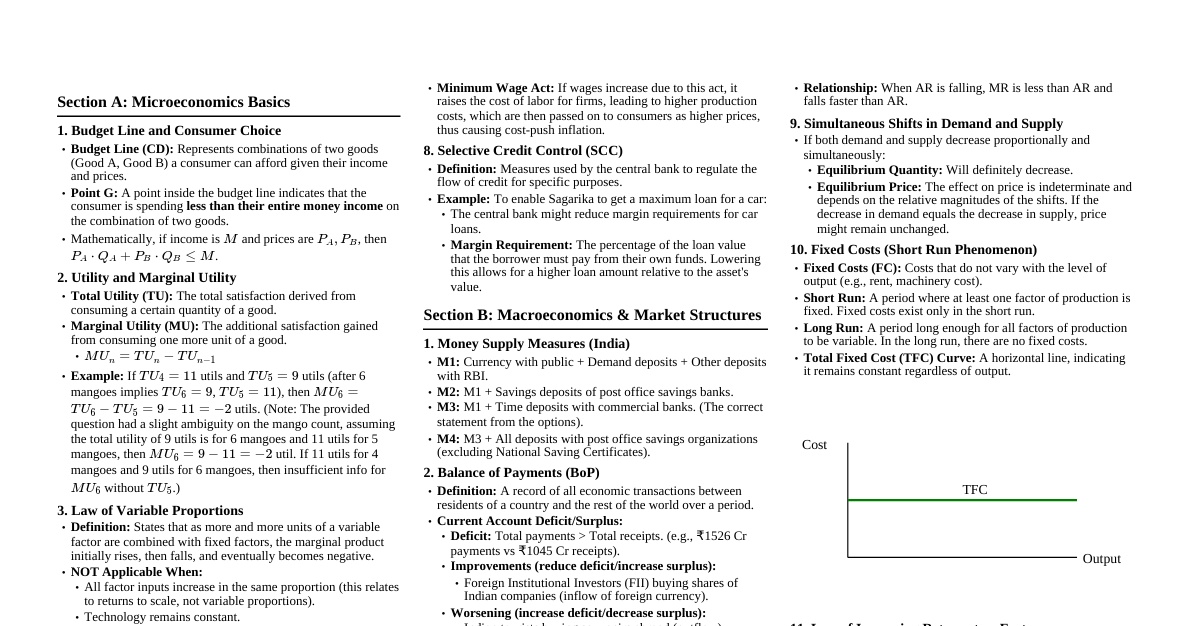
### Microeconomics: Introduction - **Demand:** Quantity a consumer is willing and able to buy at a given price and time. - **Quantity Demanded:** Specific quantity at a specific price. - **Demand Function:** Relationship between quantity demanded and its determinants. - Individual Demand Function: `Dx = f(Px, Pr, Y, T, Fe)` (Price, Related Goods, Income, Tastes, Future Expectations) - Market Demand Function: Includes additional factors like population size, income distribution, weather. ### Types of Demand - **Price Demand:** `Dx = f(Px)` (inverse relationship) - **Income Demand:** `Dx = f(Y)` (direct for normal goods, inverse for inferior goods) - **Cross Demand:** `Dy = f(Px)` (for related goods) - **Joint Demand:** Goods demanded together (e.g., car and petrol). - **Derived Demand:** Demand for a good due to demand for another (e.g., thread for clothes). - **Composite Demand:** Good with multiple uses (e.g., milk). - **Ex-ante Demand:** Planned or desired quantity to buy. - **Ex-post Demand:** Actually bought quantity. ### Law of Demand - **Statement:** Other things being constant, quantity demanded of a commodity is inversely related to its price. - **Assumptions:** Price of related goods, consumer income, tastes, and future expectations remain constant. - **Reasons for Downward Slope:** - Law of Diminishing Marginal Utility - Substitution Effect - Income Effect - Multiple uses of a commodity - Change in number of consumers - **Exceptions:** - **Giffen Goods:** Inferior goods where price increase leads to demand increase. - **Status Symbol Goods / Veblen Goods:** Demand increases with price due to prestige. - **Fear of Shortage:** Anticipated scarcity increases current demand. - **Fashion Related Goods:** Demand driven by trends, not price. - **Necessities of Life:** Demand is inelastic (e.g., salt). - **Conspicuous Consumption:** Buying expensive items to display wealth. - **Bandwagon Effect:** Demand increases because others are buying. - **Snob Effect:** Demand decreases if many others buy it. ### Demand Schedules & Curves - **Demand Schedule:** Tabular representation of quantities demanded at different prices. - **Individual Demand Schedule:** For a single buyer. - **Market Demand Schedule:** Summation of individual demands. - **Demand Curve:** Graphical representation of a demand schedule. - **Individual Demand Curve:** For a single buyer. - **Market Demand Curve:** Horizontal summation of individual demand curves. - **Movement along Demand Curve (Change in Quantity Demanded):** Caused by change in price. - **Extension of Demand:** Price falls, quantity demanded rises. - **Contraction of Demand:** Price rises, quantity demanded falls. - **Shift in Demand Curve (Change in Demand):** Caused by factors other than price. - **Increase in Demand (Rightward Shift):** More demanded at same price. - **Decrease in Demand (Leftward Shift):** Less demanded at same price. ### Utility Theory - **Utility:** Satisfaction derived from consuming a good. - **Cardinal Utility Analysis:** Utility is measurable (e.g., in 'utils'). - **Total Utility (TU):** Total satisfaction from all units consumed. - **Marginal Utility (MU):** Additional satisfaction from one more unit. `MU = TUn - TU(n-1)` - **Law of Diminishing Marginal Utility:** As consumption increases, MU from each additional unit decreases. - **Consumer's Equilibrium (One Commodity):** `MUx / Px = MUm` (Marginal Utility of money). - **Law of Equi-Marginal Utility:** Consumer distributes income such that `MUx/Px = MUy/Py` for all goods. - **Ordinal Utility Analysis (Indifference Curve Approach):** Utility is rankable, not measurable. - **Indifference Curve (IC):** Shows combinations of two goods yielding same satisfaction. - **Properties of ICs:** Downward sloping, convex to origin, never intersect, higher IC = higher satisfaction. - **Marginal Rate of Substitution (MRS):** Rate at which a consumer is willing to give up one good for another while maintaining same satisfaction. `MRSxy = -ΔY/ΔX`. - **Law of Diminishing MRS:** As more of one good is consumed, MRS decreases. - **Budget Line:** Shows combinations of two goods a consumer can afford given income and prices. `Px*Qx + Py*Qy = Income`. - **Consumer's Equilibrium (IC Approach):** Tangency of budget line with highest possible IC. `MRSxy = Px/Py`. ### Elasticity of Demand - **Definition:** Responsiveness of quantity demanded to changes in price, income, or related goods' prices. - **Price Elasticity of Demand (Ed):** `Ed = (% Change in Qd) / (% Change in Px)` - **Methods of Measurement:** - **Percentage Method:** `Ed = (ΔQ/Q) / (ΔP/P)` - **Total Expenditure Method:** Relates price changes to total expenditure. - `Ed > 1` (Elastic): P & TE inverse relationship. - `Ed 1):** Flat demand curve. - **Relatively Inelastic (Ed ### Supply - **Definition:** Quantity a firm is willing and able to offer for sale at a given price and time. - **Stock:** Total quantity available with sellers. - **Supply Function:** `Sx = f(Px, Pr, Pf, G, Ex, T, Nf, Gp)` (Price of good, Related goods, Factor inputs, Goal of firm, Future expectations, Technology, Number of firms, Government policy). - **Supply Schedule:** Tabular representation of quantities supplied at different prices. - **Individual Supply Schedule:** For a single firm. - **Market Supply Schedule:** Summation of individual supplies. - **Supply Curve:** Graphical representation of a supply schedule (upward sloping). - **Law of Supply:** Other things remaining constant, quantity supplied of a commodity is directly related to its price. - **Movement along Supply Curve (Change in Quantity Supplied):** Caused by change in price. - **Extension of Supply:** Price rises, quantity supplied rises. - **Contraction of Supply:** Price falls, quantity supplied falls. - **Shift in Supply Curve (Change in Supply):** Caused by factors other than price. - **Increase in Supply (Rightward Shift):** More supplied at same price. - **Decrease in Supply (Leftward Shift):** Less supplied at same price. - **Elasticity of Supply (Es):** `Es = (% Change in Qs) / (% Change in Px)` - **Degrees of Es:** Perfectly elastic (∞), Perfectly inelastic (0), Relatively elastic (>1), Relatively inelastic ( ### Production Theory - **Production:** Process of transforming inputs into outputs. - **Production Function:** `Q = f(L, K)` (Relationship between physical inputs and physical output). - **Short-run:** Period where some factors are fixed, some are variable (e.g., capital fixed, labor variable). - **Long-run:** Period where all factors are variable. - **Total Product (TP):** Total output produced. - **Average Product (AP):** Output per unit of variable input. `AP = TP/L`. - **Marginal Product (MP):** Additional output from one more unit of variable input. `MP = ΔTP/ΔL`. - **Law of Variable Proportions (Short-run):** As more variable factor is added to fixed factors, MP initially rises, then falls, and eventually becomes negative. - **Stage 1 (Increasing Returns):** TP increases at an increasing rate, MP rises. - **Stage 2 (Diminishing Returns):** TP increases at a decreasing rate, MP falls but is positive. - **Stage 3 (Negative Returns):** TP declines, MP is negative. ### Cost, Revenue & Producer Equilibrium - **Cost:** Expenditure incurred on factor and non-factor inputs. - **Explicit Cost:** Actual money payments to outsiders. - **Implicit Cost:** Imputed value of owner's self-supplied inputs. - **Opportunity Cost:** Cost of the next best alternative foregone. - **Short-run Costs:** - **Total Fixed Cost (TFC):** Costs independent of output. - **Total Variable Cost (TVC):** Costs varying with output. - **Total Cost (TC):** `TFC + TVC`. - **Average Fixed Cost (AFC):** `TFC/Q`. - **Average Variable Cost (AVC):** `TVC/Q`. - **Average Cost (AC):** `TC/Q` or `AFC + AVC`. - **Marginal Cost (MC):** `ΔTC/ΔQ` or `ΔTVC/ΔQ`. - **Long-run Costs:** All costs are variable. Long-run Average Cost (LAC), Long-run Marginal Cost (LMC). - **Revenue:** Amount received from sale of output. - **Total Revenue (TR):** `P * Q`. - **Average Revenue (AR):** `TR/Q` (equals price). - **Marginal Revenue (MR):** `ΔTR/ΔQ`. - **Relationship AR & MR:** - Perfect Competition: `AR = MR = P` (horizontal line). - Imperfect Competition: `AR > MR` (downward sloping curves). - **Producer's Equilibrium (Profit Maximization):** - **TR-TC Approach:** Occurs where `TR - TC` is maximum. - **MR-MC Approach:** 1. `MR = MC`. 2. `MC` curve must cut `MR` curve from below. - **Short-run:** Firm can earn supernormal profit (`AR > AC`), normal profit (`AR = AC`), or incur losses (`AR AVC`). - **Break-even Point:** `AR = AC`. - **Shut-down Point:** `AR = AVC`. - **Long-run (Perfect Competition):** Only normal profits (`AR = AC`). ### Market Forms - **Perfect Competition:** - **Features:** Large number of buyers/sellers, homogeneous product, free entry/exit, perfect knowledge, no transportation costs, uniform price. - **Firm is Price Taker:** Demand curve is perfectly elastic (`AR = MR = P`). - **Imperfect Competition:** - **Monopoly:** - **Features:** Single seller, many buyers, no close substitutes, barriers to entry, price maker. - `AR` and `MR` curves are downward sloping and relatively inelastic. - **Monopolistic Competition:** - **Features:** Many firms, product differentiation, free entry/exit, selling costs, non-price competition. - `AR` and `MR` curves are downward sloping and relatively elastic (more elastic than monopoly). - **Oligopoly:** - **Features:** Few sellers, interdependence, homogeneous or differentiated products, barriers to entry, indeterminate demand curve. - **Monopsony:** Single buyer, many sellers. ### Market Mechanism - **Market Equilibrium:** Quantity demanded = Quantity supplied. - **Equilibrium Price:** Price at which equilibrium occurs. - **Equilibrium Quantity:** Quantity at which equilibrium occurs. - **Effect of Change in Demand (Supply Constant):** - Increase in Demand: ↑ Equilibrium Price, ↑ Equilibrium Quantity. - Decrease in Demand: ↓ Equilibrium Price, ↓ Equilibrium Quantity. - **Effect of Change in Supply (Demand Constant):** - Increase in Supply: ↓ Equilibrium Price, ↑ Equilibrium Quantity. - Decrease in Supply: ↑ Equilibrium Price, ↓ Equilibrium Quantity. - **Simultaneous Changes:** Depends on the relative magnitude of shifts. - **Price Controls:** - **Price Ceiling:** Maximum legal price (below equilibrium), leads to excess demand (shortage). - **Price Floor:** Minimum legal price (above equilibrium), leads to excess supply (surplus). ### Macroeconomics: Introduction - **Aggregate Demand (AD):** Total demand for all goods and services in an economy. - **Components (Open Economy):** `AD = C + I + G + (X - M)` - `C`: Consumption Demand - `I`: Investment Demand - `G`: Government Expenditure - `X - M`: Net Exports - **Aggregate Supply (AS):** Total supply of goods and services produced in an economy (equals National Income, Y). - **Propensity to Consume:** - **Average Propensity to Consume (APC):** `C/Y`. - **Marginal Propensity to Consume (MPC):** `ΔC/ΔY`. - **Propensity to Save:** - **Average Propensity to Save (APS):** `S/Y`. - **Marginal Propensity to Save (MPS):** `ΔS/ΔY`. - **Relationships:** `APC + APS = 1`, `MPC + MPS = 1`. - **Consumption Function:** `C = C_bar + bY` (`C_bar` = autonomous consumption, `b` = MPC). - **Saving Function:** `S = -S_bar + (1-b)Y` (`-S_bar` = dissaving, `1-b` = MPS). - **Investment Function:** - **Induced Investment:** Depends on income/profit expectations. - **Autonomous Investment:** Independent of income (e.g., by government for welfare). - **Marginal Efficiency of Capital (MEC):** Expected rate of return on an additional unit of capital. ### Income & Employment Equilibrium - **Short-run Equilibrium (Keynesian):** - **AD = AS Approach:** Equilibrium where aggregate demand equals aggregate supply. - **S = I Approach:** Equilibrium where planned savings equal planned investment. - **Multiplier (K):** Measures the change in income due to a change in investment. - `K = ΔY / ΔI` - `K = 1 / (1 - MPC)` - `K = 1 / MPS` - Value of `K` lies between 1 and infinity. ### Excess & Deficient Demand - **Full Employment:** All those able and willing to work get employment at prevailing wage rate. - **Involuntary Unemployment:** Willing and able to work but cannot find employment. - **Deficient Demand:** `AD AS` at full employment level. - **Inflationary Gap:** `AD_actual - AD_full_employment`. - **Causes:** Increased public expenditure, reduced taxes, deficit financing, increased credit, increased investment demand, increased consumption, increased exports. - **Effects:** Increased employment (up to full employment), increased production (up to full employment), rise in price level (inflation). - **Measures to Correct:** - **Fiscal Policy:** Reduce government expenditure, increase taxes, increase public debt, surplus budget. - **Monetary Policy:** Raise bank rate, open market sale of securities, raise CRR/SLR, increase margin requirements. ### Money & Banking - **Barter System:** Direct exchange of goods for goods (problems: double coincidence of wants, lack of common measure of value). - **Money:** Anything generally accepted as a medium of exchange. - **Functions:** - **Primary:** Medium of exchange, measure of value. - **Secondary:** Standard for deferred payments, store of value, transfer of value. - **Contingent:** Basis of credit, distribution of national income. - **Kinds:** Commercial bank money, Fiduciary money (trust-based), Fiat money (government decree). - **Supply of Money:** Total amount of money available in an economy. - **Measures (M0, M1, M2, M3, M4):** - `M1 = Currency + Demand Deposits + Other Deposits with RBI` - `M3 = M1 + Time Deposits` - **Inflation:** Sustained increase in the general price level. - **Demand-pull inflation:** Excess aggregate demand. - **Cost-push inflation:** Increase in cost of inputs. - **Commercial Banks:** Accept deposits, grant loans, create credit. - **Credit Creation:** Banks create deposits by giving loans. - **Legal Reserve Ratio (LRR):** Fraction of deposits banks must keep as reserves (`CRR` + `SLR`). - **Central Bank (e.g., RBI):** Apex institution controlling banking system. - **Functions:** Monopoly of note issue, banker to government, bankers' bank, controller of credit, custodian of foreign exchange reserves. - **Credit Control (Monetary Policy):** - **Quantitative Methods:** Bank Rate, Open Market Operations, CRR, SLR, Repo Rate, Reverse Repo Rate. - **Qualitative Methods:** Margin Requirements, Credit Rationing, Moral Suasion. ### Balance of Payments & Exchange Rate - **Balance of Trade (BOT):** Exports of goods - Imports of goods. - **Balance of Payments (BOP):** Systematic record of all economic transactions between residents and rest of the world. - **Current Account:** Transactions related to goods, services, and unilateral transfers. - **Capital Account:** Transactions related to international capital flows (assets/liabilities). - **Autonomous Transactions:** Done for profit motive. - **Accommodating Items:** To cover BOP deficit/surplus. - **Disequilibrium in BOP:** Surplus or deficit. - **Causes:** Natural, economic, political, social factors. - **Measures to Correct:** Export promotion, devaluation/depreciation, import restrictions, exchange control. - **Foreign Exchange Rate:** Price of one currency in terms of another. - **Fixed Exchange Rate System:** Value fixed by central bank (e.g., Gold Standard, Adjusted Peg). - **Flexible Exchange Rate System:** Value determined by market demand and supply. - **Demand for Foreign Exchange:** Imports, foreign investment, tourism. - **Supply of Foreign Exchange:** Exports, remittances, foreign direct investment. - **Managed Floating:** Market-determined rate with central bank intervention. - **Concepts:** - **Depreciation:** Decrease in domestic currency value under flexible system. - **Appreciation:** Increase in domestic currency value under flexible system. - **Devaluation:** Deliberate reduction in currency value by government (fixed system). - **Revaluation:** Deliberate increase in currency value by government (fixed system). ### Public Finance - **Fiscal Policy:** Government's policy regarding revenue and expenditure to influence economy. - **Instruments:** Revenue policy, expenditure policy, debt policy. - **Public Revenue:** Government's income. - **Tax Receipts:** - **Direct Tax:** Burden cannot be shifted (e.g., income tax). - **Indirect Tax:** Burden can be shifted (e.g., GST). - **Types of Tax:** Progressive, Regressive, Degressive, Proportional. - **Non-Tax Receipts:** Fees, fines, grants, donations. - **Public Expenditure:** Government's spending. - **Importance:** Economic growth, stability, rural development. - **Public Debt:** Government borrowings. - **Methods of Repayment:** Refunding, conversion, refusal, capital levy. - **Deficit Financing:** Government spending more than revenue, covering gap by borrowing or printing money. - **Government Budget:** Financial statement of expected revenue and expenditure. - **Components:** Revenue Budget (revenue receipts/expenditure), Capital Budget (capital receipts/expenditure). - **Types of Deficits:** - **Revenue Deficit:** Revenue Expenditure > Revenue Receipts. - **Fiscal Deficit:** Total Expenditure > Total Receipts (excluding borrowings). Indicates total borrowing needs. - **Primary Deficit:** Fiscal Deficit - Interest Payments. Indicates borrowing for current spending. ### National Income - **Circular Flow of Income:** Continuous flow of production, income, and expenditure. - **Two-Sector Model:** Households and Firms (`S = I`). - **Three-Sector Model:** Households, Firms, Government (`I + S + T = E + I + G`). - **Four-Sector Model:** Households, Firms, Government, External Sector (`Y = C + I + G + (X - M)`). - **Leakages:** Income not returned to flow (savings, taxes, imports). - **Injections:** Income added to flow (investment, government spending, exports). - **Concepts of National Income:** - **Intermediate Goods:** Used for further production/resale. - **Final Goods:** For final consumption/investment. - **Domestic Territory:** Geographical area administered by government. - **Normal Residents:** Persons/institutions residing and having economic interest in a country. - **Transfer Payments:** Unilateral payments without value addition. - **Gross National Product (GNP):** Total value of final goods/services produced by residents (includes NFIA). - **Net National Product at Factor Cost (NNPFC):** National Income (`GNPFC - Depreciation`). - **Gross Domestic Product (GDP):** Total value of final goods/services produced within domestic territory. - **Nominal GDP:** At current market prices. - **Real GDP:** At constant base-year prices (adjusted for inflation). - **Net Factor Income from Abroad (NFIA):** Income earned by residents abroad - income paid to non-residents domestically. - **Personal Income:** Income actually received by households. - **Personal Disposable Income:** Personal income - direct taxes. - **National Disposable Income (NDI):** Total income available for spending. - **Measurement of National Income:** - **Value Added Method (Product Method):** Sum of value added by all producing units. - **Precautions:** Exclude intermediate goods, include imputed value of self-consumed goods. - **Income Method:** Sum of factor incomes (wages, rent, interest, profit). - **Precautions:** Exclude transfer payments, income from illegal activities. - **Expenditure Method:** Sum of final expenditures (consumption, investment, government, net exports). - **Precautions:** Exclude expenditure on second-hand goods, financial assets. - **GDP and Welfare:** GDP is an indicator, but not a perfect measure of welfare (doesn't account for externalities, income distribution, non-market activities).