Class 11 NCERT Physics (Ch 3-1
Cheatsheet Content
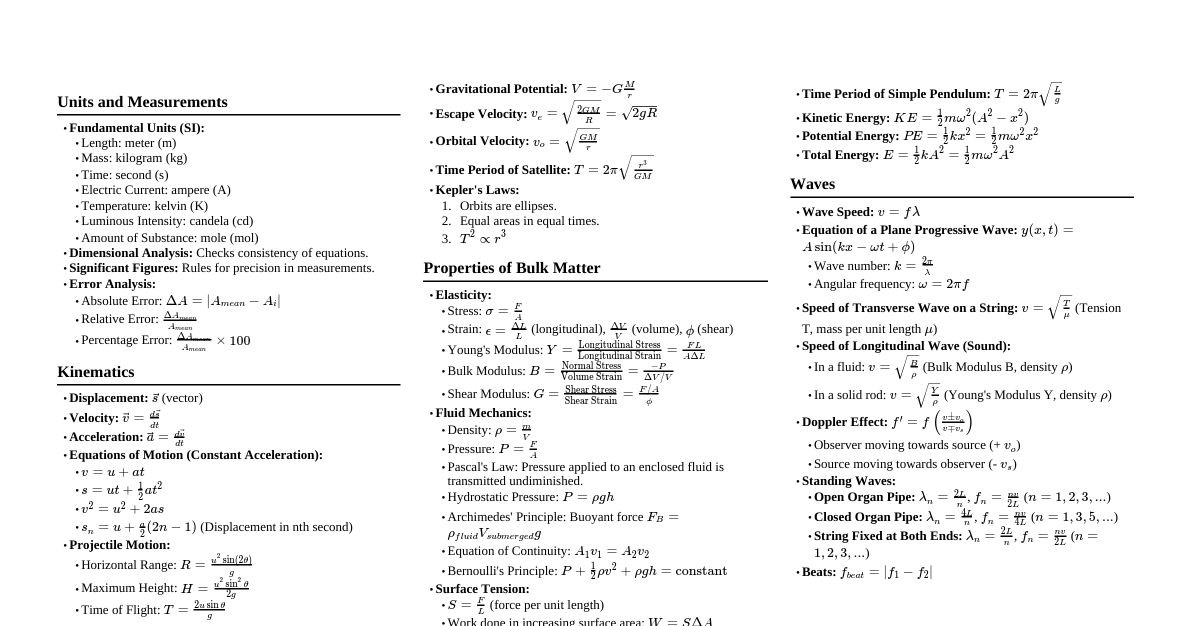
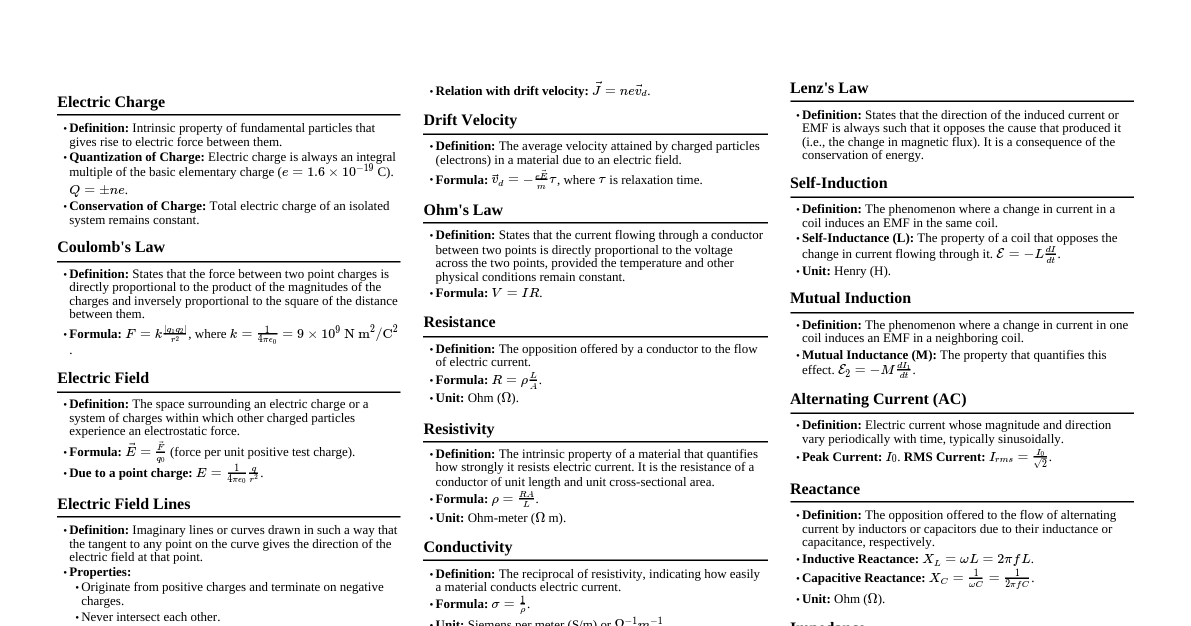
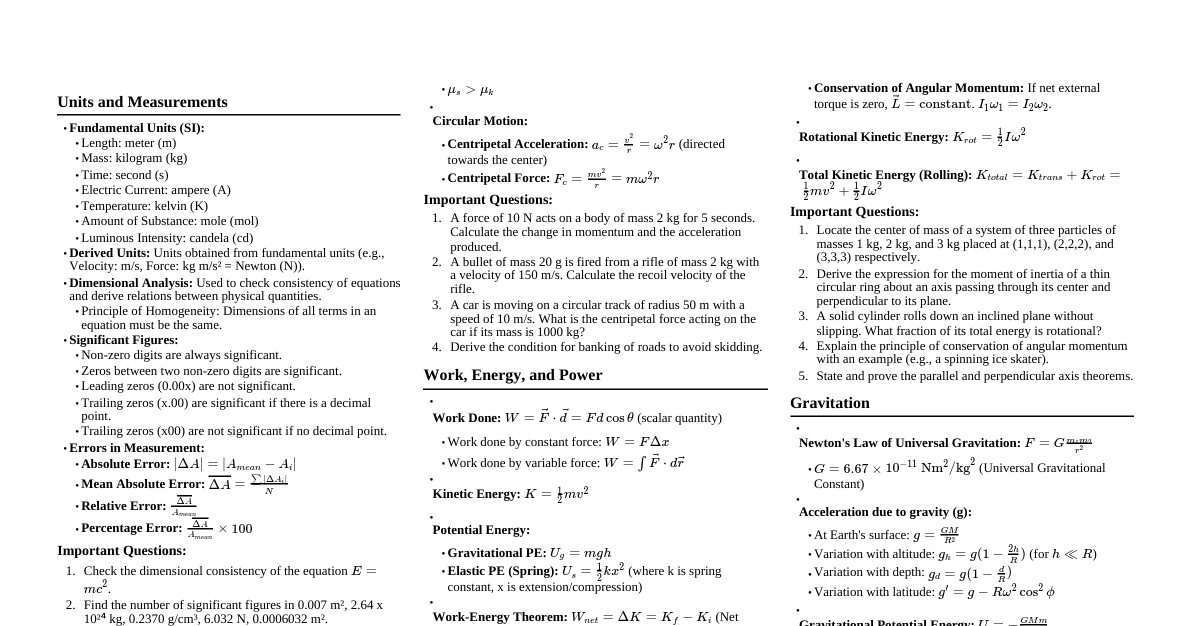
### Motion in a Straight Line (Ch 3) - **Position, Path Length, Displacement:** - Position: Location of an object with respect to origin. - Path Length: Total distance covered. Scalar. - Displacement: Change in position ($\Delta x = x_2 - x_1$). Vector. - **Speed & Velocity:** - Average Speed: Total path length / Total time. Scalar. - Average Velocity: Displacement / Total time ($\vec{v}_{avg} = \Delta \vec{x} / \Delta t$). Vector. - Instantaneous Velocity: $\vec{v} = d\vec{x}/dt$. - **Acceleration:** - Average Acceleration: $\Delta \vec{v} / \Delta t$. - Instantaneous Acceleration: $\vec{a} = d\vec{v}/dt = d^2\vec{x}/dt^2$. - **Kinematic Equations (Constant Acceleration):** 1. $v = v_0 + at$ 2. $x = x_0 + v_0t + \frac{1}{2}at^2$ 3. $v^2 = v_0^2 + 2a(x - x_0)$ 4. $x_t = v_0 + \frac{a}{2}(2t - 1)$ (Displacement in $t$-th second) ### Motion in a Plane (Ch 4) - **Scalars & Vectors:** - Scalar: Magnitude only (e.g., mass, speed, distance). - Vector: Magnitude and direction (e.g., displacement, velocity, force). - **Vector Operations:** - **Addition (Triangle/Parallelogram Law):** $\vec{R} = \vec{A} + \vec{B}$ - Magnitude: $R = \sqrt{A^2 + B^2 + 2AB\cos\theta}$ - Direction: $\tan\alpha = \frac{B\sin\theta}{A + B\cos\theta}$ - **Resolution of Vectors:** $\vec{A} = A_x\hat{i} + A_y\hat{j}$ - **Dot Product (Scalar Product):** $\vec{A} \cdot \vec{B} = AB\cos\theta = A_xB_x + A_yB_y + A_zB_z$ - **Cross Product (Vector Product):** $\vec{A} \times \vec{B} = (AB\sin\theta)\hat{n}$ - Magnitude: $|\vec{A} \times \vec{B}| = AB\sin\theta$ - Direction: Right-hand rule. - **Projectile Motion:** - **Horizontal Range:** $R = \frac{u^2\sin(2\theta)}{g}$ - **Maximum Height:** $H = \frac{u^2\sin^2\theta}{2g}$ - **Time of Flight:** $T = \frac{2u\sin\theta}{g}$ - **Uniform Circular Motion:** - **Angular Velocity:** $\omega = \frac{d\theta}{dt} = \frac{v}{r}$ - **Centripetal Acceleration:** $a_c = \frac{v^2}{r} = \omega^2 r$ (directed towards center) - **Centripetal Force:** $F_c = m a_c = \frac{mv^2}{r}$ ### Laws of Motion (Ch 5) - **Newton's First Law (Law of Inertia):** An object at rest stays at rest, and an object in motion stays in motion with the same speed and in the same direction unless acted upon by an unbalanced force. - **Newton's Second Law:** $\vec{F} = m\vec{a}$ - Force is proportional to the rate of change of momentum: $\vec{F} = \frac{d\vec{p}}{dt}$. - Momentum: $\vec{p} = m\vec{v}$. - Impulse: $\vec{J} = \int \vec{F} dt = \Delta \vec{p}$. - **Newton's Third Law:** To every action, there is an equal and opposite reaction. - **Conservation of Momentum:** In an isolated system, the total momentum remains constant. - $m_1\vec{u}_1 + m_2\vec{u}_2 = m_1\vec{v}_1 + m_2\vec{v}_2$. - **Common Forces:** - **Weight:** $W = mg$ - **Normal Force:** Perpendicular to surface. - **Friction:** Opposes relative motion. - Static Friction: $f_s \le \mu_s N$ - Kinetic Friction: $f_k = \mu_k N$ ($\mu_k ### Work, Energy and Power (Ch 6) - **Work Done:** - Constant Force: $W = \vec{F} \cdot \vec{d} = Fd\cos\theta$. - Variable Force: $W = \int \vec{F} \cdot d\vec{r}$. - **Kinetic Energy:** $K = \frac{1}{2}mv^2$. - **Work-Energy Theorem:** $W_{net} = \Delta K = K_f - K_i$. - **Potential Energy:** - Gravitational PE: $U_g = mgh$. - Spring PE: $U_s = \frac{1}{2}kx^2$. - **Conservative & Non-Conservative Forces:** - Conservative: Work done is path-independent (e.g., gravity, spring force). - Non-Conservative: Work done is path-dependent (e.g., friction). - **Conservation of Mechanical Energy:** $E = K + U = \text{constant}$ (for conservative forces). - **Power:** Rate of doing work. - Average Power: $P_{avg} = W/t$. - Instantaneous Power: $P = dW/dt = \vec{F} \cdot \vec{v}$. - **Collisions:** - **Elastic Collision:** Both momentum and kinetic energy are conserved. - **Inelastic Collision:** Momentum conserved, kinetic energy not conserved. - **Perfectly Inelastic Collision:** Bodies stick together after collision. - **Coefficient of Restitution (e):** $e = \frac{\text{relative velocity after collision}}{\text{relative velocity before collision}}$ - $e=1$ for elastic, $e=0$ for perfectly inelastic. ### System of Particles and Rotational Motion (Ch 7) - **Centre of Mass (CM):** - For two particles: $x_{cm} = \frac{m_1x_1 + m_2x_2}{m_1 + m_2}$ - For N particles: $\vec{R}_{cm} = \frac{\sum m_i\vec{r}_i}{\sum m_i}$ - **Translational Motion:** $\vec{F}_{ext} = M\vec{a}_{cm}$ - **Angular Displacement, Velocity, Acceleration:** - $\theta$, $\omega = d\theta/dt$, $\alpha = d\omega/dt$. - Relations: $v = r\omega$, $a_t = r\alpha$, $a_c = r\omega^2$. - **Moment of Inertia (I):** Measure of rotational inertia. - $I = \sum m_i r_i^2$. - **Parallel Axis Theorem:** $I = I_{cm} + Md^2$. - **Perpendicular Axis Theorem:** $I_z = I_x + I_y$ (for planar objects). - **Torque ($\vec{\tau}$):** Rotational analogue of force. - $\vec{\tau} = \vec{r} \times \vec{F}$. - $\tau = I\alpha$. - **Angular Momentum ($\vec{L}$):** Rotational analogue of linear momentum. - $\vec{L} = \vec{r} \times \vec{p} = I\vec{\omega}$. - **Conservation of Angular Momentum:** If $\vec{\tau}_{ext} = 0$, then $\vec{L} = \text{constant}$. - **Rotational Kinetic Energy:** $K_{rot} = \frac{1}{2}I\omega^2$. - **Rolling Motion:** Combination of translation and rotation. - Total Kinetic Energy: $K_{total} = K_{trans} + K_{rot} = \frac{1}{2}Mv_{cm}^2 + \frac{1}{2}I_{cm}\omega^2$. ### Gravitation (Ch 8) - **Newton's Law of Universal Gravitation:** - $F = G\frac{m_1m_2}{r^2}$ (G is gravitational constant, $6.67 \times 10^{-11} \text{ Nm}^2/\text{kg}^2$). - **Acceleration Due to Gravity (g):** - On Earth's surface: $g = G\frac{M_E}{R_E^2}$. - Variation with Altitude: $g' = g(1 - \frac{2h}{R_E})$ (for $h \ll R_E$). - Variation with Depth: $g' = g(1 - \frac{d}{R_E})$. - Variation with Latitude: $g' = g - R_E\omega^2\cos^2\phi$. - **Gravitational Potential Energy:** $U = -\frac{GMm}{r}$. - **Gravitational Potential:** $V = -\frac{GM}{r}$. - **Escape Velocity:** $v_e = \sqrt{\frac{2GM}{R}} = \sqrt{2gR}$. - **Orbital Velocity:** $v_o = \sqrt{\frac{GM}{r}}$. - **Kepler's Laws of Planetary Motion:** 1. **Law of Orbits:** Planets move in elliptical orbits with the Sun at one focus. 2. **Law of Areas:** The line joining the Sun and planet sweeps out equal areas in equal intervals of time. (Consequence of angular momentum conservation). 3. **Law of Periods:** The square of the orbital period ($T$) is proportional to the cube of the semi-major axis ($a$) of its orbit: $T^2 \propto a^3$. ### Mechanical Properties of Solids (Ch 9) - **Deforming Force:** Force that changes shape/size of a body. - **Elasticity:** Property of a body to regain its original shape/size after removal of deforming force. - **Stress ($\sigma$):** Restoring force per unit area. - $\sigma = F/A$. Unit: N/m$^2$ or Pascal (Pa). - **Strain ($\epsilon$):** Fractional change in dimension. Dimensionless. - Longitudinal Strain = $\Delta L/L$. - Volumetric Strain = $\Delta V/V$. - Shearing Strain = $\Delta x/L = \tan\theta \approx \theta$. - **Hooke's Law:** For small deformations, stress is proportional to strain. $\sigma \propto \epsilon \implies \sigma = E\epsilon$. - **Modulus of Elasticity (E):** Constant of proportionality. - **Young's Modulus (Y):** For longitudinal stress/strain. $Y = \frac{\text{Longitudinal Stress}}{\text{Longitudinal Strain}} = \frac{F/A}{\Delta L/L}$. - **Bulk Modulus (B):** For volumetric stress/strain. $B = \frac{\text{Volumetric Stress}}{\text{Volumetric Strain}} = \frac{-P}{\Delta V/V}$. - **Shear Modulus (G) or Modulus of Rigidity:** For shearing stress/strain. $G = \frac{\text{Shearing Stress}}{\text{Shearing Strain}} = \frac{F/A}{\theta}$. - **Poisson's Ratio ($\nu$):** Ratio of lateral strain to longitudinal strain. $\nu = -\frac{\Delta D/D}{\Delta L/L}$. - **Elastic Potential Energy:** Energy stored in a deformed body. - $U = \frac{1}{2} \text{stress} \times \text{strain} \times \text{volume} = \frac{1}{2}Y(\text{strain})^2 \times \text{volume}$. ### Mechanical Properties of Fluids (Ch 10) - **Pressure (P):** Force per unit area. $P = F/A$. Unit: Pa. - **Atmospheric Pressure:** $P_{atm} = 1.013 \times 10^5 \text{ Pa}$. - **Gauge Pressure:** $P_{gauge} = P - P_{atm}$. - **Pascal's Law:** Pressure applied to an enclosed fluid is transmitted undiminished to every portion of the fluid and the walls of the containing vessel. - Hydraulic Lift: $F_2/A_2 = F_1/A_1$. - **Density ($\rho$):** Mass per unit volume. $\rho = m/V$. - **Archimedes' Principle:** Buoyant force on a submerged/partially submerged object is equal to the weight of the fluid displaced by the object. - $F_B = \rho_{fluid} V_{submerged} g$. - **Equation of Continuity:** For an incompressible, non-viscous fluid in steady flow, $A_1v_1 = A_2v_2 = \text{constant}$. (Conservation of mass) - **Bernoulli's Principle:** For an ideal fluid in streamline flow, the sum of pressure energy, kinetic energy, and potential energy per unit volume is constant. - $P + \frac{1}{2}\rho v^2 + \rho gh = \text{constant}$. - **Viscosity:** Resistance to fluid flow. - **Stokes' Law:** Viscous drag force on a spherical body falling through a viscous fluid: $F_v = 6\pi\eta rv$. - **Terminal Velocity:** Constant velocity attained by a body falling through a viscous fluid when viscous drag equals buoyant force + weight. - **Surface Tension (S):** Force per unit length acting perpendicular to a line drawn on the fluid surface, tending to minimize surface area. - $S = F/L$. Unit: N/m. - **Surface Energy:** Work done per unit area to increase surface area. $E_s = S \times \Delta A$. - **Angle of Contact:** Angle between tangent to liquid surface and solid surface inside the liquid. - **Capillarity:** Rise or fall of liquid in a narrow tube. - Capillary Rise: $h = \frac{2S\cos\theta}{\rho gr}$. - **Reynold's Number ($R_e$):** Dimensionless number predicting flow patterns. - $R_e = \frac{\rho v D}{\eta}$. - $R_e 3000$: Turbulent flow.