Human Health and Disease
Cheatsheet Content
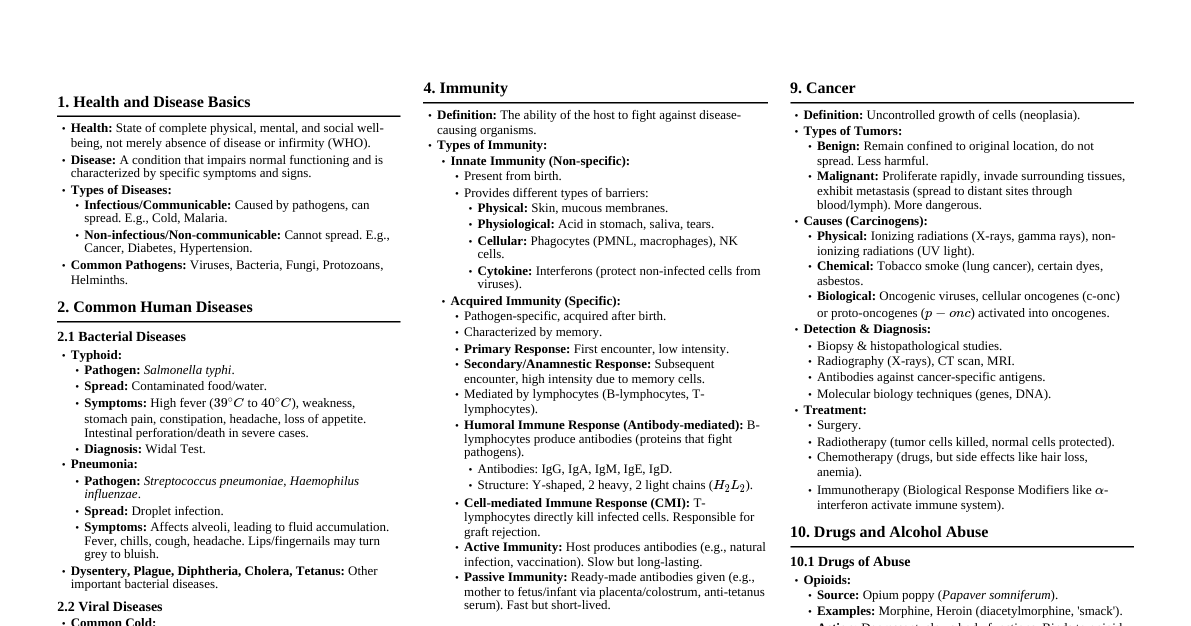
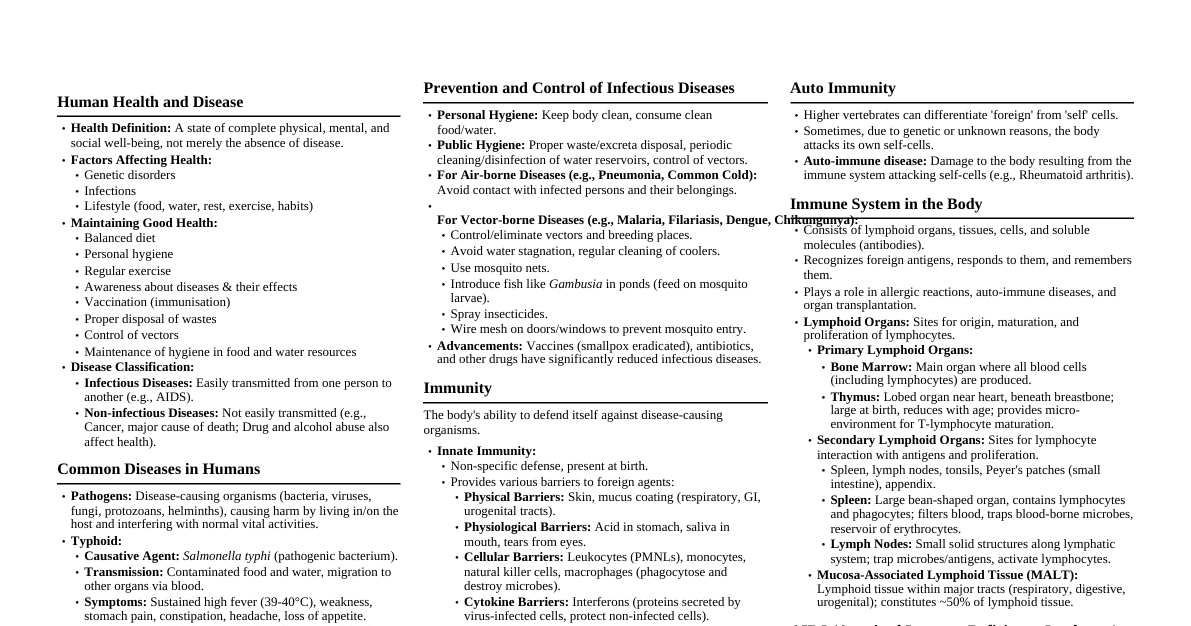
### 1. Health – Basic Concepts - **WHO Definition:** "A state of complete physical, mental, and social well-being and not merely the absence of disease or infirmity." - **Dimensions of Health:** - **Physical:** Fit body, absence of disease. - **Mental:** Calm, free from stress, able to cope with normal life stresses. - **Social:** Ability to interact and form meaningful relationships. - **Factors Affecting Health:** - **G**enetic disorders - **I**nfections (Pathogens) - **L**ifestyle (Diet, Exercise, Hygiene, Habits) - **P**ollution (Environmental factors) - **S**ocial & Economic conditions - **Trick (G.I.L.P.S.):** **G**o **I**n **L**ife, **P**repare **S**uccessfully! - **Personal & Community Health:** Both are interdependent. Personal hygiene, clean food/water, waste disposal, vector control, vaccination are crucial. ### 2. Disease - **Definition:** Any condition that impairs the normal functioning of an organism. #### Types of Diseases | Feature | Acute Diseases | Chronic Diseases | |----------------|------------------------------------------------------|------------------------------------------------------| | **Duration** | Short-lived, sudden onset | Long-lasting, slow onset | | **Damage** | Minor, short-term impact, rarely permanent damage | Major, long-term impact, often permanent damage | | **Recovery** | Complete recovery common | Complete recovery rare, often requires long-term care | | **Example** | Common cold, Typhoid, Pneumonia | Cancer, AIDS, Arthritis, Diabetes, Filariasis | | Feature | Infectious Diseases | Non-infectious Diseases | |--------------------|------------------------------------------------------|-------------------------------------------------------| | **Causative Agent**| Pathogens (bacteria, virus, fungi, protozoa, helminths)| Lifestyle, genetics, environment, age | | **Transmission** | Communicable (spreads from person to person) | Non-communicable (does not spread) | | **Examples** | Common cold, Malaria, Typhoid, AIDS | Cancer, Diabetes, Heart disease, Allergies, Arthritis | - **⚠️ NEET Trap:** Chronic disease ≠ always infectious. E.g., Diabetes is chronic but non-infectious. Filariasis is chronic AND infectious. ### 3. Infectious Diseases - **Pathogens:** Disease-causing organisms (bacteria, virus, fungi, protozoa, helminths). #### A. Bacterial Diseases - **Typhoid:** - **Causative Agent:** *Salmonella typhi* - **Transmission:** Contaminated food and water. - **Symptoms:** Sustained high fever (39-40°C), weak pulse, stomach pain, constipation, headache, loss of appetite. Intestinal perforation and death in severe cases. - **Diagnostic Test:** Widal Test. - **NCERT Line:** "Typhoid Mary" - a classic case of an asymptomatic carrier. - **Pneumonia:** - **Causative Agents:** *Streptococcus pneumoniae*, *Haemophilus influenzae*. - **Transmission:** Droplet infection (inhaling droplets/aerosols from infected person). - **Symptoms:** Fever, chills, cough, headache. In severe cases, lips and fingernails turn grey to bluish. Alveoli fill with fluid. - **Plague:** (Not detailed in NCERT, but mentioned as bacterial) - **Diphtheria:** (Not detailed in NCERT, but mentioned as bacterial) #### B. Viral Diseases - **Common Cold:** - **Causative Agent:** Rhinoviruses. - **Transmission:** Droplet infection (cough, sneeze), contaminated objects (doorknobs, books, pens). - **Symptoms:** Nasal congestion and discharge, sore throat, hoarseness, cough, headache, tiredness. Affects nose and respiratory passage, NOT LUNGS. - **Duration:** 3-7 days. - **Influenza (Flu):** (Not detailed in NCERT) - **AIDS:** (Detailed in Immunodeficiency) - **Hepatitis:** (Not detailed in NCERT, but mentioned) #### C. Protozoan Diseases - **Malaria:** - **Causative Agents:** *Plasmodium* species (*P. vivax*, *P. malariae*, *P. ovale*, *P. falciparum*). - **Most serious/fatal:** *P. falciparum*. - **Vector:** Female *Anopheles* mosquito. - **Life Cycle:** 1. Infected mosquito bites human, injects **sporozoites** (infectious form) into blood. 2. Sporozoites reach liver, multiply asexually. 3. Burst out of liver cells, infect RBCs. 4. Asexual reproduction in RBCs, causing rupture (releases **hemozoin** toxin, causing chills and high fever recurring every 3-4 days). 5. Gametocytes develop in RBCs. 6. Mosquito bites infected human, ingests gametocytes. 7. Further development/fertilization in mosquito gut. 8. Sporozoites form in mosquito salivary glands. - **NCERT Line:** Human is the primary host, mosquito is the secondary host (vector). - **⚠️ PYQ Trap:** Female *Anopheles* transmits malaria (NOT male mosquito). The male mosquito feeds on plant nectar. - **Amoebiasis (Amoebic Dysentery):** - **Causative Agent:** *Entamoeba histolytica* (a protozoan). - **Transmission:** Contaminated food and water (fecal-oral route). Houseflies act as mechanical carriers. - **Symptoms:** Constipation, abdominal pain, cramps, stools with excess mucus and blood clots. #### D. Helminthic Diseases - **Ascariasis:** - **Causative Agent:** *Ascaris lumbricoides* (roundworm). - **Transmission:** Contaminated water, vegetables, fruits (fecal-oral route). - **Symptoms:** Internal bleeding, muscular pain, fever, anaemia, blockage of intestinal passage. - **NCERT Line:** Adult worms live in the intestine. - **Filariasis (Elephantiasis):** - **Causative Agents:** *Wuchereria bancrofti*, *Wuchereria malayi* (filarial worms). - **Vector:** Female *Culex* mosquito. - **Symptoms:** Chronic inflammation of lymphatic vessels of legs, scrotal sacs, etc., leading to gross deformities. - **Duration:** Lives for many years in the infected person. #### E. Fungal Diseases - **Ringworm:** - **Causative Agents:** Fungi of genera *Microsporum*, *Trichophyton*, *Epidermophyton*. - **Transmission:** Soil, infected towels, clothes, or combs. - **Symptoms:** Dry, scaly lesions on skin, nails, scalp. Intense itching. - **NCERT Line:** Thrives in warm and moist conditions. #### 🎯 Mega Trick: Causative Organisms Mnemonic - **B**e **T**hrough **P**roper **P**lanning **D**aily (Bacterial: Typhoid, Pneumonia, Plague, Diphtheria) - **V**ery **C**lever **I**nsects **A**lways **H**ide (Viral: Cold, Influenza, AIDS, Hepatitis) - **P**rotozoans **M**ake **A**llies (Protozoan: Malaria, Amoebiasis) - **H**elminths **A**lways **F**ight (Helminths: Ascariasis, Filariasis) - **F**ungi **R**eally **I**tch (Fungal: Ringworm) #### 🧠 Flowchart: Mode of Transmission ```mermaid graph TD A[Infected Person] --> B{Mode of Transmission} B --> C1[Airborne: Droplets/Aerosols] C1 --> D1[Common Cold, Pneumonia] B --> C2[Water/Food Contamination] C2 --> D2[Typhoid, Amoebiasis, Ascariasis] B --> C3[Vector-borne] C3 --> D3[Malaria (Anopheles), Filariasis (Culex), Dengue/Chikungunya (Aedes)] B --> C4[Direct Contact] C4 --> D4[Ringworm, Common Cold (fomites)] B --> C5[Sexual Contact] C5 --> D5[AIDS, Syphilis, Gonorrhoea] B --> C6[Blood Transfusion/Shared Needles] C6 --> D6[AIDS, Hepatitis B] ``` ### 4. Immunity (Most Important Section 🔥) - **Definition:** Body's ability to fight off disease-causing organisms. #### A. Innate Immunity (Non-specific, present from birth) - **Trick to remember 4 types (P.P.C.C.):** **P**lease **P**revent **C**old **C**oughs! 1. **Physical Barriers:** Skin (main barrier), Mucus coating of respiratory, gastrointestinal, urogenital tracts (traps microbes). 2. **Physiological Barriers:** Acid in stomach, Saliva in mouth, Tears from eyes (Lysozyme), Fever. 3. **Cellular Barriers:** Phagocytes (PMNL-neutrophils, monocytes, macrophages), Natural Killer (NK) cells. 4. **Cytokine Barriers:** Interferons (proteins secreted by virus-infected cells, protect non-infected cells). #### B. Acquired Immunity (Specific, develops after exposure to pathogen) - **Key Features:** Specificity, Diversity, Memory, Discrimination between self and non-self. | Feature | Active Immunity | Passive Immunity | |--------------|-----------------------------------------------------|-----------------------------------------------------| | **Mechanism**| Body produces its own antibodies | Ready-made antibodies are given | | **Onset** | Slow, takes time to develop | Immediate | | **Duration** | Long-lasting | Short-lived | | **Examples** | - **Natural:** Infection (e.g., Measles) | - **Natural:** Antibodies from mother to fetus (placenta), or infant (colostrum). | | | - **Artificial:** Vaccination (injecting antigen) | - **Artificial:** Anti-venom, anti-tetanus injection. | - **Humoral (Antibody-mediated) Immunity (AMI):** - Mediated by B-lymphocytes (B-cells). - B-cells differentiate into Plasma cells (produce antibodies) and Memory B-cells. - Targets extracellular pathogens, toxins. - **Cell-mediated Immunity (CMI):** - Mediated by T-lymphocytes (T-cells). - T-cells differentiate into Helper T-cells, Killer T-cells, Suppressor T-cells, Memory T-cells. - Responsible for graft rejection, targets intracellular pathogens, cancer cells. - **Primary vs Secondary Immune Response:** - **Primary Response:** First exposure to antigen. Low intensity, slow. - **Secondary (Anamnestic) Response:** Subsequent exposure to same antigen. High intensity, rapid. Due to memory cells. - **⚠️ Trap:** Secondary response is stronger and faster due to memory cells. - **Trick for B cells vs T cells / Plasma cells vs Memory cells:** - **B-cells:** **B**ody fluid defense (Humoral), produce **A**ntibodies (B.A.D.). - **T-cells:** **T**argets cells directly (Cell-mediated), **T**hymus matured (T.T.C.). - **Plasma cells:** **P**roduce **A**ntibodies (P.A.P.). - **Memory cells:** **M**emory for **R**apid **R**esponse (M.R.R.). - **Antibody Structure (Immunoglobulins - Ig):** - Y-shaped protein molecule. - **2 Heavy (H) chains** and **2 Light (L) chains**. - Linked by disulfide bonds. - **Antigen Binding Site:** Formed by variable regions of H and L chains. - **Constant Region:** Determines antibody class (IgG, IgA, IgM, IgE, IgD). - **Diagram-based explanation:** ```mermaid graph TD A[Antigen Binding Site] --- B(Light Chain) A --- C(Heavy Chain) D[Disulfide Bonds] --- B D --- C E[Variable Region] --- B E --- C F[Constant Region] --- B F --- C style B fill:#fff,stroke:#333,stroke-width:2px; style C fill:#fff,stroke:#333,stroke-width:2px; ``` (Imagine a Y-shape with 2 short arms (Light Chains) and 2 long arms (Heavy Chains) connected, with antigen binding sites at the tips of the short arms.) - **Vaccination / Immunisation:** - **Principle:** Based on the property of memory of the immune system. - **Process:** Introduction of weakened/inactivated pathogen or antigenic proteins into the body. - **Outcome:** Body produces primary immune response, generates memory B and T cells. - **Booster Dose Concept:** Given to enhance and prolong the immune response (trigger secondary response). ### 5. Allergy - **Definition:** Exaggerated response of the immune system to certain antigens present in the environment (allergens). - **Allergens:** Dust mites, pollen, animal dander, certain foods, drugs. - **Mechanism:** 1. Exposure to allergen. 2. IgE antibodies produced. 3. IgE binds to **mast cells** and basophils. 4. Subsequent exposure causes mast cells to release chemicals like **histamine** and serotonin. - **Symptoms:** Sneezing, watery eyes, running nose, difficulty breathing. - **Treatment:** Antihistamines, adrenaline, steroids. - **🎯 Trick:** **IgE = "E for Emergency/Exaggerated reaction"** (mast cell degranulation). ### 6. Autoimmune Diseases - **Definition:** When immune system attacks 'self' cells/tissues, mistaking them for foreign antigens. - **Concept:** Immune system usually distinguishes self from non-self. - **Examples:** - **Rheumatoid Arthritis:** Immune system attacks joints. - **Myasthenia Gravis:** Immune system attacks acetylcholine receptors at neuromuscular junction. - **⚠️ Trap:** Autoimmune ≠ Immunodeficiency. Autoimmune is overactive/misdirected immunity; Immunodeficiency is underactive immunity. ### 7. Immunodeficiency Diseases - **AIDS (Acquired Immuno Deficiency Syndrome):** - **Definition:** Deficiency of immune system, acquired during lifetime. - **Causative Agent:** HIV (Human Immunodeficiency Virus) - a **retrovirus**. - **Transmission:** - Sexual contact with infected person. - Contaminated blood/blood products. - Sharing infected needles (intravenous drug abusers). - From infected mother to child (placenta, breast milk). - **NOT transmitted by:** Touch, physical contact, handshake, hug, mosquitoes. - **Target Cells:** Helper T-lymphocytes (T H cells). Number of T H cells drastically decreases. - **Mechanism:** 1. HIV enters body. 2. Enters macrophages (HIV factory) and replicates. 3. Enters Helper T-cells, replicates, produces progeny viruses. 4. Progeny viruses attack other Helper T-cells. 5. Gradual decrease in T H cells, leading to severe immunodeficiency. 6. Patient becomes susceptible to opportunistic infections (e.g., *Mycobacterium*, *Toxoplasma*, viruses, fungi). - **Diagnostic Test:** ELISA (Enzyme-Linked Immunosorbent Assay). - **Window Period:** Time between infection and detectable antibodies/symptoms. - **Treatment:** Antiretroviral drugs (prolong life, but not cure). - **🎯 Trick to remember HIV structure:** - **Outer:** Envelope (glycoproteins gp120, gp41) from host cell membrane. - **Middle:** Protein coat (capsid). - **Inner:** RNA genome (two identical single-stranded RNA molecules) + Reverse Transcriptase enzyme. - **⚠️ Most asked NEET topic.** ### 8. Cancer - **Definition:** Uncontrolled, abnormal, and often rapid proliferation of cells. - **Normal Cells:** Exhibit contact inhibition (stop dividing when they touch each other). Cancer cells lose this property. - **Tumors:** Masses of cells. - **Benign Tumors:** Remain confined to their original location, do not spread. Less dangerous. - **Malignant Tumors:** Proliferate rapidly, invade and damage surrounding normal tissues. Cells called neoplastic cells. - **Metastasis:** Most feared property. Cancer cells detach from primary tumor, travel through blood/lymph, form secondary tumors at distant sites. - **Causes of Cancer:** - **Carcinogens:** Physical (Ionizing radiation - X-rays, gamma rays; Non-ionizing radiation - UV light), Chemical (Tobacco smoke), Biological (Oncogenic viruses, cellular oncogenes). - **Oncogenes (c-onc/proto-oncogenes):** Normal genes that, when activated under certain conditions, can cause cell transformation into cancerous cells. - **Detection & Diagnosis:** - **Biopsy:** Histopathological studies of tissues. - **Radiography (X-rays):** Detects tumors in internal organs. - **CT scan (Computed Tomography):** Uses X-rays to generate 3D image. - **MRI (Magnetic Resonance Imaging):** Uses strong magnetic fields and non-ionizing radiation to detect pathological and physiological changes in living tissue. - **Antibodies:** Against cancer-specific antigens for early detection. - **Molecular Biology:** Detecting genes for cancer susceptibility. - **Treatment:** - **Surgery:** Removal of tumor. - **Radiation Therapy:** Cancer cells irradiated lethally, but normal tissues spared as much as possible. - **Chemotherapy:** Drugs kill cancer cells. Side effects: hair loss, anaemia. - **Immunotherapy:** Patients given alpha-interferons to activate their immune system, destroying tumor. - **🎯 Trick to remember Carcinogens:** - **R**adiation (**R**adiation) - **C**hemicals (**C**igarettes) - **O**ncogenic viruses (**O**ncogenes) ### 9. Drugs & Alcohol Abuse - **Adolescence:** Period of vulnerability, increased risk of drug/alcohol abuse. - **Commonly Abused Drugs:** - **Opioids:** - **Source:** Opium poppy (*Papaver somniferum*). - **Examples:** Morphine, Heroin (diacetylmorphine, 'smack'). - **Mechanism:** Bind to opioid receptors in CNS and GI tract. - **Heroin:** Depressant, slows down body functions. Taken by snorting/injection. - **Cannabinoids:** - **Source:** *Cannabis sativa* (hemp plant). - **Examples:** Marijuana, hashish, charas, ganja. - **Mechanism:** Bind to cannabinoid receptors in brain. - **Effects:** Affect cardiovascular system. Taken by inhalation/oral ingestion. - **Cocaine (Coca alkaloid / 'Coke' / 'Crack'):** - **Source:** Coca plant (*Erythroxylum coca*). - **Mechanism:** Interferes with transport of neurotransmitter dopamine. - **Effects:** Potent stimulant, sense of euphoria, increased energy. High dose causes hallucinations. - **Hallucinogens:** - **Examples:** LSD (Lysergic acid diethylamide), Datura, Atropa belladonna. - **Effects:** Alter thoughts, feelings, perceptions. - **Other Abused Drugs:** Barbiturates, Amphetamines, Benzodiazepines (sedatives/tranquillizers - relieve anxiety/insomnia), LSD. - **Smoking:** - **Tobacco:** Contains nicotine. - **Effects:** Increases blood pressure, heart rate (stimulates adrenal gland to release adrenaline/nor-adrenaline). Increases risk of cancer (lung, throat, oral), bronchitis, emphysema, coronary heart disease, gastric ulcer. - **Effects of Drug/Alcohol Abuse:** - **Psychological Dependence:** Craving for drugs/alcohol. - **Physical Dependence:** Withdrawal symptoms if stopped (anxiety, tremors, nausea, sweating). - **Other:** Reckless behavior, poor academic performance, violence, spread of HIV/Hepatitis (shared needles), liver cirrhosis (alcohol), nervous system damage. - **Prevention & Control:** - Avoid undue peer pressure. - Education and Counselling. - Seeking help from parents/peers. - Looking for danger signs. - Seeking professional and medical help. - **🎯 Trick to remember drug categories:** - **O**pioids: **O**nly **P**ain **S**uppressors (Morphine, Heroin from *Papaver*) - **C**annabinoids: **C**ool **H**eads **M**ake **G**ood **C**hoices (Hashish, Marijuana, Ganja from *Cannabis*) - **C**ocaine: **C**razy **S**timulant (**C**oca plant) - **H**allucinogens: **H**elp **L**SD **D**atabase (LSD, Datura) - **⚠️ NCERT lines directly asked in NEET:** - "Smack is diacetylmorphine." - "Coca alkaloid is cocaine." - "Opioid receptors are present in CNS and GI tract." ### 10. Important Diagrams to Revise 1. **Antibody structure:** (Y-shaped, H & L chains, disulfide bonds, antigen binding sites). 2. **HIV structure:** (Envelope, capsid, RNA genome, reverse transcriptase). 3. **Life cycle of Plasmodium:** (Sporozoites, liver cells, RBCs, gametocytes, mosquito gut). 4. **Cancer metastasis:** (Primary tumor, detached cells, blood vessel, secondary tumor). 5. **Primary vs Secondary response graph:** (Plot of antibody concentration vs time, showing faster and higher response for secondary). ### 🔥 Final Section: #### 15 Rapid Fire Revision Points 1. Widal test for Typhoid. 2. Rhinoviruses cause common cold, not pneumonia. 3. *Plasmodium falciparum* causes most severe malaria. 4. Female *Anopheles* transmits malaria; Female *Culex* transmits filariasis. 5. Sporozoites are the infectious stage of *Plasmodium*. 6. Hemozoin causes chills and fever in malaria. 7. Skin, mucus, acid in stomach are innate physical/physiological barriers. 8. Interferons are cytokine barriers. 9. Colostrum provides passive natural immunity. 10. Vaccination provides active artificial immunity. 11. IgE antibodies are involved in allergy. 12. Helper T-cells are target of HIV. 13. ELISA is diagnostic for AIDS. 14. Metastasis is the most feared property of malignant tumors. 15. Morphine/Heroin are opioids; Marijuana/Hashish are cannabinoids. #### 5 Most Expected NEET Questions 1. Match the disease with its causative agent/diagnostic test. 2. Identify the correct sequence in the life cycle of *Plasmodium*. 3. Differentiate between innate and acquired immunity or active and passive immunity. 4. Explain the mechanism of action of HIV or the effects of its infection. 5. Identify the type of drug based on its source plant or effects. #### 10 Common Mistakes Students Make 1. Confusing male vs female mosquito vectors. 2. Mixing up symptoms of common cold and pneumonia. 3. Assuming all chronic diseases are infectious. 4. Forgetting IgE's role in allergy. 5. Not knowing that HIV attacks Helper T-cells, not B-cells. 6. Confusing benign vs malignant tumors. 7. Misidentifying the infectious stage of *Plasmodium*. 8. Thinking AIDS is transmitted by casual contact. 9. Forgetting the diagnostic test for Typhoid (Widal). 10. Not knowing the difference between physical and physiological barriers in innate immunity.