JEE Magnetism Formulas
Cheatsheet Content
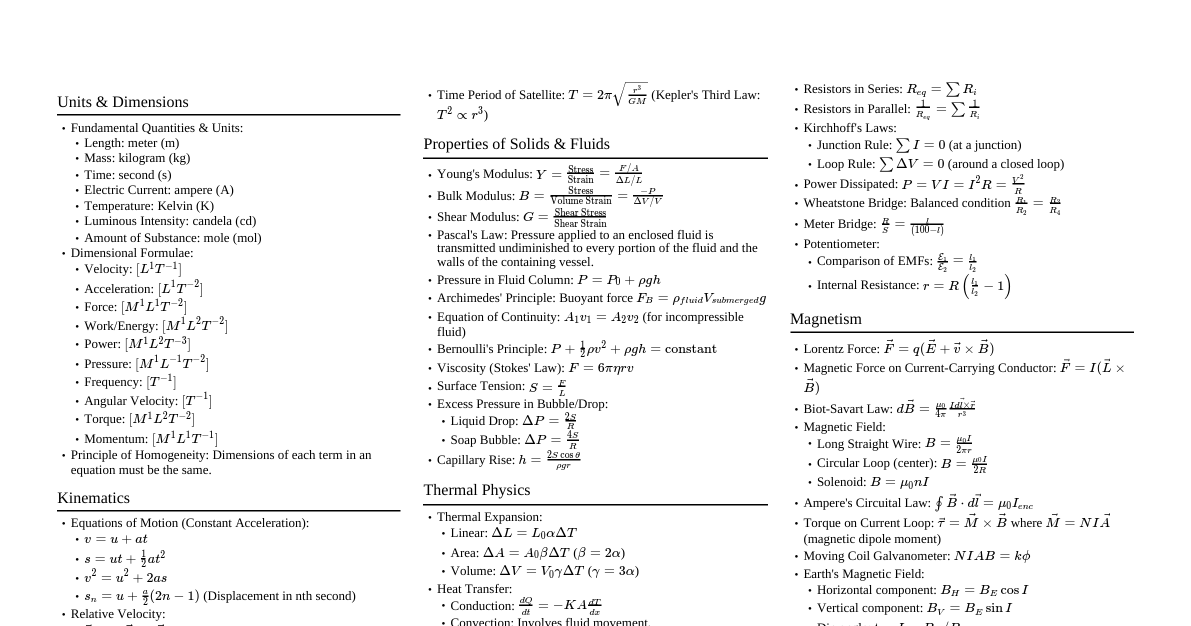
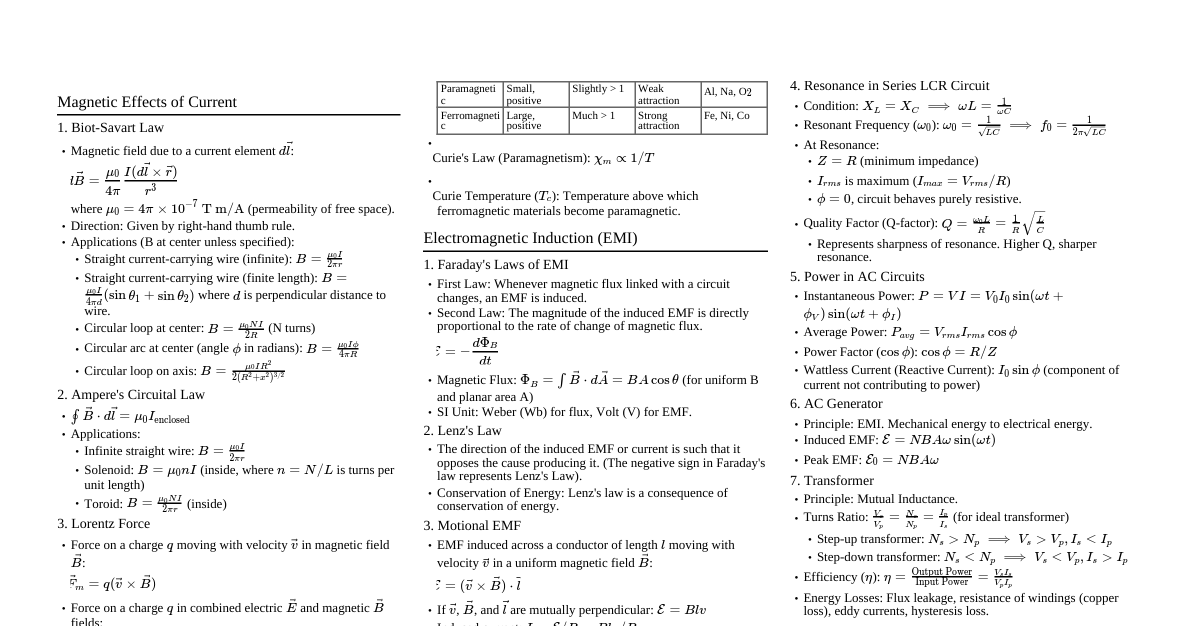
### Magnetic Force on a Moving Charge - **Lorentz Force:** $\vec{F} = q(\vec{E} + \vec{v} \times \vec{B})$ - **Magnetic Force Only:** $\vec{F} = q(\vec{v} \times \vec{B})$ - **Magnitude of Magnetic Force:** $F = qvB\sin\theta$, where $\theta$ is the angle between $\vec{v}$ and $\vec{B}$. - **Right-Hand Rule:** For positive charge, direction of $\vec{F}$ is given by $\vec{v} \times \vec{B}$. For negative charge, it's opposite. - **Circular Motion in Uniform B-field (v $\perp$ B):** - Radius of path: $r = \frac{mv}{qB}$ - Angular frequency (cyclotron frequency): $\omega = \frac{qB}{m}$ - Time period: $T = \frac{2\pi m}{qB}$ - Frequency: $f = \frac{qB}{2\pi m}$ - **Helical Motion in Uniform B-field (v at angle $\theta$ to B):** - $v_\| = v\cos\theta$ (parallel to B) - $v_\perp = v\sin\theta$ (perpendicular to B) - Radius of helix: $r = \frac{mv_\perp}{qB} = \frac{mv\sin\theta}{qB}$ - Pitch of helix: $p = v_\| T = \frac{2\pi mv\cos\theta}{qB}$ ### Magnetic Force on a Current-Carrying Conductor - **Force on a current element:** $d\vec{F} = I(d\vec{l} \times \vec{B})$ - **Force on straight conductor in uniform B-field:** $\vec{F} = I(\vec{L} \times \vec{B})$ - **Magnitude:** $F = ILB\sin\theta$, where $\theta$ is the angle between $\vec{L}$ and $\vec{B}$. - **Force between two parallel current-carrying wires (length L, distance r):** - $F = \frac{\mu_0 I_1 I_2 L}{2\pi r}$ - Attractive if currents are in the same direction, repulsive if opposite. ### Magnetic Dipole Moment - **For a current loop:** $\vec{M} = I\vec{A}$, where $\vec{A}$ is the area vector perpendicular to the loop. - **For N turns:** $M = NIA$ - **Torque on a current loop in uniform B-field:** $\vec{\tau} = \vec{M} \times \vec{B}$ - **Magnitude of Torque:** $\tau = MB\sin\theta = NIAB\sin\theta$ - **Potential Energy of a magnetic dipole:** $U = -\vec{M} \cdot \vec{B} = -MB\cos\theta$ ### Biot-Savart Law - **Magnetic field due to a current element:** $d\vec{B} = \frac{\mu_0}{4\pi} \frac{I d\vec{l} \times \hat{r}}{r^2}$ - **Units:** $\mu_0$ (permeability of free space) = $4\pi \times 10^{-7}$ T m/A - **Magnetic field due to a straight infinitely long current-carrying wire:** $B = \frac{\mu_0 I}{2\pi r}$ - **Magnetic field due to a finite straight wire (at perpendicular distance r from midpoint):** $B = \frac{\mu_0 I}{4\pi r}(\sin\theta_1 + \sin\theta_2)$ - **Magnetic field at the center of a circular loop (radius R):** $B = \frac{\mu_0 I}{2R}$ - **Magnetic field on the axis of a circular loop (radius R, at distance x from center):** $B = \frac{\mu_0 I R^2}{2(R^2 + x^2)^{3/2}}$ - **Magnetic field at the center of a circular arc (radius R, angle $\phi$ in radians):** $B = \frac{\mu_0 I \phi}{4\pi R}$ ### Ampere's Circuital Law - **Statement:** $\oint \vec{B} \cdot d\vec{l} = \mu_0 I_{enc}$ - **Magnetic field inside a long straight solenoid (n turns per unit length):** $B = \mu_0 n I$ (at the center) - **Magnetic field at the ends of a long straight solenoid:** $B = \frac{1}{2}\mu_0 n I$ - **Magnetic field inside a toroid (N total turns, radius r):** $B = \frac{\mu_0 N I}{2\pi r}$ ### Earth's Magnetism - **Magnetic declination ($\alpha$ or D):** Angle between geographic meridian and magnetic meridian. - **Magnetic dip or inclination ($\delta$ or I):** Angle between the Earth's total magnetic field vector and the horizontal at a given location. - **Components of Earth's magnetic field:** - Horizontal component: $B_H = B_E \cos\delta$ - Vertical component: $B_V = B_E \sin\delta$ - Total Earth's magnetic field: $B_E = \sqrt{B_H^2 + B_V^2}$ - $\tan\delta = \frac{B_V}{B_H}$ - **At magnetic equator:** $\delta = 0^\circ \implies B_V = 0, B_H = B_E$ - **At magnetic poles:** $\delta = 90^\circ \implies B_H = 0, B_V = B_E$ ### Magnetic Properties of Materials - **Magnetizing field (H):** $H = \frac{B_0}{\mu_0}$, where $B_0$ is the magnetic field in vacuum due to external current. - **Magnetic intensity (I or M):** Net magnetic moment per unit volume. - **Magnetic susceptibility ($\chi_m$):** $\chi_m = \frac{I}{H}$ - **Magnetic permeability ($\mu$):** $\mu = \frac{B}{H}$ - **Relative permeability ($\mu_r$):** $\mu_r = \frac{\mu}{\mu_0} = 1 + \chi_m$ - **Relation between B, H, I:** $B = \mu_0(H + I) = \mu_0 H (1 + \chi_m) = \mu_0\mu_r H = \mu H$ - **Classification of materials:** - **Diamagnetic:** $\chi_m$ is small, negative ($ -1 \le \chi_m 1$. Weakly attracted. Ex: Aluminum, sodium, oxygen. - **Ferromagnetic:** $\chi_m$ is large, positive ($ \chi_m \gg 1$), $\mu_r \gg 1$. Strongly attracted. Ex: Iron, Nickel, Cobalt. Exhibit hysteresis. - **Curie's Law (Paramagnetic):** $\chi_m = \frac{C}{T}$, where C is Curie constant and T is absolute temperature. - **Curie Temperature:** Temperature above which ferromagnetic substances become paramagnetic. ### Galvanometers, Ammeters, and Voltmeters - **Moving Coil Galvanometer:** - Torque: $\tau = NIAB$ - Restoring torque: $\tau = k\phi$, where k is restoring torque constant - In equilibrium: $NIAB = k\phi \implies \phi = \frac{NIAB}{k}$ - Current sensitivity: $S_I = \frac{\phi}{I} = \frac{NAB}{k}$ - Voltage sensitivity: $S_V = \frac{\phi}{V} = \frac{\phi}{IR_g} = \frac{NAB}{kR_g}$ - **Conversion to Ammeter:** - Shunt resistance: $R_s = \frac{I_g R_g}{I - I_g}$, where $I_g$ is full scale deflection current, $R_g$ is galvanometer resistance, $I$ is desired full scale current. - **Conversion to Voltmeter:** - Series resistance: $R_{series} = \frac{V}{I_g} - R_g$, where V is desired full scale voltage.