Basic Geometry & Trig
Cheatsheet Content
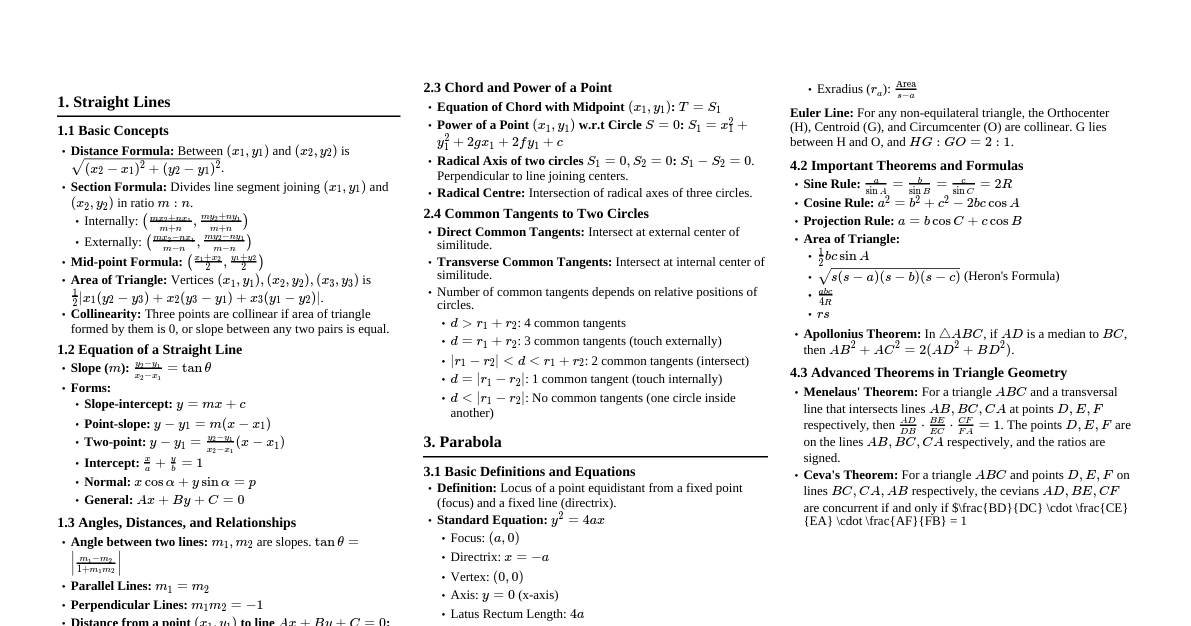
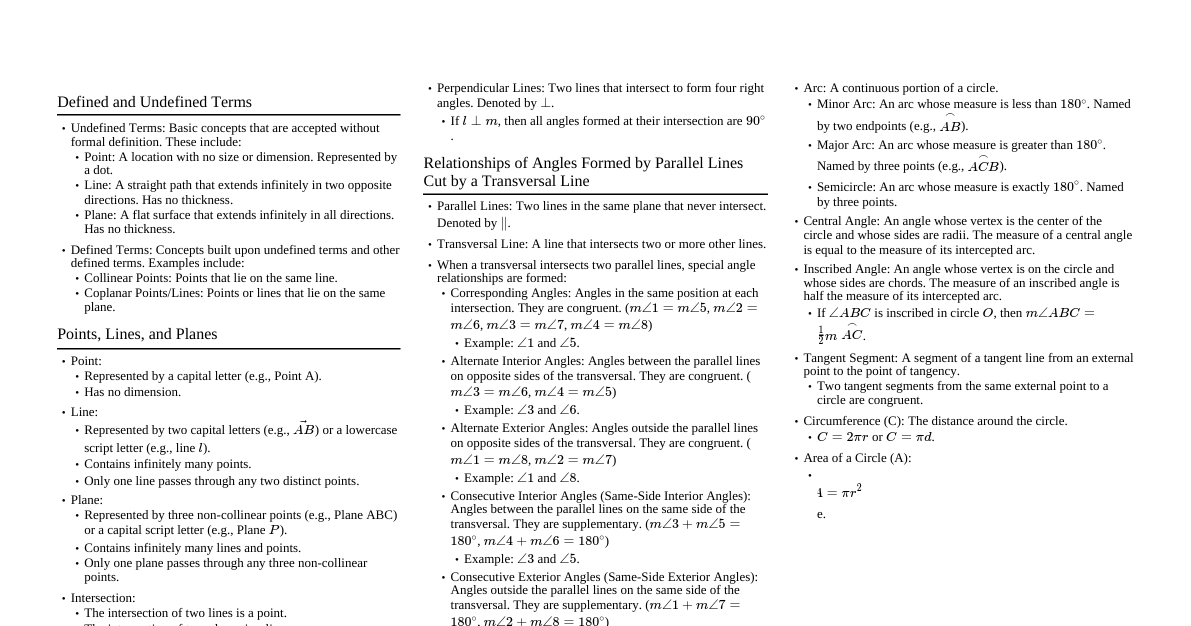
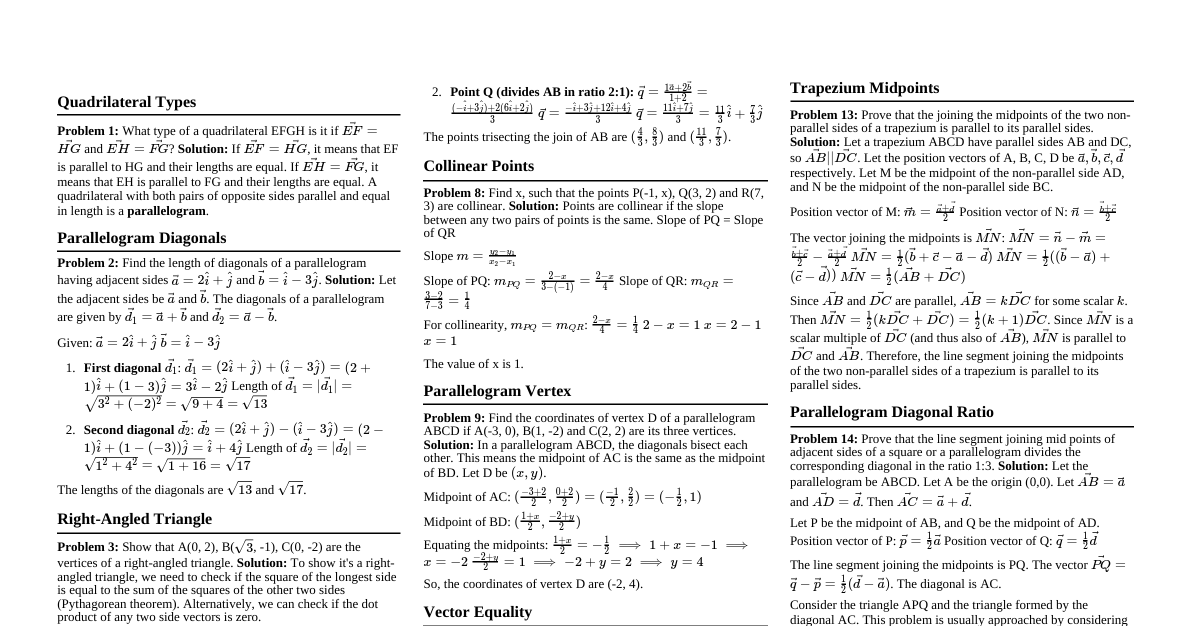
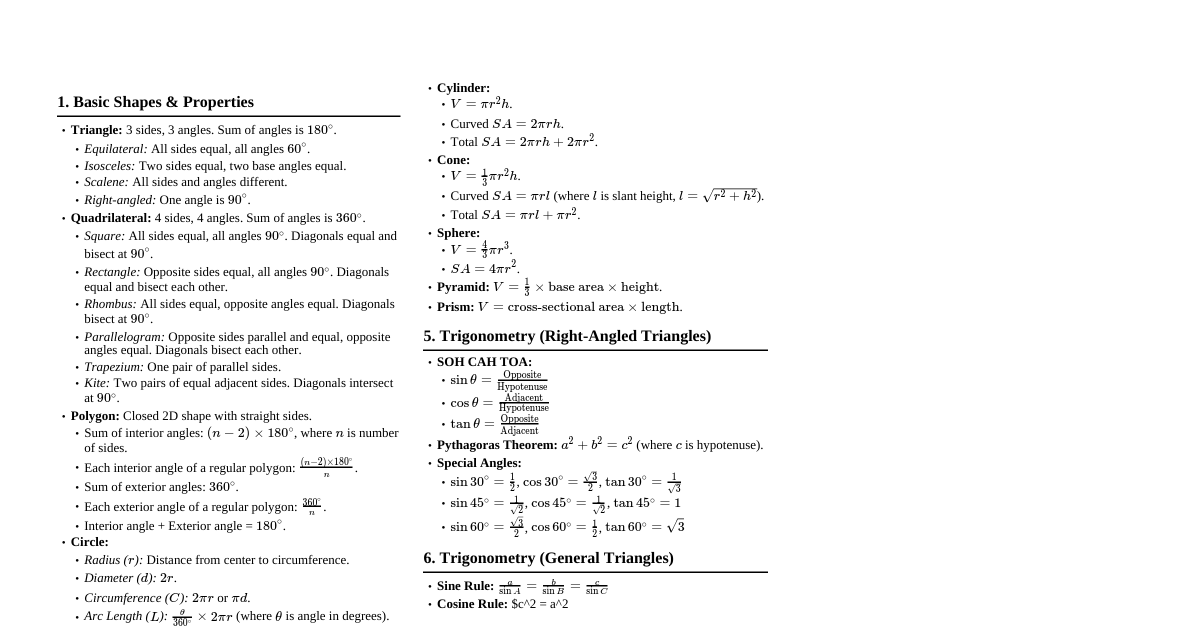
### Coordinates & Lines - **Points:** $(x, y)$ - **Distance Formula:** $d = \sqrt{(x_2 - x_1)^2 + (y_2 - y_1)^2}$ - **Midpoint Formula:** $M = \left(\frac{x_1 + x_2}{2}, \frac{y_1 + y_2}{2}\right)$ - **Slope:** $m = \frac{y_2 - y_1}{x_2 - x_1}$ - **Parallel Lines:** Have the same slope ($m_1 = m_2$). - **Perpendicular Lines:** Slopes are negative reciprocals ($m_1 \cdot m_2 = -1$). - **Equations of a Line:** - Slope-intercept: $y = mx + b$ - Point-slope: $y - y_1 = m(x - x_1)$ ### Classifying Triangles - **By Sides:** - **Equilateral:** All 3 sides equal, all 3 angles $60^\circ$. - **Isosceles:** 2 sides equal, 2 angles equal (opposite equal sides). - **Scalene:** No sides equal, no angles equal. - **By Angles:** - **Acute:** All angles $ 90^\circ$. - **Angle Sum:** Sum of interior angles is always $180^\circ$. ### Classifying Quadrilaterals - **Definition:** 4-sided polygon. Sum of interior angles is $360^\circ$. - **Parallelogram:** Opposite sides parallel and equal, opposite angles equal, diagonals bisect each other. - **Rectangle:** A parallelogram with 4 right angles. Diagonals are equal. - **Rhombus:** A parallelogram with 4 equal sides. Diagonals are perpendicular bisectors of each other. - **Square:** A parallelogram that is both a rectangle and a rhombus (4 equal sides, 4 right angles). - **Trapezoid:** Exactly one pair of parallel sides. - **Isosceles Trapezoid:** Non-parallel sides are equal, base angles are equal. - **Kite:** Two pairs of equal-length sides that are adjacent to each other. Diagonals are perpendicular. ### Trigonometry Basics - **SOH CAH TOA (Right Triangles):** - $\sin(\theta) = \frac{\text{Opposite}}{\text{Hypotenuse}}$ - $\cos(\theta) = \frac{\text{Adjacent}}{\text{Hypotenuse}}$ - $\tan(\theta) = \frac{\text{Opposite}}{\text{Adjacent}}$ - **Pythagorean Theorem:** $a^2 + b^2 = c^2$ (for right triangles, $c$ is hypotenuse). - **Law of Sines:** $\frac{a}{\sin(A)} = \frac{b}{\sin(B)} = \frac{c}{\sin(C)}$ (any triangle). - Use when given ASA, AAS, or SSA (ambiguous case). - **Law of Cosines:** $c^2 = a^2 + b^2 - 2ab\cos(C)$ (any triangle). - Use when given SSS or SAS. - **Finding Side Lengths:** - **Given sides & angles:** Use Law of Sines or Cosines. - **Given only side lengths:** (Implies finding angles or using Pythagorean for right triangles). Use Law of Cosines to find angles, then Law of Sines for remaining. ### Volume & Figures - **Circles:** - **Area:** $A = \pi r^2$ - **Circumference:** $C = 2\pi r$ - **Volume of 3D Shapes:** - **Cube:** $V = s^3$ (s = side length) - **Rectangular Prism:** $V = lwh$ - **Cylinder:** $V = \pi r^2 h$ - **Cone:** $V = \frac{1}{3}\pi r^2 h$ - **Sphere:** $V = \frac{4}{3}\pi r^3$ - **Pyramid:** $V = \frac{1}{3} B h$ (B = area of base) - **Cavalieri's Principle:** If two solids have the same height and the same cross-sectional area at every level, then they have the same volume. ### Circles: Angles & Triangles - **Inscribed Angle Theorem:** The measure of an inscribed angle is half the measure of its intercepted arc. - **Angle formed by Tangent and Chord:** The measure of an angle formed by a tangent and a chord drawn to the point of tangency is half the measure of the intercepted arc. - **Angles Outside a Circle:** - **Two Secants:** Angle $= \frac{1}{2}(\text{Far Arc} - \text{Near Arc})$ - **Two Tangents:** Angle $= \frac{1}{2}(\text{Major Arc} - \text{Minor Arc})$ or $180^\circ - \text{Minor Arc}$ - **Secant and Tangent:** Angle $= \frac{1}{2}(\text{Far Arc} - \text{Near Arc})$ - **Inscribed Triangle:** A triangle with all its vertices on the circle. If one side is a diameter, the angle opposite the diameter is a right angle. - **Circumscribed Triangle:** A triangle whose sides are tangent to the circle. - **Inscribed Quadrilateral (Cyclic Quadrilateral):** All vertices lie on the circle. Opposite angles are supplementary (add up to $180^\circ$). - **Circumscribed Circle:** A circle that passes through all the vertices of a polygon. - **Inscribed Circle:** A circle tangent to all sides of a polygon.